Released at the tail end of martial law, Yu Kan-Ping’s adaptation of Pai Hsien-Yung’s seminal novel Crystal Boys seems to anticipate a coming liberation, but also perhaps that even then not all will be free. The film’s Chinese title, Unfilial Sons (孽子, nièzǐ), hints at the way it, in a certain sense, circles back to a kind of conservatism in which the hero must reconcile with his abusive father for cultural rather than personal or psychological reasons. But at the same time, perhaps this reconciliation will be necessary at the time the present regime falls and speaks more of a need for peace as the authoritarian father must learn to accept that he has a gay son and will end his life alone if hex chooses not to do so.
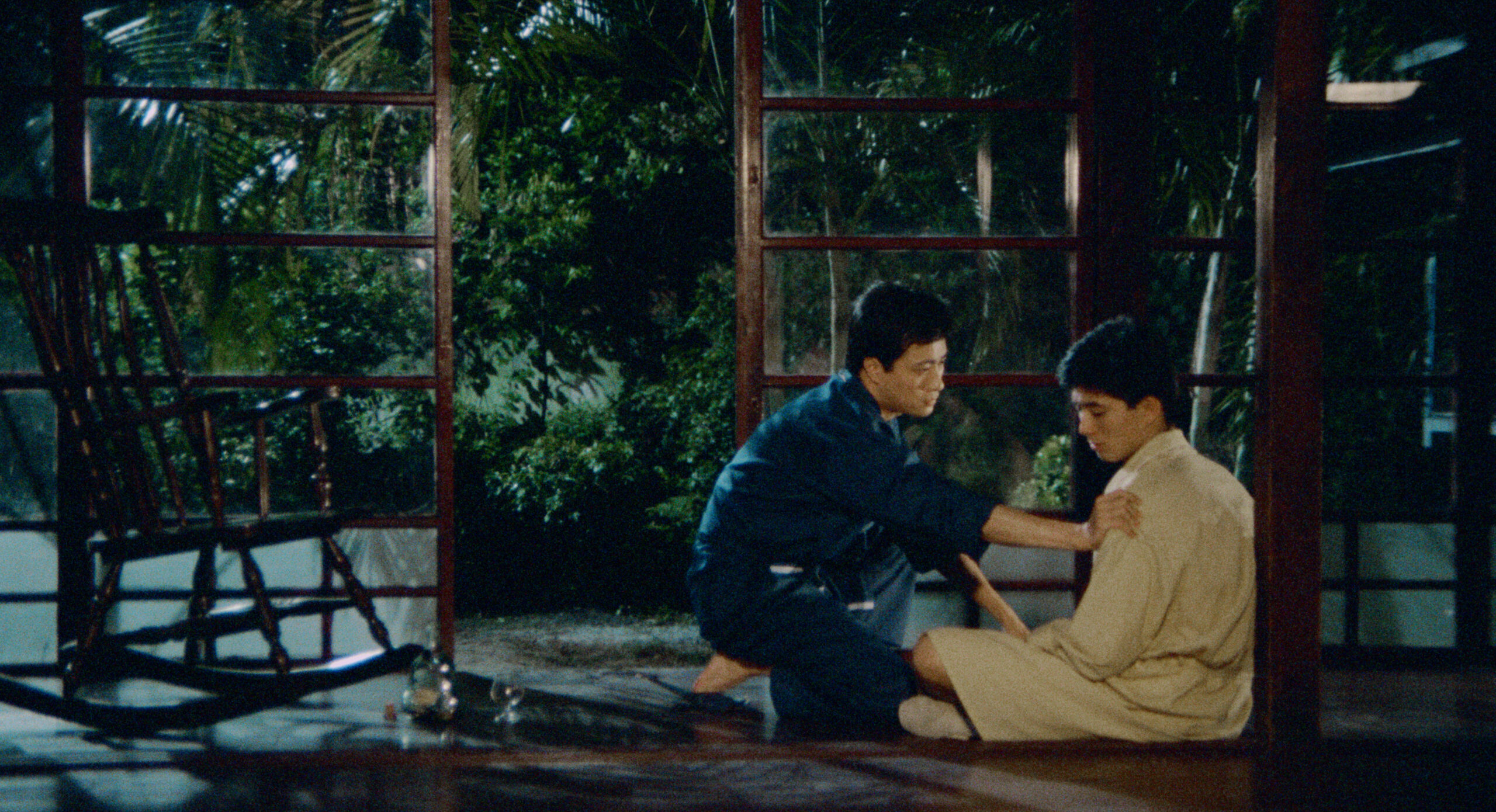
Li Qing’s (Shao Hsin) father is, in many ways, a symbol of the authoritarian regime in that he is a former KMT soldier who came to Taiwan with Chang Kai-Shek after the Chinese civil war. Filled with notions of toxic masculinity, he kicks Qing out when he is expelled from high school after being caught having sex with a male lab assistant. Screaming at him in the street, he calls him a “degenerate” and tells him never to come home. Yet it seems obvious that Qing’s father has no real power and all his abuses stem from just this fact. His son’s homosexuality calls his own manhood into question, while his violence towards his wife also stems from his insecurity that she will leave him for a better man. She eventually does leave him for a trumpet player, abandoning her two sons the youngest of which dies as a direct result of his father’s neglect.
Though Qing was a wounded, lonely little boy who felt himself rejected by both parents due to his mother’s obvious preference for his brother, he adopts a maternal position that comparable to that shown to him by “Mama Yang” who takes in “homeless birds” or young gay men who’ve been rejected by their birth families and have nowhere else to go. Qing was kicked out not only of his home but the school too, leaving him educationally disadvantaged. He can only earning a living as a sex worker in the Peace Memorial Park which has become a cruising spot for gay men. Pushed out of the mainstream society and left with nowhere to go, they have repurposed this public space as their own but are not safe even in here given the frequency of police raids. Auntie Mann, the former actress who lives with Yang, asks him where these young men are supposed to go if they can no longer go to the park with the consequence that they decide to formalise their situation by selling Yang’s photo studio and the building Mann owns to open a gay nightclub called The Blue Angel.
The club speaks of a need to carve out one’s own space in a hostile society, but also the commodification of gay life that accompanies greater acceptance. The park was free and money could also be earned there, but here the guests will need to pay because this is, after all, a business in addition to being a community hub. It also seems that for whatever reason, policemen are also drinking here, so it is not completely liberated and its existence depends on not offending the authorities. Nevertheless, it otherwise extends the family forged by Yang and Mann to a wider community of queer people by offering them a safer space in which they can be their authentic selves if only for a short time.
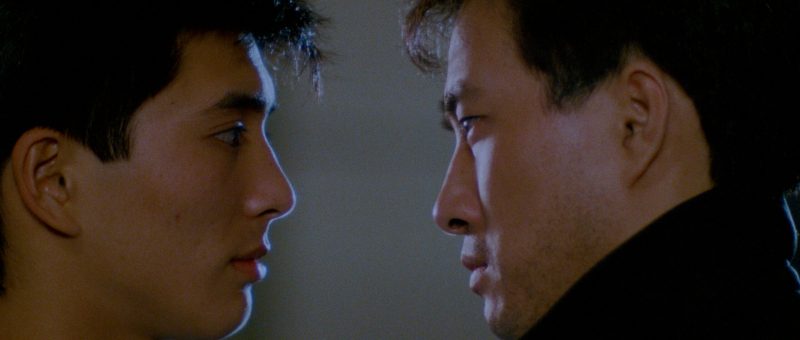
This seems to be true for Mann’s former director who seems to make a point of going everywhere with two very young and attractive women hanging on his arms, but abandons them to flirt with men at the club. Closted movie Hua Kuo-Pao similarly seems to have taken a liking to Qing, but must presumably keep his sexuality secret in order to go on working. Dangers are spoken of regarding the potential violence of obsessive love in a repressed community as Yang cautions Qing about entering an affair with Dragon, a man he meets in the park, who killed his lover Phoenix in a crime of passion and has been a wandering soul ever since having convinced himself never to love again because it would only end in death.
Yu frames murder as a moment of gothic madness as fog rises behind the bridge in the park, which was already a space of darkness and depression symbolising the degree to which these men are already isolated within their society. Another of the young men Yang takes in ties to take his own life after his lover kicks him out. Though the others tell him his boyfriend was not worth dying for, the problem seems to be more that being thrown out again convinced him he had nowhere else to go. If it were not for Yang and Auntie Mann, he would be totally alone. There does seem to be, however, a degree of tension in the relationship between Yang and Auntie Mann in which there exists a deep platonic love that cannot be resolved sexually. Just as he saves the boys, Yang also once saved Mann from an addiction to drugs, though he could not save her film career or hope for feminine fulfilment through marriage. The Blue Angel club finally only possible because of Mann’s acceptance that she will never be an actress again nor marry for love. Yang has been a kind of beard for her, helping her save face and avoid the stigma of being an unattached woman by making it look like there was a man in her life, just as she perhaps provided security for him in ways other than allowing him to rent his shop from her cheaply and have a place to live.
So tying into the film’s title, these new support networks play into a heteronormative vision of the family in which Yang becomes a father figure to Qing and teaches him how to live a more fulfilling, safer life as a gay man in contrast to his birth father’s authoritarian attempts at dominance. Another of the boys eventually leaves with a lover to look for their father in Japan, but seemingly struggles to find him reflecting the way in which each of them search for a more positive parental input having been failed or abandoned by their birth families. What they discover is a sense of brotherhood and solidarity that gives them a place to call home within the community. Nevertheless, the film ends with the symbolic gesture of Qing following Yang’s advice and attempting to reconcile with his father though an “unfilial son”, while his father too seems to have pulled himself together and is readier to accept Qing for who he is. This sense of homecoming for the homeless bird may then play into a code of familial obligation which could itself by oppressive, but also signals a new beginning and the opening up of a more liberated era.
The Outsiders screened as part of this year’s Queer East.