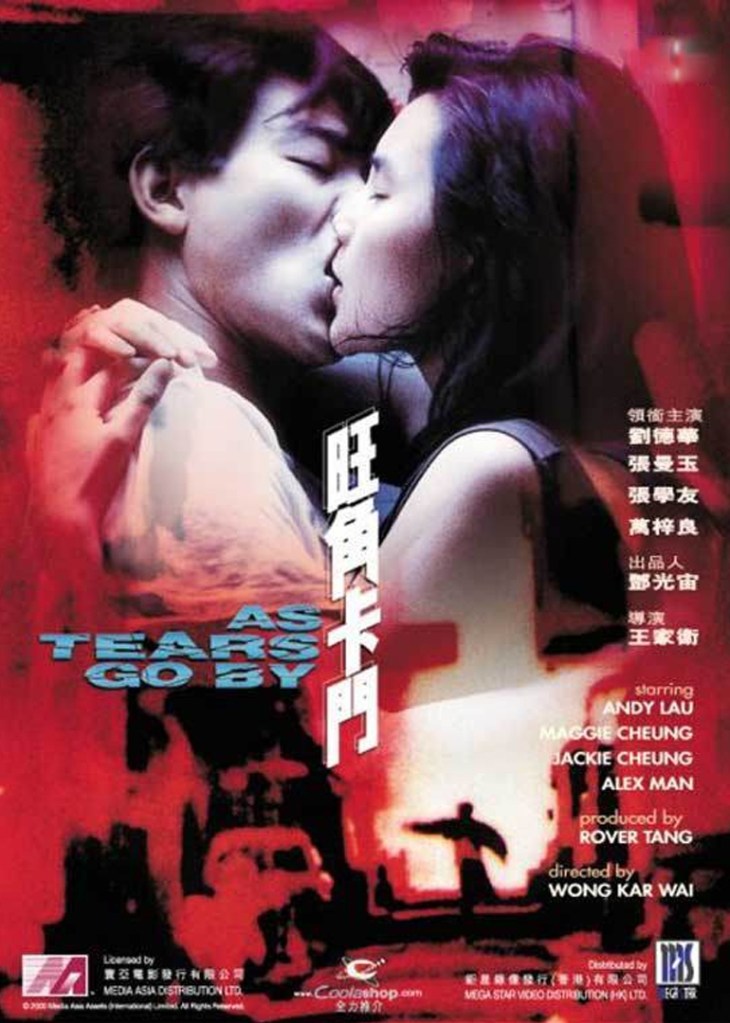
As Tears Go By (旺角卡門, Wong Kar-wai, 1988)

as tears go byThese days, Wong Kar-wai is an international auteur famous for his stories of lovelorn heroes trapped inside their memories, endlessly yearning in vain for the unattainable. In many ways his debut feature, As Tears Go By (旺角卡門, Mongkok Carmen) is little different save that it owes more to its vague heroic bloodshed, gangster inspiration and is less about memory than inevitability and a man abandoning his dreams of a better life with a woman he loves out of mistaken loyalty to his loose cannon friend.

The film opens with Wah (Andy Lau) still in bed despite it being late in the day only to be woken by a voice so piercing it can only belong to an aunty. It seems a mysterious cousin whom he’s never met before will be coming to stay with him as she has something wrong with her lungs and needs to see a specialist in town. Seconds after he puts the phone down the doorbell rings to reveal the cousin, Ngor (Maggie Cheung), standing outside. Slightly put out, Wah goes back to sleep despite the continuous phone calls from his friend, Fly, who is supposed to be collecting a bill but is not having much success. As he will do for the rest of the film, Wah will have to go down there himself and stop Fly making things even worse for everyone than they really needed to be.

For the early part of his career Wong had worked as a scriptwriter (a self confessed hack at times) and was finally given the opportunity to direct his own work as the Hong Kong film industry began to boom in the late ‘80s. This was of course largely due to the fantastically successful action flicks being made at the time including A Better Tomorrow, The Killer, City on Fire etc. so it’s not surprising that he chose the relatively safe arena of genre for his first foray into the director’s chair. His existing connections also enabled him to cast arguably the biggest young stars of the day including Andy Lau, Maggie Cheung and Jacky Cheung as his three leads meaning he had pretty much a safe bet on his hands whatever he decided to do. However, even if As Tears Go By is the most straight forward, even commercial, of his films that’s not to say it doesn’t bear many of the hallmarks of his later efforts.

Broadly speaking, As Tears Go By is a fairly standard gangster tragedy much indebted to Scorsese’s Mean Streets as its melancholic hero is caught between loyalty to his friend and the possibility of salvation through the love of a good woman. Fly is a one man disaster zone – a totally useless gangster who can’t take care of himself in a fight yet loves to buzz around irritating the hell out of everyone and starting gang wars over nothing every five seconds. Even the pair’s godfather warns Wah that sooner or later Fly is going to land him in big trouble and it would be better for everyone if they could find him something else to do. Wah seems to agree but is unable to guide his feckless friend away from the fleeting glory of the tough guy world. Wah is already tired of the gangster life, he feels old with it but knows somewhere deep down he’ll never be free. Either out of complete stupidity, mistaken loyalty and a desire for revenge, or just because he doesn’t think he deserves anything else Wah throws away his chance for something better in a pointless, though affecting, gesture of solidarity with Fly.

Shot by Andrew Lau (who would go on to direct his very own genre hit Infernal Affairs also starring Andy Lau only 15 years later), As Tears Go By sparks many of Wong’s consistent visual motifs including the use of slow motion and a persistent melancholic atmosphere which is also filled with tiny moments of contemporary life. Andy Lau makes for a super cool gangster hero in jeans, dark jacket and sun shades, cigarette hanging carelessly from his lips as he wanders about town in a perpetual statue of ennui. Like many of Wong’s subsequent lonely male heroes, he has an inner longing for something which he believes he can never have. Just as the best film noir tough guys do, he warns off his potential romantic salvation which comes in the pleasing form of Maggie Cheung by telling her that, being such as he is, he can promise her nothing because he’s learned never to bother thinking past tomorrow.

Taken on its own merits, As Tears Go By is an interesting addition to the canon of late ‘80s gangster movies which marries the classic tropes of heroic bloodshed with an arthouse aesthetic inspired by both “New Hollywood” classics and genre infused European cinema. Though he’d rarely return to such frenetic action scenes, here Wong shoots with energetic hand held camera and a kind of fury that might give Fukasaku a run for his money. Extraordinarily accomplished for a debut movie, As Tears Go By is very much a youthful feature which is stained with the same kind of unresolvable longing which would come to colour the rest of Wong’s work to date. A stylish genre effort, As Tears Go By is Wong finding his feet, but find them he does and leads us on a characteristically melancholy waltz as he does so.


Reviewed as part of HOME’s CRIME: Hong Kong Style touring season.

Such a pleasure seeing this again and in 35mm! Though there perhaps should have been a warning about how much of the film lacked subtitles (just as well I’d seen it before!).

As Tears Go By was previously released by Tartan in the UK but a word of warning as there was quite a big error involved with the UK edition in that Tartan were given the Mandarin dub of the film rather than the original Cantonese by mistake but opted to rush the film out in conjuction with the release of 2046 rather than fix the problem. Kino Lorber released the film in the US but maybe out of print. The good news is that the Hong Kong edition at least does have English subtitles.

Original trailer (no subs)

I’m not sure if the film’s title actually has anything to do with this song, but As Tears Go By is an appropriately melancholic ballad from The Rolling Stones, here’s a vintage version sung by Marianne Faithfull:

The original Cantonese title is Mongkok Carmen – Mongkok being an area of Hong Kong and Carmen referring to the opera by Bizet which certainly creates an interesting set of allusions!
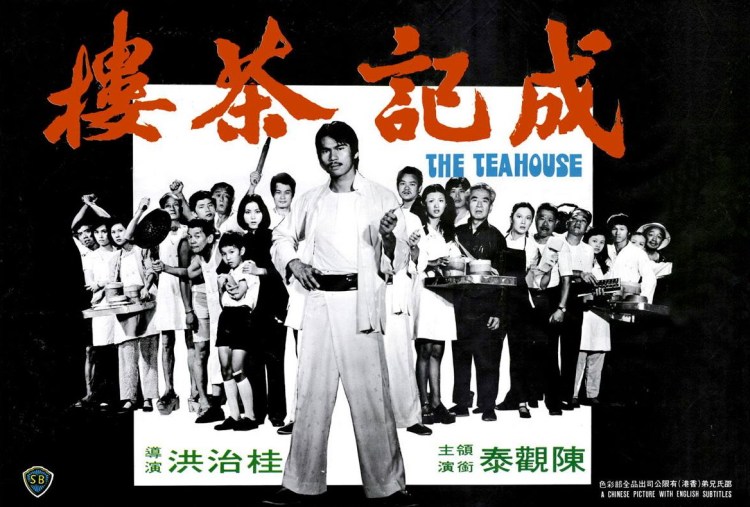
The Teahouse (成記茶樓, Kuei Chih-Hung, 1974)

TheTeaHouse+1974-248-bWhere oh where are the put upon citizens of martial arts movies supposed to grab a quiet cup of tea and some dim sum? Definitely not at Boss Cheng’s teahouse as all hell is about to break loose in there when it becomes the centre of a turf war in gloomy director Kuei Chih-Hung’s social minded modern day kung-fu movie The Teahouse (成記茶樓, Cheng Ji Cha Lou).
Wang Cheng runs a small teahouse which prides itself on being the kind of progressive environment where everyone looks after each other as long as they play by the rules. Unfortunately, one of his young guys – Blackie, fresh off the boat from the mainland, has got himself into bad company and into trouble with the law. However, as he’s a minor, he gets off with barely any punishment at all. Cheng tells him he can stay at the teahouse only if he pays properly for his crime leading him to try and get himself arrested all over again so he can go to jail (which actually proves very difficult).

Another unfortunate side effect of Blackie’s adventure is that it brings some unwanted gangster attention and when two young thugs come looking for one of the waitresses, Boss Cheng is not going to stand for any nonsense. However, after his attempts to help the girl have failed, he finds himself in trouble with two different sets of gangsters and also a meddling police inspector who seems intent on using the teahouse to trap the triads.

Boss Cheng is a good and decent man but also someone with his own opinions on justice who is not afraid to take matters into his own hands. His rules for workers at the teahouse emphasise obeying the law and behaving like responsible citizens, but he’s not above carrying out a little corrective action of his own if the need arises.

The biggest theme of the film is the rising inequality and place of migrants from the mainland in contemporary Hong Kong society but the first target Kuei has his sights set on is out of control youth. Because of the lenient laws regarding child criminality, the young men of Hong Kong run rampant, safe in the knowledge that nothing is going to happen to them while they remain under the age of responsibility. The two gangsters accused of raping and attempting to force the teenage waitress at the teahouse into prostitution give their ages as 14 and 15 respectively to the trial judge and are released without charge to go back to their life of crime with impunity and no respect for the law or conventional morality. Sadly, this system just creates another child criminal but one who will receive a jail sentence even if a lighter one to be served in a reform school rather than a prison.

Blackie was seduced into crime by a lack of funds – having managed to make it over from the mainland he has nothing other than his job at the teahouse and the support of Boss Cheng. One day a ragged looking little boy leading his sister by the hand wanders into the teahouse to beg for food. It turns out his small family escaped from the mainland too but his father never made it to Hong Kong and his mother is ill, leaving the children to try and fend for themselves. Boss Cheng takes pity on them and gives the boy a job plus paying for his school fees but he still finds himself beaten up by thugs not much older than himself in the street.

All the while, corrupt fat cats are messing with the system to keep the poor in their place while the rich get richer. Cheng takes great pleasure in playing off a corrupt industrialist who tried to use him as a sacrificial pawn in his own war against the triads (well, the triads he doesn’t like, anyway). Amusingly, one of the triad bosses seems to think Cheng is also a brother forcing him to pretend to know all about triad rituals to attempt to make a truce with them. The teahouse is situated right between the territories of two rival gangs making it a prime spot for conflict. However, the real problem comes when the police start muscling in, giving off the impression that Cheng has turned traitor on the triads. Soon, Cheng becomes the single biggest threat to his own teahouse and the progressive environment he hoped it would foster.

The Teahouse is actually a little ahead of its time concentrating not on kung fu or street fighting but mixing in a little gun play and some bloody knife crime. The shooting style is impressive throughout with a realistic, gritty atmosphere which aims to put the real streets on screen. The film does, however, have a tendency to fall into an episodic rhythm and suffers from its abrupt and slightly odd, downbeat ending which finishes things on an unsatisfying note. That said, The Teahouse is a stylishly shot and socially engaged action extravaganza that makes up for its minor shortcomings with a degree of chutzpah which looks forward to the classic heroic bloodshed movies of the ‘80s.


Seen as part of HOME’s CRIME: Hong Kong Style touring season.

Unsubtitled trailer (Mandarin):


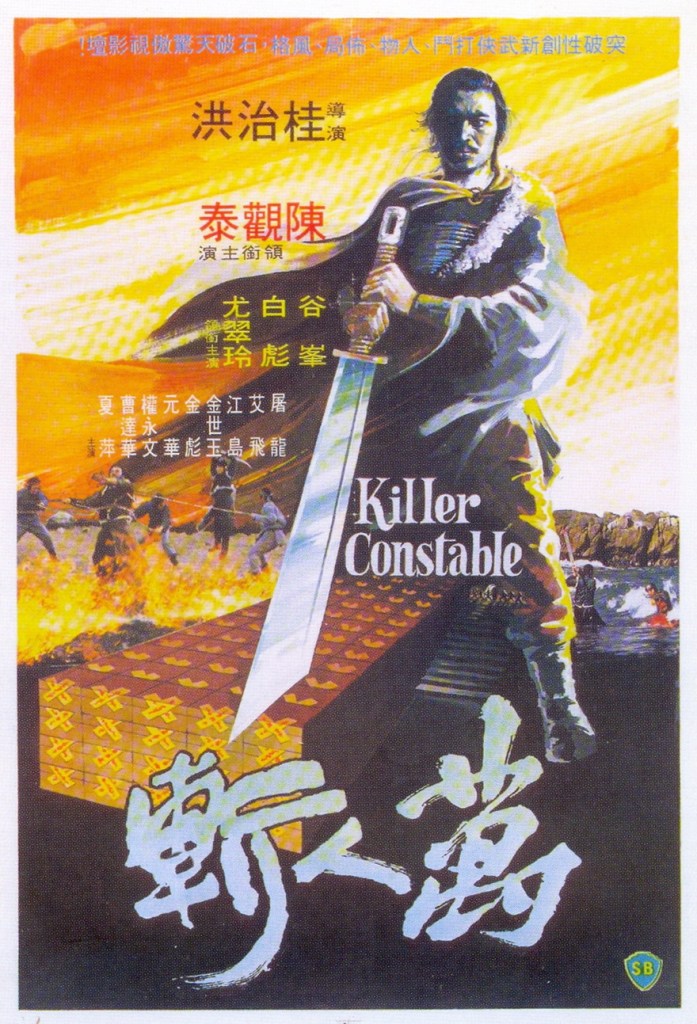
Killer Constable (萬人斬, Kuei Chih-Hung, 1980)

KillerConstable+1980-19-bEvery sovereign needs that one ultra reliable and supremely talented servant who can be called upon in desperate times. For the Dowager Empress of the Qing Empire, that man is Leng Tien-Ying – otherwise known as the Killer Constable. When a sizeable amount of gold goes missing from the Imperial Vaults, it’s Leng they call to try and get it back. However, what Leng doesn’t know is that there’s far more going on here than he could possibly have imagined and he’s about to wade into a trap so deep that you never even see the bottom.
At several points, the giant broadsword style weapon that Leng carries catches the light and appears to shine out with some kind of ethereal righteousness, yet if Leng wields the shining sword of justice he does so with a heart of ice. Early on one of his most trusted subordinates argues with him and says he intends to leave because he thinks Leng is more killer than policeman. He doesn’t take prisoners, where there’s reasonable proof of guilt he cuts the perpetrator down on the spot. At one point he tortures a suspect for information by mock drowning him in a lake while his wife and terrified children look on. When the wife complains, he hits her causing the husband to make the mistake of going for Leng which earns him the prize of getting his head cut off right in front of his family who are now left without any means of supporting themselves.

Leng cares only about the letter of the law. As the squad of policemen ride through the barren landscape, they pass through ruined towns filled with the starving and the desperate. One of the more compassionate men asks what’s happened here and if they, as policemen, shouldn’t be trying to help, but is reminded that these poor people are Hans and the policemen are Manchurians, so it’s just none of their business whether they live or die.

However, here is where Kuei’s film deviates from the accepted path. Leng’s generally bleak attitude to life is the one the film most closely identifies with. Any attempt at compassion is met with by betrayal, each act of kindness only earns retribution and being softhearted is almost another word for dying young. That is not to say the film is completely behind Leng as a hero or even as an anti-hero, he too will pay for the way he lives his life starting with realising that he alone is responsible for the deaths of the men that blindly followed him on a fruitless quest.

Killer Constable is more of a swordplay film than a kung-fu one and is filled with plenty of energetic and expertly choreographed fight sequences. The men fight in blazing heat (at one time literally), pouring rain and mud filled swamps against a suspiciously well trained gang of opponents who always seem to be lying in wait for them. The Killer Constable also seems to have something of a fetish for chopping off people’s legs which carries on right into the bloody finale with limbs flying off with oddly gleeful abandon.

As it turns out, the Killer Constable is not completely heartless, he’s just lived in this harsh world long enough to come to the opinion that the “bad” cannot be redeemed and need to be cut down like weeds so that the flowers can once again bloom. However, he, in his quest, has crossed the line and become that which he most hates. To nearly everyone else in the picture, Leng is a bad guy – the uncompromising face of the law and the knock at the door you most fear coming. In the film’s surprisingly downbeat ending he too will get what’s coming to him.

Bleak beyond measure, the only good and true thing in the cruel wold of Killer Constable is the blind daughter of one of the criminals. Kind and cheerful, she tries to help Leng as he lies wounded and is entrusted to him should her father die, yet she pays the heaviest price of all, left standing all alone in the rain waiting for the return of those who will never come home again. Far from heroic, Killer Constable is a critique of blind justice dealt out by self righteous egoists who will always discover the error of their ways far too late.


Seen as part of HOME’s CRIME: Hong Kong Style touring season.

The Pilferer’s Progress (发钱寒, John Woo, 1977)

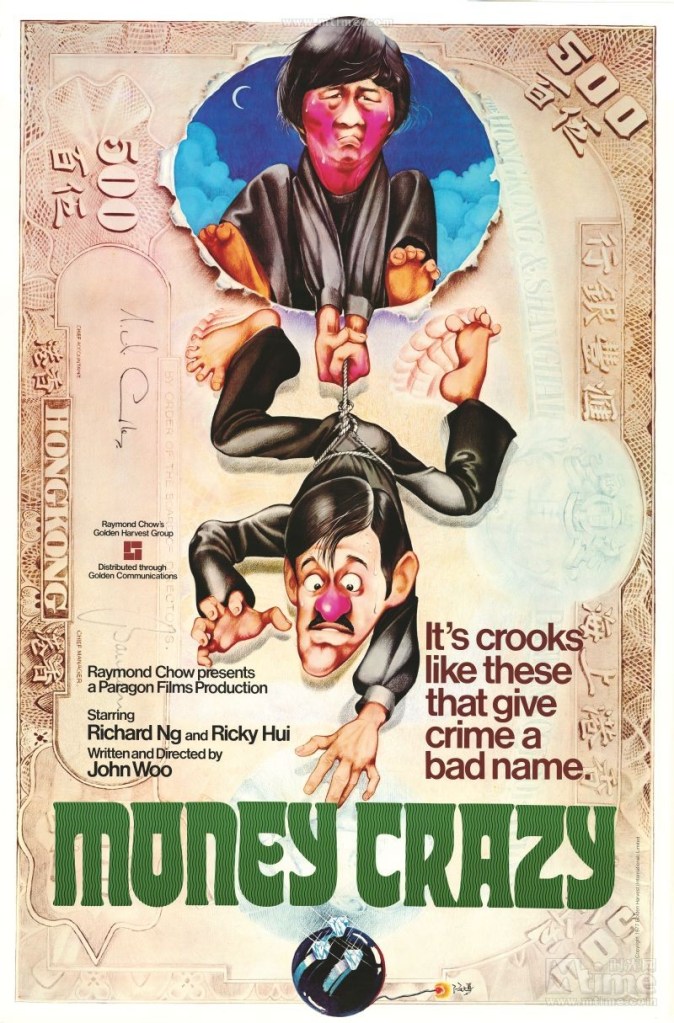
Money CrazyJohn Woo is best known in the West for his “heroic bloodshed” movies from the ‘80s in which melancholy tough guys shoot bullets at each other in beautiful ways. However, he had a long and varied career even before which began with Shaw Brothers and a stint in traditional martial arts movies. What often gets over looked outside of Woo’s native Hong Kong is his many comedies, of which The Pilferer’s Progress (AKA Money Crazy, 发钱寒, Fa Qian Han) is one of his most successful.

The plot follows the comic adventures of two down on their luck hoodlums – would be bodyguard Poison (Ricky Hui) and “private detective” Dragon (Richard Ng Yiu hon), who keep running into each other so many times that they eventually end up having to become a team. After each becoming involved with the greedy business man Rich Chan (Cheung Ying), the two find themselves lusting after a set of three diamonds which he has in his possession. Their desire only grows after meeting Mary (Angie Chiu) and her godfather to whom the diamonds originally belonged before Chan cheated him out of them.

Love trumps money, at least for a while, as Poison and Dragon team up to get revenge on Chan and get the diamonds back for Mary. Of course, more personal concerns end up raising their heads towards the end as the duo realise that if they just give the diamonds back to Mary it might buy them some brownie points but they’ll be quite massively out of pocket. They come up with a suitably anarchic solution that involves dummies holding guns and a motorbike cleverly concealed inside a haystack not to mention a fake broken arm (unsurprisingly it doesn’t go quite as smoothly as they’d hoped).

Much more slapstick buddy comedy than crime thriller, The Pilferer’s Progress is full of innovative sight gags and the fast paced Cantonese wordplay that has become a hallmark of the genre. Neither Poison nor Dragon are born criminal masterminds, they’re both just muddling through with a kind of anarchic insouciance that lends their exploits a gleefully childish quality even when Dragon is doing something as shady as indulging in a bit of analogue photoshop to fabricate a picture of Chan with a mistress so he can blackmail him. Poison’s number one manoeuvre is to get a gang together to pretend to attack his target so he can pretend to fight them all off in the hope that the “victim” will be so grateful and impressed with his martial arts skills that he’ll take him on as a bodyguard.

Dragon seems to be an avid watcher of modern spy movies and has a host of fairly useless gadgets he can use to try and get the drop on Chan such as bugging his car (Poison puts the bug on the exhaust pipe), or drilling a hole from the kitchen below right into Chan’s toilet and sticking a periscope up there to scout out the room. Chan also has a fairly elaborate security system that he mostly uses to annoy his wife but Poison and Dragon get round it by drilling another, bigger hole in the ceiling and pulling a Mission Impossible style rope manoeuvre to try and grab the diamonds from around Chan’s neck while he’s asleep. Because he’s thought of everything, Dragon even pulls out a tiny umbrella and hangs it from his nose to catch the increasing stream of sweat falling from his brow in one of the film’s funniest moments.

Woo also mixes quite a lot of exciting kung-fu action with the pure comedy as Chan’s second bodyguard is a recently graduated shaolin monk who’s pretty much invincible – to normal people, but somehow Dragon and Poison manage to outsmart him every time. There’s also a fair amount of the gunplay that was to become Woo’s signature but there are no balletic sequences here – the guns look ridiculously fake, almost like children’s toys, and are always the “butt” of the joke, literally.

The Pilferer’s Progress may not be a great lost classic but it is heaps of period specific fun with an extremely catchy soundtrack including the title song sung by star Ricky Hui. Extraordinarily successful on its original release, The Pilferer’s Progress is undoubtedly very much of its time, as perhaps it was intended to be, but its fast paced, silly slapstick humour has a universal quality that proves that true comedy has no sell by date.


Seen as part of HOME’s CRIME: Hong Kong Style touring season.

http://www.youtube.com/watch?v=TVUhmW8Iti4