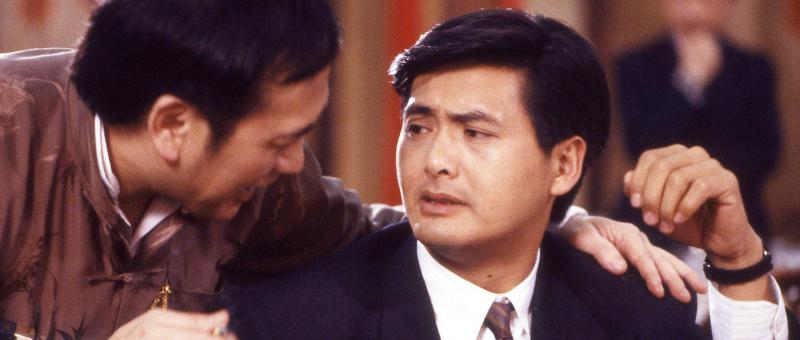
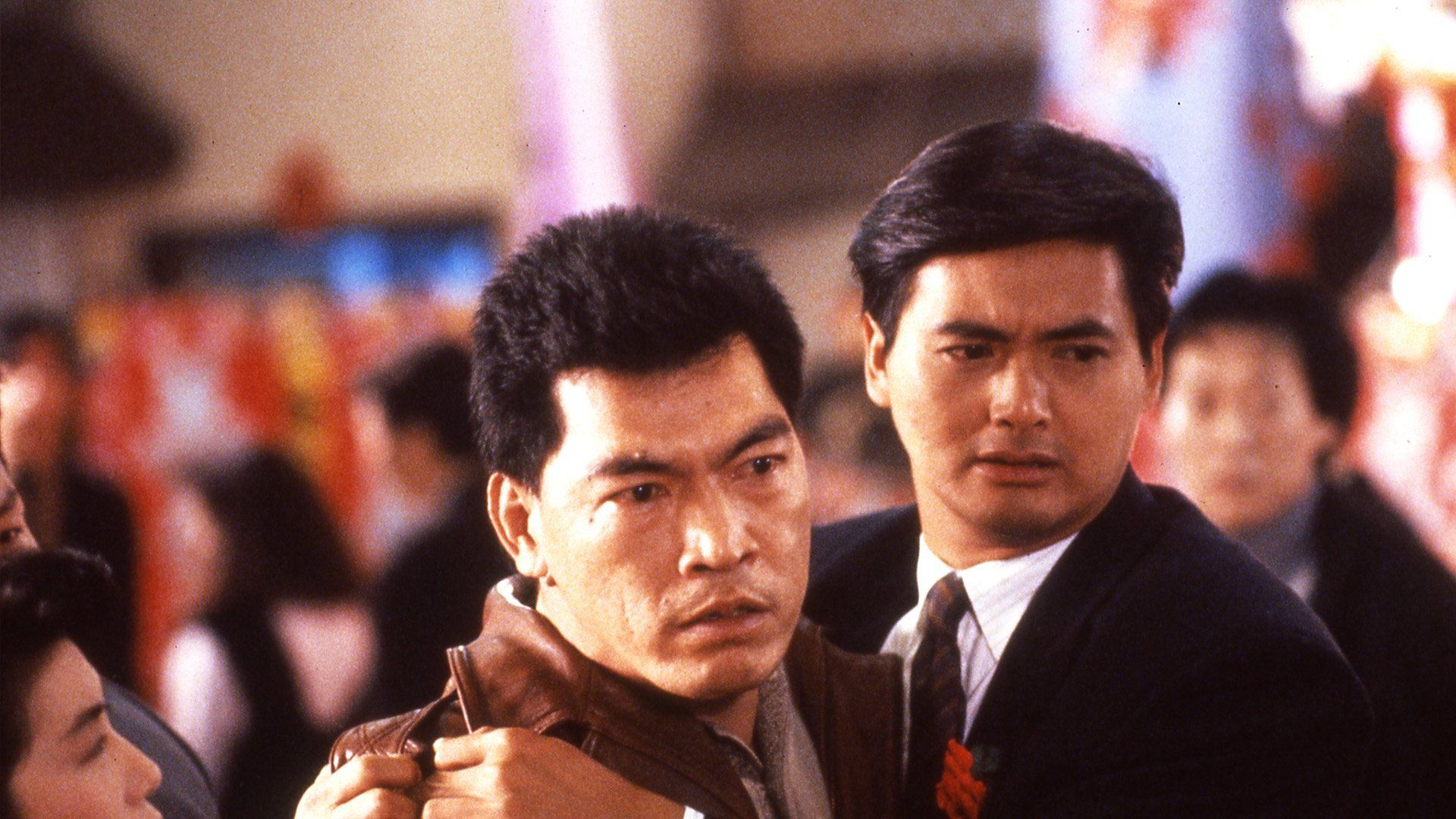
Triads: The Inside Story (我在黑社會的日子, Taylor Wong Tai-Loi, 1989)

“Brother Ho, you’re a kind leader, but not a good triad member,” a underling remarks of his rival, the biological son exiled from the world of crime now returned but struggling to accept his triad inheritance. Though Taylor Wong Tai-Loi’s Triads: The Inside Story (我在黑社會的日子) is said to have been intended to depict the life inside the triads in a more realistic way, the Chinese title, which translates as something more like “my time in organised crime,” more closely implies that this is a personal story of one man’s attempt to reconcile the two sides of himself.

Aging boss Uncle Kwan (Tien Feng) is challenged by a young upstart and killed during an ambush. With his dying breath, he instructs his right-hand men Shing (Michael Chan Wai-man) and Keung (Shing Fui-On) to tell his son, Ho (Chow Yun-fat), not to join their gang or seek revenge but to continue living his life in America. Kwan evidently sent Ho there with the intention of keeping him out of the world of organised crime, making sure he got an education and can live a nice, middle-class life. Ho indeed seems to have done quite well in the US. He has a large suburban house he lives in with his wife and young son, and has recently got into the real estate business. Nevertheless, he has a close relationship with his father even if he never approved of his triad activities.

Despite Kwan’s request, when Ho and his family return to hold the funeral, Shing and Keung press him to take over as head of the gang. Ho is understandably reluctant and insists he’ll be returning to America when all the formalities have been completed. Nevertheless, he ends up becoming somewhat involved in the gang’s business, using his corporate knowledge from America to suggest they simply sublet some of their territory to other gangs to stave off conflict and turf war, little realising that will lead to just that. Not knowing how the triad world works, he makes some catastrophic mistakes that lead to some of his father’s men being killed or injured.

In many ways Kong (Roy Cheung Yiu-Yeung), one of Kwan’s protégés, is his mirror image. Taken in by Uncle Ping (Lam Kau) and raised in triad society, he is in some ways Kwan’s natural heir but resents both still being treated as a petty foot soldier and that Ho has had all the opportunities not afforded to someone like him. Ho tells him that he’s still young, and could get a “proper job,” but Kong is illiterate and has been in triad society for most of his life. There are no other jobs he could go to, while Ho was sent abroad to study. Ho does not really belong in this society, but is respected as the biological son, while Kong, who cannot live anywhere else, is shunned and ignored.

Ho takes him to task for recruiting other young men to act as foot soldiers and scapegoats, but as Kong points out, this is how his father recruited him and triad society does at least provide a family for those who have no other. In going to America, Ho has lost touch with his culture and become somewhat exiled from his family, but also feels responsible for the empire his father built and the men who followed him. In some ways, his internal conflict may reflect a sense of anxiety that those who go abroad with the Handover looming will lose both their cultural identity and any possibility of influencing the future of the place they’ve left behind.

Yet, on the other hand, there is perhaps the idea that Ho survives abroad, while Kong sacrifices himself to save him in recognition of the fact that Ho has tried to do the same. In torching the Taoist altar along with his father’s photo, Ho sets fire to triad society itself along with the world his father left behind, asking for his father’s forgiveness while leaving to return to his new life in America without looking back. One of the first films to be awarded a Cat III certificate for its depiction of triad ritual which upset the colonial authorities, the film plays out more like a yakuza drama of fragmented paternal legacy and compromised brotherhood while exposing the inherent corruption of a gangster society before reaching a sense of catharsis as Ho prepares to burn it all down.


Trailer (Traditional Chinese / English subtitles)
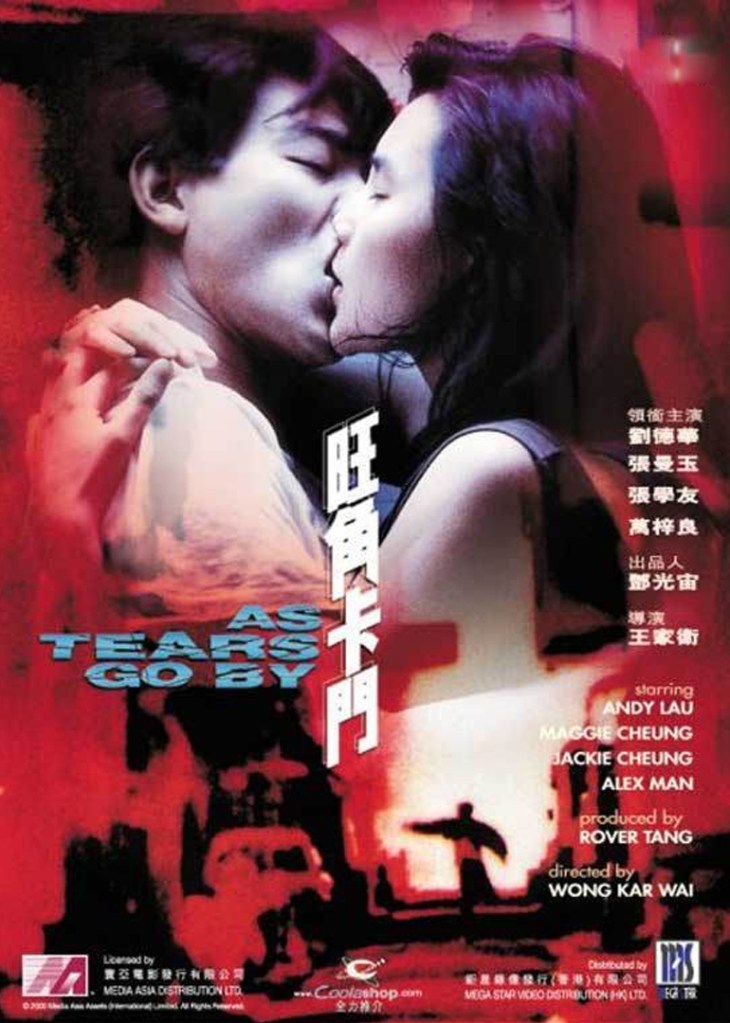
As Tears Go By (旺角卡門, Wong Kar-wai, 1988)

as tears go byThese days, Wong Kar-wai is an international auteur famous for his stories of lovelorn heroes trapped inside their memories, endlessly yearning in vain for the unattainable. In many ways his debut feature, As Tears Go By (旺角卡門, Mongkok Carmen) is little different save that it owes more to its vague heroic bloodshed, gangster inspiration and is less about memory than inevitability and a man abandoning his dreams of a better life with a woman he loves out of mistaken loyalty to his loose cannon friend.

The film opens with Wah (Andy Lau) still in bed despite it being late in the day only to be woken by a voice so piercing it can only belong to an aunty. It seems a mysterious cousin whom he’s never met before will be coming to stay with him as she has something wrong with her lungs and needs to see a specialist in town. Seconds after he puts the phone down the doorbell rings to reveal the cousin, Ngor (Maggie Cheung), standing outside. Slightly put out, Wah goes back to sleep despite the continuous phone calls from his friend, Fly, who is supposed to be collecting a bill but is not having much success. As he will do for the rest of the film, Wah will have to go down there himself and stop Fly making things even worse for everyone than they really needed to be.

For the early part of his career Wong had worked as a scriptwriter (a self confessed hack at times) and was finally given the opportunity to direct his own work as the Hong Kong film industry began to boom in the late ‘80s. This was of course largely due to the fantastically successful action flicks being made at the time including A Better Tomorrow, The Killer, City on Fire etc. so it’s not surprising that he chose the relatively safe arena of genre for his first foray into the director’s chair. His existing connections also enabled him to cast arguably the biggest young stars of the day including Andy Lau, Maggie Cheung and Jacky Cheung as his three leads meaning he had pretty much a safe bet on his hands whatever he decided to do. However, even if As Tears Go By is the most straight forward, even commercial, of his films that’s not to say it doesn’t bear many of the hallmarks of his later efforts.

Broadly speaking, As Tears Go By is a fairly standard gangster tragedy much indebted to Scorsese’s Mean Streets as its melancholic hero is caught between loyalty to his friend and the possibility of salvation through the love of a good woman. Fly is a one man disaster zone – a totally useless gangster who can’t take care of himself in a fight yet loves to buzz around irritating the hell out of everyone and starting gang wars over nothing every five seconds. Even the pair’s godfather warns Wah that sooner or later Fly is going to land him in big trouble and it would be better for everyone if they could find him something else to do. Wah seems to agree but is unable to guide his feckless friend away from the fleeting glory of the tough guy world. Wah is already tired of the gangster life, he feels old with it but knows somewhere deep down he’ll never be free. Either out of complete stupidity, mistaken loyalty and a desire for revenge, or just because he doesn’t think he deserves anything else Wah throws away his chance for something better in a pointless, though affecting, gesture of solidarity with Fly.

Shot by Andrew Lau (who would go on to direct his very own genre hit Infernal Affairs also starring Andy Lau only 15 years later), As Tears Go By sparks many of Wong’s consistent visual motifs including the use of slow motion and a persistent melancholic atmosphere which is also filled with tiny moments of contemporary life. Andy Lau makes for a super cool gangster hero in jeans, dark jacket and sun shades, cigarette hanging carelessly from his lips as he wanders about town in a perpetual statue of ennui. Like many of Wong’s subsequent lonely male heroes, he has an inner longing for something which he believes he can never have. Just as the best film noir tough guys do, he warns off his potential romantic salvation which comes in the pleasing form of Maggie Cheung by telling her that, being such as he is, he can promise her nothing because he’s learned never to bother thinking past tomorrow.

Taken on its own merits, As Tears Go By is an interesting addition to the canon of late ‘80s gangster movies which marries the classic tropes of heroic bloodshed with an arthouse aesthetic inspired by both “New Hollywood” classics and genre infused European cinema. Though he’d rarely return to such frenetic action scenes, here Wong shoots with energetic hand held camera and a kind of fury that might give Fukasaku a run for his money. Extraordinarily accomplished for a debut movie, As Tears Go By is very much a youthful feature which is stained with the same kind of unresolvable longing which would come to colour the rest of Wong’s work to date. A stylish genre effort, As Tears Go By is Wong finding his feet, but find them he does and leads us on a characteristically melancholy waltz as he does so.


Reviewed as part of HOME’s CRIME: Hong Kong Style touring season.

Such a pleasure seeing this again and in 35mm! Though there perhaps should have been a warning about how much of the film lacked subtitles (just as well I’d seen it before!).

As Tears Go By was previously released by Tartan in the UK but a word of warning as there was quite a big error involved with the UK edition in that Tartan were given the Mandarin dub of the film rather than the original Cantonese by mistake but opted to rush the film out in conjuction with the release of 2046 rather than fix the problem. Kino Lorber released the film in the US but maybe out of print. The good news is that the Hong Kong edition at least does have English subtitles.

Original trailer (no subs)

I’m not sure if the film’s title actually has anything to do with this song, but As Tears Go By is an appropriately melancholic ballad from The Rolling Stones, here’s a vintage version sung by Marianne Faithfull:

The original Cantonese title is Mongkok Carmen – Mongkok being an area of Hong Kong and Carmen referring to the opera by Bizet which certainly creates an interesting set of allusions!