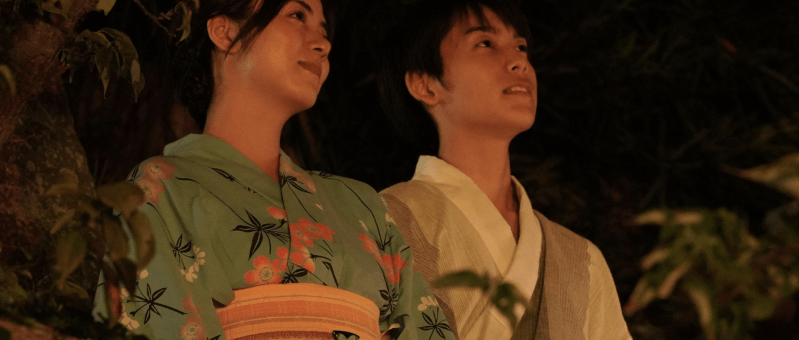

A mysterious transfer student arrives from the future. You have 20 wonderful days with him, but then he must return to his own time. He tells you that he came back to meet you and experience your time because of a book you will write, and your future self also shows you the book, tells you you did indeed write it, and that everything’s going to be okay. But in 10 years’ time, when you’re your “future self”, you from the past does not show up to get any of this information. Did something go wrong? Is the timeline crumbling? Or did you just imagine all this as a manifestation of “youth”?
When this happened to her, Miyuki (Elaiza Ikeda) believed that she was “the heroine of that summer,” but the truth is of course that she was always the heroine of her own life and had the right and power to make her own choices. Adapted from the novel by Haruka Honjo, Daigo Matsui’s Rewrite (リライト) is, like Obayashi’s The Little Girl Who Conquered Time, about the dangers of nostalgia and the over romanticisation of youth. What Miyuki gradually comes to realise is that one of the formative experiences of her teenage years may not have been unique or special but happened to literally everyone and changed them too in ways that were not always good. Because she met Yasuhiko (Kei Adachi) from 300 years in the future, she became a writer. But it remains true that her first few books weren’t about him at all. She always had the talent and the inclination. The impetus of destiny was only what gave her the confidence to pursue it. She knew she could, because she already had.
Yet, she’s in her hometown to close a loop on this unresolved romance of her youth despite having built a good life for herself as a successful author with a nice husband she met during the course of her work who is caring and supportive of her career. At the high school reunion she’s cajoled into going to, her former classmates sing the song they were practising for choir, “Cherry” by Spitz, which is also about “rediscovering each other, some day, same place,” echoing Yasuhiko’s cryptic claim that they’d meet again “in the future” (whose he doesn’t say) hinting at the way these feelings have been left hanging with only a yearning for the past and a painful nostalgia in their place. What Miyuki really has to ask herself is if she’s the person she wants to be in the present and is who she is because of the choices she made independently rather than solely because she was trying to fulfil the destiny given to her Yasuhiko.
To do so, she must face the fallacy of the “chosen one” mentality. The film rams this home in the parallel story of one of Miyuki’s classmates who tells her that she wasn’t chosen but actively chose to accept a kind of destiny rather than simply going along with it and that Miyuki too could “rewrite” the past if she wanted. In effect, this is what she’s already done as her husband implies when he repeatedly asks her if the book is “fiction”. Of course, it is, though she believed it not to be because it’s rooted in nostalgia and the personal myth making of the idealised romance of her youth. Matsui too plays with this sense of nostalgia in moving the setting of the story to Onomichi to mimic that of Obayashi’s The Little Girl Who Conquered Time and making frequent visual references to the 1983 film along with casting Toshinori Omi, the original boy who leapt through time, as the class teacher at the 10 years later reunion.
But the truth remains that Miyuki must learn to let go of the past, or else take mastery over it by rewriting her own story to accept that, as her husband says, the past and present are all hers. She can write anything and can finally leave her own time loop by writing her way out of youthful nostalgia and accepting something more like an objective reality along with the life she has now which appears to be happy and successful. Scripted by Makoto Ueda who has a long history of time-travel themed movies from Summer Time Machine Blues to River, Matsui’s poignant drama is shot through with irony and in constant dialogue with pop culture touchstones from the Obayashi film to Shunji Iwai’s Love Letter, while at the same time insisting that while you are the main character in your own life, you’re not the only one and a hundred stories are going on at the same time as yours. What really matters is not hanging on to the memories of an idealised past, but to live the life you want in the present for as long as this particular loop lasts.
Rewrite screened as part of this year’s Fantasia International Film Festival.
Original trailer (English subtitles)








 Windows on Worlds