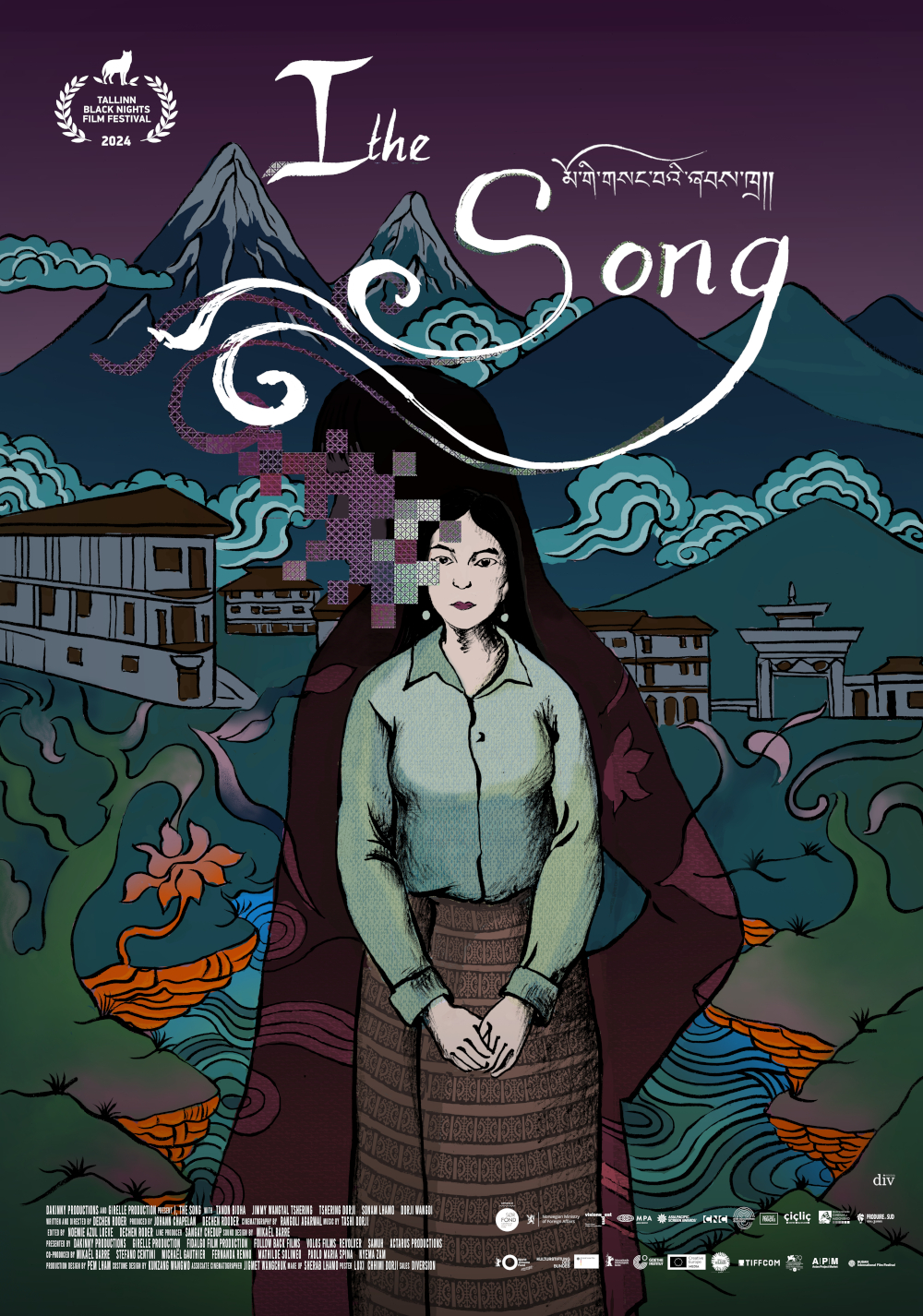
I, the Song (མོ་གི་གསང་བའི་ཞབས་ཁྲ, Dechen Roder, 2024)

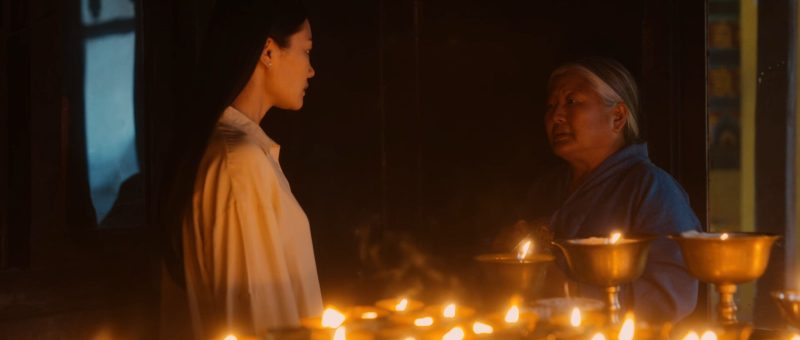
Nima’s (Tandin Bidha) boyfriend Penjor tells the tourists who come into his restaurant to experience the local culture that Bhutan is one big happy family where everyone knows everyone. This will turn out not to be the case, as Nima finds herself mistaken for someone else and struggling to affirm her own identity when everyone begins to tell she is someone she knows she is not. Dechen Roder’s I, the Song (མོ་གི་གསང་བའི་ཞབས་ཁྲ) paints a slightly less rosy vision of the so-called happiest nation of earth in which women like Nima are oppressed by patriarchal standards that are so deeply ingrained she had barely noticed them before.

Nima’s outrage runs slightly deeper than the frustration of being accused of something she hasn’t done partly because of the shame and embarrassment involved with being associated with an erotic video, but also because of its inevitable consequences. She’s let go from her job as a schoolteacher when parents complain after identifying her as the subject as a viral “blue video,” one clearly shot and uploaded to the internet without the woman’s consent. No matter how much Nima protests that it isn’t her, nobody believes her. Not only is she fired from her job, even her boyfriend distances himself from her. He scoffs a little resentfully that she’s always so proper, yet has apparently done something like this with another man. Nima is indeed quite “proper”, a little stiff and repressed. She lives her life in a conservative way, always demure and polite. It is difficult to believe that she would have had a one night stand with a man who filmed their encounter, but despite the incongruity, everyone assumes she must be lying to protect her reputation. Nima determines that the only thing to do is find the woman in question and get her to confess so she can prove to them that it really isn’t her.

But that proves a little more difficult than she first assumed it would, because every lead she turns up turns cold. Meto has disappeared into the ether like a ghost. Some say she went to America, as Nima herself apparently once did, though she doesn’t seem particularly worldly. In any case, many remark that people change after they go abroad, almost as if they were equating it as a kind of death or transition to another world. One of Meto’s old friends even suggests Nima actually is Meto having returned from America with a new identity and changed personality. The more she investigates Meto, the less certain Nima becomes of herself. What was so wonderful about your life, Meto’s former boyfriend Tandin (Jimmy Wangyal Tshering) asks her when she explains why she’s looking for Meto and Nima has to admit that maybe she doesn’t have an answer.

In looking for Meto, is she of course really looking for herself but Meto has been a lot of people too. Nima discovers that Meto came from a small village to reclaim a song that stolen by the city. Meto’s grandmother says that bad things will happen in the village if they don’t get it back, but how exactly can you return a song? In the end, Meto has become a song to Tandin who struggles to accept her sudden absence assuming she must have just left him and decided to move on without a word as she apparently had from other lives before this. In a way, Nima is returning the song of Meto in learning to sing it, bringing it home to her grandmother as if closing a loop.

What she eventually realises is that it shouldn’t matter if it was her in the video or not. The shame wasn’t Meto’s to bear, and investigating her fate she uncovers a dark history of sexual harassment and exploitation. Using her newfound identity, Nima tries to get justice for Meto by reporting the man who did this to her as a means of standing up for herself and the other women of Bhutan held to unfair double standards while men like Meto’s abuser are free to continue abusing their authority. She has in a way learned to become herself while sort of becoming someone else and reclaiming an identity that should have been hers all along in the discovery of a newfound freedom.


I, the Song screened as part of this year’s CinemAsia Film Festival.

Trailer (English subtitles)
The Red Phallus (Tashi Gyeltshen, 2018)

Red Phallus poster“I doubt anyone can get out of this paradise” laments an angry man at the centre of Tashi Gyeltshen’s debut feature The Red Phallus. Far from the happiest kingdom, the Bhutan of the Red Phallus is an oppressive place where misogyny and classism rule. Tyrannised by tradition and a conservative culture, the heroine finds herself trapped in an impossible situation, by turns mocked and humiliated because of her father’s “embarrassing” profession, and left with no-one to turn to when misused by the men all around her.

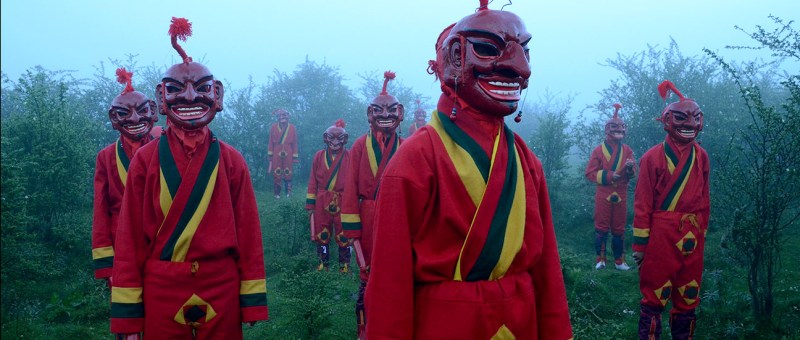
16-year-old Sangay (Tshering Euden) has trouble getting up for school. Unbeknownst to her father (Dorji Gyeltshen), the reason is not so much teenage fatigue and latent rebelliousness, but that the other children are less than kind to her because of his unusual profession – he carves wooden phalluses for a living and puts on a creepy red atsura clown outfit to participate in local festivals. At her age, Sangay should be in year X, but she’s only in year VII because she misses so much school and if she misses much more she’ll be given the rather ironic punishment of suspension. That’s not the only reason she’s in trouble though. The headmaster has also been told she’s been seen going about with Passa (Singye), a married man with two children who’s much older than her, but that’s not the problem. The problem is Passa comes from a family of butchers, which is why it’s so unseemly.

Weirdly, no one seems to be very concerned that a married man of around 30 is hanging round with a 16-year-old girl. When we first meet Passa without knowing his age or background he seems OK, possibly Sangay’s only friend, but he quickly turns nasty when she’s less than keen to take him up on his offer of running away together to the city. She tells him that she’s too young, “just a girl”, and isn’t sure that’s a decision she’s in a position to make. He begins to push her, criticising her for always saying she’s too young or not strong enough. Passa asks her when she’s going to make her own decisions, but Sangay is too clever for him. She’s well aware that by “your own decisions” he only ever means agreeing with him. She’s just made her own decision now when she told him she didn’t want to go, but he doesn’t like it so he tries to browbeat her by undermining her sense of confidence by implying that she’s too stupid to decide for herself while also lacking the courage of her convictions.

Why she’s hanging round with Passa in the first place remains a mystery save a later reference to a traumatic incident he tries to blackmail her with. What’s clear is that she doesn’t see much of a way out for herself through education and has become too afraid or embarrassed to attend school because of her father’s profession. Sangay’s dad is largely a background presence in her life, yelling at her to get out of bed or barking orders from his studio. He doesn’t like it when she takes too long coming home after school, but sends her straight back out again on errands delivering phalluses to customers when he’s too busy to go himself. Sangay is not a fan of the phalluses, and like most of the other children, seems to find them very embarrassing, virtually throwing them at the son of her customer who giggles on seeing her approach with her arms full of oversize wooden fertility ornaments.

Apparently Sangay’s dad is one of the best atsuras in the country, though for reasons perhaps connected to the aforementioned traumatic incident, he’s thinking of retiring. In any case, he’s not much of a protective talisman for his daughter, meekly bowing his head and remaining silent when called in by the headmaster, and later spectacularly failing when he tries to have a word with Passa to explain how deeply inappropriate it is for him to be sniffing round his teenage daughter who is still after all a school girl.

It’s no wonder Passa would like to leave the “paradise” of their small rural community considering he’s the lowest of the low solely because his father was a butcher. Sangay’s headmaster angrily barks at her about a lack of ambition, threatening her that she might end up a butcher’s wife as if that were the worst possible outcome. Even so, Passa – the lowliest of all the men, still thinks he has a natural right to boss and abuse Sangay, emphasising his own masculinity and the lack of it in Sangay’s meek father whose ironic profession it is to carve giant phalluses that are supposed to ward off danger when “phalluses” seem to present nothing but danger and disappointment to young Sangay. When smashing crockery to ease her frustration is no longer enough, Sangay’s rage boils over into something violent and self destructive, her silence giving way to a single scream of infinite impossibility.


The Red Phallus was screened as part of the 2019 Five Flavours Film Festival.

Original trailer (English subtitles)