Hey! Our Dear Don-chan (おーい!どんちゃん, Shuichi Okita, 2022)

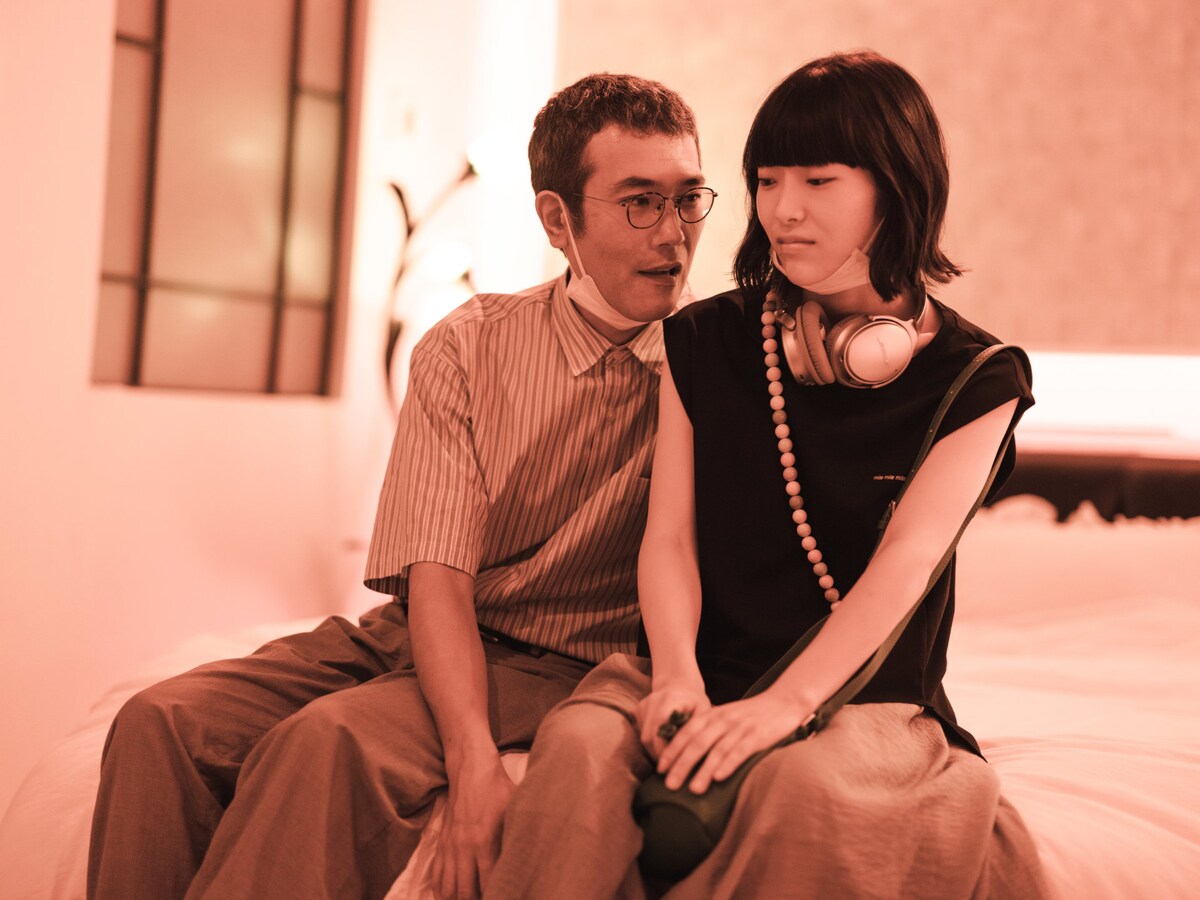
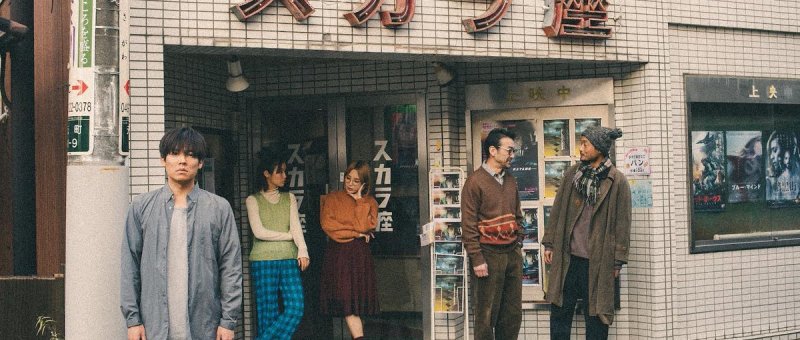
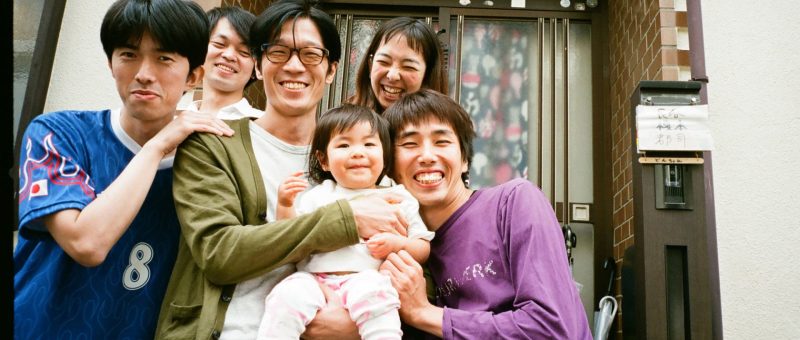
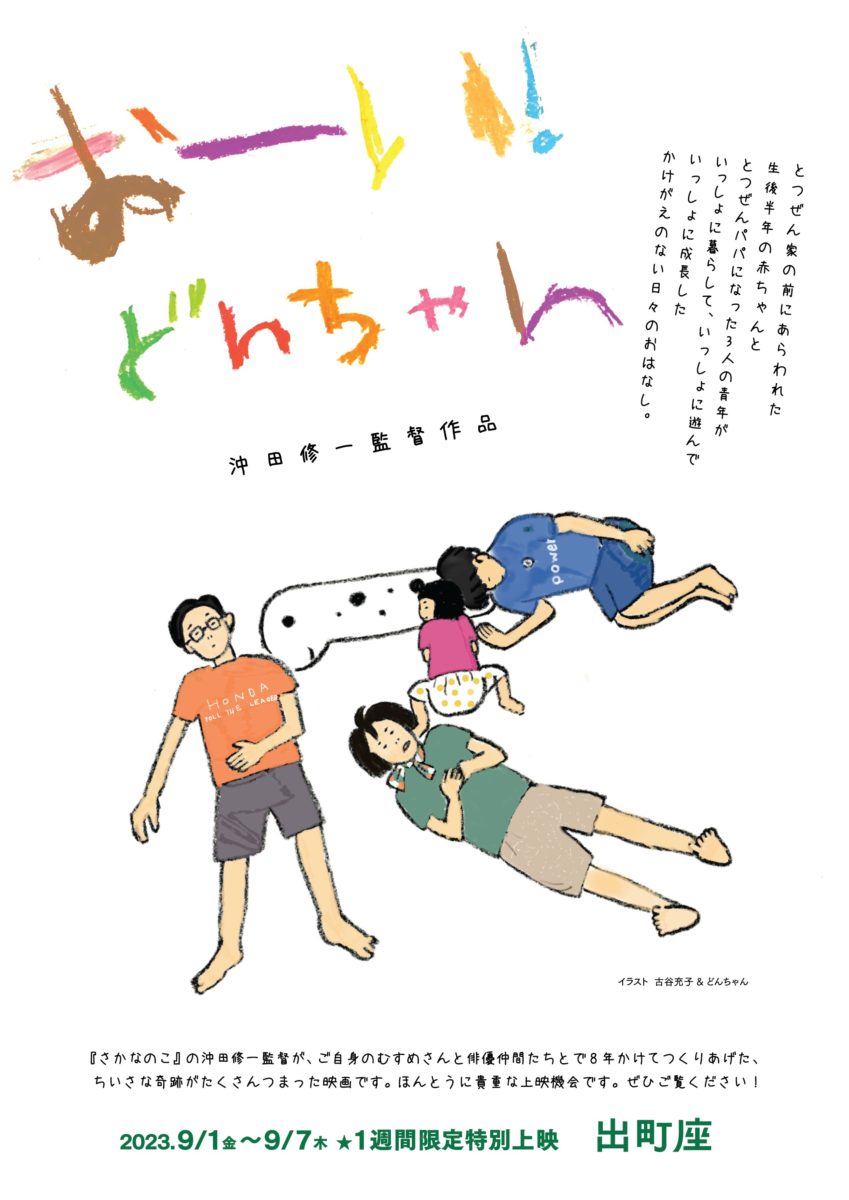
A trio of actors undergo a coming-of-age tale of their own when a baby is suddenly abandoned on their doorstep in Shuichi Okita’s charming slice of life dramedy, Our Dear Don-chan (おーい!どんちゃん, Oi! Don-chan). A take on Three Men and a Baby, the film stars the director’s own daughter and follows her over a period of three years as the actors attempt to adjust to fatherhood and the new kind of family that has arisen between them. 

As the film opens, Michio (Tappei Sakaguchi), Ken (Hirota Otsuka), and Gunji (Ryuta Endo) are struggling actors working in slightly different media but having about the same amount of luck and continually dejected about their lack of career success. Ironically while playing the game of life, Ken has a baby girl in the game but is surprised to hear one crying for real on the street below. On reading a note in her pushchair, Ken realises that the baby has been left by a previous girlfriend, Kaori, with the instruction that he raise it. 

Of course, the situation gives rise to a degree of panic, Ken wondering not only if he is the father but if he can be while supported by the other two guys, along with former houseman Sakamoto and his girlfriend Akari, taking care of more practical matter likes getting nappies and baby food. Then again, some of the practical details are already overcome by virtue of their occupations which allow them to be home during the day taking shifts to watch the baby they christen “Don-chan” on account of not knowing her real name. 

As they struggle with the demands of fatherhood, the three men each commit themselves to Don-chan’s well being, mindful of the memories she’ll make in the future and wanting to make her present as happy as possible. At one point they decide to take a camping trip in order to show her that they can be “manly dads”, but otherwise entertain her at home or take her on trips to the aquarium acting as a trio even if Ken is technically the primary dad forming a new kind of family that makes it easier to care for a small child than it might otherwise have been. If Ken had been on his own, he may not have been able to raise her. Michio and Gunji both complain at the precarious state of childcare facilities, lamenting that you can’t get a place unless you work full-time but you can’t work full-time if you can’t get childcare for when you’re at work. 

Meanwhile, they continue to struggle in their professional lives. A humiliating audition for a TV commercial causes Ken to rethink his career plans, stopping off to buy new toys for Don-chan on the way home lamenting that he “danced like an idiot for no reason.” Michio continues to go full method over researching all his roles for seconds of screen time in TV and movies, while Gunji’s stage career is disrupted when the manager of his troupe decides to admit himself to a psychiatric facility for long term care. Through their interactions with Don-chan, however, they all begin to grow up gaining further life experience which enhances their performance ability and gives them a greater goal to work towards aside from mere career success. 

A heartwarming familial drama, the film doesn’t gloss over how difficult it can be to raise a child in contemporary Japan especially as a single-parent but rather embraces a larger idea of the word family which centres platonic friendship and community while simultaneously understanding of Kaori’s position in the knowledge that none of this is easy and she may not have had access to the kind of support that made it possible for Ken to care for Don-chan with so much love and attention. In any case, little Don-chan is certainly lucky to have so many people around her all invested in her happiness and future whose lives she has also enriched just by her existence. A truly happy film, Okita adds small doses of absurdity to the already surreal events along with a nostalgic sense of childhood comfort right down to the childish font of the film’s titles complete with corrections and crossings out that are, much like life, evidence of joyful trial and error. 


Trailer (English subtitles)

During the Rains (つゆのあとさき, Shinpei Yamazaki, 2024)

At several points during Shinpei Yamasaki’s indie drama During the Rains (つゆのあとさき, Tsuyu no Atosaki) we encounter someone whose life has been disrupted by the economic effects of the coronavirus pandemic. The danger is, of course, that the pandemic itself becomes the problem which is also a way of glossing over all the problems that existed before and will likely survive whatever kind of sickness they encounter. Chief among those problems and impacting the lives of the women at the film’s centre is problematic men and the generalised disregard for women.

It seems that Kotone was working in hostess bar that closed because of the pandemic while her no good boyfriend ran off with a necklace a customer had given her. Left with nowhere to go she’s noticed on the street by Kaede, a young woman who promises her a room in a love hotel but does so in order to recruit her for a threesome. Sometime later Kotone is working in a “cafe” where young women sit behind a glass window in numbered booths for male customers pick out and select though she also has a “daddy”, Kiyooka, who pays the lease on her flat and would be annoyed to discover she was still frequenting the cafe.

It’s the at the cafe that she meets Sakura, a naive young college student who was pushed into sex work when the place she was working before closed down because of the pandemic. Kotone at one point snaps back at her that she wouldn’t even be at the cafe if it weren’t for the pandemic as if suggesting she were in some way better than the other girls after she reacted with horror to Konone’s plan to find a “hardcore daddy” who’ll pay more for the right to break a few bones and cause other kinds of harm.

This might be ironic in a sense as Sakura is a Christian who carries around bible verses to calm herself down including the ones about turning the other cheek and blessing those who persecute you which don’t seem to be particularly good advice for the situations she finds herself in especially as the lesson she’s learned from them is that you should accept whatever abuse comes your way without complaining. Ironically that might be what Kotone has been doing in her almost total indifference to her circumstances. The Roomba in her apartment gets stuck in her hallway and shuffles in confusion between the walls after constantly butting its head unable to find a way out. Yet according to Kiyooka what separates Kotone and Sakura is that Sakura seems desperate in a way Kotone does not which is a quality he appreciates presumably because it gives him more control over her, something he knows he doesn’t have over Kotone who point black tells him she has no strong feelings about whether he dumps her or not after he discovers she’s still seeing other men and engaging in casual sex work.

The lollipops she’s always sucking on give Kotone a slightly childish edge as perhaps does her moodiness but she’s also cynical beyond her years and seemingly living the way she does almost as an act of self harm. She’s being relentlessly trolled by someone who accuses her of having a sexually transmitted disease while even the other girls at the cafe resent her, ironically calling her a slut and other misogyinistic insults. Later she’s even knocked down some stairs by a previous client who is resentful that she doesn’t really remember him while another of her regulars, Yata, paws at her insultingly as if feeling himself entitled to her body. Another customer whose wife and daughter left him after his business failed asks her why she does this, adding that he’s worried about his daughter which seems to be an incredibly ironic comment given the situation.

Even the girls at the cafe complain that they’re getting les work because of the influx of women showing up there after being pushed towards sex work out of desperation, but it’s almost as if the film would like to believe the pandemic was the problem rather than attitudes society has towards these women and indeed all women. Nevertheless, through her growing friendship with Sakura and an unexpected tragedy Kotone comes to realise that she can perhaps change her circumstances and does not necessarily have to continue turning the other cheek to a society that had largely turned its back on her.


Twilight Cinema Blues (銀平町シネマブルース, Hideo Jojo, 2023)

Japan’s mini theatres have been in a status of crisis since the pandemic. Already struggling under the weight of changing times the immediate restrictions pushed many over the edge unable to entice older regulars back into screens or find a new audience among the young. This is doubly bad news for the industry as a whole as it’s mini theatres that allow indie films the platform they need to succeed and without them there is little avenue for films produced outside of the mainstream. Like Lim Kah-Wai’s Your Lovely Smile, Hideo Jojo’s Twilight Cinema Blues (銀平町シネマブルース, Ginpeicho Cinema Blues) similarly extols the virtues of the mini theatre which is not just somewhere to watch films but a place to belong that has room for anyone and everyone that wants to be there.

That’s more than true for Takeshi (Keisuke Koide), a struggling man approaching middle age who’s become near destitute and is almost sucked into a welfare scam targeting the homeless by a pair of shady yakuza claiming they run an NPO. At the orientation he runs into Kajiwara (Mitsuru Fukikoshi ), the owner of a mini theatre who declines to join the gangsters’ scheme but offers Takeshi the opportunity to bunk in his storeroom while working part-time little knowing that to Takeshi this particular mini cinema is like a return to source allowing him to rediscover his love of film.

But the mini cinema itself is also struggling. They simply don’t get bums on seats and Kajiawa is behind on paying his staff. Though they have a small collection of regulars, they aren’t enough to keep the lights on on their own. Even the projectionist is thinking he’ll probably retire along with the machine. Unable to afford new films, Kajiawara relies on cheap and easily licensable classics such as old favourite Casablanca but is largely unable to see away out of his situation while feeling guilty over ending what was effectively a family business and local landmark. The building’s 60th anniversary, 60 being a symbolic number in Japanese culture as it represents a full turn of the Chinese zodiac and literal new start, presents an opportunity to both Kajiawara and Takeshi to begin to move forward by renewing their faith in cinema.

The faith of Takeshi’s homeless friend Sato (Shohei Uno) needed no renewing. Though he had nothing, the ability to see a film twice a month made him feel human while the community at the cinema is perhaps the only one that still accepts him. He offers a small prayer after every film, and instructs Takeshi that he should the same. But his openhearted faith is also his undoing, allowing him to fall for the yakuza scam little realising they’ll force him to work for them taking half of the social security payments they helped him sign up for in the process. In the outside world, men like Sato find only exploitation and prejudice with cinema their only refuge.

Then again, filmmaking isn’t easy. A young woman who desperately wanted her debut film to play in her hometown cinema has based her first feature on the life of her father, a failed film director who drank himself to death (in a neat allusion to Oshima’s Cruel Story of Youth, her film’s title literally translates as “cruel story of a director”). Similarly, the suicide of a much loved assistant director has prevented those around him from moving on, preoccupied with the shock his death caused them in its suddenness and lack of obvious cause. They blame themselves sending their lives into a downward spiral that results in crushing financial debts and the end of a marriage. In some ways, the film is an ode to the ADs who keep everything running, including on occasions the director, and are in a sense the custodians of filmmaking.

Still, it’s clear that not everything can seamlessly repaired. Times have moved on even if some have been left behind and you can’t always simply reclaim what you’ve lost, but you can always start again with another spin of the wheel and make the most of what you’ve got. It won’t be the same, but that doesn’t mean it won’t be good. Jojo’s heartwarming tale of cinema has an undercurrent of darkness and despair running beneath, but also suggests that the silver screen can be a beacon hope when the world is at its bleakest and not least for those whose existence largely lies behind it.


Screened as part of this year’s Japan Foundation Touring Film Programme.

Original trailer (English subtitles)

The Mohican Comes Home (モヒカン故郷に帰る, Shuichi Okita, 2016)

mohican-comes-homeJapan may be famous for its family dramas, but there is a significant substrain of these warm and gentle comedies which sees a prodigal child return to their childhood home either to rediscover some lost aspect of themselves or realise that they no longer belong in the place which raised them. Shuichi Okita’s The Mohican Comes Home (モヒカン故郷に帰る, Mohican Kokyo ni Kaeru) includes an obvious reference in its title to Keisuke Kinoshita’s colourful 1954 escapade Carmen Comes Home which cast legendary actress Hideko Takamine somewhat against type as a ditsy airhead show girl eager to show off all her city sophistications to the rural backwater she abruptly ran out of some years before. Like Carmen, the hero of Mohican Comes Home makes an unexpected trip to visit his family in the picturesque Hiroshima island village where he grew up only to find not very much has changed but an equally unexpected tragedy prompts him into a wider consideration of his past and future as he faces life’s two extremes in the very same moment.

Eikichi (Ryuhei Matsuda) left his island home some years ago for the bright lights of Tokyo where he fronts a punk band by the name of Grim Reapers. The band has some moderate underground success, but the guys are getting old for the punk scene and finding themselves with real world responsibilities from healthcare costs to the prospects of supporting wives and children. Eikichi, sporting a prominent bleached mohawk, feels this more than most as he’s soon to become a father and is intending to marry his pregnant girlfriend, Yuka (Atsuko Maeda), if only he had the money. He’s been promising to take his future wife to meet his parents for some time but so far they’ve never actually made the trip.

This time, things are different and so Eikichi makes a shocking return after seven years only to wander in during an awkward scene as his mother and younger brother try to manoeuvre his drunken father into a more convenient position whilst protecting his precious white suit from alcohol born ruin. Eikichi’s family own the village liquor store but his father’s passion is for music and he also coaches the local middle school band. A devotee of legendary Hiroshima born superstar Eikichi Yazawa, Osamu (Akira Emoto) insists the kids play his favourite tune ad nauseam to much eye rolling from the youngsters forced to associate themselves with such an uncool and old fashioned song.

Eikichi’s homecoming has not got off to the best start, especially after his father begins to sober up and recommends a hair cut and real job, both of which Eikichi resolutely refuses. Things take a more serious turn when Osamu realises his son is being financially supported by his girlfriend whom he has also got pregnant but is not yet married to. Experiencing extreme moral outrage at his responsibility shirking son, Osamu chases him around the table in what appears to be a scene often repeated during Eikichi’s childhood but the situation soon ends in an unexpected way foreshadowing Osamu’s decline into ill health.

Deciding to stay a little longer than intended, Eikichi and Yuka blend into the family home trying to help mother Haruko (Masako Motai) and boomerang younger brother Koji (Yudai Chiba) adjust while Osamu is in the hospital. The contrast between town and country, traditional and modern is never far from view whether in Yuka’s kindhearted decision to finish off preparing the family dinner though she has to consult a youtube video to find out how to gut fish, or in her astonishment at the very ordinary way in which her future in-laws met (i.e. simple propinquity). While the women begin to bond over their shared concern for their men as Haruko decides to teach Yuka some home style tips and tricks, Eikichi and his father spar with each other warmly as Eikichi takes charge of a band rehearsal and allows them to let loose on the much hated song with an energised punk fuelled twist.

Despite a strained relationship with his father, Eikichi is a good person who also wants to offer some kind of comfort to the old man in his final days. Going to great lengths to track down a particular pizza Osamu suddenly requests (the last time he ate pizza was on his 60th birthday) or eventually pretending to be Yazawa himself whom Osamu is very proud to have made eye contact with during a Tokyo concert in 1977, Eikichi comes to a kind of understanding of the man his father was as well as the man he is. Full of warm, naturalistic humour giving way to two elaborately constructed set pieces, The Mohican Comes Home is a typically well observed family drama from Okita which neatly undercuts its essentially melancholy set up with a layer of stoical perseverance.


Screened as part of the Japan Foundation Touring Film Programme 2017.

Original trailer (no subtitles)