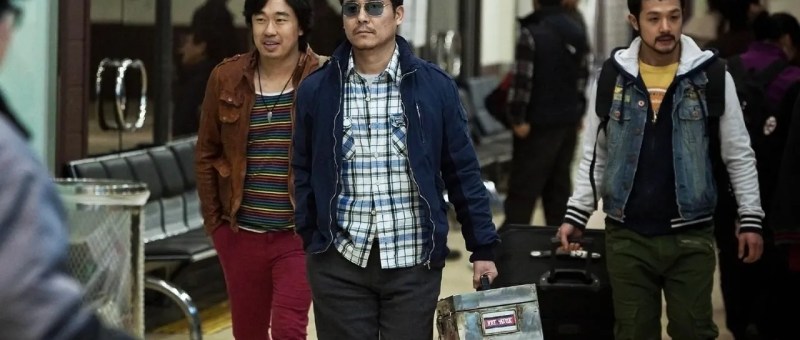
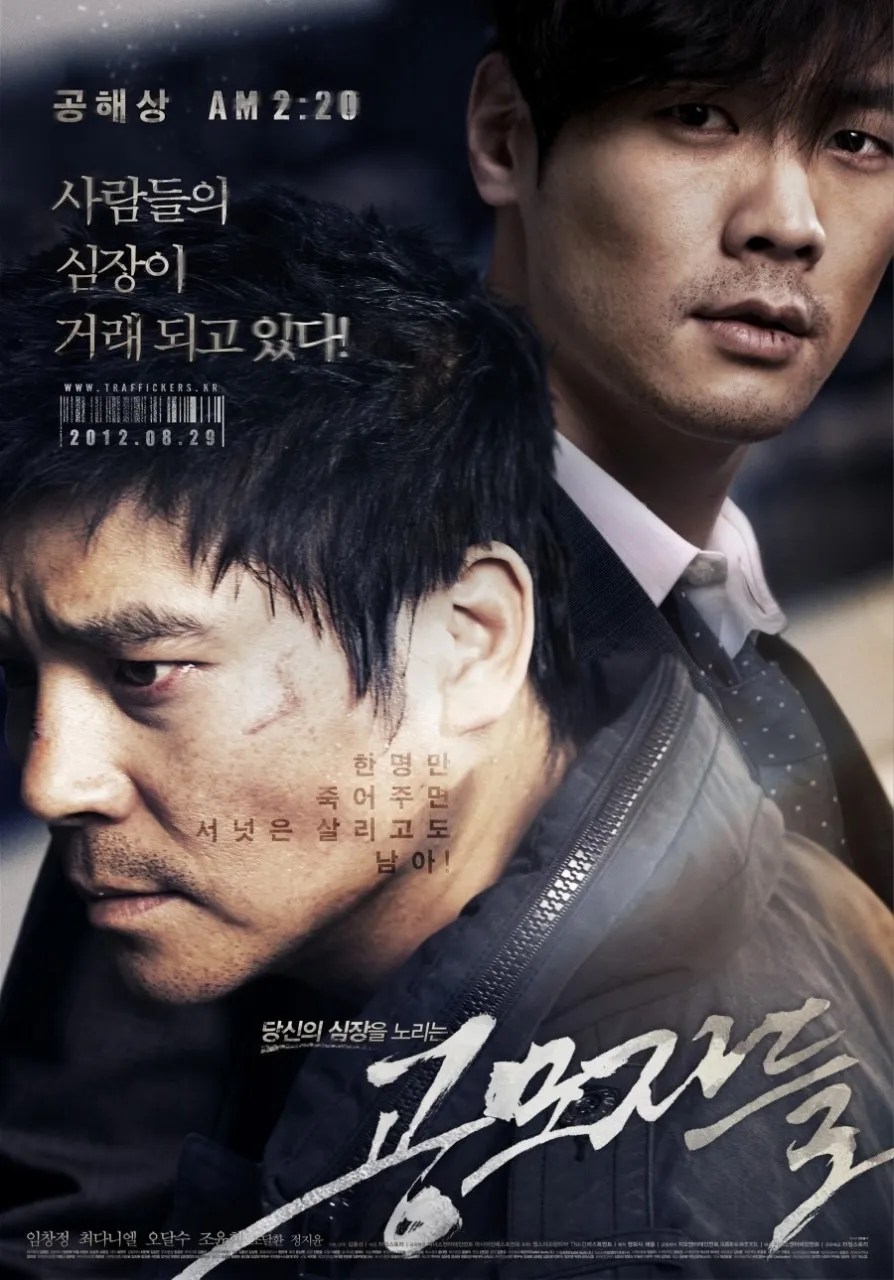
Traffickers (공모자들, Kim Hong-sun, 2012)

The one with money and power wins. The ones without it lose everything they’ve got. In many ways, it’s the overriding message of contemporary Korean cinema, but the words take on an even darker hue when uttered by the villain of Kim Hong-sun’s illegal organ transplant drama, Traffickers (공모자들, Gongmojadeul). The film’s Korean title, Conspirators, hints at the ways that this world reduces everyone to one degree or another to something less than human as they chase often small dreams of health, comfort, and happiness, in which the central conspiracy comes to stand in for a world ruled by power and money.

Young-gyu (Im Chang-jung) used to be an organ trafficker, but gave up that side of his business when his best friend was killed by a victim who woke up unexpectedly and tried to escape. Since then, he’s smuggled moderately less inhuman things and has developed a crush on a young woman who works on the ticket counter at the port. Yu-ri (Jo Yoon-hee) has a sick father who needs a transplant, but the one was lined up for is cancelled at the last minute apparently because she neglected to inform them of an issue which gave them an excuse to pull out in what seems to be a suggestion that the list is being manipulated. Fearing her only option is the black market, Yu-ri is in desperate need of money and turn to one of Young-gyu’s acquaintances, the leader of a Chinese gang. To get her the money Young-gyu decides to pull one last job, but soon finds himself in over his head as his new target turns out to have a connection to his past.

The film never really goes into Yu-ri’s decision get her father a black market transplant but rather focuses on her desperation as someone who has been frozen out of the legitimate system which itself already prioritises those with means to fight for better or more efficient treatment. It’s not clear if she is aware that the organ may come from someone who has been killed deliberately for that purpose, or if she knew but decided her father’s life was more important than theirs. Nor is it clear if she’s thought through the repercussions of indebting herself to gangsters for some of whom organ harvesting is just another means of debt collection. In any case, all she really cares about is saving her father and it seems she is willing to do whatever that takes. 

To that extent, what they prey on is desperation. The gangsters don’t expect their victims to ask too many questions, because this is all illegal anyway and they’re already at their last resort to save a loved one’s life. That said, it seems strange that they would choose Chae-hee (Jung Ji-yoon), a young woman who uses a wheelchair and thinks she’s just going to China on holiday, who is travelling with her husband, to be their next victim given that there is obviously someone who is going to be looking for her. They generally assume most of their other victims won’t be missed and write them off as those of little consequence swallowed by a dog-eat-dog world. It seems that part of the gangster’s motivation is that they don’t want to become victims themselves so have chosen the path of violence and inhumanity. 

But despite his occupation, Young-gyu is conflicted about the bloodiness of his work and on realising that he has a connection to Chae-hee begins to want to save her while equally wanting to save Yu-ri and her father. The traffickers have, however, sold them all false promise in that it’s mainly the people who were trying to buy transplants that end up becoming victims and it’s not actually clear who is getting any of these organs until a final suggestion that they’re actually going to rich people in Korea who wanted to jump the transplant queue, meaning people like Yu-ri and and her father lose out twice over. Organ trafficking works hand in hand with life insurance scams looking to make money off human misery while rich elderly men buy the blood and organs of young ones in a kind of human sacrifice they think will return their youth and and vitality in an one the nose metaphor for how the older generation oppresses the young. In this bleak and nihilistic world, the film suggests that its villain was right. The ones with money and power win, while those without are quite literally consumed and exploited by a corrupt and inhuman system. 


Trailer (English subtitles

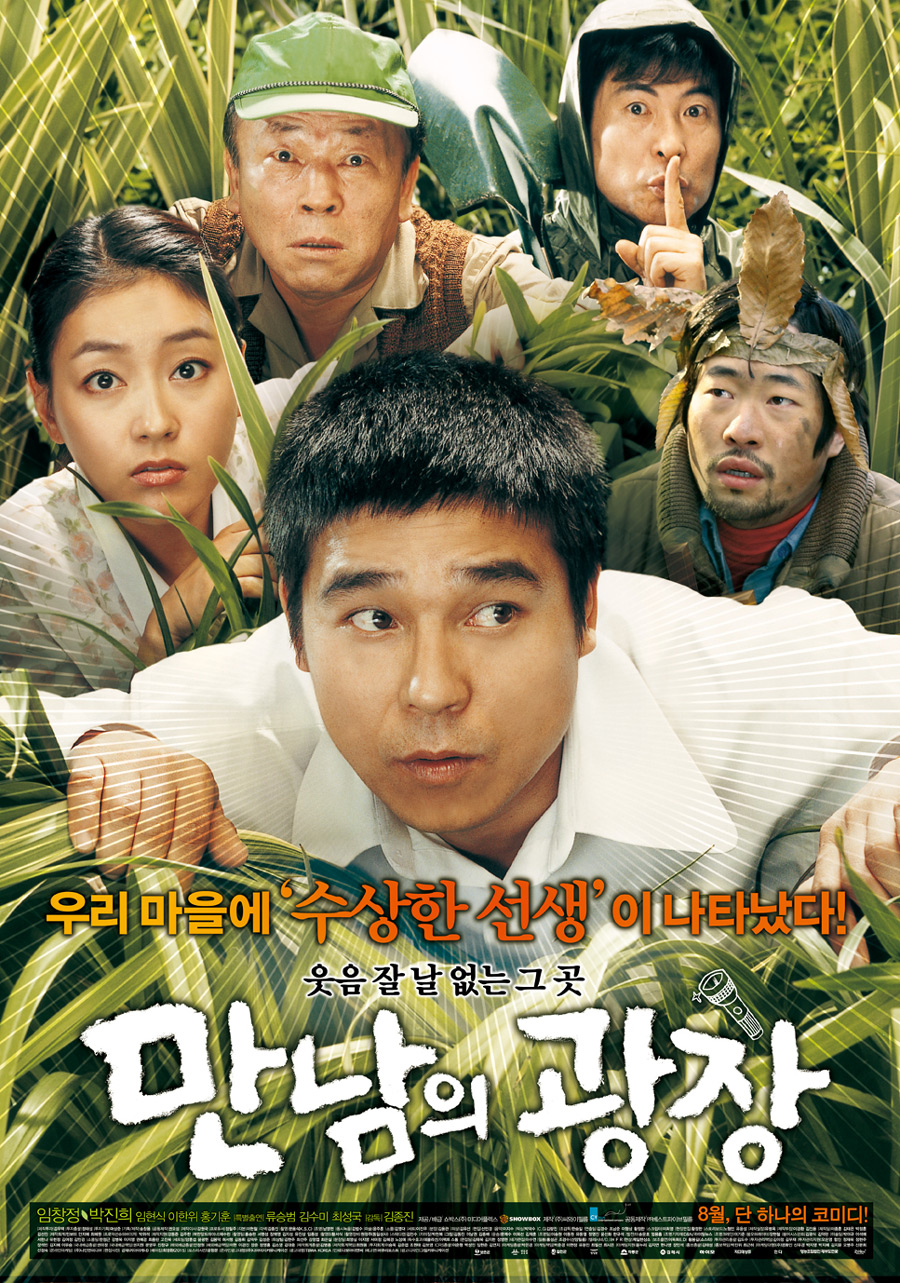
Underground Rendezvous (만남의 광장, Kim Jong-jin, 2007)

Underground Rendezvous posterAt the very beginning of Kim Jong-jin’s Underground Rendezvous (만남의 광장, Mannamui Gwangjang), a group of kindly villagers in the north of Korea are caught by surprise when they unwittingly help to build the 38th parallel – a series of fortifications which will divide them from one another forevermore. Family members are trapped on different sides of an artificial border by a matter of accident rather than choice, a decision effectively made for them by the Americans and Russians amping up cold war hostility in engineering a proxy war over war-torn Korea.

30 years after the villagers sealed their own fates through being overly helpful, the South Korea of the 1980s is perhaps not so different from its Northern counterpart. A brief hope for democracy had once again been dashed and the land remained under the yoke of a cruel and oppressive dictatorship. Young-tan (Im Chang-jung), a boy from a poor village, is determined to escape his life of poverty by travelling to Seoul and studying to become a teacher. However, within five minutes of exiting the station, his country bumpkin ways see his only suitcase swiped by a street thief. An attempt to report the crime only gets him into trouble and so Young-tan is sent to a “re-education” camp in the mountains. Falling off the back of a truck, he gets lost and eventually ends up in a remote village where they assume, ironically enough, that he is the new teacher they’ve been expecting for the local school. The village, however, has a secret – one that’s set to be exposed thanks to Young-tan’s questions about a beautiful lady he saw bathing at the local watering hole.

Young-tan turns out to be a pretty good teacher, though not exactly the sharpest knife in the drawer. The village’s big secret is that the divided families were so attached to each other that they each started digging tunnels to the other side shortly after the wall went up and eventually met somewhere in the middle where they’ve built a large cave they use for underground reunions. Apparently existing for 30 years, no one outside of trusted citizens on either side knows about the tunnel’s existence. No one has used it to switch sides, the only purpose of the tunnel is for relatives and friends to mingle freely in defiance of the false division that’s been inflicted on them by outside forces.

Young-tan, however, is fixated on the bathing woman who turns out to be North Korean Sun-mi (Park Jin-hee) – the sister-in-law of the village chief. Thinking only of his crush and also a comparative innocent and devotee of the moral conservatism of ‘80s Korea, Young-tan catches sight of Sun-mi and the village chief and is convinced that the old man is molesting an innocent young maiden. He sets out to convince the villagers of this, little knowing the truth and unwittingly threatening to expose the entire enterprise through failing to understand the implications of his situation.

Kim pulls his punches on both sides of the parallel, only hinting at the oppressions present on each side of the border with Sun-mi fairly free in the North, working as the army propaganda officer in charge of the noisy broadcasts which attempt to tempt South Koreans to embrace the egalitarian “freedoms” on offer to defectors. Meanwhile the villagers in the South live fairly isolated from the unrest felt in the rest of the country, continuing a traditional, rural way of life but are also under the supervision of a local troop of bored army conscripts on the look out for North Korean spies. Nobody wants to defect, though perhaps there’d be little point in any case, but everyone longs for the day when families can all live together happily as they used to free from political interference.

Satire, however, is not quite the main aim. An absurd subplot sees the “real” teacher marooned on his own after taking a detour and accidentally standing on a landmine leaving him rooted to the spot on pain of death, but the majority of the jokes rest on Young-tan’s “misunderstandings” as a village outsider, goodnatured simpleton, and bullheaded idiot. A final coda tries to inject some meaning by hinting at the effects of repurposing the truth for political gain and the tempered happiness of those who get what they wanted only not quite in the way they wanted it, but it’s too little too late to lend weight to the otherwise uninspired attempts at comedy.


Currently streaming on Netflix UK (and possibly other territories)

Original trailer (no subtitles)