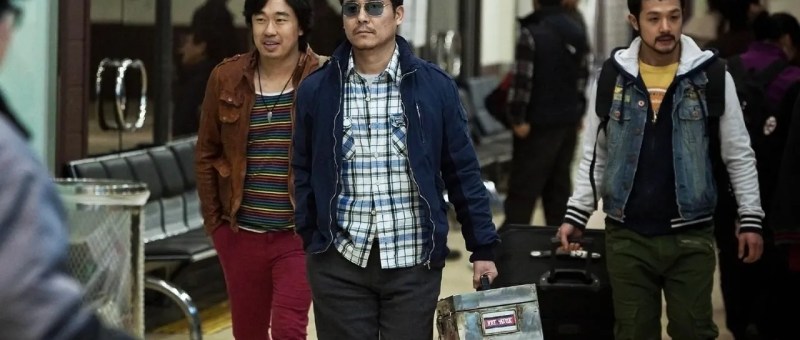
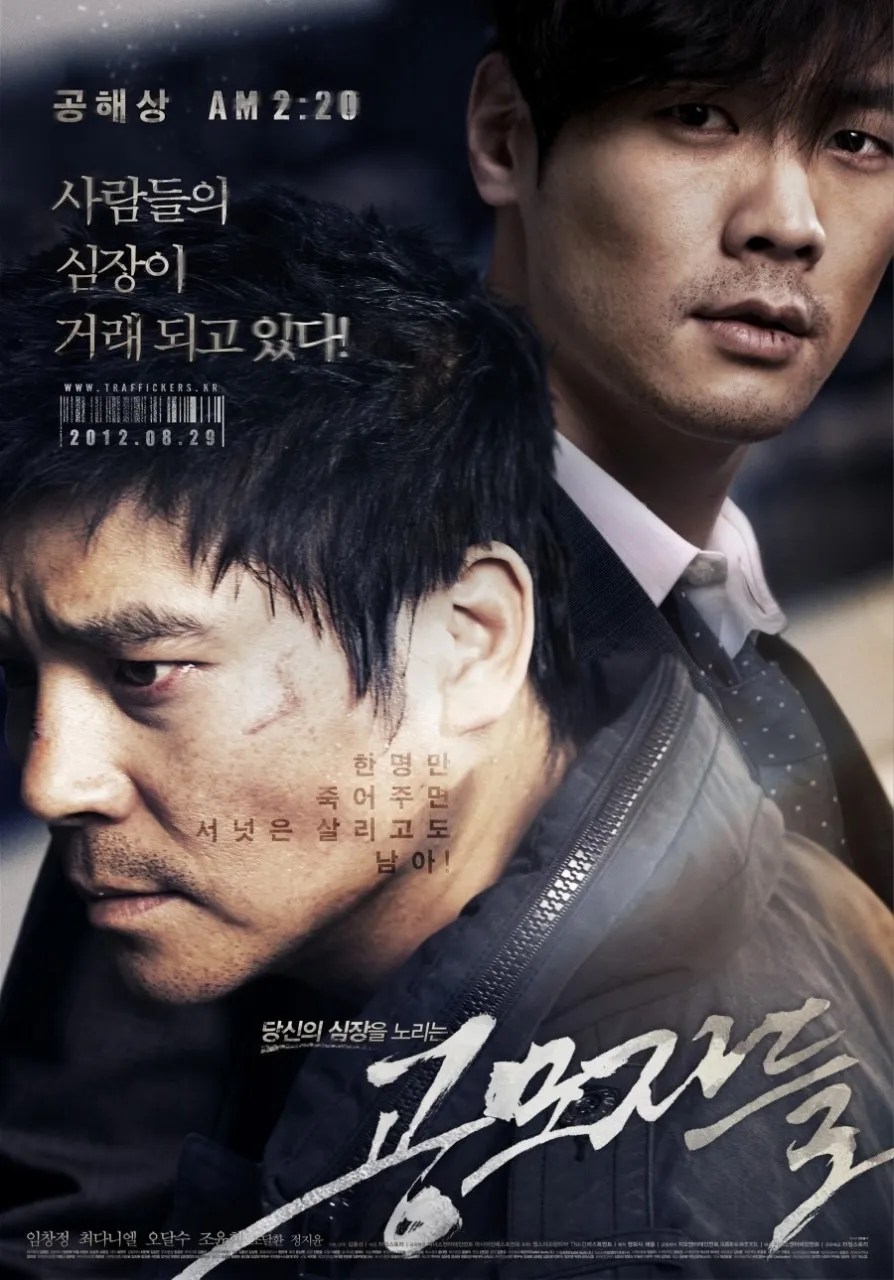
Traffickers (공모자들, Kim Hong-sun, 2012)

The one with money and power wins. The ones without it lose everything they’ve got. In many ways, it’s the overriding message of contemporary Korean cinema, but the words take on an even darker hue when uttered by the villain of Kim Hong-sun’s illegal organ transplant drama, Traffickers (공모자들, Gongmojadeul). The film’s Korean title, Conspirators, hints at the ways that this world reduces everyone to one degree or another to something less than human as they chase often small dreams of health, comfort, and happiness, in which the central conspiracy comes to stand in for a world ruled by power and money.

Young-gyu (Im Chang-jung) used to be an organ trafficker, but gave up that side of his business when his best friend was killed by a victim who woke up unexpectedly and tried to escape. Since then, he’s smuggled moderately less inhuman things and has developed a crush on a young woman who works on the ticket counter at the port. Yu-ri (Jo Yoon-hee) has a sick father who needs a transplant, but the one was lined up for is cancelled at the last minute apparently because she neglected to inform them of an issue which gave them an excuse to pull out in what seems to be a suggestion that the list is being manipulated. Fearing her only option is the black market, Yu-ri is in desperate need of money and turn to one of Young-gyu’s acquaintances, the leader of a Chinese gang. To get her the money Young-gyu decides to pull one last job, but soon finds himself in over his head as his new target turns out to have a connection to his past.

The film never really goes into Yu-ri’s decision get her father a black market transplant but rather focuses on her desperation as someone who has been frozen out of the legitimate system which itself already prioritises those with means to fight for better or more efficient treatment. It’s not clear if she is aware that the organ may come from someone who has been killed deliberately for that purpose, or if she knew but decided her father’s life was more important than theirs. Nor is it clear if she’s thought through the repercussions of indebting herself to gangsters for some of whom organ harvesting is just another means of debt collection. In any case, all she really cares about is saving her father and it seems she is willing to do whatever that takes. 

To that extent, what they prey on is desperation. The gangsters don’t expect their victims to ask too many questions, because this is all illegal anyway and they’re already at their last resort to save a loved one’s life. That said, it seems strange that they would choose Chae-hee (Jung Ji-yoon), a young woman who uses a wheelchair and thinks she’s just going to China on holiday, who is travelling with her husband, to be their next victim given that there is obviously someone who is going to be looking for her. They generally assume most of their other victims won’t be missed and write them off as those of little consequence swallowed by a dog-eat-dog world. It seems that part of the gangster’s motivation is that they don’t want to become victims themselves so have chosen the path of violence and inhumanity. 

But despite his occupation, Young-gyu is conflicted about the bloodiness of his work and on realising that he has a connection to Chae-hee begins to want to save her while equally wanting to save Yu-ri and her father. The traffickers have, however, sold them all false promise in that it’s mainly the people who were trying to buy transplants that end up becoming victims and it’s not actually clear who is getting any of these organs until a final suggestion that they’re actually going to rich people in Korea who wanted to jump the transplant queue, meaning people like Yu-ri and and her father lose out twice over. Organ trafficking works hand in hand with life insurance scams looking to make money off human misery while rich elderly men buy the blood and organs of young ones in a kind of human sacrifice they think will return their youth and and vitality in an one the nose metaphor for how the older generation oppresses the young. In this bleak and nihilistic world, the film suggests that its villain was right. The ones with money and power win, while those without are quite literally consumed and exploited by a corrupt and inhuman system. 


Trailer (English subtitles
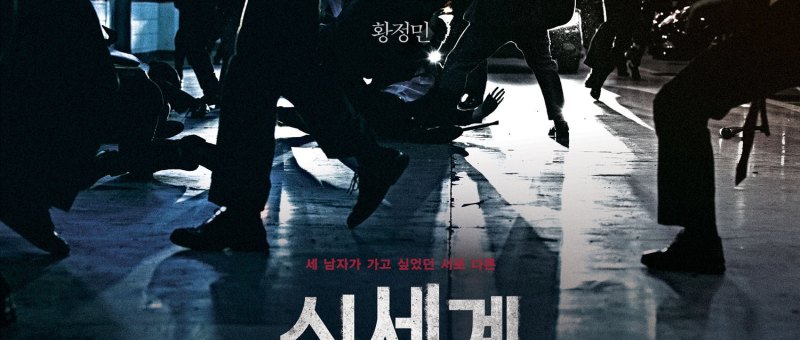
New World (신세계, Park Hoon-jung, 2013)

new world posterUndercover cop dramas have a long history of dealing more delicately with the nature of identity than in just a simple good guy/bad guy dichotomy, but New World’s (신세계, Sinsegye) moody noir setting ensures that the lines are always blurred and there may not in fact be any sides to choose from. Directed by Park Hoon-jung, scriptwriter of I Saw the Devil and The Unjust, New World makes plain that there may not be so much difference between a police officer and a gangster when each acts covertly, breaking their own rules and throwing any idea of honour out of the window in favour of self preservation or aggrandisement. In this worldview the victory of selfishness is assured, the law protects no one – not even its own, and the gangster, well, he only protects himself.

When the “CEO” (Lee Kyoung-young) of the Goldmoon “corporation” is killed in a “freak” car accident, his sudden absence creates a power vacuum in which his prime underlings, supported by their respective factions, vie for the top spot. Unbeknownst to them, police chief Kang (Choi Min-sik) has taken an interest in this suddenly instability in the largest crime syndicate in Korea and intends to launch Operation New World to interfere with the succession and ultimately install his longterm undercover agent in the director’s seat.

Lee Ja-sung (Lee Jung-jae) has been undercover for ten years, during which time he’s become the right hand man to one of the contenders to take over in the flashy Jung Chung (Hwang Jung-min). The opposing number, Lee Joong-gu (Park Sung-woong), is unscrupulous and suspicious – he has it in for Ja-sung and sees the succession as his natural right. Ja-sung, for his part, had assumed the death of the Goldmoon CEO would signal the end of his mission, allowing him to go back to his regular cop life. Soon to be a father, he’s tired of his duplicitous lifestyle and burned out on secret keeping but perhaps so long spent among the gangsters means his more natural home is exactly where he is.

This is certainly a duplicitous world. Grizzled police chief Kang may be on a mission to take down an all powerful crime group, but his methods are anything but orthodox. As usual in deep cover stories, only Kang and one other officer know of Ja-sung’s police background (at least, that’s what he wants Ja-sung to think), but Ja-sung may not be the only undercover operative Kang has on his books. Ja-sung is also sick of Kang’s obsessive surveillance which records the entirety of life in painstaking detail listing everywhere he goes and everything he eats, apparently even down to the sex of his unborn child. No one can be trusted, not even those closest to him, as Kang’s all powerful spy network has eyes and ears in every conceivable place.

Ja-sung’s identity crisis is never the focus of the narrative and a brief coda set three years previously may suggest that he’s already made his choice when comes to picking a side, but then the lines are increasingly blurred between good and bad even when the gangsters are seen committing heinous acts of torture and violence, making their enemies drink cement before dumping them in the nearby harbour. Ja-sung’s friendship with Jung Chung may be the most genuine he’s ever had in contrast to his relationship with Kang in which he remains a tool to be used at will and possibly disposed of at a later date.

Park holds the violence off as long as possible, preferring to focus on the internal psycho-drama rather than the bloody cruelty of the gangster world, but eventually violence is all there is and Park lets go with one expertly choreographed car park corridor fight followed by frenetic lift-set finale. The “New World” that the film posits is a dark and frightening one in which it’s dog eat dog and every man for himself with no room for morality or compassion. When the law fails to uphold its own values, others will prevail, for good or ill.


Screened at London Korean Film Festival 2017. Also screening in Sheffield (13th November), Glasgow (18th November) and Belfast (18th November). New World will also be released on DVD/blu-ray from Eureka Entertainment on their new Montage Pictures sub-label.

International trailer (English subtitles)

Helpless (화차, Byun Young-joo, 2012)

121003-006_1211020310103Review of Byun Young-joo’s Helpless (화차, Hwacha) first published by UK Anime Network


Can you ever really know another person? Everything you think you know about the people closest to you is founded on your own desire to believe what they’ve told you is the fundamental truth about themselves, yet you’ll never receive direct proof one way or the other. Byun Young-joo’s Helpless is based on Miyuki Miyabe’s popular novel Kasha (available in an English translation by Alfred Birnbaum under the title All She Was Worth) which literally means “fiery chariot” and is the name given to a subset of yokai who feed on the corpses of those who have died after accumulating evil deeds, which may tell you something about the direction this story is headed. After his fiancée suddenly disappears, one man discovers the woman he loved was not who she claimed to be, but perhaps also discovers that she was exactly who he thought she was all along.

Mun-ho (Lee Sun-kyun) and Seon-young (Kim Min-hee) are newly engaged and on their way to deliver a wedding invite to his parents in person. They seem bubbly and excited, still cheerful in the middle of a long car journey. It’s doubly surprising therefore when Mun-ho returns to the car after stopping at a service station to find that Seon-young has disappeared. Seon-young is not answering her phone and has left her umbrella behind despite the pouring rain which only leaves Mun-ho feeling increasingly concerned. His only clue is her distinctive hair clip lying on the floor of the petrol station toilet. Reporting his fiancée’s disappearance to the police, Mun-ho is more or less fobbed off as they come to the obvious conclusion that the couple must have argued and Seon-young has simply left him, as is her right. Confused, hurt, and worried Mun-ho turns to his old friend, Jong-geun (Cho Seong-ha), a recently disgraced ex-policeman, to help him understand what exactly has happened to the woman he thought he loved.

Mun-ho, helpless as the title, has no idea what might have transpired – has she been abducted? Was she in trouble, was someone after her? Did she simply get cold feet as the policemen suggested? A trip to Seon-young’s apartment reveals the place has been pretty thoroughly turned over leaving little trace behind, the entire apartment has even been swept for fingerprints in chillingly methodical fashion. Another clue comes from a close friend who’d been looking into the couple’s finances and found some improprieties in Seon-young’s past which he’s surprised she wouldn’t have mentioned. Perhaps she was embarrassed or ashamed of her credit history, but running out onto the motorway in the pouring rain without even stopping to pick up an umbrella seems like a massive overreaction for such an ordinary transgression.

What transpires is a tale of identity theft, vicious loan sharks, parental neglect, and the increasingly lonely, disconnected society which opens doors for the predatory. Usurious loans become an ironic recurring theme as they ruin lives left, right and centre. Following the financial crash, a father takes out a loan from gangsters to support his business but promptly goes missing. His wife is so distraught that she becomes too depressed to care for their daughter who ends up in a catholic orphanage. Gangsters have their own rules, the debt passes to the girl, young as she is, who is then forced to pay in non-monetary services until she finally escapes only to discover the torment is not yet over. Meanwhile, another woman takes out a series of loans to cover credit card debt and is forced to declare bankruptcy, left only with a lingering sense of shame towards her ailing mother who then dies in a freak accident leaving her a windfall inheritance which she uses to buy a fancy headstone for the woman she was never able to look after whilst still alive.

The original identity theft is only made possible by this fracturing of traditional communities in favour of impersonal city life. Nobody really knows anybody anymore – Seon-young had claimed to have no family and no close friends so there was no one to vouch for her. Many other young women are in similar positions, orphaned and unmarried, living in urban isolation with only work colleagues to wonder where they’ve got to should they not arrive at the office one day. Loneliness and boredom leave the door wide open for opportunists seeking to exploit such weaknesses for their own various gains.

Byun hints that something is wrong right away by switching to anxious, canted and strange angles filled with oddly cramped compositions. The eerie score enhances the feeling of impending doom as Mun-ho continues to dig into Seong-young’s past, finding confusion and reversals each way he looks. Seong-young was not who she claimed to be, and her tragic past traumas can in no way excuse her later conduct, but even if Mun-ho’s faith in her was not justified, there is a kind of pureness in his unwavering love which adds to the ongoing tragedy. Mun-ho fell in love with the woman Seong-young would have been if life had not been so cruel, and perhaps that part of her loved him too, but life is cruel and now it’s too late. An intriguingly plotted, relentlessly tense thriller Helpless will make you question everything you ever thought you knew about your nearest and dearest, but it is worth remembering that there are some questions it is better not to ask.


Reviewed at the 2016 London Korean Film Festival.

International trailer (English subtitles)