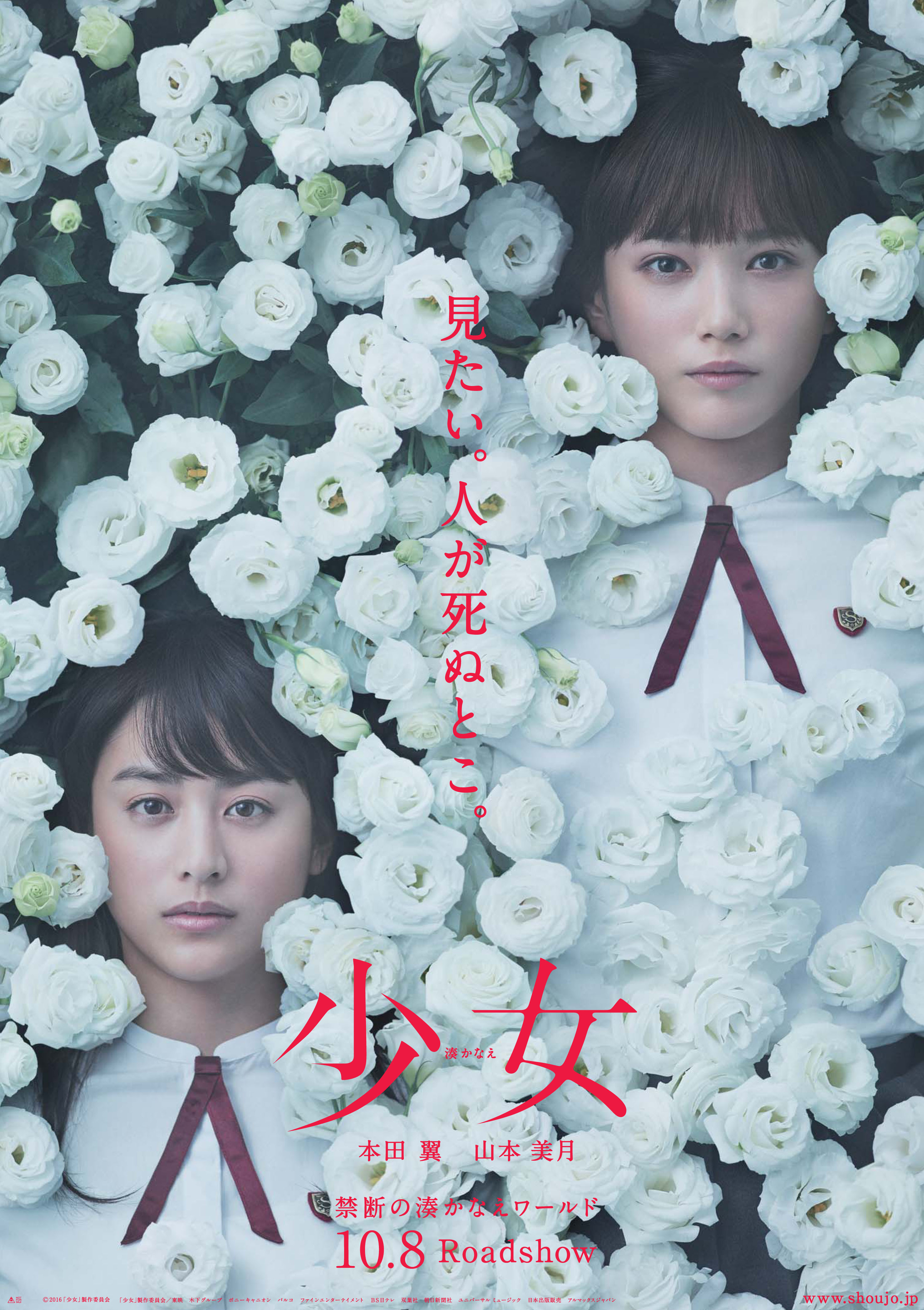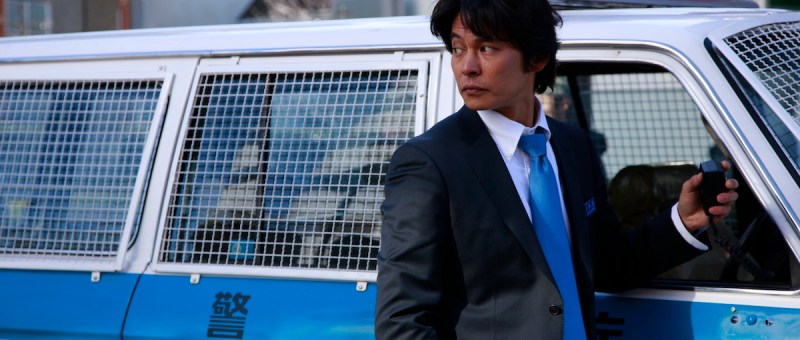
Bayside Shakedown 3: Set the Guys Loose (踊る大捜査線 THE MOVIE 3 ヤツらを解放せよ!, Katsuyuki Motohiro, 2010)

It’s all change at Wangan police station in the third instalment in the Bayside Shakedown series, Let the Guys Loose (踊る大捜査線 THE MOVIE 3 ヤツらを解放せよ!Doru Daisousasen the Movie 3: Yatsura wo Kaihou seyo!). Seven years on from the previous film, many things have changed. Aoshima (Yuji Oda) is now in charge of his team and the precinct is set to move to new purpose-built premises boasting the latest high-tech security systems which will aid them in combating potential terrorism and safeguarding local dignitaries. Even so, the gang will have to deal with some unfinished business from the past before they can fully move on as the circular tale takes us right back to the original film’s villain. 

Following the familiar formula, Motohiro opens with a gag sequence in which Aoshima prepares to give a briefing only it’s not about a case it’s about the logistics of moving offices of which he is in charge and characteristically vowing to do the best job possible. Hindering his progress, however, are two bizarre crimes, the first a bank robbery investigated by his colleague/long-term love interest Sumire (Eri Fukatsu) in which no money is stolen, and a bus hijacking he investigates himself in which the hijackers simply left the scene again without stealing anything. Ironically enough a theft does take place during the move involving three pistols which happen to belong to Aoshima, Sumire, and a new recruit from China, Wang (Kenichi Takito). Soon enough a body turns up on a boat along with Aoshima’s gun sending the gang on the chase for the mysterious thieves. 

The thing we’re constantly told about the new building is how secure it’s going to be, which makes the theft even more ironic, but the truth is that in true franchise style pretty much anyone and everyone is walking in and out carrying moving boxes so nothing is ever really “secure” even in the police station, harking back to the minor villain in the first film who was able to sneak in because he was wearing a fake cosplay police uniform and no one noticed him. Inevitably, this invisible vulnerability eventually comes back to haunt them when the criminals are simply able to steal the manual for the security system and replace it with one of their own to render it unusable to the police later trapped inside the building. Meanwhile approaches to public safety become a matter for debate when it arises that the criminals’ demand is that all of the villains we’ve seen Aoshima arrest so far including psychopathic serial killer Manami (Kyoko Koizumi) who still has a sizeable following online should be released. Counter-intuitively, the police bigwigs are in favour of acquiescing with only Muroi (Toshiro Yanagiba), who has now been promoted to sit at the table himself, objecting on the grounds that it simply isn’t safe to release such dangerous criminals back into society. 

Rather than simply bureaucracy and funding concerns, Bayside Shakedown’s third instalment is more directly critical of the interplay between politics and justice as it becomes clear that the majority of police chiefs care more about public opinion than the law while also mindful of the upcoming general election. Meanwhile the same problem arises with the local police being sidelined by the elites from HQ, a smooth liaison officer Torikai (Shun Oguri) arriving to solve any disputes insisting that the locals be fully respected and allowed to turn their jobs only to turn dark and authoritarian after suffering a catastrophic injury on the job. Once again, Aoshima is forced to consider if his work has real value not only because of the way he’s treated by the cops from HQ but subjected to a healthcare crisis which leads him and many others to assume he’s not long to live. It’s later discovered that he’s been misdiagnosed during his annual checkup, but his boss unethically decides to keep that from him noticing he’s become depressed and lost his mojo, hoping that he’ll be easier to manager but quite the reverse turns out to be true. Again mimicking their previous heart-to-hearts throughout the series, Aoshima perks up after some encouraging words from Sumire in addition to some words of wisdom from the late Waku presented by his rookie nephew and decides to live as if there’s no tomorrow going flat out for justice while caring nothing for his safety. 

Even more than ten years on from the TV series and first big-screen outing, the romance between Aoshima and Sumire still hasn’t quite blossomed despite their respective brushes with death. Many things seem set to change for the Wangan police, the new building acting as a kind of reset while Muroi prepares to move into a more political role and a new, somewhat surprising, local police chief is selected to lead them into a new future just as dedicated to compassionate local policing defined by fairness and justice as they have ever been. 

Trailer (no subtitles)
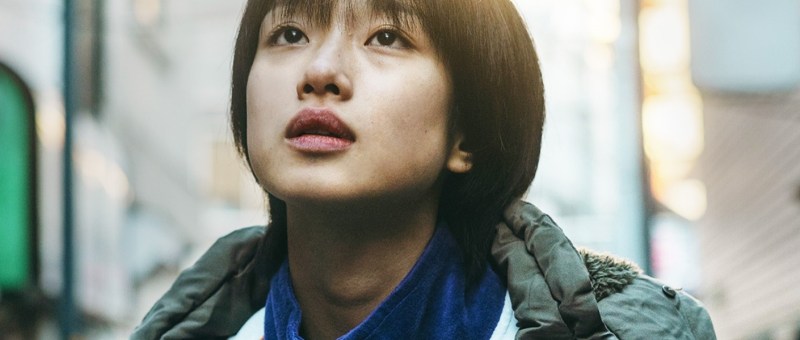
A Girl Named Ann (あんのこと, Yu Irie, 2024)

In the wake of tragedy, it’s easy to think that if only you had made a different choice then everything would be alright, but in reality it’s never as easy as that and blaming oneself is merely an act of vanity. There’s a peculiar kind of tradeoff that occurs to journalist Kirino (Goro Inagaki), that if he hadn’t written an article exposing a policeman who founded a support group for former drug users trying to integrate into mainstream society as a sex pest, then he might have gone on to help more people. Of course, he would have gone on abusing some of them too and his behaviour would probably have escalated into something much worse. The journalist begins to ask himself if it’s worth it for the net good, without necessarily examining the ramifications of the policeman’s actions.

Yu Irie’s bleak social drama A Girl Named Ann (あんのこと, An no Koto) draws inspiration from a real life case in which a young woman began to turn her life around only to reach a crisis point during the pandemic. The film’s title almost makes an everywoman of its heroine who is resolutely failed by the society in which she lives and in the end discovers only a sense of futility in realising that she will never fully be able to escape the clutches of her abusive mother (Aoba Kawai) who forced her into sex work at age 12. Ann never even finished primary school even though middle school is compulsory and is functionally illiterate. Her reading level is that of a small child which of course makes it near impossible for her to be employed in any kind of salaried job while when she does secure employment her mother steals all her money. 

Being arrested by Tatara (Jiro Sato), a policeman who at first seems well-meaning even if positing “yoga” as a means of turning Ann’s life around, finally gives Ann the encouragement to come off drugs and try to integrate into mainstream society. To his credit, Tatara does everything he can for her from providing a paternal presence to finally helping her escape her mother by getting her a place in an apartment complex set up for women who are being stalked or have experienced domestic violence. Living alone gives Ann a sense of confidence and positivity that allows her to imagine a better future for herself while confronting her past. But on the other hand, it remains true that Tatara may have been better to help her move to another city where her mother would be less likely to find her and derail her life at every conceivable opportunity rather than keeping her close at his own support group which is perhaps an act of vanity if not something worse. No one helps for free and Ann encounters only differing kinds of exploitation from the employers who take her on at poverty wages because they know how desperate she is and don’t think she deserves any better, to the conflicted journalist Kirino who is only really invested in his investigation of Tatara. Ann seems to resent him for exposing Tatara and taking him away from her, but neither of the men make much of an attempt to continue supporting her once the story breaks. 

Ann’s plight exposes how the weakest in society were disproportionately affected by the coronavirus pandemic. The care home she was working at, poignantly because she wanted to learn how to take care of her grandmother (Yuriko Hirooka) who had shielded her from her mother’s abuse, is forced to restrict the number of employees on site meaning Ann is let go while the classes she’d been taking to improve her literacy are also cancelled. Though the apartment requires no rent, she no longer has a means of feeding herself not to mention being stuck inside all the time with nothing to do but study, and not even that when all her pens run out of ink. People are often judgemental and there is no further social support available to her. Even Tatara had been overly fixated on her drug use and while it’s true that she would otherwise be unable to rejoin society without recovering, he otherwise fails to consider other factors such as Ann’s toxic home life or trauma from the long years of abuse she suffered that all contribute to the problems she is facing. 

Even so, unlike her mother Ann is a warm and caring person who is well liked at the care home and clearly has a lot of love to give but the universe won’t seem to give her a break. Perhaps it would be easiest to simply blame her mother, but something must have made her like that too and there’s no one there for her either. She sometimes calls Ann “Mama”, as if the roles were reversed and she were the child being parented by Ann rather than the other way round. In any case, she comes to embody the selfishness of an indifferent society which could have saved a girl like Ann if really wanted to but in the end did not.


A Girl Named Ann screens as part of this year’s Japan Foundation Touring Film Programme.

Trailer (English subtitles)

Images: ©2024 “A Girl Named Ann” Film Partners

(Ab)normal Desire (正欲, Yoshiyuki Kishi, 2023)

There’s a pun embedded in the Japanese title of Yoshiyuki Kishi’s heartfelt drama (Ab)normal Desire in that first character in the word for “sexual desire” (seiyoku, 性欲) has been replaced by one that can be read the same but has the meaning of “correct”, or “proper”. But “normal” is also relative construct that implies conformance with the majority even if that may not actually be the case. As one of the protagonists later remarks “everyone is pervy” though they themselves feel such a degree of shame and otherness that it’s largely prevented them from living any kind of life at all.

In that sense it may be hard to understand why a fetish for water would invite such severe self-loathing in that it causes no harm to others if admittedly resulting in ridicule if exposed. Then again, society can be a fierce watchdog. Department store shop assistant Natsuki (Yui Aragaki) is taken to task by her pregnant colleague who refuses to take her seriously when she says she’s not really interested in getting a boyfriend before giving her a lecture about her biological clock. Though Natsuki appears uninterested in her vacant prattling, the woman later becomes upset and harshly tells her that she was only trying to be “nice” because she felt “sorry” for her and that making people be nice to you in this way is actually a form of harassment which, whichever way you look at it, is some particularly twisted logic.

Her alienation seems to stem from the fact that she feels “abnormal” and that her fetish for water is a part of herself she must be careful to hide. Her parents watch a news report on Tokyo Rainbow Pride and marvel at the idea that there are now choices other than marriage and children but even among the young there remains confusion and shame amid an inability to reconcile the seemingly opposing concepts of “normality” and “diversity” as they struggle to define themselves. A plan to have a male dancer who usually dances in a masculine style dance in a more feminine way backfires when he points out that asking someone to dance in a way they don’t want to doesn’t really do much to advance “diversity”.

But diversity isn’t considered an ideal by all and parents of young children find themselves confused and conflicted when their kids begin to reject conventionality at an early age by asking to withdraw themselves from school and instead focus on other kinds of education that align with their interests. Challenged by his wife about why he never listens to their son’s concerns, prosecutor Hiroki (Goro Inagaki) replies that he should “just be normal” and later describes people who are “unable to live normal lives” as bugs in the system which must eradicated. A symbol of lingering authoritarianism, Hiroki is an intensely conservative man obsessed with properness who thinks it’s his job to decide which crimes everyone is guilty of rather than make any attempt to understand the world around him outside of binary terms like right and wrong or normal and abnormal. When his assistant passes him information on fetishes as a potential explanation for the case of a man who repeatedly steals taps, he simply rolls his eyes and dismisses it.

Yet he perhaps has his own fears and internalised shame as evidenced by his outrage on discovering that another man has been coming to the house to help his wife with tech setup for their son’s new outlet in livestreaming and not only that, he was able to blow up the balloons that Hiroki himself failed to inflate. It’s his rigid authoritarianism that eventually alienates his wife and son who come to see him only as an oppressive bully unable to accept anything that differs from his own definition of “normal”. Finally, he’s the one who is isolated, imprisoned by his own repression and lack of understanding or unwillingness to accept those around him.

Even so, despite its positive messages that no one should feel themselves alone or that society has no place for them the film muddies the waters by introducing fetishes that are necessarily problematic in that they cause harm to others who do not or cannot consent and could not and should not be accepted by mainstream society though oddly those that have them seem to feel less shame only fearing being caught because acting on their desires is against both moral and judicial laws. In any case, in discovering togetherness, that they are not alone, those who feel their desires to be “abnormal” can begin to ease their loneliness and find a place for themselves in an often judgemental world.


(Ab)normal Desire screened as part of this year’s Toronto Japanese Film Festival.

Original trailer (English subtitles)

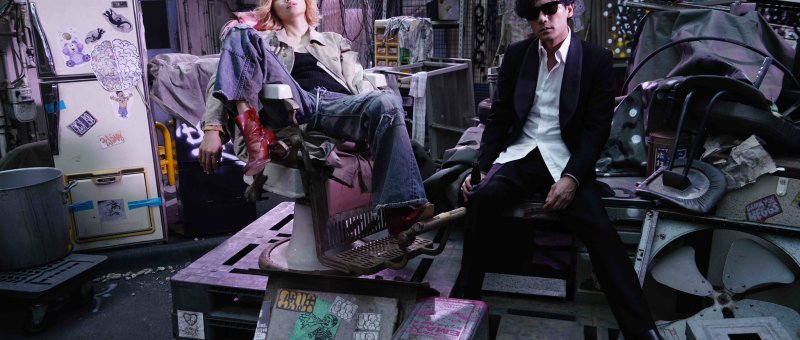
Tezuka’s Barbara (ばるぼら, Macoto Tezka, 2019)

The relationship between an artist and his muse (necessarily “his” in all but a few cases) is at the root of all drama, asking us if creation is necessarily a parasitical act of often unwilling transmutation. Osamu Tezuka’s Barbara (ばるぼら), brought to the screen by his son Macoto Tezka, takes this idea to its natural conclusion while painting the act of creation as a madness in itself. The hero, a blocked writer, describes art as a goddess far out of his reach, but also the cause of man’s downfall, framing his creative impotence in terms of sexual conquest that lend his ongoing crisis an increasingly troubling quality. 

Yousuke Mikura (Goro Inagaki) was once apparently a well regarded novelist but has hit a creative block. While his friends and contemporaries are winning awards and national acclaim, he’s become one of “those” writers busying himself with potboilers and eroticism to mask a creative decline. Passing a young woman collapsed drunk in a subway, something makes him stop and turn back. Surprisingly, she begins quoting romantic French poetry to him, and actually turns out to be, if not quite a “fan”, familiar with his work which she describes as too inoffensive for her taste. Mikura takes her home and invites her to have a shower, but later throws her out when she dares to criticise an embarrassingly bad sex scene he’s in the middle of writing. Nevertheless, he’s hooked. “Barbara” (Fumi Nikaido) becomes a fixture in his life, popping up whenever he needs a creative boost or perhaps saving from himself. 

Strangely, Barbara is in the habit of referring to herself using a first person pronoun almost exclusively used by men, which might invite us to think that perhaps she is just a manifestation of Mikura’s will to art and symbol of his destructive creative drive. He does indeed seem to be a walking cliché of the hardbitten writer, permanently sporting sunshades, drinking vintage whiskey, and listening to jazz while obsessing over the integrity of his art. We’re told that he’s a best-selling author and previously well regarded by the critics, but also that he has perhaps sold out, engaging in a casual relationship with a politician’s daughter and cosying up to a regime he may or may not actually support. He’s beginning to come to the conclusion that he’s a soulless hack and the sense of shame is driving him out of his mind. 

Mikura’s agent Kanako (Shizuka Ishibashi) certainly seems to think he’s having some kind of breakdown, though the jury’s out on whether her attentions towards him are professional, sisterly, or something more. There isn’t much we can be sure of in Mikura’s ever shifting reality, but it does seem a strange touch that even a rockstar writer of the kind he seems to think he is could inspire such popularity, recognised by giggling women wherever he goes yet seemingly sexually frustrated to quite an alarming degree. His world view is an inherently misogynistic one in which all women seem to want him, but he can’t have them. A weird encounter in a dress shop is a case in point, the assistant catching his eye from the window display turning out to be a devotee of his work because of its “mindlessness”, something which annoys Mikura but only causes him to pause as she abruptly strips off for a quickie in the fitting room. Tellingly, the woman turns out to be an inanimate mannequin, literally an empty vessel onto which Mikura can project his fears and desires, which is, perhaps, what all other women, including Barbara, are to him. 

Yet who, or what, is Barbara? Chasing his new “muse”, Mikura finds himself on a dark path through grungy subculture clubs right through to black magic cults, eventually arrested on suspicion of drug use. There is something essentially uncomfortable in his dependency, that he is both consuming and consumed by his creative impulses. Inside another delusion, he imagines himself bitten by potential love interest Shigako (Minami), as if she meant to suck him dry like some kind of vampire succubus, but finds himself doing something much the same to Barbara, stripping her bare, consuming her essence, and regurgitating it as “art”. Either an unwitting critique of the various ways in which women become mere fodder for a man’s creativity, or a meditation on art as madness, Barbara seems to suggest that true artistry is achieved only through masochistic laceration and the sublimation of desire culminating in a strange act of climax that stains the page with ink.  


Tezuka’s Barbara screens in Amsterdam on March 6/7 as part of this year’s CinemAsia Film Festival.

International trailer (English subtitles)

Another World (半世界, Junji Sakamoto, 2018)

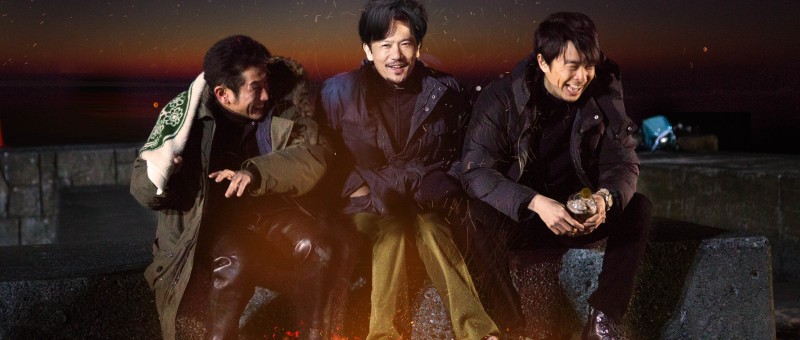
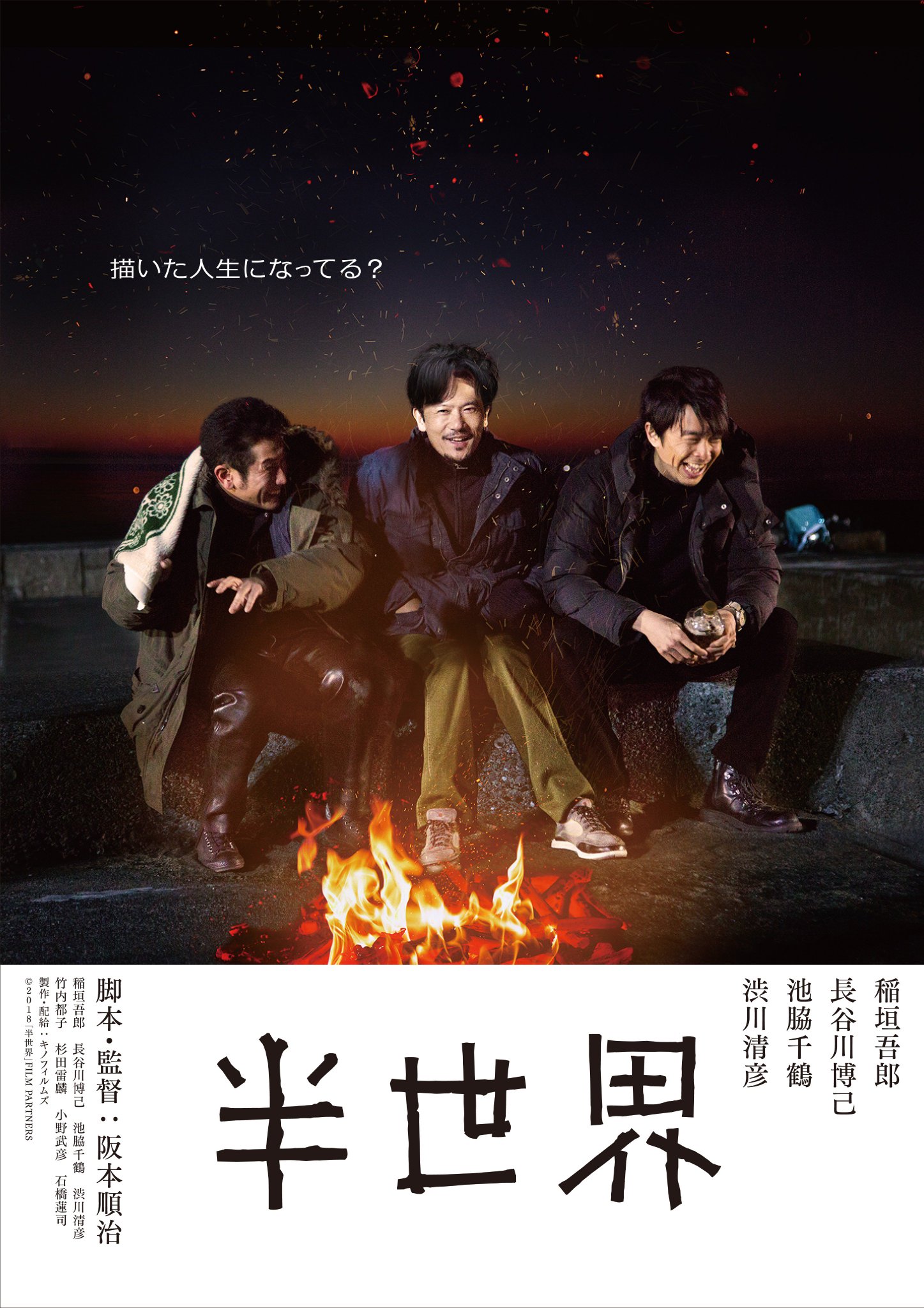
Another World poster 2Director Junji Sakamoto’s career has been more meandering than most. Shuttling between hyper masculine fighting dramas, issue movies, and broad comedies, Sakamoto has always displayed an intense interest in the depth of male friendship which where his latest feature, rural drama Another World (半世界, Hansekai), takes him. A deceptively gentle story of small-town homecoming eventually broadens into a meditation on fathers and sons, frustrated dreams, and middle-aged malaise as its three dejected heroes attempt to bridge the gulf of years between them in order to rekindle the simple, innocent friendship they forged as naive teenagers more than 20 years previously.

The drama begins when Koh (Goro Inagaki) spots childhood friend Eisuke (Hiroki Hasegawa) unexpectedly hanging around his old home, now sadly abandoned following the death of his mother. Eisuke, unlike his friends, left his hometown to join the self defence forces and see the world. He has not returned home in some years and his sudden appearance is a pleasant, if perhaps concerning, surprise. Koh calls the other leg of the triangle, Mitsuhiko (Kiyohiko Shibukawa), and the trio of teenage buddies reunite, but Eisuke still seems distant and remains holed up in his family home rarely venturing outside, reluctant to confide in his old friends about whatever it is that he’s going through.

Meanwhile, the small town guys have problems of their own. Koh made the stubborn decision to take over his father’s charcoal business mostly to spite him, but times have changed and not only is demand dwindling but his product is unfavourably compared to his dad’s. Despite a seemingly happy marriage to the supportive Hatsuno (Chizuru Ikewaki), his home environment is also tense with resentment high between father and son as Koh struggles to relate to sullen teen Akira (Rairu Sugita) who is, unbeknownst to him, being bullied by the local delinquents. Unique among the three, Mitsuhiko has never married and still lives at home where he helps out with the family’s struggling car dealership, but remains cheerful in himself and is the most invested in maintaining the relationship between his two best friends in place of forging new relationships of his own.

Eisuke brings a new dynamic back with him as he struggles to readapt to small town life. As Koh suggests, he likely came back because he didn’t know where else to go but to his old friends even if he doesn’t quite want to let them help him. Now divorced and struggling with PTSD from his time in service as well as guilt over the death of a colleague, Eisuke provides an unexpected source of support for the conflicted Akira as he teaches him how to fight in order to defend himself while imparting what he knows of Koh in order to smooth the path between father and son. Koh, he tells him, had a bad relationship with his own violent dad who forbad him from the charcoal business which is exactly why he rebelled and did it anyway. Still fighting the ghost of his father, Koh has not found a way to connect with his son other than to let him be.

In a sense, each of these now middle-aged men is living in their own individual worlds as they push back against the forces of desperation but as Koh tells Eisuke, this small town existence is the “real world” too. Eisuke longs for escape, eventually retreating to a life on the sea after exposing his barely suppressed rage through an ill-advised show of violence which was itself in service of friendship. He superficially rejects the attempts of his friends to bring him back into the intimacy of their younger days as if fearing he no longer belongs in this ordinary world of wholesome small-town pleasures, but continues to search for the time capsule they buried all those years ago as if longing to recover their buried innocence.

Yet there is hope for the younger generation at least. Akira, coming to understand his father, accepts that he has a choice and eventually decides to honour both his father’s legacy and his own desires as he ponders the lonely life of a charcoal maker while putting on the boxing gloves that will allow him to fight for a freer future. Tragedies strike, life doesn’t turn out liked you hoped, but it goes on all the same with or without you. A warm if melancholy tribute to the healing power of friendship and its capacity to endure despite the weight of ages, Another World puts middle-aged malaise in perspective as its three disappointed heroes begin to find accommodation with where their choices, informed by those who came before, have led them, finding both peace and resignation in their in their ordinary small-town existence.


Another World was screened as part of the 2019 Nippon Connection Film Festival.

Original trailer (no subtitles)

Oshin (おしん, Shin Togashi, 2013)

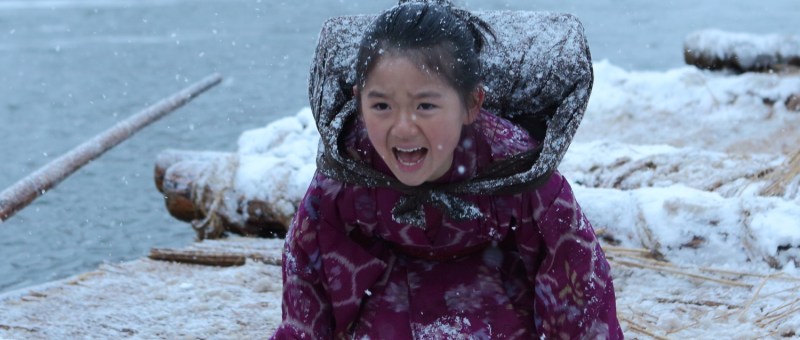
Oshin posterBack in the 1980s, an “asadora” named “Oshin” proved so popular with Japanese television viewers that its title became a byword for tenacity and perseverance, attached to any underdog who battled bravely against insurmountable odds. The “asadora”, as its name suggests, is a 15 minute drama serial broadcast in the mornings and therefore mainly targeted at housewives. As such it often focusses on the lives of women and particularly on women who work hard to triumph over adversity. Oshin is no different in this regard except that it also recounts the painful history of 20th century Japan through that of its stoical heroine who travels from a life of poverty in snowy Yamagata to becoming the owner of a supermarket chain in the bustling consumerist economy of 1983. In celebration of the 30th anniversary of the TV series, Oshin graduated to the big screen. Shin Togashi’s Oshin (おしん) movie focusses exclusively on Oshin’s childhood at the tail end of the Meiji era in which she suffered all the downsides of lingering feudalism and benefitted from few of the new freedoms of the age.

The winter of 1907, Yamagata – snow country. Oshin (Kokone Hamada) lives with her parents, grandmother, and siblings and looks forward to finally being allowed to go to school when spring arrives. Sadly, Oshin will not be going to school after all. Her father has arranged for her to work for another family who own a timber yard a few towns over for the period of one year. Only seven years old, Oshin pleads not to be sent away but her father will not back down. There is not enough food to feed the family and, unbeknownst to Oshin, her mother (Aya Ueto) is pregnant again.

Finally agreeing to go after her mother takes drastic action to try and reduce the burden on the family, Oshin arrives at the timber yard but is treated cruelly by the head housekeeper who refuses to recognise that Oshin is only a child and will of course lack basic knowledge as to how to run a household. Though Oshin bears the constant hardship for her family she eventually runs away when falsely accused of theft.

The world of 1907 is harsh and cruel. Women have few rights and almost no say in their lives or destinies. Oshin might count herself lucky that she’s merely been contracted as a household servant in an age where selling one’s daughter to a brothel to feed one’s sons was not an unusual event, but nevertheless her life at the timber yard is hard. Bright and curious, Oshin longs to learn to read and write but because of her lowly “peasant” birth, she is constrained into a life of drudgery where her labour will only ever be in service of her family and never herself.

A “peasant” background is, as a kinder mistress reminds Oshin, a burden in that she is always likely to be viewed with suspicion. This is doubly true when she runs away and is rescued by a fugitive deserter hiding in a mountain shack. Shunsaku (Shinnosuke Mitsushima), a sensitive young man marked by service in a war he no longer believes in, teaches Oshin how to read and write as well as giving her a grounding in humanitarian politics. He is, however, a problematic figure for going against the martial culture of the age and having “betrayed” his nation by deserting. Oshin is tainted by her association with such a radical young man, but boldly comes to Shunsaku’s defence when others seek to discredit his memory.

This boldness is a part of Oshin’s essential “goodness” in which she refuses to give in to injustice even whilst stoically bearing all of the troubles that come her way. Eventually she finds herself a servant in a much nicer house where the staff take pity on her and welcome her warmly into their extended family. Treated with such kindness, Oshin works even harder to repay it and impresses all with her earnestness and morally upright character. She does, however, clash with the spoilt daughter of the house, Kayo (Manami Igashira), who has her own share of troubles though hers are those of the privileged classes. Lonely and bored, Kayo resents the attention golden girl Oshin seems to get from the staff but the two eventually become friends when Kayo realises Oshin is the only person willing to treat her as an equal rather than the young mistress.

Though the overall arc of the TV series painted a more positive picture of female resilience and capability, the film’s focus on the late Meiji childhood era is unavoidably more conservative in its pointed message that a woman’s life is served in dedication to others with the unpleasant undertone that she must keep nothing back for herself and that she is not entitled to personal happiness but only that of repaying the sacrifices that have been made on her behalf by other women (and especially by mothers – biological and surrogate). Nevertheless, Oshin’s earnestness and deep love for her family are admirable qualities and when she trudges back out into the snow again, always waiting for the spring, she does so with hope and determination.


Oshin is screening in London on 18th August as part of the Japan Foundation London’s Summer Explorers season of free film screenings.

Original trailer (no subtitles)

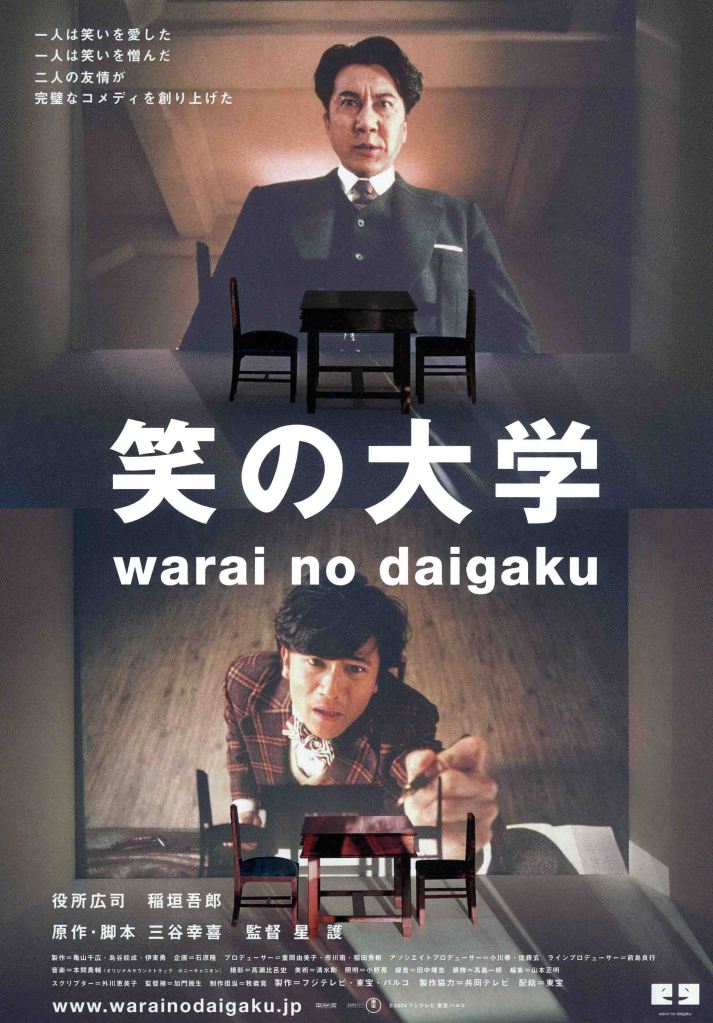
Night’s Tightrope (少女, Yukiko Mishima, 2016)

night's tightrope japanese posterKanae Minato is known for her hard-hitting crime stories from Confessions to Chorus of Angels, The Snow White Murder Case, and Penance but in adapting her second novel, Shojo (少女), Yukiko Mishima has moved away from the mystery for a no less penetrating look at the death of childhood in the story of two best friends each dealing with traumatic pasts and presents. Childhood is a place of tightly controlled powerlessness, but adulthood offers little more than corruption and selfishness with its predatory teachers, abusive parents, and dirty old men so obsessed with school uniforms they barely see the girl inside them. Adolescent anxiety provokes a fascination with the idea of death which perhaps reflects this transitionary stage, but at its centre is the fracturing of a friendship which has endured all else.
The film opens with a strange avant-garde play being performed in a church by a group of girls in austere school uniforms. The monologue offered by the collective reads like an instruction booklet for the birth of fascism with its calls for genetically engineered test tube babies and universal childcare in which each child is “equal” and receives “exactly the same” education and resources. The girls are students at a strict Christian fundamentalist school where they’re also expected to participate in strange rituals including dancing round the maypole (incongruous as that may seem).

Atsuko (Mizuki Yamamoto) – a former kendo champion with a limp, and Yuki (Tsubasa Honda) who has a large scar across her hand resulting from domestic abuse, have been lifelong friends but have recently begun to drift apart. Given the overriding survival of the fittest atmosphere in the school, it’s not surprising that the other girls have turned on Atsuko and proceeded to make her life a misery by telling her to die either in person, on line, or in one particularly grim episode by shoving a sanitary towel into her locker with the message written on it in blood. Yuki is trying to help her but doesn’t know how and has taken to writing everything down in a book instead.

The world of teenage girls can often be a vicious one but there’s a strange kind of mania in the way Atsuko’s schoolmates set about pushing her towards the edge. Formerly a top kendo player, Atsuko has vivid, panic attack inducing flashbacks to her life changing accident in which she recalls her teammates prentending to comfort her but secretly hurling accusations under their breaths while Yuki looks on in horror from the stands.

Yuki has been writing their story in the form of a novel she calls Night’s Tightrope but the completed manuscript goes missing. The girls’ teacher who has longstanding dreams of literary stardom steals it, sends it to a magazine, and even wins a prestigious literary prize for brand new novelists. Yuki’s revenge is swift but has terrible, unforeseen consequences which add to her obsession with death and dying, eventually culminating in the worrying desire to see someone die in order to fully understand the nature of the “phenomenon”.

While Yuki develops a friendship with a boy she met in a library while she was destroying copies of the teacher’s stolen story, Atsuko goes in a different direction by falling under the spell of troubled transfer student Shiori (Ryo Sato). Recently witnessing a dead body herself, Shiori is just as death obsessed as the other girls but her vision is darker. Shiori introduces Atsuko to her world of blackmail and exploitation, pulling her into a high school girl scam in which they accuse a nearby salaryman of groping them and then blackmail him. Shiori may think she’s taking revenge on venal older men who lust after school uniforms – there are plenty of these on offer from skeevy old men luring school girls to abandoned houses and then trying to get them to do laundry, to teachers visiting love hotels with their students – but actions have consequences and ramifications can be severe.

The girls are caught in a kind of limbo, walking a tightrope into adulthood but doing it blind and alone. Splitting up they take similar paths with Atsuko volunteering at an old people’s home, and Yuki spending time with terminally ill children but soon enough their death obsession changes form as their twin causes eventually overlap. Stepping away from Minato’s sometimes nihilistic pessimism, Night’s Tightrope leaves a space for hope in the reconciliation of the protagonists who rediscover their shared pasts once the message buried in the novel is finally delivered. The adult world may be mired in the dark of night but the girls have recaptured the sunlight, taking solace in the depth of their friendship and stepping off the tightrope and into the world of adulthood hand in hand.


Original trailer (English subtitles)

University of Laughs (笑の大学, Mamoru Hoshi, 2004)

warainodaigakuUniversity of Laughs (笑の大学, Warai no Daigaku) is certainly an apt name for a film which aims to teach the universal power of comedy. Based on a 1997 stage play by Japanese comedy master Koki Mitani and directed by Mamoru Hoshi, the film is set in 1940 at the height of Japan’s militaristic fervour. With the annexation of Manchuria only three years previously and the war in full swing, there is no room for such petty bourgeois pleasures as slapstick comedy shows. The censor’s stamp rules all and if the piece doesn’t exult the glorious nature of the empire, then what good is it?

Or so thinks recent Manchurian returnee Sakisaka (Koji Yakusho) – the newly appointed occupier of the censor’s chair. Sakisaka has been appointed because he has no sense of humour at all and very little in the way of human feeling. In fact, he even thinks this censorship business is a little pointless and it would be better to just ban everything outright. Then, one day, he encounters quite the stupidest piece of low comedy he’s ever come across in the form of the latest play by a company called “University of Laughs” written by their company director, Tsubaki (Goro Inagaki).

Tsubaki is a nervous, neurotic young man. “Don’t worry, we very rarely use torture” Sakisaka reassures him. Still, Tsubaki tries to talk him through his parodic play script called “The Tragedy of Juleo and Romiet”. However, Tsubaki’s play is no good at all! It’s full of foreigners! And there’s romance, and no one talks about how amazing Japan is, what the hell sort of play is this!? Sakisaka tells him to bring it back tomorrow with the requisite changes. However, tomorrow’s effort is only a little better. Maybe another day? Gradually over the course of a week the pair become uneasy collaborators as Sakisaka eventually rediscovers his sense of humour.

The central irony being that in trying to eliminate all subversive elements in the script, Sakisaka actually ends up in the position of editor – all of the changes he suggests only succeed in making the play funnier and more coherent. The more advice he receives from Sakisaka, the better a writer Tsubaki becomes. However, Sakisaka is the representative of everything the true artists abhors as the tool of an oppressive state which seeks to repress all independent thought. In going along with Sakisaka’s recommendations, isn’t Tsubaki becoming just another government lapdog? Is it better to compromise, go as far as you can go, and stay open or should you staunchly refuse and boycott the regime in its entirety?

For Tsubaki, comedy is a religion. He’s a comedy writer, if he can’t write comedies he may as well not exist at all and the way he sees it, this stuff is making the work better so who cares what it’s all about, really, so long as the work is good. His actors, though, feel differently and Tsubaki is paying a heavy price for his awkward quasi-friendship with the government stooge. Nevertheless, the two develop a strange bond with the previously stiff Sakisaka bucking his rigid adherence to government doublespeak in opening up to Tsubaki’s comedic education. However, their friendship may not be as deep as Tsubaki hopes when he unwisely reveals his real feelings about the regime causing Sakisaka to remind him where his loyalties lie. This is 1940 after all and the spectre of war lies all around. In the end, even if Tsubaki’s now near perfect work is passed for presentation, he may be unable to realise it in person.

Consciously old fashioned, University of Laughs has echoes of Fellini though perhaps filtered through mid period Woody Allen. The Nino Rota-esque score further enhances the association as does the idea of the fascist state as a mad circus where one is forced repeat the same actions over and over again until the ringmasters finally applaud. Warm, witty and surprisingly engaging for a film that is essentially two guys in a room for two hours, University of Laughs is another impressive effort from the pen of Mitani which offers both a cutting critique of oppressive censorship, a defence of the artist and an exultation of the universal power of laughter.