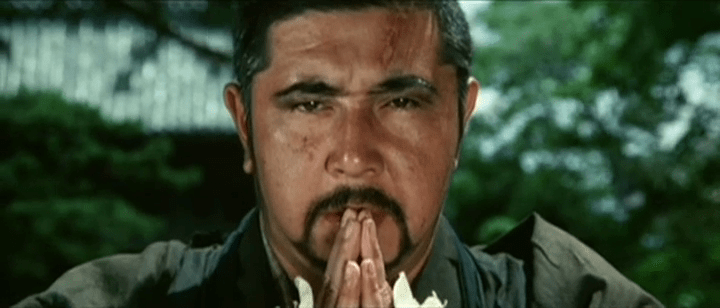
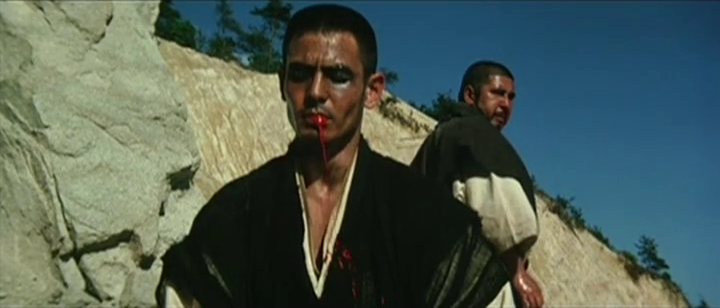
Three years on from his arrest at the end of the previous film, Shinkai (Tomisaburo Wakayama) returns for more lecherous adventures across Japan in Wicked Priest 3: Killer’s Pilgrimage (極悪坊主 念仏人斬り旅, Gokuaku Bozu: Nenbutsu Hitokiri Tabi). This time he finds himself mixed up with revolutionary pirates planning to overthrow the government with weapons smuggled in from Singapore, but it isn’t so much politics that bothers Shinkai as injustice as he tries to help the townspeople defend themselves against politicised bandits and a weird new religion while dealing with the fallout from the last time he found himself enacting justice.
As usual however the film opens with an odd prologue in which a randy Shinkai is invited to the home of a man who tells him there’s a strange local custom in which women soon to be married think it good luck to be deflowered by a passing stranger and even better if he’s a monk. Of course, Shinkai nearly gets a little more than he bargained for before heading off towards the central fishing village which is at this time of the year home to only women and old men with all the husbands and sons off chasing tuna for the foreseeable future. Taking a liking to a widow named Omine (Hiroko Sakuramachi), Shinkai’s plans are scuppered when she realises that he’s the man who killed her admittedly no good, violent drunk of a gambling husband. Being the charmer that he is, Shinkai manages to talk her round only her brother-in-law Ryuji (Tatsuo Terashima), who’s supposed to marry her sister Otae (Eiko Ito), is hellbent on revenge. Meanwhile, the town is invaded by cruel pirates who commandeer the local well and keep the villagers prisoner.
“Helping people is my duty,” Shinkai had told the man who weirdly wanted him to sleep with his daughter and true enough he’s never been one to turn away from those in need even if he’s not all that keen on taking responsibility for them. He feels bad for Omine that he ended up killing her husband even if he thinks her husband brought it on himself because of his behaviour, and even after encountering Ryuji tries to talk him down from his revenge rather than simply fighting him even though Ryuji still refuses to forgive him even after Shinkai is nearly fed to sharks in his place by the cruel leader of the pirates. He is later saved by Yamanami (Minoru Oki), a fugitive on the run for killing a politician in Tokyo presumably as part of his revolutionary activities but has become disillusioned with the gang whom he thinks have lost sight of their cause and are now no better than bandits. Shinkai had claimed he could see Yamanami was a good man because of his all-seeing monk eyes, and later praises him as someone who held fast to his beliefs while bravely standing up to his sociopathic gang boss. It isn’t so much that Shinkai has much opinion on their political stance and desire to overthrow the government, only about the way they conduct themselves, callously throwing dynamite around and hassling the local women. Yamanami asks his boss what the point of winning is if everyone resents you, but his boss simply tells him to think about winning first and ideological purity later.
In a bizarre subplot, meanwhile, Shinkai also finds himself squaring off against a weird sex cult/fake religion on an island connected with the pirates who are also planning to sell off the village women as payment for their Singaporean weapons. Once again, the randy monk becomes a staunch defender of women, saving Otae from becoming the weird priest’s sex slave and shutting down the trafficking plot by indulging his strange love of eye gouging. Meanwhile he’s still being pursued by Ryotatsu (Bunta Sugawara), the blind monk from the previous two films. Blow for blow, there may not be as much action for the warrior monk despite his heroic attempt to reach the well while under fire and eventual descent on the bandit hideout in a single-handed bid for justice, but there is something in Shinkai’s demands for a just world despite his lasciviousness that overcomes his fixation on women even if this time it seems as if the sun may have set on his travels.


 When AnimEigo decided to release Hideo Gosha’s Taisho/Showa era yakuza epic Onimasa (鬼龍院花子の生涯, Kiryuin Hanako no Shogai), they opted to give it a marketable but ill advised tagline – A Japanese Godfather. Misleading and problematic as this is, the Japanese title Kiryuin Hanako no Shogai also has its own mysterious quality in that it means “The Life of Hanako Kiryuin” even though this, admittedly hugely important, character barely appears in the film. We follow instead her adopted older sister, Matsue (Masako Natsume), and her complicated relationship with our title character, Onimasa, a gang boss who doesn’t see himself as a yakuza but as a chivalrous man whose heart and duty often become incompatible. Reteaming with frequent star Tatsuya Nakadai, director Hideo Gosha gives up the fight a little, showing us how sad the “manly way” can be on one who finds himself outplayed by his times. Here, anticipating Gosha’s subsequent direction, it’s the women who survive – in large part because they have to, by virtue of being the only ones to see where they’re headed and act accordingly.
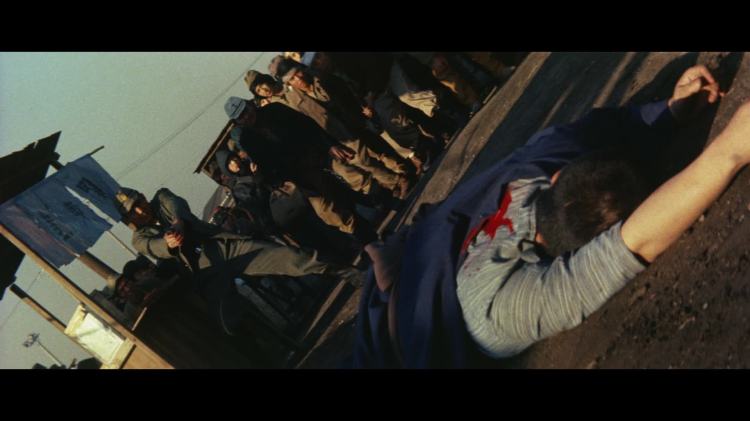 When it comes to the history of the yakuza movie, there are few titles as important or as influential both in Japan and the wider world than Kinji Fukasaku’s Battles Without Honour and Humanity (仁義なき戦い, Jingi Naki Tatakai). The first in what would become a series of similarly themed movies later known as The Yakuza Papers, Battles without Honour is a radical rebooting of the Japanese gangster movie. The English title is, infact, a literal translation of the Japanese which accounts for the slightly unnatural “and” rather than “or” where the “honour and humanity” are collected in a single Japanese word, “jingi”. Jingi is the ancient moral code by which old-style yakuza had abided and up to now the big studio gangster pictures had all depicted their yakuza as being honourable criminals. However, in Fukasaku’s reimagining of the gangster world this adherence to any kind of conventional morality was yet another casualty of Japan’s wartime defeat.
 Windows on Worlds