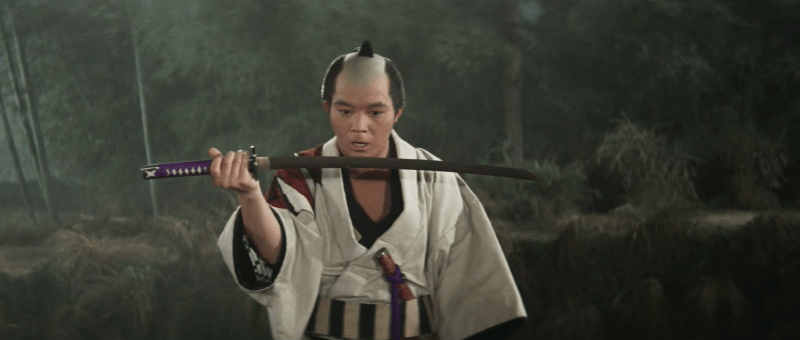
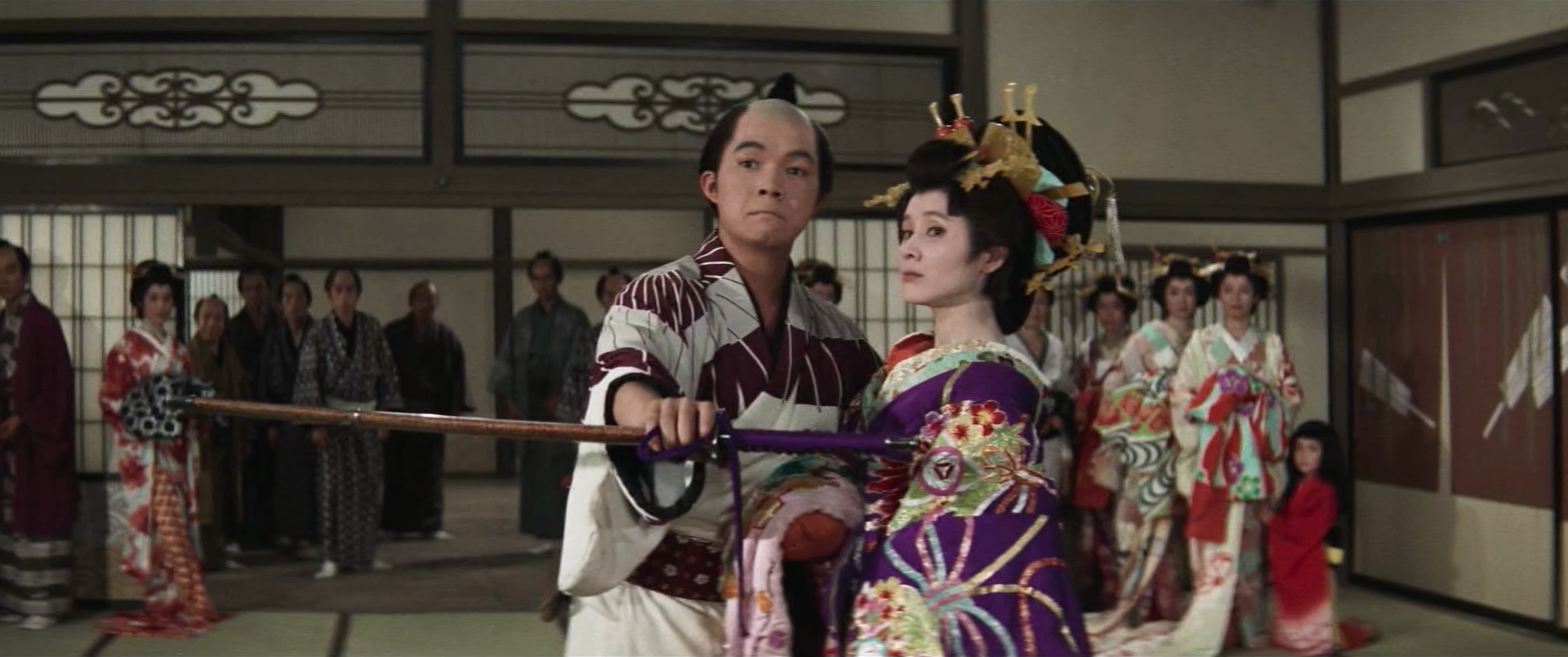
Kyu-chan, Draw Your Sword (九ちゃん刀を抜いて, Masahiro Makino, 1963)

Kyu Sakamoto was a hugely popular singing star in the 1960s best known internationally for the smash hit Ue wo Muite Aruko (Sukiyaki) which, somewhat incongruously, features in this jidaigeki comedy, Kyu-chan Draw Your Sword (九ちゃん刀を抜いて, Kyu-chan Katana wo Nuite), directed by one of the masters of the samurai movie, Masahiro Makino. Adapted from the novel by Ippei Okamoto, the film is essentially a vehicle for Sakamoto as indicated by the inclusion of his name in the title even though he plays a character called “Sangoro”.

The joke is that Sangoro is incredibly lazy and can hardly lift his head off the pillow while his ageing parents are struggling to feed themselves. If they don’t find a way to get him working soon, they’ll all starve to death but Sangoro seems incapable of understanding. The parents try to think up various jobs he could do without having to exert himself and eventually come up with Kyokaku, or “town knight”, a man about town of the Edo era somewhere between street tough and vigilante. In fact he even ends up meeting some legendary characters such as Banzuiin Chobe (Eitaro Shindo) who became a kind of Robin Hood figure in later literature standing up for the common man against the abuses of the samurai class. 

When he goes off to the city to become a Kyokaku because he figures starving to death would be too much effort, Sangoro’s father cautions him not to be too lazy to draw his sword even though it’s rusty and unlikely to do much damage. Sengoro does, however, take his ambition seriously and is keen to make a name for himself in Edo which he first does by becoming the blood brother of Gonbei (Chiyonosuke Azuma), one of Banzuiin’s men. Though his clumsy attempts to fight him don’t bode well for Sangoro’s career, Gonbei takes him on precisely because he’s fun to have around even if he is a bit useless and sometimes you need guys like that too. Introducing him to area’s top courtesan Takamado (Yoko Minamida), they hope to set the cat among the pigeons with a local gang that’s been harassing them led by the irritating Mizuno (Fumitake Omura) and Shirogoro (Koshiro Harada).

Though the film may be, in a way, a sort of satire poking fun at aimless post-war youth that lacks ambition in comparison to their parents’ generation who bore the brunt of wartime privation. Naive and childish, Sangoro is a well-meaning bumbler, but Takamado unexpectedly likes him precisely for these qualities. She hates men like Mizuno who are obsessed with proving their masculinity and finds it refreshing that Sangoro is not afraid to show his weakness. Just like Gonbei, she appreciates him not for his command of the sword or imposing air of authority, but simply because he’s an uncomplicated good person and fun to be around.

Mizuno and Shigoro are, by contrast, cruel and abusive Tokugawa vassals, who, it’s implied, have a habit of murdering sex workers during their New Year endurance tests. Sangoro is keen to save a young woman, Omitsu (Yumiko Kokonoe), after her father did him a favour and explained he needed 25 ryo to buy back her contract after she agreed to sacrifice herself to get the money for her mother’s medical treatment. Which is to say, she’s the opposite of Sangoro. It turns out that Takamado has a sad story of her own staged by Makino using kabuki-esque sets and effects to dramatise her flashback as she explains her samurai father took his own life after a prisoner he was watching disappeared. Though in another film this might lead to a violent confrontation challenging the evil samurai, in this version a bizarre misundersanding is revealed to have caused the death of Takamado’s father leading to another act of levelling as the supposed villain agrees to give them his secret recipe for pickles with an exclusive license to manufacture it for three years before it’s essentially made open source for the good of the people. Thus Sangoro essentially becomes a shopkeeper and releases both Omitsu and Takamado from their position as indentured sex workers, restoring both their birthright and their freedom basically by being nice and the right kind of righteous while Mizuno and Shigoro just end up embarrassed when all their posturing and obsession with their samurai status appears to mean little in a world in which the merchant has indeed become king.


Sword of Destiny (孤剣は折れず 月影一刀流, Yasushi Sasaki, 1960)

A wandering swordsman winds up in intrigue on returning to his fencing school to find his old master murdered in Yasushi Sasaki’s Sword of Destiny (孤剣は折れず 月影一刀流, Koken wa Arezu: Tsukage Ittoryu). A classic jidaigeki adventure, it nevertheless has to be said that this one is a little more sexist than most in actively pushing its series of female warriors into the background as the hero by turns sends them all back to typically feminine roles while declaring that he will be the one to claim vengeance and clear up corruption in the court itself caused by a woman’s apparent forgetting of her place. 

At least, this is what Mikogami Genshiro (Koji Tsuruta) is told by an old friend, Izu, after an altercation with the fiery princess Kazu (Hibari Misora). The Shogun’s nurse, Lady Kasuga, has apparently taken an interest in politics and has most of the inner palace in her grasp enriching herself in the process. Izu believes that she may also be behind the assassination of Geshiro’s former mentor Ono while working in league with the Yagyu who coveted the position of fencing master to the Shogun. He asks Genshiro to kill her which he’s only too happy to do while seeking vengeance for Ono, but later gains a second reason after meeting the two orphaned daughters of a former retainer forced to take his own life thanks to Lady Kasuga’s machinations. 

Itoya (Yoshiko Fujita) wanders round with a gun and disrupts Genshiro’s first assassination attempt. He later tells her to leave the killing business to him and live “the life of a woman” insisting that one girl has no power to kill Lady Kasuga anyway. Meanwhile, he also makes an enemy of the Shogun’s sister Princess Kazu after challenging her in the street on seeing her callous disregard for a peasant her horse had run over. Princess Kazu falls in love with him after he defeats her in a duel, temporarily rebelling in insisting she will resist a dynastic marriage and take no other husband though he eventually rejects her partly on the grounds of their class difference and partly because he is a wandering sword who lives in the moment and may know no tomorrow. 

Nevertheless, she is later seen capitulating to her proper role as a princess who exists largely to continue the family line, marrying a man chosen by the Shogun and his advisors with no real power to chose anything other than her obedience. In much the same way he does with Itoya, Genshiro pushes her back towards the typically feminine while falling for Itoya’s meek, sickly sister Mine (Hiroko Sakuramachi) who is otherwise an idealised image of femininity in her softness and naivety while like every other woman in the picture falling for Genshiro because of his robust manliness and ability to protect her by gaining the sisters’ vengeance on their behalf. 

Meanwhile, Genshiro also facing off against the rival Yagyu school whom he suspects of having killed Ono to usurp his place as the shogunate fencing master with the assistance of underling Takagaki who has now taken over leading to a mass exit of students fed up with his authoritarian teaching methods. Interestingly enough, Genshiro is temporarily imprisoned by the Yagyu alongside a dissident Christian whose death they’d faked while keeping him alive in order to torture the names of other Christians out of him. On fulfilling his request to take his cross to his daughter who has become a sex worker, Genshiro succeeds only in endangering her while she also falls in love with him. 

All in all, he’s not much of a responsible hero also reckless with the life of his former burglar sidekick Kurobei (Shin Tokudaiji) who uses his ninja tricks to get him out of prison. As expected, it all ends with in a battle against a treacherous swordsman and the spineless Takagaki with the final revelation that Lady Kasuga (who just dies of old age) had not much to do with anything anyway despite having been a “meddling” old woman who forgot her proper place. Even Mine is forced to admit that she can’t come between Genshiro and his sword so she plans to become a nun while Kazu sends him an elaborate katana to remember her by certain that he will not accept a place in the Shogun’s household but will return to the road to continuing his training. In any case, a kind of justice is done and order restored even if that order is in itself fairly unideal. 


Sasuke and His Comedians (真田風雲録, Tai Kato, 1963)

Criminally unknown in the Anglophone world, where Tai Kato is remembered at all it’s for his contribution to Toei’s ninkyo eiga series though his best known piece is likely to be post-war take on High Noon made at Shochiku, By a Man’s Face Shall You Know Him in which a jaded doctor finds himself caught in the middle of rising tensions between local Japanese gangsters and Zainichi Koreans. Kato’s distinctive visual style shooting from extreme low angles with a preference for long takes, closeups and deep focus already make him an unusual presence in the Toei roster, but there can be few more unusual entries in the studio’s back catalogue than the wilfully anarchic Sasuke and his Comedians (真田風雲録, Sanada Fuunroku), a bizarre mix of musical comedy, historical chanbara, and ninja movie, loosely satirising the present day student movement and the limits revolutionary idealism. 

An opening crawl introduces us to the scene at Sekigahara, a legendary battle of 1600 that brought an end to Japan’s warring states period and ushered in centuries of peace under the Tokugawa. Onscreen text explains that this is the story of the boys of who came of age in such a warlike era, giving way to a small gang of war orphans looting the bodies of fallen soldiers and later teaming up with a 19-year-old former samurai realising that the world as he knew it has come to an end. Soon the gang is introduced to the titular Sasuke who, as he explains, has special powers having been irradiated during a meteor strike as a baby. Recognising him as one of them, the war orphans offer to let Sasuke join their gang, but he declines because he’s convinced they’ll eventually reject him in fear of his awesome capabilities. Flashing forward 15 years, the kids are all grown up and the only girl, Okiri (Misako Watanabe), is still carrying a torch for Sasuke (Kinnosuke Nakamura) who dutifully reappears as the gang find themselves drawn into a revolutionary movement led by Sanada Yukimura (Minoru Chiaki) culminating in the Siege of Osaka in 1614. 

Don’t worry, this is not a history lesson though these are obviously extremely well known historical events the target audience will be well familiar with. A parallel is being drawn with the young people of early ‘60s Japan who too came of age in a warlike era and who are now also engaging in minor revolutionary thought most clearly expressed in the mass protests against the ANPO treaty in 1960 which in a sense failed because the treaty was indeed signed in spite of public opinion. Kato’s Sanada Yukimura is a slightly bumbling figure, first introduced banging his head on a low-hanging beam, wandering the land in search of talented ronin to join up with the Toyotomi rebellion against the already repressive Tokugawa regime. His underling sells this to the gang as they overlook a mile long parade of peasants headed to Osaka Castle as a means of bringing about a different future that they can’t quite define but imply will be less feudal and more egalitarian which is how they’ve caught the attention of so many exploited farmers. 

Of course, we all already know how the Siege of Osaka worked out (not particularly well for anyone other than the Tokugawa) so we know that this version of the 16th century better world did not come to pass the implication being that the 1960s one won’t either. The nobles are playing their own game, the Toyotomi trying to cut deals but ultimately being betrayed, while the gang fight bravely for their ideals naively believing in the possibility of victory. Sasuke, for his part, is a well known ahistorical figure popular in children’s literature and this post-modern adventure is in essence a kids’ serial aimed at a student audience, filled with humorous anachronisms and silliness while Kato actively mimics manga-style storytelling mixed with kabuki-esque effects. Boasting slightly higher production values than your average Toei programmer, location shooting gives way to obvious stage sets and fantastical set pieces of colour and light which are a far cry from the studio’s grittier fare with which Kato was most closely associated. That might be one reason that the studio was reportedly so unhappy with the film that it almost got Kato fired, but nevertheless its strange mix of musical satire and general craziness remain an enduring cult classic even in its ironic defeatism. 


Original trailer (no subtitles)