Shinobi no mono 7: Mist Saizo Strikes Back (忍びの者 新・霧隠才蔵, Kazuo Mori, 1966)

After the initial trilogy, the Shinobi no Mono series has changed direction following instead another ronin, Saizo, opposed to the Tokugawa because the promised world of peace had no room for ninja. Nevertheless, as time moved on, the sixth instalment shifted again to follow Saizo’s son, Saisuke, who continued his father’s vendetta against the Tokugawa but largely found himself frustrated by the times in which he lived. Nevertheless, film seven picks back up with Saizo and takes place in 1616 shortly after the siege of Osaka. 

Having joined up with a band of other displaced ninja, it seems that Saizo (Raizo Ichikawa) has had the rather unusual charge of heart in that his experiences with Yukimura have apparently convinced him to devote himself to serving a lord rather than living wild and free as a ninja while he still has a burning desire to kill Ieyasu but mainly for personal revenge. This is partly in recognition that he’s realised the Tokugawa are here to stay and politically it won’t make any difference killing Ieyasu as one of his underlings will simply move up to take his place.

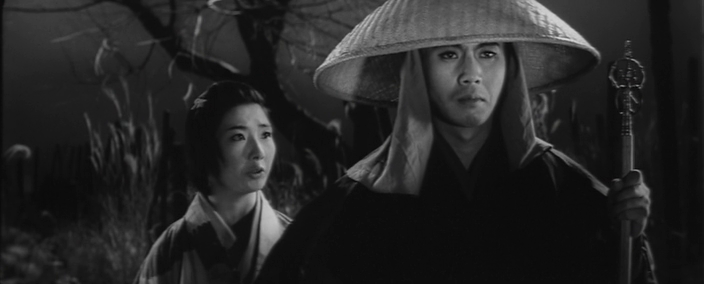
The other problem that he has is that there seems to be a mole and the other ninja have all settled on Akane (Shiho Fujimura) as the likely source of the treachery seeing as she is a “kunoichi” and therefore not a real ninja. Akane of course rejects this, but has also fallen in love with Saizo, which is of course against the ninja code. Saizo somewhat reinforces the sexist message by telling her to think of her pride and happiness as a woman, both things that a female ninja is expected to reject. Even so, he does not agree with his fellow ninja that she is the traitor and does not reject her affections in quite the way he usually does. Meanwhile, the gang is also in touch with another woman, Yayoi (Yuko Kusunoki), a maid to Lady Sen who also claims to be looking for revenge against the Tokugawa as her father was killed at Osaka Castle while her clan is also opposed to Ieyasu. 

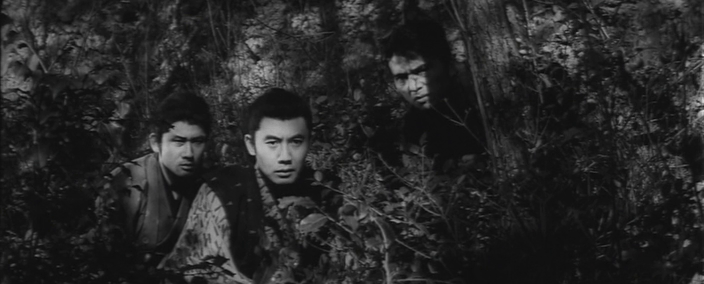
Ever duplicitous, Ieyasu sends his own ninja against them. Led by Fuma Daijuro (Takahiro Tamura), the clan is apparently an ancient enemy of the Iga with whom they’ve long been waiting for a showdown only they don’t usually leave their home promise. The vendetta pushes the film back into regular jidaigeki tragedy, if one with a spy element as Saizo and the others try to figure out the identity of the mole while plotting to kill Ieyasu. The other ninja are somewhat blinded by their own preferences despite the prohibitions against human feeling though they do eventually admit their mistakes and apologise.

This one is perhaps a little nastier with the rival gang calling Akane a whore and threatening to rape her while the Tokugawa also admit they plan to tie up loose ends by knocking off the mole when they’re no one longer useful. Returning to the director’s chair, Kazuo Mori leans more towards a classic samurai aesthetic, but nevertheless stays close to the series’ nihilistic atmosphere which is perhaps deepened by the solidifying of the Tokugawa regime which makes the ninja’s existence more or less redundant. In a slightly meta motif, this film overlaps with the last of the original trilogy in which Goemon does in fact bring about Ieyasu’s death even if, as Ieyasu says, he was old and would have died soon anyway though now he now goes out at the top of his game having achieved all of his major life goals.

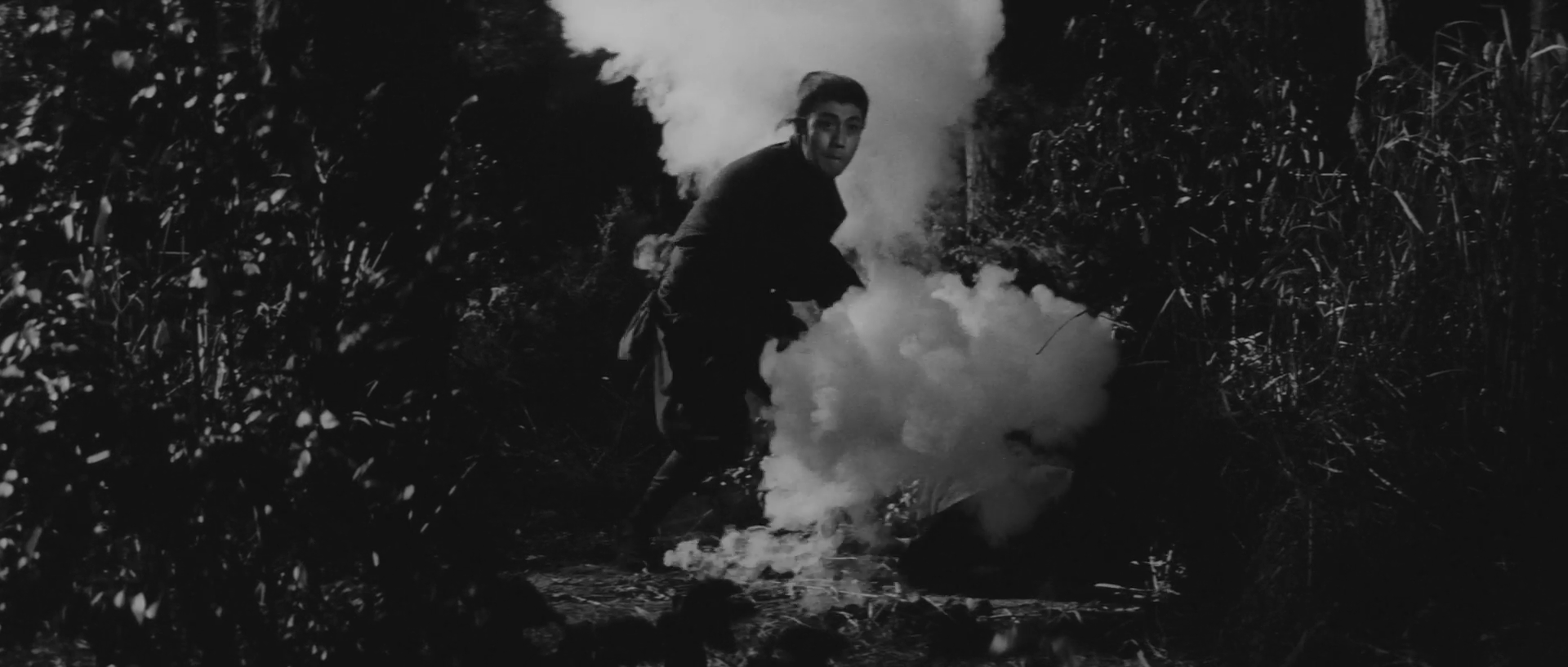
It does however adopt the slightly more fantastical trappings of the later films in its flaming shrunken and whirring fire whips not to mention the spear action from Fuma’s gang. The final showdown takes place amid copious snow echoing the coldness of the ninja lifestyle in which human emotions are largely forbidden while not even fellow ninja can really be trusted. Trusting only his mission, Saizo cuts a lonely figure and cannot seem to separate himself from it, running fast towards Edo and a confrontation with politics hoping to start a domino effect, resulting in the decline of the Tokugawa through a simple process of elimination.
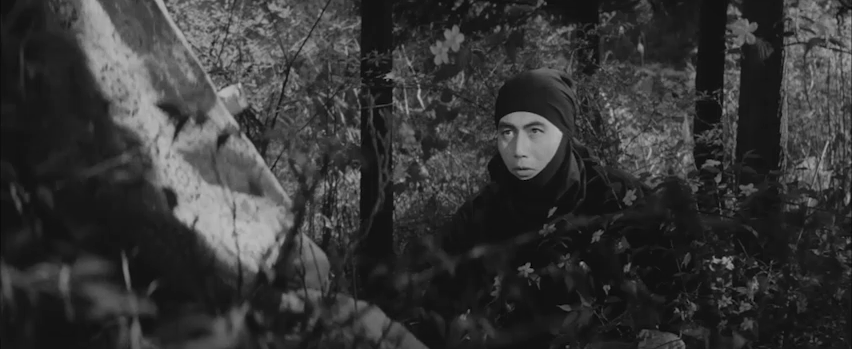
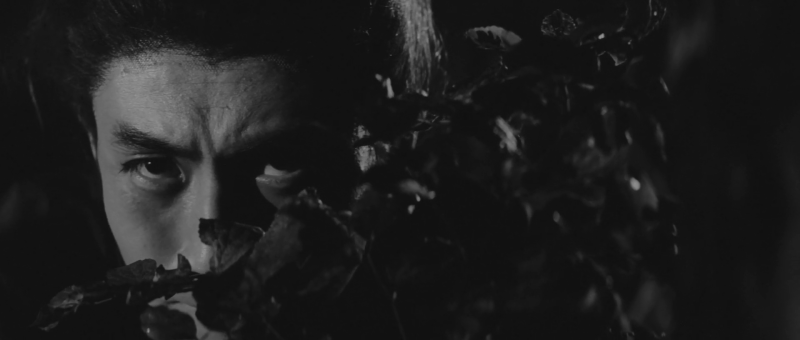
Shinobi No Mono 6: The Last Iga Spy (忍びの者 伊賀屋敷, Kazuo Mori, 1965)

Though there’s a clear divide between the first three films in the Shinobi no Mono series and those that followed, one thing that remained constant is that time passed. By the sixth instalment, we’re already in 1637 which is more than 50 years after the setting of the first film which began in 1575 at the tail end of the Warring States era. Hero of films four and five, Saizo had been desperate to return to the chaos of the pre-Seikgahara society in which the ninja could indeed hold sway though as he discovered the pax Tokugawa was definitely here to stay. 

Given that Saizo would now be an old man, the torch is passed to his son, Saisuke (Raizo Ichikawa), who like his father opposes the Tokugawa but also has a desire for revenge against the corrupt petty official who killed him during the battle of Shimabara which definitely sealed the Tokugawa victory. Ieyasu may be dead, but the regime has only become more oppressive while it seems there is still enough intrigue to provide work for the jobbing ninja only now it’s taking place largely within the palace in the de facto one party state of the feudal society. 

On the other hand, there is a degree of destabilisation and societal flux as the old class system struggles to adjust to a world of peace. The nation is filled with disenfranchised samurai and ronin who largely have no real options to support themselves other than becoming mercenaries or taking odd jobs from various lords in the hope of eventually being taken in as a permanent retainer. It’s these ronin that Saisuke, and the rebellion’s leader Yui Shosetsu (Mizuho Suzuki), hope to marshal in convincing them to rise up against Tokugawa oppression and regain at least a little of the freedom their immediate forebears enjoyed.

The evils of this system can be seen in an otherwise sympathetic lord’s insistence that his underling will have to take the blame and commit seppuku if his decision to help the rebels is discovered. As Saisuke later remarks, the era of human knowledge rather than weaponry is already here and battles are largely being fought over parlour games played in court. At this point, the shogun’s sudden demise leaving only an 11-year-old son has opened a power vacuum that allows unscrupulous lords, like Saisuke’s enemy Izu (Isao Yamagata), to exercise power vicariously. Izu has used it to enrich himself by exploiting desperate ronin and spending vast sums on personal projects, yet he proves himself a true politician in effortlessly covering up for the lord who tried to help the rebels doubtless knowing that he now has him in his pocket for life.

Seemingly returning to the low-key social principles of the first few films, Saisuke’s rebellion is also towards the inherently unfair system complaining that the battle for power is a monster that feeds on courage and will crush conscience like an insect. But as Izu says, times have changed and the struggle cannot be ended even if Saisuke argues that anything manmade can be dismantled. Saisuke has to admit that he’s been outplayed, the leader of the revolution also turns out to be corrupt, taking advantage of other people’s desperation and dissatisfaction to enrich himself while Izu’s plotting has left him largely blindfolded as a ninja clearly out of his depth in the new and confusing world of the Tokugawa hegemony. A powerful man is always looking for a victim, he reflects, perhaps echoing the plight of Goemon unwittingly manipulated by the duplicitous Sandayu while admittedly somewhat drunk on his own misplaced sense of self-confidence. 

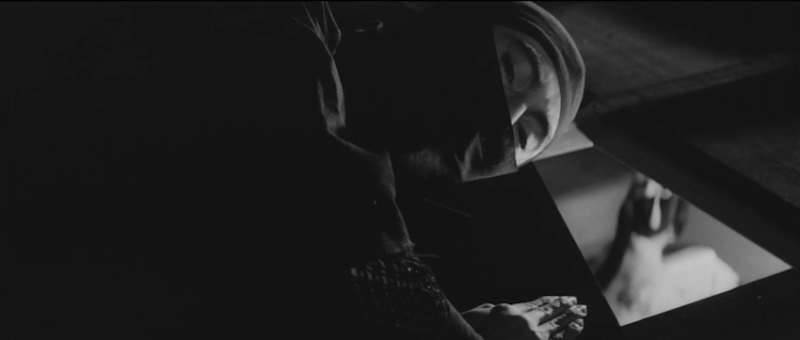
Deviating a little from the realism of the series as a whole, the film shifts into more recognisably jidaigeki territory revolving around corrupt lords and an exploited populace even if in this case it’s the disenfranchised warrior class experiencing a moment of mass redundancy though apparently unwilling to resist. Peep holes behind noh masks add a note of quirky innovation to the backroom machinations of the Tokugawa regime while silent ninja battles and flaming shuriken add to the sense of noirish danger even as it becomes clear that the ninja is approaching a moment of eclipse, no longer quite necessary in a world of constant duplicity.  


Shinobi no Mono 3: Resurrection (新・忍びの者, Kazuo Mori, 1963)

At the end of the second film in the Shinobi no Mono series, Goemon (Raizo Ichikawa) was led away to be boiled alive in oil after failing to assassinate Hideyoshi Toyotomi. Obviously, Goemon did not actually die, but exchanged places with a condemned prisoner thanks to the machinations of Hanzo Hattori (Saburo Date) which is a clear diversion from the accepted historical narrative to which the film otherwise remains more or less faithful. However, in this instalment more than all the others, Goemon is very much a shadow figure, pale and gaunt, who appears much less frequently on screen and mainly relies on stoking the fires of an already simmering succession conflict in the Toyotomi camp.

At this point, Hideyoshi has already made himself de facto leader of a unified Japan having been made the “kampaku”, advisor to the emperor, only to cede that position in favour of his adopted heir, Hidetsugu (Junichiro Narita) taking the title of “Taiko.” Hideyoshi has been childless for many years which is why he adopted his nephew, but the birth of his son by blood has dangerously unbalanced the palace order with Hidetsugu increasingly certain he’s become surplus to requirements. Meanwhile, in an effort to secure his position Hideyoshi has also embarked on an ambitious plan to conquer Korea as a means of getting to Ming China and circumventing the tributary requirements necessary for trading with it. 

This plan necessarily means that they need more money with Hideyoshi calling an end to all building and renovation projects including that of a Buddhist temple playing into the series’ themes about hubris in the face of Buddha though by this point Goemon too has lost faith in Buddhism in the clear absence of karmic retribution. As Ieyasu (Masao Mishima) points out, this works out well for him as it will stir discord among local lords who will be forced to squeeze their already exploited subjects even more earning nothing more than their resentment which will then blow back on oblivious Hideyoshi.  

Thus Goemon’s role mostly involves sneaking in and telling various people that others are plotting against them and they’d be better to get ahead of it. A secondary theme throughout the series has been a sense of powerlessness which is perhaps inevitable in a historical narrative in which we already know all of the outcomes. Ieyasu scoffs at Goemon, remarking that he thinks he’s walking his own path but is really being manipulated into walking that which Ieyasu has set down for him, though Goemon effectively rejects this stating at the conclusion that as Ieyasu believed he was using him he was also using Ieyasu to achieve his revenge on Hideyoshi for the death of his wife and son. In the historical narrative, Hideyoshi dies of a sudden illness as he does here with Goemon lamenting that his revenge is frustrated by the fact that Hideyoshi is now old and frail though he achieves it through symbolically cutting off his bloodline but explaining to him that Hideyoshi will not become the heir to anything because Ieyasu will be taking the role he has so patiently waited for. Hideyoshi has in any case perhaps disqualified himself as the father of a nation by wilfully sacrificing his adopted son, Hidetsugu, who was ordered to commit suicide to avoid any challenge to Hideyori after becoming desperate and debauched in the knowledge that his days were likely numbered anyway.

In any case, Goemon perhaps declares himself free in asking why he should care who’s in charge after Hanzo once again tries to recruit him to work for a now triumphant Ieyasu whose long years of simply waiting for everyone else to die have paid off. This is what passes for a happy ending in that he has thrown off the corrupt authority of the feudal era and discovered a way to live outside of it as a “free” man though as others point out the system hasn’t changed. Poor peasants continue to be exploited by lords who are greedy but also themselves oppressed by an equally ruler playing petty games of personal power. Fittingly, ninja tricks mainly revolve around smoke bombs and the covert use of noxious fumes to weaken the opposition as they creep in to spread their poison. Never shedding the series’ nihilistic tone, the film ends on a moment of ambivalent positivity albeit one of exile as Goemon declines the invitation to the fold instead wandering off for a life of hidden freedom in the shadows of a still corrupt society. 

Bronze Magician (妖僧, Teinosuke Kinugasa, 1963)

Even when you’re the empress, a woman has little freedom. Teinosuke Kinugasa’s Bronze Magician (妖僧, Yoso) is loosely based on a historical scandal concerning Nara-era empress Koken/Shotoku and a Rasputin-like monk, Dokyo, who unlike his counterpart in the film, eventually tried to seize the throne for himself alone only to have his ambitions frustrated by the empress’ death and the fierce resistance of her courtiers. As the title implies, Kinugasa is more interested in Dokyo than he is in the perilous position of Nara-era women even in power, painting his fall from grace as a Buddhist parable about a man who pays a heavy price for succumbing to worldly passions. 

As the film opens, Dokyo (Raizo Ichikawa) emerges from a shallow cave amid many other caves after meditating for 10 years during which he reached a higher level of enlightenment and obtained mystic powers. Now he thinks it’s time to continue the teachings of departed mentor Doen and use his abilities to “actively do good and save the masses”. Before that, however, he does some not quite Buddhist things like turning a rat into a living skeleton, and twisting a snake into a tangle. In any case, he begins roaming the land, miraculously healing the sick. While reviving a thief who had been killed by samurai after trying to make off with a bird they shot, Dokyo is spotted by a retainer of the empress who brings news of his miracles back to her closest advisors. 

Empress Koken (Yukiko Fuji), in the film at least, was a sickly child and even after ascending the throne has often been ill. She is currently bedridden with a painful respiratory complaint that is giving her servants cause for concern. None of the priests they’ve brought in to pray for her (apparently how you treat serious illness in the Nara era) has been of much use. The empress’ steward Mabito (Tatsuya Ishiguro) orders that Dokyo be found and brought to the palace to see if he can cure Koken, which he does while stressing that he’s helping her not because she’s the empress but in the same way as he would anyone else. 

As might be expected, the empress’ prolonged illness has made her a weak leader and left the door open for unscrupulous retainers intent on manipulating her position for themselves. There is intrigue in the court. The prime minister (Tomisaburo Wakayama) is colluding with a young prince to depose Koken and sieze power. Left with little oversight, he’s been embezzling state funds to bolster his position while secretly paying priests to engineer Koken’s illness continue. Dokyo’s arrival is then a huge threat to his plans, not only in Koken’s recovery and a subsequent reactivation of government but because Dokyo, like Koken, is of a compassionate, egalitarian mindset. She genuinely cares that the peasants are suffering under a bad and self-interested government and sees it as her job to do something about it, which is obviously bad news if you’re a venal elite intent on abusing your power to fill your pockets while the nation starves. 

As the prime minister puts it, however, the empress and most of her courtiers are mere puppets, “naive children”. At this point in history, power lies in the oligarchical executive who are only advised by the empress and don’t actually have to do what she says. As she is also a woman, they don’t necessarily feel they have to listen to her which is one reason why the prime minister assumes it will be easy to manoeuvre the young prince toward the throne. Koken’s short reign during which she overcame two coups is often used to support the argument against female succession because it can be claimed as a temporary aberration before power passed to the nearest male heir. Nevertheless, Koken tries to rule, even while she falls in love with the conflicted Dokyo. Her right to a romantic future, however, is also something not within her control. Many find the gossip scandalous and use it as an excuse to circumvent her authority, especially after she gives Dokyo an official title which allows them to argue she has been bewitched by him and he is merely manipulating her to gain access to power. 

Dokyo, meanwhile, is in the middle of a spiritual crisis. After 10 years of study he as reached a certain level of enlightenment and attained great powers which he intended to use for the good of mankind. He is happy to discover that Koken is also trying to do good in the world but she is, ironically, powerless while the elitist lords “indulge in debauchery”, abusing their power to enrich themselves while the people starve. He begins to fall in love with her but the palace corrupts him. He accepts a gift of a beautiful robe despite his vows of asceticism, and then later gives in to his physical desire for Koken only to plunge himself into suffering in the knowledge that he has broken his commandments. He loses his magic, but chooses to love all the same while rendered powerless to hold back Koken’s illness or to protect her from treachery. 

The pair mutually decide they cannot “abandon this happiness”, and Dokyo’s fate is sealed in the acceptance of the extremely ironic gift of golden prayer beads which once belonged to Koken’s father. He is reborn with a new name in the same way as the historical Koken was reborn as Shotoku after surviving insurrection, embracing bodily happiness while attempting to do good but battling an increasing emotional volatility. The lords continue to overrule the empress’ commands, insisting that they are really commands from Dokyo, while Dokyo’s “New Deal” involving a 2 year tax break for impoverished peasants finds support among the young radicals of the court who universally decide that they must stand behind him, protecting the ideal even if they are unable to save the man.

This troubles the elders greatly. Declaring that Dokyo has used “black magic” to bewitch the empress, they determine to eliminate him, but Dokyo never wanted power. “Power is not the final truth” he tells them, “those blindly pursuing status and power only destroy themselves”. Yet Dokyo has also destroyed himself in stepping off the path of righteousness. He damns himself by falling in love, failing to overcome emotion and embracing physical happiness in this life rather than maintaining his Buddhist teachings and doing small acts of good among the poor. Nevertheless, he is perhaps happy, and his shared happiness seems to have started a compassionate revolution among the young who resolve to work together to see that his ideal becomes a reality even in the face of entrenched societal corruption.


Original trailer (no subtitles)

The Haunted Castle (秘録怪猫伝, Tokuzo Tanaka, 1969)

haunted castle 1969These days, cats may have almost become a cute character cliche in Japanese pop culture, but back in the olden days they weren’t always so well regarded. An often overlooked subset of the classic Japanese horror movie is the ghost cat film in which a demonic, shapeshifting cat spirit takes a beautiful female form to wreak havoc on the weak and venal human race. The most well known example is Kaneto Shindo’s Kuroneko though the genre runs through everything from ridiculous schlock to high grade art film.

Daiei’s 1969 genre effort The Haunted Castle (秘録怪猫伝, Hiroku Kaibyoden) sits towards the high art end but remains firmly within the realm of entertainment. Displaying the high production values the studio was known for, the film paints its 18th century tale with a plush opulence and makes fantastic use of the nighttime gloom to evoke a gothic, supernatural atmosphere which is at least extremely unsettling even if it stops short of actual terror.

As for the story, it’s another take on the classic Japanese supernatural tale The Vampire Cat of Nabeshima. Events are set in motion when blind monk Mataichirou and his sister Sayo run into their lord whilst out walking one day. Lord Tangonokami Nabeshima takes a liking to Sayo and wants to add her to his collection of concubines. He despatches an underling to ask Mataichirou about it, but Mataichirou understandably refuses, offering the excuse that Sayo is “too awkward” and the the lord wouldn’t find her very good company anyway. Nabeshima is angry at this affront to his authority and summons Mataichirou for their regular round of Go where Mataichirou once more resolutely refuses to surrender his sister. When Mataichirou realises Nabeshima and his aid are cheating, the pair argue and Nabeshima loses his temper and kills him.

This is a big problem for several reasons so they pretend not to know anything about it and dump the body in a well. Fearing discovery, they also banish the sister, Sayo, but she opts to commit harakiri and begs the weird cat that had been attached to her brother to drink her blood and become a demon to enact their revenge! Soon enough, two maids are dead in the Nabeshima household and the lord’s favourite mistress is refusing to take baths and has developed a liking for fish which she previously could not stand….

Ghost cats mostly come at night (mostly) so the majority of the film takes place in the intense darkness of the pre-electric world. The cat begins to stalk its prey quietly with only the tinkling of its ghostly bell and then tiny, bloody paw prints left as evidence of a supernatural killing. Tanaka opts for a floating, dreamlike shooting style weaving a degree of hypnotic confusion into the proceedings which also manage to keep up a high level of tension as the demonic cat spirit goes about its bloody business.

Of course, the moral of the tale is to live your life in a more altruistic manner – stop trying to take things which aren’t yours, respect the views of others, and don’t lose your temper and rashly kill people for no reason at all. All good advice there. The “hero” of the story is the more sympathetic vassal, Komori, who is trying to broker a satisfactory outcome of this complex situation right from the start, but finds himself frustrated as the servant of an unreasonable lord whose will cannot be restrained. Komori can’t avoid the supernatural retribution but manages to ride the waves well enough to ensure a morally satisfying ending where corruption is exposed and the land returned to its rightful owners rather than remaining in the hands of a lascivious usurper. It’s an old story, but a good one, and is presented with such a degree of sophistication to make The Haunted Castle one of the better horror offerings of the late ‘60s.