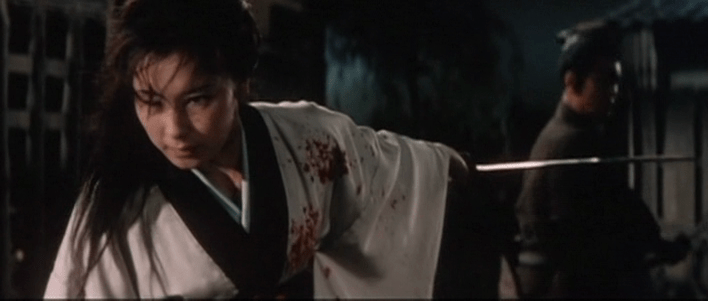
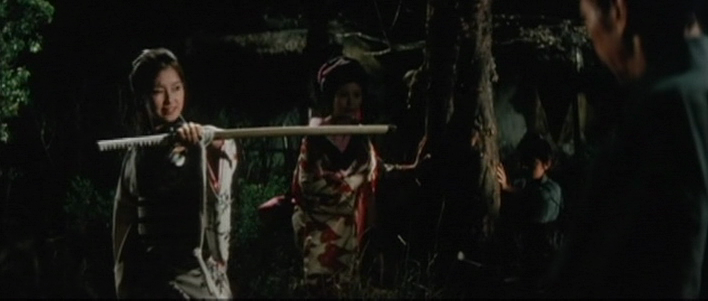
A one-armed, one-eyed swordswoman finds herself fighting a war on two fronts after rescuing a young woman running away from mistreatment while herself pursued by a venal lord determined to get his hands on her ancestral blade in Kimiyoshi Yasuda’s jidaigeki adventure Lady Sazen and the Drenched Swallow Sword (女左膳 濡れ燕片手斬り, Onna Sazen: Nuretsubame Katate Giri). This wasn’t the first time the classic character of Tange Sazen had been re-envisioned as a woman, though it does appear to have been an attempt by Daiei to launch a Toei-style female-led period action series even if no further instalments were ever made.
Nicknamed “Lady Sazen”, Okin (Michiyo Yasuda) lives in a small shack with the former retainer, Gosuke (Yusaku Terashima), who raised her, and Yasu, a little boy they seem to have taken in. Gosuke provides for them by weaving baskets, while it remains true Okin occupies an awkward space in Edo-era society. Having lost an arm and bearing a large scar over one eye which is no longer functional, Okin likely could not marry even if she wanted to, nor are there any occupations which are open to her which is why the only way that she can make money is by participating in the male world of sword fighting and gambling, much to Gosuke’s disapproval. It’s also why she’s branded monstrous by her opponents simply for being a woman who is able to use a sword.
A mysterious wanderer remarks that it might have been better had she been born a man, a sentiment with which Okin agrees even as the man jokingly complains about her lack of femininity and subsequent inability to offer the customary hospitality to a guest. She also speaks roughly and drinks sake directly from a gourd. Nevertheless, she sympathises with Omitsu (Natsuko Oka) precisely because of the similarity in their life stories as two women wronged by the patriarchal samurai order. Omitsu was promised advancement through serving at the castle, but was then essentially trafficked by the Minister for Temples and Shrines who sent her to the corrupt priest at Hojoji temple where she was pressed into sex work. Having attempted to escape, she returns home to discover both her parents have been murdered after reusing to give up her location. Okin’s parents were similarly murdered by a greedy lord who demanded her father give up his sword and killed him when he refused.
There is a degree of homoerotic tension that arises between Omitsu and Okin as the pair settle in to a kind of domesticity, yet the film hints at a potential romance with sometime enemy Eizaburo (Kojiro Hongo) who has been sent by his lord who is obsessed with swords to get hold of Okin’s. Eizaburo later gives up on the idea after finding out her family history, but is also beholden to samurai mores especially when he learns his sister is to be sent to the corrupt priest as part of his lord’s plan to win favour and possible promotion from the high priest. As Okin now lives outside of samurai society, she cannot restore order within it, but is determined to use public pressure to flush the wrongdoers out by exposing the corruption through a series of pamphlets. The priest, however, is able to simply blame everything on his former co-conspirator thanks to the fact he has already installed his daughter as the shogun’s mistress.
The unseen Lady Osode wields power in a different way, even if on the surface it looks like she too is being trafficked by her father. Refreshingly enough, Okin’s abilities as a one-armed swordswoman are totally respected. Though she may sometimes fight alongside men or they may provide assistance to her by buying time for her to escape, they never try to take over or get in her way. Rather, they treat her as an equal who is not in need of their protection. Though Eizaburo vows to give up the sword and abandon his samurai status, this is something that Okin can ever do because her duty lies in protecting her familial legacy in the form of the blade inherited from her father. She may be to a degree feminised in assuming a maternal position over Yasu, but maintains her independence in once again taking to the road in search of new adventures.
 These days, cats may have almost become a cute character cliche in Japanese pop culture, but back in the olden days they weren’t always so well regarded. An often overlooked subset of the classic Japanese horror movie is the ghost cat film in which a demonic, shapeshifting cat spirit takes a beautiful female form to wreak havoc on the weak and venal human race. The most well known example is Kaneto Shindo’s Kuroneko though the genre runs through everything from ridiculous schlock to high grade art film.
 Windows on Worlds