Revenge of the Pearl Queen (女真珠王の復讐, Toshio Shimura, 1956)

Born amid the labour disputes that engulfed Toho in the late 1940s, Shintoho began as a rather lofty endeavour mostly geared towards artistic films, but after a series of box office failures was soon in the red. Impresario Mitsugu Okura was brought in to turn the company around, but his ethos was decidedly populist. He shifted the studio away from the auteurist focus of its early days towards the racy dramas and ghost films with which it would become associated. 

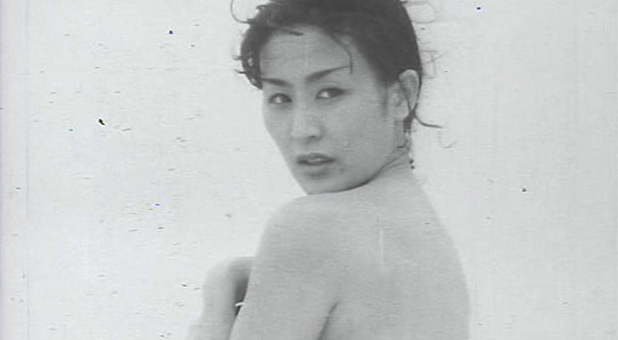
Revenge of the Pearl Queen (女真珠王の復讐, Onna shinju-o no fukushu) was key to this transformation and made a star out of its leading lady Michiko Maeda who had been discovered working in the kimono department of the Mitsukoshi department store. Though sometimes billed as the first mainstream feature to depict full female nudity, what it really sells is the promise rather than the reality. The nudity in the film is generally abstract or artistic, shooting Maeda from behind and at a distance amid nature or capturing brief shots of her rear as her skirt flutters in the wind. Otherwise, she is seen in loose, torn clothing or with her hands covering her bare breasts as she, ironically, tries to escape from a series of men trying to assault her.

Adapted from a novel by Yoshihisa Aoki, the film is also inspired by a real life incident in which a group of men and one woman were marooned on Anatahan island at the end of the war. The men eventually ended up killing each other over the woman. The same incident inspired the 1953 film by Josef von Sternberg. Natsuki (Michiko Maeda), an office worker, is engaged to diligent employee Kizaki (Ken Utsui) and about to undertake a trip abroad with her boss, Asamura (Susumu Fujita). An early scene sees their passports arrive with some fanfare as it was still difficult at this time for ordinary people to acquire one or indeed to travel outside of Japan. But it soon turns out that her boss has an ulterior motive. Kizaki is framed for the murder of the company president, while Asamura first attempts to blackmail Natsuki into entering a sexual relationship with him, then tries to assault her when she refuses. She manages to get away from him, but he chases her and she ends up being thrown overboard.

She then washes up on an island and is “rescued” by five shipwrecked sailors. Three of them are desperate to rape her, while the oldest of the men Ishizuka (Saburo Sawai) is against it and tries to protect her along with his son-in-law to be Yuzo (Shigeru Amachi). Ishizuka takes the men to task and asks them how they could show their faces in Japan having done something so heinous, but they just laugh at him. In some ways, this seems to be an echo of wartime atrocities and the fishermen stand-ins for men who did terrible things overseas and then were able to forget about it and live normal lives in post-war Japan. The same is true of Asamura whose wartime service in intelligence is often referenced, though his subordinate Noguchi (Tetsuro Tanba) later suggests he’s embellished his record. Asamura isn’t even his real name, though he’s been able to build a business empire for himself largely based on fraud, tax evasion, forgery, and apparently also drug smuggling. He used Kizaki as a foil to kill his boss and take over the company, while hoping to also bed Natsuki at the same time.

Nevertheless, after the three aspiring rapists turn on each other and are killed, Natsuki discovers a wealth of riches under the sea while attempting to save one of them from a whirlpool. Spending her entire time diving for pearls, she becomes incredibly wealthy and is able to rebrand herself as “Helen Minami”, a Japanese-American “pearl queen”, on her return to Japan. Sharing her riches with Ishizuka and Yuzo, the trio plot revenge hoping to clear Kizaki’s name and expose Asamura’s corruption. They use the money to attack them through the stock market while also discouraging their clients from doing business with them until the company is finally on its knees. The crows are coming home to roost for Asamura with Natsuki returning to expose all his wrong doing, though such occurrences were perhaps rare for other men like him in reality. By reinventing herself, Natsuki is at least able to cure this corruption and restore her innocent connection with Kizaki in a dramatic nightclub showdown in which justice is finally served.


Bronze Magician (妖僧, Teinosuke Kinugasa, 1963)

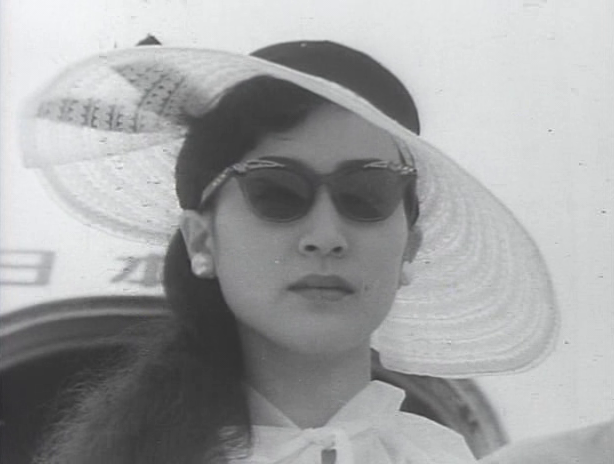
Even when you’re the empress, a woman has little freedom. Teinosuke Kinugasa’s Bronze Magician (妖僧, Yoso) is loosely based on a historical scandal concerning Nara-era empress Koken/Shotoku and a Rasputin-like monk, Dokyo, who unlike his counterpart in the film, eventually tried to seize the throne for himself alone only to have his ambitions frustrated by the empress’ death and the fierce resistance of her courtiers. As the title implies, Kinugasa is more interested in Dokyo than he is in the perilous position of Nara-era women even in power, painting his fall from grace as a Buddhist parable about a man who pays a heavy price for succumbing to worldly passions. 

As the film opens, Dokyo (Raizo Ichikawa) emerges from a shallow cave amid many other caves after meditating for 10 years during which he reached a higher level of enlightenment and obtained mystic powers. Now he thinks it’s time to continue the teachings of departed mentor Doen and use his abilities to “actively do good and save the masses”. Before that, however, he does some not quite Buddhist things like turning a rat into a living skeleton, and twisting a snake into a tangle. In any case, he begins roaming the land, miraculously healing the sick. While reviving a thief who had been killed by samurai after trying to make off with a bird they shot, Dokyo is spotted by a retainer of the empress who brings news of his miracles back to her closest advisors. 

Empress Koken (Yukiko Fuji), in the film at least, was a sickly child and even after ascending the throne has often been ill. She is currently bedridden with a painful respiratory complaint that is giving her servants cause for concern. None of the priests they’ve brought in to pray for her (apparently how you treat serious illness in the Nara era) has been of much use. The empress’ steward Mabito (Tatsuya Ishiguro) orders that Dokyo be found and brought to the palace to see if he can cure Koken, which he does while stressing that he’s helping her not because she’s the empress but in the same way as he would anyone else. 

As might be expected, the empress’ prolonged illness has made her a weak leader and left the door open for unscrupulous retainers intent on manipulating her position for themselves. There is intrigue in the court. The prime minister (Tomisaburo Wakayama) is colluding with a young prince to depose Koken and sieze power. Left with little oversight, he’s been embezzling state funds to bolster his position while secretly paying priests to engineer Koken’s illness continue. Dokyo’s arrival is then a huge threat to his plans, not only in Koken’s recovery and a subsequent reactivation of government but because Dokyo, like Koken, is of a compassionate, egalitarian mindset. She genuinely cares that the peasants are suffering under a bad and self-interested government and sees it as her job to do something about it, which is obviously bad news if you’re a venal elite intent on abusing your power to fill your pockets while the nation starves. 

As the prime minister puts it, however, the empress and most of her courtiers are mere puppets, “naive children”. At this point in history, power lies in the oligarchical executive who are only advised by the empress and don’t actually have to do what she says. As she is also a woman, they don’t necessarily feel they have to listen to her which is one reason why the prime minister assumes it will be easy to manoeuvre the young prince toward the throne. Koken’s short reign during which she overcame two coups is often used to support the argument against female succession because it can be claimed as a temporary aberration before power passed to the nearest male heir. Nevertheless, Koken tries to rule, even while she falls in love with the conflicted Dokyo. Her right to a romantic future, however, is also something not within her control. Many find the gossip scandalous and use it as an excuse to circumvent her authority, especially after she gives Dokyo an official title which allows them to argue she has been bewitched by him and he is merely manipulating her to gain access to power. 

Dokyo, meanwhile, is in the middle of a spiritual crisis. After 10 years of study he as reached a certain level of enlightenment and attained great powers which he intended to use for the good of mankind. He is happy to discover that Koken is also trying to do good in the world but she is, ironically, powerless while the elitist lords “indulge in debauchery”, abusing their power to enrich themselves while the people starve. He begins to fall in love with her but the palace corrupts him. He accepts a gift of a beautiful robe despite his vows of asceticism, and then later gives in to his physical desire for Koken only to plunge himself into suffering in the knowledge that he has broken his commandments. He loses his magic, but chooses to love all the same while rendered powerless to hold back Koken’s illness or to protect her from treachery. 

The pair mutually decide they cannot “abandon this happiness”, and Dokyo’s fate is sealed in the acceptance of the extremely ironic gift of golden prayer beads which once belonged to Koken’s father. He is reborn with a new name in the same way as the historical Koken was reborn as Shotoku after surviving insurrection, embracing bodily happiness while attempting to do good but battling an increasing emotional volatility. The lords continue to overrule the empress’ commands, insisting that they are really commands from Dokyo, while Dokyo’s “New Deal” involving a 2 year tax break for impoverished peasants finds support among the young radicals of the court who universally decide that they must stand behind him, protecting the ideal even if they are unable to save the man.

This troubles the elders greatly. Declaring that Dokyo has used “black magic” to bewitch the empress, they determine to eliminate him, but Dokyo never wanted power. “Power is not the final truth” he tells them, “those blindly pursuing status and power only destroy themselves”. Yet Dokyo has also destroyed himself in stepping off the path of righteousness. He damns himself by falling in love, failing to overcome emotion and embracing physical happiness in this life rather than maintaining his Buddhist teachings and doing small acts of good among the poor. Nevertheless, he is perhaps happy, and his shared happiness seems to have started a compassionate revolution among the young who resolve to work together to see that his ideal becomes a reality even in the face of entrenched societal corruption.


Original trailer (no subtitles)