Female Prisoner Scorpion: Death Threat (女囚さそり 殺人予告, Toshiharu Ikeda, 1991)

It had been 14 years since the conclusion of the rebooted Female Prisoner Scorpion series and 18 since the iconic Meiko Kaji had stepped away from the role when Toshiharu Ikeda decided to resurrect the iconic Nami Matsushima for Toei’s V-Cinema line. Ikeda was reportedly a fan of the original series and put his name forward to direct with the intention of getting Kaji to return as a now middle-aged Sasori but she turned him down flat so they instead embarked on a quasi sequel in which the original Nami has died and another woman slowly takes her place to become the next incarnation of the legend.

Consequently, Scorpion is not the protagonist of this film that otherwise bears her name. Cast in the lead role of a nameless hit woman, Natsuki Okamoto was then a popular pinup model known as “High Leg Queen”. The film opens with her emerging from a barrel of concrete after being dumped by a group of men who had gang raped and then left her for dead. She’s then rescued by a yakuza, Kaizu (Minori Terada), who teaches her how to kill and is effectively her handler. After posing as a bigger to knock off an obnoxious businessman, he’s recruited by Goda (Kenji Imai), the former warden prison stabbed in the eye (though not by Nami as he claims here) in the original trilogy but now a local councillor with aspirations of being elected to parliament. The prison is about to be redeveloped and Goda claims he’s been keeping Nami a prisoner in the dungeon for the last 20 years so he needs her knocked off before anyone bothers to have a look down there.

Of course, there are a few things that don’t make sense with this scenario and are out of continuity with the events of the original trilogy. In any case, now called 701 the assassin infiltrates the prison and knocks off a woman she’s been led to believe is the original scorpion but may not actually be. It seems Scorpion has already passed into legend and the woman has become less important than the idea or the inspiration she provides to the other inmates who are then minded to rebel against authority. By hiding Scorpion away, the authorities have made a rod for their own back in allowing her apotheosis into a goddess of vengeance of all women kind.

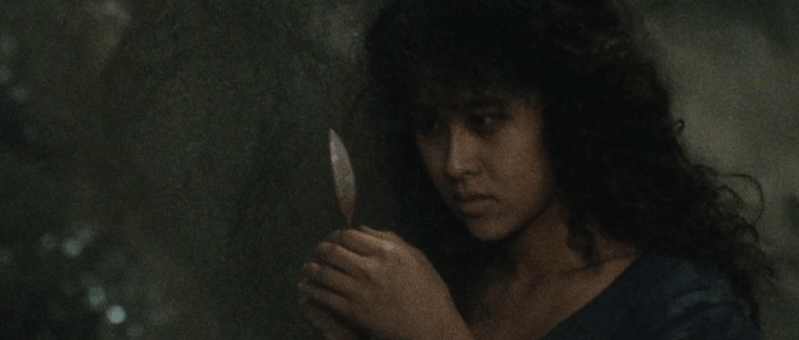
701 is in a way reborn as Sasori. Betrayed by the people who hired her, she’s crucified in the courtyard until rescued by fellow inmate and Sasori fan Shindo (Mineko Nishikawa) who helps her try to escape from the prison in an attempt to find out what happened to the “real” Nami. It’s she who first likens the fire in 701’s eyes to that of the Scorpion and begins to give her permission to take on her name and mission. A line is drawn between the two in Nami’s incasement in concrete and 701’s breaking out of it in the opening sequence. Though it would be wrong to call this horror film, Ikeda makes frequent use of ghostly techniques to imply Nami’s apotheosis such as the sound of her spoon scraping the concrete which she later bequeaths to 701 who then becomes the “new” Scorpion. 

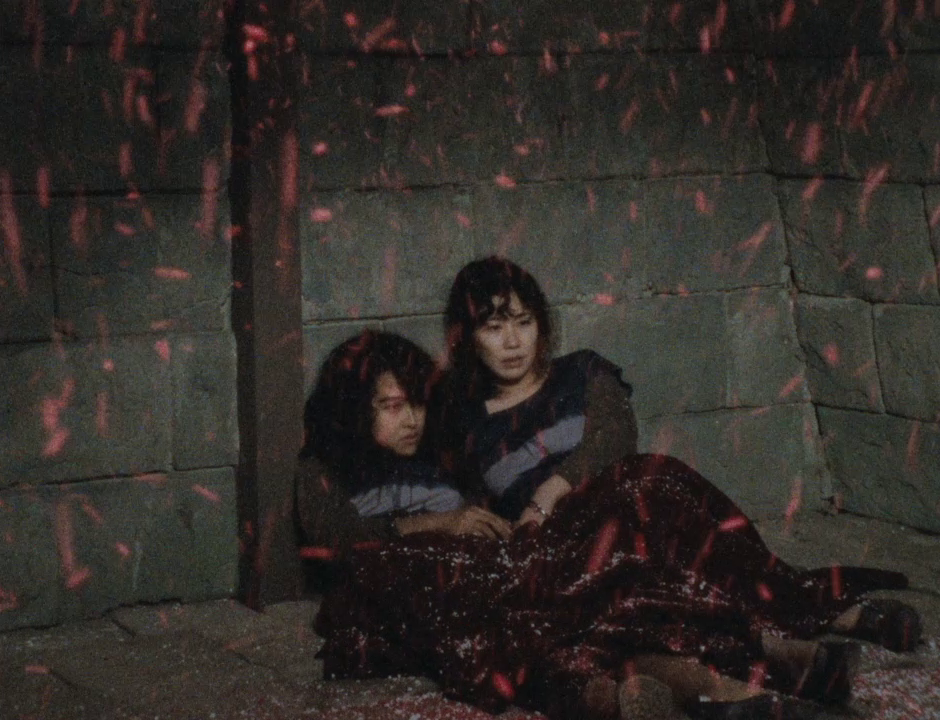
The film was in fact a big hit for Toei video and theatrical sequel was planned as a co-production with Golden Harvest in Hong Kong though the project fell through when Okamoto took a break from show business ostensibly for health reasons though there were rumours she had objected to the requirements for nudity. Contrary to expectations for a straight to video release, there is not actually a lot of sexual content in the film which is mainly restricted to a single sequence in which two prisoners pretend to get it on in order to distract a guard to facilitate an escape attempt. Unlike other instalments in the series, the film doesn’t have a lot of women in prison elements either, though it does make space for Dump Matsumoto, a popular villain character from women’s wrestling, as a sadistic guard with a crush on another warden who is she says the only one who treated her like a woman. Instead, it focuses on 701’s passage towards becoming Scorpion and the fulfilment of her twin missions as an avenger of wronged women breaking free from the concrete dungeon of patriarchal oppression to take bloody revenge on the forces of corruption.


Trailer (English subtitles)
The Beast Must Die (野獣死すべし, Toru Murakawa, 1980)

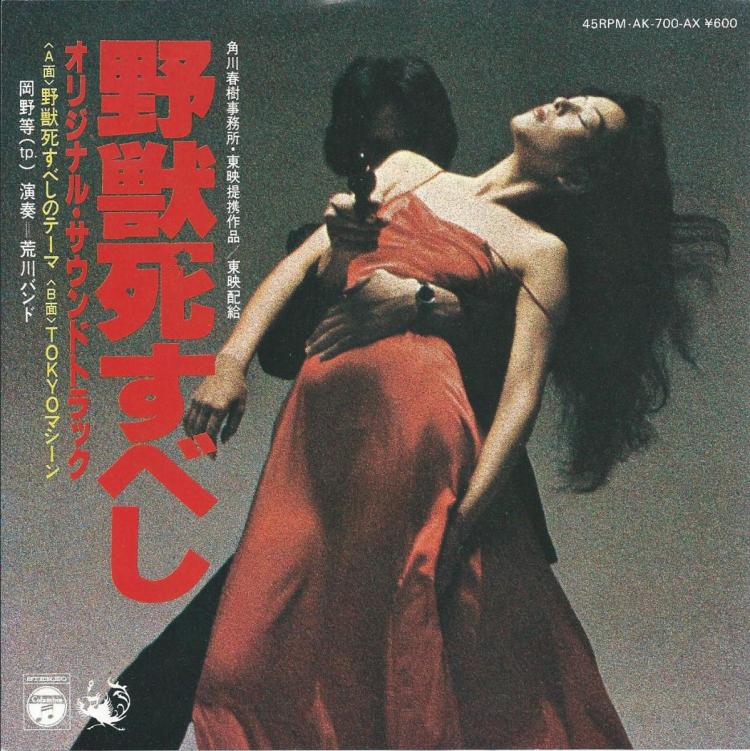
LP Soundrack record cover

Yusaku Matsuda was the action icon of the ‘70s, well known for his counter cultural, rebellious performances as maverick detectives or unlucky criminals. By the early 1980s he was ready to shed his action star image for more challenging character roles as his performances for Yoshimitsu Morita in The Family Game and Sorekara or in Seijun Suzuki’s Kagero-za demonstrate. The Beast Must Die (野獣死すべし, Yaju Shisubeshi, AKA Beast to Die) is among his earliest attempts to break out of the action movie cage and reunites him with director Toru Murakawa with whom he’d previously worked on Resurrection of the Golden Wolf also adapted from a novel by the author of The Beast Must Die, Haruhiko Oyabu. A strange and surreal experience which owes a large amount to the  “New Hollywood” movement of the previous decade, The Beast Must Die also represents a possible new direction for its all powerful producer, Haruki Kadokawa, in making space for smaller, art house inspired mainstream films.

Shedding 25 pounds and having four of his molars removed to play the role, Matsuda inhabits the figure of former war zone photo journalist Kazuhiro Date whose experiences have reduced him to state of living death. After getting into a fight with a policeman he seems to know, Date kills him, steals his gun, and heads to a local casino where he goes on a shooting rampage and takes off with the takings. Date, now working as a translator, does not seem to need or even want the money though if he had a particular grudge against the casino or the men who gather there the reasons are far from clear.

Remaining inscrutable, Date spends much of his time alone at home listening to classical music. Attending a concert, he runs into a woman he used to know who seems to have fond feelings for him, but Date is being pulled in another direction as his experiences in war zones have left him with a need for release through physical violence. Eventually meeting up with a similarly disaffected young man, Date plans an odd kind of revenge in robbing a local bank for, again, unclear motives, finally executing the last parts of himself clinging onto the world of order and humanity once and for all.

Throughout the film Date recites a kind of poem, almost a him to his demon of violence in which he speaks of loneliness and of a faith only in his own rage. Later, in one of his increasingly crazed speeches to his only disciple, Date recounts the first time he killed a man – no longer a mere observer in someone else’s war, now a transgressor himself taking a life to save his own. The violence begins to excite him, he claims to have “surpassed god” in his bloodlust, entering an ecstatic state which places him above mere mortals. A bullet, he says, stops time in that it alters a course of events which was fated to continue. A life ends, and with it all of that time which should have elapsed is dissolved in the ultimate act of theft and destruction. His acts of violence are “beautiful demonic moments” available only to those who have rejected the world of law.

Murakawa allows Matsuda to carry the film with a characteristically intense, near silent performance of a man driven mad by continued exposure to human cruelty. Hiding out in Date’s elegant apartment, Matsuda moves oddly, beast-like, his baseness contrasting perfectly with the classical music which momentarily calms his world. Mixing in stock footage of contemporary war zones, Murakawa makes plain the effect of this ongoing violence on Date’s psyche as the sound of helicopters and gunfire resounds within his own head. The imagery becomes increasingly surreal culminating in the moment of consecration for Date’s pupil in which he finally murders his girlfriend while she furiously performs flamenco during an dramatic thunderstorm. Date is, to borrow a phrase, no longer human, any last remnants of human feeling are extinguished in his decision to kill the only possibility of salvation during the bank robbery.

Anchored by Matsuda’s powerful presence, The Beast Must Die is a fascinating, if often incomprehensible, experience filled with surreal imagery and an ever present sense of dread. Its world is one of neo noir, the darkness and modern jazz score adding to a sense of alienation which contrasts with the brightness and elegance of the classical music world. At the end of his transformation, there is only one destination left to Date though his path there is a strange one. Fittingly enough for a tale which began with with darkness we exit through blinding white light.


There’s also another adaptation of this novel from 1959 starring Tatsuya Nakadai which I’d love to see but doesn’t seem to be available on DVD even without subtitles. This film has a selection of English language titles but I’ve used The Beast Must Die as this is the one which appears on Kadokawa’s 4K restoration blu-ray release (sadly Japanese subtitles ony).

Original trailer (no subtitles)

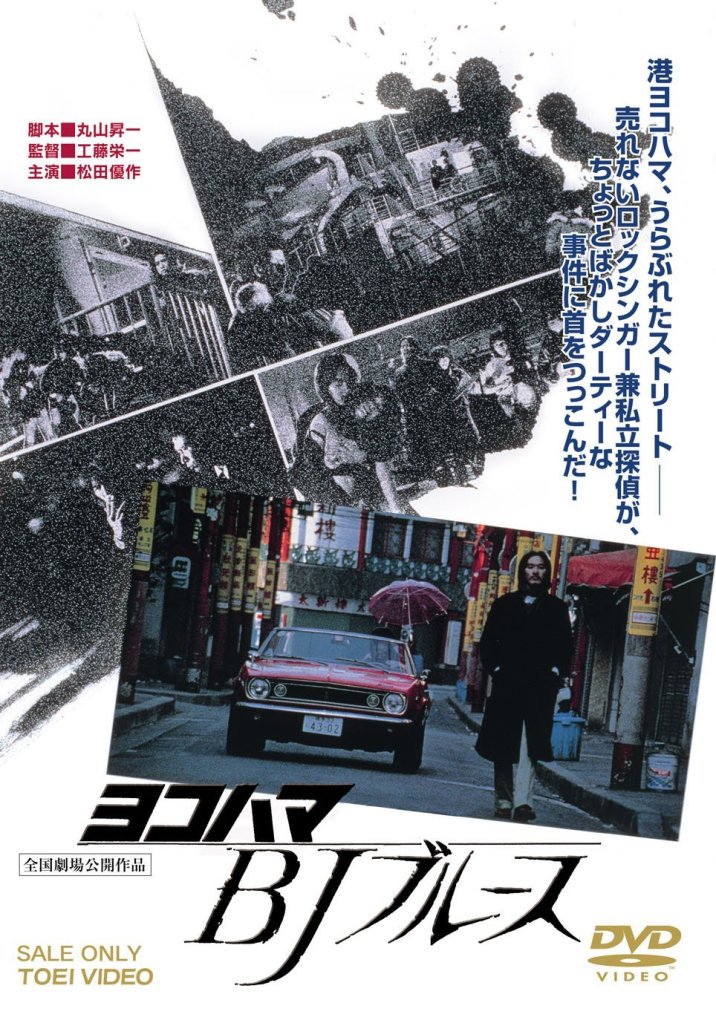
Yokohama BJ Blues (ヨコハマBJブルース, Eiichi Kudo, 1981)

Yokohama bj bluesYusaku Matsuda may have been the coolest action star of the ‘70s but by the end of the decade he was getting bored with his tough guy persona and looked to diversify his range a little further than his recent vehicles had allowed him. Matsuda had already embarked on a singing career some years before but in Eiichi Kudo’s Yokohama BJ Blues (ヨコハマBJブルース), he was finally allowed to display some of his musical talents on screen as a blues singer and ex-cop who makes ends meet through his work as a detective for hire.

After his set at a rundown jazz bar, BJ’s first job is tracking down a missing son. When he finds the guy, Akira, he seems to have become the employee (and possible sex slave?) of a gay gangster. Akira says he’s fine with his new life and wants his mother to leave him alone so BJ gets the hell out of there to give her the message but the unpleasantness of the situation lingers with him a little.

Shortly after, BJ receives a telephone call from an old police buddy, Ryo, who needs his help. Ryo got in too deep with the same gang BJ just came up against and is thinking of quitting the force in a bid to make the “Family” lose interest in him. However, Ryo is gunned down in broad daylight leaving his partner, Beniya, convinced that BJ is somehow responsible. BJ now doubly has it in for Family and starts working on his own behalf to try and find some answers and possibly a little vengeance too.

You see, back when Ryo and BJ were partners, they both liked the same girl, Tamiko, who eventually married Ryo. Beniya thinks BJ killed his friend to steal his wife and is much more interested in giving BJ a good kicking rather than investigating this very strange gang set up which seems to have some kind of drug smuggling gig going with the triads in Hong Kong.

BJ forms an odd sort of friendship with Akira in the hopes of tracking down the four gay, leather clad punk henchmen of Ali who probably gunned down his friend. However, the conspiracy only deepens and BJ finds himself suspecting even his closest of friends.

With its jazz soundtrack and melancholy tone, Yokohama BJ Blues is channelling hard boiled in a big way though does so in a distinctly modern fashion. BJ sings the blues whilst walking around this strange noir world which seems to endlessly disappoint him. Unfortunately for him, BJ is quite a good detective and quickly gets himself in way over his head only to end up finding out a few things it might be better not to know.

One of the film’s most notable components is its use of homoerotic themes with its gangs of gay gangsters, rent boys and punks. Indeed, though the wife of his former partner is floated as a possible motive, the love interest angle is never fully explored and all of BJ’s significant interactions in the film are with other men. Firstly his relationship with his former police partner Ryo which kick starts the entire adventure and then his strange almost date-like experience with Akira about half way through. BJ remains otherwise alone, a solo voice seeking justice for his fallen friends.

Of course, the film’s selling point is Matsuda’s singing so he’s allowed to play his own chorus in a sense by narrating the events from the stage in the form of the blues. Not quite “The Singing Detective”, but almost – BJ tries to bring some kind of order to his world by turning it into a song. In addition to adding to the noir tone, the bluesy soundtrack even allows for a New Orleans-esque musical funeral which oddly fits right in with the film’s weird, macabre atmosphere.

A surreal, noir inspired crime drama with musical elements, Yokohama BJ Blues is quite a hard film to categorise. Unusual for its homosexual milieu and overt homoerotic plotting the film occupies something of a unique place given its obvious marketing potential and star’s profile coupled with its decidedly murky noir tone. Difficult, yet interesting, Yokohama BJ Blues ultimately succeeds both as an intriguing crime drama and as a star vehicle for its versatile leading man.


This is a really, deeply, strange film.

Unsubtitled trailer:

http://www.youtube.com/watch?v=oYzkD-YJbjo

I actually quite like Matsuda’s foray into the world of jazz, the title song from Yokohama BJ Blues which is heard in the trailer is called Brother’s Song and is included on Matsuda’s 1981 album Hardest Day. Here he is on a talk show singing Yokohama Honky Tonk Blues:

http://www.youtube.com/watch?v=5Yr4fW2zoFk