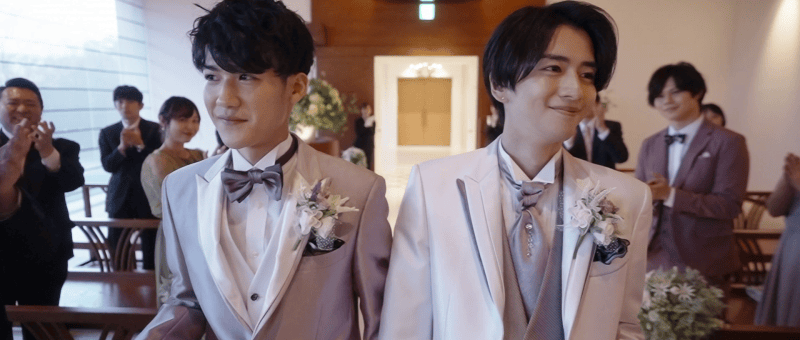
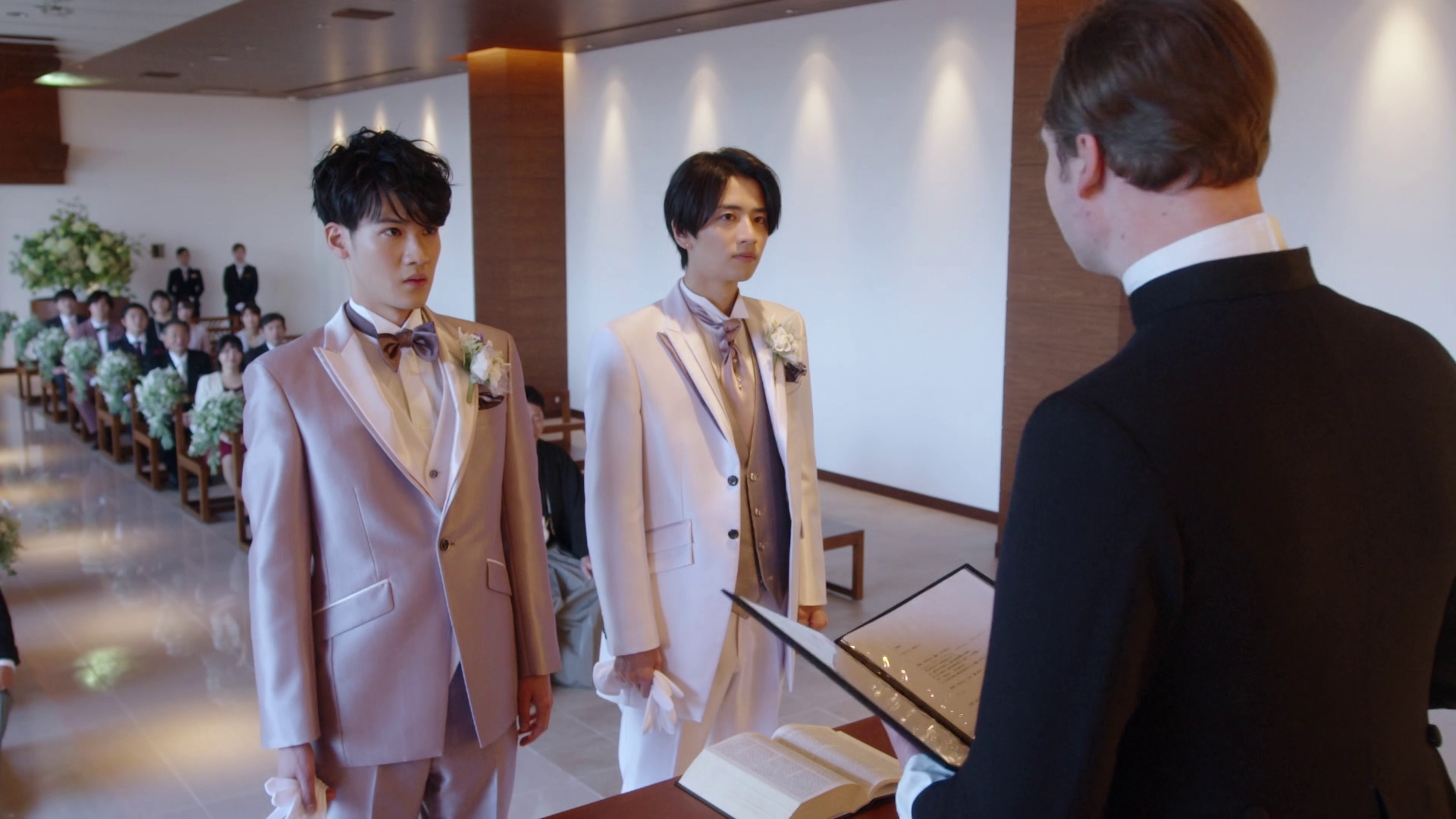
Ryosuke (Shono Hayama) is about to marry the love of his life, Mizuki (Hiroki Iijima), but there’s just one snag. He’s never got round to telling his family or any of his friends that he’s gay, and a sizeable contingent of the wedding party are under the assumption that he’s going to be marrying a woman. A recent addition to the wedding farce genre, Koji Tanaka’s We’re Both Grooms (僕もアイツも新郎です。, Boku mo Aitsu no Shinro desu.) explores both the lingering homophobia in the contemporary society and the internalised shame and fear that prevents people from fully committing to what it is they really want out of life.
It is after all perhaps a little bit strange to meet your child’s intended for the first time at the wedding, but no one really seems to remark on the fact that they have no idea who the groom is supposed to be marrying. But then again, it seems Ryosuke didn’t invite half of these people, they were reeled in by his overzealous mother who, like everyone else, has made a massive assumption. That in itself may imply that Ryosuke doesn’t have many friends. He doesn’t seem to have invited anyone to the wedding aside from his boss, the headmaster of the school where he works, whom he also hasn’t told he’s gay leading to some last minute wedding speech panic. Though his boss is keen to assure him he’s fine with that sort of thing, it’s clear his original speech was full of misogynistic jokes and male banter, while his attempts to correct himself reveal a latent homophobia.
Meanwhile, a childhood friend, again invited by Ryosuke’s mother, is on the one hand hurt he never shared this part of his life with her, and resentful as it seems she had romantic designs on him that prevented her from pursuing other relationships. Mizuki has also invited an ex to the wedding who takes Ryosuke to task for treating Mizuki like a dirty secret, asking how they can live a happy life together if Ryosuke can’t even acknowledge their relationship in public let alone tell the world of his love for Mizuki. Mizuki is also starting to feel guilty and conflicted, realising that he’s insensitively forced Ryosuke into coming out because of his desire to paper over his own anxiety about their relationship through a public commitment ceremony. Japan does not currently legally recognise same-sex marriages, but Mizuki is hoping that the wedding will clarify their relationship status and what they mean to each other, only it seems to have backfired.
The main obstacle is Ryosuke’s traditionalist, civil servant father (Mantaro Koichi) who outright tries to stop the wedding claiming that his son is just “easily led” and must have been led astray by Mizuki. While all of Mizuki’s family know and accept that he is gay and have also warmed to Ryosuke, Ryosuke’s family do not seem to understand and cannot get their heads around the idea of two men being in a committed relationship despite the grandmother’s public telling off of her son and unexpected announcement that she too is bisexual and that her first love was another woman. Surprisingly, Ryosuke’s father explains that he used to be a delinquent so he faced familial disapproval when he married too but was warmly supported by his wife. Though he confesses that he really just wanted to see Ryosuke marry someone who would make him happy, it takes him quite a bit longer to figure out that he’s trying to do just that.
The biggest problem remains, however, Ryosuke himself who has evidently not reached the level of self-acceptance that would allow him to fully commit to a romantic relationship, as he’s advised by the ever-helpful wedding planner trying to keep the event on track. Only once he becomes more sure of himself, can tell people proudly that he is gay and that Mizuki is the love of his life, do those around begin to see the authenticity of their relationship and accept it as they would any other. Even Mizuki’s incredibly stiff father eventually comes around with a speech to the effect that the true beauty of life lies in diversity. Despite the farcical comedy at its centre, the film ends on a surprisingly touching note as the couple reaffirm their love for each other and also see it embraced by those around them.
Trailer (English subtitles)
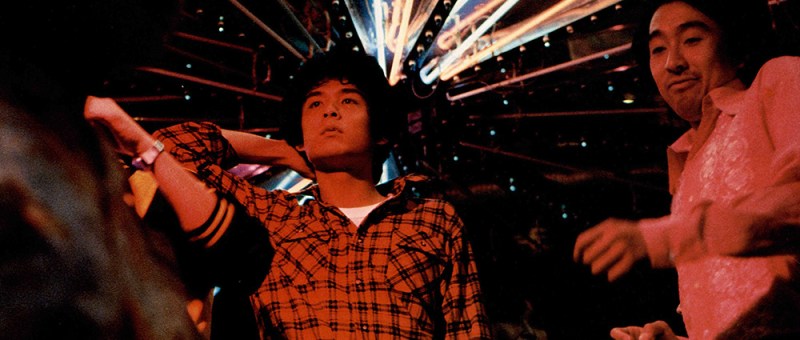

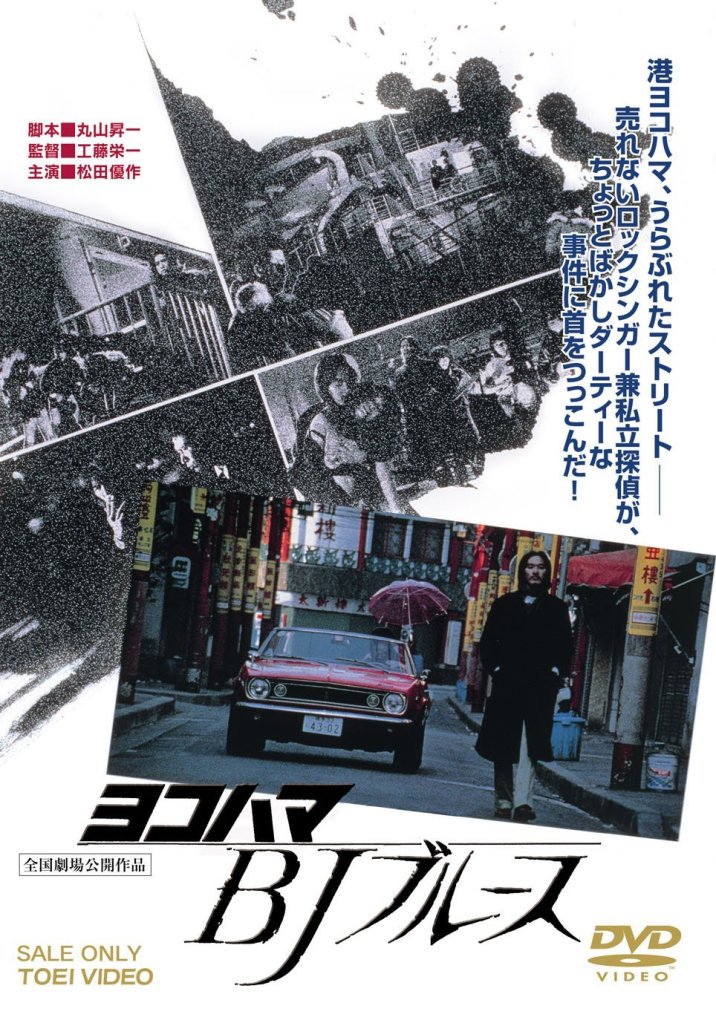 Yusaku Matsuda may have been the coolest action star of the ‘70s but by the end of the decade he was getting bored with his tough guy persona and looked to diversify his range a little further than his recent vehicles had allowed him. Matsuda had already embarked on a singing career some years before but in Eiichi Kudo’s Yokohama BJ Blues (ヨコハマBJブルース), he was finally allowed to display some of his musical talents on screen as a blues singer and ex-cop who makes ends meet through his work as a detective for hire.
 Windows on Worlds