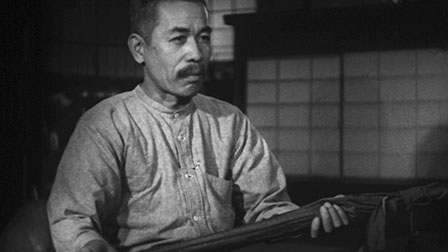
The Living Magoroku 生きてゐる孫六 (Keisuke Kinoshita, 1943)

Film_Eclipse_LivingMagoroku_original

The Living Magoroku, the second film in Criterion’s Kinoshita and World War II box set, is the director’s second feature also made 1943 shortly after Port of Flowers. Like his previous film, it was also made under the severe censorship requirements in place during the war but this time around the propaganda is far more pronounced though still fairly mild given the time period. That said, The Living Magoroku is still full of the wit and warmth characteristic of Kinoshita’s filmmaking even if it is forced to up its jingoistic content.

Incongruously beginning with a samurai battle taking place in 1573, the action quickly shifts to the same battleground where a group of raw recruits are being put through their paces before being sent off to die nobly for the Emperor in distant lands. Berating them for their lack of respect, the instructor reminds them that each recruit is descended from the very men who died on fields like these whose graves they should still be tending. This small rural town still goes by the old ways. There may be no real samurais anymore but each and every decision has to go through the local matriarch, Mrs Onagi. Actually, Mrs Onagi has a son who should rightfully be in charge but he’s such a neurotic drip who thinks he’s dying of lung disease that no one pays much attention to him. The Onagis own the entire battlefield area, some 75 acres, given to their ancestor after the battle and legend has it there’s a curse that should anyone try to cultivate it all the men of the Onagi line will die young. The field has remained untouched for 300 years, but with a war on shouldn’t the Onagis rethink their reluctance to turn this wasteland into a productive agricultural area, even if the ridiculous idea of an ancient curse was somehow real?

Like Port of Flowers, The Living Magoroku is actually fairly light on militarism despite featuring a group of soldiers and prefers to focus on the slightly backward looking nature of this small village. Even under the conservative nature of wartime Japan, it’s odd that a couple of young people would feel the need to ask the old lady at the manor for permission to marry given that she really has very little to do with them – and even odder that she would refuse to give it and that her refusal would actually bother them. The cause of the problem being that the girl’s brother is the chief instigator of the motion to get the field back in use, and that he went directly to the young master rather than the mother who’s been de facto in charge of these things. Local politics – some things never change! The young people want to use the land, curse-shmursh, but the old people would rather not. Just suppose the curse is real – poor Yoshihiro, technically head of the Onagi family, is so worried about his prospective fate (and the way his mother, grandmother and sister seem to worry about it for him) that he’s almost paralysed with fear and resentment!

Thrown into the mix is another problem concerning the sword referenced in the title – a sword of unparalleled fineness forged by Maguroku the First of which very few survive. The instructor at the army base claims to have one which infuriates the local blacksmith and sword expert as he simply refuses to believe it. By coincidence, the Onagis also have one of these swords and are paid a visit by an army doctor seeking to buy it as, it turns out, his family once owned one but he sold it unknowing its rarity to pay for his medical tuition. Of course, the Onagis don’t want to sell a precious family heirloom, though they admire the doctor’s zeal to repay his debt to his late father by acquiring another one. The instructor’s sword turns out to be a fake anyway prompting the blacksmith to make him a new one – after all, needs must and a sword is just a sword, the name on it won’t matter much on battlefield. Similarly a field is just a field, isn’t it selfish not to use it when the country needs grain even if it might cost your life seeing as every other young man is looking down the barrel of a gun at the present time? The message is clear, traditions should be honoured, yes, but when it comes down to it, the present is more important than the past and superstition gives way to clearheaded pragmatism. Every resource must be pooled for the common good and personal sacrifices must be made to ensure a better future for everyone.

The Living Magoroku feels a little more uneven than Port of Flowers, and actually ends quite abruptly with a strange newsreel style wrap-up of events. Luckily, it’s still broadly a comedy in strictest sense (it ends in a series of marriages, everyone not already married ends up wed), poor old Yoshihiro gets a new lease on life and becomes a productive member of society, the village gets a bumper harvest and all is right in the world save the strange final message about the instructor who is apparently carrying his new sword bravely in the heat of battle. Like Port of Flowers, it wants to reinforce the traditional values of community spirit and giving up your own individual pleasures and freedoms for everybody’s good. The past informs the future, how could it not, but when push comes to shove you have to let it go. Like everything in life there has to be a balance, respect your history – yes, but not so much that it costs you your future.

Port of Flowers 花咲く港 (Keisuke Kinoshita, 1943)

film_syosai_img_01_04-thumb-730x480-1642Keisuke Kinoshita is far better known in his native Japan than outside it despite his long and prolific career in filmmaking. Equally adept at comedy and tragedy and tackling all genres from musicals to crime dramas, Kinoshita began his career in the relatively turbulent war years where every last detail was at the censor’s mercy.  Port of Flowers is his very first foray into the director’s chair and began a long association with the comedy genre. Though, yes, it has it’s obligatory moments of bare faced propaganda, the film is refreshingly light on heavy handed political statements and prefers to focus on a humorous take on small town life.

Life in a sleepy little port town is about to get significantly more exciting after the local inn has received two rare telegrams purporting to be from the same man but sent from different locations one day apart. The man in question claims to be the son of a businessman who lived in the town some years previously but has since died and the bereaved child has a hankering to see the little shipping village that the father apparently loved so much. After picking up their new guest at the station the mini delegation of inn keepers and officials are shocked to discover another disgruntled customer also claiming to be the sender of the letter. Sufficed to say neither of the two in question is what he claims to be but has come to town with the intention of fleecing some gullible country bumpkins out of grandma’s silver. The two decide to work together but eventually the goodnatured enthusiasm of the villagers (and the rising war effort) begin to make them rethink their nefarious ways!

Given the time period and strict censorship, it would be ridiculous not to expect some degree of pro-war sentiment in the film but Kinoshita has managed to more or less leave the conflict as merely a background setting. Life in this little fishing village seems fairly tranquil and the war has barely encroached on its idyllic settings. There are youngish men about, the people aren’t rich but they aren’t afraid and the only mention of turbulence seems to be a young woman who’s recently returned from Manchuria not entirely at her own volition. There are some fairly excited mentions of various victories but these are fairly minor events, almost like something happening far away to other people to whom you feel connected but not quite involved with. The most important thing is the building of the ship – not only is it a source of pride for the villagers, a way of fulfilling the dream of a respected visitor they all remember fondly but it will also be for their country. Everyone must contribute as they can because it’s for the entire community of citizens, not just the village but for everyone in the country and it’s important. Their sacrifice and hard work will matter because it will be for the greater good.

Here endeth the lesson, for the most part. What of our two bumbling crooks? It’s never really explained how they came to know so much about this poor, unsuspecting community and simultaneously hatched on the same scheme at the same time but they must have been pretty well out of options to think these poor villagers were going to be worth this much effort. They came to commit a fraud but ended up having to actually do the impossible and make their improbable scheme work solely because the villagers’ kindness was too much to bear. The addendum to the lesson being that pure hearts can shame the devil and innocence becomes infectious after a while (in the best possible way).

Very much of its time and with an air of disposability, Port of Flowers is an enjoyable, surprisingly warm film but not without its faults. Eschewing heavy handed propaganda for a subtle enforcement of traditional, communal values it reflects Kinoshita’s subsequent humanistic concerns and even manages to do so without giving in to the censor’s red pen. A nice take on an old story, Kinoshita once again proves that nothing matters so much as people and goodness will always win through in the end.

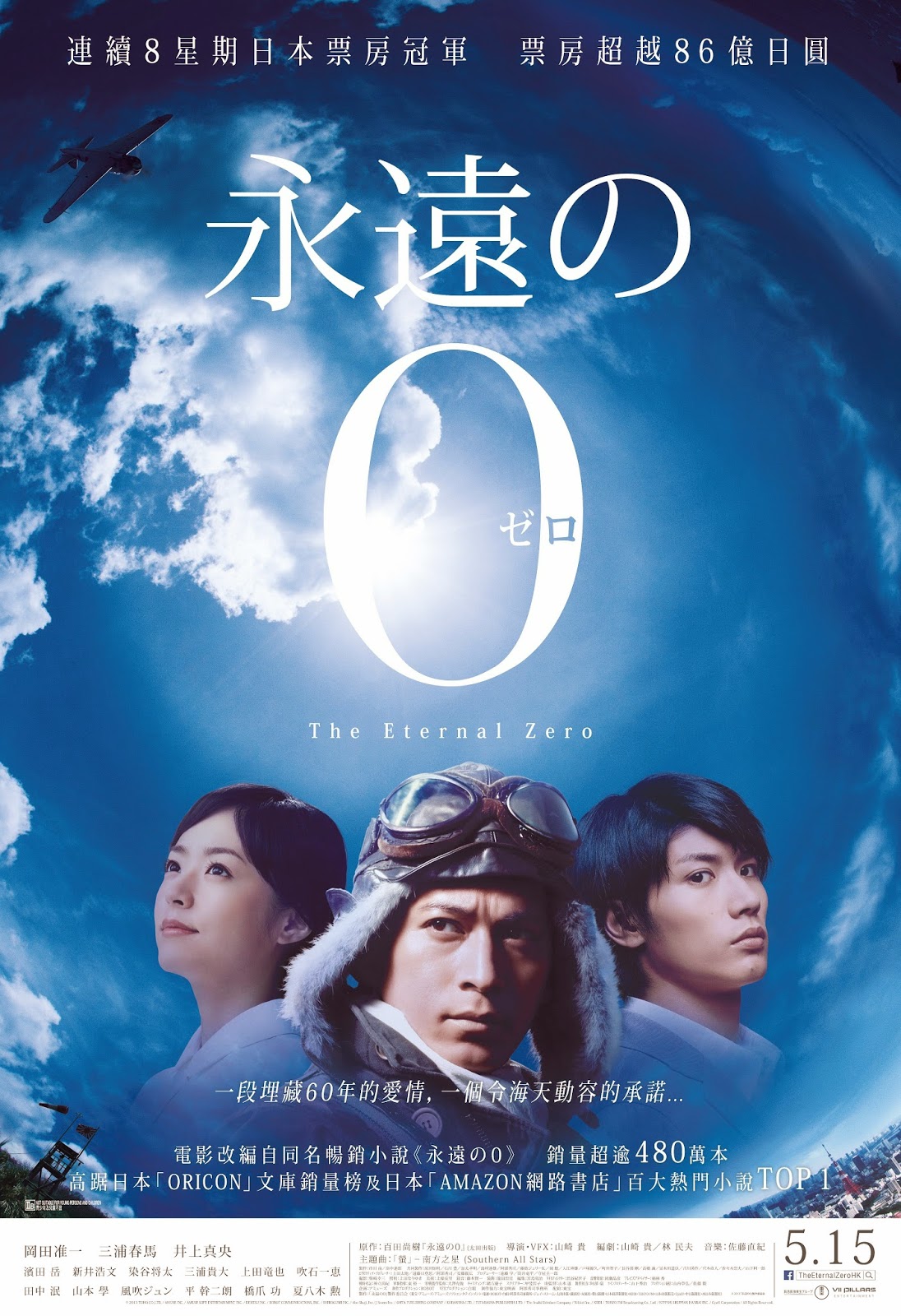
The Eternal Zero 永遠の0

eternal_zero

It’s difficult to think of a recent film that’s caused quite as much controversy as The Eternal Zero (save perhaps Hayao Miyazaki’s own World War II epic The Wind Rises). Written by a right wing pundit and close ally of current Japanese prime minister Shinzo Abe, Naoki Hyakuta, The Eternal Zero definitely has an ambiguous stance on several things that most people just don’t really want to talk about. However, it would also be fallacy to pretend that anybody else’s war movies are completely unbiased, or willing to look at the complexities of any given war beyond jingoistic drum beating which has often been the point of a war film. In truth, The Eternal Zero is actually more or less a-political for most of its running time save a possibly misjudged epilogue which does its best to undo the entirety of the film’s message up until right before the fatal flaw. Setting politics to one side, how does The Eternal Zero fare when it comes to taking this most American of subjects, in the most American of ways? Pretty OK, to be frank, not bad at all.

Like a lot of Japanese films tackling the recent past, the film starts in the present with little lost boy Kentaro (Haruma Miura) attending the funeral of his grandmother whereupon he discovers the heartbroken man he’d assumed to be his biological grandfather (Isao Natsuyagi) was in fact his grandmother’s second husband and not his mother’s true father at all. Mind truly blown, Kentaro is talked into further investigations by his older sister in which he discovers his biological grandfather was an air force pilot who died in a kamikaze mission during the war. On talking to some of his fellow officers, Kentaro and sister first hear that their grandfather was a coward, a supposedly skilled pilot who hid in the clouds during sorties and endangered the lives of his comrades through his negligence. Until that is, they chance upon those closest to him who tell a different story – that Kyuzo Miyabe (Junichi Okada) was the bravest of men. A man who knew the war was pointless and wasn’t afraid to say so, who simply wanted to survive and get back to protecting what was most important to him – his wife and child. Why then, would this man who was so desperate to survive finally give his life in a suicide mission for something he did not believe in?

To deal with the most obvious question first – no, The Eternal Zero is not “a propaganda film” in the truest sense of the term. Yes, it ignores the external context because it simply wants to focus on the nature of war and what it does to those who conduct it (as well as those who only stand and wait) which *is* a form of propaganda in a sense because of all the things that it refuses to acknowledge. However, for 90% of the running time, the film has a thoroughly modern sensibility where the overriding feeling is absurdity, that this war is a crazy waste of youth that no one should have to have gone through. The original group of pilots that brand Miyabe a “coward” are shown up for a group of brainwashed idiots and Miyabe portrayed as the soul prophet who sees things as they are and has the courage to speak his mind. Later, there are other headstrong boys who think they’re men and don’t understand what they’re getting themselves into but the main thing is just how stupid all of these ideas of honour and sacrifice really are when all it will likely mean is leaving destitute women crying and starving at a home you’ve failed to protect. However, all of these more “liberal” ideas are totally undercut in the last five minutes of the film which seeks to glorify an act that the previous two hours have branded an idiotic waste of life. Politically confused, Eternal Zero doesn’t quite know where to put itself when acknowledging the tremendous sacrifice that was made by an entire generation without quite wanting to see just what those sacrifices were in name of.

To be fair to it, it isn’t as if most most Hollywood war movies don’t also do the same thing to a similar extent – present the heroism and perhaps the personal conflict without acknowledging all that goes with it. In truth, what The Eternal Zero most resembles is a classic Hollywood war film which is quite invested in remorse for the loss of life (and sometimes even for that on all sides) but also in not wanting feel any lives were lost in vain. Thus there is a feeling towards the end of the film that young people of today still owe a debt to these men, that they owe it to them in return for the sacrifice that was made to live their lives freely and to the utmost. To spend so long saying that war is a cruel game that makes pawns of young men’s lives only to turn around and say it’s the job of the youngsters of today to make those pawns kings is a little perverse, but understandable on a human level.

The Eternal Zero is blockbuster movie in every sense, the budget and shooting style are also aping your typical Hollywood epic though doing it fairly well. The script is clunky with its inelegant switching between time periods and to be frank the entire “modern” section feels a little superfluous and underwritten.  It’s a little long at over two and a half hours and does occasionally fall into a televisual rhythm – there is a great deal of talking and explaining which probably would have had more impact if it were done in a less bald way. Nevertheless, what The Eternal Zero sets out to do, it does pretty well. It may speak to something dangerous, but it is not dangerous in and of itself. For the most part excellently filmed with its fair share of stand out sequences, The Eternal Zero will appeal most to fans of old-fashioned (and uncomplicated unless you want to really think about it) war films but may struggle to maintain the interest of more jaded viewers.

The Tale of the Princess Kaguya (かぐや姫の物語, Isao Takahata, 2013)

no3_kaguya_nikonikoboard_outSo, Studio Ghibli is no more. For the moment anyway – both of the old masters have hung up their paint brushes for good, intent on indulging other pursuits, or so they say. Neither has yet found a suitable apprentice to succeed them and so all Ghibli’s revels are now ended, the staff is broken, the book is burned and it’s time we all went home. We’ve not quite set them free yet though, 2014 saw both the founders release their “final masterpiece” in a pattern that was intended to mimic their early success – the double header of the gently melancholic yet uplifting My Neighbour Totoro and the utterly devastating Grave of the Fireflies. Miyazaki’s The Wind Rises read like a deeply moving final poem – a artist’s apology for his failings as man. Takahata’s, in a pattern reminiscent of his career overall, feels in some ways harsher. He pushes deeper both artistically but also emotionally, less cynical but also perhaps less forgiving. Based on the classic Japanese folktale by the same title, often translated into English as The Tale of the Bamboo Cutter, The Tale of the Princess Kaguya is another late career masterwork from Takahata that cuts right to the quick of what it means to be human.

Bamboo cutter Okina makes his everyday journey up the mountain to cut bamboo, but this time finds a single stalk shining strangely. When he cuts into it, a tiny yet elegant lady is sleeping inside. Quickly realising she must be a princess sent from heaven, he carries her home to his wife in whose hands she suddenly morphs into a screaming human child. The couple embrace their miraculous gift heartily and raise the girl as if she were their own. “L’il Bamboo” as the other village kids call her, grows at an alarming rate, but enjoys an idyllic country childhood full of long hot summers, juicy, ripe melons pinched from a neighbour’s garden and fantastic adventures. However, another shining bamboo stalk has yet more presents for Okina in the form of gold and expensive kimonos. Believing his little princess is intended for the life of a noble woman, not that of the lowly daughter of a bamboo cutter, he buys a big house in the city filled with teachers and servants. However, one person’s idea of “best” can be quite different from another’s, and no matter how much you love someone, there are lines that cannot be crossed.

Li’l Bamboo is an elemental creature, meant for frolicking with frogs and dancing under cherry blossoms but Princess Kaguya, the name given to her by a nobleman as she comes of age, is forced into the constrained life of a court lady. Imprisoned inside her castle, separated from her childhood friends and confined to a life of sedately studying “the feminine arts” Kaguya’s once wild love of life seems to dissipate under the weight of adulthood. Even on a rare (and secret) journey outside to once again view the transient cherry blossoms, she decides to return almost immediately after encountering a mother and her children who rapidly kneel, apologise for their presence and leave. Feeling the ever present barrier between herself and “ordinary” people because of her fine clothes and appearance, Kaguya retreats despondently. However, as relative “new money” to the noble set, she doesn’t fit in there either.

The life that Okina envisages for his “princess” maybe one that society regards as better, but that isn’t to say it’s the best for everyone. Okina’s tragedy is that he never stops to consider his adopted daughter’s own feelings. The responsibility he takes is too great and he never sees that he’s stifling the gift nature has given him. Kaguya goes along with most of this because he’s her father and she doesn’t want to displease him, but she’s constantly setting free caged animals because she herself feels so imprisoned. Okina’s desire to ensure his daughter’s future happiness has only made her miserable and in the end will cost them both dearly. As common now as it’s ever been, this classic miscommunication between parent and child is made all the more tragic because it has love at its core.

Unfolding like an illustrated scroll, Princess Kaguya is full of beautiful and imaginative artistry. With its beguiling watercolour-like aesthetic, the film often breaks into breathtaking, impressionistic spectacle that can allow a girl to dissolve into the landscape or summon dragons from the clouds and waves. It’s a style that’s perfectly suited to the classic nature of the story which is only aided by the traditional, folk-tale narration and whimsical score from Joe Hisaishi (working with Takahata here for the first time despite his long association with Studio Ghibli as a whole).

A fitting end to a long and sometimes difficult career, Princess Kaguya is, in the end, a tale of sad yet inevitable partings. Still, though Kaguya was often unhappy on Earth, ultimately she doesn’t want to leave nor to forget her experiences be they of joy or sorrow. Perhaps better appreciated from a perspective of age, Princess Kaguya is a sorrowful tale in many ways, full of misunderstandings and missed opportunities yet there is great beauty in it too. All things must pass, and we must bid goodbye to Studio Ghibli (for now, at least) though painful as it may be, we ought to be grateful for having had something to grieve.

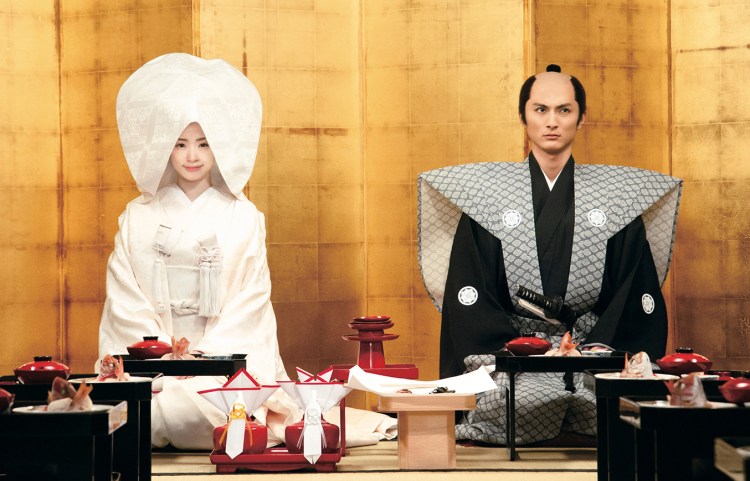
A Tale of Samurai Cooking – A True Love Story (武士の献立, Yuzo Asahara, 2013)

A-Tale-of-Samurai-Cooking-teaser

I kind of love this photo because he already looks so annoyed 🙂

Review of period romantic comedy/drama with a side serving of culinary delight A Tale of Samurai Cooking – A True Love Story up at UK Anime Network.


It’s a little known fact but though all samurai carry swords, some of them hang them up when they get to work and serve their lords with meat cleavers and skewers in the relative safety of the kitchen rather than the noisy chaos of a battlefield. Of course, a retainer’s job is to serve the lord in whatever capacity is expected of him, though some maybe happier with their dictated fates than others. In A Tale of Samurai Cooking – A True Love Story (武士の献立, Bushi no Kondate), it’s not only a conventional romantic tale between two initially mismatched people that the title alludes to, but also how one may fall in love with a path in life that was once deeply resented.

Back in feudal Japan, Haru (Aya Ueto) is an orphaned maid servant to a prominent samurai house. She was briefly married, but embarrassingly enough was “sent back” because her new husband and his family found her far too headstrong for their household. The daughter of a pair of restaurateurs, Haru has a keen sense of cooking of her own which sees her catch the attention of a visiting famous cook, Dennai Funaki (Toshiyuki Nishida), when she is the only person able to guess the real ingredients in his “mock crane” dish. Instantly smitten, Dennai makes her a proposal – albeit one for his son who is set to take over the family business but has no real aptitude for cooking. Yasunobu (Kengo Kora) is his second child whose fate was sealed on the death of his elder brother and though he would rather be a more conventional kind of samurai, he is the only heir to this kitchen empire. Can Haru’s cooking skills raise a fire in Yasunobu’s heart for his unwanted destiny or will they both be subjected to a lifetime of cold dinners?

A Tale of Samurai Cooking is definitely much more “period drama” than “samurai movie” though it does share a little of the historical intrigue of your typical “jidaigeki”. Set in the Edo period of feudal Japan, there are plenty of sudden reversals of fate where one house jumps ahead of another which then falls out of favour, sometimes with tragic consequences. However, though those these events inform the drama they are really just the backdrop to the true story of the very grown up (though extremely chaste and innocent – this is a U rated movie!) slow burning love story between Haru and Yasunobu. Though it’s a very charming and old fashioned sort of romance, it’s also true that Kengo Kora and Aya Ueto don’t have a tremendous amount of chemistry and their love story is pretty subtle and one sided until very late into the film. Of course, the audience knows how this sort of film has to end, but the film does rather rely on this fact.

Yasunobu is at heart a kind man undergoing very difficult circumstances. Having had to let go of the life he wanted that was so nearly his following the death of his older brother, it isn’t a surprise that he’s generally sullen and extremely resentful that his father has arranged this marriage for him with a slightly older woman who’s already been married once before, not to mention the fact that it’s all because she’s better than he is at this thing he’s now supposed to do for the rest of his life. Yasunobu doesn’t even like cooking, he thinks it’s “woman’s work” and had devoted his life to the art of the sword. Luckily, Haru’s perspicacity extends beyond her palate and she’s quickly figured out what’s going on with Yasunobu so she can turn him into the ace cook his father needs him to be. Haru’s influence opens up his wilfully closed eyes to the rewards of both good women and good cookery which is part way to saying that food cooked with love can heal a broken heart, but it’s equal parts changing times and a young man growing up.

As films about food go, A Tale of Samurai Cooking certainly has a fair few mouth watering dishes on display but perhaps lacks the hearty fare of something like the comparatively more sensual, though equally comic, Tampopo. In truth, its overwhelming quality is a kind of inoffensive niceness and perhaps for some tastes could have done with a little more spice though like the best Japanese cuisine offers its own rewards precisely because of its subtlety. It’s a perfectly nice light meal, but you’ll probably wishing you’d gone for something more substantial come bed time.


I went a bit overboard with the food metaphors, which is maybe what you get when you spend your food budget on movie tickets. I regret nothing.

Anyway this is showing at the Curzon in Mayfair until tomorrow, though they did say it may extend if there’s enough interest. It’s also going to be screened at the Genesis Cinema in Mile End and the Everyman and apparently will open in Ireland from 9th January. Yume Pictures will then release it on DVD in 2015 if you aren’t near a cinema that’s showing it, or you can even watch it on Curzon Home Cinema right now.


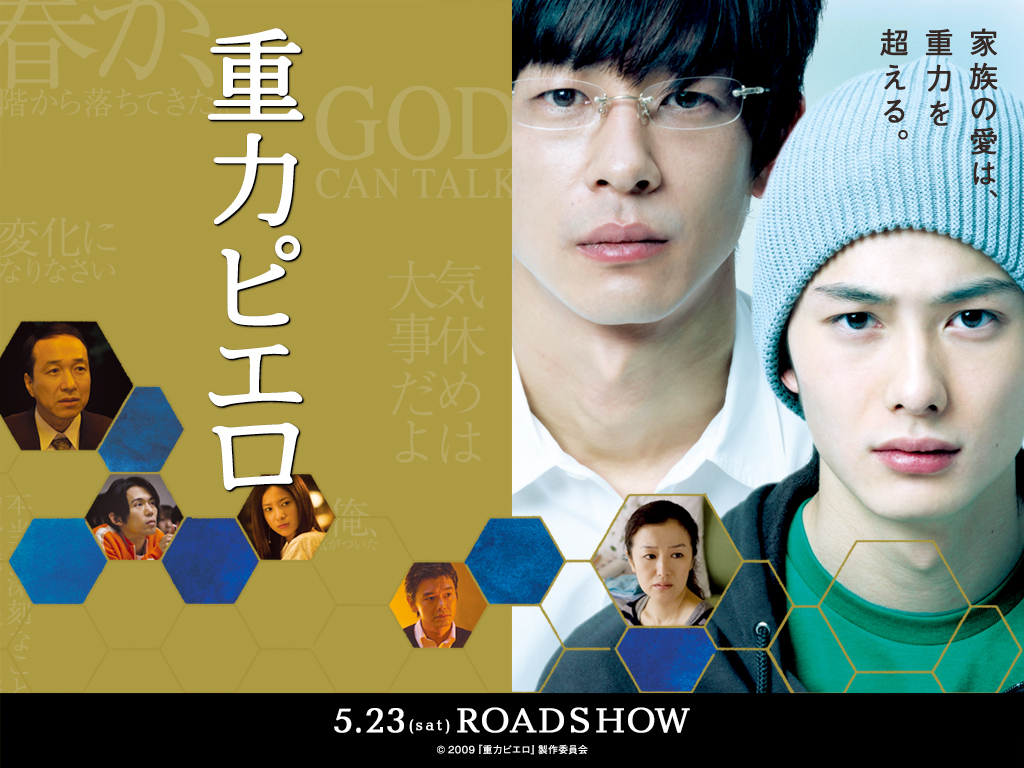
Gravity’s Clowns (重力ピエロ, AKA A Pierrot, Junichi Mori, 2009)

wp03_1024-768

Based on a novel by Kotaro Isaka (Fish Story; The Foreign Duck, the Native Duck and God in a Coin Locker), Gravity’s Clowns is the story of two very different brothers who discover a dark family secret following the death of their mother. Part mystery story part character drama, Gravity’s Clowns takes a look at the themes of nature vs nurture as well as the importance of familial love and acceptance.

Returning home for the first anniversary of his mother’s death, Izumi (Ryo Kase) and his younger brother Haru (Masaki Okada) spend some time with their father Tadashi (Fumiyo Kohinata) reminiscing about the past. Watching a local news broadcast, Haru realises the site of a recent arson attack is not far from where he’s been working. Noticing a pattern in the location of the attacks, Haru decides to investigate and ropes his brother in for the ride. However, the mystery Izumi finds himself embroiled in ends up being far different than the one he imagined.

It’s revealed fairly early on in the movie, but the fact of the matter is that Izumi and Haru may only be half brothers as their mother became pregnant with Haru shortly after being brutally assaulted in her own home by a serial rapist operating in the area. Having decided to have the baby and raise the child together whatever his true parentage, Haru’s parents did their best to give him a normal, loving upbringing alongside his older brother. Though there was some gossip in the town thanks to the incident’s notoriety, neither Haru nor Izumi were aware of their mother’s ordeal until after her death. After discovering the truth, both brothers react in different, though ultimately similar ways.

As a mystery, Gravity’s Clowns tries to pack in a fair few twists and turns though ultimately they are all quite obvious and frequent viewers of crime thrillers or psychological dramas will have guessed the entire plot in the first ten minutes. However, the mystery is definitely of secondary importance to the character drama that is being played out in front of it. The real key to the film is in the relationship between the two brothers, and to a larger extent the family as a whole. What’s important is that the brothers support and and love each other no matter what and as their father told them, their family is the strongest family there is. No matter what past traumas or biological facts may interfere, these guys will always come through for each other.

Having said that, the narrative does meander somewhat and in particular the “comedy stalker” subplot feels a little out of place and under developed. Despite playing a crucial plot role, and providing quite an amusing joke early on in the film and at its end, Yuriko Yoshitaka’s “Natsuko” (this is just a nickname and a fairly amusing pun as Haru’s name means “spring” and she always follows him around so they called her “Natsuko” which means “summer’s child” , she doesn’t even get a proper name) doesn’t have a tremendous amount to do. Likewise, the small but important role played by the boys’ father feels as if it bounces around a little in terms of weight as does that of their mother who is only seen in flashback. Ultimately Gravity’s Clowns over reaches itself as it tries to tackle some more weighty themes like nature vs nurture and the ethics of certain kinds of crimes which are only addressed in a very superficial way, and in fact concluded fairly ambiguously.

A flawed, if pleasant enough character drama, Gravity’s Clowns is generally entertaining but ends up feeling a little insubstantial. High quality and committed performances from the cast and especially from Ryo Kase and Masaki Okada as the two central brothers help to elevate the material but somehow it never quite takes off. Heart warming and actually quite funny at times, Gravity’s Clowns is a noble effort but one that ultimately fails to strike home.

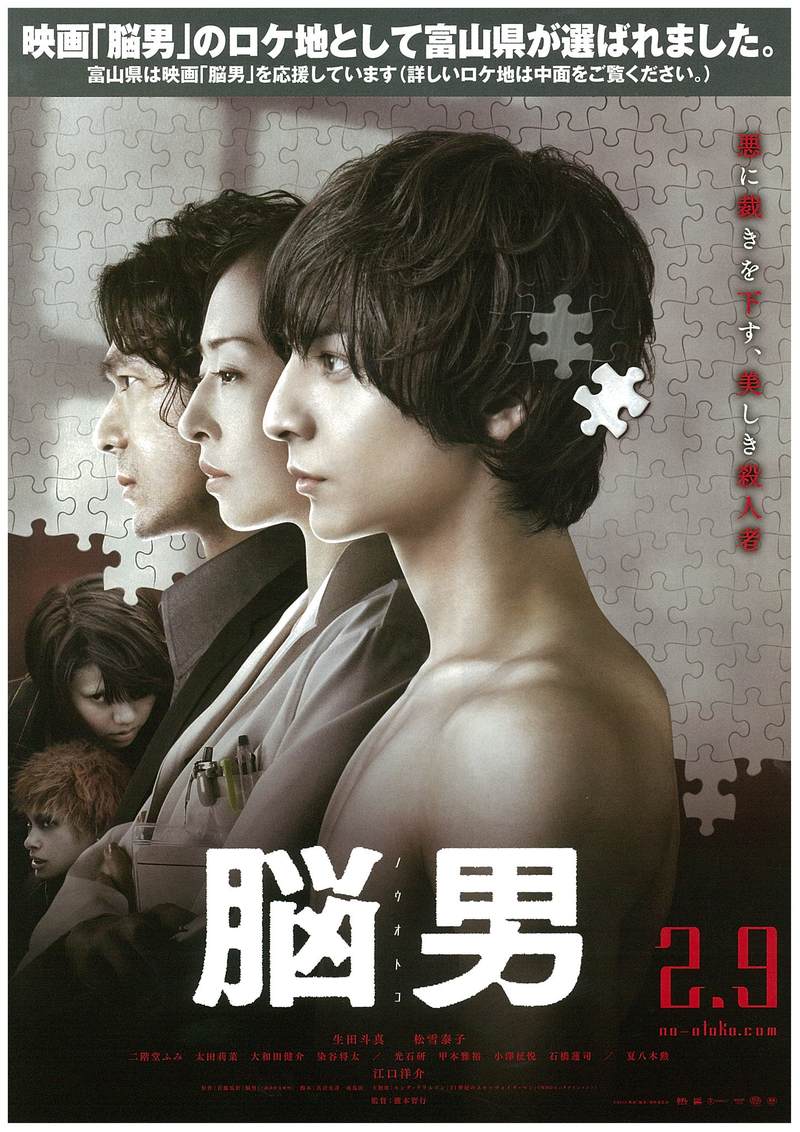
Brain Man 脳男

imgnewly1-187l

Based on the Edogawa Rampo award winning novel by Urio Shudo, Brain Man is a stylish psychological thriller which addresses such themes as guilt, redemption and the effects of childhood trauma. Are some people just born bad, can even those who’ve committed terrible crimes be rehabilitated? People on opposite sides of the legal system seem to have some conflicting ideas but perhaps the answer is never going to be as simple as ‘yes’ or ‘no’.

While a series of explosions rock a small provincial town, forensic psychologist Mariko Washiya (Yasuko Matsuyuki)  is the head of a research programme which aims to help convicted felons come to terms with their crimes through interacting with the victim’s families and there by coming to feel a kind of empathy for all the hurt and destruction they have caused. After leaving the office one day she races to catch the bus only to miss it by seconds while a bunch of bratty kids make faces through the window. Moments after the bus pulls away, it explodes killing all on board. Becoming an unwitting witness to events, Mariko finds herself at odds with the hardline policeman investigating the crime. When the police arrest the perfect suspect, a strange, near silent man discovered at the site of an explosion, Mariko is called upon to examine him. Ichiro Suzuki (Toma Ikuta) presents himself robotically, answering each of Mariko’s questions at face value no matter how strange and otherwise remaining motionless. That is, until something disturbs his sense of justice and he breaks out some killer martial arts moves. As might be expected, nothing is quite as cut and dried as it might seem on the surface and something convinces Mariko that there might be something more ‘human’ locked away deep down in Ichiro’s psyche.

First and foremost Brain Man is pretty mainstream thriller which means it isn’t totally free of a few melodramatic turns and far fetched plot developments but by and large it gets away with them. The first plot line centred around the bombings quickly gives way to the mystery surrounding Brain Man himself before getting back to the bombers towards the end. The two narrative strands sometimes seem at odds with each other and don’t feel as cohesive as they perhaps should. Though having said that though the “bombers” plotline is definitely the film’s second strand it gives ample room for Fumi Nikaido’s gloriously crazed depiction of a drug addled lesbian terrorist which she manages to play in a refreshingly restrained way (well, as far as the part allows – it is a particularly well pitched performance). There is also even a third subplot regarding Mariko’s prestige project of a young man who’s shortly to be released from a young offenders institute (played by Shota Sometani) seemingly rehabilitated and eager rejoin society all thanks to Mariko’s new therapy program which plays in conjunction with a fourth subplot concerning Mariko’s family and its own past traumas. Undoubtedly, there’s a lot to juggle but Brain Man makes a surprisingly valiant attempt at getting it all to work together.

Director Tomoyuki Takimoto is probably best known for his previous film Ikigami: The Ultimate Limit – a low budget though similarly impressive adaptation of a manga. Brain Man has a slightly higher budget and its fair share of flashy direction both of which impress from the get go. Even more so Takimoto has amassed a cast of up and coming stars who each turn in well rounded performances ranging from the completely out there extremes of the aforementioned Fumi Nikaido to Shota Sometani’s small but complicated patient and, of course, Toma Ikuta’s powerful portrayal of the near silent and emotionless killing machine the Brain Man not to mention Yasuo Matsuyuki’s warm hearted doctor.

Although a little slow to get going initially and excusing the odd lacuna brought about by throwing the points on the great train track of narrative, Brain Man manages to pack in a decent amount of excitement into its relatively tightly plotted structure. In many ways it isn’t particularly original, but it does what it does pretty well and mixes in enough twists and turns to keep even the most jaded mystery enthusiast interested. Perhaps a little bit too crazy for its own good, Brain Man is another classy Japanese thriller that isn’t afraid that isn’t afraid to go to some pretty strange places in the name of entertainment.

New Directors From Japan Box Set (UK Anime Network Review)

A1rM9z8kBbL._SL1500_Great new box set from Third Window Films reviewed on Uk-anime.net.


We’re used to Third Window Films bringing us some of the best in contemporary Japanese cinema (as well as a few classics too), but this time they’ve gone even further and let us in on the ground floor as we meet these three new directors on the rise. This project was also a first as it took the unusual route of going to Kickstarter to fund its production, albeit following a pleasingly straightforward pre-order system. The three directors featured in this set all come from different backgrounds and are working in very different genres. As such they represent the level of diversity in modern Japanese indie filmmaking and each prove they have something very different and particularly idiosyncratic to offer in their later careers.

The first of these up and coming directors is Nagasa Isogai who has two films featured in the set – her student film My Baby and her longer short film, The Lust of Angels. My Baby tells the slightly crazy story of two sisters whose sibling rivalry intensifies as they both plan to have children of their own. Made to very strict guidelines, it’s shot in a now old fashioned looking 4:3 screen ratio with non-sync sound and has a strangely ‘70s-esque feeling with its odd, melodramatic concept and mostly straight forward shooting style.

Similarly, Lust of Angels takes on a lot of baggage from ‘70s exploitation cinema and though shot in a more modern feeling 2.35:1 widescreen it still has a distinctly old school feeling. Taking its queue from the delinquent girl movies of the past, The Lust of Angels is a dramatic story about train groping and female revenge. Transfer student Yuriko accidentally catches the train to school, something which most girls don’t do owing to its reputation as a “groper train”, where she discovers fellow student Saori about to fall victim to just this unpleasant crime. However, unbeknownst to the others Saori catches the train because she enjoys the attentions of the various perverts who ride it and even goes so far as to carry a special book which marks her out as desiring their attentions. Exploring such complicated themes as the differing reactions to burgeoning teenage sexuality, sexual abuse and sexual violence as well as female violence and revenge, The Lust of Angels is one of the more complex efforts in the set. However, first and foremost it works best as an exercise in genre and proves enjoyable both in that regard and in offering a good deal of promise for the future.

Next up is Kosuke Takaya whose 27 minute short is the most straightforwardly comic selection on the bill. Made under the NDJC program which aims to give a helping hand to promising new Japanese directors, Buy Bling Get One Free is a humorous satire on the fashion industry. Its hapless protagonist Kamono is literally a fashion victim – much less interested in expressing himself than in fitting into a scene, Kamono is easy prey for a bunch of weird fashion cultists. While it is undoubtedly very funny (and totally packed with awesome puns!), Buy Bling Get One Free is slightly hemmed in by the constraints of the NDJC programme. As such it may feel like a slighter effort than the other offerings in the set but it does still allow director Kosuke Takaya to show off a fair amount of skill which bodes well for the future.

The final and longest film included comes from Hirofumi Watanabe whose 88 minute feature tells the surreal story of layabout Takashi who unexpectedly discovers he has a teenage half sister he was previously completely unaware of. Takashi is a divorced father with no job and no hopes or plans for the future but his sudden discovery of a little sister and the new found responsibility being a big brother prompts him into thinking about his life. Finally, he makes a decision but unfortunately it ends up involving drug smuggling, shady business and finally….aliens! And The Mud Ship Sails Away is definitely the most surreal film in the set. It starts off with a sort of Jarmuschian aloofness which is brought out by the relatively static camera and black and white photography but towards the end this has been completely turned on its head. The last and strangest act takes on a Gilliam-esque level of absurdity with completely crazy, jagged camera action and bizarrely framed super close-ups. Some may feel the third act is simply too much or at least too far removed from the relative naturalism of the rest of the film but for those who like their movies surreal with a capital “S” And the Mud Ship Sails Away is another excellent addition to weird cinema.

Alongside the films themselves the package also offers interviews with each of the directors discussing how they got into filmmaking and more specifically how they came to make these particular films, as well as their general hopes for the future. Additionally, there’s also an interview with producer Shogo Tomiyama who’s the supervisor of the NJDC programme at the moment but is also famous for his involvement in the Godzilla franchise. This entire package was something of a labour of love for its producers and a fairly risky business venture – hence the initial need for Kickstarter. However, what The New Directors From Japan box set proves is that there is a wide and varied crop of new talent hovering just below the surface of contemporary Japanese cinema. Hopefully not the last boxset of this kind, each of the films presented has its own degree of promise and it will certainly be interesting to see how these burgeoning careers develop in years to come.


Rurouni Kenshin 2: Kyoto Inferno (UK Anime Network Review)

ruruoni_kenshin_the_kyoto_inferno_still(saito’s just so cool!)

Review of the first Rurouni Kenshin sequel, Rurouni Kenshin 2: Kyoto Inferno up at UK Anime Network.


At the end of the first Rurouni Kenshin live action film, you might have been forgiven for thinking that this once wandering warrior had finally found a place to hang up his (reverse blade) sword for good. As fans of Nobuhiro Watsuki’s much loved manga and its anime adaptation will know, there’s no such luck for Himura Kenshin or the long suffering Kaoru as once again Kenshin will be called upon to put his unique skills to use and this time the very survival of Japan’s new era of modernism and equality is at stake!

Having successfully seen off would be drug baron Kanryuu and the false Battosai Jin-e, once remorseless killer Kenshin (Takeru Satoh) has moved into the dojo run by Kaoru (Emi Takei) and made a seemingly joyful life alongside Kaoru’s only pupil, the boy Yahiko (Kaito Oyagi), the doctor Megumi (Yu Aoi) and loud mouth Sanosuke (Munekata Aoki). However, the happy family’s peace is about to be rudely interrupted as an envoy from the Home Minister arrives and requests a private meeting with Kenshin. It seems an old enemy once believed dead has been discovered to be alive and currently plotting terrible vengeance against the new government in Kyoto. Shishio’s skills are matched only by Kenshin and so the government wishes to make use of his services once again to stop this new threat to the development of the modernising Japan. However, Kenshin has laid down his sword and dedicated his life to atoning for the lives he took as a warrior – will he really return to the life of a wandering swordsman? Originally reluctant and very much against the wishes of Kaoru, a tragic event finally convinces Kenshin he has no choice but to stop Shishio whatever the cost!

Even more so that the first film, Rurouni Kenshin 2: Kyoto Inferno is set against the backdrop of a Japan in the middle of earth shattering cultural shifts. The age of the Shogun is over, there are no more samurai or feudal loyalties to fulfil. This fresh new world of possibilities has no place left in it for the men who fought so bravely to bring it into being. Some, like Kenshin, hung up their swords and set themselves into atoning for the violence of the past by vowing to build a better, kinder, future. Others, however, like Shishio, were left with nothing other than the desire to return to a world where their skills mattered – the familiar world of lords and castles and glorious battles. Kenshin and Shishio are two sides of the same coin – light and shadow. Having been assassinated and thrown on a funeral pyre before miraculously surviving thanks to a fortuitous fall of snow, Shishio has made fire his very own symbol and primary weapon of attack. This new world is a hell for him and along with his bandage clad gang of followers, he’s about to plunge all of Japan into a fiery abyss too.

The first instalment was also notable for its fairly high production values and if anything, Kyoto Inferno even improves upon the original film’s impressive aesthetics. Fire in particular has often proved something of a bug bear for the modern action film and as you might expect from the title Kyoto Inferno is jam packed with flaming action. From its extremely striking opening scene, Kyoto Inferno lays on some of the most complex and beautifully filmed action sequences to be seen in a Japanese film in quite some time. Where it falls down slightly is bound up with its nature as the first part of a two part film as it is does begin to pile on the sub plots and risks becoming overloaded while the original gang (and particularly Yu Aoi’s doctor Megumi) end up with relatively little to do. Likewise, as with the first film the more manga-like elements such as some of the overly broad comedy or a couple of characters who are just the wrong sort of outrageous don’t quite fit with the otherwise classical feeling of the film though fans of the manga franchise may appreciate this attempt at remaining faithful to the source material.

In many ways the Rurouni Kenshin movies are just fluffy mainstream action films (not that there’s anything wrong with that) but Rurouni Kenshin 2: Kyoto Inferno is that rarest of beasts in that it manages to build on the foundations of the first film to become something greater with the result that it even helps to elevate the original. Of course, this largely hinges on how well the last part of the trilogy, appropriately entitled The Legend Ends will fare but suffice to say the first two thirds have stood it in very good stead. Action packed but with a tightly plotted storyline, convincing characters, good performances and high production values Rurouni Kenshin 2: Kyoto Inferno offers everything that’s good about blockbusters without any of the drawbacks. In fact the only real problem that the film presents is the likely long wait until The Lengend Ends finally arrives!


This is out in UK cinemas from Friday 28th November 2014 when it’ll play all these cool places:

  • Cineworld Enfield
  • Cineworld Crawley
  • Cineworld Sheffield
  • Cineworld West India Quay
  • Cineworld Glasgow RS
  • Cineworld Cardiff
  • Cineworld Stevenage
  • Cineworld Bolton
  • Vue Piccadilly (London)

Well worth seeing on the big screen, might even be better than the first one!

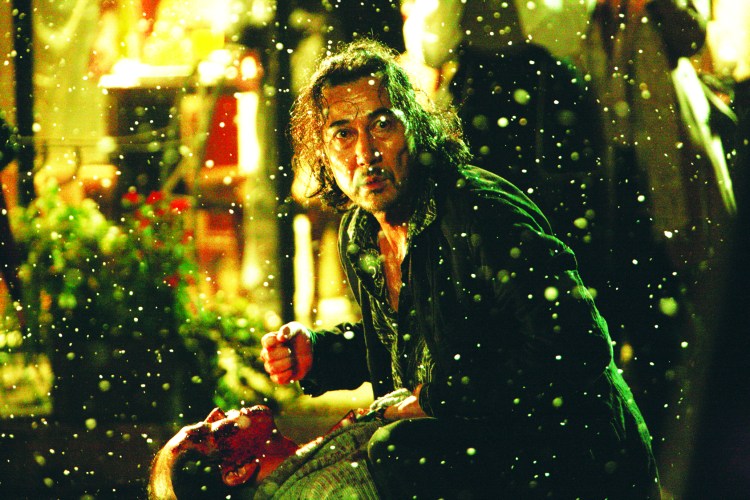
The World of Kanako (渇き, Tetsuya Nakashima, 2014)

WorldOfKanako-PAnother LFF review up at UK Anime Network – The World of Kanako. I was also lucky enough to interview the director, Tatsuya Nakashima, who was actually very nice and quite chatty in contrast to some of the other interviews I’d read with him! (The consequence being I had way too many questions so it’s sort of a front loaded interview, oh well.) Interview’s already transcribed and in the system so hopefully live soon.


Tetsuya Nakashima is probably best known for his 2010 film, Confessions, which saw a school teacher’s extremely convoluted bid to avenge the death of her daughter at the hands of her students spill out to reveal a whole host of other ‘confessions’ of varying natures from its out of control teenage cast. Though Confessions had its fair share of violence and blood, this is nothing compared to the hellish darkness which fills The World of Kanako. Corrupt cops, teenage femme fatales, wife beaters, child traffickers, pimps and drug dealers make up the cast of this grim exposé of just how wrong you can be about the people most close to you. Those of you with a weak disposition had better step off here – this journey is not for the faint of heart.

Disgraced former policeman Fujishima has a whole host of problems in his life, alcoholism and possible schizophrenia being but two of them. Suddenly he gets a call from his estranged wife who’s out of her mind with worry because their teenage daughter, Kanako, has not been home in a few days. On searching her room in true detective style, he finds a stash of illegal drugs hidden in her school pencil case. This alarming discovery sends Fujishima down an increasingly dark alley way that leads only to the heartbreaking realisation that the kind and beautiful straight A student he believed his daughter to be was no more than a figment of his own imagination.

Fujishima is not a nice guy. There’s not really any other way to put it – he’s an arsehole. A self aggrandising drunk who lives inside a dream where he’s a hero fighting for justice with a loving wife and adorable little daughter waiting for him in their beautiful home. Except that his wife wants nothing to do with him, he hasn’t seen his daughter in a very long time and he’s been kicked off the force and currently works in security. Often drunk and on medication he’s never quite in the moment and therefore neither are we – thrown between flashbacks and unreliable mental images, we begin to float just as freely as Fujishima. It’s testimony to the abilities of the great Koji Yakusho that somehow we still feel a degree of sympathy and a desire to understand Fujishima’s complex psychology despite his deep seated rage which is directed both at himself and others. Deluded beyond belief, his quest to find his daughter is really a thinly veiled attempt to save himself by resurrecting the idealised image he had of her as the one decent thing he’d been able to  build in his life.

His daughter turns out to be daddy’s little girl after all, just not in the way Fujishima originally thought. She may be beautiful and clever, but never kind and her attentions are always part of some grander plan. Like the femme fatales of old and despite her young age, Kanako knows how to get what she wants but what she wants is to cause other people pain. She too lives in a dream, or perhaps a nightmare, as she says at one point falling like Alice in Wonderland through a seemingly endless black hole. There aren’t any ‘decent’ people in this world, everyone is fighting to maintain some kind of delusional self image that will allow them to believe in their own goodness – often through projected images of an idealised family.

Coupled with this intensely dark world, the film wears its influences on its sleeve including ‘60s quirky cool action films, as evidenced by its psychedelic title sequence, and 50s Noir B-movies with their down at heel antiheroes who are often lost in worlds far darker than their imaginings. It’s also true the film is extraordinarily violent in way you don’t generally see in modern times but that doesn’t mean that Nakashima’s gift for intensely beautiful set pieces is entirely absent. The teenager’s world is full of extreme bubblegum pop and purikura garishness coupled with introspective retro tunes and animated sequences which contrast heavily with the adults’ universe of bespoke kitchens and ordered realities.

Ironically, Fujishima turns out to be quite a good detective, though the clues don’t lead him to the answers he really wanted to find. Where they do lead him is ever onward down a dark and dingy rabbit hole with no end in sight. It’s a gloriously bleak tale, but told with an ironic, detached eye that seems to be finding all of this cosmic lack of clarity ever so slightly amusing. The World of Kanako almost redefines the word ‘extreme’ but it does it with so much style that even the most jaded of viewers couldn’t help raising a wry, if slightly depressed, smile.