The Fish Tale (さかなのこ, Shuichi Okita, 2022) [Fantasia 2022]

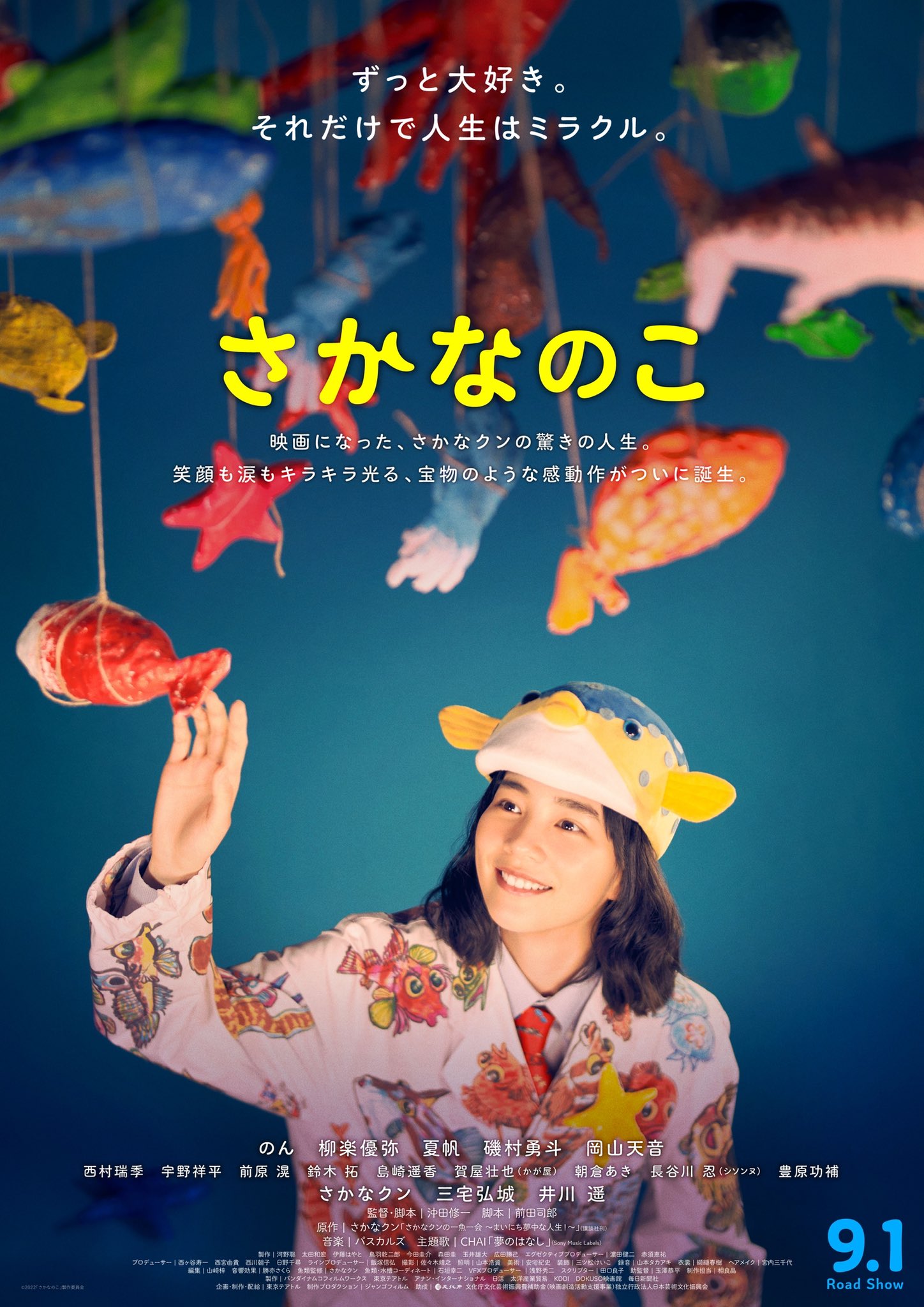
Shuichi Okita has made a career for himself exploring the lives of eccentric people and The Fish Tale (さかなのこ, Sakana no kKo) is certainly no exception. Based on the memoirs of the real life “Sakana-kun”, the film is a testament to the ways in which true enthusiasm can become an infectious source for good while even subjects which might seem esoteric can have universal appeal when delivered in the right way. Meebo (Non) is not like everyone else but sees nothing wrong in that nor do they see anything wrong in the way others live their lives (save for thinking edamame are better than fish). 

Later a TV personality, best-selling author, and YouTuber, Meebo has been totally obsessed with fish all their life. They draw pictures of fish, edit a fish-themed newspaper in middle school, and talk about fish all day long but they still eat fish and find how good it tastes just another thing that makes fish the best thing ever. Though Meebo’s mother (Haruka Igawa) is ever supportive, their father (Hiroki Miyake) has his doubts worried that Meebo isn’t like the other children and is going to struggle later in life. When Meebo meets a strange man with a fish hat on his head (a cameo from the real life Sakana-kun) whom most of the other children avoid, their mother says it’s alright to go to his house to see his aquarium but their father disagrees for obvious reasons later calling the police when Meebo fails to return home at the agreed time. Mr. Fish Head is the only person with whom the young Meebo can truly bond in their shared love of sea life but he also bears out their father’s sense of disapproval in admitting that he came from a wealthy family but is now low on funds because like Meebo he wasn’t suited to conventional schooling and has never been able to hold down a steady job. 

Meebo’s mother meanwhile is more relaxed, calmly telling Meebo’s teacher that having good grades isn’t necessarily important for everyone and she doesn’t want to force Meebo to make themselves unhappy by giving up fish to get them. In any case employment is something Meebo struggles with, fired from the aquarium for spending too much time admiring the fish and then later let go from a sushi bar. Meebo is hired to create an aquatic display for a dentist with an extremely gaudy office but fails to correctly interpret the brief unable to understand the dentist just wanted something flashy and superficial (like himself), but is finally offered a job at a pet shop with a sympathetic boss who appreciates their deep knowledge of and love for fish. 

As Meebo says, they don’t understand what “normal” is save for a vague sense that they may not be but continues to live their life happily no matter what others might think. When they’re targeted by delinquents in high school, Meebo ends up simply inviting them to come fishing with them and is generally able to win over those who don’t understand or approve of their obsessive interest with the force of their enthusiasm. Then again, there are those who are simply too conventional such as the young woman childhood friend Hiyo (Yuya Yagira) tries to introduce her to who rudely laughs at Meebo’s “childish” determination to become a “fish expert” as if such a thing were inherently ridiculous. Time and again its these special connections often made in childhood which continue to help Meebo on their way, engineering a friendship between the leaders of two rival high school gangs who later hire them to help decorate the interior of a new sushi bar. 

That’s not to say their life is not sometimes difficult, but their love for fish always seems to carry them through while the joy and enthusiasm they bring with them makes others happy and more curious about the world in which they live. Their love of sea life eventually trickles down to the next generation with childhood friend Momo (Kaho) taking her daughter to the aquarium just like Meebo’s mother had them and buying her an encyclopaedia of fish which Meebo themselves had written. A quirky, warmhearted tale of total self-acceptance, Fish Tale is also testament to the positive influence of “obsessive” passion which far from dark or introverted can help to illuminate the lives of those who might also be afraid of their differences and love for that which others may deride as niche.


The Fish Tale screened as part of this year’s Fantasia.

International trailer (English subtitles)
Lesson in Murder (死刑にいたる病, Kazuya Shiraishi, 2022)

Parental disconnection and the legacy of abuse come under the microscope in a dark psychological thriller from Kazuya Shiraishi, Lesson in Murder (死刑にいたる病, Shikei ni Itaru Yamai). Adapted from the novel by Riu Kushiki, the film’s ironic Japanese title means something more like Sickness Unto Death Sentence and hints at an almost spiritual infection that spreads violence and cruelty as embodied by the moral vacuum at the film’s centre, a genial serial killer of stereotypically “good” kids chillingly played comic actor Sadao Abe. 

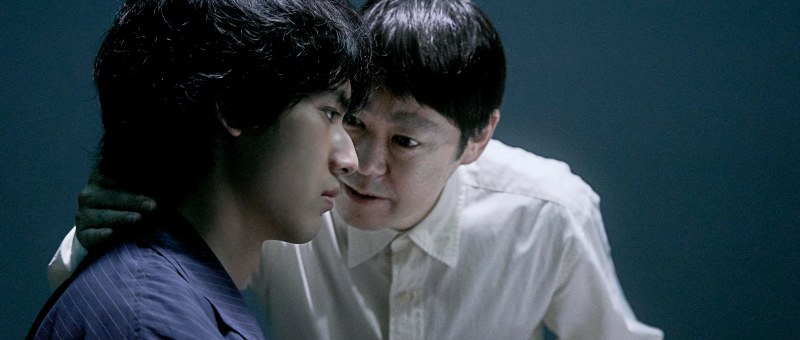
The psychodrama is played out, however, in the mind of young legal student Masaya (Kenshi Okada) who once frequented the popular bakery owned by Yamato (Sadao Abe) before he was exposed as the killer of 23 teens and one adult woman. On returning home for his grandmother’s funeral, Masaya is surprised to receive a letter from Yamato asking for his help. He admits killing the 23 teens (and perhaps more) but claims that he is not responsible for the death of the adult woman who after all does not fit his pattern. As he reveals, Yamato killed teens in their last year of high school and the grooming process which may have started even years before was central to his M.O. He delighted in winning their trust and then betraying it by torturing them to death in a smokehouse on the grounds of his isolated farmhouse. 

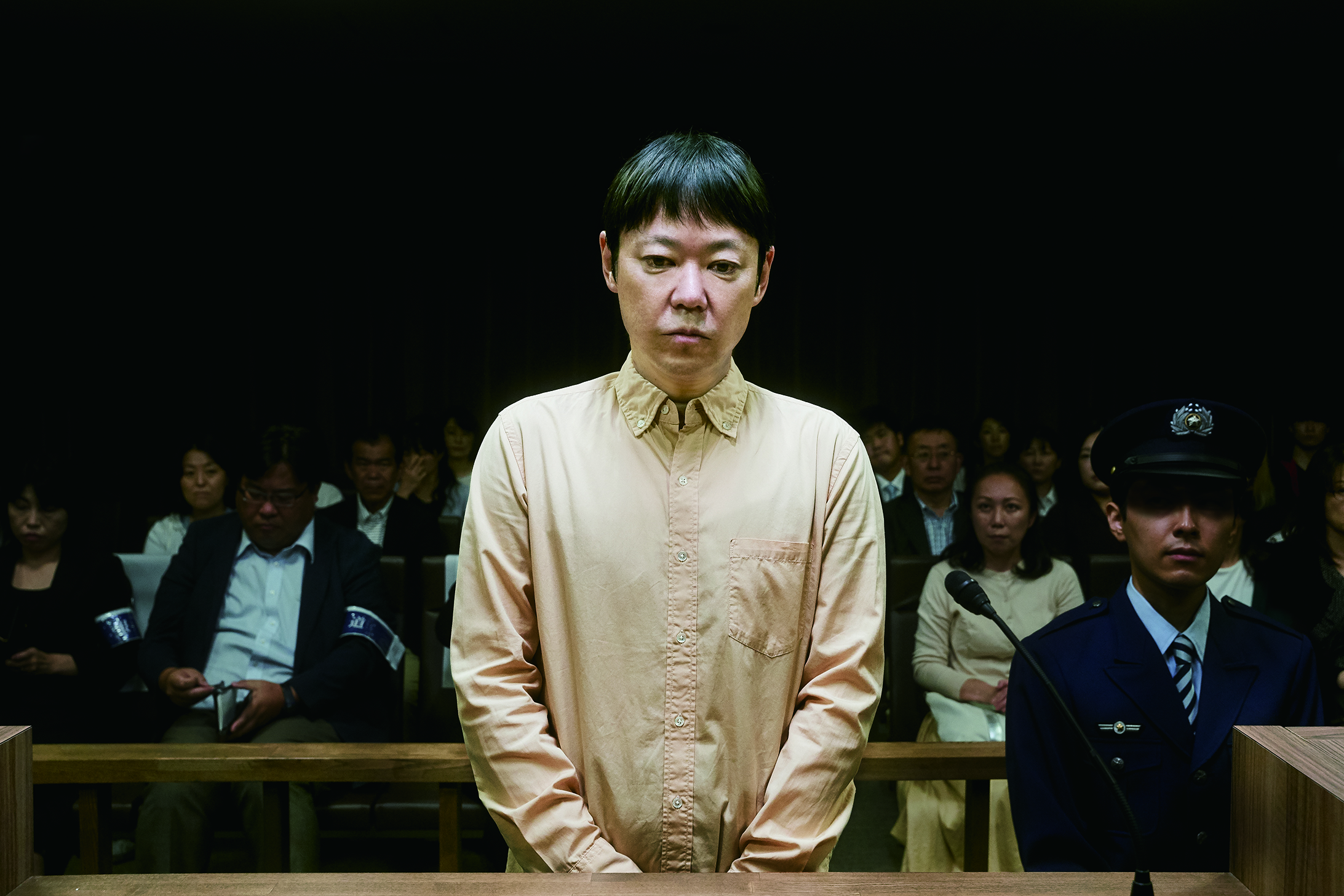
In court, Yamato explains that killing is simply “essential” to his being while insisting that he was caught because he became complacent rather than as a result of efficient policing. Yet he tells Masaya that it annoyed him that he never fell under suspicion, people always trusted him without question and he wanted to challenge that level of social complacency. In any case what’s clear is that he is and has always been a manipulative narcissist attributing those personality traits to his childhood abuse implying that they were a part of an abandoned child’s defence mechanism. He praised others to make them love and protect him, becoming drunk on the power he held over them. At first it seems as if his killings stem from resentment towards these “perfect” children who were well behaved and studied well in school but in fact the reason the children behaved in that way was often born of a desire for parental approval which made them vulnerable to Yamato’s grooming. “Repressed children have low self-esteem” he tells Masaya, an abused child himself, claiming that he wanted to help them grow in confidence through his persistent love bombing. 

Masaya is also on some level being groomed and may at times even be aware of it, but is so consumed with resentment towards his own father that he longs for a more sympathetic father figure and is even willing to accept to a serial killer as a potential paternal mentor. He becomes desperate to prove Yamato didn’t kill Kaoru (Ryo Sato), a 26-year-old office worker, almost forgetting that the killing of the 23 teens is not in dispute. His father resents him because the family run a prestigious school but Masaya was not academically gifted, bullying and beating both Masaya and his mother who is also an underconfident survivor of childhood neglect. She constantly asks for Masaya’s help making decisions, as do other survivors that he meets, while Yamato ironically tells him that the choice to investigate Kaoru’s death is entirely his own while wilfully manipulating him. Even so under his influence, Masaya’s own feelings of resentment towards the conservative society as mediated through middle-aged salarymen eventually bubble to the surface leading him on a dark path towards a potentially murderous destiny. 

Then again, as much as Yamato tries to take control of the narrative Kaoru’s death would still have been as a result of his actions no matter who it was who actually killed her. In another uncomfortabe irony what he’s doing while clearly grooming Masaya is in a sense as he claimed to be doing with his victims restoring his self-confidence in forcing him to face his dysfunctional family situation while proving that he is capable of solving this crime and perhaps in the end solving it a little better than intended. A killer final twist lends an additional layer of insanity to Yamato’s banal evil while Shiraishi’s cool direction at times superimposing the faces of the two men one over another in the glass that divides them at the prison with the faces of the victims projected behind may suggest that darkness hangs all around us and more to the point within. 


Lesson in Murder screens at Lincoln Center 21st July as part of this year’s New York Asian Film Festival.

International trailer (English subtitles)
Images: ©2022 ”Lesson in Murder” Film Partners

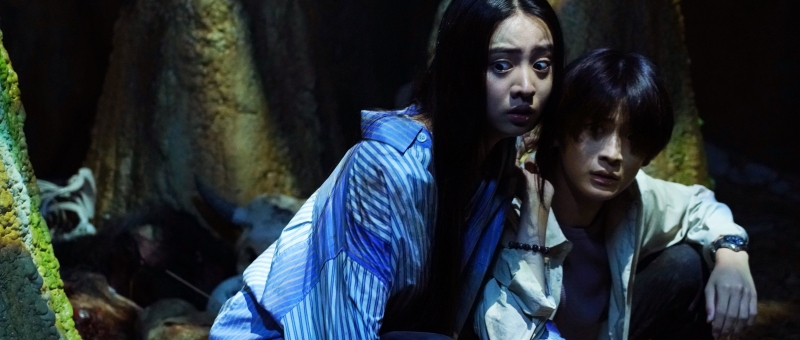
Ox-Head Village (牛首村, Takashi Shimizu, 2022)

“A story about nothing” is how one middle-aged man jokingly dismisses a local legend about an ox-headed woman. Are urban legends just one big dad joke? Everybody who hears this story dies, so they say, which is obviously true whichever way you look at it though if it really were a curse it would have to move quickly or there’d be no-one to pass it on. As the heroine of Takashi Shimizu’s summer adventure horror movie Ox-Head Village (牛首村, Ushikubi Mura) discovers, however, there may be something to it after all in uncovering the dark history behind the local folklore. 

In her last year of high school, teenager Kanon (Koki) is beginning to experience strange events such as a series of mysterious scratches on her arm, odd bangs and noises at home, and her phone constantly playing a message about bad pennies and their tendency to keep turning up. Her friend Ren (Riku Hagiwara), who has a crush on her, shows her a viral video of some girls on paranormal live stream that goes wrong leading one, who looks exactly like her, to fall down a lift shaft and then mysteriously disappear. To find out what’s going on the pair head out into the country to the abandoned hotel where the shoot took place but end up battling supernatural malevolence born of the cruelty of previous eras. 

Like the previous two films in the “Village” trilogy, Ox-Head Village revolves around rural folkloric beliefs this time focussing on the suspicion cast against twins which in this village at least seems to have continued until the late 1960s. The root of the curse is the unnatural act of dividing something that should be one into two in attempting to separate pairs of twins leaving the one left behind, lonely, burdened with the residual stigma of being one of multiple births, and perhaps experiencing a little survivor’s guilt. In the film’s second sequence, bathed in yellow and shot with a 70s-style soft focus, two little girls kill a butterfly and bury it with its friends because it would just be lonely on its own. The resolution is that that which has been divided must be reunited in life or in death in order to end the curse, though as we later see that may not quite be the end of it. 

Meanwhile, though a supernatural horror film, Ox-Head Village is also part of a grand tradition of teen summer adventure movies. Kanon and Ren are about to embark on the last summer as high schoolers, the trip they take together as so many are is also about self-discovery as Kanon answers a few lingering questions about her past while searching for her doppelgänger. Her quest is also in its way about rescuing herself and laying to rest the sense of loneliness which has always plagued her. Along for the ride, Ren is perhaps more curious while obviously smitten hoping to cement his romance through a romantic road trip only to be blindsided by supernatural intrigue and country superstition. 

Nevertheless, there is something truly creepy about the innocent flowers the little girls draw along with the pre-modern superstition that informs life in the village. Though the sinister presence may in this case be firmly rooted in the past, they are able to mediate their curse through modern technology such as manipulating Kanon’s phone as a means of communication while using lift shafts to mimic the well which becomes the repository for the darkness of the village. As an old man puts it, a prejudice against twins might have been intellectually understandable in a time of famine, though morally indefensible and obviously absurd and out of place in the modern society. Even so, old beliefs have a way of persisting even if they are no longer clearly understood. 

Along with all the folk horror of ox-headed women, headless buddhist statues and “stories about nothing” there is the lingering dread of the lonely incompleteness visited on the little girls in yellow because of the outdated superstitions of an earlier era. Overcoming the curse requires both self-knowledge and self-sacrifice in order to heal the unnatural act of division which has been carried out but even this may not be enough to repair the damage of centuries of cruelty and prejudice. 


Ox-Head Village screens at Lincoln Center 19th July as part of this year’s New York Asian Film Festival.

Original trailer (English subtitles)

Images: © 2022 OX-HEAD VILLAGE Production Committee

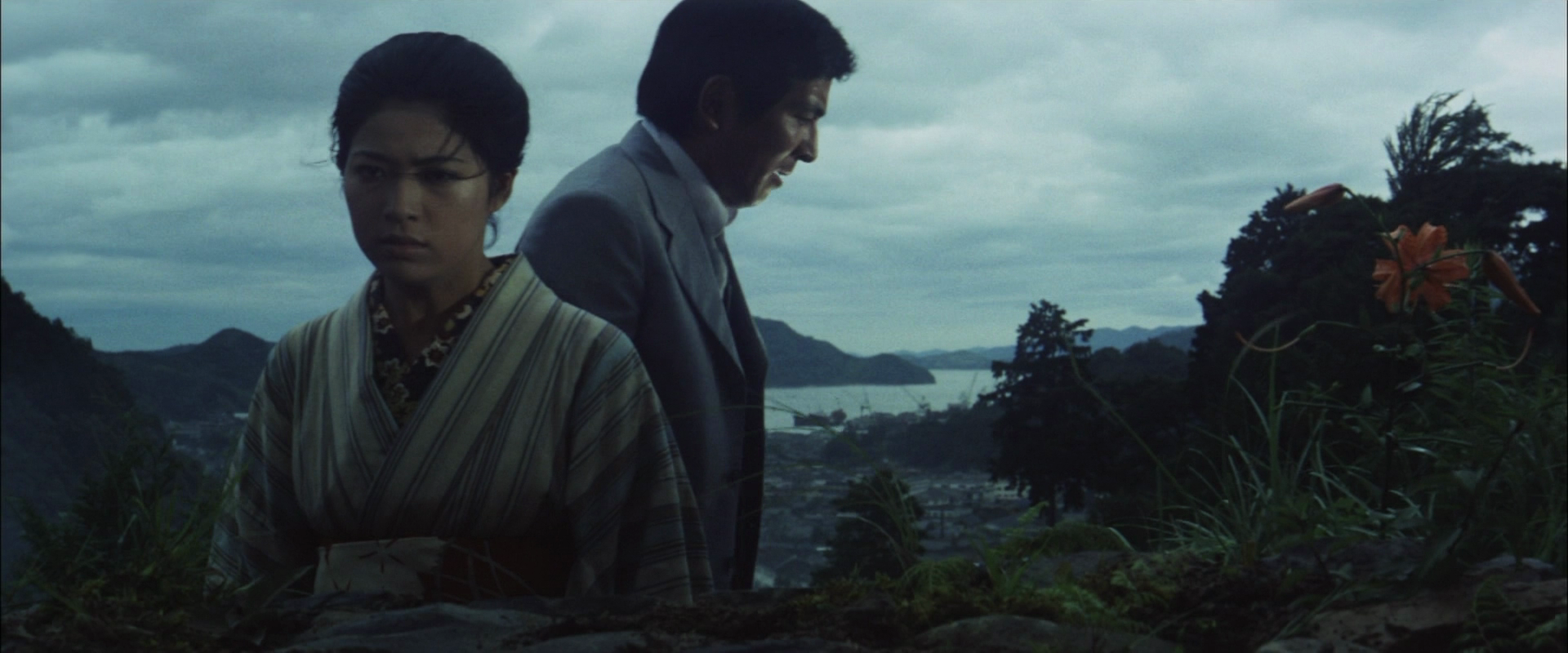
The Blossom and the Sword (日本侠花伝, Tai Kato, 1973)

After joining the studio in the mid-1950s, Tai Kato quickly made a reputation for himself with Toei’s key brand of ninkyo eiga yakuza movies set in the chivalrous world of pre-war gangsterdom. By the early 70s, however, the genre was already played out and Kato began to work more frequently with other studios and in various genres but 1973’s The Blossom and the Sword (日本侠花伝, Nihon kyoka den), produced for Toho the studio which he had first joined at the beginning of his career in 1937, takes him back to his ninkyo roots if less directly in a politicised tale revolving around the 1918 rice riots

The film opens, however, a few years earlier with the heroine, Mine (Hiroko Maki), attempting to sell children’s educational picture books aboard a train (an activity strictly prohibited). As she explains, they are in the middle of a recession and times are hard for everyone though as we discover the reason for Mine’s journey is that she is in the process of eloping with the mild-mannered Minoru (Kunio Murai), the son of a wealthy family with literary dreams, who is prevented from marrying her because of the class difference between them. The couple are doing well enough evading detection, but are caught out when accidentally implicated in the murder of a treacherous politician by left-wing agitator/noble gangster Seijiro (Tetsuya Watari) who fatefully locks eyes with Mine while trying to escape forever binding their fates together. 

Epic in length the film was originally released in two parts with an interval in-between, this first half focussing on Mine’s doomed romance which is thwarted in part by the outdated social codes of the early Taisho society and the moral cowardice of her lover who finds himself unable to resist them. The pair are thrown in prison as possible co-conspirators and beaten by the police, Mine striking up a friendship with a woman, Tsuru (Junko Toda), imprisoned for distributing pamphlets as a labour activist who later helps her to get a waitressing job and teaches her rudimentary writing while Minoru lounges around in their home sort of writing a novel. Tsuru seems to be touched by their cross-class romance, “where love is concerned to hell with social status!” she insists berating Minoru for giving in so easily when the pair are finally tracked down by his austere mother. Her socialist activism may not directly rub off on Mine but does perhaps inform her later actions after discovering the depths of Minoru’s spinelessness, rescued after a failed bid at double suicide by a truly good man, Kinzo (Meicho Soganoya), who also happens to be a traditional yakuza heading a harbour gang in Kobe. 

After becoming his wife, Mine comes to witness the persistent unfairness and exploitation all around her as mediated by the outcry surrounding the fluctuation of rice prices in the late 1910s caused by attempts at profiteering and the necessity of supplying the military forces then participating in the war in Europe. Meanwhile, would be local dictator and amoral yakuza Kishimoto (Toru Abe) is intent on squeezing the Osada gang out of the harbour further pushing up rice prices while in cahoots with corrupt local authorities. Seijiro re-enters her life when dispatched to assassinate Kinzo on the orders of Kishimoto but stabbing him as carefully as possible to make sure he doesn’t die, thereafter switching sides to fight for the rights of the poor who he warns face even greater oppression should a man like Kishimoto be allowed to dominate the harbour. 

With Kinzo out of action, Mine assumes her natural destiny as a local leader doing her best to stand up to Kishimoto and the corrupt authorities but still faces difficulty getting her voice heard without a man standing next to her. On taking Kinzo’s place at a meeting of local bosses, she is dismissed as “just a woman” before a sympathetic naval officer decides to hand her a lucrative job shifting rice intended for sailors overseas because of her knowledge of current affairs undercutting Kishimoto’s attempts to game the system. It’s the trust the navy have in her that later saves her again when she is arrested and brutally tortured by corrupt policemen working with Kishimoto intent on tracking down Seijiro for the murder on the train all those years previously. Mine’s rise is also in a sense Seijiro’s redemption as he atones for the attack on Kinzo, rejects his association with Kishimoto to re-embrace his socialist beliefs, and fulfils the romantic destiny sparked when their eyes met on the train. 

Drawing a direct line between burgeoning militarism and gangsterdom along with the amoral exploitations of an increasingly capitalist society, Kato makes his intentions clear by dropping a ninkyo eiga hero into a world of infinite corruptions in which he eventually becomes a defender of the poor. Kato’s striking composition and use of colour along with expressionistic imagery lend the air of legend implied by the title as Mine fights her way through the oppressions of her era as a figurehead for justice in an increasingly unjust society.


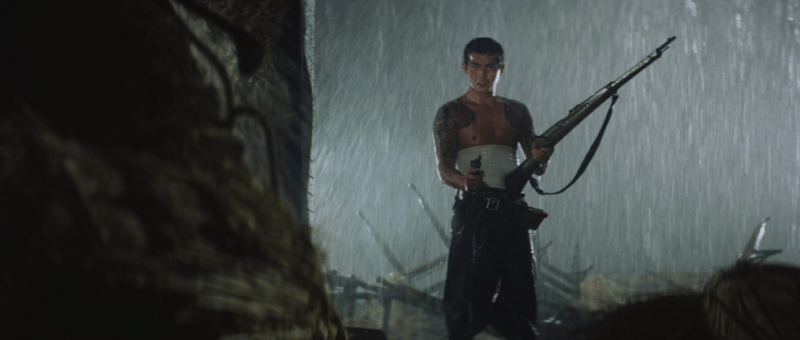
Rub Out the Past (日本暗黒街, Masaharu Segawa, 1966)

A former yakuza’s attempts to shed his old identity and start again as an upscale restaurateur are disrupted by the unwelcome appearance of an old acquaintance in Masaharu Segawa’s noirish drama, Rub Out the Past (日本暗黒街, Nihon Ankokugai). Another “akokugai” or “underworld” film, Segawa’s surprisingly subversive Toei crime story involves not only the drugs trade but hints of Manchurian transgression as the hero tries to forget his past while unable to realise his love for the daughter of a man he killed on the order of his boss. 

Now calling himself Yashiro, Kageyama (Koji Tsuruta) runs a swanky bar in Kobe and is in love with his pianist Yoko (Eiko Muramatsu) who is also, though she doesn’t know it, the daughter of a former associate back in his yakuza days whom he apparently killed for otherwise unclear reasons leaving Yoko and her mother alone and defenceless in Manchuria during the evacuation at the end of the war. When a mysterious man arrives and explains he’s from “Hayami Industries”, Kageyama is reluctant to listen but eventually forced to accompany him to Tokyo where he is led into Hayami’s rather swanky new office complete with electronic displays and workers positioned in tiny booths. Since the end of the war, Hayami has become a “respectable” businessman running some of Asia’s most prestigious hotels in addition to a chain of casinos. Yet his real business is of course in drug smuggling, which is a problem because the guy he put in charge of the Hong Kong route has drawn the attention of the police. He makes Kageyama an offer he can’t refuse ,much as he tries, to take it over. He accepts on the condition it’ll just be a one time thing. 

In any case, Kageyama’s involvement with Hayami soon costs him his relationship with Yoko, who is aware of Kageyama’s criminal past but blames Hayami for her father’s death, and with it a potential for redemption. Details are few, but there are constant references to the gang’s illegal and immoral dealings in Manchuria, a time that Kageyama is keen to leave in the past having made a new more honest life for himself in the post-war society while Hayami has shifted into the increasingly corporatised realms of contemporary organised crime. Yet despite himself Kageyama is good at being a gangster, effortlessly subduing the bumbling head of “Sekiya Industries” and realising that part of the problem is that too many of his men are getting high on their own supply. To streamline the business he lays off drug users telling them to come back when they’re clean and temporarily pauses the business while he reorganises it at street level. This however leaves a small vacuum in the underworld economy which is soon filled by “alternative” suppliers. 

More akin to one of Toho’s spy spoofs, Hayami Industries seems to be incredibly keen on zany gadgets like cigarette lighters that double as secret radios and guns which shoot listening devices not to mention the panel wall which hides Hayami’s secret control room or the knuckle dusters and belt swords sported by the Sekiya guys. All of which is slightly at odds with the seriousness of the constant reminders of abuses in Manchuria and on the Mainland, and the frankness with which drugs are treated onscreen with frequent shots of syringes and powder. As usual in these films, the main villain is from Hong Kong, an unhinged maniac who kidnaps Yoko and gets her hooked on drugs partly at the instigation of Hayami who seems to be making something of a strategic blunder in his attempts to manipulate Kageyama. Yet Kageyama can only get his redemption through reassuming his wartime persona to face Hayami if indirectly in trying to engineer a gang war between middlemen with Hong Konger Tei caught in the middle. 

Segawa adds to the noir feel through the melancholy jazz score reinforcing the fatalism and futility that seems to define Kageyama’s life as he tries but fails to escape from his violent past. A product of wartime misuse he finds himself at odds with the contemporary society, inconveniently falling in love with the daughter of a man he killed and therefore unable to move on from the shadow of his life of crime only granted a second chance after losing everything and paying his debt to society by destroying the system he himself helped to create. 


A Far Shore (遠いところ, Masaaki Kudo, 2022)

A young mother struggles to find a way through a legacy of parental abandonment and exploitation in Masaaki Kudo’s Okinawan drama, A Far Shore (遠いところ, Tooi Tokoro). As the title implies, the heroine does indeed long to go somewhere far away but finds herself hemmed in by the nature of the island on which she lives while facing rejection from all sides. She tries to do everything right, working to support herself and her son, but is finally left with no place to turn in a fiercely patriarchal and judgemental society. 

At 17 (Kotone Hanase), Aoi makes her living as a bar hostess leaving her two-year-old son Kengo (Tsuki Hasegawa) with her grandmother. Her husband, Masaya (Yoshiro Sakuma), is a drunken lout who can’t, and doesn’t want to, hold down a job. She hides the money she earns in various stashes around their apartment including in the bathroom bin fearful that Masaya will take it and they’ll be left short on the rent again. Though he refuses to work, Masaya resents being kept by his wife and often turns violent, viciously beating Aoi if he suspects her of hiding money from him or otherwise feels in some way belittled. 

On the one had, she isn’t supposed to be working in the clubs because she’s a minor but realistically they are the only place where she can find the kind of employment that will pay enough to support herself and her son. The clubs know they make more money off underage girls so they are keen to employ them, a gaggle of men from Tokyo obviously taken with the transgressive thrill of buying cocktails for a girl who technically isn’t old enough to drink, but cut them loose when the police come knocking as Aoi discovers when she is picked up by a patrol who take her in for questioning and ask insensitive questions such as how a woman who does what she does can love her son while making her the criminal rather than prosecuting the bar which employed her. In any case when Masaya beats her so badly she is forced to take on even more debt paying for hospital treatment she can no longer do bar work because men won’t want to drink with a woman whose face is bruised. In another irony, it’s the inability to work in bars, which only requires sitting and talking with men, that finally leaves her with little option other than sex work in which her clients are also often violent. 

Her plight in a sense echoes a legacy of abandonment in the Okinawan islands, her own parents having seemingly disowned her with her mother apparently in prison on the mainland and her father remarried with other children. When she asks him for help he just tells her that it’s easy for a woman to find work when men will struggle all their lives in Okinawa’s difficult employment environment, brushing off grandma’s reminder of the lucrative subsidy she assumed he had as a fisherman. Meanwhile Grandma also takes against her, believing she’ll end up wayward like her mother but seemingly accepting little responsibility for either of the women while suggesting that part of her problem lies in not having given enough respect to her local Okinawan heritage neither speaking the language nor obeying the customs. Grandma’s last straw is seeing Aoi take back Masaya after he abandoned her and ran off with all her savings, while he echoes his refusal to work by insisting they move in with his mother who can’t do anything with him either because he’s been indulged by a fiercely patriarchal social culture that encourages him to think he owes women no basic respect or decency. To add insult to injury he ends up landing Aoi with even more debt when he’s arrested after a bar fight and tells the police that his wife will pay the compensation money he owes to the other guy for throwing the first punch.

Eventually Aoi is brought to the attention of social services who do actually seem a little more sympathetic than might be expected but still largely fail to accept that she may be a mother but she’s also a child in need of care. She tries get to a respectable job in a cafe but encounters only further exploitation with extreme low wages, a shift pattern that doesn’t suit a working mother, and a one month probationary period during which she wouldn’t be paid which is obviously impossible for her to manage with no other means to support herself while everywhere she goes people just look down on her. A bleak portrait of life in contemporary Okinawa, Kudo’s icy drama suggests the hope of a distant place is all women like Aoi have to keep them going but in the end it may not be enough. 


A Far Shore made its World Premiere at this year’s Karlovy Vary International Film Festival.

Embalming (EM エンバーミング, Shinji Aoyama, 1999)

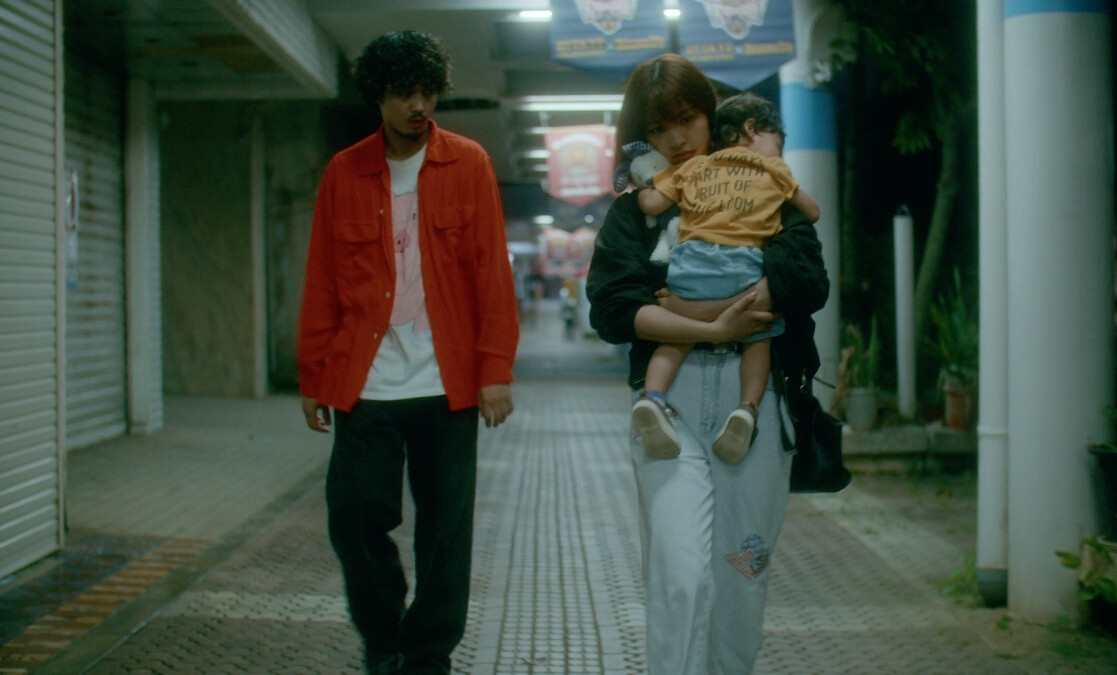
“Nothing can last forever” according ironically enough to an embalmer who feels it is her calling to preserve the bodies of the dead she says to help their grieving families, but does that actually help or is she actively preventing them from moving on in enabling their desire to hold on to something beautiful that is already gone? Jumping on the J-horror boom, Shinji Aoyama’s adaptation of the mystery horror novel by Michiko Matsuda Embalming (EM エンバーミング, EM Embalming) is another millennial mediation on the loss of bodily autonomy amid the corruptions of the late 20th century. 

A predominantly Buddhist funerary culture, embalming is rare in Japan which generally favours cremation over burial. As the opening crawl explains to us, the process may be familiar from the ancient Egyptian mummy, but was also put to use during the American Civil War in order to transport bodies of fallen soldiers home to their families. It also says that through technological advances, bodies can now be preserved for up to one hundred years though according to embalmer Miyako Murakami (Reiko Takashima), the best she can do is 50 days or perhaps she’s merely decided that after the the 49th day it’s inappropriate to hold on any longer. Apparently friendly with local policeman Hiraoka (Yutaka Matsushige), Miyako is called in when the 17-year-old son of a local politician, Yoshiki, is found dead on the pavement outside a tall building having fallen from above. Having no reason to suspect foul play, Hiraoka concludes it’s most likely to be a suicide. The reason he’s called Miyako is that the mother is out of her mind with grief and insisting her son be embalmed to preserve him as he was for all eternity though his father does not agree. 

Neither does local priest Jion (Kojiro Hongo) who sends a couple of his goons to pick Miyako up so he can tell her in imposing and ritualistic tones that she must stop the “evil acts” she’s “inflicting” on Yoshiki’s body, insisting that she’s spanner in the karmic wheel of life and death holding up the cosmos by refusing to let nature take its course in returning Yoshiki’s body to the universe. “What you are carrying out is a violation of the silence of Bodhisattva, and is therefore an act of evil!” he explains though Miyako is hardly about to be swayed from her life’s work and as we later realise Jion has motives other than the spiritual in mind. Nevertheless, it’s true enough that even if Miyako insists embalming gives dignity to the dead, Yoshiki has no further say as to what happens to his body or how much longer he remains in this world. There’s no way to know how the bodies Miyako works on would have felt about the prospect of being mummified or if they would be happy with the way their bodies may go on being used after their death. 

“When a human being dies, they become an object. Human flesh becomes food for maggots and bacteria and eventually the bodies disappear completely” according to another embalmer, Dr. Fuji (Toshio Shiba), who works with shady “death dealers” and in Miyako’s opinion betrays the art of embalming by frankensteining his bodies using a series of replacement parts to achieve the appearance of perfection. He seems to regard human bodies dead and alive as inanimate entities to be treated no differently from plant matter, recounting tales of his war trauma which seems to have permanently disconnected him from his humanity. The only reason Miyako has tracked him down is because Yoshiki’s head was severed and stolen in freak burglary and she’s received word he might know where it is. Yet to Dr. Fuji and other death dealers as Hiraoka had previously mentioned, the head is the least valuable part as he proves by simply dropping one in the bin while talking to an unfazed Miyako. 

Miyako may be as some accuse her “possessed by death” and attempting to exorcise her unresolved grief and mortal anxiety through the art of embalming in search of an eternity she does not really believe exists. But then as her assistant Kurome (Seijun Suzuki) reminds her, the dead cannot be brought back to life, “you can only be a flower while alive”. Dr. Fuji hints at a dark history that recalls the crimes of Unit 731, experimentation on living bodies and total disregard for the dignity of the dead, while an even older corruption seems to stem from shady priest Jion, “some rip-off faith healer targeting society’s political and economic echelons” as Hiraoka describes him. At times darkly humorous, Aoyama’s bleak drama is filled with existential dread and a sense of the uncanny as we see corpses twitch and flicker with the absence of life while Miyako meditates on an impossible eternity rejecting her powerlessness in the face of transience in favour of the simulacrum of existence in a world ruled by death. 


Paper City (Adrian Francis, 2021)

In March 1945, the firebombing of Tokyo killed 100,000 civilians and devastated 16 square miles of the city yet 70 years later those who survived have yet to be acknowledged by their government which has made no investigation or attempt to assist those who lost everything to the fires. Adrian Francis’ documentary Paper City follows a series of now elderly men and women who experienced the tragedy first hand and worry that the lessons of the past are being lost especially with the increasingly nationalistic mindset of the current government which seems hellbent on remilitarisation and the end of the pacifist constitution. 

One of the chief concerns of the survivors is that there is no dedicated memorial to those died in the bombing. The remains of some victims are housed behind the memorial to the victims of the 1923 Great Kanto Earthquake, hidden away and out of sight. Survivors cite the example of other nations such as Germany in which the government has acknowledged its role in the harm caused to civilians through warfare and has acted to protect those who lost their homes, livelihoods, and families because of it. In Japan they feel ignored and forgotten, particularly aggrieved because government policy at the time exacerbated the problem in that they were instructed to stay and fight the fires rather than to evacuate the city. Many had been lulled into a false sense of security believing that as the areas they lived in were residential and had no military facilities they would not be targeted little knowing that the bombing would be indiscriminate with no intention to spare civilian life. 

As one elderly man puts it, they lost everything. Only a child himself as many of these now elderly people were, he lost not only his closest family members but his home and community along with any means they may have had to support themselves economically leaving them little more than destitute beggars in the ashes of a ruined city yet the government did nothing to help them. The Morishita district is one of few that made an attempt to record the names of the victims, those who were confirmed dead and those who were assumed so whose bodies were never found, holding a memorial service for them every year. Meanwhile another man only 14 at the time recalls being drafted to help clear up bodies using firemen’s hooks to pull them from the local river and now all these years later still unable to forget the face of a young mother with a child on her back whose hands still held tight to her hair. Another recalls seeing bodies piled up in a local park and disposed of en masse without dignity or identity as if they had never existed at all. 

What they fear most is being forgotten, that with the city entirely rebuilt no one even remembers anymore that it was once burnt to the ground. They petition the government for official recognition while protesting the injustice of war and the Abe administration’s determination to abandon the pacifist constitution. Protesting outside the Diet, they are ironically heckled by a nationalist counter protest who insist that the Japanese state is not at fault and the protestors should be taking their concerns to the American embassy instead. A kind of hopelessness sometimes falls over them, believing that the prospect of change is slim while the current iteration of the LDP remains in government while knowing that a change of government is also itself all but impossible. 

In any case, they know that their time is running short and they will need new voices to carry their message to the next generation to ensure that the firebombing of Tokyo is never forgotten. They share their harrowing stories of rivers on fire and blood red skies as a warning to the living while honouring the souls of the dead pausing for a moment to admire the figure of a wounded tree still standing tall reaching for the sky, in its way also a monument to endurance. Mainly observational in style with some direct interviews, Francis’ documentary captures the sense of desperation in the older generation that their suffering must not be in vain hoping that their message will get through and that one day there will be no more cities of ash or lonely children left behind to mourn them. 


Paper City streamed as part of this year’s Nippon Connection.

Original trailer (English subtitles)
Salaryman (サラリーマン, Allegra Pacheco, 2021)

The concept of the salaryman is deeply associated with Japan and with a particular way of working but is also in its own way troubling in its implications about the relationships between the employed and the employer in the contemporary society. Allegra Pacheco’s documentary Salaryman (サラリーマン) explores this culturally specific phenomenon along with its radiating effects on the wider society and the attitudes of younger workers who are beginning to turn their backs on the duplicities of the salaryman dream.

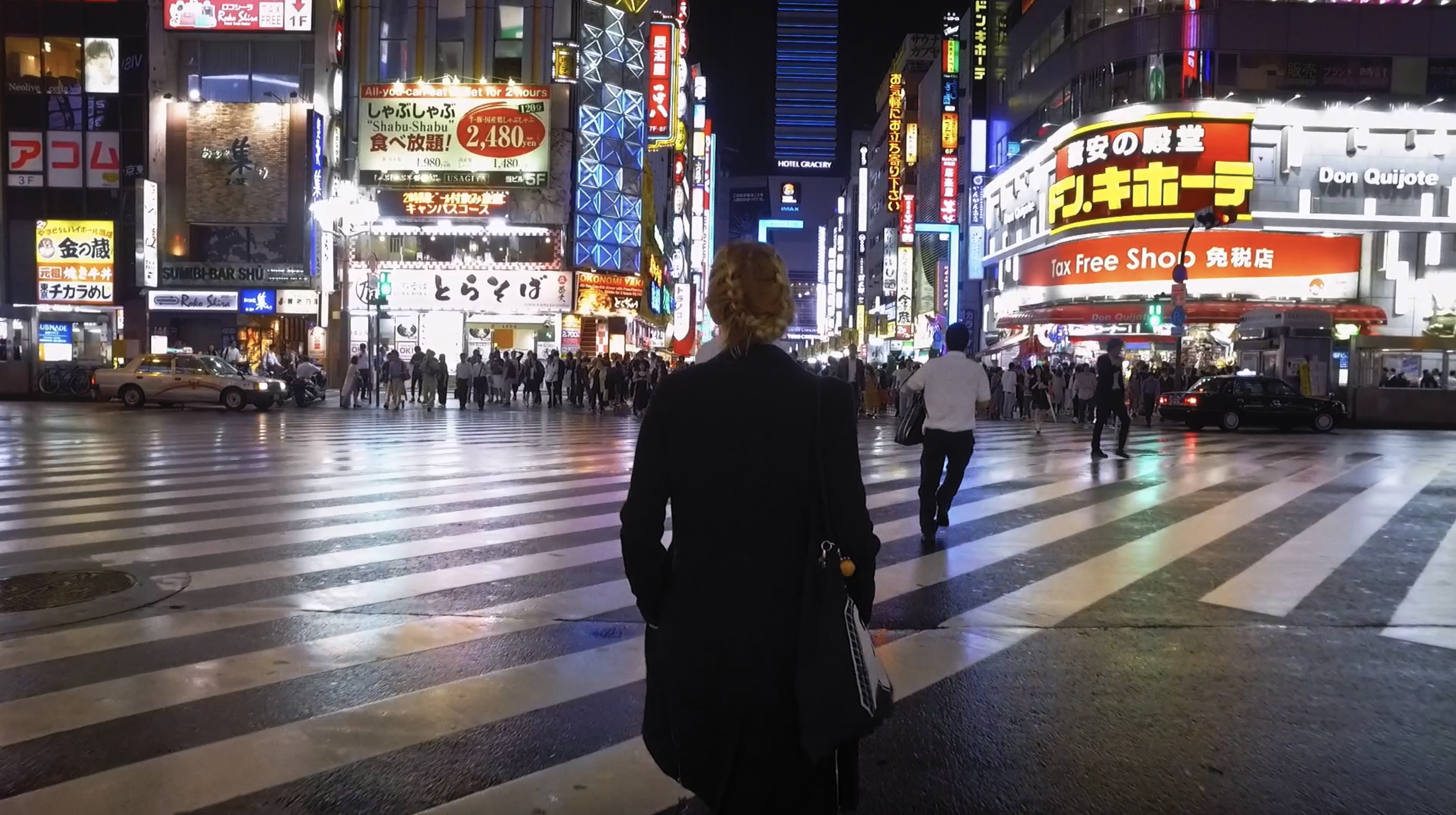
Originally from Latin America, Pacheco was first struck by the ubiquitous sight of drunk men in suits asleep on the streets of the nighttime city. The phenomenon has become so commonplace that few would remark on it or even really notice, yet to an outsider such as Pacheco it appeared strange. After all in few other cities would it be possible to fall asleep in a public place and wake up unharmed in full possession of one’s belongings. What she discovers through talking to several salarymen is a story of continual erasure in which the “corporate cattle” as one brands himself are left with no other acceptable outlets to relieve workplace stress born of an oppressive and bullying culture than excessive drinking often as part of the semi-compulsory nomikai afterwork drinking sessions. Having missed the last train, these men often have no other option than to simply wait until the morning when rather than returning home they replace their shirt at a convenience store and head straight back into the office.

These excessive working practices of course take a toll on the family when men rarely arrive home before 10pm if at all and leave early for the morning commute with little opportunity to interact with their wives and children. Pacheco then follows one working mother who is more or less left to handle the entirety of childrearing alone in her husband’s continual absence having to work taking her son to daycare and picking him up into her own working day along with the housework and cooking her own dinner. Meanwhile Pacheco also turns her attention to the phenomenon of the Office Lady or “OL” which is not exactly a salarywoman but separate category of worker treated almost like corporate domestic staff. Such women are often looked down on by the society around them which views the job solely as a stopgap for those looking to leave the workforce on marriage to become a traditional housewife. 

The presence of the OL may reinforce the idea of the corporate entity as a patriarchal authority in which the female executive or salarywoman is not regarded as an equal in what is often regarded as a homosocial society. One commentator describes the self-image of the salaryman as a contemporary samurai who owes ultimate loyalty to his company prioritising his corporate family over the social. Another reason salarymen can be found scattered over the city another expert argues is that they simply fear going home to a less certain environment in which familial bonds may have begun to fray under the strain of their workplace stress. Though Japan actually has well placed labour law designed to protect employees from exploitation it is not well enforced partly because of the nature of the relationship between workers and employers that prevents employees from speaking up about workplace bullying or injustice. 

These bonds between the employed and the employer are largely founded on the post-war promises of the era of rising prosperity in which companies offered jobs for life along with a tacit agreement to look after employees and their families which encouraged the already collectivist mindset that allowed workers to believe they were working towards a common goal of rebuilding the nation and ensuring economic prosperity for all. Such bargains however largely fell apart after the collapse of the Bubble Economy leaving the present generation with all of the stress and few of the rewards their parents may have enjoyed. Pacheco interviews the mother of Matsuri Takahashi who sadly took her own life in exhaustion born of the exploitative working environment at a top advertising firm with a reputation as a “black company” regularly ignoring standard employment law in the knowledge that they are unlikely to be challenged for breaking it. Other young people similarly cite burnout and the fear of karoshi or death from overwork as reasons they decided to leave the corporate world but even they do not necessarily find fault with the system only point out that it suits some better than others and was no good for them.

Then again according to a man who organises the extreme commute as an ironic sporting contest, the pandemic may have issued a wakeup call to the ranks of salarymen realising how nice it is not to have to cram themselves into a rush hour train or miss their kids’ bedtimes because they can’t get out of a nomikai. According to him the salarymen and women of tomorrow will demand the right to work when and where they want less likely to conform to outdated ways of doing business or wilfully participate in a system of widespread exploitation when offered no guarantees of future employment by a company who may try to silence them if they speak up and is just as likely to casually discard them at the first sign of trouble. His belief that this working revolution may usher in a new age of mutual compassion may seem naive or idealistic but it seems there’s hope for the salaryman yet that he may finally discover the means to free himself from an oppressive and exploitative working culture. 


Salaryman streamed as part of this year’s Nippon Connection.

Original trailer (English subtitles)

An Outlaw (ならず者, Teruo Ishii, 1964)

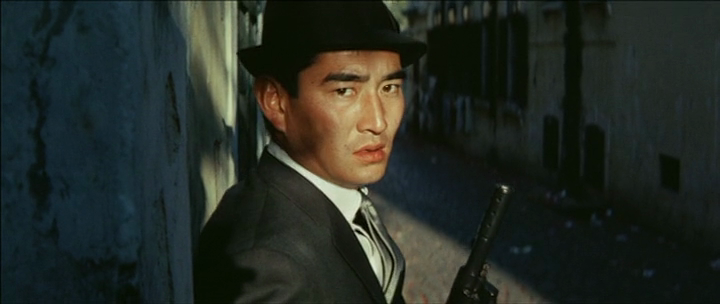
Outside of Japan, “king of cult” Teruo Ishii is most closely associated with a particular brand of transgressive ero-guro exploitation films such as Horrors of Malformed Men, yet his career was much more eclectic than many might assume. Starring Ken Takakura with whom Ishii was developing a professional relationship which would eventually lead to the hugely successful Abashiri Prison series, 1964’s An Outlaw (ならず者, Narazumono) is one of a string of noir thrillers from the earlier part of Ishii’s career this one taking place mainly in Hong Kong and Macao. 

China-based Japanese hitman Nanjo (Ken Takakura) runs into trouble after he offs a man he assumed to be “the biggest thug in the underworld” but actually turns out to have been a law enforcement official working against a people trafficking ring. To make matters worse when Nanjo returns to his hotel where he was supposed to get his pay off, he discovers the body of a young woman in his bed who is later identified as the official’s daughter. Understandably annoyed, Nanjo starts trying to track down the people who hired him to figure out what’s going but is accidentally dragged into underworld intrigue after being mistaken for a drug deal middle-man owing to the yellow flower he’s wearing on his lapel. 

Like any good noir hero and especially one played by Takakura, Nanjo is basically a good guy with a strong sense of justice and an acute moral compass. He doesn’t like having been manipulated into killing someone who wasn’t in the game nor does he approve of those who make their living by exploiting women such as arch villain Mao (Toru Abe) whom he discovers to have been running a nefarious international trafficking ring getting Japanese women hooked on drugs, shipping them to Hong Kong and Macao, and working them to death before abandoning them once they’ve served their purpose. Then again, he also has a strange problem with women who like to lie in bed in the middle of the day which seems slightly puritanical for a man who kills for a living yet you’d have to admit no one could call him lazy. 

Not much of Nanjo’s past is revealed save that he was born in prison to a woman who stabbed her former partner because he left her for another woman while she was pregnant with his child, raising her son to be anything but dishonest especially with women. In any case, he appears to have been based in China and Hong Kong for some time, claiming that he came down from Xiamen for the job and speaking fairly fluent Cantonese and Mandarin though in another strange coincidence many of the people he meets turn out to be Japanese. In this there’s a slightly ironic inversion of the normal patterning of post-war crime films which sees Japan exporting crime to China the big mcguffin revolving around a tin of drugs Nanjo was given by mistake intended for the local market while the secondary target becomes Mao’s people trafficking operation bringing sex workers who’ve gotten into his bad books to Hong Kong or to be used for the pleasure of wealthy men. Despite his apparent disapproval, Nanjo reveals he was given part payment for the job in the form of a girl who he could use for his “convenience” though it seems unlikely that he did so.

On the other hand, the secondary villain, the Japanese-speaking Minran (Yoko Mihara), is painted as something of a femme fatale playing off Nanjo and her boss while trying to get her hands on the drugs to split the proceeds with her Cantonese-speaking lover who accidentally kills a young girl Nanjo had befriended in Hong Kong. The girl’s death is in part Nanjo’s responsibility in that he placed her in danger without warning or an understanding of what he was asking her to do, yet he later proves no better when he kills the landlady of the hotel who had watched as she died and then blackmailed Minran for financial gain. Aside from the girl and her Japanese friend Aki (Yoko Minamida) who is dying of consumption after being worked to death as one of Mao’s trafficked women, and a detective with whom Nanjo later forms an unexpected alliance, Nanjo is the representative of humanist morality despite his morally compromised existence reminding Mao that his mistake was in thinking that there is nothing money could not buy in rejecting his efforts to pay him off. 

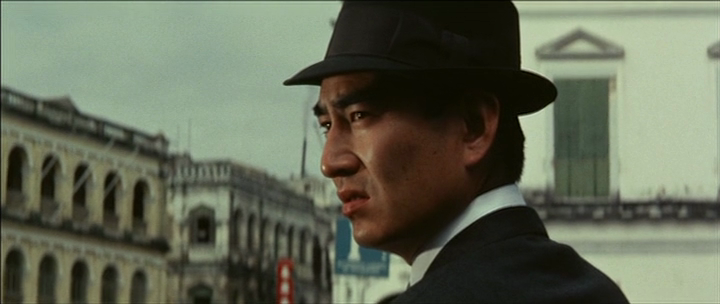
Shot largely on location in Hong Kong and Macao, Ishii adds to the noirish tone with frequent voice over and a melancholy jazz score while making full use of the atmospheric environment with its deserted alleyways and cobbled streets not to mention the naturally canted angles of the Victoria Peak funicular, while there is a fair amount of lowkey sleaze more typical of his later career along with a bizarre scene in which Nanjo sucks out blood from the mouth of a woman suffering a pulmonary haemorrhage. First and foremost a fatalistic noir thriller in which the hero, unfairly damned by a corrupt society, is unable to outrun his past transgressions, An Outlaw nevertheless suggests that true nobility is to be found only in those existing outside of its borders.


Original trailer (no subtitles)