The Sands of Kurobe (黒部の太陽, Kei Kumai, 1968)

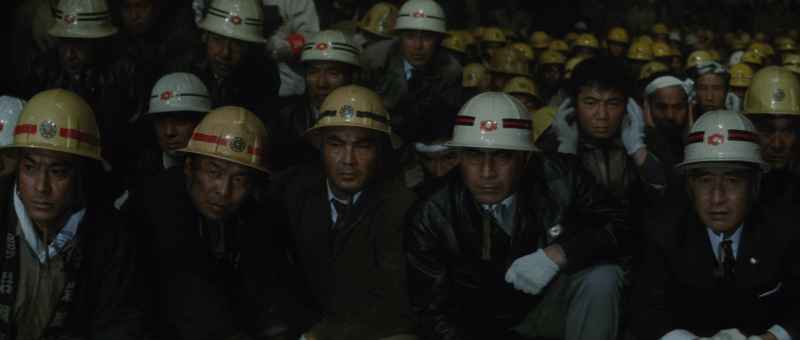
Kei Kumai’s three-hour epic of human engineering The Sands of Kurobe (黒部の太陽, Kurobe no Taiyo) opens with a titlecard to the effect that the film testifies to the courage of the Japanese people who brought the nation back to life after the war. Partly produced by Kansai Electric Power along with the production agencies of stars Toshiro Mifune and Yujiro Ishihara, the film is therefore somewhat conflicted, part bombastic celebration of Japanese engineering skill and ambivalent critique of the wilful decision to place success above all else including the welfare and safety of ordinary workers.

This critique is most evident to the flashbacks to the construction of Kuro 3 in 1938 which as many point out was conducted by the military under brutal and primitive conditions. The construction of the new Kurobe hydroelectric dam, by contrast, is a much more modern, enlightened affair in which workers have proper equipment and are not simply hacking at rocks with pickaxes wearing only a vest. But then as the conflicted Takeshi (Yujiro Ishihara) points out, it’s all effectively the same. Just because no one is pointing a gun at their heads, it doesn’t mean the men actually building the dam aren’t being exploited rather simply pressured by a vague notion of national good that they should be ready to lay down their lives. Could it be that “prosperity” is worse thing to die for than “patriotism”, especially when it appears as if your employer cares little for your physical wealth and economic wellbeing simply pledging that they will support the families of men killed during the dam’s construction. 

That there will be deaths seems inevitable. The man placed in charge of building a tunnel through the mountain, Kitagawa (Toshiro Mifune), is haunted by the vision of a man falling from a cliff that he witnessed when they first hiked to the dam site. He originally described the project as “crazy” and wanted to resign but was convinced to stay on. Kitagawa is himself fond of insisting on safety first where others are minded to cut corners, but also troubled by domestic issues in the film’s sometimes insensitive use of his daughter’s terminal leukaemia as a mirror for the dam project in considering what is and isn’t possible through human endeavour. The suggestion is that Kitagawa wants to believe the miracle of the dam is possible because needs to keep believing in a scientific miracle that can save his daughter, though obviously even if it is ultimately possible to build this dam that’s designed to fuel the post-war rocket to economic prosperity there are limits and unfortunately decades later we have still not found a cure for cancer though treatment may be more effective. 

Takeshi meanwhile has a similar battle with his hard-nosed father whose devotion to the dam project he describes almost like an addiction, suggesting that he values nothing outside of tunnelling and is willing to sacrifice everything in its name including the lives of himself and others. A flashback to to 1938 reveals that he asked his own teenage son to place dynamite and inadvertently caused his death though lax safety procedures which is the understandable reason why his wife eventually left him taking Takeshi with her. But the strange thing is for all his original opposition, Takeshi too is later captivated by the immensity of the challenge if also wary that the workers are falling victim to the same sickness as his father and are still being exploited by those like him who expect them to offer up their lives while paying them a pittance and complaining when the project does not proceed along their schedule. 

The almost nationalistic, bombastic quality of the film seems at odds with some of Kumai’s previous work save the discussion of the building of the 1938 tunnel though this largely serves as a contrast to imply that this time is different because they’re doing it for love of country rather the forced patriotism of the militarist past. Kitagawa justifies himself that if they don’t build the dam, economic prosperity will stall, companies will go bust, and people will lose their jobs but it seems somewhat hollow in the knowledge many men are certain to die while building this dam. Kumai undercuts the bombast with a series of scenes shot like a disaster movie in which supports collapse and the tunnel floods, or men are hit by falling rocks, eventually closing on an ironic Soviet-style statue dedicated to the labour of the workers that seems to question the immense loss of life along with the destruction of the natural beauty of Mount Kurobe but cannot in the end fully reconcile himself, torn between a celebration of human endeavour and its equally human costs. 


Original trailer (no subtitles)
I Hate But Love (憎いあンちくしょう, Koreyoshi Kurahara, 1962)

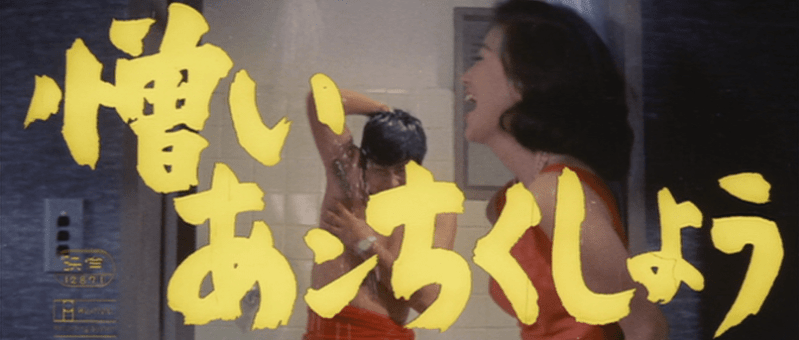
I hate but love posterDoes “pure love” exist in the Japan of 1962, and if so what does it look like? Yujiro Ishihara, the poster boy for youthful rebellion, might not be the best person to ask but it’s his unfulfilled media superstar that ultimately determines to find out. In I Hate But Love (憎いあンちくしょう, Nikui Anchikusho) Koreyoshi Kurahara puts the jazz clubs and delinquency of The Warped Ones to one side for a Technicolor romp that owes more to Day/Hudson than it perhaps does to James Dean or Marlon Brando. Yet there is something mildly subversive in its low level criticism of Japan’s lurch towards the consumerist future, finding only emptiness in fame and success while the central couple’s deliberately repressed desires push them towards a point of both spiritual and physical exhaustion.

Daisaku (Yujiro Ishihara) and Noriko (Ruriko Asaoka) have been a couple for two years. Noriko is also Daisaku’s manager and has been with him since he was broke and an aspiring poet. Now he’s one of Japan’s top DJs and she looks after his schedule which is packed in the extreme – in fact it leaves him no time for sleeping between his radio show, TV appearances, and meetings in bars, not to mention a late night date starting at 2am! Raiding the local papers for a suitable human interest story they can flag up on the show, Noriko stumbles over the tale of a local woman who is looking for a “driver who understands humanism”. Intrigued, Daisaku and his producer Ichiro (Hiroyuki Nagato) set off to interview her but the woman doesn’t want to be involved with the media – she doesn’t want to sully her love! The fact of the matter is, Yoshiko (Izumi Ashikawa) has kept up a romance with a doctor in a rural town by letter alone and used all her savings to buy a jeep to help transport his patients more effectively. Yoshiko doesn’t need to see Toshio (Asao Koike) – her dashing doctor fiancé, she believes in their love and that’s good enough for her. She just needs someone to actually take the jeep to Kyushu where it is most needed.

Just at this point, Daisaku’s relationship with Noriko reaches a crisis point. Lovers for two years, they each feared the sparks would fade and so to keep them popping they’ve committed to a rule of no physical contact. Spark they do (though not always in a good way), but when trapped in Daisaku’s apartment one rainy afternoon and bored out of their minds they nearly give in – damaging the fragile balance they’ve managed to build through mutual rejection of their equally mutual attraction. Though Noriko remains committed to their plan for long term romance, the non-encounter pushes Daisaku into a profound state of crisis in pondering the nature of his relationship – does “pure love” exist, does he really “love” Noriko, what is the point and the purpose of their central bond of negation? Hoping to find all of that out, Daisaku makes a surprise on air announcement that he himself will drive Yoshiko’s truck to Kyushu and see what her Toshio does with that.   

Yoshiko and Noriko set themselves up as rivals – not for Daisaku’s heart but for the true nature of “love”. “Reclaiming” Daisaku’s Jaguar so she can chase after him, Noriko has a few words for Yoshiko, pointing out that she’s been patiently “building” her love with Daisaku for 737 days. Yoshiko looks at her pityingly – you don’t “build” love, she tells her, you just believe it. For Yoshiko her letters were enough, her love an act of faith, but for Noriko love is a process and an almost scientific endeavour filled with recordable and quantifiable data. Yet everything Noriko says about Daisaku is correct – she knows who he is and truly understands him, every part of him is welcome to her and so she is perfectly placed to find him off on his magic quest even if her desire to bring him back to the city is misplaced.

Daisaku’s journey puts them both through the ringer though their bond is never seriously in question. He runs and she follows, though neither of them can quite escape the net of the society in which they live. Daisaku’s flight is perhaps more from his micromanaged yet extremely comfortable life than it is just of a difficult romance. Taking to the road he wants to feel something, to know that there is something real out there. Unfortunately, even his attempt to embrace something “real” is subverted by his media buddies who secretly film him and air the footage like it’s all been a giant publicity stunt. Fearing that their cash cow is “drunk on humanism”, they ready a contingency plan to bring him back into the fold.

Ichiro tells Noriko that her desire to “tie Daisaku down” is not love but “female egotism”. What drives Noriko isn’t really a desire for control (Daisaku seemingly allows her enough of that), but a need to be needed and fear that Daisaku, now rich and famous, will eventually leave her. Paranoid their love will fail, she rejects its consummation. Yet faith alone is not enough, as Yoshiko painfully finds out on witnessing the disconnect between her imagined love created through her letters and the real flesh and blood man before her to whom she essentially has no real connection. Reaching the end of their journey, Daisaku and Noriko are forced together again, each abandoning some part of their Tokyo lives and personas to break through to something deeper and more essential. Their path takes them straight into a bizarre summer festival complete with giant floats and excited men in traditional Japanese underwear throwing water everywhere. When they finally reach their destination, their love transcends faith to become ritual, their ennui somehow transformed into an ironic celebration of life in fulfilled desire.   

Ichiro categorises Noriko and Daisaku as stingy children – defiantly saving the best for last. There is certainly something immature in their constant bickering and bargaining, the superstition that they can keep their love alive by continually rejecting it and repressing their desire for each other, but there’s also something faintly realistic in the messy grown-up commitment phobia of it all even if it joyfully strays into the absurd. Light and bright and breezy, Kurahara works in the darknesses of early ‘60s Japan from the destructive effects of celebrity and media manipulation to the emptiness of a life of excess but even if he doesn’t quite find “pure love” he does find something close to it in a perfect merger of faith and industry.


Outlaw: Gangster VIP 2 (大幹部 無頼, Keiichi Ozawa, 1968)

Outlaw Gangster VIP 2So, as it turns out the end of Outlaw: Gangster VIP was not quite as final as it might have seemed. Outlaw Gangster VIP 2 (大幹部 無頼, Daikanbu Burai) picks up not long after the end of the first film when Goro (Tetsuya Watari), having recovered from his injuries, takes a train to go and find Yukiko (Chieko Matsubara) with the intention of starting an honest life with her away from the temptations of the big city. However, as often happens, his past follows him.

Like the first film, Outlaw: Gangster VIP 2 also begins with a black and white flashback sequence reminding us of Goro’s childhood only this time with a voice over from Goro himself who goes on to include the first film’s events in his recap. Goro might have come to the country to get away from the gangster life but as soon as he steps off the train he gets himself into trouble with a local gang by interfering with a few tough guys who are trying to entrap a group of actresses and force them into their employ. One of the leading actresses is just as taken with Goro as Yukiko was in the first film and gives him her red scarf as a thank you. Goro is still very much with Yukiko though and trudges off through the snow to find her.

She and Yumeko, Sugimoto’s former girlfriend, are living in a small hut but Yumeko has fallen ill and is refusing to see a doctor out of fear of the expense. Goro gets a legitimate logging job but before long the company hits trouble and he’s let go. All the while Yumeko’s condition is weakening and the three are in desperate need of money. One of the local gangsters Goro runs into trouble with turns out to be an old friend who offers him a job. Goro was hoping to leave the Yakuza world behind forever but it seems it isn’t finished with him yet…

In many ways this second instalment in the Outlaw: Gangster VIP series is very much more of the same as noble outlaw Goro battles the ever more cruel and corrupt forces of the Yakuza underworld in defence of women folk and underdogs everywhere. Directed this time by Keiichi Ozawa the film is disappointing only where it begins to feel like a rehash by following the familiar story beats of the first film with its betrayed underlings and treacherous bosses yet still manages to feel fresh and exciting for most of the running time.

The action this time around takes place in the vast snowy expanses of Northern Japan and has a much more open feeling overall with greater use of location shooting rather than the studio bound atmosphere of the first film. Ozawa follows Masuda’s lead but angles for a few expressive sequences of his own such as attempting to cut a flamenco dance sequence (starring a young Meiko Kaji acting under her original name) with a potential stand off and less successfully by playing a high school girl volleyball game against the final fight to the death which is going on in the waterway below.

The concept of home and having a home town is once again emphasised as a recurring motif where the desire for a normal life and family can get a man killed – the recurrent message being that a yakuza is a man without ties to the normal world. Such relationships are now denied him by his bond to his gangster brothers and will not only place in danger those you most love, but will ultimately lead to your own downfall too. Once again Goro wrestles with his desire to build a more normal life with Yukiko and the self knowledge that his yakuza past will never let him rest and perhaps the best thing for her is to make her go.

Outlaw: Gangster VIP 2 can’t quite match the power of the first film’s finale and often feels as if it’s retreading the same ground yet it is quite interesting ground to retread. Even if there weren’t another four films in the series, one gets the feeling that fate hasn’t finished toying with Goro yet and even if the yakuza world continues turning in the same ancient cycles of violence and revenge, Goro at least will be standing on the side of right, perpetually and ironically fighting in an attempt to put an end to it all for good.


Outlaw: Gangster VIP 2 is the second of six films included in Arrow films’ Outlaw: Gangster VIP The Complete Collection box set (which is region free on DVD and blu-ray and available from both US and UK).

English subtitled original theatrical trailer:

https://www.youtube.com/watch?v=nmXRcvzyXCQ