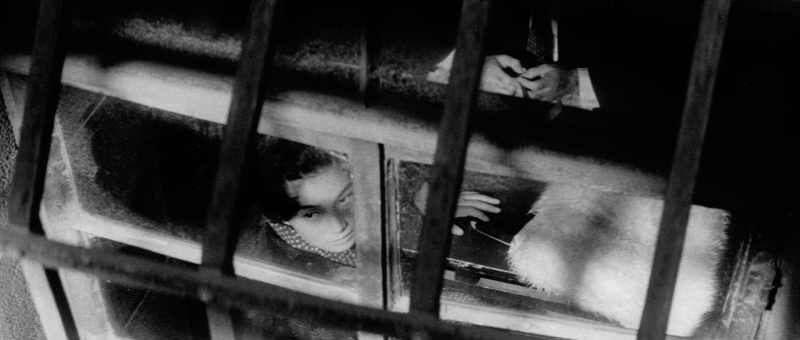
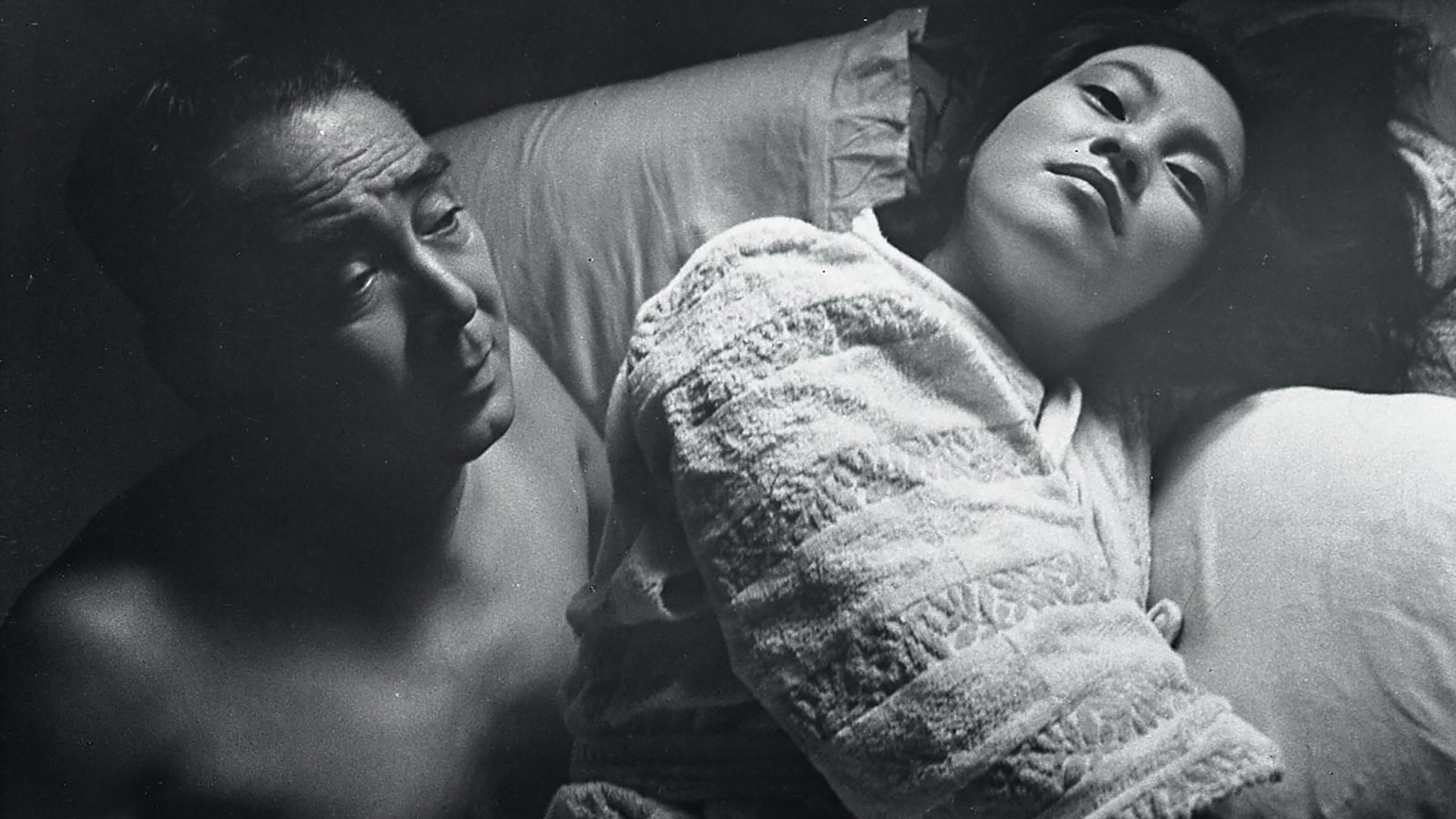
The Insect Woman (にっぽん昆虫記, Shohei Imamura, 1963)

“What other way is there?” a young woman says to her mother, little understanding that what she so casually tells her quietly crushes her mother’s view of herself as if her long years of suffering had all been for nothing while exposing her justification that everything she had done was to save her daughter from her own fate as not strictly true. The opening scenes of Shohei Imamura’s The Insect Woman (にっぽん昆虫記, Nippon Konchuki) follow a bug stubbornly traversing rough terrain, slipping, pushing onward, overcoming obstacles, yet not really getting anywhere.

The bug’s journey is echoed in Tome’s (Sachiko Hidari) return to the village at the end of the film, now an ageing woman struggling with mountain roads after long years spent in the city and finally snapping her geta leaving her barefoot on rocky ground. Like that of the bug, Tome’s life seems to be a flat circle in which history repeats itself inexorably. The film opens in 1918 as Tome is born out of wedlock to a promiscuous woman who has entered a common law union with a man who appears to have learning difficulties. Chuji (Kazuo Kitamura) may or may not be her biological father, but has an attachment to Tome. As a child, she had asked him whether they are “married” seeing as they sleep together, and he had said that they were. There is definitely more than humouring a little girl’s silly question in his reply, while he flies into jealous rages when there is talk of marrying off the older Tome to the local landlord’s son. 

Just as her mother had, Tome also has a child out of wedlock, though the father can only be Shuzo, the man her family intended her to marry in part in settlement of a longstanding debt. Tome’s early life is defined by the lingering feudalism of the rural society in which her family are serfs beholden to the whims of the landlord. The older women in the village call her away from her factory job which she says she is doing for the war effort to help on the landlord’s farm. Though she is assured she is only required to do farm work, she is raped by Shuzo who urges her to submit to him and serve her country in another way by letting him have his way with her as he will soon be going off to die for the emperor. Tome then becomes his woman, but not actually his legal wife while this justification wears a little thin when it is revealed that Shuzo has another woman and child already and thus will likely not marry her. When she becomes pregnant and Chuji beats Shuzo up, Tome is sent back to her family to have the baby. It turns out to be a girl and the older women have a brief conversation about whether to let it die as female babies are worthless and resources are scarce. This seems to run contrary to rural wisdom seen in other films such as Imamura’s later The Ballad of Narayama in which, grim as it is, male children are often exposed as girls at least can be sold, though possibly not any longer in the new democratic society.

Nevertheless, Tome insists on keeping her baby though feels out of place among her family and returns to the factory where he she has an affair with the married foreman who gets her into trade unionism and then complains that she’s too militant about the labour movement when he gets promoted to assistant manager. Tome bristles at his hypocrisy, but later abandons her ideals herself and becomes an exploiter of women after moving to the city. After visiting a shady cult to overcome her sense of guilt after a child she was looking after who reminded her of her own faraway daughter died in accident, Tome meets a devotee who complains that all of the contemporary society’s ills are caused by a lack of religious rigour, yet is actually running a brothel staffed by “amateur” sex workers to which she forcibly recruits Tome by locking her in a room with a customer. 

Just as Tome schemes by dobbing her new boss in to the police so she can start up her own business using the women as call girls posing as one half of a regular couple to avoid police detection, so she is later betrayed by her own prodigy. Tome’s travel from her rural hometown to Tokyo mimics the nation’s transition from an agrarian to an urban society mired in post-war corruption as seen in the cynical and exploitive conditions at the brothel in which the madam takes almost all the money for herself, deducting large amounts for things like kimonos and room and board, while the “amateur” sex workers prepare blood vials to convince the customers they are virgins. Tome always states that her goal is to earn enough money so that she, Chuji, and her daughter Nobuko who have been shunned by the family, could live together but though she becomes quite wealthy and sends large amounts of money home she makes no real attempt to bring them with her or to go back to the village. 

A grown-up Nobuko (Jitsuko Yoshimura) later comes to her and asks for money because some of the local youngsters are trying to start a collective farm in the wake of land reforms that redistributed landlords’ lands and ended serfdom. Tome is distressed to know that Nobuko has dropped out of school though Tome has been sending her money for the fees, realising that Nobuko will not escape the village through education nor through marrying a nice professional husband and moving to the city. In fact, Nobuko follows in the footsteps of her mother and grandmother by conceiving a child of uncertain lineage out of wedlock after being coaxed into a sexual relationship with her mother’s former lover, Karasawa (Seizaburo Kawazu), a once-prominent businessman who has fallen on hard times. He agrees to lend her the money for the farm on the condition that she make herself sexually available to him twice a week. He eventually asks her to stay and run a shop he owns instead. Nobuko agrees, but actually runs off with the money for the farm and returns to her boyfriend Yoshiji. Like Chuji, he also questions the paternity of her child, but seems to have accepted the fact it may not be his while agreeing to raise it. Tome, meanwhile, returns to the village on Karasawa’s behalf planning to tell Yoshiji about Nobuko’s life in the city in an attempt to force her to return to him.

In blowing Karasawa off and taking the money to invest in the farm, Nobuko may have broken the cycle in another way in shaking off male authority and rejecting the consumerism of the urban society, though her farm is also envisioned as a money-making business that will make them rich rather than purely self-sufficient. Another passenger on the train Tome is travelling on remarks that the rice tastes better because they have had good harvests, bearing out Nobuko’s optimism for the future. Yet in other ways, Tome is merely a passive everywoman largely oblivious to the history happening all around her. She misses the emperor’s speech announcing the end of the war while sick from malnutrition and canoodling with her lover. A former union organiser she ironically gets caught up in the Matsukawa train derailment that was blamed on the Communist Party and Japan National Railway Union which the authorities desperately wanted to crush. As an older woman, she runs into the 1960 Anpo protests, but is irritated because they disrupt her cab journey costing her time and money. She may have been corrupted by the urban, amoral capitalism of the post-war society, but is neither good nor bad, just herself and someone doing what they can to survive. 

Imamura had said that he wanted to challenge the image of suffering womanhood seen in golden age cinema. Self-sacrificing heroines such as those in Naruse’s Floating Clouds or Mizoguchi’s Life of Oharu don’t really exist, he explained. His heroines were strong and outlived men, just like Tome who tries to carve out a kind of independence for herself, but eventually finds it taken from her by other women trying to do the same. Imamura had been prevented from making another film for three years after going over budget on Pigs and Battleships, but returns with a bold new stylistic experiment using freeze fames and ironic composition to depict the “messiness” of Tome’s life in all of its moral ambiguities, victories, and defeats.


Tokyo Drifter (東京流れ者, Seijun Suzuki, 1966)

“Money and power rule now, honour means nothing” according to the new bread of upstarts gangsters in Seijun Suzuki’s Tokyo Drifter (東京流れ者, Tokyo Nagaremono). In many ways, what separates Nikkatsu’s youthful crime movies from Toei’s yakuza epics is that the nobility of Toei’s heroes is rarely questioned. In a Toei movie, it’s the world that’s wrong because the code is good and should be obeyed just as the hero obeys it, but in a Nikkatsu picture nihilism rules. The code isn’t right either, in fact it’s just another tool to manipulate and the hero, while noble, is wrong to follow it. 

That is in essence how Tetsu (Tetsuya Watari) will end up a Tokyo drifter, caught between the old world and a new consumerist Japan in which even the yakuza is attempting to corporatise and reform its image. His old boss, Kurata (Ryuji Kita), has done just that only he’s had to take out a sizeable loan from another former gangster turned real estate agent, Yoshii (Michio Hino), to do it. Realising his weakness, the upstart Otsuka gang sees an opportunity and stages an elaborate ruse that allows them to get their hands on Kurata’s valuable building and take out Yoshii at the same time though it results in Yoshii’s secretary (Tomoko Hamakawa), also the girlfriend of one of the Otsuka gang, getting caught in the crossfire. 

Tetsu describes his relationship with Kurata as like father and son and is sure he would never betray him. To preserve their new image, Tetsu does not fight back when ambushed by Otsuka goons and even puts himself on the hook for the secretary’s murder, but as much as Kurata insists he wouldn’t betray one of his “kids” to make things easier for himself perhaps he will if the situation calls for it. A defector from Otsuka’s gang, Shooting Star (Hideaki Nitani), tries to warn Tetsu that his faith in ideals like duty and loyalty is misplaced but Tetsu refuses to believe him. “Don’t shatter my dreams” Tetsu pleads, claiming that he cannot be around someone with “no sense of duty”.

Tetsu even feels sorry for Shooting Star, attributing his melancholy air to his having lost his sense of purpose in his disillusionment with post-war gangsterism. He might have a point in Shooting Star’s world weariness, but fails to realises that Shooting Star does in fact have a sense of duty and is in some ways the film’s only truly free man in forging it for himself from basic humanitarian values if tinged with a degree of cynicism. Though the pair clash, Shooting Star claims that he wants to save Tetsu from the pain of his inevitable betrayal and the disillusionment that will eventually come with it rendering him a perpetual wanderer and exile from mainstream society. 

Both men are in a sense lost amid the rapid social changes of their era, unable to move on from the post-war past into the new society even after breaking with the yakuza code in order to live by their own. In Suzuki’s complex colour scheme, Shooting Star is always clad in a forest-like green which echoes his freedom, while Otsuka is represented by a bloody red, and Tetsu dressed in an innocent powder blue suit until the final confrontation in which, along with his equally innocent love interest Chiharu (Chieko Matsubara) who had previously been associated with the colour yellow, is dressed in a pure white while all around him are now in black as representatives of those who have succumbed to the amoral capitalism of the the contemporary society. 

Suzuki even has Tetsu walk down an arched corridor reminiscent of a church into an abstract space expanding the stage at the club to lend this moment of existential struggle a little more theatricality. In a sense what Tetsu does is an act of suicide, severing his ties to the yakuza world by smashing Kurata’s glass and killing at least the image of him as a father figure to become a new man or perhaps a wandering ghost who no longer has a home and must even give up his romance with Chiharu in an acknowledgement of his exile. On Otsuka’s death, it’s almost like an alarm is switched off in the sudden shift from red to white in the giant statue standing behind Chiharu, the survivors united in white but rather than the wedding suggested by the colour of their clothes the atmosphere is funereal as Tetsu accepts he can no longer stay in this temporary space and must enter another sort of purgatory as lonely wander comforted only by his newfound freedom.


Tokyo Drifter screens at Japan Society New York on Feb. 4 as part of the Seijun Suzuki Centennial.

Original trailer (English subtitles)

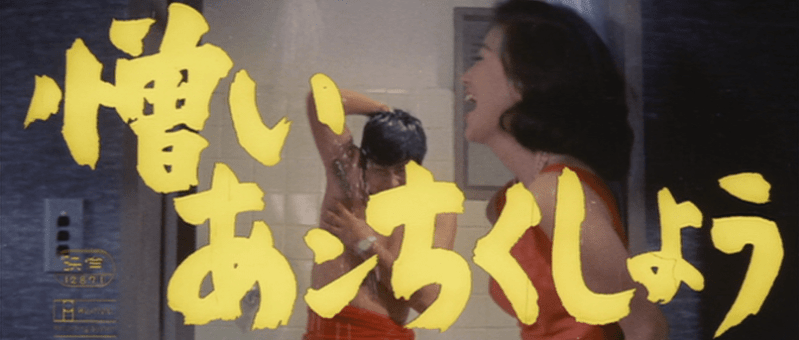
I Hate But Love (憎いあンちくしょう, Koreyoshi Kurahara, 1962)

I hate but love posterDoes “pure love” exist in the Japan of 1962, and if so what does it look like? Yujiro Ishihara, the poster boy for youthful rebellion, might not be the best person to ask but it’s his unfulfilled media superstar that ultimately determines to find out. In I Hate But Love (憎いあンちくしょう, Nikui Anchikusho) Koreyoshi Kurahara puts the jazz clubs and delinquency of The Warped Ones to one side for a Technicolor romp that owes more to Day/Hudson than it perhaps does to James Dean or Marlon Brando. Yet there is something mildly subversive in its low level criticism of Japan’s lurch towards the consumerist future, finding only emptiness in fame and success while the central couple’s deliberately repressed desires push them towards a point of both spiritual and physical exhaustion.

Daisaku (Yujiro Ishihara) and Noriko (Ruriko Asaoka) have been a couple for two years. Noriko is also Daisaku’s manager and has been with him since he was broke and an aspiring poet. Now he’s one of Japan’s top DJs and she looks after his schedule which is packed in the extreme – in fact it leaves him no time for sleeping between his radio show, TV appearances, and meetings in bars, not to mention a late night date starting at 2am! Raiding the local papers for a suitable human interest story they can flag up on the show, Noriko stumbles over the tale of a local woman who is looking for a “driver who understands humanism”. Intrigued, Daisaku and his producer Ichiro (Hiroyuki Nagato) set off to interview her but the woman doesn’t want to be involved with the media – she doesn’t want to sully her love! The fact of the matter is, Yoshiko (Izumi Ashikawa) has kept up a romance with a doctor in a rural town by letter alone and used all her savings to buy a jeep to help transport his patients more effectively. Yoshiko doesn’t need to see Toshio (Asao Koike) – her dashing doctor fiancé, she believes in their love and that’s good enough for her. She just needs someone to actually take the jeep to Kyushu where it is most needed.

Just at this point, Daisaku’s relationship with Noriko reaches a crisis point. Lovers for two years, they each feared the sparks would fade and so to keep them popping they’ve committed to a rule of no physical contact. Spark they do (though not always in a good way), but when trapped in Daisaku’s apartment one rainy afternoon and bored out of their minds they nearly give in – damaging the fragile balance they’ve managed to build through mutual rejection of their equally mutual attraction. Though Noriko remains committed to their plan for long term romance, the non-encounter pushes Daisaku into a profound state of crisis in pondering the nature of his relationship – does “pure love” exist, does he really “love” Noriko, what is the point and the purpose of their central bond of negation? Hoping to find all of that out, Daisaku makes a surprise on air announcement that he himself will drive Yoshiko’s truck to Kyushu and see what her Toshio does with that.   

Yoshiko and Noriko set themselves up as rivals – not for Daisaku’s heart but for the true nature of “love”. “Reclaiming” Daisaku’s Jaguar so she can chase after him, Noriko has a few words for Yoshiko, pointing out that she’s been patiently “building” her love with Daisaku for 737 days. Yoshiko looks at her pityingly – you don’t “build” love, she tells her, you just believe it. For Yoshiko her letters were enough, her love an act of faith, but for Noriko love is a process and an almost scientific endeavour filled with recordable and quantifiable data. Yet everything Noriko says about Daisaku is correct – she knows who he is and truly understands him, every part of him is welcome to her and so she is perfectly placed to find him off on his magic quest even if her desire to bring him back to the city is misplaced.

Daisaku’s journey puts them both through the ringer though their bond is never seriously in question. He runs and she follows, though neither of them can quite escape the net of the society in which they live. Daisaku’s flight is perhaps more from his micromanaged yet extremely comfortable life than it is just of a difficult romance. Taking to the road he wants to feel something, to know that there is something real out there. Unfortunately, even his attempt to embrace something “real” is subverted by his media buddies who secretly film him and air the footage like it’s all been a giant publicity stunt. Fearing that their cash cow is “drunk on humanism”, they ready a contingency plan to bring him back into the fold.

Ichiro tells Noriko that her desire to “tie Daisaku down” is not love but “female egotism”. What drives Noriko isn’t really a desire for control (Daisaku seemingly allows her enough of that), but a need to be needed and fear that Daisaku, now rich and famous, will eventually leave her. Paranoid their love will fail, she rejects its consummation. Yet faith alone is not enough, as Yoshiko painfully finds out on witnessing the disconnect between her imagined love created through her letters and the real flesh and blood man before her to whom she essentially has no real connection. Reaching the end of their journey, Daisaku and Noriko are forced together again, each abandoning some part of their Tokyo lives and personas to break through to something deeper and more essential. Their path takes them straight into a bizarre summer festival complete with giant floats and excited men in traditional Japanese underwear throwing water everywhere. When they finally reach their destination, their love transcends faith to become ritual, their ennui somehow transformed into an ironic celebration of life in fulfilled desire.   

Ichiro categorises Noriko and Daisaku as stingy children – defiantly saving the best for last. There is certainly something immature in their constant bickering and bargaining, the superstition that they can keep their love alive by continually rejecting it and repressing their desire for each other, but there’s also something faintly realistic in the messy grown-up commitment phobia of it all even if it joyfully strays into the absurd. Light and bright and breezy, Kurahara works in the darknesses of early ‘60s Japan from the destructive effects of celebrity and media manipulation to the emptiness of a life of excess but even if he doesn’t quite find “pure love” he does find something close to it in a perfect merger of faith and industry.


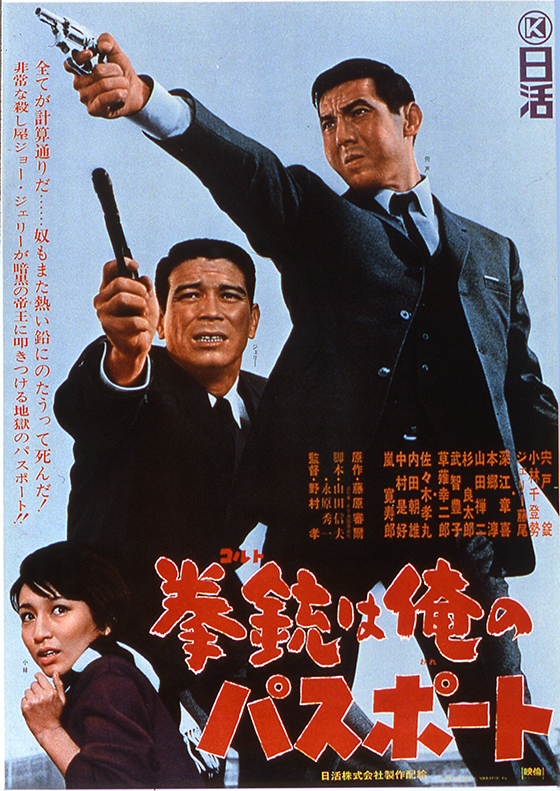
A Colt is My Passport (拳銃は俺のパスポート, Takashi Nomura, 1967)

colt is my passport posterJo Shishido played his fare share of icy hitmen, but they rarely made it through such seemingly inexorable events as the hero of Takashi Nomura’s A Colt is My Passport (拳銃は俺のパスポート, Colt wa Ore no Passport). The actor, known for his boyishly chubby face puffed up with the aid of cheek implants, floated around the lower end of Nikkatsu’s A-list but by 1967 his star was on the wane even if he still had his pick of cooler than cool tough guys in Nikkatsu’s trademark action B-movies. Mixing western and film noir, A Colt is My Passport makes a virtue of Japan’s fast moving development, heartily embracing the convenience of a society built around the idea of disposability whilst accepting the need to keep one step ahead of the rubbish truck else it swallow you whole.

Kamimura (Joe Shishido) and his buddy Shiozaki (Jerry Fujio) are on course to knock off a gang boss’ rival and then get the hell out of Japan. Kamimura, however, is a sarcastic wiseguy and so his strange sense of humour dictates that he off the guy while the mob boss he’s working for is sitting right next to him. This doesn’t go down well, and the guys’ planned airport escape is soon off the cards leaving them to take refuge in a yakuza safe house until the whole thing blows over. Blowing over, however, is something that seems unlikely and Kamimura is soon left with the responsibility of saving both his brother-in-arms Shiozaki, and the melancholy inn girl (Chitose Kobayashi) with a heart of gold who yearns for an escape from her dead end existence but finds only inertia and disappointment.

The young protege seems surprised when Kamimura tosses the expensive looking rifle he’s just used on a job into a suitcase which he then tosses into a car which is about to be tossed into a crusher, but Kamimura advises him that if you want to make it in this business, you’d best not become too fond of your tools. Kamimura is, however, a tool himself and only too aware how disposable he might be to the hands that have made use of him. He conducts his missions with the utmost efficiency, and when something goes wrong, he deals with that too.

Efficient as he is, there is one thing that is not disposable to Kamimura and that is Shiozaki. The younger man appears not to have much to do but Kamimura keeps him around anyway with Shiozaki trailing around after him respectfully. More liability than anything else, Kamimura frequently knocks Shiozaki out to keep him out of trouble – especially as he can see Shiozaki might be tempted to leap into the fray on his behalf. Kamimura has no time for feeling, no taste for factoring attachment into his carefully constructed plans, but where Shiozaki is concerned, sentimentality wins the day.

Mina, a melancholy maid at a dockside inn, marvels at the degree of Kamimura’s devotion, wishing that she too could have the kind of friendship these men have with each other. A runaway from the sea, Mina has been trapped on the docks all her adult life. Like many a Nikkatsu heroine, love was her path to escape but an encounter with a shady gangster who continues to haunt her life put paid to that. The boats come and go but Mina stays on shore. Kamimura might be her ticket out but he wastes no time disillusioning her about his lack of interest in becoming her saviour (even if he’s not ungrateful for her assistance and also realises she’s quite an asset in his quest to ensure the survival of his ally).

Pure hardboiled, A Colt is My Passport is a crime story which rejects the femme fatal in favour of the intense relationship between its two protagonists whose friendship transcends brotherhood but never disrupts the methodical poise of the always prepared Kamimura. The minor distraction of a fly in the mud perhaps reminds him of his mortality, his smallness, the fact that he is essentially “disposable” and will one day become a mere vessel for this tiny, quite irritating creature but if he has a moment of introspection it is short lived. The world may be crunching at his heels, but Kamimura keeps moving. He has his plan, audacious as it is. He will save his buddy, and perhaps he doesn’t care too much if he survives or not, but he will not go down easy and if the world wants a bite out of him, it will have to be fast or lucky.


Original trailer (no subtitles)