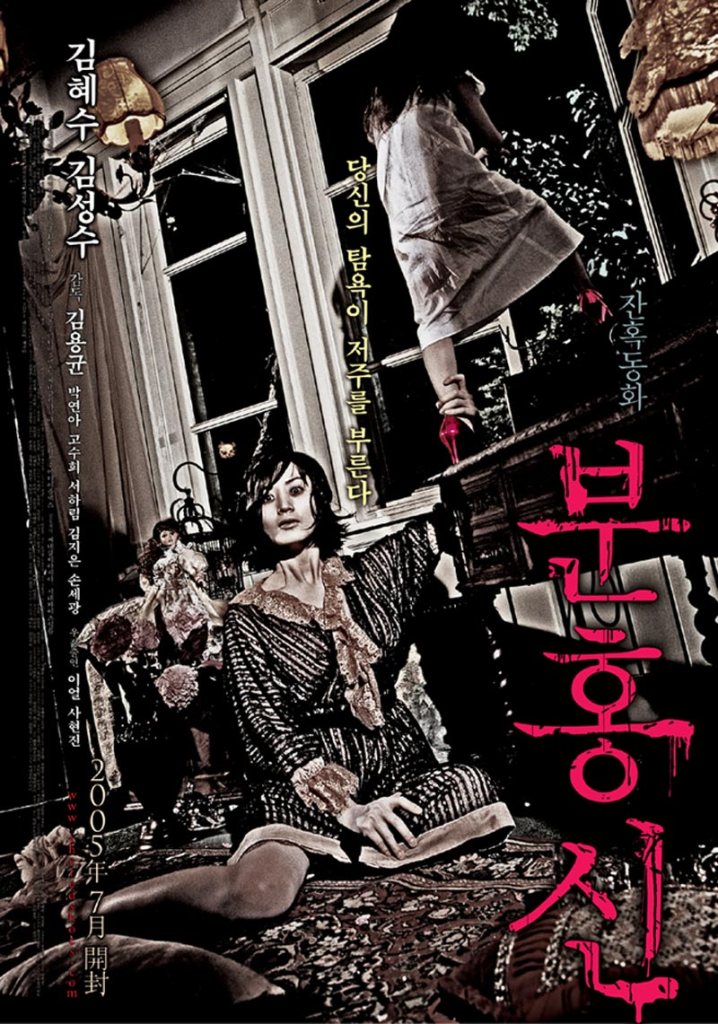
The Red Shoes (분홍신, Kim Yong-gyun, 2005)

the-red-shoesWalk a mile in a man’s shoes, they say, if you really want to understand him. If Kim Yong-gyun’s The Red Shoes (분홍신, Bunhongsin, 2005) is anything to go by, you’d better make sure you ask first and return them to their rightful owner afterwards without fear or covetousness. Loosely based on the classic Hans Christian Andersen tale this Korean take replaces dancing with murder and also mixes in elements from other popular Asian horror movies of the day, most notably Dark Water in its dank and supernaturally tinged dingy apartment setting.

Late one night at a deserted train station in Seoul, a high school girl complains that she’s been waiting ages for her friend to arrive before noticing a pair of hot pink high heels resting incongruously on the platform’s edge. Strangely drawn to them, the girl puts the shoes on only for her friend to turn up and immediately become infatuated with the unexpected footwear herself, suddenly exclaiming that she saw them first. The two fight as the first girl is almost pushed onto the tracks by her friend and all over a random pair of actually quite ugly funny coloured shoes. The eventual winner will come to regret their victory as that night in an otherwise empty train station a teenage girl will loose her footing to a pair of high heels which slowly fill with blood and then disappear leaving only a pair of severed legs behind them.

After this grim opening, we meet another little girl who has definite opinions about her footwear in the form of little Tae-soo who wanted to wear her red shoes to ballet but mum Sun-jae (Kim Hye-soo) says no and they’re already late. Letting Tae-soo learn independence by telling her to make her own way but surreptitiously following her backfires when Tae-soo somehow evades the net leading Sun-jae to head home earlier than expected and discover her husband pleasuring another woman who is also wearing a pair of Sun-jae’s favourite shoes, just to add insult to injury. Next thing you know Sun-jae and Tae-soo have moved into a horrible (but presumably cheap) apartment while they wait for Sun-jae’s new optometrist’s clinic to be finished. It’s all kind of OK, until Sun-jae notices a pair of hot pink high heels all alone on the subway and in obvious need of adoption by a pair of loving feet…

Anyone with a even a passing knowledge of the genre will have figured out the central twist well ahead of time though, strangely, it seems almost irrelevant. The shoes are cursed, but they’re cursed with jealous desire as they both contain the entirety of a scorned woman’s rage and humiliation, and a lingering want for that which has been lost. Spreading like a virus, the shoes pick a host and then target those whom it infects with the need to posses them. This tension manifests itself in odd ways as mother and daughter become rivals in the tug of war over who the rightful owner of the shoes should be. A precocious child, Tae-soo has soon tried on her mother’s new shoes and there after progressed to makeup and pretty dresses. Her mother, rather than using authority or reason to regain her lost treasure, fights with her daughter like a child eventually resorting to violence but with all the force of adulthood. The shoes corrupt even this most innocent and essential of relationships as Sun-jae continues to struggle with maternity as Tae-soo’s overwhelming need to possess the shoes and eclipse her mother’s femininity arrives well ahead of schedule.

Shoes aside, Sun-jae does not seem to be a well woman. Problems with her eyes do not quite explain the flashbacks she’s been experiencing to an apparently traumatic episode in the 1940s in which the shoes seem to feature. She’s also begun having strange waking dreams which involve blood, lots of blood – far more blood than any one body could realistically contain, and bad things happening to Tae-soo. Eventually Sun-jae figures out that the shoes were a bad idea and that there may be other stuff going on in her life that she isn’t exactly aware of, but the extent to which cursed footwear is influencing her behaviour may be open to debate given later (though extremely obvious) revelations.

It just goes to show that misplaced desire can leave you footless and fancy free. Kim does his best to make modern day Seoul a supernaturally scary place, overlaying eerily empty shots of intersections and train stations with gothic infused musical cues whilst having Sun-jae move into the kind of place which only someone trying to disappear would consider. Adding in touches of surrealism from the aesthetically beautiful fantasy sequences to snowing blood, Kim creates the atmosphere of fairy tale whilst allowing for an imbalance of perception in the possibly fracturing mind of his heroine. Despite the often impressive cinematography and strong leading performance from Kim Hye-soo, The Red Shoes never manages to transcend its lack of originality and frequent callbacks to similarly themed genre efforts but nevertheless offers its share of elegantly composed scares even if its internal integrity fails to convince.


Original trailer (English subtitles)
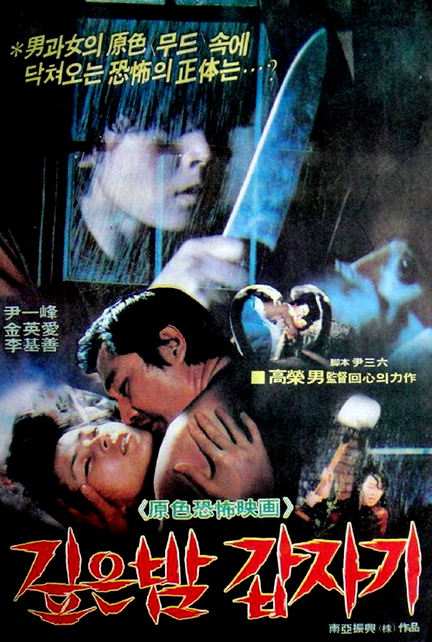
Suddenly in the Dark (깊은밤 갑자기, Go Yeong-nam, 1981)

suddenly-in-the-darkEverybody ought to have a maid, goes the old adage, but finding one you can trust can be a tall order. Kim Ki-young’s The Housemaid clearly sounds a warning call to husbands everywhere not to be tempted by the enticements of pretty young girls or conniving social climbers with designs on upending the domestic order by supplanting the legitimate wife from within her own home. The Housemaid is melodrama rewritten as horror in which a parasitical force colonises the domestic environment hell bent on taking it over through a subversion of its binding yet taboo foundation – sexual desire. Twenty years later, Suddenly in the Dark (깊은밤 갑자기, Gipeun Bam, Gapjagi) returns to the same theme but from a different angle. A once harmonious household is suddenly turned upside down following the introduction of a second female, provoking a series of crises within the already strained mind of its wife and mother.
Lepidopterist Kang Yu-jin (Yoon Il-bong) returns home after three weeks away chasing butterflies and is warmly greeted by his faithful wife, Seon-hee (Kim Young-ae), and their loving daughter. Seon-hee looks on while her husband shows off some slides of his latest finds to his colleagues but is disturbed by the incongruous presence of a shamanic statue, somehow mixed in with the shots of rare butterflies. The creepy doll-like figure continues to haunt Seon-hee who finds herself in a state of agitation regarding her husband’s frequent absences.

She is then, fairly non-plussed when Yu-jin returns from another trip with a strange young girl in tow. Essentially kind but also absent minded and a little insensitive, Yu-jin has picked up a waif and stray, recently orphaned and alone, with the idea of killing two birds with one stone by taking her into his house as a maid. On hearing Yu-jin’s explanation, Seon-hee reconsiders and is excited to get both some much needed domestic help and a degree of companionship in her otherwise lonely life. The girl, Mi-ok (Lee Ki-seon), is a little strange but seems grateful to have found a place to belong. Seon-hee, however, gradually becomes alarmed firstly by Mi-ok’s youth and beauty, and later by the presence of the same shamanic statue that’s been haunting her all this time among Mi-ok’s few belongings. Increasingly unhinged and paranoid, Seon-hee becomes convinced that her new maid has seduced her husband and means to kill her by any means possible.

Like The Housemaid, Suddenly in the Dark turns on the parasitical threat of an outsider within the family unit. Focussing on the women rather than the temptation and fall of the man of the house, the narrative shifts away from a crisis of male desire and responsibility to the fear and insecurity of the neglected, lonely housewife intentionally isolated from society at large yet under appreciated and often bored at home. By all appearances, the Kangs have made a fairly nice life for themselves with a spacious, if remote, country villa filled with nicknacks and elegant furniture, and seem to have a happy and fulfilled marriage. However, Yu-jin is often away for long stretches of time and even when home is often too occupied with work to appreciate his wife and daughter.

Seon-hee appears to have only one real “friend” who seems to be the sort of woman who likes to talk people down and undermine the happiness of others to make herself feel better. Consequently, she’s filled Seon-hee’s mind with lots of imagined troubles. Women over thirty might as well be sixty when it comes to male attention, she says. Suddenly throwing Seon-hee into a morass of uncertainty regarding her husband’s growing indifference towards her as he retreats to the spare room to finish writing his book, Eun-yeong is then quick to disregard Seon-hee’s distress over the threat posed by her new maid, refusing her help at the very time it’s most needed.

Mi-ok moves between an innocent young girl clutching the talisman left to her by her mother like a child her doll, and a predatory sex fiend corrupting and possessing Seon-hee’s husband aiming to displace her from her rightful position in this ordinary middle-class world. Aside from Seon-hee’s subjective perception, Yu-jin seems mostly indifferent or genially paternal in his dealings with Mi-ok, and even her caustic friend Eun-young remarks that she doesn’t think Mi-ok is all that pretty after all. In fact, the only person to be struck by Mi-ok’s physical beauty is Seon-hee who finds herself personally bathing her new maid, caressing her lithe and youthful body and remarking on the beauty of her skin. Insecure of her own ageing appearance, Seon-hee is, in one way or another, desirous of Mi-ok’s youthful figure, either jealously wishing to possess and wear it for herself, or possess it in a more obvious, externalised way.

Even if Seon-hee describes Mi-ok’s beauty as striking enough to attract even a woman, any latent desire on her own part is left on the level of psycho-sexual subtext rather than directly addressed even if each of the lingering shots of Mi-ok’s naked body are from Seon-hee’s POV and her (perhaps fantastical) observations of Mi-ok and her husband making love are entirely focussed on the younger woman.

Where Suddenly in the Dark diverges from its closer genre relatives is in its shamanistic themes as Seon-hee finds herself haunted by the creepy talisman and its later personification as Mi-ok before finally perhaps becoming the image herself. Shamanism had been aggressively suppressed in recent history, often viewed distastefully as a remnant of a backwards, superstitious age. Though Yu-jin insists that the doll is just a doll and holds no power, forcing Seon-hee to stay in the same room with it to overcome her irrational fear of a bit of old wood, the ancient ways work their magic on her, adding to her madness and ultimately provoking the final, psychedelic rampage.

Through the disorientating, kaleidoscopic butterfly vision which fractures Seon-hee’s fragile world view, Go creates a strange and eerie atmosphere of uncertainty as perception and reality diverge into opposing poles. Taking advantage of the recently relaxed censorship codes to further enhance the film’s erotic quality, Suddenly in the Dark is a psychedelic tour de force with its glass bottom view, green tinted shamanistic visions, taxidermy filled creepy mansion, and constantly shifting uncertainty born of spiritual and mental battling inside its heroine’s soul. A fantastic example of esoteric Korean horror, Suddenly in the Dark is an important rediscovery for the genre’s history but also a fascinating zeitgeisty character study which refuses definitive interpretation.


Recently released on blu-ray by Mondo Macabro with English subtitles (currently sold out, second pressing released 2017)

Mondo Macabro trailer (dialogue free, NSFW, quite creepy)

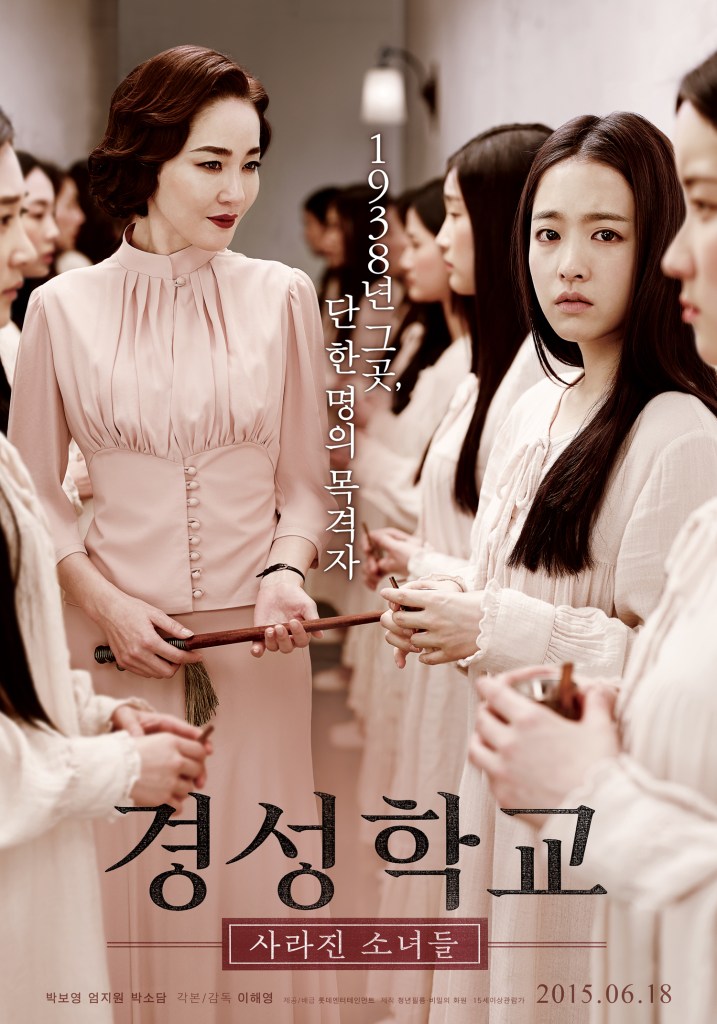
The Silenced (경성학교: 사라진 소녀들, Lee Hae-Young, 2015)

the-silencedThe Silenced (경성학교: 사라진 소녀들, Gyeongseonghakyoo: Sarajin Sonyeodeul) has all the classic genre aspects of the boarding school horror story familiar to fans of gothic literature everywhere, but this is no Victorian tale of repressed sexuality and hallucinatory psychosis. What The Silence does is take all of these essential elements and remix them as a metaphor for the horror of colonialism. Surrounded by quislings and forced into submission in order to survive, how does the essential soul of an oppressed people survive? The Silence would seem to argue that perhaps it can’t, but can evolve and learn to resist its colonisers even if it has to bend to do so.

Korea, 1938. Teenage girl Ju-ran (Park Bo-Young) is dropped off by her rather cool step-mother at a hospital school before her parents relocate to Tokyo. On arrival, Ju-ran switches to her Japanese name of Shizuko which raises a stir among her new schoolmates because another girl with the same name previously occupied her new bed before disappearing suddenly without a word of goodbye. Her physical resemblance to the previous Shizuko, coupled with her ill-health, provokes mistrust among the other girls, especially top girl Yuka and her minions. Shizuko is now expected to get used to all of the school’s arcane rules and regulations as soon as possible or risk harsh punishment. This includes “treatment” for her illness which involves frequent distribution of pills, injections, and other experimental courses. Before long Shizuko begins to notice odd behaviour among the girls, some of whom begin to disappear.

After a lengthy series of diplomatic manoeuvres beginning in the Meiji era, Japan annexed Korea in 1910 beginning a period of direct rule which would continue until the end of the Second World War. During this period, Japanese became the dominant, official language and mainland Japanese culture sought to displace that of the indigenous Korean society. The school, as an official institution, is careful to follow these regulations to the letter. Each of the pupils has a Japanese name which becomes their “official” designation, the Korean identity is “buried” with Korean birth names used only with close friends whose trust is certain.

Similarly, the school’s official language is Japanese with lessons and official business always conducted in the appropriate language. Linguistic shifts suddenly become an interesting phenomenon as the girls continue to talk to each other in their native Korean in the school room and out (even if sticking to Japanese names) but maintain order by obeying commands in the language of authority. The headmistress generally sticks to Japanese, at least when she’s at the lectern, but notably switches to Korean when addressing a girl personally or when she wishes to appear kind and non-threatening rather than authoritarian. This point is further brought home when one girl descends into a fit of rage and attacks another, ranting and raving in Japanese whilst gripping the other girl’s throat. Korean is both the language of kindness and friendship as opposed to the coldness and violence of the official Japanese, and a tool to be manipulated in order to create a false sense of camaraderie between colonised and coloniser.

The school is staffed by collaborators working with the Japanese authorities and training these young women to be model Japanese citizens. Part of their classwork involves a large embroidery project sewing beautiful pink cherry blossoms onto a map of Korea – a motif which is later chillingly repeated by sewing those same flowers onto the body the body of a collaborator. Tokyo has become a kind of magical wonderland paradise and the school even offers the girls hope of advancement there through winning a competition based on physical ability in which the school will select the two most promising candidates and dispatch them to the capital. The headmistress, once the final mystery has been exposed, begs the Japanese military forces to put their faith in her because she is determined to become a loyal Japanese citizen and leave this backward Korea behind forever.

The main thrust of the narrative centres around the interplay between these teenage girls who stand in for a subjugated people, ruled over by their collaborating teachers. Shizuko (Ju-ran) strikes up a friendship with Kazue (or Yeong-duk to restore her Korean name), previously the best friend of her predecessor. The two girls become closer though the the disappearance of the previous Shizuko always stands between them. Beginning to solve the mystery, the two girls are the only opposition to the ruling regime as they accept the various “benefits” of their treatment and education, and return to use them against their oppressors. The girls’ innocence has been corrupted by their experiences, but this same corruption is the very thing which allows them to take a stand for their independence.

Though the supernatural is posited as the ultimate enemy, the solution of the mystery leads straight back into the political realm rather than any less Earthly kind of evil. Director Lee Hae-young generates a supremely creepy atmosphere from the opening sequence onwards which empahises the gothic aesthetic and inescapable presence of something dark lurking in the shadows. Though using minimal instances of jump scares, supernatural episodes, and hallucinatory images, the film pushes its horrors into the real world even if the solution it ultimately offers is more akin to a superhero origin story than a revolutionary uprising. Beautifully photographed, The Silenced is the story of those denied a voice realising they have the right to rebel but like any gothic horror story paints its central battle as an ongoing, unwinnable fight against the darkness.


Original trailer (select English subs from settings menu)

https://www.youtube.com/watch?v=_fstE9JDSOA

The Wailing (곡성, Na Hong-Jin, 2016)

wailingFor the world’s more full of weeping than you can understand – the residents of Goksung, the setting for Na Hong-jin’s nihilistic horror movie The Wailing (곡성, Goksung), might be inclined to agree with Yeats if only because the name of their town is also a homonym for the “sound of weeping”. There is plenty to weep over, and in places Na’s film begins to feel like one long plaintive cry reaching far back to the dawn of time but the main wounds are comparatively more recent – colonisation, not only of a landscape but of a soul. When it comes to gods, should you trust one over another simply because of its country of origin or is your faith to  be bestowed in something with more universal application?
Goksung is a sleepy little rural town way up in the mountains. This is the kind of place where nothing much ever happens but today all of that is about to change as a local man has committed a series of bloody murders and is now in a dissociative state. Bumbling policeman Jong-goo (Kwak Do-won) arrives late to the crime scene but quickly finds himself pulled in to the ongoing investigations as bodies begin piling up in the previously quiet town.

The rational explanation for the spate of violent killings is blamed on a tonic containing some funny mushrooms but others have another idea. All of this started happening after a Japanese guy (Jun Kunimura) moved to the town. Some say he’s a professor, some say he’s a Buddhist monk, but there also those who hold him responsible for the rape of a local woman, and there are even reports of him running about the forest dressed only in a loincloth and feasting on the remains of fallen animals.

Eventually, Jung-goo’s young daughter Hyo-jin (Kim Hwan-hee) falls under the curse, giving him an unavoidable impetus to find the truth. As well as the “suspicious” Japanese visitor, Jung-goo also comes into contact with a mysterious young woman dressed in white (Chun Woo-hee) who may be either friend or foe, whilst shamans and the Catholic Church are each approached for their advice on this singularly supernatural phenomenon.

This being quite a sleepy town, Jung-goo’s days most likely involved a lot of napping, eating, and card playing, broken up with chatting to old ladies. So unaccustomed to crime are they, they didn’t quite remember to put their gloves on before investigating a crime scene. Jung-goo and his partner are constantly branded “morons” by their boss and if the night they end up guarding the police station during a thunderstorm is anything to go by, they aren’t exactly the bravest of souls either. Not the best pair to be investigating a complex, supernatural mystery they decide to heed the rumours and pay a visit to the Japanese guy living way out in the woods.

Known only by the derogatory term “the Jap”, the new addition to the village quickly falls under suspicion thanks to the old fashioned crime of not being from around here. Whether out of resentment for historical crimes or simply because of being an outsider, everyone decides the Japanese visitor must, in some way, be responsible. Suspicions are compounded when Jung-goo, his partner, and his partner’s nephew who happens to be a Catholic priest in training with a solid command of Japanese, discover some very odd things whilst snooping around the man’s home. Is the mysterious visitor really, literally, a “Japanese devil” or just the victim of an ongoing campaign of intense xenophobia and the supernatural elements attributed to him a manifestation of that extremely offensive term?

Na keeps us guessing. Meanwhile, ancient remedies are sought when ancient ones are awakened, hence Jung-goo’s mother-in-law turns to shamanism to try and cure her granddaughter of her increasingly serious illness. The shaman (Hwang Jung-Min) arrives more like a TV evangelist than a witch doctor – smart suit and turtleneck, topped of with long hair tied into a bun. The exorcism scene itself is a furious battle between light and darkness (or so we presume) as the shaman dances wildly to the pulsating drum beats of his orchestra, sacrificing a chicken here and a goat there, all while Hyo-jin writhes in agony in the next room and his enemy performs a counter ritual from his recently refurbished lair.

“Believe in me and you shall be saved” is a message Jung-goo receives from just about everyone during the course of the film. The Catholic Church, however, is resolutely opposed to the idea of this demonic threat and informs Jung-goo that this is not a religious matter – he ought to take his daughter back to the hospital and instil his “faith” in modern medicine. Faith appears to be the central question, in what or whom should one believe? Can Jung-goo trust his shaman, is the Japanese guy an ally, threat, or just a neutral, ordinary man, and what of the oddly intense woman dressed in white? In the end, Jung-goo’s faith is questioned but he pays dearly for his final decision. Had he placed more faith in the old gods, his fate might have been very different but Jung-goo chose real world logic (not his strongest suit) over spiritual intuition and failed to heed the warnings.

Jung-goo, though presented as a broadly sympathetic presence, is partly responsible for his own downfall through his willingness to embrace the baser elements of his nature. In contrast to his otherwise laid-back character which sees him late to work because of family meals, Jung-goo has a violent streak first seen when he takes defending himself from an angry dog far further than he needed to. Later he rounds a group of friends to help him take out the Japanese man in a worrying stab at mob justice. Neither quality is very endearing but Jung-goo’s position as a slightly dim bruiser who mistakenly thinks he can smash his way out of a spiritual conundrum makes him an unlikely choice of saviour.

Na offers nothing in the way of hope, the forces of darkness are set to conquer the world helped only by humanity’s propensity towards doubt, its selfishness, and its fear. The dark humour fades as the pace increases until the film approaches its bleaker than bleak finale. This is a land of ghosts, both fleshy and otherwise but in order to bid them goodbye you must first accept their presence. In the end it’s all a question of faith but those most worthy of it may be among the most difficult to believe.


Reviewed at 2016 BFI London Film Festival

Original trailer (English subtitles)

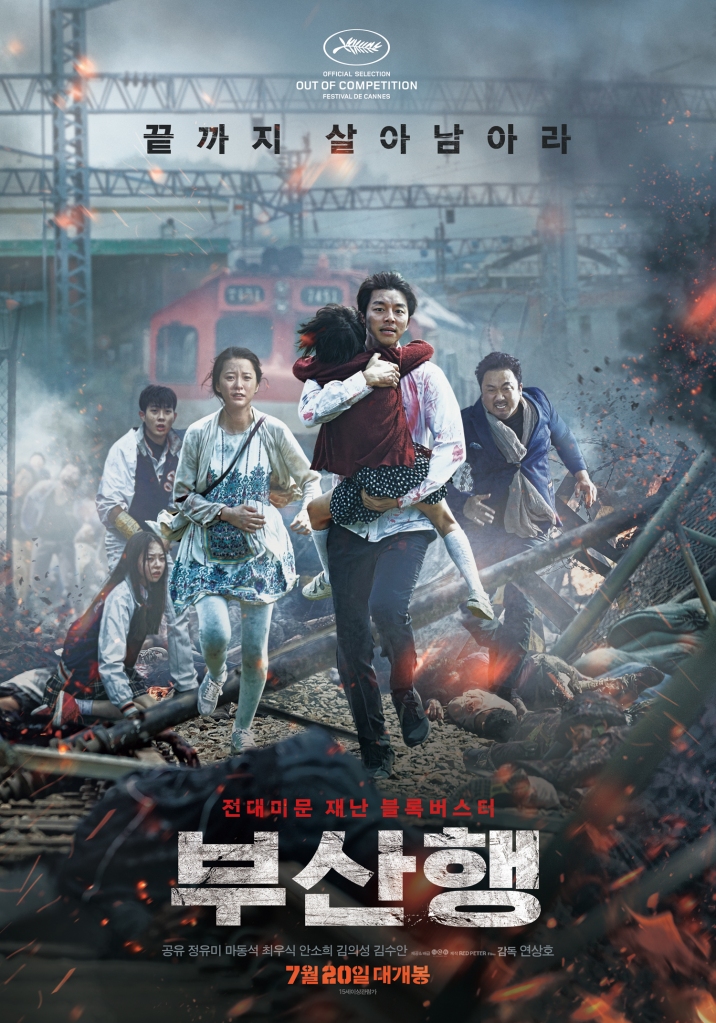
Train to Busan (부산행, Yeon Sang-ho, 2016)

Train to BusanMany people all over the world find themselves on the zombie express each day, ready for arrival at drone central, but at least their fellow passengers are of the slack jawed and sleep deprived kind, soon be revived at their chosen destination with the magic elixir known as coffee. The unfortunate passengers on an early morning train to Busan have something much more serious to deal with. The live action debut from one of the leading lights of Korean animation Yeon Sang-ho, Train to Busan (부산행, Busanhaeng) pays homage to the best of the zombie genre providing both high octane action from its fast zombie monsters and subtle political commentary as a humanity’s best and worst qualities battle it out for survival in the most extreme of situations.
Workaholic fund manager Seok-woo (Gong Yoo) is having a series of very bad days. His wife has left him and for unclear reasons, also left their young daughter, Soo-an (Kim Soo-ahn), in her father’s care though apparently wants custody in the ugly divorce battle that now seems inevitable. It’s Soo-an’s birthday but all she wants is to catch a train to Busan to see her mum and if she has to she’ll even go by herself. After his attempt at a birthday present spectacularly backfires, Seok-woo gives in and agrees to take Soo-an to her mother’s before catching the next train back after dropping her off. Unfortunately, they have picked a very bad day to take the train.

Yeon Sang-ho takes his time to build to the central train based set piece but is is careful to create an atmosphere which makes it plain that there is something very wrong with this seemingly everyday set up. After a brief dig about pig farmers losing out to government policy on foot and mouth disease and irresponsible hit and run drivers leaving deer corpses behind them for someone else to deal with, he has a parade of emergency vehicles racing past Seok-Woo and Soo-an on their trip to the station while ash rains down on their car. Seok-woo is still focussed on work though sleepy on the train so he misses Soo-an’s shocked reaction to a station guard being rugby tackled just as the train is leaving while a mass of improbable early morning revellers are trying to break through the line of staff holding them back at the platform steps.

Patient zero bounds onto the train just as the doors close though one wonders why no one is paying much attention to this obviously distressed young woman as she stumbles and writhes around in the train carriage before the virus fully takes hold. Just as we think someone is about to come to her aid, it turns out to be a case of a snooty passenger taking offence at the presence of an “odd person” on the train. The “odd person” turns out to be a homeless guy whose mutterings of “dead, all dead” take on a prophetic air rather than the ramblings of a mad man that the train guards assume them to be.

This kind of stereotypical othering and the selfish refusal to help fellow humans in need is at the very heart of the film. Seok-woo admonishes his goodhearted daughter when she repeatedly makes an effort to be a kind and decent person by giving up her seat for an old lady or wanting to stop and help others escape the zombie onslaught. However, Soo-an’s goodness wins through as she in turn chastises her father and explains that his selfishness and lack of regard for the feelings of other people is the very reason her mother left the family. Even if he begins by cruelly closing the door on the film’s most heroic character and his pregnant wife, Seok-woo gradually begins to develop a sense of social responsibility whether out of simple pragmatism or genuine fellow feeling.

Workaholic fathers with minimal connections to their offspring may be something of a genre trope but, as father-to-be Sang-hwa says, fathers often get a bad rap – making all of the sacrifices and enjoying none of the rewards. In an attempt to show solidarity with Seok-Woo, Sang-hwa assures him that his daughter will understand why he worked so hard all the time when she grows up and reiterates that true fatherhood is about self-sacrifice. This is one sense plays into the earlier themes of Seok-Woo’s self-centred viewpoint in asking if he really is working hard for his family or only wants to been as such, maintaining his own social status and upperclass lifestyle and completing it with a perfectly posed family photo. A father is supposed to protect his daughter and now Soo-an has only him to rely on, if Seok-woo is going ensure her survival he will have to decide what kind of sacrifices he’s prepared to make on her behalf.

If the film has a villain it isn’t the rabid zombie hordes who, after all, are only obeying their programming, it’s personal, corporate, and political greed. The clearest embodiment of this is in the panicked businessman who frequently tries to issue orders to the train staff and insists the train take him to his preferred destination. After trying to get the homeless man thrown off the train early on, the fascistic businessman picks up a lackey in the form of a steward and begins trying to exclude all the “suspicious” people from his general vicinity. Cruel and cowardly, the businessman’s selfish actions only cause more problems for everyone else whilst whipping up unhelpful paranoia among those who will need to work together to survive. Literally feeding even his most loyal comrades to zombies to buy himself time to escape, this egotistical CEO is the perfect metaphor for cannibalistic nature of the capitalist system which is, as Sang-hwa said, content to let the “useless” fall behind.

That’s not to forget the actual undead threat. Yeon Sang-ho’s walking dead take inspiration from his animated work and move quickly with jerky, uncanny movements more like Butoh dancers than the usual stupefied shufflers. The set pieces are expertly choreographed and well shot, maintaining the tension throughout though the increase in scale towards the final stretch is at odds with the leaner, meaner approach of the early scenes. Despite eventually giving in to melodrama in a heavily signposted script, Yeon Sang-ho’s live action debut is an impressive effort making room for his standard social concerns whilst also providing innovative zombie thrills. Yeon Sang-ho’s message is clear, when disaster strikes no one can survive alone, the only chance for salvation lies in altruistic compassion. In the end the best weapon against the darkness is a children’s song as innocence finally triumphs over fear.


UK release trailer:

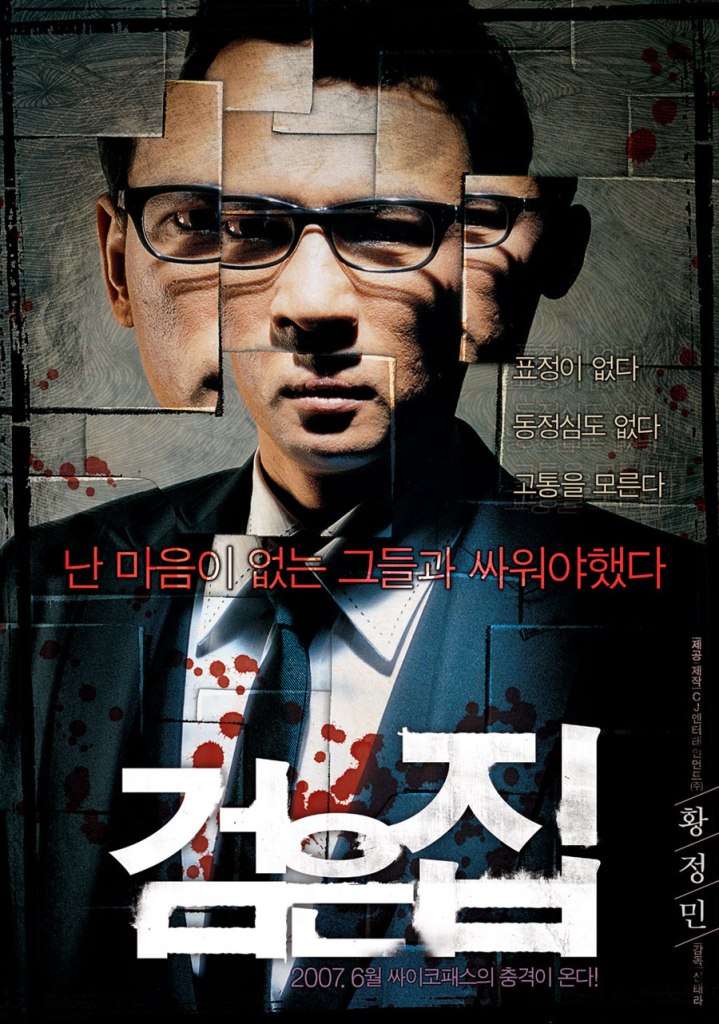
Black House (검은집, Shin Terra, 2007)

Black House (korea)Yusuke Kishi’s Black House source novel was previously adapted by Yoshimitsu Morita in its native Japan back in 1999, but eight years later the tale made its way to Korea by way of director Shin Terra who opts for a much more straightforward approach than Morita’s characteristically bizarre take. Sold as K-horror, the tone is closer to nasty thriller only giving way to classic slasher action in the final stretch. In eschewing Morita’s idiosyncratic tendency to insert himself into the material, Shin crafts a more mainstream aesthetic, but loses the various layers of social and psychological commentary that went with it.
Juno (Hwang Jung-min) is a mild mannered insurance clerk, new on the job and extremely naive. His first case involves a visit to a hospital with his boss to visit a persistent claimant whom they believe is deliberately scamming the system and possibly with the hospital’s help. In many ways, Juno is an innocent, he believed in insurance as a safety net and a power for social good so he’s shocked that anyone would deliberately manipulate the rules in this way – particularly when he discovers some people will go so far as to deliberately maim themselves just to claim on their insurance policies.

Not long after he starts working at the company, Juno gets a strange phone call from a man asking if insurance policies pay out in case of suicide. It’s possible, Juno says – he’ll need to check the policy to make sure. Suddenly worried the person he’s talking to is in a dark place, he starts trying to dissuade him from the idea of taking his own life and unwisely gives a lot of first hand advice despite the highlighted section in his employee guide cautioning him never to reveal personal information to clients. Soon enough, a client has asked for him personally to go out to their remote house and chat about a policy. When he gets there he receives a nasty surprise as the man’s young son has apparently hanged himself in the back room. Appalled, Juno waits to greet the police but becomes convinced the man has deliberately killed the boy, who was his step-son, to get the payout on his life insurance.

Juno refuses the claim but Choong-bae, the claimant, won’t give up and starts coming to the office everyday to ask for his money. Choong-bae is a scary looking guy and frightens most of the other staff with his vacant staring. He also has an insurance policy on his wife leading Juno to fear that she is next but his decision to try and alert her to her husband’s plans will prove a mistaken one, drawing him into the web of a dangerous and psychopathic serial killer.

Shin’s adaptation is most likely closer to the original novel but he is far less interested in the psychological or social implications than Morita was. There is no explanation offered for the actions of the killer though the childhood sequences with their reliance on dreams and hearsay remain intact, only with lesser impact. The question of insurance fraud and scamsters, people so desperate for money that they will literally sacrifice an arm or a leg, only exists as background and isn’t presented as a societal problem so much as just something that happens because there are some shameless people out there who would rather play the system than do an honest days work. Juno has also been given his own tragic backstory which tries to play him off as a mirror of the killer though somehow this never quite works and Juno’s own flashbacks are overplayed.

Beginning as a slow burn thriller where Juno plays the nervous, softhearted neophyte as yet uninured to the murkiness of the insurance world, Black House (검은집, Geomeun Jip) takes a huge detour during the final third which sends it into slasher territory when Juno decides to travel to the titular Black House, alone, during the middle of the night, because the police won’t listen to him and there are people in danger. When he gets there he finds a veritable house of horrors with body parts and nooses hanging from the ceiling, blood and carnage everywhere. Then it’s a straightforward fight to the death as Juno faces off against the psychopathic terror despite his nervous disposition culminating in some unexpectedly gory business with a key.

Like most slasher movies, Black House has several endings and finishes on a note of uncertainty but it never quite manages to make its sudden descent into violence work in its favour. Lacking the depth of Morita’s adaptation, Shin’s Black House may have stronger genre influences but with nothing to back them up all that remains at the end is a darker than usual serial killer tale with mild slasher tendencies. A decent enough mainstream thriller, Black House has a lot to offer despite stumbling in its final third but nevertheless lacks a distinctive element to mark it out from similarly themed genre efforts of recent times.


Unsubbed trailer:

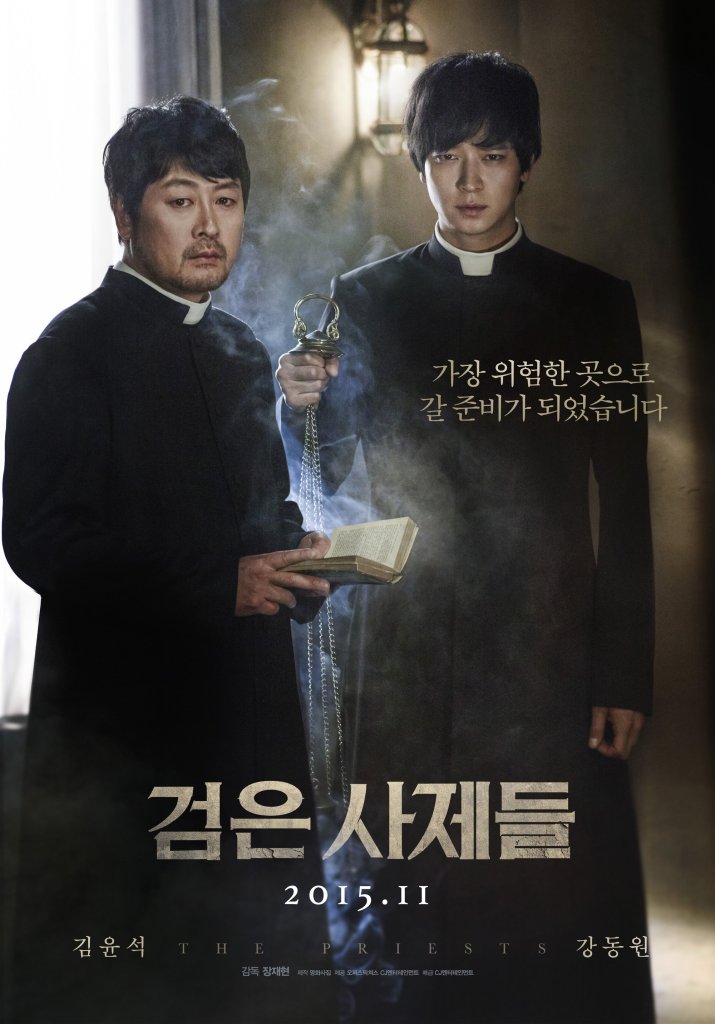
The Priests (검은 사제들, Jang Jae-Hyun, 2015)

The Priests PosterThe era of hero priests might be well and truly behind us but at least when it comes to the exorcism movie, the warrior monk resurfaces as the valiant men of God face off against pure evil itself risking both body and soul in an attempt to free the unfortunate victim of a possession from their torment. To many, the very idea sounds as if it belongs in the medieval era – what need have we for demons now that we posses such certain, scientific knowledge? There are, however, things far more ancient than man which are far more terrifying than our ordinary villainy.

The Priests (검은 사제들, geom-eun sa-je-deul) begins with two Italian clerics in the Vatican discussing the somewhat taboo subject of exorcism and demonic possession. They have been made aware of a serious case in Korea and, as they can’t get in touch with the Korean exorcism department, head out there themselves for a little pest control of their own. However, the enemy they were facing proves too strong for them as they become involved in a multi-car pileup allowing the demon they’ve trapped inside a small dog to escape and migrate to a better humanoid host.

Now we turn to the Korean church authorities who are also worried about a young girl who appears to be displaying the symptoms of demonic possession. Their leader repeatedly tells them he will not “officially” sanction any kind of action whilst making it clear he wants them to go ahead and deal with it. No one knows much about exorcism so they reluctantly turn to the maverick preacher Father Kim who, as it also turns out, is a friend of the girl, Young-sin. Matters have reached an impasse as the demon inside Young-sin tries to make her commit suicide by jumping from her hospital room window in order to migrate to a more robust host, leaving her in a comatose state.

Anyone with any basic knowledge of exorcism in the movies knows that you need a young priest and an old priest so Kim gets a sidekick in the form of the equally unusual Deacon, Choi, who is not exactly a model student at the seminary. Choi is initially quite excited to be assisting in such an arcane ritual even if his chief job title is “pig sitter” and his new “boss” is a gruff and world weary man who he has also been asked to spy on just in case this is all down to Kim acting “inappropriately” with an underage girl rather than a visitation from an even more ancient evil. Needlessly to say, Choi quickly discovers Father Kim has been speaking nothing but the truth and he is in way over his head.

Though this is a Catholic crisis bound up with Christian cosmology and centuries old rites, this is still Korea and so Eastern concerns seep into the Western religiosity. The night Kim has chosen for his final assault coincides with the Buddhist feast of the Hungry Ghost when the dead return to visit the living and one of the criteria that made Choi a prime choice for the role of the assistant is that he was born in the year of the Tiger and therefore supposedly more spiritually sensitive. In a quest to help the girl, all avenues are being explored so shamanistic rites are also performed (though with little success) and Kim seems to have a kind of professional respect for his shamanic counterpart even if the two obviously disagree on some quite fundamental things.

Thanks to its double layer of exoticised mysticism, The Priests quickly works up a supernaturally charged atmosphere though its eyes are strictly on entertainment rather than exposing any deep seated social concerns.The possessed girl calls forth animals, speaks in tongues offering bizarre and disturbing prophesies, and eventually projectile vomits blood and snakes all over a painting of the Virgin Mary yet the film never aims for the shock factor that defined Friedkin’s The Exorcist. Though tagged as horror, The Priests is not particularly frightening (jump scares aside) but does manage to evoke a kind of ever present dread in the face of this unfaceable threat.

Despite the heavy atmosphere, Jang is careful to allow the occasional comic episode providing a welcome break from the seriousness of the war against ancient evil. Impressive action sequences including the early serial car crash and later chase sequence add to the urgency of the situation whilst also alleviating some of the ever increasing tension. Though he visits some dark places, Jang’s world view is not as bleak as Friedkin’s as we’re left with a feeling of restitution, once the original threat removed, though we obviously know that other such threats remain. The heroic ending allows us to forget this for a moment as we enjoy the right and proper victory of good over evil, neglecting that this is but one of many battles in an eternal, celestial war.


Reviewed at a Teaser Screening for the upcoming London Korean Film Festival to take place in November 2016.

US trailer with English subs: