The Inferno (地獄, Tatsumi Kumashiro, 1979)

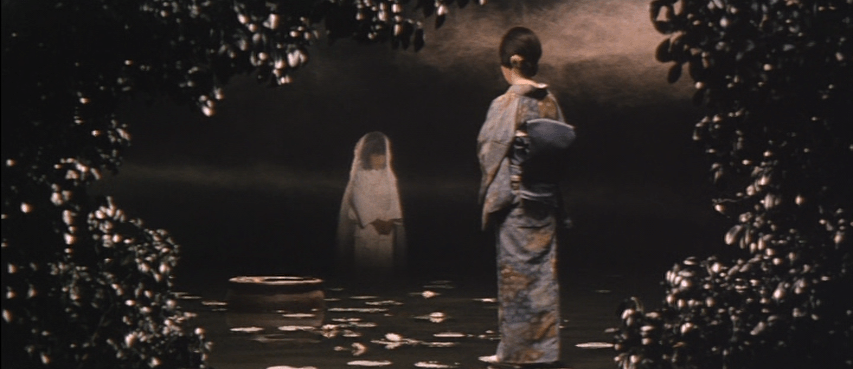
No one can escape from their sins according to the ominous voiceover that opens Tatsumi Kumashiro’s loose reimagining of Nobuo Nakagawa’s Jigoku, The Inferno (地獄, Jigoku). Then again, some of these “sins” seem worse than others, so why is it that a woman must bear a heavy burden for adulterous transgression while the man who killed her seemingly suffers far less? Perhaps hell, in this case, is born of conservative social attitudes more than anything else besides the darker elements of the human heart such as jealousy and romantic humiliation. 

Those negative emotions are however as old as time as reflected in the folk song which opens the film about a young couple, though not the young couple currently onscreen, who are eloping because their incestuous desire is not accepted by the world around them. The connection between the couple onscreen might also be deemed semi-incestuous for Ryuzo (Ken Nishida) has run off with the wife of his brother, Miho (Mieko Harada), who is carrying (what she claims to be) Ryuzo’s child. Unpei (Kunie Tanaka), the brother, finally catches up with them and shoots Ryuzo with a shot gun. Miho tries to escape, but her foot is caught in a bear trap and Unpei decides to leave here there to die, while Ryuzo’s jealous wife Shima (Kyoko Kishida) later does the same. The body is found by local hunters, and in a strange miracle the baby is born from Miho’s dead body while Miho is dragged to hell for her “sins” where she learns that her baby has been born in hell but remains above. Not knowing what to do, the locals give the baby, Aki, to Shima but she obviously doesn’t want it and so swaps it with a foundling thanks to a weird old man, Yamachi, coming to love this other child, Kumi, as a daughter. 

This is quite literally a tale of the sins of the parents being visited on the child, the 20-year old Aki (Mieko Harada) later lamenting that she has no identity of her own and is solely a vehicle for her mother’s revenge. Though she apparently ends up in the same rural town “by chance” knowing nothing of her past, she resembles her mother physically and discovers she has some of her talents such as an innate ability to play the shamisen. What she also has is a trance-like lust that bewitches the men around her, though this is in a sense complicated by the fact it does not seem to be of her own volition so much so as a manifestation of her mother’s curse. Thus she ends up sleeping with the vulgar younger brother of the man she actually likes, Suchio, who in truly ironic fashion is actually her half-brother. She describes herself as having her mother’s “tainted blood”, while Shima later adds in a degree of class and social snobbery revealing that Miho had been a geisha Unpei unwisely fell for and was unworthy even of being a maid in their upper-middle class household let alone the wife of the second son. 

For all of her resentment, Shima is otherwise a loving mother to her sons and even to Kumi whom she is able to accept as a daughter in a way she would never have accepted Aki who was after all an embodiment of her husband’s betrayal. Colder and more austere than Aki or Miho would seem to be, she clings to the mummified body of her husband kept in a secret vault as a secret triumph over her humiliation laughingly remarking that now he’s hers forever and will never cheat on her again. Even if she left Miho to die, Shima does not particularly resist her fate well aware that her son has fallen for his half-sister (which probably wouldn’t have happened if she hadn’t swapped babies) and merely hoping Aki can be convinced to leave town alone rather than plotting any more drastic action. 

But the inferno of hell envelopes them all, crying out for retribution as the cycles of repressed or inappropriate attractions repeat themselves. Kumi realises that her love for her brother, Suchio, is actually not inappropriate because they are not related after all but is then consumed by her own hell in realising that he does in fact love his biological half-sister but is uncertain if he accept damnation in order to pursue it. What she, Miho, and Aki are punished for is female sexual desire aside the arguably taboo qualities of its direction though in hell it seems men are punished for this too, or more accurately for giving in to it, in a way they often aren’t in the mortal realm. “They cut their own flesh and blood for the vision of a woman in the future,” the guide explains as the brothers and Unpei literally climb over each other reaching for an illusionary representation of Aki/Miho at the top of the tree. In the mortal world they do something similar, grappling with each other, mired in competitions of masculinity as mediated through sexual dominance, conquest, or humiliation. 

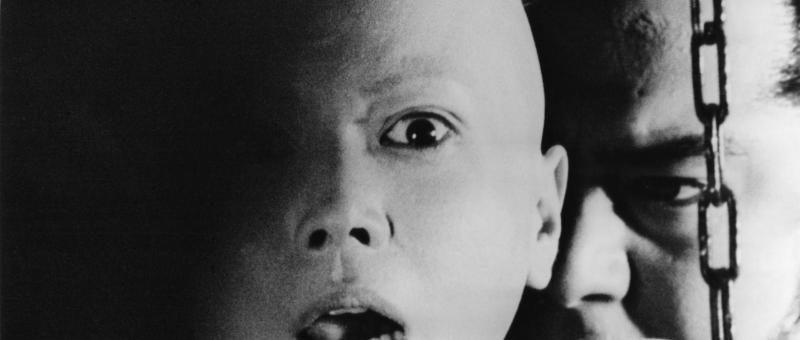
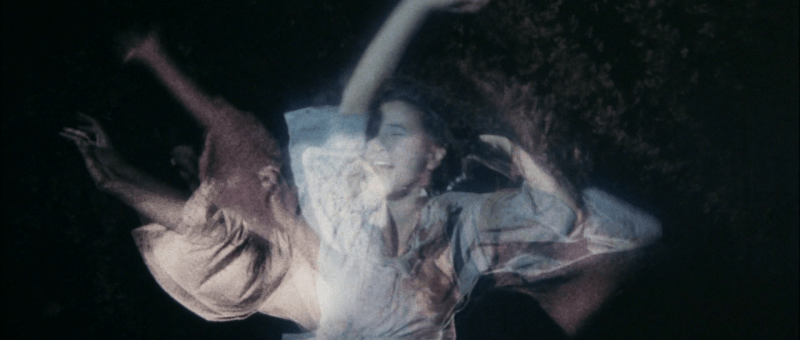
Yet Aki’s path to hell is also a confrontation with her femininity and her search for an identity as a woman by reuniting with the birth mother who died before she was born. Kumashiro’s visions of hell are terrifying and outlandish, a giant land in which the dead are thrown into a huge meat grinder they then have to push themselves. For the sin of eating meat, others are condemned to spend eternity eating human flesh. Miho has lost all sense of reason and is incapable of recognising her daughter seeing her only as another source of food but there is a kind of rebirth that takes place even if it’s only once again to be born in the underworld. Surreal and harrowing, Kumashiro’s eerie land of giant demons and shuffling corpses does indeed suggest that as the opening titles put it we all live our lives alongside hell.


Original trailer (no subtitles)
The Possessed (妖婆, Tadashi Imai, 1976)

Shinto priests, black magic, and demonic possession. As the opening voiceover of Tadashi Imai’s The Possessed (妖婆, Yoba) remarks, you can hardly believe that such things could happen in the modern world alongside cars, trains, and telephones yet the tale we’re about to be told begins in 1919. Based on a story by Akutagawa, the film is however less a contemplation of ancient superstition amid rising modernity than the destructive patterns of class and patriarchy which conspire against the lives of two women who had once been good friends. 

In 1919, Shima (Machiko Kyo) marries Shinzo (Shinjiro Ehara) who has taken her name and become the presumptive heir of her family. Everyone at the wedding remarks on what a good catch he is, adding almost as an after thought that Shima seems happy about it too. The problem is that Shinzo is repeatedly unable to consummate the marriage. Part of this seems to be down to his wounded masculinity in having married into the family. He resents being under the thumb of his father-in-law along with the rumours that he only married Shima for her money even though this appears to be exactly what he has done. Perhaps further humiliated by his inability to perform, Shinzo tells Shima that it’s her fault because there is something wrong with her body that prevents him from becoming sufficiently aroused. Being a sheltered woman of the Taisho era, Shima wonders if her husband has a point and visits a doctor to find out but as expected he tells her there’s nothing at all wrong with her and it’s most likely Shinzo’s performance anxiety that is to blame. 

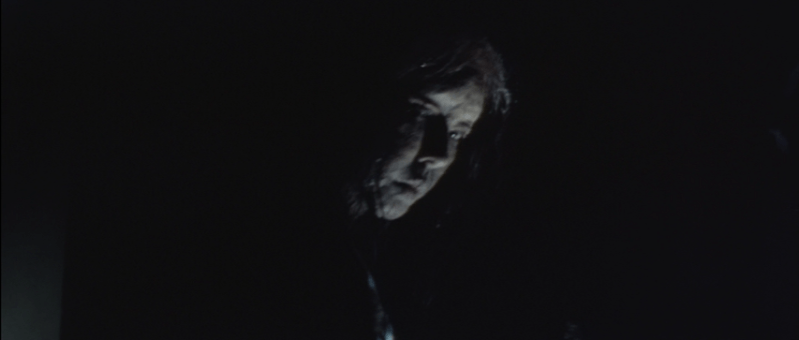
However, when her cousin Sawa’s (Kazuko Ineno) comb is found inside Shinzo’s kimono sleeve, the family begin to realise that the problem is he prefers her. He later admits as much and reveals that he’s planning to move closer to the family’s goldmine in Hokkaido and install Sawa in a house there as his common law wife with Shima left behind as a spouse of symbolic value. Shima has already felt herself haunted, but it’s at this point that the family brings in a Shinto priest who explains that Shinzo is possessed by an evil spirit though also giving the more rational advice that she should probably divorce him. Shima is forced to endure a strange ritual including purification by waterfall, but is also sexually assaulted by the randy priest though it it’s not completely clear that she fully realises what has happened to her. 

The implication is that the family treated Sawa as a kind of poor relation they trotted out to keep Shima company because she was an only child. Having grown resentful of Shima’s class privilege, Sawa’s jealousy manifested as covetousness that made her intent on taking whatever Shima had. She too later resorts to shamanistic black magic, fearful that Shima bears her a grudge for ruining her life and hoping to neuter any dark energy that she might be emanating in order to protect her teenage daughter Toshi (Miki Jinbo) who, ironically, has been betrothed to the son of a kimono shop named Shinzo (Taro Shigaki). 

Sawa never married and bore her child out of wedlock. She implies that she depended on men for financial support but never elaborates further. Shima, meanwhile, has been able to build an independent life for herself as a well-respected tailor. “It’s not normal for someone to suffer this much” a shamanically-inclined midwife later tells her when she too becomes pregnant out of wedlock but loses both the child and the man. The boot is perhaps on the other foot, Shima envies the life Sawa has with the one thing that will always be denied her, a child of her own. The midwife had once again told her that she was possessed, this time by the vengeful spirit of her lover’s daughter with his legal wife she fears may have been drowned deliberately by her mother out of jealousy. 

Shima is given a talisman of beads from the goddess of mercy, Kanon, and told that she can have what she wants if she prays hard enough, but Sawa is told the same thing and ends up going too far with the help of a shamaness praying to Basara Okami who later affirms that Sawa’s request comes with a price for the god wants Shima as a human sacrifice which is not really what Sawa had in mind. There is perhaps something symbolic in Shima’s gradual wasting away, becoming old before her time in her loneliness and sorrow (she is only supposed to be 33 at the film’s conclusion, actress Machiko Kyo was 52 at the time) even if she were not having the life force sucked out of her by a supernatural entity, though both women eventually pay a heavy price for their jealousy set against each other by a fiercely patriarchal and classist society which forces them to compete for husbands and standing. 

Imai’s photography is noticeably eerie if occasionally surreal as in the frequent and increasing sight of frogs, usually sign of good fortune or fertility but here ominous harbingers of supernatural dread in league with dark shamanistic forces. As the voiceover admits, it’s difficult to believe that these primitive ideas can exist side by side with the motor car but then again jealousy is as old as time itself and unlikely to disappear from the human psyche anytime soon even if in this case it could have been avoided if only the world were a little more equal. The film’s conclusion suggests it may now be, in a way, with a love match in the younger generation bringing the cycle of envy and resentment to a close even if the vengeful ghost of Shima may still be lurking somewhere in the shadows. 


The Hunter’s Diary (猟人日記, Ko Nakahira, 1964)

Ko Nakahira is most closely associated with the seminal Nikkatsu Sun Tribe film Crazed Fruit which sent Yujiro Ishihara to stardom though he began his career at Shochiku in 1948 alongside Seijun Suzuki who like Nakahira would transfer to the newly re-established Nikkatsu when it resumed production in 1954. Suzuki was rather famously let go in 1968 due to creative differences with Nakahira also leaving the studio that year in similar circumstances having decamped to Shaw Brothers in Hong Kong in 1967 where he remade some of his previous hits including 1964’s Hunter’s Diary (猟人日記, Ryojin Nikki). 

Based on a mystery novel by Masako Togawa who in fact stars in her only film role as the hero’s little seen wife, Hunter’s Diary is one of a string of films in the mid-1960s critical of the functioning of the legal system in the post-war society. Nakahira opens with a lengthy sequence introducing new forensic technologies which anticipate the use of DNA as an investigative tool in the use of blood type analysis to place a suspect at a crime scene. This science will however be undercut by the sympathetic lawyer Hatanaka (Kazuo Kitamura) who reminds us that the presence of such evidence is not proof in and of itself in much the same way that DNA has since become the new smoking gun and is as susceptible to misuse as any other kind of forensic technique. 

It’s a problem for the hero, Honda (Noboru Nakaya), because his blood type is incredibly rare. In fact he was once in the paper for saving a baby by coming to the rescue with a donation just in time which as we later discover is ironic because much of his behaviour is shaped by the loss of his own child who was born with osteogenesis imperfecta and did not survive. The traumatic circumstances of the birth left his wife, Taneko, with a fear of pregnancy that eventually destroyed their marriage. The couple now live largely apart, she in her family’s country mansion painting disturbing pictures and he in the city “hunting” women for one night stands adopting the persona of a man who is foreign or part-Japanese. There is something of the fear of foreignness seen in other similarly themed films of the era in the fact that Honda’s child is born in Mexico while the couple had met and married in the US, Taneko convinced that had they returned to Japan earlier her baby may have survived while Honda claims that “intellectual” women are drawn to foreign men as he assumes his rather creepy “Monsieur Soubra” alter-ego complete with a funny accent and slightly broken Japanese. 

He positions his “hunting” as a way of dealing with the collapse of his marriage and his guilt over the death of his child overcoming his sense of impotence through transgressive sexuality though many of the women Hatanaka later interviews describe him as disappointingly vanilla and as we discover his games might have begun long before. Meanwhile the women are themselves judged for their sexuality, the discovery of a male muscle magazine in the home of a mousy spinster somewhat amusing to Honda while the unintended darkness of his sport is brought home by the film’s opening sequence in which a 19-year-old woman who became pregnant after he seduced and abandoned her takes her own life in shame and desperation only to be branded an “idiot” by her grieving sister for having slept with a man she had only just met. When a previous conquest of his is murdered in her apartment, Honda is momentarily worried but assumes it’s a grim coincidence. When her death is followed by that of a woman who could have provided him with an alibi he comes to the conclusion that someone is trying to frame him. 

Hatanaka’s conviction is that “the law is everything in court” and that Honda should not be judged on his moral character for his sleazy philandering only on the basis of the evidence presented which he believes may have been deliberately planted to incriminate him. His investigations take him to unlikely places discovering the potentially unethical practices of blood donation programs along with the illegal sale of blood and other bodily fluids such as semen while seeing the tables turned on visiting a gay bar where a male sex worker reports a weird encounter with a suspicious client, and salesman continues to frequent a Turkish bath hoping to run into a woman who seduced him but may only have been interested in his blood type. Honda soon forgets the name of the woman who took her own life, but is haunted by the visions of the women he has harmed while simultaneously rejecting the labels placed on him as a pervert or a predator and believing that his child’s death is punishment for his “abnormal sexuality” as some may brand it. 

This sense of guilt is also reflected in his worry that he is a “spreader of death”, as if though he did not kill them directly he were the carrier of a disease or else some kind of grim reaper beckoning these women towards their demise though he evidently thinks little of them outside of their status as trophies and does not stop to consider the consequences of his actions on others. Above his bed in his city hideout (officially he lives in a hotel) there is a picture of a fox hunt making plain that his satisfaction lies in the chase rather than its conclusion yet otherwise his motives are rather banal. He cannot leave his wife because he married into her prominent family and his social standing depends on his connection to them, likewise he decides against alerting the police or the building’s caretaker on discovering one of the women’s bodies because his reputation would be ruined if were to become involved in a murder and his secret life exposed. Ironically his salvation comes precisely because of this social standing when his wealthy father-in-law hires Hatanaka to handle his appeal and save him from the death penalty. 

Hatanaka had resigned from a previous position in opposition to the system, disappointed on meeting the lawyer who defended Honda at trial and realising they did not attempt to mount a defence nor investigate his case simply try to mitigate it in the hope of working it down to a custodial sentence. He instructs his naive young assistant who wonders if Honda is the sort of man they should be saving that she should approach every case on its merits as if the defendant is innocent without bringing in external moral judgements on his character. As he tells him, Honda may be legally vindicated but his moral judgement would depend on how he lives his life from then on later offering him a kind of absolution in telling him that one of his conquests, who does not want to be identified, gave birth to a son who is healthy and happy signalling that his is not an original sin and he does not bear that kind of responsibility for the death of his child. Veering towards the avant-garde Nakahira makes frequent use of superimposition and dissolves to reflect Honda’s fracturing mental state along with the persistence of his guilt while shifting into the purely documentarian in his lengthy explanation of forensic techniques and the science behind blood types but always returns to the Hitchcockian interplay of sex, death, and remorse which is true source of Honda’s trial. 


DVD remaster trailer (no subtitles)

Hanzo the Razor: The Snare (御用牙 かみそり半蔵地獄責め, Yasuzo Masumura, 1973)

Hanzo the Razor the Snare posterYasuzo Masumura had spent the majority of his career at Daiei, but following the studio’s bankruptcy, he found himself out on his own as a freelance director for hire. That is perhaps how he came to direct this improbable entry in his filmography on the second of a trilogy of exploitation leading jidaigeki films for Toho. Essentially a vanity project for former Zatoichi star Shintaro Katsu who both produces and stars in the series, Hanzo the Razor: The Snare (御用牙 かみそり半蔵地獄責め , Goyokiba: Kamisori Hanzo Jigoku Zeme) is another tale of the well endowed hero of the Edo era protecting ordinary people from elite corruption, but Masumura, providing the script himself, bends it to his own will whilst maintaining the essential house style.

Hanzo (Shintaro Katsu) chases a pair of crooks right into the path of treasury officer Okubo. As expected, the lord and his retainers kick off but Hanzo won’t back down, shouting loudly about honour and justice much to his lord’s displeasure. Eventually Hanzo takes the two crooks into custody and they tell him exactly what’s happened to them this evening – they snuck over from the next village to steal some rice from the watermill but they found a dead girl in there and so they were running away in terror. Hanzo investigates and finds the partially clothed body still lying in the mill untouched but when he takes a closer look it seems the girl wasn’t exactly murdered but has died all alone after a botched abortion. Realising she smells of the incense from a local temple, Hanzo gets on the case but once again ends up uncovering a large scale government conspiracy.

Though it might not immediately seem so, Masumura’s key themes are a perfect fit for the world of Hanzo. In his early contemporary films such as Giants & Toys and Black Test Car, Masumura had painted a grim view of post-war society in which systemic corruption, personal greed, and selfishness had destroyed any possibility of well functioning human relationships. It was Masumura’s belief that true freedom and individuality was not possible within a conformist society such as Japan’s but this need for personal expression was possible through sexuality. Sex is both a need and a trap as Masumura’s (often) heroines chase their freedom through what essentially amounts to an illicit secret, using and manipulating the men around them in order to improve their otherwise dire lack of agency.

Hanzo’s investigation takes him into an oddly female world of intrigue in which a buddhist nun has been duped into becoming a middle-woman in a government backed scheme pimping innocent local girls to the highest bidder among a gang of wealthy local merchants. Hanzo berates the parents of the murdered girl for not having kept a better eye on her, but these misused women are left with no other recourse than the shady protection of others inhabiting the same world of corrupt transactions such as the local shamaness who has developed a “new method of abortion” just as Hanzo has developed a “new method of torture” which involves a bizarrely sexualised ritual in which both parties must be fully naked before she enacts penetration with her various instruments. Hanzo first tries more usual torture methods on the nun before indulging in his trademark tactic of trapping her in a net to be raised and lowered onto his oversize penis which he keeps in top notch by beating it with a stick and ramming it into a bag of rough uncooked rice.

Unlike the first film, the women are less ready to fall for Hanzo’s giant member. The nun complains loudly that her Buddhist vows of chastity are being violated while Hanzo’s later rape of the woman who runs the local mint is a much more violent affair. Hanzo grapples with her legs as she struggles, gasping as he opens his loincloth and reveals his surprisingly large appendage, once again playing into the fallacy that all women harbour some kind of rape fantasy. Hanzo has done this, he claims, to “calm her down”, because he could sense her sexual frustration and desperate need for male contact. To be fair to Hanzo, he does appear to be correct in his reading of the woman’s behaviour as she sheds her anxiety and becomes a firm devotee of the cult of Hanzo.

Meanwhile, political concerns bubble in the background as the main conspiracy revolves around consistent currency devaluations which are placing a stranglehold on the fortunes of the poor while their overlords, who are supposed to be protecting them, spend vast sums on claiming the virginity of innocent young girls. Hanzo may be a rapist himself (though he makes it clear that he derives no pleasure from his actions and only gives pleasure to the women involved), but he draws the line at the misuse of innocents, saving a little girl about to be violated by the master criminal Hamajima (Kei Sato) in a daring confrontation in which he boldly brings his own coffin, just in case.

Masumura broadly sticks to the Toho house style, but gone is the camp comedy of the first instalment with its giggly gossipers and humorous shots of Hanzo’s permanently erect penis. Instead he opts for an increase in sleazy voyeurism, filling the screen with female nudity whilst neatly implicating the male audience who enjoy such objectification by shooting from secretive angles as his collection of dirty old men crowd round a two way mirror to watch the lucky winner torture and abuse the soft young flesh they’ve just been bidding on. Like Sword of Justice, The Snare also ends with a slightly extraneous coda in which Hanzo settles a dispute with another official by means of a duel he would rather not have fought. Walking off bravely into the darkness, Hanzo utters only the word “idiot” for a man who wasted his life on petty samurai pride. Hanzo has better things to do, protecting the common man from just such men who place hypocritical ideas of pride and honour above general human decency in their need for domination through fear and violence over his own tenet of unrestrained pleasure.


Original trailer (no subtitles)
https://www.youtube.com/watch?v=2qwRTC0p3mM

Flora on the Sand (砂の上の植物群, Ko Nakahira, 1964)

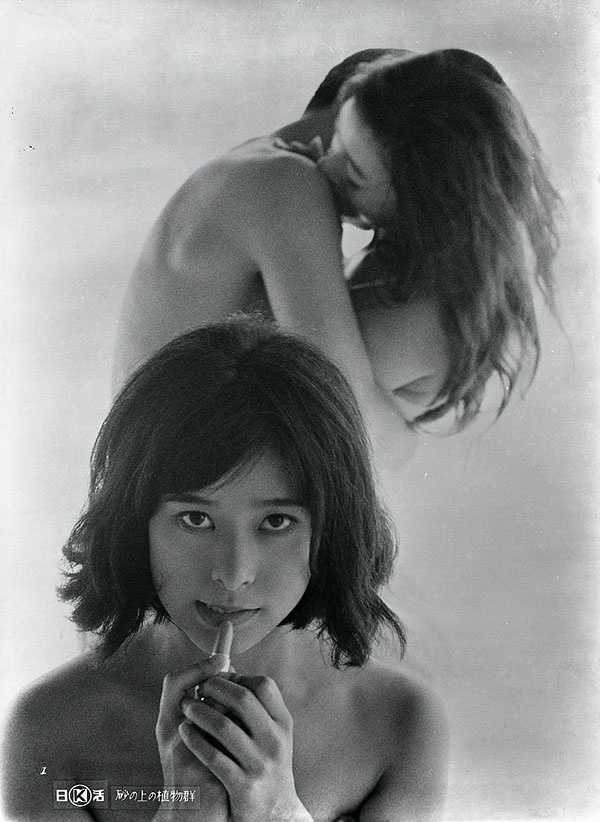
© 1964 Nikkatsu CorporationDespite being among the directors who helped to usher in what would later be called the Japanese New Wave, Ko Nakahira remains in relative obscurity with only his landmark movie of the Sun Tribe era, Crazed Fruit, widely seen abroad. Like the other directors of his generation Nakahira served his time in the studio system working on impersonal commercial projects but by 1964 which saw the release of another of his most well regarded films Only on Mondays, Nakahira had begun to give free reign to experimentation much to the studio boss’ chagrin. Flora on the Sand (砂の上の植物群, Suna no Ue no Shokubutsu-gun), adapted from the novel by Junnosuke Yoshiyuki, puts an absurd, surreal twist on the oft revisited salaryman midlife crisis as its conflicted hero muses on the legacy of his womanising father while indulging in a strange ménage à trois with two sisters, one of whom to he comes to believe he may also be related to.
After a brief prologue in which our hero, cosmetics salesman Ichiro Igi (Noboru Nakaya), imagines a scenario for a novel in which a dying husband becomes so jealous of the man that may succeed him in his wife’s life that he sets about plotting to make her the weapon of that very man’s destruction, Igi heads to his regular barber and longtime family friend where he takes the time to probe him about his late father’s womanising habits. Igi’s father died young at only 34 for years of age, three years younger than the age Igi is now. His father’s spitting image, Igi cannot help seeing him everywhere he goes and feels unable to evade his ongoing influence, almost as if he were possessed by his father’s (un)departed spirit.

The major preoccupation Igi has is that his wife (Yukiko Shimazaki) may have slept with his father before they were married while she was just a teenager. The barber tells him he’s pretty sure not, but Igi cannot let the idea go and repeatedly brings it up with his wife, creating discord in the family home. Meeting a precocious schoolgirl at the Marine Tower one evening, Igi finds himself taking her to a hotel and deflowering her even though she begins to resist him at the last minute. The girl, Akiko (Mieko Nishio), then makes a strange request of him – she wants Igi to seduce and “hurt” her older sister Kyoko (Kazuko Inano) whose sanctimonious attitude she can no longer stand. Igi does indeed visit the bar where Kyoko works as a hostess and embarks on an intense affair with her but Akiko’s pleas to “hurt” her sister are complicated by Kyoko’s masochistic tendencies and Igi’s descent into a kind of madness.

Beginning with the painting by Paul Klee which gives the film its name, Nakahira asks us to imagine what would happen if a large dash of red were suddenly to appear, disrupting the comforting harmony of Klee’s perfectly matched colours. The discomforting redness does dutifully appear as strangely shaped squares on the canvas but the symbolic value of the colour is felt throughout the black and white narrative from the dark stain of Akiko’s broken maidenhead to the affectation of her lipstick and constant references to red seas and suns.

Though Igi’s world may have seemed just as perfectly ordered as Klee’s painting from the outside, his constant preoccupations with his father become the disruptive influence which leads to all of the redness later leaking in. Haunted by his father as he is, seeing his face everywhere from train windows to the barber shop mirror, Igi’s attempt at a plot for a murder mystery takes on a strangely Oedipal quality as we begin to wonder if it’s his father rather than Igi himself who has assumed the role of the “protagonist”, leaving a time bomb for his wayward son, the inheritor of his woman, just as Igi laid out in his prologue. Bizarre reality or another symptom of Igi’s increasingly fractured mind, the plot seems likely to succeed at least in a sense as Igi declines into a dishevelled mess, prone to hallucinations and uncertain visions.

Nakahira gives us several of these as Igi panics and struggles with a key only to open a door into bright white light and nothingness or another in which he and Kyoko dine in an empty restaurant which is suddenly filled with the noisy chatter of other diners. Strange touches such as the German beerhall with a Spanish guitarist, or the odd peepshow in which Igi and his two friends take on the appearance of demons or impassive Buddhist statues thanks to the light reflected into their eyes, add to the unbalanced atmosphere as do the frequent closeups of lips and hands, and the symbolic value of seeds never meant to be planted which nevertheless flower at an unintended moment. Shooting in black and white, Nakahira begins with a colour sequence featuring the abstract artwork with occasional flashes of colour as well as voice over and occasional intertitle-style captions adding to the absurdist atmosphere.

A surreal and complex psychological exploration of sex, power, obsession, identity, and legacy Flora on the Sand finds Nakahira flexing his experimental mussels for a drama rife with ambiguity and strangeness. Sadly this brand of innovation was not entirely welcome at Nikkatsu head offices and so he found himself left out in the cold eventually ending up in Hong Kong making action movies for Shaw Brothers. Despite some later success at international festivals, Nakahira’s work remains sadly neglected but the unusual degree of sophistication and almost playful atmosphere seen in Flora on the Sand make him worthy of attention as more than just an almost was of the rising New Wave.


Screened as part of the Japan Foundation Touring Film Programme 2017.

Eros + Massacre (エロス+虐殺, Kiju Yoshida, 1969)

Snapshot-2015-11-17 at 11_12_15 PM-1889818228One of the foremost avant-garde filmmakers of the New Wave era (though he detested this term which, in fairness, is a retrospective and often arbitrary label), Kiju (Yoshishige) Yoshida has remained largely unseen in the West. Some of this is his own fault – fiercely independent, Yoshida nevertheless found himself working with ATG after leaving Shochiku but the relationship was an unusual one and often far from easy. All but the latest film in Arrow’s Kiju Yoshida boxset, Coup d’Etat, were completed more or less independently and only distributed though ATG and as such not truly “ATG” films. Though it bears many of the hallmarks of a late ‘60s ATG movie, Eros + Massacre (エロス+虐殺, Erosu Purasu Gyakusatsu) is one such effort and the one which helped to make Yoshida’s name even if it was only seen in an abridged version.

Structurally complex, Eros + Massacre mixes the world of the Taisho anarchists, Osugi Sakae and Ito Noe, with the contemporary Tokyo of the sixties through the prism of two modern students who are running a research project into the events surrounding their ultimate assassination during the panic after the great Kanto Earthquake of 1923. Eiko is a sexually liberated modern woman who engages in casual prostitution and her boyfriend, Wada, is a sexually impotent young man with a traumatic past and habit of playing with fire. The vision we see of the Taisho era is filtered through the perceptions of Eiko and Wada and, in fact, we start to see them as living with us in a real sense as Ito wanders around modern Tokyo, observing the fruits of her struggle and in one notable episode being interviewed by Eiko.

The film exists in two distinct versions – this is less to do with any kind of censorship, either commercial or political, than a legal or possibly moral issue. The fact is, the other of Osugi’s mistresses, Kamichika Ichiko, was still alive at the time the film was completed and had also become a serving politician. Unhappy with her portrayal in the film and unwilling to have a potentially embarrassing event from her previous life dragged back into the spotlight, she threatened to sue and Yoshida voluntarily decided to recut the film to remove many of her scenes as well as renaming the character to distance her from her real life counterpart. The shorter version of the film is the one which helped make Yoshida’s reputation and though nothing in the shorter version is not in the longer one, this version feels a little less “avant-garde” in tone than the intended full cut of the film.

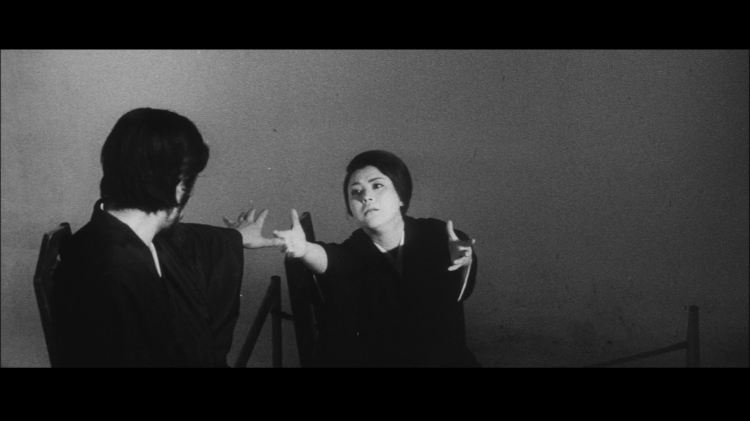
Yoshida often gives way to surreal incidents such as the clash between the Taisho era followers of Osugi and a group of young rugby players tussling over the white wrapped remains of Osugi, the expressionist scene in which the mistress, Itsuko, clutches at a knife hovering in mid air causing the screen to fill with blood raining down from above or the repeated stabbings of Osugi each re-imagined in differing scenarios. His framing is always beautifully idiosyncratic as he makes use of the edges of the frames, disembodying his actors or dividing them with walls and windows. There is no sense of conventional narrative as timelines blur into each other becoming evermore indistinct and the dialogue is often elliptical or poetic rather than offering naturalistic content. Nevertheless, the shorter version retains fewer of these flourishes than are present in the original cut of the film.

Eiko is interested in Osugi because of his free love philosophy rather than any other political aim. Other than their interest in sexual politics, Eiko and Wada do not appear to be particularly politically active in any other way. Osugi’s ideas of total freedom do not even go down very well with his comrades who don’t approve of the way he treats his various women and his disingenuous denial that there is any discord between his band of concubines seems wilfully naive. Osugi’s treatment of the three women in his life – his wife, Yasuko, mistress Itsuko (who is financially supporting both Osugi and his wife despite Osugi’s advocacy of free love insisting on financial independence of all parties), and now his latest lover Noe, is extremely self-centred and unfair. As the first to live in this unorthodox fashion, it’s unsurprising that the arrangement comes in for criticism from all quarters. Yoshida posits that it was Osugi’s free love lifestyle that eventually lead to his shock execution during the chaos following the Great Kanto earthquake as his modern ideals threatened the very idea of the traditional family and ultimately the state itself.

By contrast, Eiko’s modern sexuality appears merely an attempt to ward of her sense of ennui. Where for Osugi sex was a political action (or so he would have it), for Eiko it’s a means of trying and failing to add some kind of meaning to her life. Eiko and Wada are not committed to any kind of rebellious action – they’re simply bored. They literally play with fire without understanding its consequences. Yoshida’s other central tenet is that youth is not beautiful – it is destructive. By implication, Eiko and Wada’s selfish pursuit of personal freedom and the modern commodification of desire is nothing more than willful self destruction.

Yoshida has stated that his primary idea for the film is how to bring about a revolution and to ask the question of what it is that needs to change. Osugi is shown up as a hypocrite whose ideals are imperfect and self centred, though his eventual murder is dictated by his refusal to conform. The fact that he envisioned a different future, wished to live in a different way, was sufficient enough to necessitate his death. The modern couple misuse their own freedom and are willing to watch the world burn just to feel the heat. They are incapable of effecting real social change because their focus is always inwards rather than a dedication to the betterment of all mankind. Confounding, intriguing and beautifully shot Eros + Massacre is far from easy to digest but is an essential entry in the history of Japanese avant-garde cinema.


Available now in the UK as part of Arrow Films’ Kiju Yoshida: Love + Anarchism box set.

Reviews of the other movies in the set: