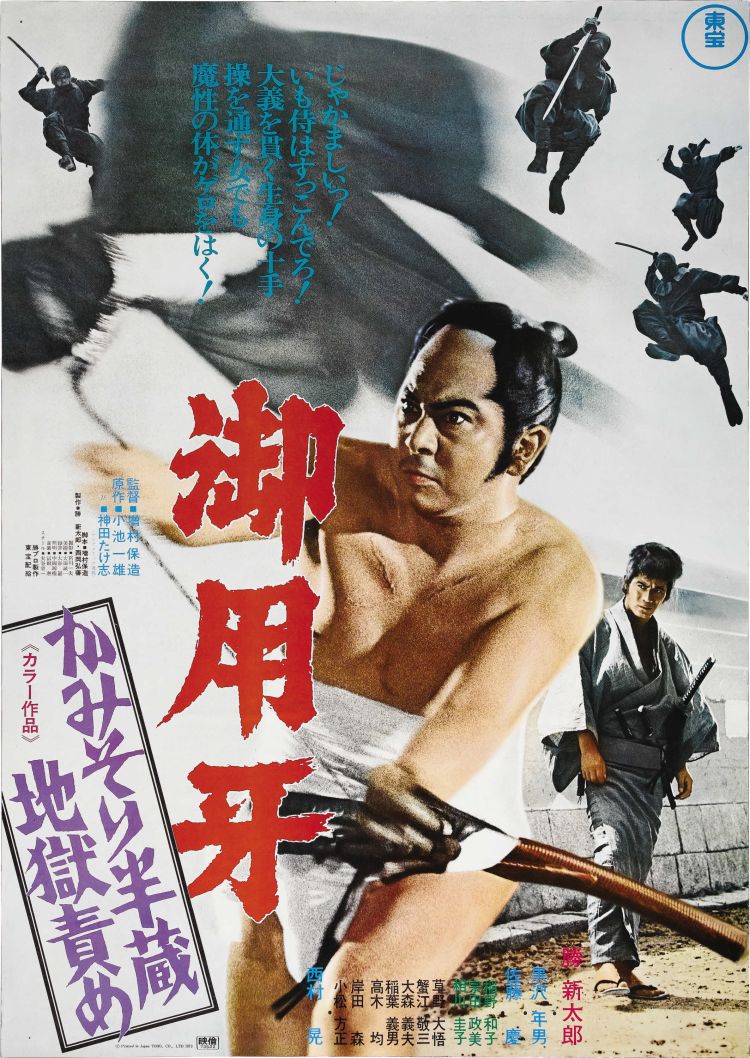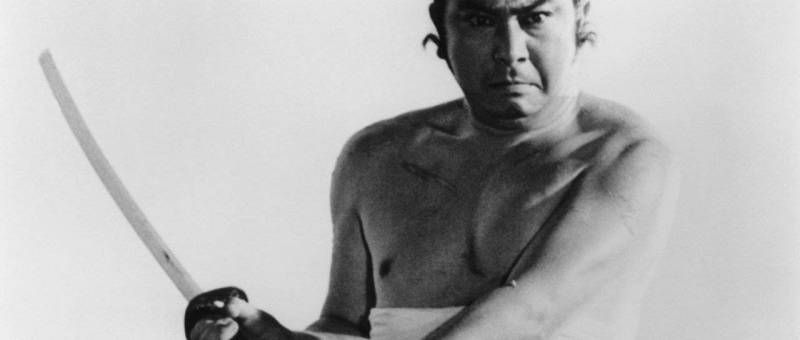
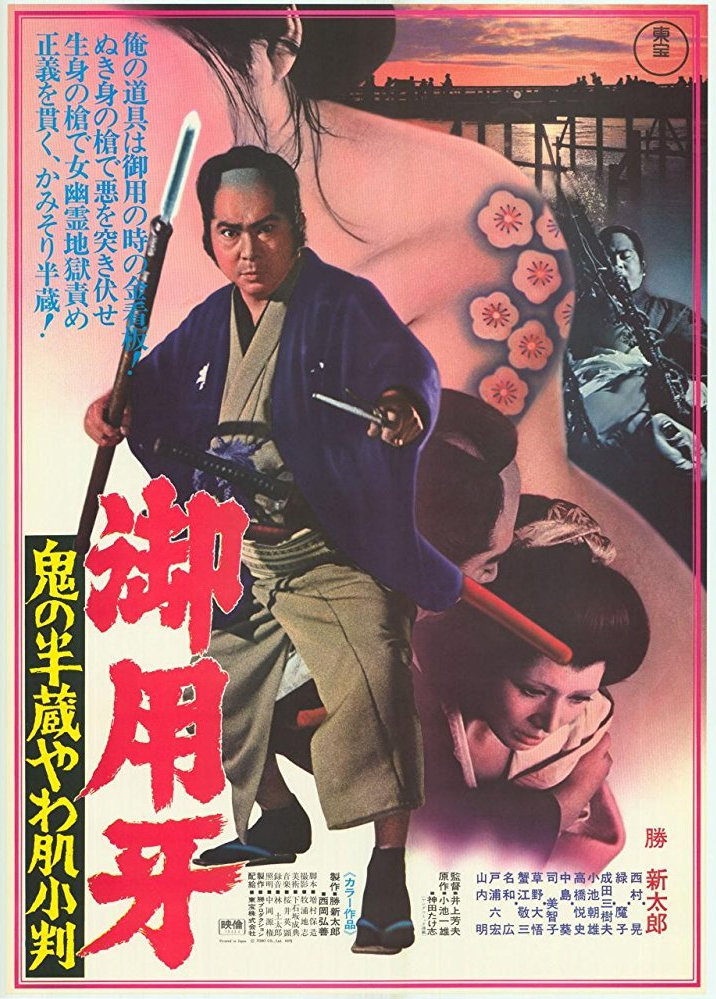
Hanzo the Razor: The Snare (御用牙 かみそり半蔵地獄責め, Yasuzo Masumura, 1973)

Hanzo the Razor the Snare posterYasuzo Masumura had spent the majority of his career at Daiei, but following the studio’s bankruptcy, he found himself out on his own as a freelance director for hire. That is perhaps how he came to direct this improbable entry in his filmography on the second of a trilogy of exploitation leading jidaigeki films for Toho. Essentially a vanity project for former Zatoichi star Shintaro Katsu who both produces and stars in the series, Hanzo the Razor: The Snare (御用牙 かみそり半蔵地獄責め , Goyokiba: Kamisori Hanzo Jigoku Zeme) is another tale of the well endowed hero of the Edo era protecting ordinary people from elite corruption, but Masumura, providing the script himself, bends it to his own will whilst maintaining the essential house style.

Hanzo (Shintaro Katsu) chases a pair of crooks right into the path of treasury officer Okubo. As expected, the lord and his retainers kick off but Hanzo won’t back down, shouting loudly about honour and justice much to his lord’s displeasure. Eventually Hanzo takes the two crooks into custody and they tell him exactly what’s happened to them this evening – they snuck over from the next village to steal some rice from the watermill but they found a dead girl in there and so they were running away in terror. Hanzo investigates and finds the partially clothed body still lying in the mill untouched but when he takes a closer look it seems the girl wasn’t exactly murdered but has died all alone after a botched abortion. Realising she smells of the incense from a local temple, Hanzo gets on the case but once again ends up uncovering a large scale government conspiracy.

Though it might not immediately seem so, Masumura’s key themes are a perfect fit for the world of Hanzo. In his early contemporary films such as Giants & Toys and Black Test Car, Masumura had painted a grim view of post-war society in which systemic corruption, personal greed, and selfishness had destroyed any possibility of well functioning human relationships. It was Masumura’s belief that true freedom and individuality was not possible within a conformist society such as Japan’s but this need for personal expression was possible through sexuality. Sex is both a need and a trap as Masumura’s (often) heroines chase their freedom through what essentially amounts to an illicit secret, using and manipulating the men around them in order to improve their otherwise dire lack of agency.

Hanzo’s investigation takes him into an oddly female world of intrigue in which a buddhist nun has been duped into becoming a middle-woman in a government backed scheme pimping innocent local girls to the highest bidder among a gang of wealthy local merchants. Hanzo berates the parents of the murdered girl for not having kept a better eye on her, but these misused women are left with no other recourse than the shady protection of others inhabiting the same world of corrupt transactions such as the local shamaness who has developed a “new method of abortion” just as Hanzo has developed a “new method of torture” which involves a bizarrely sexualised ritual in which both parties must be fully naked before she enacts penetration with her various instruments. Hanzo first tries more usual torture methods on the nun before indulging in his trademark tactic of trapping her in a net to be raised and lowered onto his oversize penis which he keeps in top notch by beating it with a stick and ramming it into a bag of rough uncooked rice.

Unlike the first film, the women are less ready to fall for Hanzo’s giant member. The nun complains loudly that her Buddhist vows of chastity are being violated while Hanzo’s later rape of the woman who runs the local mint is a much more violent affair. Hanzo grapples with her legs as she struggles, gasping as he opens his loincloth and reveals his surprisingly large appendage, once again playing into the fallacy that all women harbour some kind of rape fantasy. Hanzo has done this, he claims, to “calm her down”, because he could sense her sexual frustration and desperate need for male contact. To be fair to Hanzo, he does appear to be correct in his reading of the woman’s behaviour as she sheds her anxiety and becomes a firm devotee of the cult of Hanzo.

Meanwhile, political concerns bubble in the background as the main conspiracy revolves around consistent currency devaluations which are placing a stranglehold on the fortunes of the poor while their overlords, who are supposed to be protecting them, spend vast sums on claiming the virginity of innocent young girls. Hanzo may be a rapist himself (though he makes it clear that he derives no pleasure from his actions and only gives pleasure to the women involved), but he draws the line at the misuse of innocents, saving a little girl about to be violated by the master criminal Hamajima (Kei Sato) in a daring confrontation in which he boldly brings his own coffin, just in case.

Masumura broadly sticks to the Toho house style, but gone is the camp comedy of the first instalment with its giggly gossipers and humorous shots of Hanzo’s permanently erect penis. Instead he opts for an increase in sleazy voyeurism, filling the screen with female nudity whilst neatly implicating the male audience who enjoy such objectification by shooting from secretive angles as his collection of dirty old men crowd round a two way mirror to watch the lucky winner torture and abuse the soft young flesh they’ve just been bidding on. Like Sword of Justice, The Snare also ends with a slightly extraneous coda in which Hanzo settles a dispute with another official by means of a duel he would rather not have fought. Walking off bravely into the darkness, Hanzo utters only the word “idiot” for a man who wasted his life on petty samurai pride. Hanzo has better things to do, protecting the common man from just such men who place hypocritical ideas of pride and honour above general human decency in their need for domination through fear and violence over his own tenet of unrestrained pleasure.


Original trailer (no subtitles)

https://www.youtube.com/watch?v=2qwRTC0p3mM

Hanzo the Razor: Sword of Justice (御用牙, Kenji Misumi, 1972)

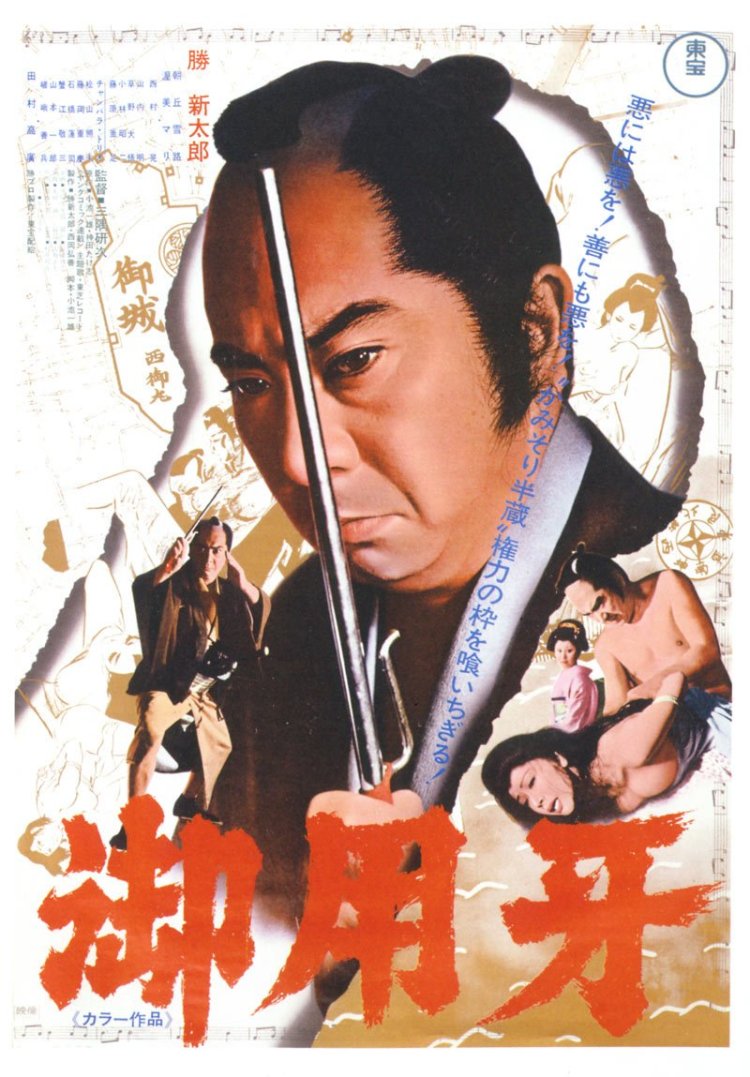
Hanzo sword of Justice posterJapanese cinema was in a state of flux in the early ‘70s. Audiences were dwindling. Daiei, a once popular studio known for polished, lavish productions folded while Nikkatsu took the proactive measure to rebrand itself as a purveyor of soft core pornography. Toho did not go so far, but in its first foray into a new kind of jidaigeki, exploitation was the name of the game. Hanzo the Razor: Sword of Justice (御用牙, Goyokiba) was released in 1972 – the same year as the beginning of another seminal series, Lone Wolf and Cub, which was produced by Hanzo’s star, former Zatoichi actor Shintaro Katsu, who also happens to the be brother of the franchise’s lead Tomisaburo Wakayama. Like Lone Wolf and Cub, Hanzo the Razor is based on a manga by Kazuo Koike whose work later provided inspiration for the Lady Snowblood films, and is directed by Lone Wolf and Cub’s Kenji Misumi. It is then of a certain pedigree but its intentions are different. More obviously comedic in its exaggerated, unpleasant sexualised “humour”, Hanzo the Razor is also a tale of the systemic corruption of the feudal order but one which casts its “hero” as a noble rapist.

Honest and steadfast police officer Hanzo (Shintaro Katsu) usually skips the annual swearing in ceremony but this year he’s decided to make an appearance. He appears to have done so to make a personal stand by refusing to sign the policeman’s oath because he knows everyone else is breaking it. Officers may not be doing something so obvious as accepting cash for preferential treatment, but they gladly accept free drinks, gifts from lords, and entertainment in the local geisha houses. Hanzo’s actions, honest as they are, do not go down well with his fellow officers and if he can’t figure something out on time, Hanzo faces the possibility that his career in law enforcement may come to an abrupt end when contracts are up for renewal at the end of the year.

Whatever else Hanzo is, he doesn’t like bullies or those who abuse their authority and the trust placed in them by those they are supposed to be protecting. More than just saving his own skin, Hanzo is determined to unmask the hypocrisy and corruption of his boss, Onishi (Ko Nishimura), who he discovers shares a mistress with a notorious killer still on the run. Chasing this early thread, Hanzo walks straight into a chain of corruption which leads all the way to the top.

At his best, Hanzo is a steadfast champion of the people who remain oppressed by the corrupt and venal samurai order. Far from the a by the books operative, Hanzo is prepared to do what’s best over what’s right as in his decision to help a pair of siblings who are faced with a terrible dilemma trying to care for a terminally ill father. He’s also extremely well prepared, having installed a host of booby traps and hidden weapons caches throughout his home to deal with any conceivable threat. Dedicated in the extreme, Hanzo has also spent long hours testing his torture techniques on himself to find out the exact point of maximum efficiency for each of them.

Here’s where things get a little more unusual. As Hanzo climbs down from a bout of torture, a huge erection is visible inside his loincloth, prompting him to reveal that it’s pain which really turns him on. Later we see Hanzo doing some maintenance on his “tool” which involves placing it on a wooden board bearing a huge penis shaped indent, and hitting it repeatedly with a hammer before ramming it back and forth into a bag of uncooked rice. Each to their own, but Hanzo derives no pleasure from these acts – they are simply to make sure his “special interrogation method” runs at maximum efficiency. Which is to say, Hanzo’s preferred technique for getting women to talk amounts to rape but as each of them fall victim to his oversize member they cry out in pleasure, willing to spill the beans just to get Hanzo to finish what he started. Playing into the fallacy that all women long to be raped, Hanzo’s inappropriate misuse of his own authority is played for laughs – after all, the women eventually enjoy themselves so it’s no harm done, right? Troubling, but par for the course in the world of Hanzo.

This essential contradiction in Hanzo’s character – the last honourable man who nevertheless abuses his authority in the course his duty (though he apparently takes no personal pleasure in the act), is reduced to a roguish foible as he goes about the otherwise serious business of taking down corrupt authority and ensuring the law protects the people it’s supposed to protect. Odd as it is, Hanzo’s world is an strangely sexualised one in which sexually liberated women wield surprising amounts of power. Hanzo is assured one of his targets has “no lesbian tendencies” as other older court ladies are said to, while a gaggle of camp young men gossip about the size of Hanzo’s world beating penis. In an odd move, Misumi even includes a penis eye view of Hanzo’s techniques, superimposed over the face of a woman writhing in pleasure. Surreal and broadly humorous if offensive, Hanzo the Razor: Sword of Justice is very much of its time though strangely lighthearted in its obviously bizarre worldview.


Original trailer (English subtitles)

Young Girls in Love (恋する女たち, Kazuki Omori, 1986)

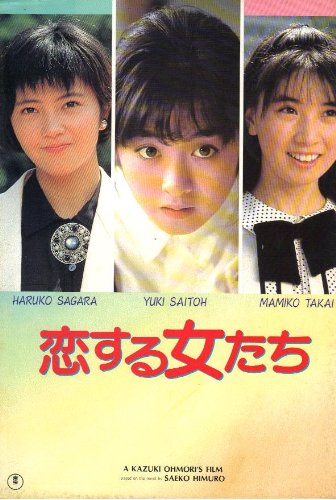
young women in loveThe friends you make in high school are the friends you’ll have the rest of your life, says Takako – the heroine of Kazuki Omori’s Young Girls in Love (恋する女たち, Koisuru Onnatachi). Only she doesn’t quite want hers – they’re weird and cause her nothing but trouble. Also one of them is too pretty so she soaks up all of the attention – where’s the fun in that? Takako is not altogether happy in her adolescence but at least she has her friends there beside her, right?
Takako’s two best friends have both recently fallen in love leaving her feeling a little left out. Midoriko (Mamiko Takai), the most “unusual” girl in her group (but also thought to be the prettiest), had fallen in love with a teacher and even struck up something of a friendship with him as evidenced by her collection of cute photos of them together. However, he’s recently got married leaving her heartbroken so Midoriko is having another one of her trademark “funerals” in which she buries painful memories from her past. Previously she’s had funerals for an unfortunate PE related incident in which she ripped her shorts during gymnastics, and another for when her grades got so bad that the teachers told her she probably wouldn’t graduate from high school.

Teiko has a difficult homelife as her literature professor father has left the family for unspecified reasons and her mother is still mourning the end of the marriage. However, she has found herself and older poet who formerly wrote lyrics for cheesy teen idol pop songs (though he’s a serious poet now so that’s all beneath and behind him). Teiko knows that this relationship is doomed to failure but is pursuing it in any case.

Takako is so wound up by her friend’s series of love stories that she finds herself visiting “raunchy” movies like 9 1/2 weeks. This is where she encounters possible crush and high school baseball star Kutsukake (Toshiro Yanagiba), but does she really like him or is she just lovesick and jealous of her friends? A new complication also arises in the form of fellow student Kanzake (Yusuke Kawazu) who previously had a crush on older sister Hiroko (Kiwako Harada) but seems to have shifted his attentions on to Takako.

Young Girls in Love is a little broader than the average idol drama though it maintains an overall quirky tone with a few swings towards melodrama. Takako continues with her romantic dilemma although in contrast to what she says towards the opening of the film she mostly does so alone. Rather than her similarly romantically troubled friends, Takako confides in a painter friend, Kinuko (Satomi Kobayashi) who has some rather more grown up advice for her than other friends (or sister) are willing or able to offer.

During her troubles Takako also goes to visit another girl who is kind of involved with low level bosozoku motorcycle gangs, and finds out that her morbid friend Midoriko has gone seriously off the rails. Leading some kind of double life, Midoriko is a disco queen in another town, dancing her troubles away and enchanting all the boys in the club (including the other girl’s biker boyfriend). Distressed, yet a little envious of Midoriko’s ability to soak up all the attention for herself, Takako is the only one to try and intervene during a drag race duel though little heed is given to her desperate plea for sanity and she is only one that gets hurt during the proceedings.

It’s all fairly innocent stuff even though biker gangs, older boyfriends, and boyfriend stealing, all fall into the mix. Omori keeps things simple and brings his idols to the fore to do what they do best though he does overly rely on TV style reaction shots for some of his gags. According to the anecdote Takako offers at the end, none of the various love stories have worked out they way the girls hoped (at least for now) but everything carries on more or less as normal. The three girls have another of their traditional extreme tea ceremonies dressed in kimono and sitting on the edge of a cliff, but they’re all still together despite their recent romantic adventures. The real love story is between three childhood friends who may have temporarily drifted apart over teenage drama, but their bonds are strong enough to withstand the storm and, as Takako stated in the beginning of the film, they’ll be together for the rest of their lives.


Original trailer (no subtitles)

https://www.youtube.com/watch?v=HCLCCflxD28

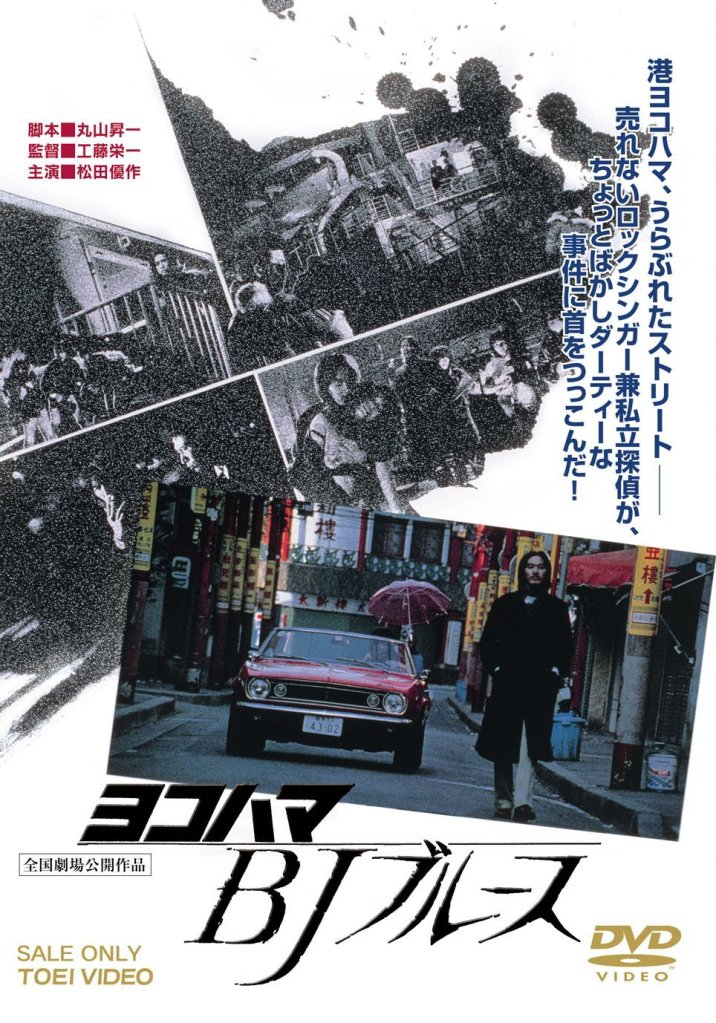
Yokohama BJ Blues (ヨコハマBJブルース, Eiichi Kudo, 1981)

Yokohama bj bluesYusaku Matsuda may have been the coolest action star of the ‘70s but by the end of the decade he was getting bored with his tough guy persona and looked to diversify his range a little further than his recent vehicles had allowed him. Matsuda had already embarked on a singing career some years before but in Eiichi Kudo’s Yokohama BJ Blues (ヨコハマBJブルース), he was finally allowed to display some of his musical talents on screen as a blues singer and ex-cop who makes ends meet through his work as a detective for hire.

After his set at a rundown jazz bar, BJ’s first job is tracking down a missing son. When he finds the guy, Akira, he seems to have become the employee (and possible sex slave?) of a gay gangster. Akira says he’s fine with his new life and wants his mother to leave him alone so BJ gets the hell out of there to give her the message but the unpleasantness of the situation lingers with him a little.

Shortly after, BJ receives a telephone call from an old police buddy, Ryo, who needs his help. Ryo got in too deep with the same gang BJ just came up against and is thinking of quitting the force in a bid to make the “Family” lose interest in him. However, Ryo is gunned down in broad daylight leaving his partner, Beniya, convinced that BJ is somehow responsible. BJ now doubly has it in for Family and starts working on his own behalf to try and find some answers and possibly a little vengeance too.

You see, back when Ryo and BJ were partners, they both liked the same girl, Tamiko, who eventually married Ryo. Beniya thinks BJ killed his friend to steal his wife and is much more interested in giving BJ a good kicking rather than investigating this very strange gang set up which seems to have some kind of drug smuggling gig going with the triads in Hong Kong.

BJ forms an odd sort of friendship with Akira in the hopes of tracking down the four gay, leather clad punk henchmen of Ali who probably gunned down his friend. However, the conspiracy only deepens and BJ finds himself suspecting even his closest of friends.

With its jazz soundtrack and melancholy tone, Yokohama BJ Blues is channelling hard boiled in a big way though does so in a distinctly modern fashion. BJ sings the blues whilst walking around this strange noir world which seems to endlessly disappoint him. Unfortunately for him, BJ is quite a good detective and quickly gets himself in way over his head only to end up finding out a few things it might be better not to know.

One of the film’s most notable components is its use of homoerotic themes with its gangs of gay gangsters, rent boys and punks. Indeed, though the wife of his former partner is floated as a possible motive, the love interest angle is never fully explored and all of BJ’s significant interactions in the film are with other men. Firstly his relationship with his former police partner Ryo which kick starts the entire adventure and then his strange almost date-like experience with Akira about half way through. BJ remains otherwise alone, a solo voice seeking justice for his fallen friends.

Of course, the film’s selling point is Matsuda’s singing so he’s allowed to play his own chorus in a sense by narrating the events from the stage in the form of the blues. Not quite “The Singing Detective”, but almost – BJ tries to bring some kind of order to his world by turning it into a song. In addition to adding to the noir tone, the bluesy soundtrack even allows for a New Orleans-esque musical funeral which oddly fits right in with the film’s weird, macabre atmosphere.

A surreal, noir inspired crime drama with musical elements, Yokohama BJ Blues is quite a hard film to categorise. Unusual for its homosexual milieu and overt homoerotic plotting the film occupies something of a unique place given its obvious marketing potential and star’s profile coupled with its decidedly murky noir tone. Difficult, yet interesting, Yokohama BJ Blues ultimately succeeds both as an intriguing crime drama and as a star vehicle for its versatile leading man.


This is a really, deeply, strange film.

Unsubtitled trailer:

http://www.youtube.com/watch?v=oYzkD-YJbjo

I actually quite like Matsuda’s foray into the world of jazz, the title song from Yokohama BJ Blues which is heard in the trailer is called Brother’s Song and is included on Matsuda’s 1981 album Hardest Day. Here he is on a talk show singing Yokohama Honky Tonk Blues:

http://www.youtube.com/watch?v=5Yr4fW2zoFk