WE 12 (12怪盜, Berry Ho Kwok-man, 2023)

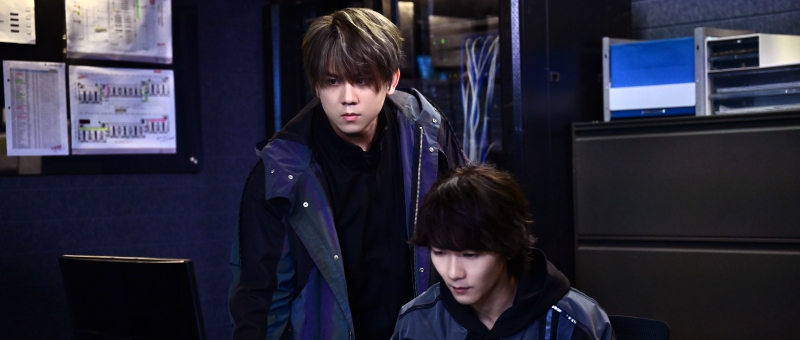
Phenomenally popular Cantopop boyband Mirror have been dominating the Hong Kong box office lately with several of the guys playing regular roles in movies not particularly designed as vehicles for their star persona such as Anson Lo’s turn in arty horror It Remains, or Lokman Yeung in Mad Fate. We 12 (12怪盜) is however the first time the band have made a movie altogether as an ensemble star vehicle and is clearly intended for their many devoted fans filled as it is with what seem to be in jokes and references to the guys’ “real” personas or at least those of the “character” they play in terms of their membership of Mirror.

The guys’ solo projects and movie work are perhaps hinted at in the film’s central thesis, if you can call it that, in that the boys have been doing too many solo missions and have lost their team spirit. In the universe of the film, they’re a kind of crime fighting zodiac who do things like save princesses and conduct jewel heists. Each of the band members, who use similar character names, is introduced with a special power which ranges from the ability to converse telepathically with animals to the nebulous “strategic planning” and the downright plain “abseiling” which seems particularly unfair given that any of the other guys could obviously learn to abseil too and then he wouldn’t have a power anymore.

In any case, their group mission is to stop a mad scientist from activating a device which can send mosquitos to other universes because it would destroy our ecosystem. Meanwhile other scientists are working on creating a “right-wing chicken” which turns out to be less political than it sounds and in fact much more absurd, along with a series of other cancer causing foods just in case you weren’t sure if they were really “evil” or not. Even so, the plot isn’t really important more a means of tying the silliness together given that focus is split between the 12 guys who each have their particular moment to shine and personalised gags. When the big job goes wrong because they decided to all do their own thing rather than work as a team, they have to come back together again and rediscover the equilibrium of Kaito (i.e. Mirror). 

Which is all to say, it’s a little impenetrable to the uninitiated but fans of the band will doubtless be in heaven. It’s all in the grand tradition of boyband popstar movies in which the silliness is sort of the point in generating a sense of conspiracy with fans that they’re the ones who get the jokes because of their intimate relationships with the stars. The film also features extended cameos from fellow Cantopop group Error who play their back up team and have a few gags of their own, while Malaysian actress and star of Table for Six Lin Min Chen also has a small cameo as the kidnapped princess. 

The best performance comes however from The Sparring Partner’s Yeung Wai-lun as the slimy security manager Johnny who is obsessed with order and dresses in fascist uniform so obviously out of keeping with the silliness and absurdity the boys represent in a mild kind of rebellion towards anything serious or grown up society in general. There is something quite childish about the way the gags suddenly pop up out of nowhere along with the otherwise nonsensical nature of the film which isn’t so much a nonsense comedy like those of the 80s and 90s as much something totally random perhaps intended to express the essence of Mirror or at least that which its fans believe it to be. For all of these reasons, the film makes very little literal sense and does not hang together very well for anyone not already well versed in the world of the band but presumably plays out just fine for anyone with a 21st-century equivalent of a decoder ring and a silly sense of humour willing to join the boys for whatever crazy adventure they may be embarking on next.


WE 12 is on UK cinemas now courtesy of CineAsia.
The Moon Thieves (盜月者, Steve Yuen Kim-Wai, 2024)

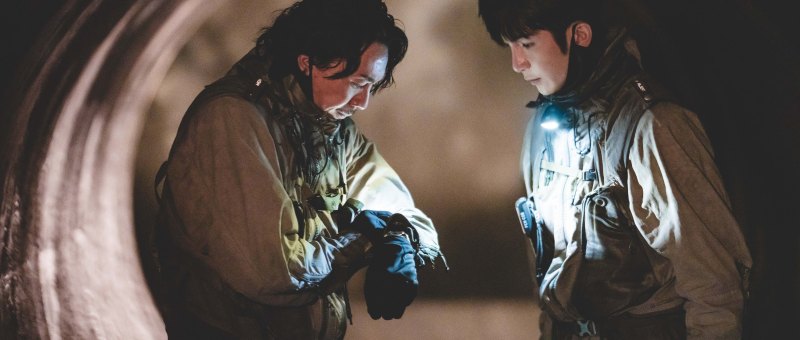
If something’s constructed entirely from orphaned parts of others like it, can you really say it’s a “fake”? Watchmaker Vincent (Edan Lui Cheuk-on) might say no, making his living through passing off “period correct” replicas of fancy watches as the “real” thing while trying to stay one step ahead of the authorities and the gangsters who seem to be his prime customers. Then again, The Moon Thieves (盜月者), Steve Yuen Kim-Wai’s return to the big screen in four years since Legally Declared Dead and a vehicle for phenomenally popular boyband Mirror, never really stops to ask just why vintage luxury watches are so desirable that the super wealthy are prepared to expend vast sums on a niche vanity status symbol but perhaps there really is no answer for that one. 

In any case, Vincent’s obsession is with the watch worn by Buzz Aldrin as he stepped onto the moon which seems to have become lost to time with NASA apparently refusing to confirm or deny its existence. His decision to make a period correct watch for a petty gangster in order to retrieve some info on the Moon Watch lands him in hot water when he’s blackmailed by local kingpin Uncle (Keung To), who is actually a youngish guy who’s taken over the name and criminal empire of his late father. Unless he wants the gangster to find out the watch is “fake”, Vincent will have to join his heist team and travel to Japan where he’ll sneakily replace three watches worn by Picasso with his homemade replicas. 

It has to be said that the film’s fatal flaw is the miscasting of Keung To as the mercurial gangster, Uncle. Though his boyish bravado might play into the idea that Uncle is out of his depth, too insecure to even use his own name rather than adopt his father’s, To’s total lack of menace or authority leaves him a rather hollow villain who alternates between super sharp intelligence and dull predictability laced with misplaced smugness. Meanwhile, Vincent is able to stay a few steps ahead of him if only in his canny knowledge of the vintage watch trade and easy power to manipulate the markets though even he probably didn’t plan on incurring the wrath of space-obsessed local yakuza who are very annoyed to have had their luxury watches stolen out from under them. 

This leaves the gang doubly vulnerable while veteran members Chief (Louis Cheung) and Mario (Michael Ning) begin to suspect that Uncle is getting rid of all his father’s previous associates and doesn’t really plan to let them live. Tensions within the group are only further strained by an unexpected hitch in the plan which brings them to the attention of the yakuza despite their incredibly careful preparations. Yuen keeps the tension high through the heist slipping into slick Ocean’s Eleven-style visuals which lend a sense of cool to the gang’s endeavours which are after all a kind of rebellion against Uncle as much as they are a capitulation to his stronghold on the local community. 

Twists and double-crosses abound as the gang try to stay ahead of him with not everything quite as it seems. Like the watches, they take everything apart to put it back together again in a way that better suits them, freeing themselves from Uncle’s thumb which might in itself stand in for another distant and corrupt authority. Ironically, the yakuza remarked that no one remembers who came second yet everyone is desperate to get their hands on the famed Moon Watch worn by the second man to walk on the moon as a kind of holy grail among horologists that they would maim or kill for though of course even if they had it they could never show it to anyone fearing they’d caught out by the authorities including NASA who apparently have a lot of say over this particular relic of the moon landing. The heist isn’t quite as daring as actually stealing the moon, though it is definitely a sticky situation for all involved which eventually requires them to hide their quarry in plain sight while doing their best to outsmart Uncle and avoid turning on each other. Smart and slick, the broadly comic overtones lend an endearing quality to Vincent’s quest for survival while targeted by a ruthlessly corrupt and infinitely implacable authority.                                                                                                                                                                  


The Moon Thieves opens in UK cinemas 23rd February courtesy of Central City Media.

UK trailer (English subtitles)

My Heavenly City (我的天堂城市, Yu Sen-I, 2023)

After taking a job as an interpreter working with the social and courts systems, overseas student Mavis (Vivian Sung) sits under a sign at centre for teens reading “you are not alone.” As she reveals to her client, alone is something she’s often felt while living in New York where everyone has “people to see, things to do, and homes to go to” while she feels herself in limbo with nothing and no one to turn to for support. Inspired by her own experiences, director Yu Sen-i’s My Heavenly City (我的天堂城市, wǒ de tiāntáng chéngshì) explores both the freedom and loneliness that can come with living abroad through the stories of three Taiwanese migrants who share unknown connections. 

Mavis is nursing heartbreak and finding it difficult to concentrate on her studies while her money runs out and she feels as if she isn’t getting anywhere. When an opportunity teaching Mandarin to the son of a Taiwanese-American couple falls through, she applies for a job as an interpreter but soon discovers that it requires more than language skills not least because many of the cases she’s called in on are emotionally difficult. Though reminded that an interpreter should maintain a professional distance and avoid becoming friends with a client, she can’t help bonding with 16-year-old Xiao Jian. Suspected of having come to the US undocumented, Xiao Jian was found wandering around alone in Bryant Park and is refusing to speak. 

What Mavis discovers is that she can’t really help him and no one wants to hear what he’s got to say anyway but in any case she comes to see him as a mirror for herself, another lost soul struggling to find a footing in the city. The same is true of street dancer Jack (Keung To) who is conned out of money by duplicitous locals but bonds with a young woman from Singapore, Lulu (Jessica Lee), who hoped that she’d find herself in New York but discovers only more lonely rootlessness and uncertainty. Even her connection with Jack is threatened by looming visa issues. Even so, in New York, Jack discovers greater freedom to be himself in embracing his love of dance if fulfilling parental expectation by continuing to study computer science.

Jack describes his mother’s micromanaging as oppressive, and is relieved to be if not freed from it that at least at a greater distance. These differing ideas of parenthood are also beginning to erode the relationship between successful architect Jason (Jack Yao), who came to the US 20 years previously, and his Taiwanese-American wife Clare (Mandy Wei) who struggles to deal with her own fiercely authoritarian father. The couple have a son, Jasper, who is autistic and also has emotional problems that have resulted in problematic violence that echoes a case that Mavis was brought in on of domestic abuse. Only nine years old, Jasper explains that he gets “very, very angry” when frustrated and it seems that he may not be well suited to busy city life. Clare’s father doesn’t believe in mental illness and assumes it’s discipline issue, believing that Clare and Jason are at fault for spoiling him rather than correcting his behaviour.

The conflict may echo a cultural divide between the authoritarian patriarchy of traditional culture and the aspirations of Clare who says she wants to try a new parenting style founded on love, but the fundamental problem for the family is in effect and absence of the father. The economic demands of living in an expensive city have forced Jason to abandon his family while he also seems unprepared to deal with Jasper’s complex needs and leaves everything to Clare who is then overburdened on the brink of burn out. Jasper’s increasing volatility and its effects on his mother finally convince Jason that he must find a way to rebalance his commitments and be emotionally, rather than just financially, present in the family and in his relationship with Clare.

A final visit to a lost and found office echoes the sense of displacement each of them feel but also what they discover in the city and the connections they make there whether they plan to stay or not. Though it may sound bleak in its exploration of the difficulties of living in an unfamiliar culture, the film discovers a sense of serenity in the improbably sunny city that cuts through its shadows and offers an unexpected of connection between its melancholy exiles. 


My Heavenly City opens in UK cinemas on 10th November courtesy of CineAsia.

Original trailer (Traditional Chinese & English subtitles)

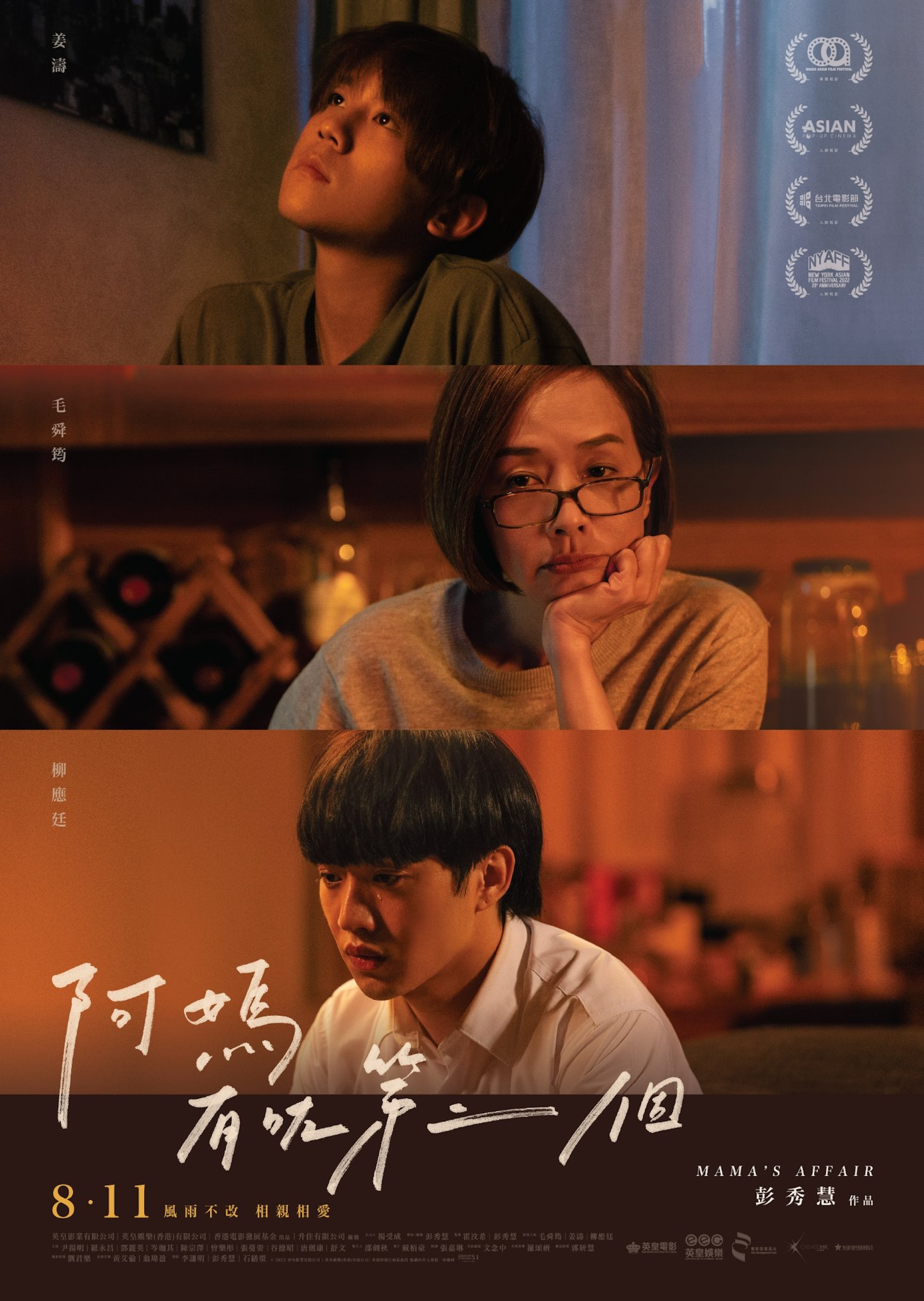
Mama’s Affair (阿媽有咗第二個, Kearen Pang, 2022)

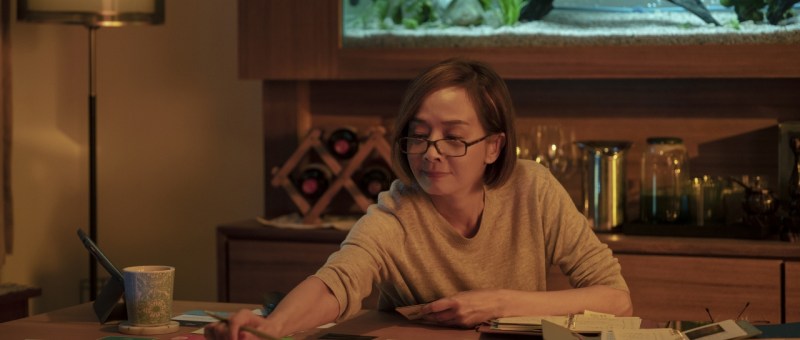
A middle-aged woman finds her desire to take back her life after the failure of her marriage frustrated by her teenage son’s resentment and the lingering patriarchal social codes of the contemporary society in Kearen Pang’s familial dramedy Mama’s Affair (阿媽有咗第二個). The “affair” of the title is an ironic take on her new maternal relationship with a young man she takes under her wing framing it as in a way cheating on her son which is clearly the way he feels about it, while it’s clear that some still view her desire to find fulfilment outside of her role as a wife and mother as a betrayal of her family. 

Before her son was born, Mei-fung (Teresa Mo Shun-kwan) was a top talent manager at a record label but gave up her job at her husband’s insistence after suffering a miscarriage. With her son, Jonathan (Jer Lau of boyband Mirror), about to graduate high school and hoping to get into Cambridge University, she decides to re-enter the world of work but soon discovers that those she once helped in their careers are not necessarily keen to repay the favour. An old associate more or less laughs her out of the room suggesting she’s simply too old for the music business and recommends she join another old friend at his music company which turns out to be a school for small children. She takes the job anyway and quickly bonds with the two younger employees who introduce her to Fang Ching (Keung To of boyband Mirror), a young man with a prodigious talent for song and dance that has Mei-fung thinking of getting back into the management game.  

Though Jonathan had mostly reacted with indifference to his mother’s decision to return to work, claiming that he’d long wanted more independence anyway, he can’t seem to let go of a sense of resentment towards Ching which is compounded by his confusion surrounding the status of his parents’ marriage which it seems had long gone cold. His father Yan has moved out and though Jonathan doesn’t know it is having a baby with an old friend of his mother’s all of which informs his feelings of displacement as if he’s been pushed out of the family circle fearing that Mei-fung has gone out and got herself a new son who admittedly seems to appreciate her more. Displaced from his own family by tragic circumstances, Ching does indeed value the small things Jonathan has begin to resent in teenage angst yet is also unexpectedly sensitive and mindful of the ways in which his relationship with Mei-fung and presence in the household may be affecting Jonathan who is still struggling to come to terms with his parents’ decision to end their marriage without even really telling him. 

In an another ironic note it’s Mei-fung’s maternity which is positioned as her key strength as a manager, quietly lending support and encouragement that allows Ching to reach his full potential. On Ching’s arrival to the studio a mother had come in to the school with her young son who was bawling his eyes out because he wanted to join a dance class but the mother wouldn’t let him because she said he was too fat and would only embarrass himself only to be proved wrong when Ching invites him to try out on the dance floor demonstrating both the damage that can be done by a judgmental parent and the positive influence of an actively supportive environment. While Mei-fung keeps telling Jonathan he needs to learn to look after himself, she patiently nurtures Ching and eventually encourages to him sort out his complicated feelings towards his family while helping him achieve his dreams as an artist. 

In some ways, Mei-fung never really transcends the role of mother or escapes the tendency to define her role in relation to the two boys while somewhat resentful of all she was forced to give up because of the patriarchal, authoritarian mindset of the husband who later left her for a younger woman. Jonathan and Ching eventually sort things out through a good old fashioned fist fight generating a kind of brotherhood that leaves each of them equally displaced but also finding firmer footing more secure in their roles and relationships. “No one can handle everything alone” Ching wisely advises, as each of the trio develops a kind of independence founded on mutual solidarity, Mei-fung reclaiming her right to an individual life while giving each of the boys the courage to go off and pursue their destinies through the superpower of maternal love. 


Mama’s Affair is in UK cinemas from 19th August courtesy of CineAsia.

UK trailer (English subtitles)