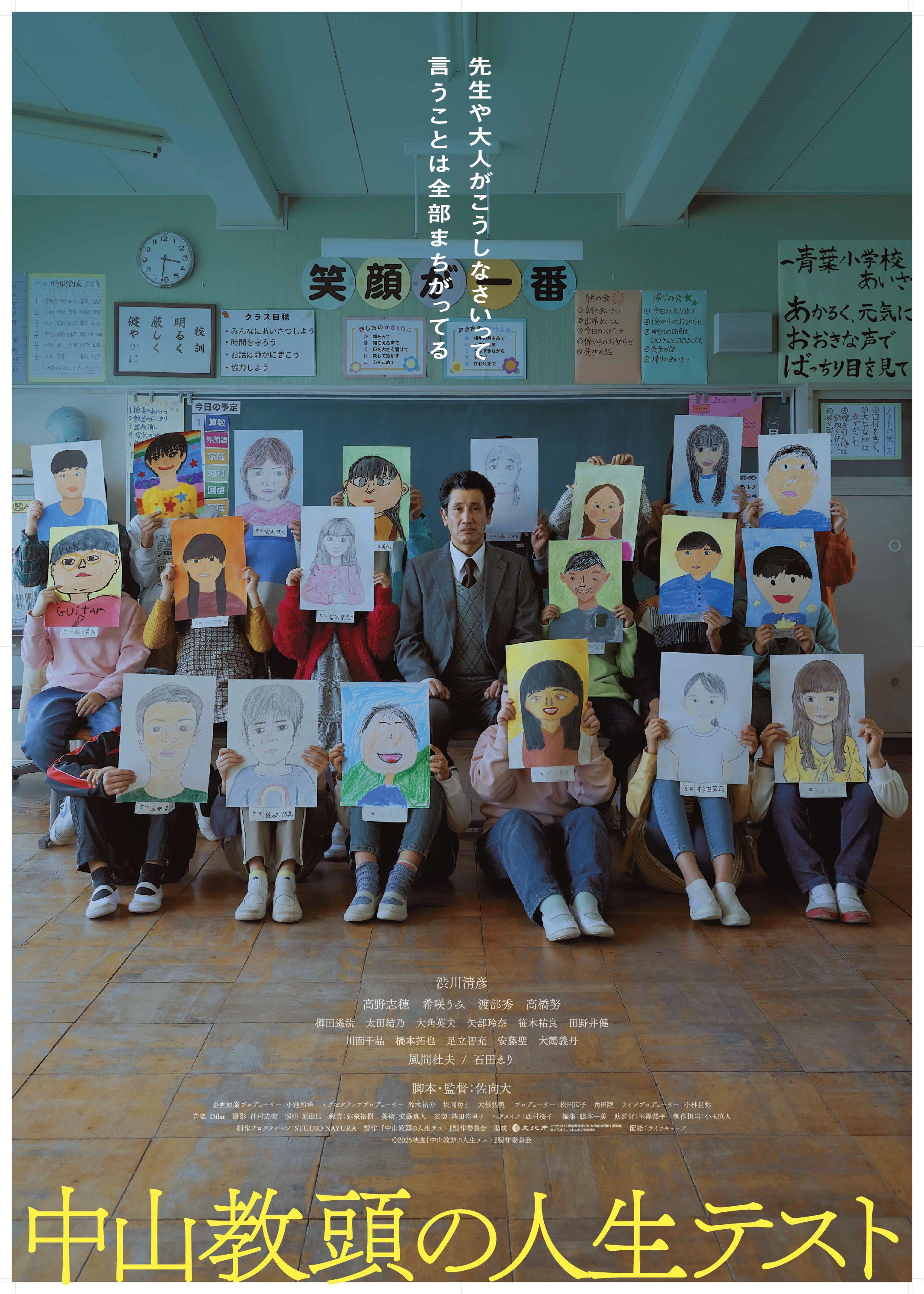

PRINCIPAL EXAMINATION (中山教頭の人生テスト, Dai Sako, 2025)

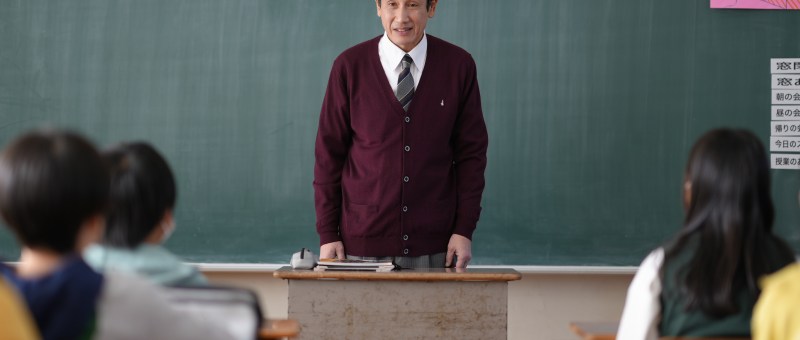
What is the place of the teacher in the contemporary society? Are they extensions of authority whose only role is to insist on order and produce children who will be obedient and know how to follow rules, or is it to educate and care for them so they can become the best versions of themselves free from the pressures of a conformist society? After taking some time away from active teaching, an absent-minded deputy headmaster finds himself confronted by just these contradictions as he’s suddenly tasked with taking over a class of primary school children while studying for the exams to qualify as a head teacher.

A mild-mannered man, it’s clear that Nakayama (Kiyohiko Shibukawa) is already overloaded and that the headmistress, Ms. Takamori (Eri Ishida), delegates most of her work to him. Though he was a frontline teacher for most of his career, he took an admin job after his wife’s death and seemingly lost his enthusiasm for the profession but quickly finds himself in the middle of a wider dispute about the scope of a teacher’s responsibilities to their students. He’s asked to take over after the current teacher, Kurokawa (Shu Watanabe), takes a leave of absence having come in for criticism from the children and their parents over his overly harsh teaching style. We see him force the children to repeat their morning greeting several times because they were not “in unison,” while he otherwise singles children out in front of the class for various rule infractions or poor performance. He appears to be more or less bullying some of the students, including Reona (Michiru Kushida), who comes from a single-parent family and is not able to get her mother to check her homework over for her because she just doesn’t have time.

There is a degree of push and pull between the teachers and parents over the shared responsibility for educating the child with some feeling that asking parents to do this kind of task is unreasonable while also reinforcing traditional gender roles in expecting there to be someone at home who is always available and dedicated only to raising children. This mistaken assumption disadvantages children like Reona while also stigmatising her in front of the rest of the class. Meanwhile, teachers are overly cautious of upsetting parents if they tell a child off in school. One irate father makes a point of coming in to see them when his son was merely questioned about something that happened after class and appears to be something of a bully himself. His son was one of the boys who criticised Kurokawa, and seems to have a lot of pent-up anger that could become a problem in the future but there isn’t much they can do about it at school. 

Kurokawa had only been appointed because Ms. Takamori insisted on temporarily suspending the original teacher, Ms. Shiina (Shiho Takano), because of complaints about something that happened outside of school. She had accepted an invitation to a barbecue with the children’s families where a child fell over and was injured. Ms. Shiina was then criticised for not properly supervising the children though she had only been at the barbecue as a guest and wasn’t responsible for watching them. Nevertheless, she was criticised because her role as a teacher leads people to think that she should be somehow responsible for any children present even when attending in a personal capacity as a private citizen, further emphasising a blurring of the lines when assessing the boundaries around the roles of teacher and parent. 

Ms. Shiina, who also appears to be queer coded, is presented as a more progressive teacher who doesn’t care about playing the game but only about the children’s welfare and wants them to grow up to be morally responsible people who can think for themselves. The irony is that Ms. Takamori may have been similar, later saying that Ms. Shiina reminded her of herself when she was younger, but because of the discrimination and prejudice she faced as a woman she decided her life would be best served by following all the rules so no one could complain. A former champion weightlifter, she had been criticised for a lack of femininity all her life and is also subject to the sexist and misogynistic judgements of the former headmaster, Kishimoto, who has made Nakayama his prodigy, but only if he plays the game which means becoming the kind of teacher who puts appearances first and enforces discipline rather than attempting to find out what’s going on in the children’s lives or fully understand the realities of class dynamics.

Indeed, it turns out to be the kids who are following the rules who are the worst and actively encouraging the semblance of order maintained through hierarchical bullying. Nakayama tries to investigate, but only arrives at half the truth and is torn between his desire to become a head teacher, which means submitting himself to the rigidity of the school system, and the idealism he once had for teaching. He finds himself effectively bullied, pressured into going along with things he doesn’t think are right which is the opposite of what he wanted for the children. As he eventually tells one of them, everything the teachers say is wrong, and what they really wanted to do was right, which is as close to admitting the irony of his position as it’s possible to get. 

The film’s English title has its ironies too as this is also an examination of Nakayama’s principles and how far he’s willing to compromise on them to be validated by the system in becoming a headmaster. He betrays his principles when he takes the test, but gets away with it and is in fact uncomfortably praised for his hardline stance after lying to protect Ms. Takamori by saying it was his decision to suspend a pupil who was caught shoplifting and drinking though some criticise it for its unfairness on the child. After all, suspending them will just result in them having nothing to do and getting into more trouble. But on the other hand, some parents now see this child as problematic and don’t want them back at the school where they worry they may prove disruptive to their own children’s education and development. 

The film offers no solutions though lands on the side of the children rather than the authority, sympathising with Ms. Shiina and encouraging Nakayama to regain his former idealism rather than become just another tool of an already oppressive social system. The fact that Nakayama loses his notebook implies a disregard for the kind of rules that are written in the headmaster’s manual and a return to his own judgement while leaving his final decision ambiguous as to which side of the line he will finally be on or whether he can really change this system from within. Though pretty bleak about the education system and its implications for the wider society, there is still a note of optimism in those like Ms. Shiina who don’t care about the rules so much as the children’s wellbeing that there is still a place for a more idealised form of teaching even within a fairly oppressive society.


PRINCIPAL EXAMINATION screens 31st May as part of this year’s Nippon Connection.

Trailer (no subtitles)

Lumberjack the Monster (怪物の木こり, Takashi Miike, 2023)

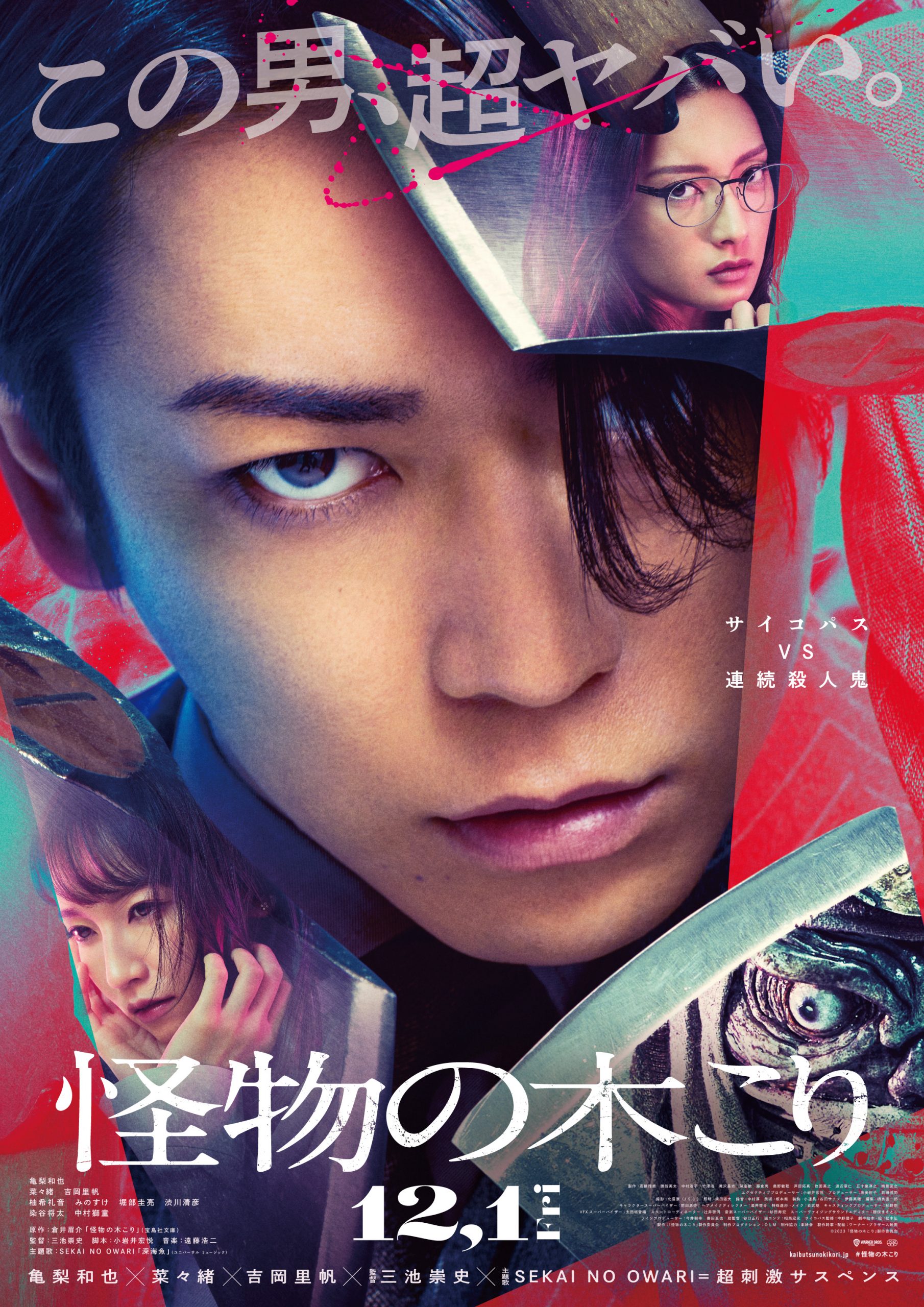
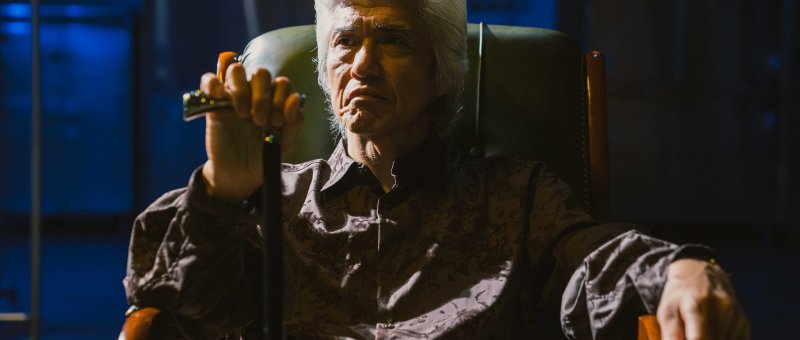
Could being a psychopath actually be better? It might be an attractive thought for some, the absolute freedom of living without emotional or moral constraint. Emotion is after all a difficult thing to bear, though life without it might also be lonely and unfulfilling leaving a void often filled by other desires such as a lust for wealth, status, power, or proof of superiority. Based on a novel by Mayusuke Kurai, Takashi Miike’s Lumberjack the Monster (怪物の木こり, Kaibutsu no Mikori) finds its hero at a point of existential crisis no longer certain of his true nature or identity.

The film takes its title from a fairytale featured in a picture book being read by a small boy who has been abducted and illegally experimented on. A monster begins living as a lumberjack in a small town where he begins killing and eating the residents, only no one notices. Eventually it realises that he spends more time being the lumberjack than the monster and is confused about his identity. With no friends left to talk to (because it ate them all), the monster decides to move to another town to make more friends but ends up sneaking into the house of a lumberjack, stealing a baby, and fashioning after itself to create another monstrous lumberjack.

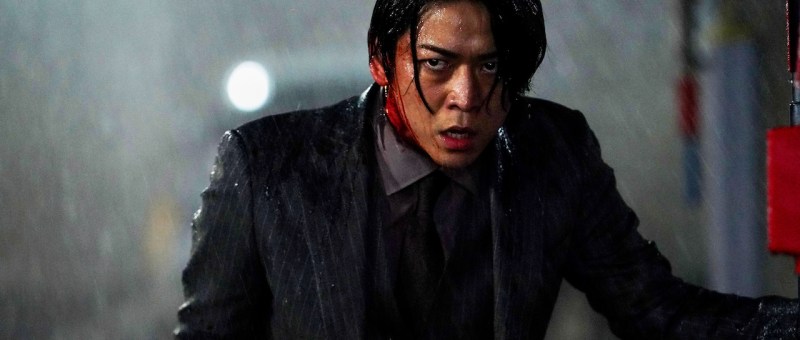
This is in a sense what’s happened to Akira (Kazuya Kamenashi), now a lawyer who discovers he has a “neuro-chip” in his brain that suppresses his emotions after he’s attacked by a masked figure and it breaks re-introducing him to an unwelcome humanity. This is quite inconvenient for him in that he’s done quite a lot to feel guilty about, firstly participating in a scheme with his “friend” Sugitani (Shota Sometani), a natural-born psychopaths, to facilitate his experimentation on live humans, and secondly that he murdered his boss who is also his fiancée’s father to take over his law firm. Though the fiancée, Emi (Riho Yoshioka), seems to be afraid of him, it’s also true that simple proximity to her warmth and kindness may have begun to reopen his heart.

Of course, it could be true that the mad scientists who abducted the children accidentally picked up a few who were already psychopaths but in this case it seems like the chip did its job on each of the victims of the axe-wielding assassin. Meanwhile, we also see “psychopathic” traits in lead investigator Toshiro (Nanao) who admits that she will do whatever it takes to get to the truth even if it includes throwing out the police rulebook. Akira asks her if her desire to solve the case isn’t also a roundabout means of vengeance for the death of her brother, leaving her not so different from the assassin who is also extracting vicarious revenge on man-made psychopaths, but she replies that that’s exactly how a psychopath might see it while also deflecting a similar question from embittered cop Inui (Kiyohiko Shibukawa) who remarks that if the killer’s only taking out psychopaths then why bother stop them?

In some ways, Akira is like the lumberjack. He was simply being what he was and knew no different, but gradually beginning to rediscover his humanity is burdened with guilt and remorse now acutely aware not just of the feelings of others rather than their consequences but of his own feelings too. The couple who abducted the children claimed they were doing it to save their son, trying to reverse engineer psychopathy so they could cure him though their actions were themselves psychopathic and like the lumberjack they created only more monstrous children like themselves. Akira has it seems rediscovered the person he may have been if he had been raised in the loving family from which he was abducted and is determined to search for the meaning of life, but he is also responsible for the decisions he made as a man who knew no guilt or remorse and may in fact have to pay for the moral transgressions he was not fully aware he was making. Miike conjures a sense of the gothic in the creepy, candlelit mansion where the children were kept and otherwise sticks to standard procedural for the “real” world, but finally lands back in the realms of fairytale as his hero finds himself part of neither one world nor another while faced with a choice that may earn him redemption but also loneliness and futility.


Trailer (English subtitles)

Promised Land (プロミスト・ランド, Masashi Iijima, 2024)

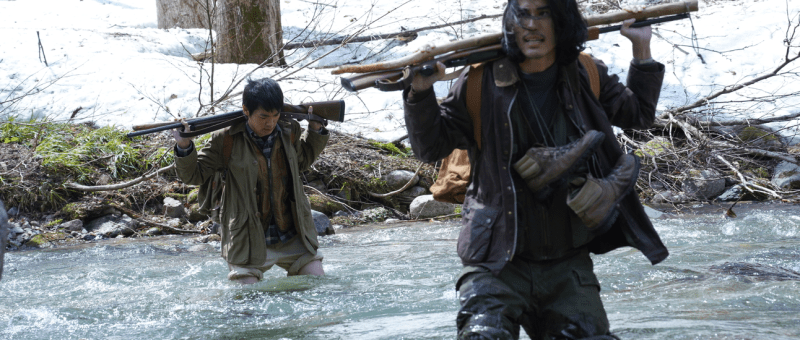
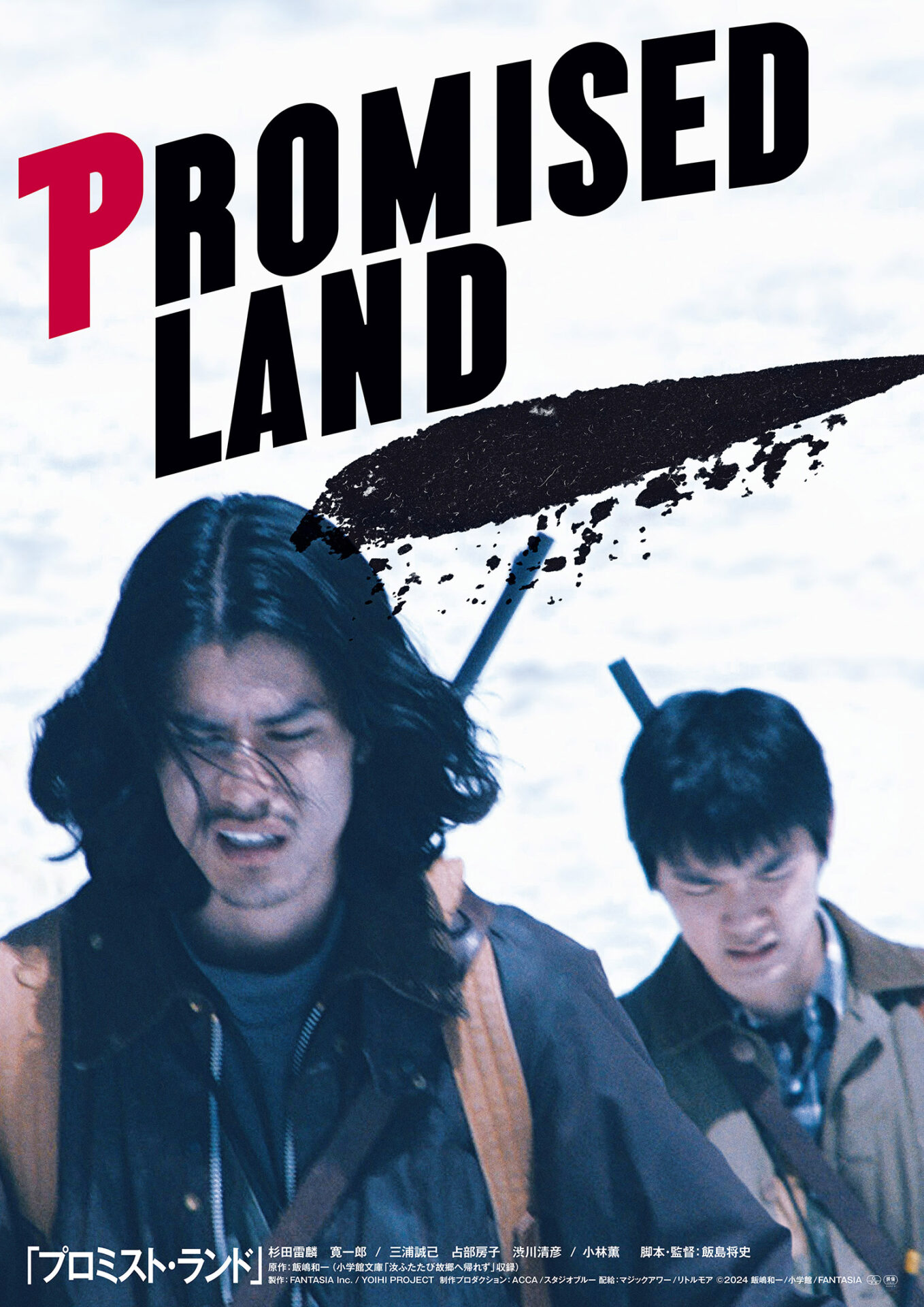
An avalanche approaches a small town in Japan, a harbinger of change in which the centuries old practice of bear hunting has finally been put to rest by government directive. The buried question at the centre of Masashi Iijima’s Promised Land (プロミスト・ランド) is who exactly that land has been promised to and what the rights and responsibilities surrounding it are in the midst of a changing society in which there may longer be a place for the hunter.

Some might argue that there shouldn’t be, and it has to be said this is one ancient tradition that’s increasingly hard to defend. Set in 1983, the film finds the “Matagi”, or traditional hunter, already all but extinct even before the head of the local association (which appears to only have five members) calls them all together and tells them the hunt is off for that year due to a preservation order by local government. One of the younger members, Rei (Kanichiro), immediately objects sensing that if the hunt is canceled this year it will never be held again. He says he thinks it’s unfair as it’s industry encroaching on the forests that has led to a decrease in the bear population rather than overhunting while another of the men takes constant pops at rich men from the city who come in and treat hunting like a hobby failing to abide by any of their rules such as not shooting mothers with their cubs.

The hunters seem to think of themselves as keeping nature in check, “culling” the bears to keep the mountain safe though there’s no sign that they are any real danger to humans and anyway their numbers are now depleted. There doesn’t seem to be any other way to defend this practice outside of tradition, but it’s evidently something very important to Rei, important enough to constitute a large part of his identity. Thus he alone is determined to defy the order and kill a bear anyway even though he knows there’s a good chance of going to prison for illegal hunting and being branded a poacher. 

Rei ropes in Nobu (Rairu Sugita), a childhood friend who apparently owes a debt to him having received a blood transfusion from him when he was four and now deeply resents having that fact wielded against him all these years later. Unlike Rei, Nobu is a much more modern young man whose father makes fun of him for wearing fashionable clothes and perfume. He hates working on his father’s farm and longs to escape the moribund small town and its brutal traditions such as the bear hunt he’s been roped into since birth just because like many things his ancestors always did it. While hunting for a bear, the pair have an opportunity to talk, Rei admitting that hunting and the gun represent for him the essence of the man he once was while reeling from the breakdown of his marriage to a woman he failed to support when she failed to fit in to village life. He recounts the story of a banker he did some work for who says that he envies the freedom of his life as a landscape gardener while he sits in a prison all day counting other people’s money but when he asks him why he does’t give it a try the man just backtracks and starts making excuses.

Rei seems to be wondering what true freedom means and perhaps feels he doesn’t really have it, asserting dominance over the mountain by killing the bear to regain control over his life. He calls the bears a gift from the mountain god as if they existed only for him to kill, though it’s difficult to see why his tradition or need for raw masculinity is worth more than a living creature’s life. When he eventually kills a bear, the film hovers on the ritualistic quality of the act as Nobu and Rei bend over the body, wafting it with leaves, and skinning its pelt before drinking its blood. This is an act of cruelty more of necessity. They have no need of the pelt or meat, do not make a major part of their income from selling them, and the bear did not threaten them. This is in short a tradition that can safely be left by the wayside, but by the film’s conclusion the two men seem to have switched positions Rei now pondering leaving the village while Nobu seemingly has a renewed desire to stay and preserve these old traditions. Perhaps it is his promised land after all, or else was intended to exist for the bears as creatures of nature free from the destructive forces of humanity.


Promised Land screened as part of this year’s Camera Japan.

Original trailer (no subtitles)

The Box Man (箱男, Gakuryu Ishii, 2024)

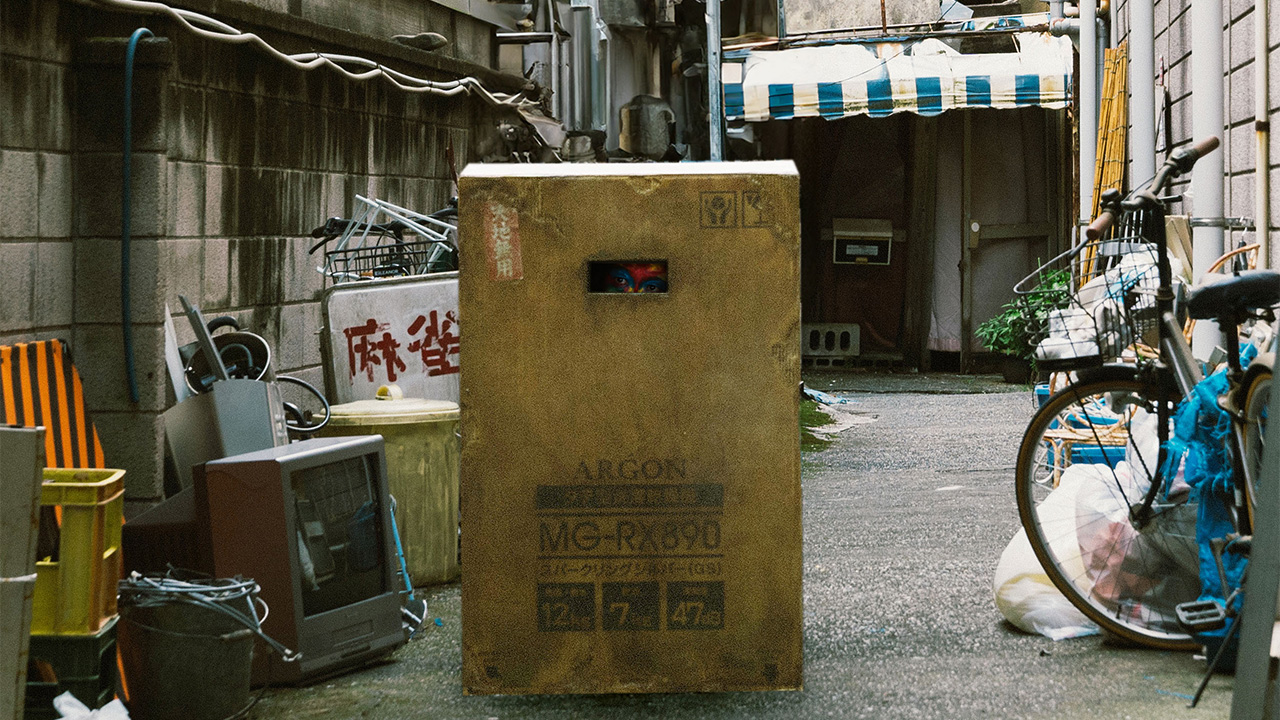
Those who obsess over the Box Man, become the Box Man, in Gakuryu Ishii’s adaptation of the Kobo Abe novel. Yet the unnamed hero’s problem is that he feels himself unable to become “the real thing” and is thereafter trapped inside a labyrinth while forever seeking an exit. It’s never clear to him, or to us, if the cardboard box he wears is really just that or something imbued with a supernatural power that actively masks his identity even from himself.

Tellingly, the only named character is a woman, Yoko (Ayana Shiramoto), who seems to exist outside of the box. She appears to be free, confident, aware of all she is and apparently certain of her identity. The Box Man, or perhaps “a” Box Man, meanwhile, is known only as “myself,” a former photographer (Masatoshi Nagase) who almost pities those who target him in memory of the Box Man who once infected and cursed him to the same fate. Watching the city through the tiny letterbox slit, he remains a step away from our world and later refers to the box as the entrance to some other place suggesting that it’s really we who are trapped on the other side of the cardboard.

He advances something similar when he in effect turns the box inside out, walling himself inside a single room by covering the windows and doors to box out the world but not really finding escape. Still, others seem to covet the title of Box Man, those also without concrete identities but going by names such as Fake Doctor (Tadanobu Asano) and the General (Koichi Sato), both of whom are apparently interested in the Box Man and tracking his every move. It seems they believe there can only be one real, authentic Box Man allowed, but become increasingly uncertain which of them is “real”. The notes the Box Man is keeping become key to his identity, but like a metaphor for the unseen hand of fate, one points out that perhaps someone else has written them out for them, Myself lamenting that the author has written a better version of himself than he ever could. 

There is something undeniably absurd about the way the Box Men scuttle around, occasionally sticking their ams out of the box’ flaps while arguing over the true identify of the Box Man despite having described the mystery as boring. The Fake Doctor seems to want to destroy the box, as if he wanted to obliterate it perhaps in an attempt to destroy the image of a mask to avoid the suggestion that he has one himself, while it remains unclear if this would free the other Box Man or trap him further while Fake Doctor would take his place. When Myself killed the Box Man before him, a mask may have been what he wanted. A photographer sick of seeing the world and longing to be free of it, to shed himself of an identity he no longer wanted only to search for it once again even as others try to crush it from without. 

The Box Man comes to the conclusion that it’s the world that should be boxed away, but of course it’s all the same. When he remarks that Yoko, after leaving their sanctuary, did not really escape but has simply gone to a deeper level, it’s reflective if his own desire to find meaning in a meaningless world. He claims that he dreams of a world yet to begin but is finally confronted perhaps by anonymity in witnessing a row full of Box Men apparently all also devoid of personality which might in an ironic sense tell him who is if only in reflection. 

Strange and surreal, Ishii lends an edge of absurdity to the strange existence of the Box Man while perhaps aligning the letterbox frame of his open window to that of the cinema screen and the artificial reality that surrounds us. In any case, it seems the other world the Box Man longed to enter was that of the self, his interior life expanding inside the box as a small galaxy he has somehow become lost inside, no longer able to see beyond himself but trapped inside an “exitless black hole” looking for a path to authenticity away from this “fantasy” in which everything is “fake” save the potential salvation of a distant guiding light.


The Box Man screens in New York July 13 as part of this year’s JAPAN CUTS.

Original trailer (English subtitles)

All the Long Nights (夜明けのすべて, Sho Miyake, 2024)

The latest in a recent series of films critical of Japan’s contemporary employment culture, Sho Miyake’s All the Long Nights (夜明けのすべて, Yoake no Subete) presents a more compassionate working environment as key to a happy and fulling life brokered by small acts of attentive kindness in the knowledge that we are all carrying heavy burdens. Based on a novel by Maiko Seo, the film captures a sense of serenity that can be found in the wonder of life itself and the discovery of the “infinite vastness beyond the darkness” that a starry sky presents.

A lack of compassion in the generalised society is signalled early on in the fact that the heroine, Misa (Mone Kamishiraishi), struggles with a condition that is little understood and belittled by those around her. On bonding with workplace colleague Takatoshi (Hokuto Matsumura) who is experiencing panic disorder, he dismisses her issues as “that female thing” and suggests it doesn’t compare to the effects his condition is having on his life. She counters him that she didn’t know there was a ranking, but is obviously rankled by the refusal of the world around her to take her PMS seriously even though it causes her to lash out at others and often ruins employment opportunities because it’s impossible for her to regulate her emotions in the way that is generally expected in contemporary working culture. 

Each of them have ended up working at a small company that manufactures scientific instruments for children after originally working in larger corporate structures with very clear hierarchical systems and rigid modes of behaviour. Yet we can see right away that Misa’s colleagues are aware of her condition and seem to have accepted it. When she blows up at Takatoshi over his habit of drinking carbonated water the sound of which gets on her nerves, they gently steer her away while explaining to him not to pay it any mind. In any case, Misa is still embarrassed by her behaviour and regularly buys pastries at a nearby bakery in an act of continual atonement even though her boss tells her not to get into the habit of it.

Takatoshi’s rather rude refusal of her pastries, clumsily explaining that he dislikes raw cream, is another symptom of his aloofness and unwillingness to be a part of the office community. He is continually looking to get his old job back and looks down on this kind of work as being lower in status than a regular office job at a big company, something perhaps reinforced by his well-meaning girlfriend who seems to want him not only to get better but to reassume his former position despite the implication that it’s what made him ill in the first place. Tsujimoto (Kiyohiko Shibukawa), his former boss, however remains compassionate and supportive perhaps in part because his older sister took her own life due to workplace pressures which has made him more sensitive to the troubles of those around him. That’s also true of the boss of the science company, Kurita (Ken Mitsuishi), whose younger brother also took his own life for unclear reasons leaving him acutely aware of the importance of paying attention to the feelings of others.

It’s in this compassionate environment that Misa and Takatoshi each begin to rediscover a new sense of confidence in their mutual solidarity regarding their personal struggles along with a better idea of what kind of life suits them rather than focusing on how they’re seen by others or living up to a societal notion of what defines conventional success. As they’re tasked with creating a voiceover script for the company’s mobile planetarium, they come to an appreciation of the beauty found in darkness along with the light that shines within it in. As Misa reflects, there is nothing in life that does not change, not even the stars, but amid all that anxiety we can still help each other and live peaceful, quietly profound lives finding fulfilment in the mundane. Shot in a hazy, slightly detached naturalism the film eventually finds a joy in life’s simplicity and the warmth of human connection that exists outside of the corporate superstructures that have come to define most of our lives while otherwise robbing us of the ability to fully embrace it or ourselves.


All the Long Nights screened as part of this year’s Toronto Japanese Film Festival

Original trailer (English subtitles)

Sanka: Nomads of the Mountain (山歌, Ryohei Sasatani, 2022)

A young man finds himself caught between the new Japan and the old while befriending the last remnants of a nomadic people in Ryohei Sasatani’s poetic drama, Sanka: Nomads of the Mountain (山歌, Sanka). Set in the mid-1960s the film harks back to something older and more mystical that seems at odds with the Japan of the bullet train and economic miracle but equally sees its hero reckon with the more recent past in his father’s authoritarianism born of his militarist upbringing and wartime service.

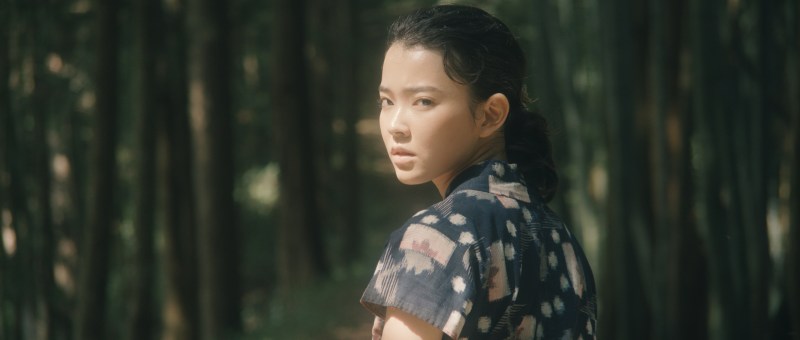
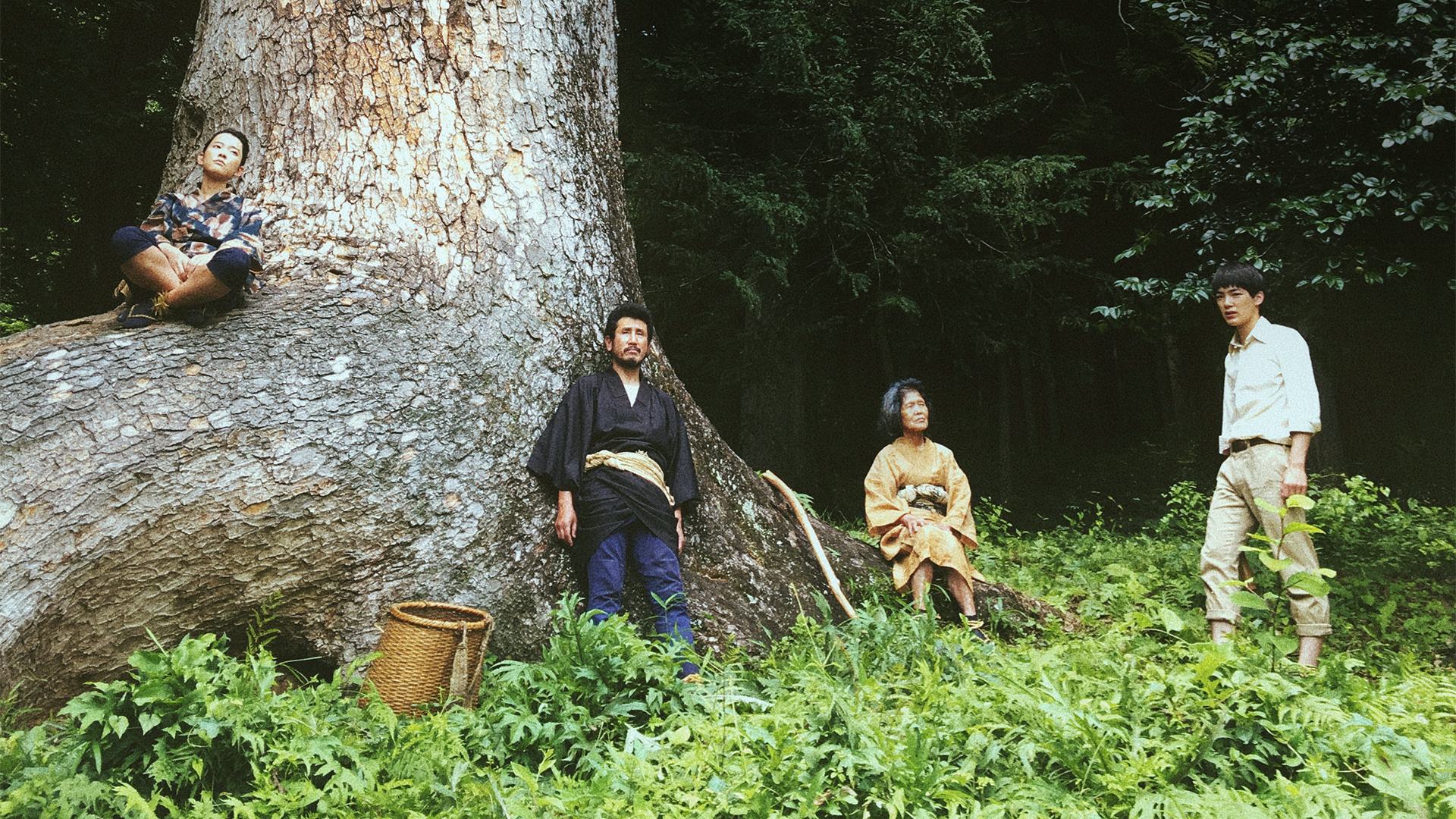
Norio (Rairu Sugita) does seem to be a more sensitive boy. Bullied at school he comes home with a bruised face and is berated by his father Sakaguchi (Kisuke Iida) for his lack of manliness while struggling to come to terms with the death of his mother on the mountain two years previously. That’s one reason he ends up bonding with Shozo (Kiyohiko Shibakawa), one of the last remaining members of the Kenshi people who live a nomadic lifestyle migrating across the mountain throughout the year to take advantage of the terrain. Becoming a kind of father figure, Shozo teaches him how to fish and live on the mountain while Norio also develops a fondness for his daughter Hana (Naru Komukai) who appears to be around the same age as he is. 

The contrast between the two men could not be more stark. People in the town still refer to Sakaguchi as “the sergeant” and fiercely respect him for his wartime service. Norio finds a picture of his father in uniform along with a gun wrapped up in the back of drawer as if reminding him of the oppressive authority that hangs over the house. The townspeople are also grateful to Sakaguchi because he’s planning to build a golf course, a symbol of a newly prosperous society with a growing middle class, that will bring a lot of jobs to the area which is struggling economically with the decline of the agricultural industry. To build the golf course, Sakaguchi plans to get to rid of the mountain which will force Shozo and his family off the land and sever their connections with the forest and earth. 

To the townspeople the presence of the Kenshi is something taboo that embarrasses them. People accuse them of thievery and try to shoo them away. A policeman even stops Shozo and forces him to throw the fish he was trying to sell back to the river claiming that he’s frightening people just in his presence. Norio experiences an additional layer of shunning solely because of his association with the Kenshi and is later berated by his father for causing him embarrassment by associating with them. He reminds him to be mindful of his “status” and describes the Kenshi as “trespassers” as if denying them the right to exist. 

Norio obviously disagrees and is quickly seduced by the mountain’s serenity explaining that it helps him forget about the troubles of his life. But for Hana the situation is more complicated. Her friend Yoshi and her family went town from the mountain two years previously and she enviously looks on as she gossips with her school friends torn between her loyalty to her Kenshi roots and the desire for modernity in which she could live a comfortable life and get an education. If she stays on the mountain, she’ll be the last of her kind yet she struggles to reconcile herself with the idea of moving on just as Norio struggles with his own future in a rapidly changing Japan and seeks refuge in the mountains and a world beyond invisible to humans. 

Filled with a gentle poetry as Hana dances amid a rainstorm and voices echo through woods along with the sound of feet clad in woven sandals, the film is a kind of lament for an older, mystical Japan eventually eroded by a quickening modernity along with a critique of the lingering militarist authoritarianism which has simply transformed into corporate capitalism as symbolised by Norio’s cruelly conservative father. Yet as Hana had said, they’ll be Kenshi wherever they go, implying perhaps that her culture will not necessarily disappear so much as be carried forward even as the mountain itself becomes a casualty of a society in danger of forgetting its roots in a headlong dash towards a prosperous modernity.


Sanka: Nomads of the Mountain screened as part of this year’s JAPAN CUTS.

Original trailer (no subtitles)

Winny (Yusaku Matsumoto, 2023)

Can a creator be held legally responsible for what other people might decide to do with their creation? For some, that is the essential question of the trial at the centre of Yusaku Matsumoto’s legal drama Winny, but in speaking more to the present day than the early 2000s in which the real life events took place the film is more concerned with freedom of speech in a society in which established authorities may seek to resist the democratisation of information. 

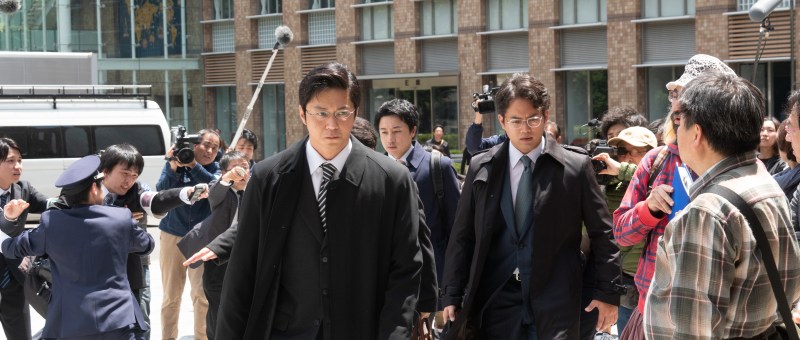
A talking head seen on television at one point suggests that peer-to-peer file sharing programme Winny disrupts the democratic copyright regime, but according to its creator Isamu Kaneko (Masahiro Higashide) the appeal of peer-to-peer is that it is by nature democratic in forging a network of machines on an equal footing. Nevertheless, in November 2003 two people were arrested for using Winny to share copyrighted material and Isamu’s home was searched by the Kyoto police who arrested him for aiding and abetting copyright infringement. He and his lawyers argue that to charge the developer is wrongheaded and irresponsible in that it will necessarily stifle technological advance if developers are worried about prosecution if their work is misused by others while his intention in any case had not been to undermine copyright laws but essentially for technological innovation in and of itself. 

Meanwhile, the film devotes much of its running time to a concurrent police corruption scandal in which a lone honest cop is trying to blow a whistle on a secret slush fund founded on fraudulently produced expense receipts. The implication is that the reason the police decided to go after Isamu is that they feared Winny’s potential to expose their own wrongdoing. A member of the police force had apparently used Winny and introduced a vulnerability to the police computer system that allowed confidential data to be leaked, and Winny is indeed later used to publicly disseminate evidence which proves the claims of the whistleblower, Semba (Hidetaka Yoshioka), are true. Semba had previously tried to take his concerns to the press privately but was ignored, the editor simply printed a police press release without investigation unwilling to rock the boat. But a programme like Winny exists outside of the establishment’s control which is why, the film suggests, the police in particular resent it. 

A younger officer Semba reproaches at his station gives the excuse that everybody does it and refusing to fill in the false receipts would make it difficult for him to operate in an atmosphere in which corruption has become normalised. Even the police use Winny, a prison guard confiding in Isamu that he’s used the programme to download uncensored pornography while prosecution lawyers conversely attempt to embarrass Isamu by leaking pictures of his porn collection to the press and bringing it up on the stand. “Everybody does it” is not a good defence at the best times aside from being a tacit admission of guilt but reinforces a sense that the police operates from a position of being above the law. A particularly smug officer thinks nothing of perjuring himself on the stand, spluttering and becoming defensive when Isamu’s lawyers expose him in a lie. 

Isamu is depicted as a rather naive man whose social awkwardness and childlike innocence leave him vulnerable to manipulation. He’s told to sign documents by the police so he signs them thinking it’s better to be cooperative, taking the advice he’s given when he questions a particular sentence that he can correct it later at face value while assuming that he’ll be able to straighten it all out in court by telling them the truth and that he signed the documents because the police told him to. Meanwhile, he’s almost totally isolated, prevented from talking to friends and family out of a concern that he may use them to conceal evidence. 

The film seems to suggest that the stress of his ordeal which lasted several years may have led to his early death at the age of 42 soon after his eventual acquittal. In any case he finds a kindred spirit in his intellectually curious lawyer (Takahiro Miura) who defends him mostly on the basis that the right to innovate must be protected and a developer can not be responsible for the actions of an end user any more than a man who makes knives can be held accountable for a stabbing. Matsumoto captures the sense of wonder Isamu seems to feel for the digital world and has a great deal of sympathy for him as an innocent caught up in a game he doesn’t quite understand while fiercely defending his right to express himself, along with all of our own, without fear no matter what the implications may be.


Winny screens in New York Aug. 2 as part of this year’s JAPAN CUTS.

Original trailer (no subtitles)

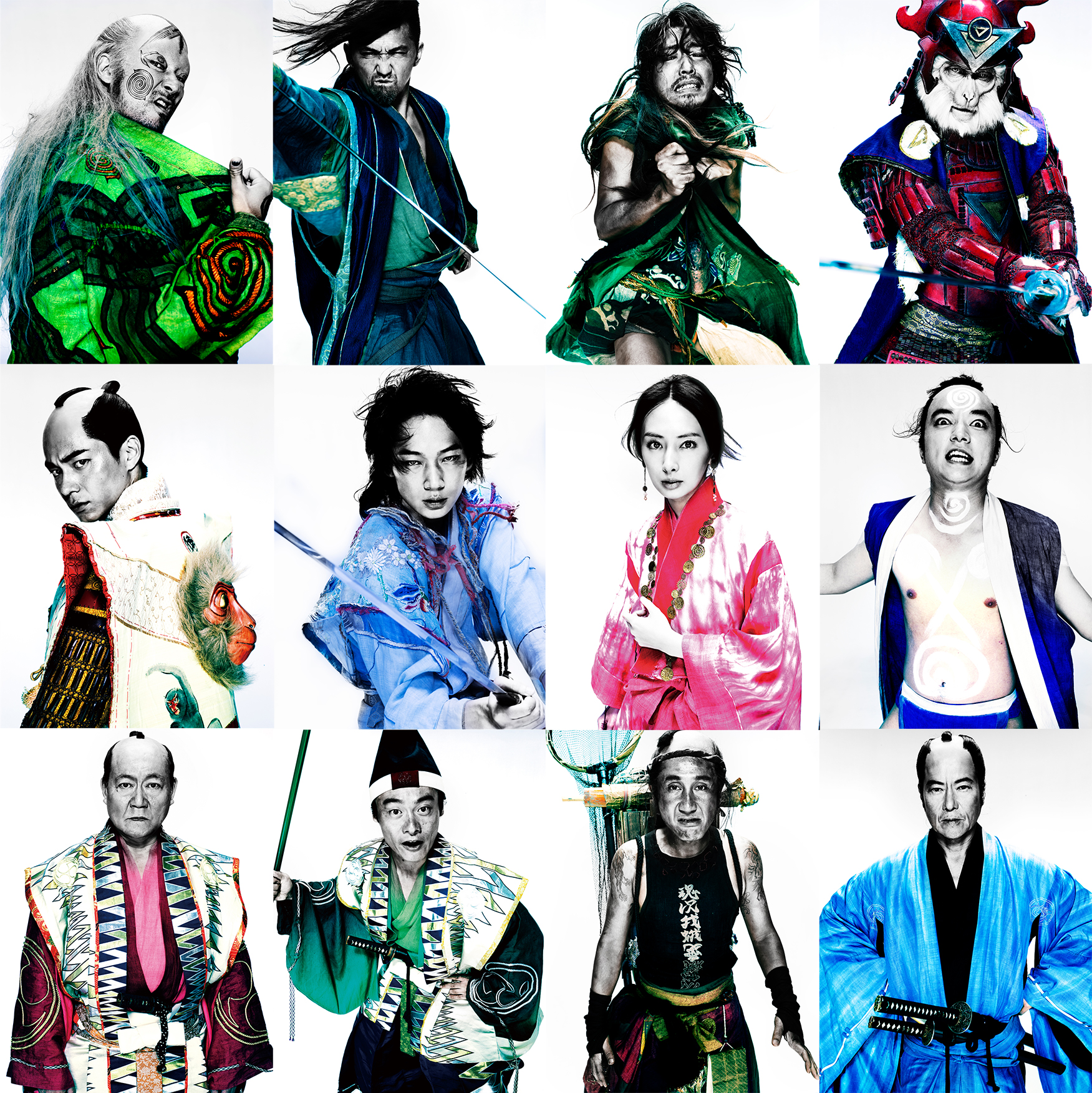
Punk Samurai (パンク侍、斬られて候, Gakuryu Ishii, 2018)

Gakuryu Ishii began his career under the name Sogo as a representative of the youth voice, in fact still a college student when invited by Nikkatsu to film a feature-length version of his Panic High School short though they paradoxically saddled him with the more experienced Yukihiro Sawada as a co-director in case his voice turned out to be more youthful than anticipated. In any case, he went on to make his name with a series of anarchic punk films such as Burst City and The Crazy Family before retreating from filmmaking in the early 2000s. When he returned in 2012 with Isn’t Anyone Alive?, he did so under a new name, Gakuryu, as if signalling a new phase in his artistic career that seemed to have left punk behind.

Like 2015’s That’s it, Punk Samurai is billed as a kind of return to Ishii’s anarchic roots while also harking back to surreal samurai movie Gojoe. Even so, Punk Samurai isn’t really a punk samurai film even in its irreverence towards the genre so much as an ironic jidaigeki comedy which eventually positions its hero’s nihilistic outsider status as his saving grace in a “fake” world where nothing has true meaning. “This world might be fake, but I’m alive” he insists, claiming not to ask anything of it, simply stating that he is “different” because he belongs to no group and has been a lonely a wanderer.

Nevertheless, Kake (Go Ayano) had wanted to join a clan so desperately that he spun a tale of dangerous cult rebellion to a naive retainer of a useless lord whose inability to rule has ruined his fiefdom. After killing a pilgrim he believed to be a member of the Bellyshaker Party, Kake is taken in by the Kuroae where he is enlisted by duplicitous councillor Naito (Etsushi Toyokawa) who seizes on the idea of the Bellyshaker threat as a means of undermining his rival, Ohura (Jun Kunimura), to seize the reins from overly serious lord Kuroae (Masahiro Higashide). 

The Bellyshaker cult believes that this “fake” world exists within a giant tapeworm and seeks escape though being excreted by it into the “real” world as a means of achieving some kind of spiritual enlightenment. Their furious belly shaking is deliberately meaningless in an effort to antagonise he tapeworm to such a degree that it gives it spasms to “spew” the believer into a more authentic existence. Not even the cult leader believed this to be true, and as Kake later suggests the appeal lies in a kind of Manichaeanism that allows the believer to believe nothing is their fault it’s just that this “fake” world is wrong. In the end, the conflict comes down to a battle between “monkeys and idiots”, while even an enlightened ape (Masatoshi Nagase) finds his revolution failing and is left with no option other than to retreat to the Heavens. 

The world is indeed in disarray, Kuroae is constantly plagued by his own poor decision making, or failure to make decisions at all, while there are constant allusions to the decline of his clan from persistent famine to military weakness after having made most of his foot soldiers redundant as part of an austerity programme. Many of the recruits to the “fake” Bellyshaker cult resurrected by Naito with the assistance of former devotee Chayama (Tadanobu Asano), who has two telepathic servants who speak for him, are in fact refugees from Kuroae who fled its disorder. Kake prides himself on being an outsider but in reality had wanted to join the clan, and there is perhaps something in the sudden collapse of the world around him along with a return to blue skies the moment his rebellion is ended. 

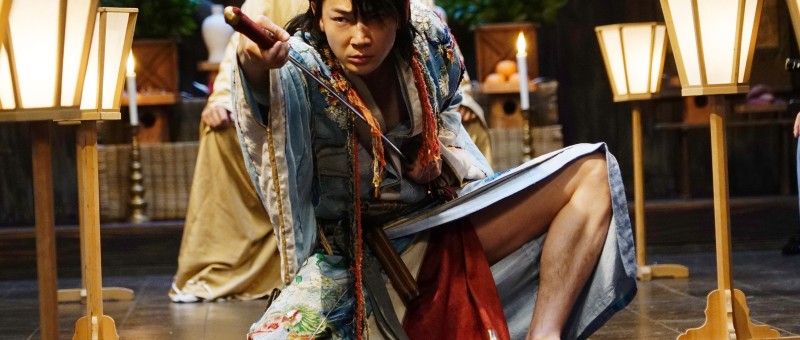
Yet for all its weirdness and incomprehensibility, for much of is running time Punk Samurai is a typical jidaigeki comedy about a useless lord, his clever underlings, and a chaotic ronin if one that also hints at the absurdist meaninglessness of the hierarchical samurai society. Only in its closing moments does the film truly embrace its punk spirit with psychedelic kaleidoscope backgrounds, electric swords, and the true slash down of the social order as Kake’s life comes full circle proving that even in this “fake” and meaningless world there are some things from which there is no escape.


Punk Samurai is released on blu-ray in the UK on 13th March courtesy of Third Window Films.

Original trailer (English subtitles)

Tsuyukusa (ツユクサ, Hideyuki Hirayama, 2022)

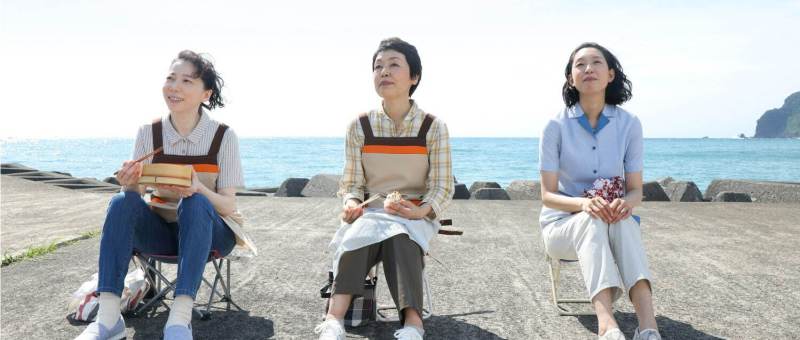
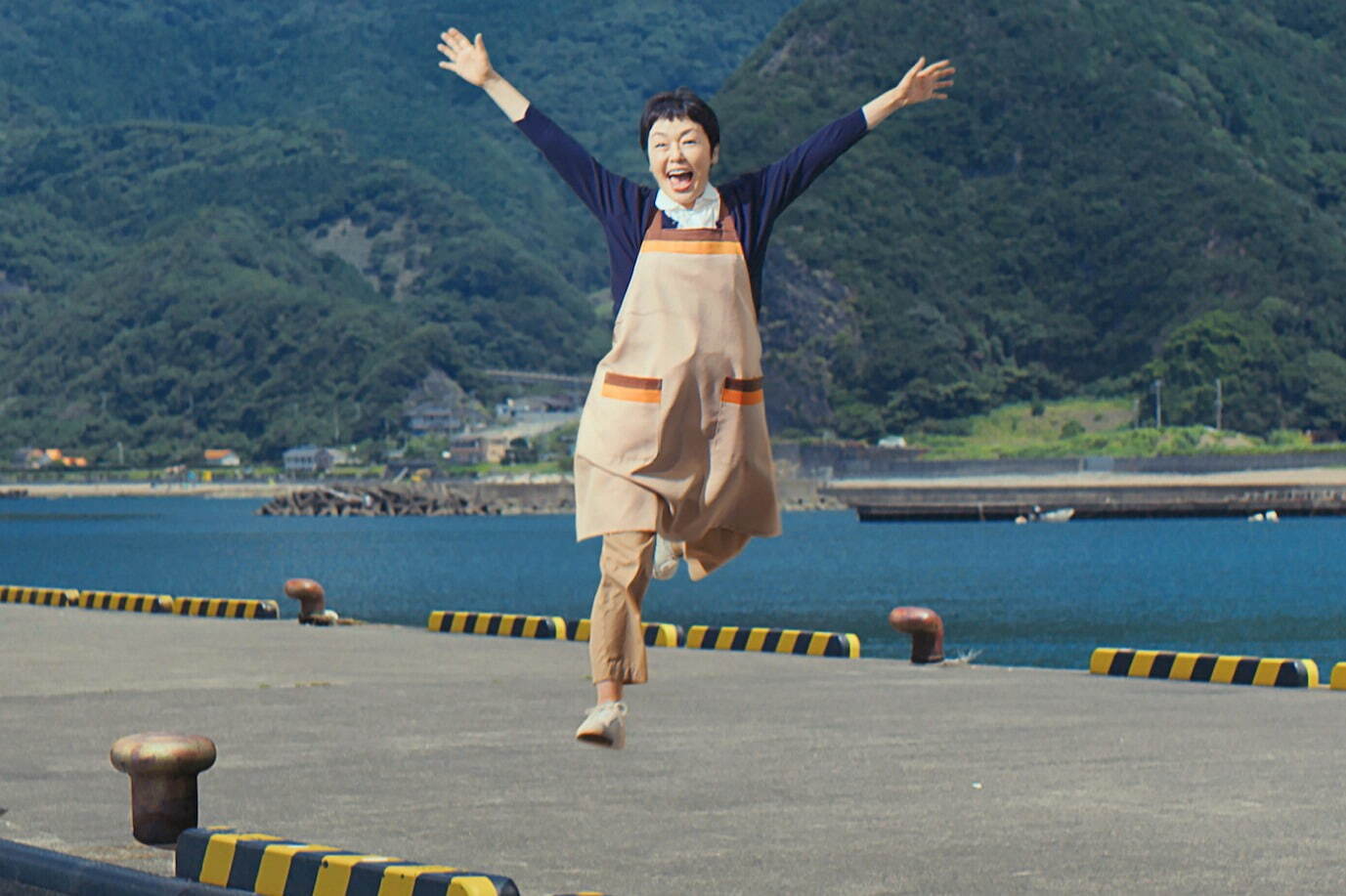
A middle-aged woman decides to embrace possibility after her car is hit by a meteorite in Hideyuki Hirayama’s charmingly quirky dramedy, Tsuyukusa (ツユクサ). Though dealing with difficult subjects such as grief, depression, alcoholism, and loneliness, a spirit of warmth and generosity shines through in the quiet seaside town as its various inhabitants each in their own way find themselves pondering new beginnings and while discovering that change may be scary it’s worth taking the risk for greater happiness. 

49-year-old Fumi (Satomi Kobayashi) lives in a quiet village by the sea and works in a textile factory where the atmosphere is laidback and collaborative. For poignant reasons only later disclosed she’s formed a close relationship with her friend’s son Kohei (Taiyo Saito) who is obsessed with all things space. It’s Kohei who decides that whatever it was that hit her car while she was driving home one evening was probably a meteorite and declares that Fumi must be one very lucky lady because the chances of witnessing a meteorite strike are all but infinitesimal. Fumi too seems to take it as a good omen, wearing the moon rock that Kohei finds at the beach as a pendant and symbol of the new possibilities in her life. 

Meanwhile it seems clear that Fumi is dealing with a series of things including a problem with alcohol which is why she’s been attending a local support group which is surprisingly large given the size of the town. Then again she’s not the only one dealing with crisis, her two friends from the factory are also at a point of transition. Kohei’s mother Nao (Kami Hiraiwa) is at odds with her husband (Kiyohiko Shibukawa) who has accepted a job offer in another town but suggests that she and Kohei stay behind in part because he is the boy’s stepfather and worries about uprooting him especially as Kohei does not seem to have fully accepted him as a father. Taeko (Noriko Eguchi) meanwhile has embarked on a secret affair with a Buddhist monk (rakugo performer Tougetsuanhakusyu) she somewhat transgressively met when he read the sutras at her late husband’s funeral. Fumi is gradually warming up to new love of her own in taking a liking to Goro (Yutaka Matsushige), a melancholy gentleman of around her own age whom she often sees sadly blowing the tsuyukusa leaves like a harmonica in the local park. 

The village is for them a gentle space of healing, many coming from the city following some kind of emotional trauma and looking for a quiet place to escape their sorrow. Even Kohei is caught at a point of transition, exclaiming that all the adults he knows are liars while attempting to deal with his first real heartbreak and contemplating moving away from all his friends and the town he grew up in with a man he doesn’t quite feel he knows. But then as Goro points out, the tsuyukusa grow everywhere and happiness is always in reach as long as you decide to go out and fetch it. Fumi may originally over invest in the symbolism of the moon rock, as if being hit by a meteorite really was an omen of change and a kind of good luck charm in itself rather than a funny thing that happened and caused her to reevaluate her life but finally realises that she didn’t need a meteor strike to give her permission to be happy. 

Even so the quirky seaside town does seem to be a cheerful place with a series of colourful characters even if many of them are lonely or displaced. Fumi’s boss is forever doing tai chi by the beach after apparently being left by his wife and unsuccessfully travelling to Taiwan in search of a new one. The guy who runs the local bar used to be a whaler and sends customers out on errands on his behalf, while the old man who runs the alcohol support group finds his job so stressful that it’s driving him to drink. “Just fix the pain, please. Then I can keep on going” Fumi tells a dentist though it’s a fairly apt metaphor for life. Reminiscent of the work of Naoko Ogigami of which Satomi Kobayashi is perhaps a representative star, Tsuyukusa never shies away from the darker corners of life but nevertheless allows its warmhearted protagonist to rediscover joy if only in the simple things. 


Tsuyukusa screened as part of this year’s Five Flavours Film Festival and is available to stream in Poland until 4th December.

Original trailer (no subtitles)

Shrieking in the Rain (雨に叫べば, Eiji Uchida, 2021)

“Let’s change Japanese film” a duplicitous distributor tries to convince a diffident director though his “creators first” stance predictably turns out to be somewhat disingenuous. Inhabiting the same territory as Netflix’s Naked Director, Eiji Uchida’s meta dramedy Shrieking in the Rain (雨に叫べば, Ame ni Sakebeba) finds a young woman struggling to take charge of her artistic vision while plagued by workplace sexism, commercial concerns, and absurd censorship regulations but finally claiming her space and along with it her right to make art even if not quite everyone understands it, 

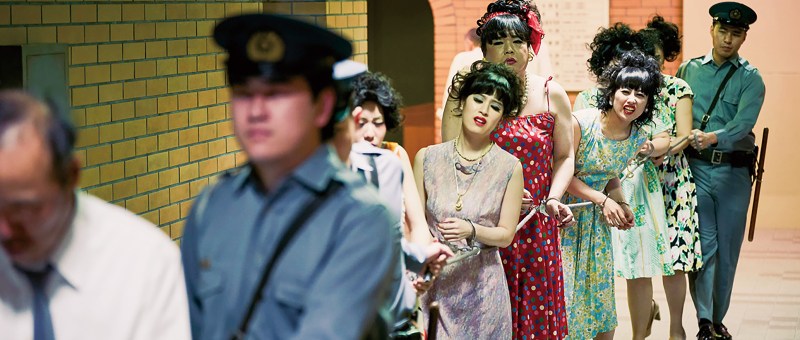
Set entirely on a Toei lot in the summer of 1988, the film opens with rookie director Hanako (Marika Matsumoto) locking herself inside a car with her hands clamped over her ears, fed up with the chaos that seems to surround her. How Hanako got the job in the first place is anyone’s guess, but it later becomes clear that she is in a sense being exploited by the producer, Tachibana (Kazuya Takahashi), who thinks a pretty young girl directing a softcore porno is a selling point in itself. Meanwhile, he’s teamed up with an US-based production company and its Japanese producer, Inoue (Kiyohiko Shibukawa), who seems fairly exasperated by the Japanese-style shoot and despite his pretty words is all about the business. For him, the main selling points are the actors, one a young idol star intending to boost his profile by getting into films and the other a veteran actress stripping off for the first time in an attempt to revitalise her fading career. 

Surrounded by male industry veterans, Hanako struggles to get her voice heard and feels under confident on set as they encircle her and bark orders she doesn’t quite understand. Her decisions are continually overruled by the male AD, cameraman, and finally Tachibana who always has his mind on the bottom line while Hanako’s inability to express herself to the crew results in endless takes of scenes that others tell her are “pointless” and should be cut despite her protestations that they are essential to the piece. A forthright female makeup artist (Chika Uchida) asks if filmmaking should really be this heartless as she watches Hanako humiliated by the chauvinistic cameraman who forces her to get on her knees and beg for help, while a more sympathetic grip (Gaku Hamada) later tells her that becoming a successful director has little to do with talent and a lot to do with the art of compromise. 

Nevertheless, Hanako tries to hold on to her artistic vision even while some roll their eyes considering the project is a softcore romantic melodrama revolving around a love triangle involving two brothers in love with same woman. Inoue claps back that film is a business, admitting that when he said creators first he just meant the ones that make money. According to him, anyone could direct the film because all anyone’s interested in is the actress’ bared breasts and the teenybopper appeal of top idol Shinji. Or in other words, it doesn’t really need to be good, it’s going to sell anyway. In any case, it seems incongruous to cast a squeaky clean idol in an edgy erotic drama especially considering that if they want to market it to his fans then they need to secure a rating which allows them to see it without adult supervision. Business concerns and censorship eventually collide when the rather befuddled censor puts a red line through some of their kink and explains that the actress’ third hip thrust has just earned them an X rating. 

Unlike Hanako and her similarly troubled junior camerawoman Yoshie (Serena Motola), veteran actress Kaede at least knows how to advocate for herself and get what she wants on set so that she can do her best work. Only in this case doing her best work means she wants to go for real with arrogant idol star Shinji who refuses to wear a modesty sock or trim his pubic hair to fit in with the arcane regulations of the censors board. Shinji is brought to task by aspiring actor Kazuto who is pissed off by his unprofessional behaviour while struggling to get a foothold in a difficult industry and apparently finding one through a romantic relationship with the producer which otherwise seems to be a secret from cast and crew. 

In any case a final confrontation prompts a rebellion against Inoue’s production line metaphor as the crew reaffirm that they are a team working together on an artistic endeavour not mere cogs in his machine. Reemerging in bright red lipstick, Hanako returns to retake what’s hers boldly claiming her artistic vision and taking charge on set before descending into an unexpected musical number. With a retro sensibility, the film neatly echoes late 80s production style with a cutesy background score often heard in movies of the era while posters for top Toei movies from the 70s and 80s such as Yukihiro Sawada’s No Grave for Us line the walls. A meta rebuke against the constraints placed on filmmakers by those who shout “creators first” to bolster their image but never follow through Shrieking in the Rain, is at once a homage to the classic days of low budget Toei erotica and an inspirational tale of an artist finding her voice in a sometimes repressive industry.


Shrieking in the Rain screened as part of this year’s Camera Japan.

Original trailer (no subtitles)