Female Slave Ship (女奴隷船, Yoshiki Onoda, 1960)

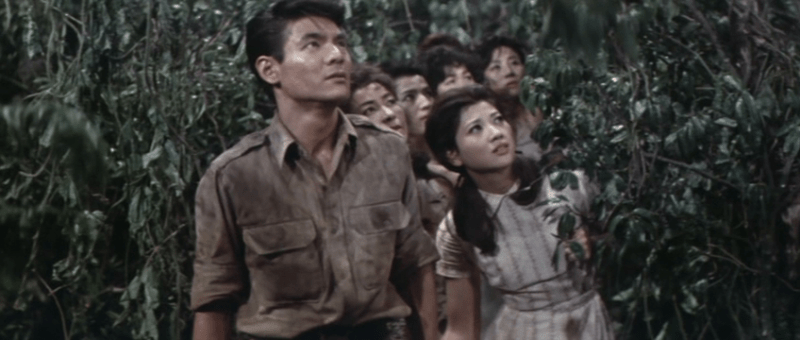
Playing out much more like a classic serial than war movie, Yoshiki Onoda’s Female Slave Ship (女奴隷船Onna dorei-sen) takes a curiously flippant approach to the conflict along with a moral perhaps a little at odds with similar films of the time. Adapted from a novel by Jun Funazaki, the film begins as spy thriller but ends up drifting into pirate territory as a Japanese solider with an incredibly important mission is shot down on his way to Tokyo, rescued by a freighter carrying women en route to being sex trafficked in Shanghai, and then captured by pirates who want to sell him to a Chinese spy working for the Americans. 

It’s right at the end of the war and Japan is losing quite badly they think because of advancements made in radar by the Allied forces. They’ve been passed blueprints for a better radar system by a German contact and so Lt. Sugawa (Bunta Sugawara), stationed in Malaya, has been charged with bringing them back to Tokyo disguised as a photo of a pretty young woman they’re going to say is his sister. Perhaps the most surprising thing about the film is that Sugawa abandons his mission quite quickly and instead devotes himself to rescuing the women, vowing not to return to Tokyo without them despite the fact that this vital information he’s carrying could supposedly turn the tide of the war.

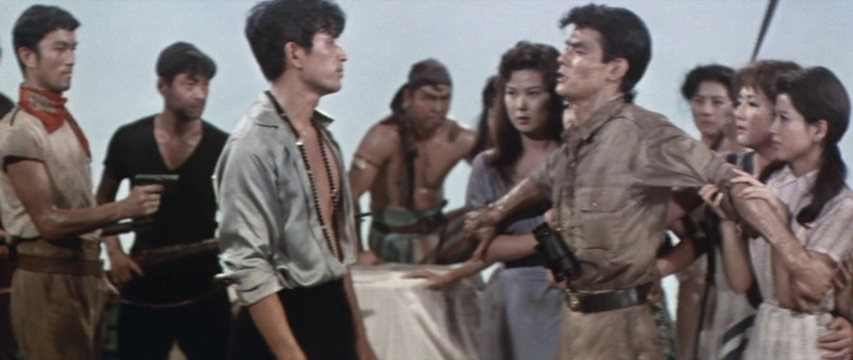
Even so, this manly chivalry defines his code of heroism. He is constantly trying to escape and defiantly stands up both to the captain of the tugboat, who is not actually in charge, but also to the pirate captain (Tetsuro Tanba) who doesn’t really seem to be doing much of anything. Among the crew of pirates is a Japanese man who later confirms that he’s a deserter but alternately switches sides, first offering to team up with Sugawa because he’s fed up with the discrimination he faces from the other pirates, and then betraying him before doing the same thing again but claiming that he feels bad about deserting and wants to do something for Japan now that his Japaneseness has been truly awoken.

It was indeed other Japanese people who were operating the slave ship, chief of them being the Queen (Yoko Mihara) who rules the boat with an iron hand but then uses her sex appeal to curry favour with the pirate captain while simultaneously developing feelings for Sugawa who is equally drawn to a meek young woman, Rumi (Utako Mitsuya), who was tricked onto the boat on the promise of a nursing job in Manchuria. Most of the other women, few of whom are actually given any characterisation, are established sex workers and resolved to their fates but all feel bad for and protective of Rumi. Though she’s the one Sugawa is closest to, it’s quite refreshing that the women are otherwise treated as equals rather than looked down on because of their occupation with Sugawa insistent on rescuing them all before they can be sold in Shanghai. 

As is usual for these kinds of films, the chief villain is Chin (Shuji Kawabe), a Chinese man apparently with ties to the Americans who has somehow found out about the radar plans, even knowing that they’re presented on a photo of a woman, and wants to capture Sugawa to get his hands on them. The bounty causes a rift between the pirate captain and Chin with the pirate captain wanting in on the deal and Chin not really willing to share, though there is a clear implication that these mercenary pirates are on the wrong the side in working with the Chinese and Americans while the slave ship was more on the level of not being okay but definitely not as bad. 

In any case, it comes down to a battle of masculinity between the monkey-loving pirate captain and his trusty whip, and Sugawa’s good old-fashioned chivalry. Surprisingly chaste given its racy title, even the pirates are more of the drunken and lascivious type than violent and rapacious, the film has a rather odd sensibility landing somewhere between jungle adventure and wartime escapade in which an earnest young man bravely carries the weight of the nation on his shoulders while doing his best to address a more immediate threat and rescue 12 captive women from the evils of Japan’s imperialist expansion. 


Original trailer (no subtitiles)
The Ghost of Kasane (怪談かさねが渕, Nobuo Nakagawa, 1957)

“Fear the hatred of the dead!” a blameless slain wife exclaims after being cruelly cut down by her deluded husband in Nobuo Nakagawa’s tale of karmic vengeance, The Ghost of Kasane (怪談かさねが渕, Kaidan Kasane-ga-fuchi). Then again, though cleaving close to the standard formulas of the ghost movie not to mention the famous tale, these fatalistic, generationally twinned tales of ghostly revenge have an oddly imprecise quality in which it is the innocent who are eventually made to suffer, caught between concentric circles of guilt and retribution. 

The tale opens in 1773 with a blind masseur/money lender, Soetsu (Yoji Misaki), leaving his home on a snowy day hoping to catch venal samurai Shinzaemon (Akira Nakamura) at home. Shinzaemon and his wife are hospitable, but a conflict soon breaks out during which Shinzaemon accuses the old man of disrespecting him as a samurai and generally getting above himself as a mere member of the peasant class. All Soetsu has done is politely ask for the money he’s owed while making it clear that Shinzaemon’s attempts to give him the run around are wearing thin, but he ends up with a nasty gash on his face after the enraged samurai throws a pot at him. Driven into a frenzy by this unwelcome class-based anxiety, Shinzaemon slashes Soetsu with his sword and kills him, instructing a servant to stuff his body in a case and dump it in Kasane swamp. Soetsu, however, does not rest easy, returning to taunt him, eventually causing him to murder his wife by mistake and thereafter drawing him to his death by drowning in the very swamp where he dumped the body. 

20 years later in Edo, Soetsu’s daughter Rui (Katsuko Wakasugi) has become a successful shamisen teacher, while Shinkichi (Takashi Wada), the orphaned son of Shinzaemon, was taken in by a merchant family who continue to treat him as a poor relation. While having internalised a servant mentality that ironically inverts his father’s anxiety in his samurai status, Shinkichi has fallen in love with the daughter of the house, Hisa (Noriko Kitazawa), who is about to be betrothed against her will to the horrible son of local merchants, Seitaro (Shuji Kawabe). Rui, meanwhile, an older unmarried woman, is desperate to fend off the violent attentions of rough ronin Omura (Tetsuro Tanba), eventually convincing herself she is in love with the mild-mannered Shinkichi who might well think a rebound relationship is a good idea if it clears the way for Hisa’s inevitable marriage. 

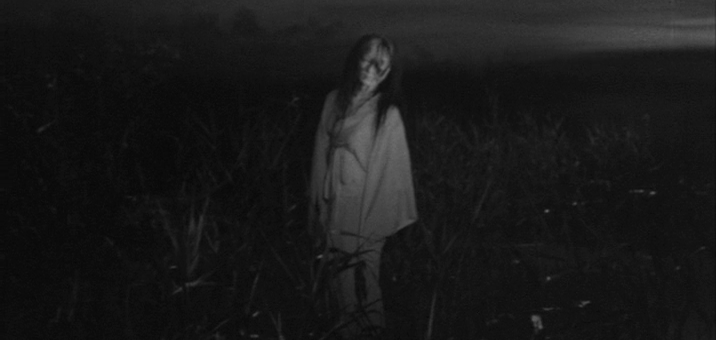
Oddly enough and somewhat incomprehensibly, it’s Rui who becomes the target of her father’s curse, perhaps for her unwitting affection for the son of the man who killed him though it seems insufferably cruel that a father would involve his own child, not to mention the blameless infant of his murderer, in his bid for vengeance from beyond the grave. For his part, Shinkichi pays a heavy price for his unmanly diffidence, brave enough neither to say no to Rui or to run away with Hisa, simply passive if kind in the face of mounting impossibilities. Yet as much as it’s her father’s resentment that causes her downfall, struck by the pluck from the shamisen which scars her face to mirror his, she adds her own share in the wrath of a woman scorned dragging Shinkichi towards the lake for his inability to let go of his love for Hisa.

Old Soetsu might have a right to be vengeful, but his curse has collateral damage, enacted on women in order to target men as in Shinzaemon’s unwitting murder of his wife and Shinkichi’s accidental violence against Hisa at the instigation of Rui. Only the two old servants are left behind to make peace and tell the story, united by their respective positions rather than divided by their conflicting affiliations. Studio-bound yet filled with a series of supernatural tricks, Nakagawa’s atmospheric adaptation of the classic tale once again features the bug-eyed deformity of the scorned female ghost as Rui’s initial injury eventually balloons as her “sickness” intensifies, later finding time to turn her rage on Omura who was not, it has to be said, on the original list of victims being simply an embodiment of the cruelty of the age. Nakagawa ends, however, not with darkness but with light, freeing the souls of the troubled lovers from the gloom of earthly torment in urging them to leave their hatred behind and return to Buddha in eternal peace.