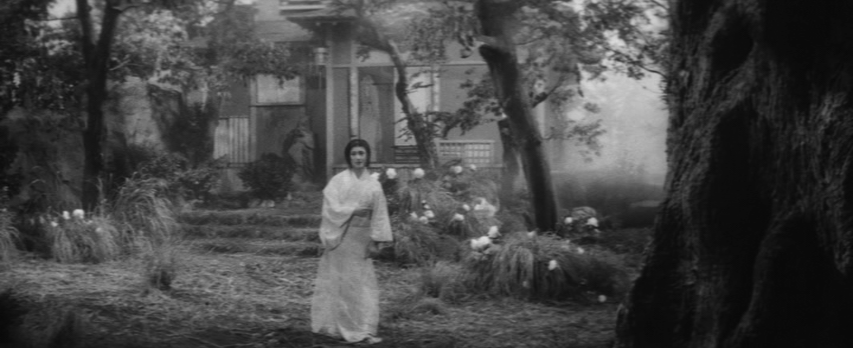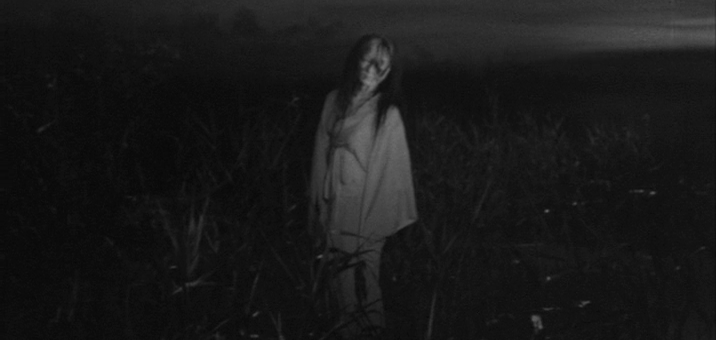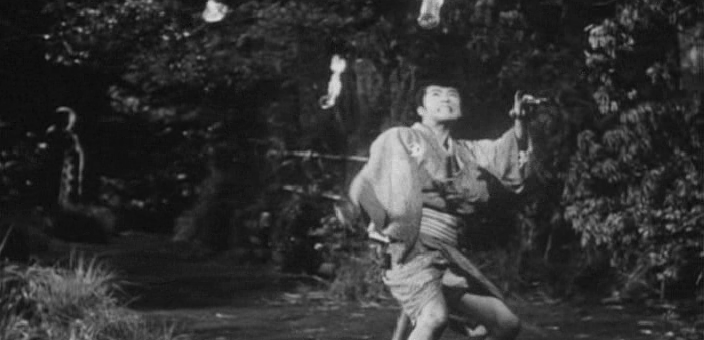
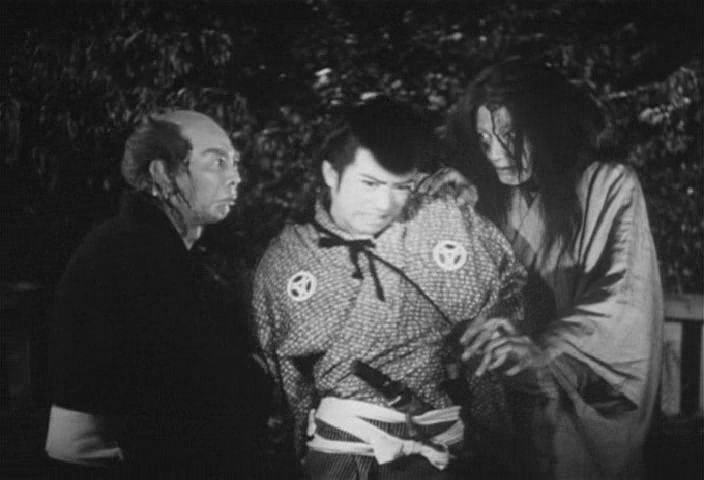
The Mother Tree (怪談乳房榎, Goro Kadono, 1958)

An amoral ronin worms his way into the home of a famous painter with the intention of stealing his wife in Goro Kadono’s eerie tale of ghostly revenge, The Mother Tree (怪談乳房榎, Kaidan Chibusa Enoki). As might be expected, it doesn’t go particularly well for him. He is, though, perhaps a symbol of the latent fear of social interlopers and those displaced within the Edo-era class system. Namihei (Asao Matsumoto) claims that he was let go by his master for being too interested in painting, though is otherwise focused on short-term gains and causing destruction.

Shigenobu (Akira Nakamura) is said to be “the greatest artist in Edo”, and is certainly very much in demand. He is father to an infant son, Mayotaro, and husband to devoted wife Kise (Katsuko Wakasugi). He appears to be a good man, if a little scatterbrained and hugely overworked, which is one reason why he was grateful to take on a pupil. The irony is that both Kise and the family’s maid Hana (Keiko Hasegawa) remark on what a nice guy Namihei is and how glad they are to have him in the household. He’s even good with the baby who apparently likes to be held by him. All of which suggests that he might have actually had talent for painting and could probably have succeeded Shigenobu, in time, if hadn’t been such a terrible person. 

Unfortunately, however, Namihei reminds Shigenobu that he promised to paint a freeze for a temple some distance away and had sort of forgotten about it. An impulsive soul, Shigenobu decides he’d better leave right away if only to shake off this sense of unfulfilled obligation that’s been plaguing him. He entrusts the women of the household to Namihei in his absence and has no reason to fear any harm may come to them while he’s away. Namihei, however, attempts to rape Kise as soon as he leaves. Though she resists him, he threatens to kill her son and she is forced to give in to a prolonged period of sexual exploitation.

This is actually quite a dangerous move on Namihei’s part considering that the penalty for adultery under Tokugawa law is death, which might be why he finally ends up killing Hana after she witnesses Kise being abused and tries to help her. Namihei evidently doesn’t have a long-term plan for how all this is supposed to pan out and panics on hearing that Shigenobu will be returning much earlier than he expected. The irony may be that Shigenobu intended to paint eyes that might see into the next world and eventually becomes a vengeful ghost after being brutally murdered by Namihei, though was unable to see his treachery. Evidently never having read a ghost story himself, Namihei dumps the body in a pond, which is all but guaranteed to come back and haunt him. “Though you kill me, I will not die,” Shigenobu curses, vowing that he cannot pass on while his dragons lack eyes. 

What might be surprising is that neither of the vengeful ghosts blame Kise for her plight or seek revenge against her. The rage of a vengeful ghost can often be indiscriminate, but both Shigenobu and Hana seem to understand that Kise has been abused by Namihei and only submitted to him out of maternal devotion in the desire to have her son. Namihei’s transgression aims at straight at the concept of motherhood and with it the entire social order. Having displaced Shigenobu, Mayotaro now seems a nuisance to him. He believes he’s conquered Kise by fear and no longer needs this leverage to control her now her husband is dead.

It is mainly fear that causes people to behave in strange ways. Namihei orders their servant Shosuke (Hiroshi Hayashi) to kill Mayotaro, telling Kise that he is to be sent to a noble samurai family that will assist in his social advancement. Kise seems to go along with this, despite having sworn to raise Mayotaro to take revenge. Shosuke is unable to resist after Namihei threatens him with death, but places Mayotoyo by the Mother Tree which had once nourished him. Following her husband’s murder, Kise’s milk had dried up in shock as if echoing this attempt on her maternity which was then restored by the ancient natural authority of the tree. 

That it’s the Buddhist priest that becomes a figure of moral authority and goodness positions Buddhism as the counter to the amoral nihilism of men like Namihei. Having been struck by Namihei, Kise leaves her son in the priest’s care who will raise him not for revenge but peace and forgiveness. This might run counter to the Shinto-inflected role of the Mother Tree as a symbol of the power of nature, but ultimately suggests that true righteousness is found in Buddhism and its values. Namihei pays for his amoral venality after being tormented by spirits appearing as flaming orbs. Japanese ghosts rarely harm humans directly, but cause them to hurt themselves through fear and madness. That he ultimately kills Kise despite Shigenobu’s telling her to raise their son suggests that she is being punished too, though none of this was her fault and it is really she who puts end to Namihei’s reign of terror. With his death, order is, in a sense, restored as Shigenobu returns to put the eyes on his dragons who can indeed see a better world free of greed or cruelty. 
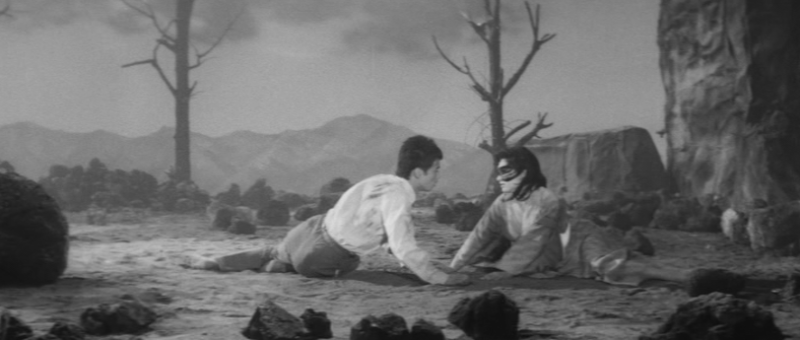

Lust of the White Serpent (蛇精の淫, Morihei Magatani, 1960)

The lingering inequalities of the feudal society are manifested in a snake woman’s thwarted desire for love in Morihei Magatani’s Shintoho horror Lust of the White Serpent (蛇精の淫, Jasei no In). Not quite as salacious as its title may imply, Magatani’s film takes a sympathetic view of the classic snake lady painting her as a tragic heroine betrayed by the codes of the mortal world with its persistent classism and misogyny while offering the conflicted hero caught between the old and the new only a compromised escape in spirituality. 

In what the opening voiceover describes as a local legend that has been passed on “since ancient days” though seemingly taking place in the relatively recent past, village boy Minokichi (Hiroshi Asami) hears a woman’s screams while walking along a mountain path and investigates to find her writhing around in the long grass. Having been attacked by a snake, the woman, Kinu (Kinuko Obata), seems confused though Minokichi recognises her as the daughter of the village headman and offers to carry her home. Unfortunately Kinu’s retinue immediately jump to the conclusion that filthy peasant boy Minokichi must have abducted her, roundly beating him for having dared to lay his hands on such a fine lady. “Even if you try to interact with them, they won’t treat you as an equal. This our fate” his mother reminds him cautioning him against any further attempts at interclass friendship. 

The problem is that the half-crazed Kinu has apparently imprinted on Minokichi and insists that she will marry only him or else die. This is unwelcome news for her father who had been considering marrying her off to the son of a local businessman who has learning difficulties on the promise of a seat on the prefectural council. As for Minokichi, he is technically betrothed to childhood friend Kiyo (Yumiko Matsubara) but is growing resentful having fallen for Kinu but knowing that their romance is impossible because of the barrier of social class. In a surprising move, Kinu’s father chooses his daughter’s happiness over both the current social order and his own financial gain in formally offering Kinu to Minokichi who is then conflicted, at first reassuring Kiyo that he cannot accept only for her to tell him that he must on hearing the rather naive conviction of the local policeman that this taboo-breaking interclass union will liberate the villagers from their subjugation by the townspeople and they’ll never be looked down again. 

As it turns out, Kinu has been possessed by the spirit of a snake woman, Sakurako, who fell in love with Minokichi after he saved her when she became trapped on a rock. The pair had had a brief affair a year earlier which Minokichi’s mother had put a stop to fearful that Minokichi was falling victim to a curse and that Sakurako meant to drain him of his energy and move on. “My background doesn’t matter, does it?” Sakurako had ironically asked having explained to Minokichi that she was just “a poor girl with no one to turn to” echoing the forbidden quality of Minokichi’s romance with Kinu. Yet their relationship is also transgressive in spanning two worlds. “Intimacy with an animal is non-Buddhistic behaviour” Minokichi is later scolded by an intense priest though still finding himself drawn to Sakurako despite the entreaties of his mother and Kiyo trying to drag him back to the village and his “proper” place in the contemporary social order. 

As for Kinu little thought is given to this reckless usurpation of her body, Sakurako seemingly having chosen her to appeal to Minokichi’s desire for social advancement. Once everyone knows she is possessed by a snake spirit things get even stranger with some of the men in the village believing that the only way to tell is to sleep with her. Having tried a shinto shamaness who confirmed a diagnosis of possession by a white snake, Kinu’s father tries a Western doctor branded a “horny weirdo” by the villagers. Despite everyone knowing this and that he is clearly drunk, the doctor is left alone in a room with Kinu and proceeds to rape her while the servant Sakuzo who had beaten Minokichi merely for touching his mistress watches silently from outside. When Sakurako strangles the doctor, winding her snake body around his chest, it is read as an expression of the snake’s curse, everyone instantly understanding what the doctor had done but merely covering up the crime while later petitioning Kinu’s father to have her sent away to save them from the havoc she is wreaking with storms, droughts, and floods in protest at her unhappy fate. 

Minokichi who was supposed to unite two worlds and dissolve barriers finds himself in a liminal state no longer a member of either, Kiyo’s father refusing to welcome him back into the village while having separated from Kinu on realising she is a snake woman denies him a place in the town. While he tells himself that he should know his place, reintegrate himself into the village and accept his proper social role by settling down and marrying Kiyo as he was supposed to do he cannot let go of his desire for Sakurako/Kinu and in the end cannot resist following her even if or perhaps precisely because it may lead to his death. When the “curse” is broken he is led away once again only this time by the priest as a new devotee of Buddhism reinforcing a spiritual message but ironically also implying that Minokichi’s fault was in trying to help others, firstly the snake and secondly Kinu, when he should like his mother advised have minded his own business and refrained from interacting with those outside of his immediate community be they beautiful noblewomen or alluring snake spirits. Though light on effects, Magatani ups the atmosphere with copious fog while employing a series of dissolves for the snake women’s transformations and some superimposition for their wrathful curses. The message may be know your place or you’ll end up nowhere, but the film nevertheless has unexpected sympathy for the lonely Sakurako beaten into submission by a cruel and misogynistic society. 


Original trailer (no subtitles)

The Ghost of Kasane (怪談かさねが渕, Nobuo Nakagawa, 1957)

“Fear the hatred of the dead!” a blameless slain wife exclaims after being cruelly cut down by her deluded husband in Nobuo Nakagawa’s tale of karmic vengeance, The Ghost of Kasane (怪談かさねが渕, Kaidan Kasane-ga-fuchi). Then again, though cleaving close to the standard formulas of the ghost movie not to mention the famous tale, these fatalistic, generationally twinned tales of ghostly revenge have an oddly imprecise quality in which it is the innocent who are eventually made to suffer, caught between concentric circles of guilt and retribution. 

The tale opens in 1773 with a blind masseur/money lender, Soetsu (Yoji Misaki), leaving his home on a snowy day hoping to catch venal samurai Shinzaemon (Akira Nakamura) at home. Shinzaemon and his wife are hospitable, but a conflict soon breaks out during which Shinzaemon accuses the old man of disrespecting him as a samurai and generally getting above himself as a mere member of the peasant class. All Soetsu has done is politely ask for the money he’s owed while making it clear that Shinzaemon’s attempts to give him the run around are wearing thin, but he ends up with a nasty gash on his face after the enraged samurai throws a pot at him. Driven into a frenzy by this unwelcome class-based anxiety, Shinzaemon slashes Soetsu with his sword and kills him, instructing a servant to stuff his body in a case and dump it in Kasane swamp. Soetsu, however, does not rest easy, returning to taunt him, eventually causing him to murder his wife by mistake and thereafter drawing him to his death by drowning in the very swamp where he dumped the body. 

20 years later in Edo, Soetsu’s daughter Rui (Katsuko Wakasugi) has become a successful shamisen teacher, while Shinkichi (Takashi Wada), the orphaned son of Shinzaemon, was taken in by a merchant family who continue to treat him as a poor relation. While having internalised a servant mentality that ironically inverts his father’s anxiety in his samurai status, Shinkichi has fallen in love with the daughter of the house, Hisa (Noriko Kitazawa), who is about to be betrothed against her will to the horrible son of local merchants, Seitaro (Shuji Kawabe). Rui, meanwhile, an older unmarried woman, is desperate to fend off the violent attentions of rough ronin Omura (Tetsuro Tanba), eventually convincing herself she is in love with the mild-mannered Shinkichi who might well think a rebound relationship is a good idea if it clears the way for Hisa’s inevitable marriage. 

Oddly enough and somewhat incomprehensibly, it’s Rui who becomes the target of her father’s curse, perhaps for her unwitting affection for the son of the man who killed him though it seems insufferably cruel that a father would involve his own child, not to mention the blameless infant of his murderer, in his bid for vengeance from beyond the grave. For his part, Shinkichi pays a heavy price for his unmanly diffidence, brave enough neither to say no to Rui or to run away with Hisa, simply passive if kind in the face of mounting impossibilities. Yet as much as it’s her father’s resentment that causes her downfall, struck by the pluck from the shamisen which scars her face to mirror his, she adds her own share in the wrath of a woman scorned dragging Shinkichi towards the lake for his inability to let go of his love for Hisa.

Old Soetsu might have a right to be vengeful, but his curse has collateral damage, enacted on women in order to target men as in Shinzaemon’s unwitting murder of his wife and Shinkichi’s accidental violence against Hisa at the instigation of Rui. Only the two old servants are left behind to make peace and tell the story, united by their respective positions rather than divided by their conflicting affiliations. Studio-bound yet filled with a series of supernatural tricks, Nakagawa’s atmospheric adaptation of the classic tale once again features the bug-eyed deformity of the scorned female ghost as Rui’s initial injury eventually balloons as her “sickness” intensifies, later finding time to turn her rage on Omura who was not, it has to be said, on the original list of victims being simply an embodiment of the cruelty of the age. Nakagawa ends, however, not with darkness but with light, freeing the souls of the troubled lovers from the gloom of earthly torment in urging them to leave their hatred behind and return to Buddha in eternal peace.