Ghost Stories of Wanderer at Honjo (怪談本所七不思議, Goro Kadono, 1957)

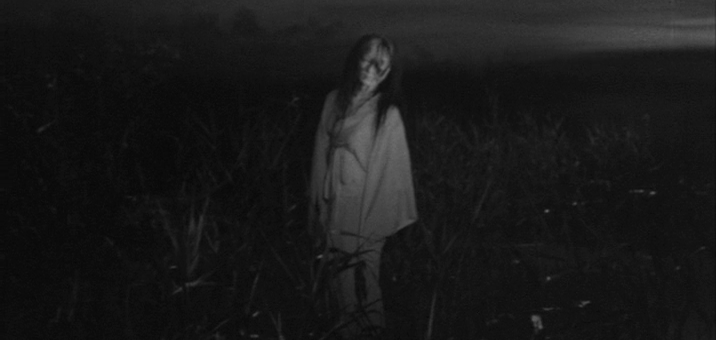
Ghost Stories of Wanderer at Honjo (怪談本所七不思議, Kaidan Nana Fushigi) seems to have become mistitled somewhere along the line seeing as the Japanese is something more like The Seven Wonders of Honjo, an area of Tokyo that had a reputation for gloominess during the Edo era. The “seven wonders” are a collective name for a series of local ghost stories, of which there may actually be more than seven, which were popular fare for rakugo tales and other forms of storytelling. Though the film opens with a brief rundown of the seven wonders which it weaves into the tale, it is more of a revenge drama that throws in the appearance of popular yokai such as Rokurokubi, Kasa-obake, and Hitotsume-kozo.

The yokai emerge to scare a pair of fishermen who were about to ignore a ghostly voice telling them to leave the fish they’d just caught in the river behind, but what the fishermen really seem to object to is the presence of a tanuki who makes a habit of tricking the local people. After becoming fed up with them, the locals hunt down the tanuki and are about to turn it into soup when a wealthy nobleman, Komiyama (Hiroshi Hayashi), arrives and buys the tanuki from them which he then frees. Komiyama tells the tanuki to stop bothering the villagers in return and continues home after marking the anniversary of his wife’s passing and the departure of his son who is going out into the world.

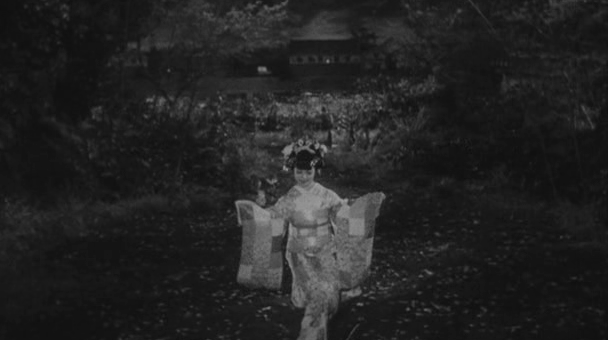
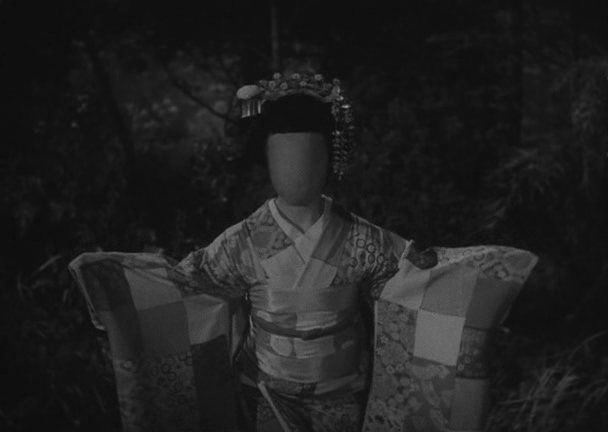
The tanuki later appears in the form of a beautiful young woman to tell Komiyama that she is grateful for his saving her life and will always protect him. Unfortunately, however, Komiyama gets into trouble on the night of a tanuki ritual, so she doesn’t make it in time to save him from a dastardly plot by his disinherited nephew to murder him for his money. She can, however, help his son Yumenosuke (Juzaburo Akechi) exact revenge and put a stop to the amoral Gonkuro’s (regular Shintoho villain Shigeru Amachi) reign of terror.

As in many tales like these, it’s Gonkuro who is real terror threatening chaos in the ordered Edo society while being unable to conform to his proper role in life. Before the film begins, Komiya has already disowned his nephew for being a wastrel. Gonkuro says that he’s come to pay his respects to his late aunt, but Komiyama suspects he’s after money again which he’ll spend on drink, women, and gambling. There is a direct contrast being drawn between the good son Yumenosuke and Gonkuro, though it’s Yumenosuke who apparently becomes seriously ill while on his travels preventing his speedy return until his desire for revenge enables him to overcome his illness. 

Meanwhile, Komiyama has recently married again to a younger woman, Sawa (Akiko Yamashita), who turns out to be a former lover of Gonkuro’s. Though she at first resists, she’s bullied into resuming a sexual relationship with him which she then carries on enthusiastically. She and Gonkuro seem to be symbols of the evils of the age in their lack of properness and humanity. Not only does Sawa cheat on her husband, but even goes along with Gonkuro’s murder plot to kill him and inherit his money.

Though the tanuki fails to save Komiyama and is generally depicted as an untrustworthy trickster, it is a kind of guardian of these virtues in standing behind Yumenosuke as a source of righteousness. Komiyama’s act of kindness will eventually be repaid, while Gonkuro’s attempt to triumph over the moral order represented by Komiyama will be denied. Having dispatched Komiyama, Gonkuro occupies an awkward class status as a usurping lord and even tries to rape Yumenosuke’s betrothed Yae during an expressionist storm as a means of asserting his triumph over his cousin. Sawa meanwhile does something similar by flirting with and then potentially entering a sexual relationship with their servant Gosuke (Saburo Sawai) in full contravention of the social order. Their attempts to get rid of the tanuki by praying her away are a means of reasserting control and dissolving the rules of human morality that they feel constrain them.

In that sense, the tanuki and yokai are not particularly frightening but a constant presence that enforces a moral order defined by humanity and compassion. The two fishermen are only spooked because they ignore the disembodied voice telling them to leave the fish, not because they heard it in the first place. The tanuki, meanwhile, are mainly seen dancing as part of their ritual rendered as ghostly figures not quite of this world. They appear not to do anything that could be considered more than irritating even when messing with locals and definitely don’t deserve to get made into soup. The message seems to be that being good and kind might not save you personally, but it will eventually pay off, and is after all, the right thing to do as man can only thrive when living in harmony with nature and the supernatural world rather than attempting to transcend it through immorality like the selfish and thoughtless Gonkuro.


The Ghosts of Kagami Pond (怪談鏡ケ淵, Masaki Mori, 1959)

“How could you do this to me?” asks a wandering ghost in Masaki Mori’s 1959 Shintoho kaidan Ghosts of Kagami Pond (怪談鏡ケ淵, Kaidan Kagami-ga-fuchi). Based on a story by Kozo Hayama, Mori’s supernatural morality tale is in many ways fairly typical for the genre save that the vengeance wreaked by the wronged spirit is extremely targeted rather than the sometimes indiscriminate curses aimed more at a corrupt society than the figures directly responsible for the death and mistreatment inflicted on the now wrathful ghost. 

The good-hearted hero, Yasujiro (Shozaburo Date), was forced to move to Edo after his father fell into disgrace with the Shogunate authorities and is grateful to have been taken in by the owner of kimono shop Ejimaya. However, his presence is intensely resented by veteran employee Kinbei (Joji Ohara) who had been expecting to inherit the business. Overhearing the boss, Jiemon (Hiroshi Hayashi), and his wife (Fumiko Miyata) discussing a possible marriage between Yasujiro and his childhood friend Kiku (Noriko Kitazawa) reunited by chance in the city, Kinbei realises that he intends to make Yasujiro his heir and hatches a plan to ensure that doesn’t happen beginning with selling Kiku’s sister Sato (Reiko Seto) a knock off wedding kimono that tears during the ceremony leading her intended’s family to cancel the marriage entirely leaving Sato a shamed woman in an impossible situation. Wandering the streets in despair intending to throw herself into Kagami Pond and thereafter become a vengeful ghost cursing the house of Ejimaya, Sato encounters Kinbei again and is killed in the ensuing struggle only to tumble into Kagami Pond sinking without trace. 

“No one ever floats up out of there” Kinbei later insists suggesting the pond as a possible dumping ground for additional bodies of which there are a fair few. As kaidan villains go, Kinbei is of the one note variety in simply being evil for no particular reason the only justifications offered for his ill conduct being his previous devotion to the kimono store and the fear that all his hard work will go to waste if Yasujiro is allowed to inherit. Even so, this seems disingenuous given an early scene in which an angry customer brings a kimono back complaining of shoddy work and suggesting she’s been fobbed off with a substandard product. Kinbei blames the whole thing on new employee Yasujiro though it later seems clear that he probably sold her a cheap kimono and pocketed the difference in price. 

He even goes so far as to mug Yasujiro in disguise, stealing 15 Ryo which he’d been transporting on behalf of the store attempting to sink his rival in debt. When Yasujiro’s disgraced father offers to sell a precious family sword to pay back Jiemon, Kinbei kills him too while 15 Ryo is also the amount for which he indentures Kiku to a brothel after framing her for adultery (illegal at the time) with the help of his sex worker co-conspirator Naka (Keiko Hamano) who bumps off Jiemon’s wife and quickly takes her place. Jiemon, who had previously been kind and fatherly insisting that Yasujiro and Kiku are like his own children to him, undergoes an unexplained and abrupt change of character becoming cruel and greedy, loaning money to another store holder in the assumption he won’t be able to pay it back in order to get his hands on his business and eventually party to all of Kinbei’s scheming little realising he most likely intends to bump him off too after he’s married Naka so that they will have full control of the business. 

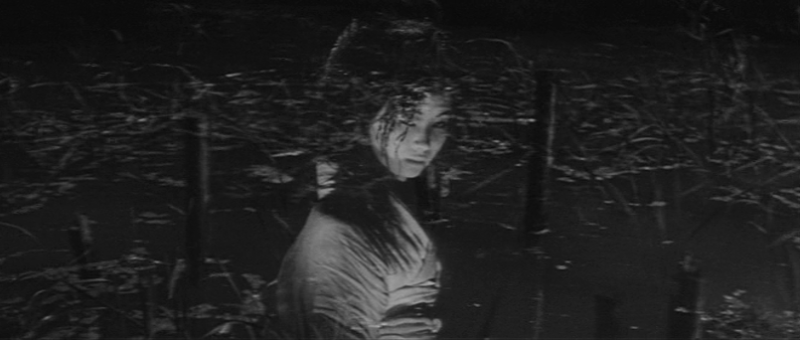
Kinbei is occasionally haunted by the rising ghost of Sato who chillingly repeats the phrase “How could you do this to me?” but carries on with his dastardly deeds anyway. As in most kaidan tales, she cannot hurt him directly but leads him to hurt himself by causing him to hallucinate, as do the ghosts of Yasujiro’s dad and the storeowner eventually calling him towards Kagami Pond and his watery fate. Some disjointed storytelling aside, the introduction of a potential ghost cat for example is never followed up, Ghosts of Kagami Pond is a fairly typical B-movie kaidan running a tight 60 minutes even if the effects and supernatural imagery are perhaps muted in comparison with Shintoho’s similarly themed ghostly morality tales. 


Clip (no subtitles)

The Ghost of Kasane (怪談かさねが渕, Nobuo Nakagawa, 1957)

“Fear the hatred of the dead!” a blameless slain wife exclaims after being cruelly cut down by her deluded husband in Nobuo Nakagawa’s tale of karmic vengeance, The Ghost of Kasane (怪談かさねが渕, Kaidan Kasane-ga-fuchi). Then again, though cleaving close to the standard formulas of the ghost movie not to mention the famous tale, these fatalistic, generationally twinned tales of ghostly revenge have an oddly imprecise quality in which it is the innocent who are eventually made to suffer, caught between concentric circles of guilt and retribution. 

The tale opens in 1773 with a blind masseur/money lender, Soetsu (Yoji Misaki), leaving his home on a snowy day hoping to catch venal samurai Shinzaemon (Akira Nakamura) at home. Shinzaemon and his wife are hospitable, but a conflict soon breaks out during which Shinzaemon accuses the old man of disrespecting him as a samurai and generally getting above himself as a mere member of the peasant class. All Soetsu has done is politely ask for the money he’s owed while making it clear that Shinzaemon’s attempts to give him the run around are wearing thin, but he ends up with a nasty gash on his face after the enraged samurai throws a pot at him. Driven into a frenzy by this unwelcome class-based anxiety, Shinzaemon slashes Soetsu with his sword and kills him, instructing a servant to stuff his body in a case and dump it in Kasane swamp. Soetsu, however, does not rest easy, returning to taunt him, eventually causing him to murder his wife by mistake and thereafter drawing him to his death by drowning in the very swamp where he dumped the body. 

20 years later in Edo, Soetsu’s daughter Rui (Katsuko Wakasugi) has become a successful shamisen teacher, while Shinkichi (Takashi Wada), the orphaned son of Shinzaemon, was taken in by a merchant family who continue to treat him as a poor relation. While having internalised a servant mentality that ironically inverts his father’s anxiety in his samurai status, Shinkichi has fallen in love with the daughter of the house, Hisa (Noriko Kitazawa), who is about to be betrothed against her will to the horrible son of local merchants, Seitaro (Shuji Kawabe). Rui, meanwhile, an older unmarried woman, is desperate to fend off the violent attentions of rough ronin Omura (Tetsuro Tanba), eventually convincing herself she is in love with the mild-mannered Shinkichi who might well think a rebound relationship is a good idea if it clears the way for Hisa’s inevitable marriage. 

Oddly enough and somewhat incomprehensibly, it’s Rui who becomes the target of her father’s curse, perhaps for her unwitting affection for the son of the man who killed him though it seems insufferably cruel that a father would involve his own child, not to mention the blameless infant of his murderer, in his bid for vengeance from beyond the grave. For his part, Shinkichi pays a heavy price for his unmanly diffidence, brave enough neither to say no to Rui or to run away with Hisa, simply passive if kind in the face of mounting impossibilities. Yet as much as it’s her father’s resentment that causes her downfall, struck by the pluck from the shamisen which scars her face to mirror his, she adds her own share in the wrath of a woman scorned dragging Shinkichi towards the lake for his inability to let go of his love for Hisa.

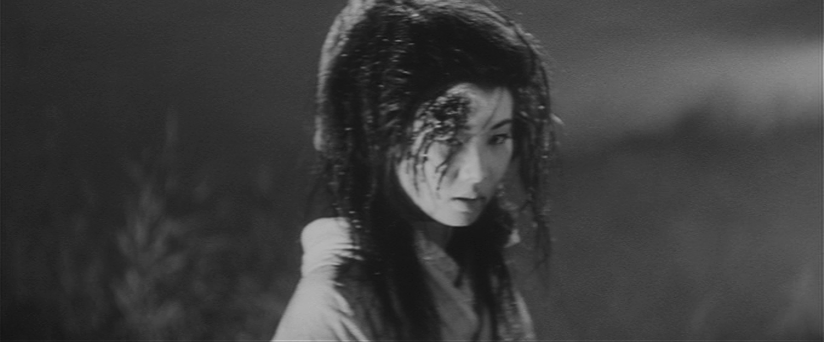
Old Soetsu might have a right to be vengeful, but his curse has collateral damage, enacted on women in order to target men as in Shinzaemon’s unwitting murder of his wife and Shinkichi’s accidental violence against Hisa at the instigation of Rui. Only the two old servants are left behind to make peace and tell the story, united by their respective positions rather than divided by their conflicting affiliations. Studio-bound yet filled with a series of supernatural tricks, Nakagawa’s atmospheric adaptation of the classic tale once again features the bug-eyed deformity of the scorned female ghost as Rui’s initial injury eventually balloons as her “sickness” intensifies, later finding time to turn her rage on Omura who was not, it has to be said, on the original list of victims being simply an embodiment of the cruelty of the age. Nakagawa ends, however, not with darkness but with light, freeing the souls of the troubled lovers from the gloom of earthly torment in urging them to leave their hatred behind and return to Buddha in eternal peace.