The Killing Machine (少林寺拳法, Norifumi Suzuki, 1975)

“As long as somebody like you is around, there’s hope for Japan,” an oddly sympathetic prison warden says to the last patriot standing in post-war Osaka. The title of Norifumi Suzuki’s Sonny Chiba vehicle The Killing Machine (少林寺拳法, Shorinji Kempo) maybe somewhat inappropriate or at least potentially misleading as the film is deliberately constructed as a martial arts parable emphasising the spiritual philosophy of self-improvement and compassion that is inextricable from its practice.

To that extent, the hero, Soh Doushin (Shinichi Chiba), is trying to fight his way out of the miasmas of the immediate post-war era. As may be apparent, Soh has taken a Chinese name, though Soh was apparently his along and belonged to a former samurai family whose nobility has been crushed by militarism. As the film opens, however, he’s a Japanese secret service operative in Manchuria blindsided by the news of Japan’s surrender. Soh is it seems a nationalist and a patriot, but a fairly revisionist one who stands up to the abuses of the Japanese army. He later says that he protested the way that the local Chinese population were often treated and he does indeed raise a fist toward an officer who wants to sell a young Japanese woman to a Chinese soldier in return for a guarantee of their safe passage to a boat heading out of the country. The young woman’s mother protests that she is an innocent virgin, a fact that has some later relevance. Soh refuses to let the officers take her, though evidently separated from her later.

When he meets the young woman again in the bomb-damaged backstreets of Occupation Osaka, she is dressed in Western clothing as opposed to the smart kimono she wore in Manchuria and is about to become a “pan pan” or streetwalking sex worker catering to American servicemen. Of course, Soh can’t let this happen either, but as she later tells him, she was raped by Russian soldiers during the retreat and now feels herself to be despoiled. She never wears kimono again and becomes a kind of symbol for a despoiled nation that Soh is reluctantly forced to accept he cannot save in part because his philosophy, which is still uncomfortably rooted in the philosophy of militarism, only valued strength when it should have valued love. The kind of love that Kiku (Yutaka Nakajima) had for her brother that made her willing to sacrifice herself for his wellbeing. 

Even so, Soh is doing his best to issue a course correction by caring for a small group of war orphans and helping them support themselves by running a rice soup stall so they won’t end up becoming dependent on the yakuza or the black market. It’s the yakuza and their increasingly corporatising nature that become Soh’s chief enemies, though standing right behind them are the Occupation Forces. They are, of course, just the biggest gang, as we can see when one of the kids steals a few tins from the gangster’s crate which is marked with text making it clear it came from the mess hall at the American base. The backstreets are full of sleazy soldiers and pan pans or otherwise the starving and dejected, sometimes violent demobbed soldiers filled with despair. It’s these men that Soh wants to buck up, telling them to rediscover their fighting spirit and giving them the opportunity to do so through learning Shaolin martial arts.

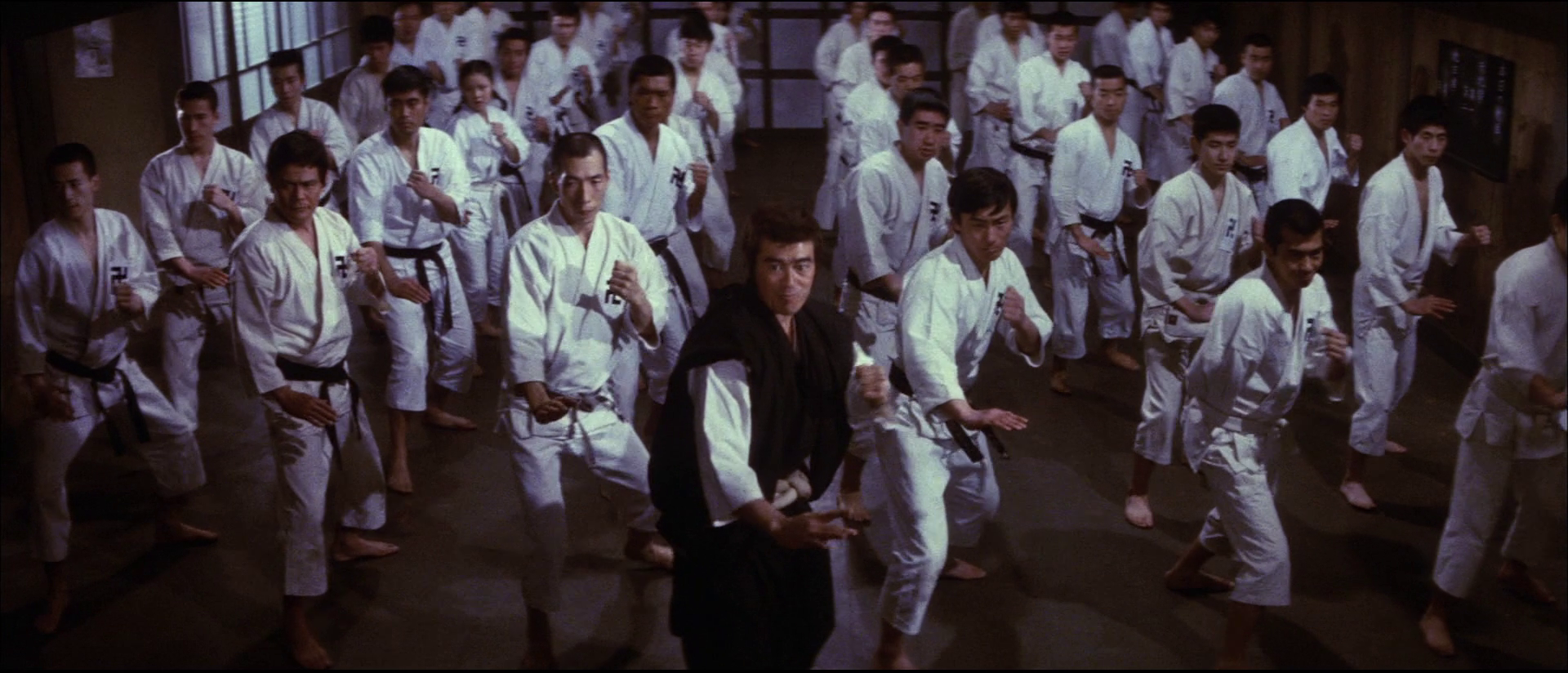
Of course there are those who don’t want to learn Chinese kung fu in the midst of their defeat, but what Soh is advocating is something that has a greater spiritual application even than karate can also have. It’s a kind of humanitarian riposte to the futility of the post-war society that might sometimes fail to recognise the depths of the impossibility faced by many in insisting they can be faced by discipline and moral fortitude but at the same time is not really judgemental except toward those who have deliberately abandoned their humanity, such as the trio of goons who rape a school for amusement (the girl is later seen among the students at Soh’s school along with the children from Osaka). The girl’s father reports it to the police, but the police and the gangsters are in cahoots, so nothing gets done. Soh cuts the guy’s bits off so he won’t be doing that again. Strength without justice is violence, he realises. But justice without strength is inability. Strength and love like body and mind should never be separated. The closing shots show an entire mountain covered in white-clad figures practising Shaolin kung fu and joining the humanitarian revolution rather than the cruel and selfish one represented by the gangsters with their red-light districts and black markets. It may be a simplistic solution, but it is in its way satisfying and at least a rejection both of the militarist past and the capitalistic future.


*Norifumi Suzuki’s name is actually “Noribumi” but he has become known as “Norifumi” to English-speaking audiences.

Curse of the Dog God (犬神の悪霊, Shunya Ito, 1977)

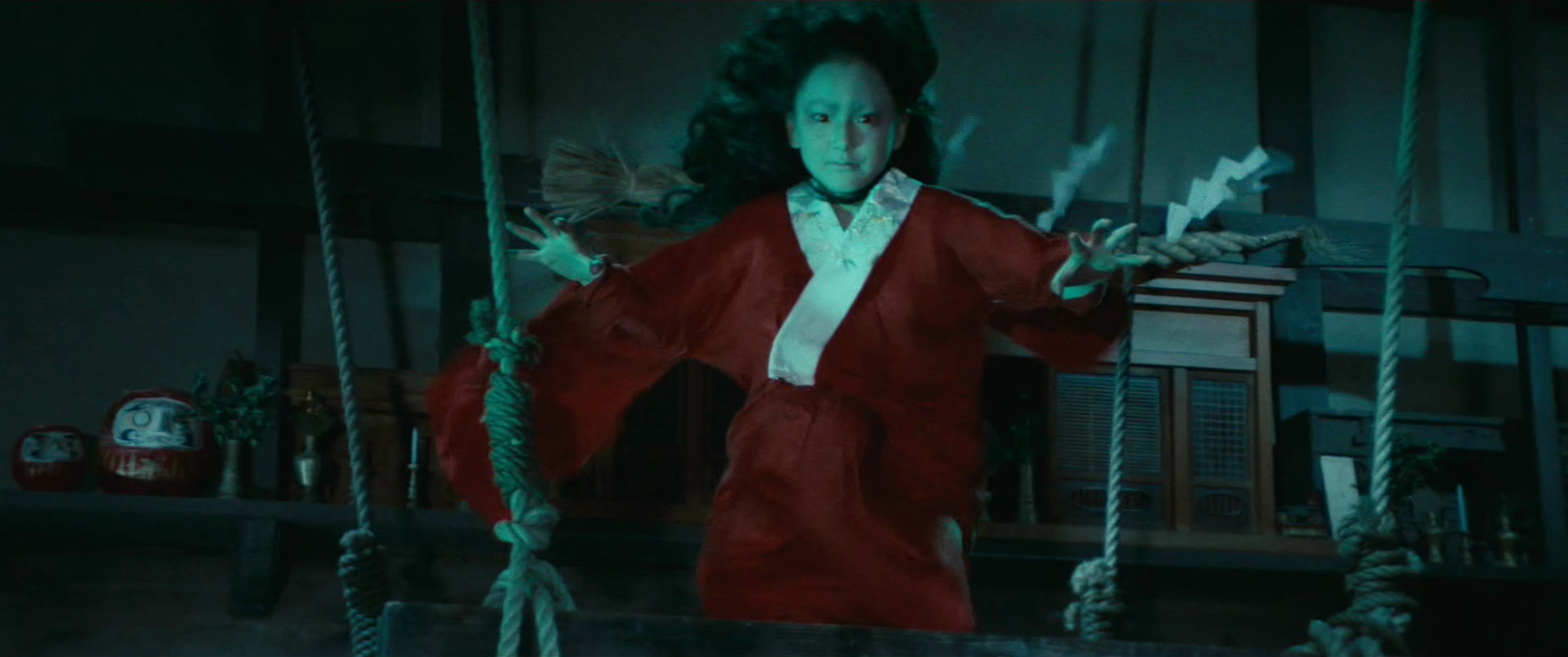
By the late 1970s, Japan was a very prosperous place and the cutting edge of modernity yet old beliefs die hard and those who run afoul of a natural order they assumed had long been forgotten will pay a heavy price for their arrogance. After a four-year hiatus following the third of the Female Prisoner Scorpion films, Shunya Ito returned with a strange slice of folk horror The Curse of the Dog God (犬神の悪霊, Inugami no Tatari) in which it is indeed the city invaders who have transgressed these ancient boundaries in their wilful indifference to the natural world.

The conflict between these two Japans is clear in the opening sequence in which three men pass through a tunnel in a truck bearing the logo of a nuclear power company and emerge into a village where a group of boys jump out from behind a row of tiny haystacks wearing masks made of leaves. The boys crowd around the van asking the strangers why they’re here and they jokingly tell them that they’ve come to look for “treasure,” which turns out to be a quest to find uranium in the local mountains. Otherwise uninterested in the village or the landscape, the men back their truck into a dilapidated roadside shrine which then collapses, and subsequently run over a little boy’s dog which had attempted to stop their car by barking fiercely at them. Rather than stop to apologise or comfort the boy who is cradling his dead dog in his arms, the men sheepishly drive off as if embarrassed. 

Of course, the shrine turns out to belong to the Dog God who is guardian deity of these mountains and now incredibly annoyed not just by the destruction of the shrine and killing of the dog, but by the men’s intention to tear the natural world apart looking for something which could prove very destructive even if they claim they want to use it responsibly to fuel the economic rocket which is Japan in the 70s. The Kenmochi family, the head of which, Kozo, is the local mayor are very receptive to the firm’s entreaties and immediately grant them access to their land while arranging a marriage which at least in part dynastic between Kozo’s daughter, Reiko (Jun Izumi), and the head of the expeditionary group Ryuji (Shinya Owada). But once they return to the city, the other two men die in mysterious circumstances, one entering a kind of trance and walking off the roof of the hotel after the couple’s formal wedding reception and the other attacked by a pack of wild German Shepherds in the middle of Tokyo. 

Reiko is quick to exclaim that it’s all the fault of the Dog God, though it’s never quite clear whether or not she is aware that her family is the subject of an ancestral curse because they themselves offended the deities by getting their hands on the land cheaply when it was used as collateral for a loan. In contrast to the Tarumis, the family of Reiko’s best friend Kaori (Emiko Yamauchi) and her little brother Isamu (Junya Kato) who is the boy whose dog they killed, the Kenmochis put on heirs and graces and as if they were the ancestral aristocracy of this area rather than having made a speedy class transition thanks to someone else’s misfortune and the vagaries of the post-war era. The Tarumis, meanwhile, live in a much more humble home and dress in a much more traditional mountain village manner. Patriarch Kosaku (Hideo Murota) point-blank refuses to sell his land and will have little truck with Ryuji or the mine once it opens, leaving the family regarded as outcasts within the village. 

But then there is a definite and literal pollution signalled by the arrival of the prospectors. At a meeting, it’s suggested that the sulphuric acid they’re using to flush out the uranium in inaccessible areas of the mine could contaminate the local groundwater which is a problem when many families are still taking their water from wells but they all laugh it off. Sometime later Ryuji is horrified to see dead fish floating in the river, while his own in-laws, the older generation of the Kenmochi family, are also killed by ingesting contaminated water. A rumour arises that the culprit is the Tarumis who have poisoned the wells out of spite, and when Ryuji tries to raise the alarm after getting a positive result for sulphuric acid in the water supply the company tell him to pin it on them instead. 

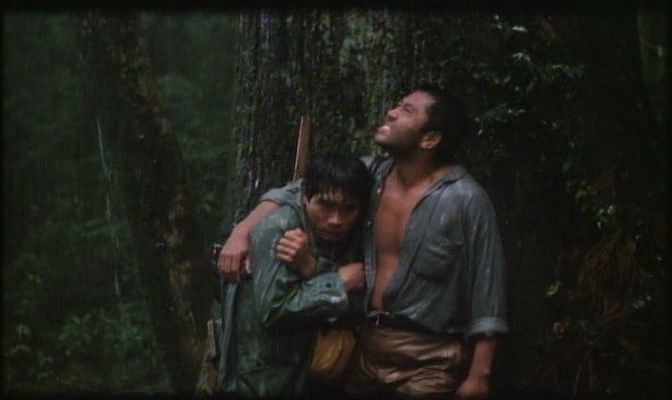
The intrusion of modernity has interrupted the careful, if woefully feudal, balance of the village with terrifying and tragic consequences. Yet Kosaku is also surprised, asking how a city man like Ryuji could really believe in something like a “curse”. The shamans they bring in to do a ritual also blame everything on the Terumis, adding the suggestion that the ill will is motivated by Kaori’s sexual jealousy over Ryuji giving rise to yet another interpretation of the curse’s origin besides the Kenmochi’s class transgression and the unintentional offence caused by the destruction of the shrine. Then again, perhaps it really is all because of the Dog God in a great confluence of coincidences that have led to this incredibly strange and unfortunate situation. In the end, even the film’s purest character, the Kenmochi’s small daughter Mako (Masami Hasegawa), is possessed by the evil spirit and made to take her revenge with a remorseful Ryuji desperately trying to repair what he himself broke in the acceptance that he should not have come here and was the catalyst for this confrontation with fate. Weird and haunting even in its bizarre obscurity the film nevertheless makes a case for the protection of the dark heart beating at the centre of the contemporary society which speaks of something older that cannot be crossed and most specially by those hellbent on a hubristic path to prosperity that has little respect for the land.


Fire Festival (火まつり, Mitsuo Yanagimachi, 1985)

By 1985 the Japanese economy was approaching its zenith yet along with increasing economic prosperity had come social change of which small-town Japan was either casualty or sacrificial victim. “Nigishima will stay as it is” declares the last holdout of an increasingly obsolete way of life in Mitsuo Yanagimachi’s intense modernity drama, Fire Festival (火まつり, Himatsuri), a manly mountain man and animalistic force of nature by several metrics unsuited to life in the contemporary society into which he is ultimately unable to progress. 

There are many things which it seems have not changed in Nigishima for generations, one being the animosity between the cohorts of its bifurcated community, those who live by land and those who live by sea. Rural depopulation may have forced them to come closer but it has also increased their sense of mistrust while both industries continue to suffer in an economy which no longer prizes their humble rural output. Despite being catapulted into a promised modernity by the advent of the railway to great fanfare in 1959, it now seems that Nigishima cannot survive without a new road which could be paid for by the development of a marine park only mountain man Tatsuo (Kinya Kitaoji) owns the property right in the middle of the earmarked area and has hitherto refused to sell further increasing the tension between the two communities. 

Tatsuo is thought of, and thinks of himself, as a big man in the area quite literally it seems as part of the reason he enjoys this status is down to his being unusually well-endowed. He believes himself to have a special relationship with the mountain goddess, often joking to the other men about having a sexual relationship with her while sometimes describing her as his girlfriend. Several times he is mistaken for an animal, firstly by the boatman bringing his childhood sweetheart and sometime mistress Kimiko (Kiwako Taichi) back to the island who assumed he was a monkey crawling along the cliff edge thoughtlessly throwing rocks at them, while he often gambols through the forest whooping like some kind of Tarzan. Entirely unreconstructed, his worldview is patriarchal and misogynistic. All of his banter with the other men is sexual, constantly referring to his penis while greeting his friends with lewd hand gestures thrusting his fist into his pocket as if waving with an erection. The cure for offending the goddess he tells his young protege Ryota (Ryota Nakamoto) is to drop his trousers and display his manhood, Tatsuo strangely believing this would appease her for taking wood from a sacred tree or killing without permission. 

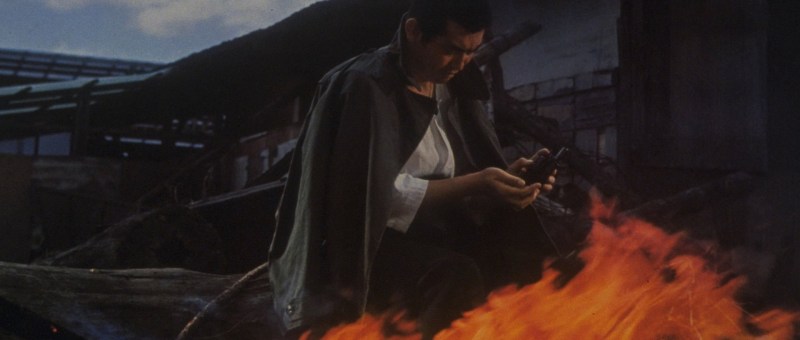
Smearing the blood of a sacrificial animal over his chest and forearms he dedicates the death to the goddess, a gesture he will repeat in the film’s violent and tragic conclusion yet there is also arrogance in his conduct as if he believes himself above natural law, protected as the goddess’ favourite even as he describes himself as “suffocated” by the women in his life from his mother and five older sisters all of whom indulge him to his wife, kids, and mistresses. He has trained his dogs to hunt wild boar without the use of guns in a method he admits even other hunters describe as “cruel” while breaking a local taboo shooting monkeys in the forest well aware of nature red in tooth and claw. As such, there is little nobility to be seen in his determination to preserve this already obsolete way of life. His virility maybe contrasted with that of the ageing land broker Yamakawa (Norihei Miki) and his failed attempts to bed sex worker Kimiko who tricks him into paying off her debts, but he at least knows the way the wind is blowing explaining to her that towns such as Nigishima survive only through things like marine parks or hotels or even nuclear power plants. Without the road, the town will die. 

Yet in 1959 they were told the railway would save them and it seems it did not. Tatsuo’s love making with Kimiko in a boat borrowed from a treacherous fisherman who later agrees to sail it transgressively into sacred waters is intercut with memories of the rail line’s opening ceremony, two teenagers who might have been them or at least of around the same age ride an elephant on the jetty while the townspeople arrange themselves into the formation of the character for “celebration” captured by the aerial photographer above. For Tatsuo as a boy, was this a rebirth of Nigishima or the beginning of its demise as the coming modernity began to eat away at its foundations? 

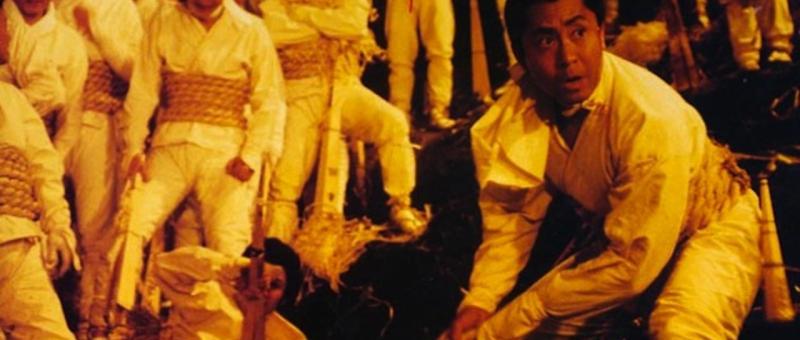
The fire festival is “for men”, according to Tatsuo, “to drive out evil spirits”, his manliness getting the better of him as he disrupts the proceedings to attack a man he accuses of having brought “false fire”. These are the lessons he teaches to surrogate son Ryota whose devotion to him borders on the homoerotic, Tatsuo cradling him during the climactic rain storm and he seeming to develop a fascination for Kimiko as a kind of indirect fixation. Ryota has learned Tatsuo’s chauvinism mimicking his lewd hand gestures and swaggering walk, his cruelty in sacrificing 1000 yen to trick Yamakawa into injuring his hand in a bear trap, and his arrogance ensuring that his problematic masculinity will survive into another generation presumably no more capable of halting the march of modernity than he has been. Tatsuo poisons the waters with fuel oil which as one of the greek chorus of fish wives points out does not catch fire, Tatsuo himself smouldering until an inevitable explosion. Receiving some kind of epiphany during a mystical congress with the goddess in the middle of a storm, he knows what he must do and accepts that he cannot progress into the modern society. Smoulderingly intense in its small-town animosity and primeval sensibilities, Yanagimachi’s poetic tragedy of futility and the broken promises of a badly distributed modernity may accept the the sacrifice but mourns it all the same. 


Fire Festival screens at the BFI on 20/27 December as part of BFI Japan.

Clip (English subtitles)

Graveyard of Honor (仁義の墓場, Kinji Fukasaku, 1975)

“Like hell you’re free” the “hero” of Kinji Fukasaku’s Graveyard of Honor (仁義の墓場, Jingi no Hakaba) coolly snaps back in squaring off against a rival gang in a crowded marketplace. Perhaps a familiar scene in the jitsuroku eiga, a genre Fukasaku had helped usher into being and later solidified in the hugely influential Battles Without Honour and Humanity series. A reaction against the increasingly outdated ninkyo eiga and their tales of noble pre-war gangsterdom, the jitsuroku or “true account” movie claimed a higher level of authenticity, inspired by the real lives of notorious gangsters and depicting the chaotic post-war period as it really was, a Graveyard of Honor. 

Based on another true crime novel by Battles Without Honour and Humanity’s Goro Fujita, Graveyard of Honour charts the slow self-implosion of reckless gangster Rikio Ishikawa (Tetsuya Watari). In keeping with the jitsuroku mould, Fukasaku opens in documentary mode, onscreen text giving us Rikio’s pregnant birthdate of 6th August, 1924 before giving way to the voices of, we assume, real people who actually knew him when he was child. They describe him alternately as shy, an oversensitive crybaby, and an evil genius in waiting who was always different from the others and had a lifelong ambition to become a yakuza. They wonder if it was the chaos of the post-war world which turned him into a “rabid dog” but note that he was in fact just as crazy before the war and after.

A cellmate during his time in juvenile detention recalls that Rikio would often liken himself to a balloon, intending to rise and rise until he burst but his trajectory will be quite the opposite. A mess of contradictions, he repeatedly tells his remarkably understanding boss Kawada (Hajime Hana) that whatever it is he’s done this time it was all for the gang but all he ever does is cause trouble, picking fights with the rival area gangs in an obsessive need for masculine dominance over his surroundings. His trip to juvie was apparently down to getting into a fight defending Kawada’s honour, implying that he was “the sort of kid who genuinely respected his godfather”, yet it’s in transgressing this most important of unwritten yakuza rules that he damns himself. Beaten up as punishment for setting fire to the car of a gang boss he felt slighted him, Rikio is asked for his finger but gets so drunk psyching himself up that he eventually turns on his own side and is exiled from the capital for a decade. 

That gang boss, meanwhile, Nozu (Noboru Ando), is currently running for political office in Japan’s new push towards democracy. He eventually loses but only by a small margin, bearing out that in this extremely difficult post-war environment, the yakuza is still a respected, if perhaps also feared, force providing services which ordinary people are sometimes grateful for in that they provide a buffer against other kinds of threat. Meanwhile, the first of Rikio’s gang raids is undertaken against so called “third country nationals” a dogwhistle euphemism for Zainichi Koreans, Chinese, Taiwanese, and other citizens from nations colonised by Japan during in its imperialist expansion who entered the country as Japanese citizens but have now been “liberated” only to face further oppression while those like Rikio accuse them of looking down on and taking revenge against the Japanese for the abuse they suffered as imperial subjects. When both sides are arrested a racist policeman allows the yakuza to escape, thanking them for helping him round up all the Chinese businessmen who will now go to jail for illegal gambling allowing the local gangs to seize their turf. 

The greatest irony is, however, that the American occupation forces may be the biggest gang of all, willingly collaborating with Kawada in peddling blackmarket whiskey (amongst other things) from the local base. The yakuza is also in collaboration with the local sex workers who use their connections with American servicemen to facilitate yakuza business. When Rikio starts a fight with a rival gang in a local bar that threatens to spark a war, it’s the Americans who are called in as neutral third party mediator, Nozu being unable to fulfil that role in having an affiliation with Kawada. The Americans, however, merely issue a loudspeaker announcement for the gang members to disperse or face possible arrest, keeping the peace if somewhat hypocritically. 

Rikio, meanwhile, continues to flounder. Exiled from his gang, he becomes addicted to hard drugs and gets a problematic minion of his own, Ozaki (Kunie Tanaka), not to mention contracting tuberculosis. In a particularly morbid moment, he has his own gravestone carved, perhaps detecting that the end is near or at least that an ending is coming for him. In another somewhat inexplicable turn of his life, though a common trope in jitsuroku, he eventually marries the sex worker who fell in love with him after he raped her, presumably touched by his concern after he burned a hole in her tatami mat floor. Wearied by grief and already out of his mind, a final act of nihilistic craziness sees him approach his former boss for the turf and capital to form his own gang, crunching his late wife’s bones as hardened gang members look on in utter disbelief. 

Rikio’s desire for freedom, to be his own boss, is elusive as the red balloon we often see floating away away from him, free in a way he’ll never be. “Don’t these young people respect the code anymore?” Kawada exasperatedly asks on hearing that Rikio has broken the terms of his exile and returned only a year into his sentence. But Rikio’s tragedy may in a sense be that he understood the code too well. On the side of his tombstone he writes the word “jingi”, honour and humanity, full in the knowledge that such concepts in which he seems to have believed no longer exist in the cruel and chaotic post-war world which forces even true believers to betray themselves in a desperate bid for survival. “We all live by a code” his friend echoes, “there’s just no way around the rules”. 

A case of printing the legend, Fukasaku’s take on the life of Rikio Ishikawa may not quite be the “true account” it claims but is in its own strange way a tale of frustrated gangster nobility, a cry baby’s failure to become the man he wanted to be in the complicated post-war landscape. Capturing the confusion of the era through frantic, handheld camera Fukasaku nevertheless takes a turn for the melancholy and mediative in his shifts to sepia, the listless vacant look of a drugged up Rikio somehow standing in for the nihilistic emptiness of a life lived in honour’s graveyard. 


Original trailer (English subtitles)

Wolf Guy (ウルフガイ 燃えよ狼男, Kazuhiko Yamaguchi, 1975)

Wolf Guy posterUniversal’s Monster series might have a lot to answer for in creating a cinematic canon of ambiguous “heroes” who are by turns both worthy of pity and the embodiment of somehow unnatural evil. Despite the enduring popularity of Dracula, Frankenstein (dropping his “monster” monicker and acceding to his master’s name even if not quite his identity), and even The Mummy, the Wolf Man has, appropriately enough, remained a shadowy figure relegated to a substratum of second-rate classics. Kazuhiko Yamaguchi’s Wolf Guy (ウルフガイ 燃えよ狼男, Wolf Guy: Moero Okami Otoko, AKA Wolfguy: Enraged Lycanthrope) is no exception to this rule and in any case pays little more than lip service to werewolf lore. An adaptation of a popular manga, Wolf Guy is one among dozens of disposable B-movies starring action hero Sonny Chiba which have languished in obscurity save for the attentions of dedicated superfans, but sure as a full moon its time has come again.
Chiba plays Inugami (literally “dog god”, in Japanese folklore an Inugami is a vengeful dog spirit which can possess people in times of emotional extremity), a melancholy reporter with a reputation for getting himself into trouble who comes across a strange scene in the street in which a white suited man begins raving about a tiger before being gored to death by invisible forces. The police, dragging in Inugami for questioning, can’t come up with anything better than demons to explain such strange events but Inugami’s interest is piqued – more so when he runs into a shady paparazzo who tips him off to similar crimes all targeting a rock band run by a prominent talent agency.

Wolf Guy is not the most coherent of films, it explains itself piecemeal as it goes along and mostly through Inugami’s own world-weary voiceover. Despite this immediate access to Inugami’s psyche, he remains aloof, brooding, and distant. Literally a lone wolf, Inugami is the last of his kind – the little boy saved from a massacre in the black and white still frames of the opening sequence. Yamaguchi chooses not to engage with this theme on much more than a surface level though he maintains a low-level anger towards corrupt authority and those who attempt to wield power from the shadows, targeting the different or the weak.

Through this deeply held feeling of alienated otherness, Inugami comes to feel an intense kinship with the wronged woman at the centre of the curse. Miki (Etsuko Nami) is even more a victim of this intense authoritarianism than Inugami himself. A working class nightclub singer in love with a politician’s son, Miki becomes a problem for her potential father-in-law, one which he solves with gang rape and infection with syphilis. Dumped, alone, infected, and also hooked on drugs, Miki’s mental state is understandably volatile but her troubles are not yet over. The mysterious tiger and Inugami’s wolf man attributes bring the pair to the attentions of a shady group intent on harnessing these unique supernatural powers for themselves with no regard for the “human” cost involved.

Inugami sympathises with Miki out of a shared hatred for “humans” who can treat each other in such inhumane ways. Humans massacred his family and when he tries to go home, the sons of the men who did it seem to know who he is and want to finish the job. Lonely and afraid, Inugami starts to wonder if humans and his own kind will ever be able to live together in harmony. Though he does begin to form brief romantic relationships, none of them end well. It’s almost a running joke that he’s irresistible to every woman in the film, but as much as they run to him they run to death – his love is toxic and even the invulnerability conferred by the moon is unable to save the women in his life from the violence of mortal men. Yet for all his sadness and internalised rage, the Wolf Guy is a hippy hero, the kind who throws away his gun and chooses to retreat in peace rather than fight on in a pointless and internecine quest for vengeance.

Rather than a story of humanity overturned by overwhelming, irrational emotional forces, Wolf Guy presents a hero perfectly in tune with his emotional life even if imbued with Chiba’s iconic coolness. This is not a “werewolf” story, Chiba never transforms nor does he lose himself at the sight of a full moon – rather it strengthens, sustains, and protects him. This almost new age idea gels well with the generally psychedelic approach filled with groovy ‘70s guitar, whip pans, zooms and crazy action though the film certainly goes to some dark places including an extremely unsettling surgery scene followed by an equally disturbing one of healing body horror in which exposed intestines rearrange themselves neatly inside the stomach cavity which then begins to knit itself together again. An eccentric, essentially disposable offering, Wolf Guy makes no real attempt at coherence but is willing to embrace just about every kind of madcap idea which presents itself. Strange, absurd, and all the better for it Wolf Guy is one wild ride but also has its heart in the right place as its melancholy hero heads out into the mountains, a self-exile from a cruel and unforgiving world.


Wolf Guy is released on Dual Format DVD & Blu-ray in the US and UK on 22nd/23rd May 2017 courtesy of Arrow Video.

Arrow release EPK video


Female Prisoner Scorpion: Jailhouse 41 (女囚さそり第41雑居房, Shunya Ito, 1972)

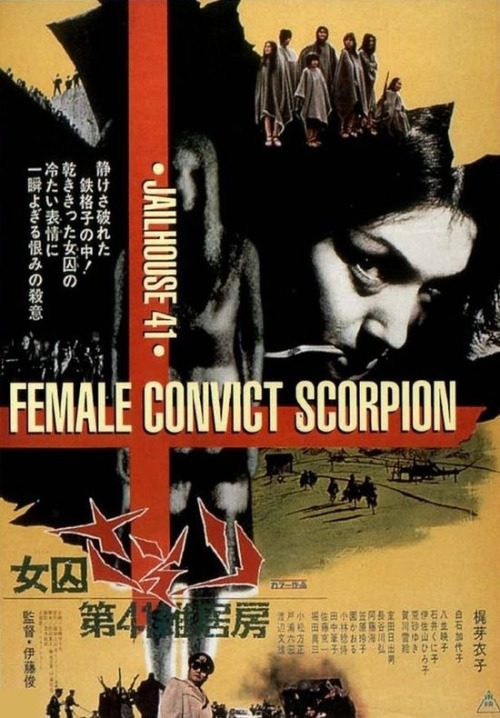
scorpion-2Female Prisoner Scorpion: Jailhouse 41 (女囚さそり第41雑居房, Joshu Sasori – Dai 41 Zakkyobo) picks up around a year after the end of Female Prisoner #701: Scorpion and finds Matsu (Meiko Kaji) tied up in a dingy prison basement, apparently left bound and in solitary confinement for the entire interval. Once again directed by Shunya Ito, the second instalment in the Female Prisoner Scorpion series is another foray into the women in prison field but Ito resolutely refuses to give in to the exploitative genre norms, overlaying his tale of individualistic rebellion with an arthouse sensibility that has a much wider scope than its ordinary vengeance driven narrative may suggest.

Matsu may have been lying bound and gagged in a dingy underground hole for the best part of a year but today is a special day and sadistic prison warden Goda (Fumio Watanabe) is going to let her out to be shown off in front of a visiting inspector who’s paying a final visit before Goda is promoted to a top job in Tokyo. When Matsu makes a lunge for Goda, the inspector is so afraid that he wets himself, sending the other woman into a frenzy and resulting in a riot. Once again the entirety of the prison is punished, but this time Matsu is singled out for a public punishment gang rape by Goda’s goons. This kind of humiliation is too much for her fellow prisoners who instantly turn on her, but their violence provides an opportunity for escape and before long Matsu is on the run, again.

At the end of the first film, Matsu had accomplished her first round of vengeance – against the man who orchestrated her downfall and the men who secured it, but ultimately she wound up a female prisoner once again. Though Goda may have had her hidden away because of her habitual escapism, Matsu had not given up as we see from her attempts to scrape the floor away with her spoon held tight in her mouth. Barely speaking, Matsu is an unstoppable column of pure rage but an elegant one, supported by her self contained restraint.

Her anger this time is directed towards Goda himself, especially after his despicable organised punishment rape that was designed both to break her own spirit once and for all and also to damage her in the eyes of her fellow inmates who are intended to see her defeated and destroyed. The guards are a stand in for society at large, using sexual dominance and social position to keep their women in line. The visiting prison inspector makes a point of telling Matsu that “they” don’t hate her personally – they’re there for her, to help her “recover” and become a functioning member of society. Which is ironic because Goda does hate her personally as he holds her responsible for the damage to his eye sustained in the previous film. His last act before moving on is one against Mastu – an attempt by the forces of authority to crush her individual rebellion and use their victory as a coercive tool to force others to conform.

In this way, Matsu’s position as a member of a subjugated class is less important than her status as an agitator but these are women who have each suffered at the hands of men. As an extremely theatrical sequence sung in the traditional form informs us, the women who escaped with Matsu committed their crimes out of love or jealousy. Poisoned rivals, dead lovers, even children murdered to get back at their philandering father in some Medea level psychotic rage which ruins the perpetrator even more than the intended victim.

Later while the women are enjoying their brief taste of freedom, one of them is brutally raped and murdered by a troupe of feral men who boast about the wartime atrocities they committed before descending on a lone woman like a pack of rabid dogs. The others take their revenge for their friend, but also for all the women who have met a similar fate inflicted by a male dominated society which sees them as something to be controlled and then made use of, little more that cattle hemmed in and milked until dry.

As in the first film Ito makes use of expressionist techniques and strange angles to give his film a more elevated feeling that might be expected but this time he adds in a surrealist, spiritual dimension as with the old woman who sings the stories of our heroines and then dies only to bury herself in leaves and disappear into the ether, like some forgotten deity of misused women. Likewise, when one of the prisoners is raped and murdered, the men throw her body into a nearby river like an empty beer can but the waterfall behind her suddenly runs with blood as an expression of the violence which pollutes the natural world. A bus suddenly splits in two, separating our subjugated women from the violent men who mentally sentence them, given free reign simply because of their sex. Ironically enough, our last glimpse of of Matsu takes place in the reflection of Goda’s glasses and then in his false eye when she is suddenly rejoined by her compatriots for a triumphant dance of freedom on a city rooftop.

Even stronger than in the original Female Prisoner #701 Scorpion, Jailhouse 41 further advances its ideology of free individuals battling the conformist authority of the state all filtered through the prism of the patriarchy. Matsu’s vengeance is personal, she keeps her distance from the other women who do not seem inclined to band together to oppose the forces which oppress them so much as seek a wary, temporary alliance of necessity, but seeing them all reassembled in spirit at the end brings a larger dimension to Matsu’s victory which now seems much less like solving a practical problem than a deliberate strike at a wall which was solely designed to keep a certain group of people in their place. The jail is broken, all that remains is to choose to escape its restraints.


Original trailer (English subtitles, NSFW/gore)