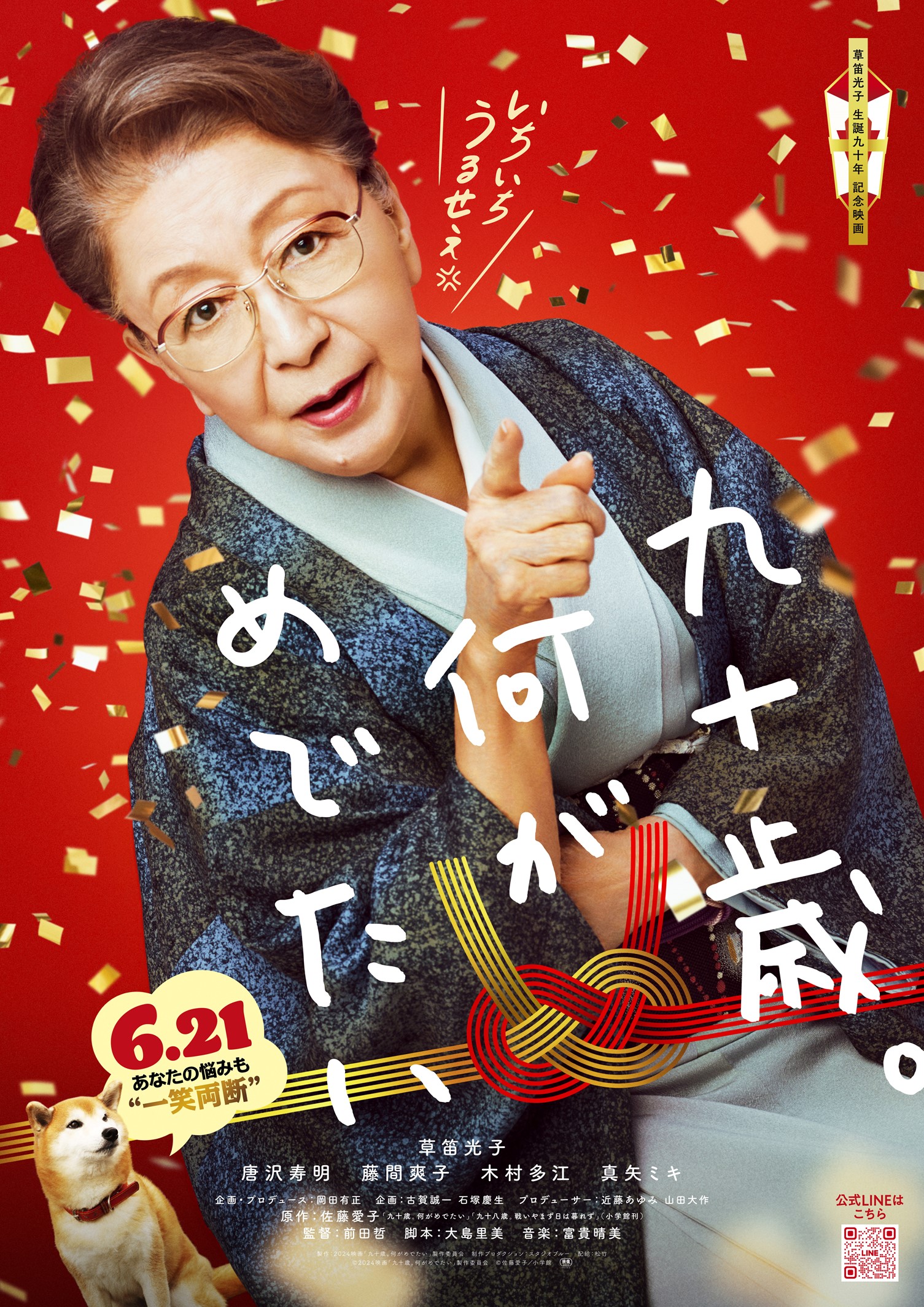
90 Years Old – So What? (九十歳。何がめでたい, Tetsu Maeda, 2024)

Everyone keeps congratulating Aiko Sato (Mitsuko Kusabue) on reaching 90, but she can’t see what’s so special about it. Having retired from writing after publishing her last novel at 88, she’s really feeling her age and has little desire to anything but sit around waiting to die. That is, until she’s badgered into picking up her pen by a down on his luck, “dinosaur” editor certain that her words of wisdom will strike a chord with the young people of today.

Marking the 90th birthday of its leading lady Mitsuko Kusabue and directed by comedy master Tetsu Maeda, the film takes its name from a collection of essays published under the title “90 Years Old, So What?” which largely deal with what it’s like to be old in the contemporary society along with the way things have changed or not in Japan over the last 90 years. It does not, however, shy away from the physical toll of ageing despite Kusabue’s sprightliness or the undimmed acuity of Aiko whose only barrier to writing is that she fears she’s run out of things to say and the energy to write them. During her retirement, she remarks on the fact that her legs and back hurt while she also has a heart condition and everything just feels like too much bother. Her daughter Kyoko (Miki Maya), who lives with her along with her twenty-something daughter Momoko (Sawako Fujima), asks her why she doesn’t go out to meet a friend, but as Aiko says, most of her friends have already passed on or like her don’t really have the energy to leave the house. 

In many ways, her age isolates her as she finds herself slightly at odds with the contemporary society. She turns the television up louder because she finds it difficult to understand what younger people are saying and doesn’t get why they stare at their phones all the time. Though she manages most things for herself, she has to call repair people, which costs money, if something breaks down while her daughter’s not around to fix it, even if it’s something as simple as a paper jam in a fax machine or pushing the off button on the TV too hard so it won’t turn back on again. Nevertheless, so intent is she on “enjoying” her retirement that she repeatedly turns down the entreaties of a young man from her publisher’s who wants her to write a column and always turns up with fancy sweets which are, as she says, well-considered gifts, but also a little soulless and superficial being driven by fashionable trends of which Aiko knows nothing and by which she is not really impressed.

There is something quite interesting about the contrast between herself and fifty-something Yoshikawa (Toshiaki Karasawa) who is also a man behind the times and a relic of the patriarchal culture she railed against in her writing and rejected in her personal life, divorcing two husbands and going on to raise her daughter alone. In the opening scenes, she reads an entry from an advice column about a woman who’s sick of her husband of 20 years because he’s a chauvinist who dumps all of the domestic responsibilities onto her while looking down on her because of it. Aiko tuts and contradicts the advice of the columnist, remarking that the answer is simple. She should just tell him to his face that she hates him and then leave. Nevertheless, the fact remains that not all that much has changed since she was young. The husband’s behaviour is considered “normal”, while the woman’s desire to be treated with respect or leave her marriage is not. Yoshikawa is effectively demoted because he has no idea that his treatment of a female employee amounts to workplace bullying and sexual harassment even if he didn’t intend that way because he’s trapped within this old-fashioned patriarchal ideal and is unable to see that his behaviour is not acceptable nor that he’s been taking his family for granted while considering only his own needs and positioning himself as the provider. 

Yet it’s 90-year-old Aiko rather than his humiliating demotion or the failure of his marriage who begins to show him the error of his ways by accepting him into her own family like a lonely stray. Aiko’s essays don’t really say that everything was better in the past, even if she’s confused by modern people who are annoyed by the cheerful sounds of children playing and a city alive with life because she remembers how everything went quiet during the war and how depressing that could be. But she does sometimes think that progress has gone far enough and things were better when people had more time for patience with each other. That said, patience is one of the things Aiko has no time for, advising Yoshikawa to charge forward like a wild boar because one of the benefits of age is that you just don’t care anymore what anyone thinks so get ready to annoy people or exasperate them but carry on living life to the full. Ironically, that might be a gift that he gave her by convincing her to write again which returned purpose to her life and gave her a reason to engage again with the world around her lifting her depression and making her feel as if she still mattered. The real Aiko turned 100 in 2023 and carried on writing, while 90-year-old Kusakabe is herself undergoing something of a career resurgence in recent years proving that even if you’re 90 years old, so what? There’s still a lot of life left to be lived and you might as well carry on living it doing what you love for as long as you can.


90 Years Old – So What? screens 21st June as part of this year’s Toronto Japanese Film Festival.

Trailer (English subtitles)
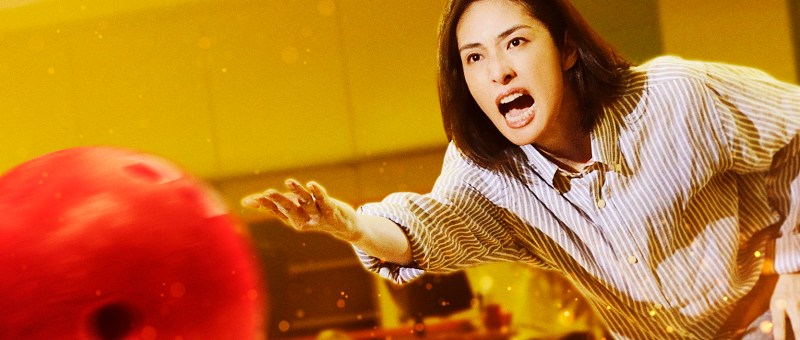
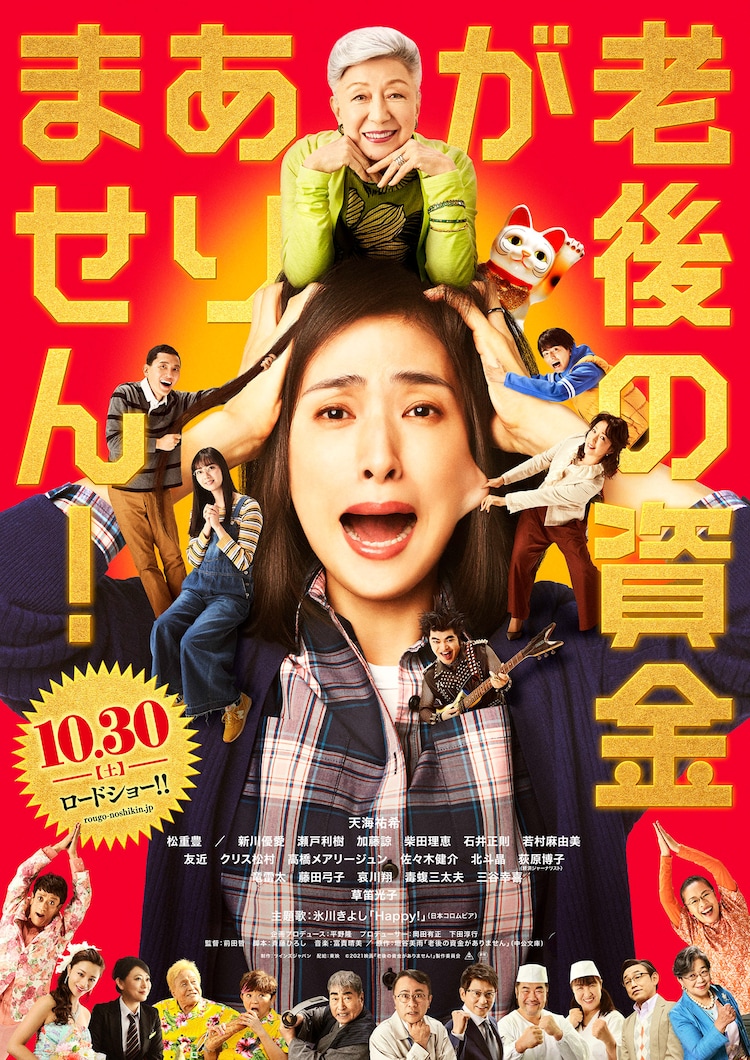
What Happened to Our Nest Egg!? (老後の資金がありません!, Tetsu Maeda, 2021)

A minor controversy erupted in Japan in 2019 when then finance minister Taso Aso issued a statement recommending that couples should have 20 million yen (£104,620 total at the time of writing) saved for their retirement on top of the state pension in order to live a comfortable life in old age. All things considered, 20 million yen actually sounds like quite a low sum for two people who might live another 30 years post-employment. Nevertheless, Atsuko (Yuki Amami) and her husband Akira (Yutaka Matsushige) are now in their mid-50s and don’t have anywhere near that amount in savings. They’re still paying off their mortgage and though their children are grown-up, neither of them seem to be completely independent financially and both still live at home. 

Tetsu Maeda’s familial comedy What Happened to Our Nest Egg!? (老後の資金がありません!, Rogo no shikin ga arimasen!) explores the plight of the sandwich generation which finds itself having to support elderly relatives while themselves approaching retirement and still needing to support their children who otherwise can’t move forward with their lives. Seeing an accusatory ad which seems to remind her personally that even 20 million yen isn’t really enough when you take into consideration the potential costs of medical treatment or a place in a retirement home, Atsuko has a sudden moment of panic over their precarious financial situation. The apparently sudden death of Akira’s 90-year-old father acts as a sharp wake up call especially as Akira’s apparently very wealthy but also selfish and materialistic sister Shizuko (Mayumi Wakamura) bamboozles him into paying for the entirety of the funeral while pointing out that they’ve been footing most of the bill for the parents’ upkeep over the last few years.

There was probably a better time to discuss the financial arrangements than with their father on his deathbed in the next room, but in any case Shizuko doesn’t pay attention to Atsuko’s attempt to point out they’ve been chipping in too. Akira’s mother Yoshino (Mitsuko Kusabue) also reminds them that their family was once of some standing and a lot of people will be attending the funeral so they need to make sure everything is done properly. The funeral arranger is very good at her job and quickly guilts Atsuko into spending large sums of money on pointless funeral pomp to avoid causing offence only to go to waste when hardly anyone comes because, as she later realises, all of the couple’s friends have already passed away, are bedridden, or too ill to travel. 

Yoshino is however in good health. When Shizuko suddenly demands even more money for her upkeep, Atsuko suggests Yoshino come live with them but it appears that she has very expensive tastes that don’t quite gel with their ordinary, lower-middle class lifestyle. Having lived a fairly privileged life and never needing to manage her finances, Yoshino has no idea of the relative value of money and is given to pointless extravagance that threatens to reduce Atsuko’s dwindling savings even more while in a moment of cosmic irony both she and Akira are let go from their jobs. Now they’re in middle age, finding new ones is almost impossible while their daughter suddenly drops the bombshell that she’s pregnant and is marrying her incredibly polite punk rocker boyfriend whose parents run a successful potsticker restaurant and are set on an elaborate wedding.

The film seems to suggest that Atsuko and Akira can’t really win. They aren’t extravagant people and it just wasn’t possible for them to have saved more than they did nor is it possible for them to save more in the future. Instead it seems to imply that what they should do is change their focus and the image they had of themselves in their old age. One of the new colleagues that Akira meets in a construction job has moved into a commune that’s part of the radical new housing solution invented by his old friend Tenma (Sho Aiwaka). Rather than building up a savings pot, the couple decide to reduce their expenses by moving into a share house and living as part of a community in which people can support each other by providing child care and growing their own veg. Yoshino too comes to an appreciation of the value of community and the new exciting life that she’s experienced since moving in with Atsuko. It may all seem a little too utopian, but there is something refreshing in the suggestion that what’s needed isn’t more money but simply a greater willingness to share, not only one’s physical resources but the emotional ones too in a society in which everyone is ready to help each other rather than competing to fill their own pots as quickly as possible. 


What Happened to Our Nest Egg!? screens as part of this year’s Japan Foundation Touring Film Programme.

Trailer (English subtitles)

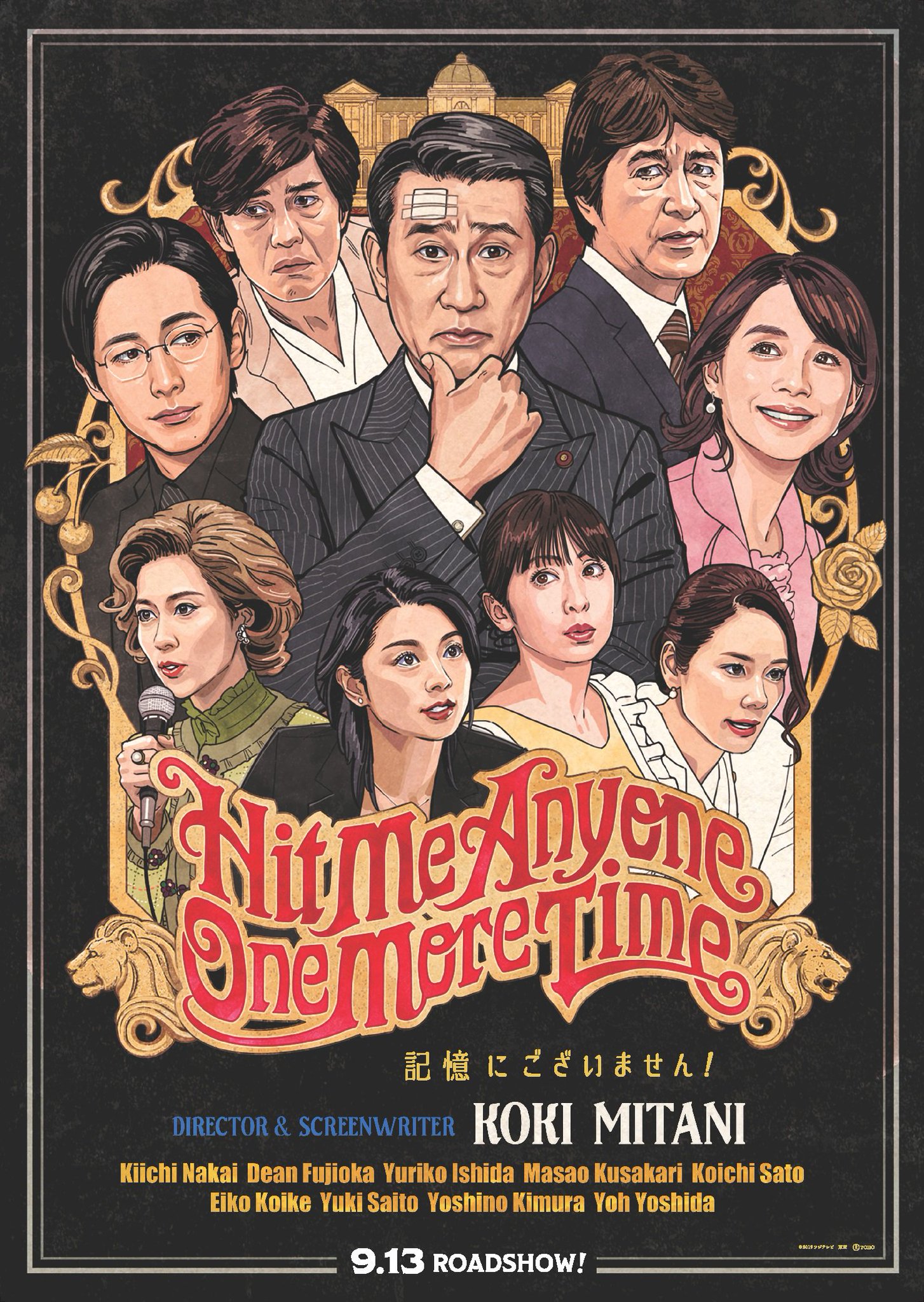
Hit Me Anyone One More Time (記憶にございません!, Koki Mitani, 2019)

Imagine if you woke up one day and found out you’re actually the national leader of your country and not only that absolutely everyone, including your wife and son, hates you with furious intensity. The hapless protagonist of Koki Mitani’s lowkey political satire Hit Me Anyone One More Time (記憶にございません!, Kioku ni Gozaimasen!) finds himself in just this stressful situation having lost all of his memories since he made the fateful decision to enter politics, rendered infinitely naive as he tries to keep up appearances while internally conflicted by the direction both his life and his country under his stewardship seem to have taken. 

Regarded as the “all-time worst prime minister” in Japanese history, Keisuke Kuroda (Kiichi Nakai) is known as a venal bore, a ghastly misogynist and all-round arsehole. To put it bluntly the very fact that a man like Kuroda could ever have become prime minster in the first place hints at a deep-seated rot in the political order. Aside from his gaffe-prone personality, the chief complaints against his administration are a sales tax hike and welfare cuts both of which target those with the least means, not that Kuroda cares very much about them. His big legacy idea is to build a second Diet building right next to the first Diet building only with spa facilities, illicitly teaming up with a childhood friend turned construction magnate who has been supplying him with hefty “donations”. 

After insulting the electorate during an outdoor balcony speech, Kuroda is hit on the head by a rock thrown by a disgruntled voter. Having lost his memory he regresses to a state of innocence from before he was corrupted by the cutthroat world of Japanese politics, now a nice, polite, slightly mild-mannered man who stuns his staff with his newfound consideration for others including a widely televised moment in which he stops to help up a female reporter who trips while chasing him in the lobby. Few believe he’s really changed, assuming this is some sort of bit intended to help rehabilitate his reputation. His new attitude, however, eventually fosters a new sense of hope for political change among his previously jaded, cynical staff who had long since given up hope of building a better Japan. 

Unsurprisingly, Mitani mostly avoids direct allusions to real world politics but adopts a mildly progressive stance as he sends a virtual innocent into the lion’s den of contemporary politics. It’s not long before Kuroda’s asking sensible questions about policy that wouldn’t go down so well with his (presumably) centre-right party including lowering the sales tax and raising the corporate, taking the time to greet constituents including a contingent of cherry farmers which contributes to his later decision to turn down a tariff-free trade deal for American cherries endangering diplomatic relations with the Japanese-American US President. No longer a ruthless political animal but a rueful middle-aged man who actually cares about ordinary people, Kuroda attempts to change the course Japanese politics largely by taking on the king maker, Tsurumaru (Masao Kusakari), his Chief Cabinet Secretary and the true holder of power in this infinitely corrupt political system. 

All sorts of sordid politics is on display from Kuroda’s womanising and a potential blackmail plot involving his wife’s affair to Tsurumaru’s yakuza ties and an even worse secret he would find personally ruinous should it get out. The ironic Japanese title of the film takes its name from that most universal of political get out of jail free cards, “I do not recall”, Kuroda’s standard response when questioned in the Diet about any of his extremely dodgy dealings. Instructing Kuroda that he should drop this “shallow humanism”, Tsurumaru can offer only the motivation that he wants to “remain in politics for as long as possible” while discovering that his old-school methods of political manipulation may no longer work when those around him find the courage to shed their cynicism and embrace a cleaner, kinder politics. 

Throwing in random gags such as a foreign minister who can’t speak English and has large ears with a pot belly that give him the appearance of Buddha while taking minor potshots as the usually toothless TV media through his series of acerbic anchors only too keen to criticise the PM live on air, Mitani’s comedy is characteristically inoffensive with its mix of slapstick and goodnatured farce but nevertheless makes a subtle plea for decent, compassionate politics which puts the interests of the people first rather than those of the governing elite. 


Hit Me Anyone One More Time streamed as part of this year’s Nippon Connection.

Original trailer (English subtitles)

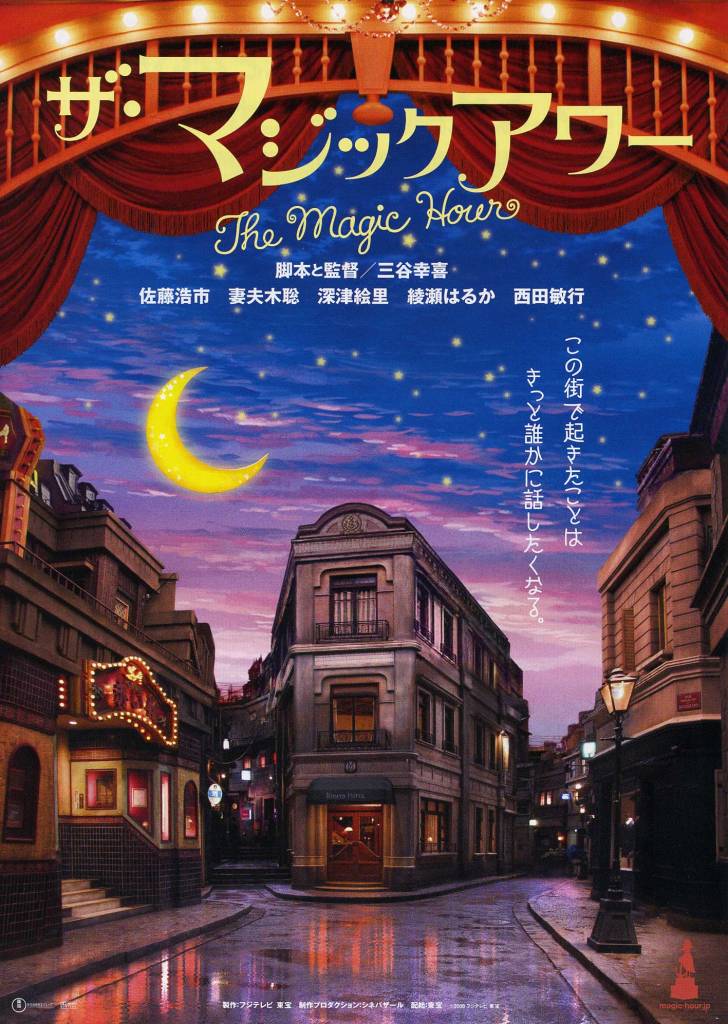
The Magic Hour (ザ・マジックアワー, Koki Mitani, 2008)

Magic Hour PosterIf there’s one thing you can say about the work of Japan’s great comedy master Koki Mitani, it’s that he knows his cinema. Nowhere is the abundant love of classic cinema tropes more apparent than in 2008’s The Magic Hour (ザ・マジックアワー) which takes the form of an absurdist meta comedy mixing everything from American ‘20s gangster flicks to film noir and screwball comedy to create the ultimate homage to the golden age of the silver screen.

In classic style the film opens with a bunch of goons chasing a scantily clad club owner out of a hotel window. Bingo (Satoshi Tsumabuki) has been hitting the jackpot with the boss’ girl, Mari (Eri Fukatsu), so the two are about to be given a new set of kicks in the latest fashion – cement. Luckily Bingo overhead some of the other guys talking about looking for another gangster, Della Togashi, so he quickly starts talking about him as if he were a long lost friend. The boss, Tessio (Toshiyuki Nishida), gives the pair a reprieve on the condition Bingo tracks down Togashi and brings him in within five days. Slight hitch – Bingo had never heard of Togashi before today and has no idea where to start. Finally, with the help  of some of his bar staff he hatches on the idea of getting a random actor to play the part, seeing as no one knows what Togashi looks like. However, the actor, Murata (Koichi Sato), plays his part a little too well and gets hired to work for the gang all the while thinking it’s just a movie! Pretty much everyone is getting a little more than they bargained for…

If you’re thinking that the oddly American looking 1920s street scene looks a little fake and everyone seems to be overacting like crazy, you wouldn’t be wrong but like everything else there’s a reason for that. What originally looks to be the primary setting for the film is a strange bubble which seems to co-exist with the modern world only its filled with people straight out of The Public Enemy or Scarface who think cement shoes is an efficient way of dealing with traitors. Murata, by contrast, is from our world and is completely oblivious to the strangeness of this movie gangster sound stage universe.

Murata is fixated on the Casablanca-esque final scene of his favourite movie in which a dyed in the wool tough guy entrusts the love of his life to a loyal friend before heading off to face certain death. His own career has not been going particularly well and even if he originally turns down Bingo’s offer as working with a first time director on a film where there’s no script sounds pretty fishy to begin with, circumstances soon find him throwing himself into the mysterious leading role with aplomb. Indulging his long held gangster dreams, Murata becomes the archetypal movie hit-man. He’s giving the performance of his life but has no idea there is no film in the camera.

The “Magic Hour” of the title refers to the twilight time near the end of the day when the light is dying but the conditions are perfect for making a movie. Mitani doesn’t fail to remind us we’re watching a film with constant exclamations of “just like a movie” or “doesn’t this look like a film set”. It’s a Barnum & Bailey world, just as phoney as it can be – but somehow it all just works despite its rather arch, meta approach. By the point we’ve hit Mari sitting on a crescent moon to give us her rendition of I’m Forever Blowing Bubbles (we’re back to The Public Enemy again) we’ve hit peak ‘20s though we scarcely mind at all.

Though he is indeed sending a lot of these classic ideas up, there’s real love here particularly for those golden age Hollywood movies with their wounded tough guys and beautiful chorus girls in need of rescue. Mitani adopts a primarily theatrical tone which meshes well with the absurdist, artificial atmosphere but always makes sure to leave us a fair few clues in the way of laughs. However, probably correctly assuming we know these films as well as he does, Mitani doesn’t give us the typical narrative that would almost write itself (or allow Bingo to write it based on his own trips to the motion picture house). The “bad” guy turns out to be not so bad, the “hero” wasn’t who we thought he was and none of our central guys winds up with a girl. Beautifully silly yet intricately constructed, The Magic Hour is another comedy masterpiece from Mitani which is filled with his characteristic warmth, mild sentimentalism and plenty of off-centre humour of the kind only Mitani can come up with.


The Japanese DVD/blu-ray release of The Magic Hour includes English subtitles.


Gentle 12 (12人の優しい日本人, Shun Nakahara, 1991)

161_img_1_oAs you might be able to tell from its title, Gentle 12 (12人の優しい日本人, Juninin no Yasashii Nihonjin) is a loose Japanese parody of the stage play 12 Angry Men notably filmed by Sidney Lumet back in 1957. The Japanese title literally translates as “12 Kindly Japanese Guys” and the film takes the same premise of twelve jurors debating the verdict in a murder case which was previously thought fairly straightforward. This time our jury is a little more balanced as it’s not just guys in the room and even the men are of a more diverse background.
In contrast to the American version, each of our twelve jurors is immediately inclined to acquit and some of them are even walking out the door before one juror, Juror no. 2, raises an objection. He thinks the defendant may be guilty and they should at least talk about it a little more. Irritated, the jurors walk back into the room and enquire why he’s had this sudden change of heart. They will, of course, be entitled to some refreshments now, so what’s the harm in hanging round to talk things through. Eventually people start to switch sides, some in confusion or just wanting to get it over with, but gradually each is exposed as having a personal reason for feeling the way they do that has relatively little to do with the facts of the case.

In contrast to the original stage play, the first instinct of the Japanese jurors is to acquit. No one wants to believe the defendant, who is the mother of a young child accused of pushing her violent ex-husband into the path of an oncoming truck, could have wilfully planned such an outrageous crime in advance. Whatever the facts are, she has clearly suffered enough and her child certainly doesn’t deserve to be orphaned through having its mother taken away by over zealous seekers of “justice”. Nevertheless Juror no.2 doesn’t believe her story and thinks there’s at least the possibility that she pushed him deliberately if not having engineered the entire situation in someway.

As in the American version, they proceed to debate the facts of the case in detail but while some change sides after thinking over the arguments, others are rigidly committed to their positions. Of those in the not guilty camp, some of them can’t quite articulate their reasoning beyond “it’s just a feeling” which proves particularly infuriating to Juror No. 2. The US version placed more emphasis on societal prejudices with personal ones largely backing them up – i.e. they took against the defendant in that case because he was a poor boy from the slums so in their middle class, majority culture minds it was natural that he was guilty. Here, there’s a great deal of sympathy for the defendant who seems to have experienced a lot of misfortune but continues to try and do the best for her young son.

Even so, some take against her because she reminds them of past misfortune of their own, or take against the victim because even as a thoroughly unpleasant man he’d managed to attract himself a pretty wife and son only to misuse and abandon them. Some believe themselves to be excellent judges of character or to be good at spotting a liar only to have their opinions about themselves undermined when scrutinised. The revelations here are personal rather than societal, but the central fact remains that you can’t really ever know or prove what happened and even having witnessed something with your own eyes doesn’t necessarily mean you’ve totally understood the situation fully. Much of the juror’s deliberations consist of creating a narrative out of scattered facts and exercises in supposition. In the end, it more or less comes down to gut feeling anyway.

Originating as a stage play and scripted by Japanese comedy master Koki Mitani, Gentle 12 has its moments of humour and never really takes itself too seriously. What else could you say about a case which seems to hinge on the smallest size of pizza available from a delivery company and how someone might say the words “ginger ale” when really, really angry. The “kindly” jurors also have a wonderful tendency towards tolerance or towards restrained anger that sees them getting quite annoyed whilst trying not to lose their tempers in exasperation or just calmly restating their arguments (or lack thereof) and infuriating everyone else in the process. Neatly filmed by Shun Nakahara, Gentle 12 might not have the same level of cultural bite as its original work suggests but it does prove an enjoyably absurd confined space drama which offers a few cultural revelations of its own.


http://www.youtube.com/watch?v=R8PJSdhrQtY


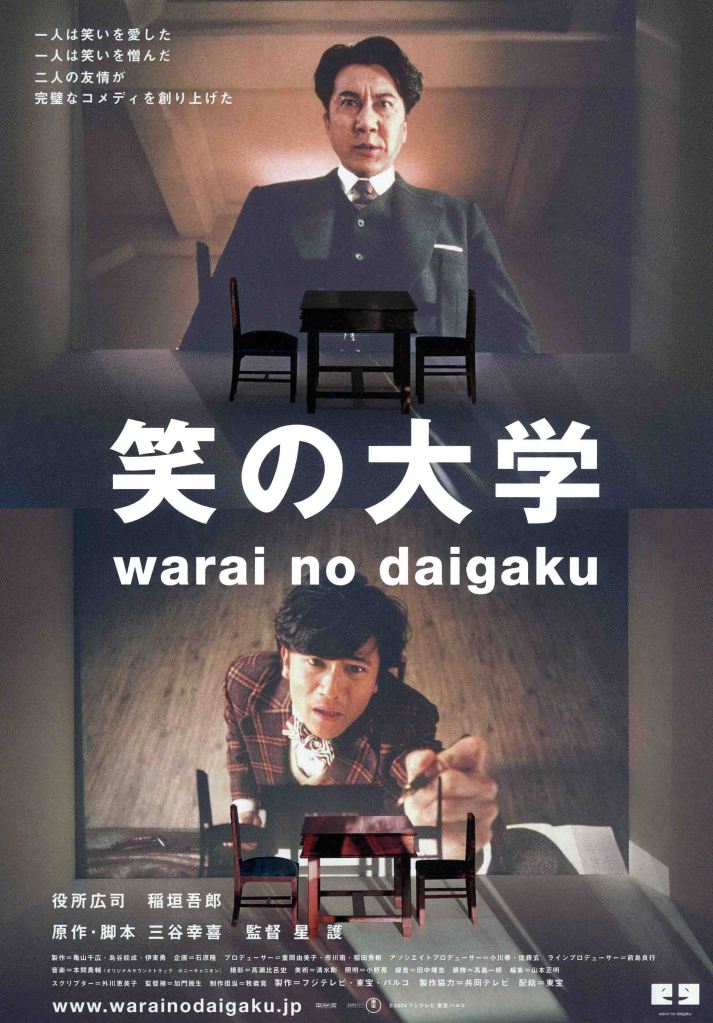
University of Laughs (笑の大学, Mamoru Hoshi, 2004)

warainodaigakuUniversity of Laughs (笑の大学, Warai no Daigaku) is certainly an apt name for a film which aims to teach the universal power of comedy. Based on a 1997 stage play by Japanese comedy master Koki Mitani and directed by Mamoru Hoshi, the film is set in 1940 at the height of Japan’s militaristic fervour. With the annexation of Manchuria only three years previously and the war in full swing, there is no room for such petty bourgeois pleasures as slapstick comedy shows. The censor’s stamp rules all and if the piece doesn’t exult the glorious nature of the empire, then what good is it?

Or so thinks recent Manchurian returnee Sakisaka (Koji Yakusho) – the newly appointed occupier of the censor’s chair. Sakisaka has been appointed because he has no sense of humour at all and very little in the way of human feeling. In fact, he even thinks this censorship business is a little pointless and it would be better to just ban everything outright. Then, one day, he encounters quite the stupidest piece of low comedy he’s ever come across in the form of the latest play by a company called “University of Laughs” written by their company director, Tsubaki (Goro Inagaki).

Tsubaki is a nervous, neurotic young man. “Don’t worry, we very rarely use torture” Sakisaka reassures him. Still, Tsubaki tries to talk him through his parodic play script called “The Tragedy of Juleo and Romiet”. However, Tsubaki’s play is no good at all! It’s full of foreigners! And there’s romance, and no one talks about how amazing Japan is, what the hell sort of play is this!? Sakisaka tells him to bring it back tomorrow with the requisite changes. However, tomorrow’s effort is only a little better. Maybe another day? Gradually over the course of a week the pair become uneasy collaborators as Sakisaka eventually rediscovers his sense of humour.

The central irony being that in trying to eliminate all subversive elements in the script, Sakisaka actually ends up in the position of editor – all of the changes he suggests only succeed in making the play funnier and more coherent. The more advice he receives from Sakisaka, the better a writer Tsubaki becomes. However, Sakisaka is the representative of everything the true artists abhors as the tool of an oppressive state which seeks to repress all independent thought. In going along with Sakisaka’s recommendations, isn’t Tsubaki becoming just another government lapdog? Is it better to compromise, go as far as you can go, and stay open or should you staunchly refuse and boycott the regime in its entirety?

For Tsubaki, comedy is a religion. He’s a comedy writer, if he can’t write comedies he may as well not exist at all and the way he sees it, this stuff is making the work better so who cares what it’s all about, really, so long as the work is good. His actors, though, feel differently and Tsubaki is paying a heavy price for his awkward quasi-friendship with the government stooge. Nevertheless, the two develop a strange bond with the previously stiff Sakisaka bucking his rigid adherence to government doublespeak in opening up to Tsubaki’s comedic education. However, their friendship may not be as deep as Tsubaki hopes when he unwisely reveals his real feelings about the regime causing Sakisaka to remind him where his loyalties lie. This is 1940 after all and the spectre of war lies all around. In the end, even if Tsubaki’s now near perfect work is passed for presentation, he may be unable to realise it in person.

Consciously old fashioned, University of Laughs has echoes of Fellini though perhaps filtered through mid period Woody Allen. The Nino Rota-esque score further enhances the association as does the idea of the fascist state as a mad circus where one is forced repeat the same actions over and over again until the ringmasters finally applaud. Warm, witty and surprisingly engaging for a film that is essentially two guys in a room for two hours, University of Laughs is another impressive effort from the pen of Mitani which offers both a cutting critique of oppressive censorship, a defence of the artist and an exultation of the universal power of laughter.