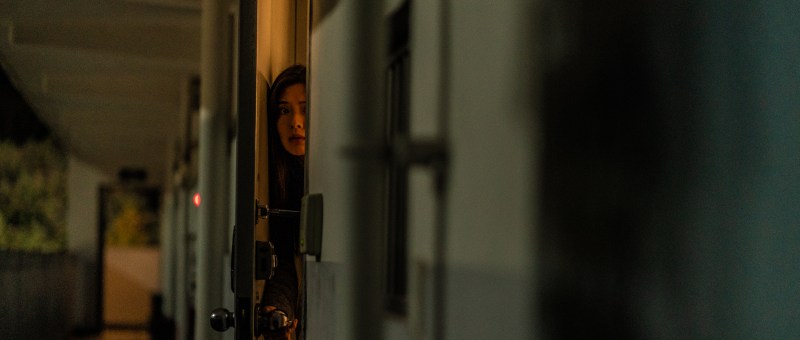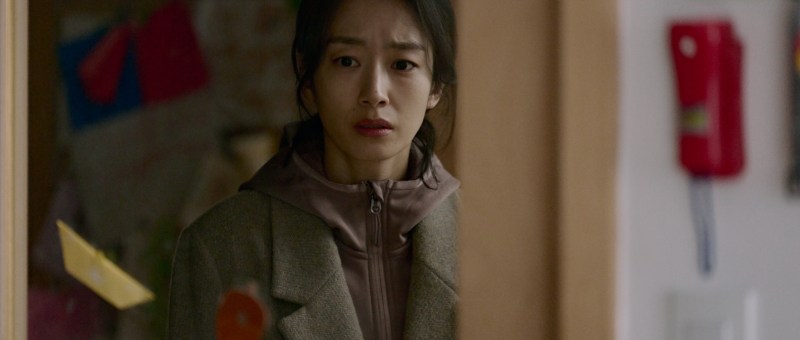
Noise (노이즈, Kim Soo-jin, 2024) [Fantasia 2025]

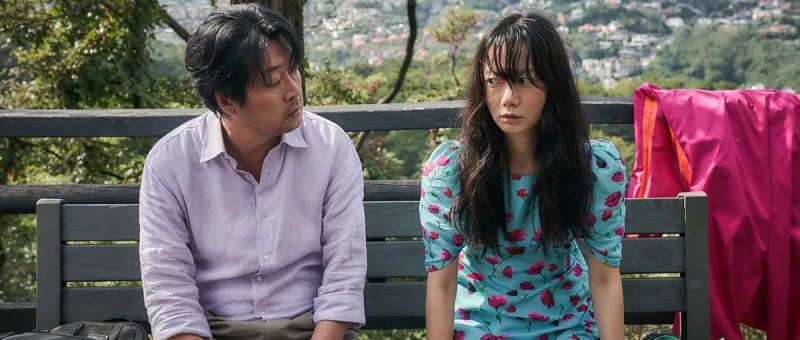
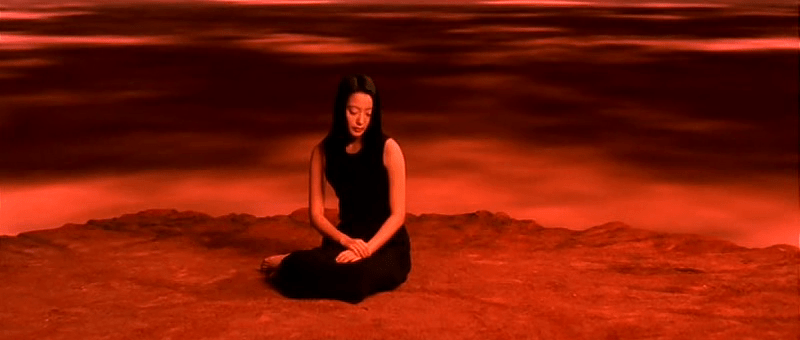
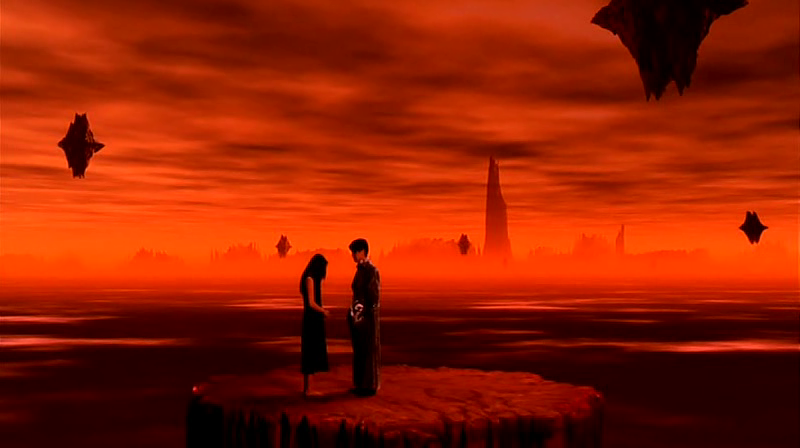
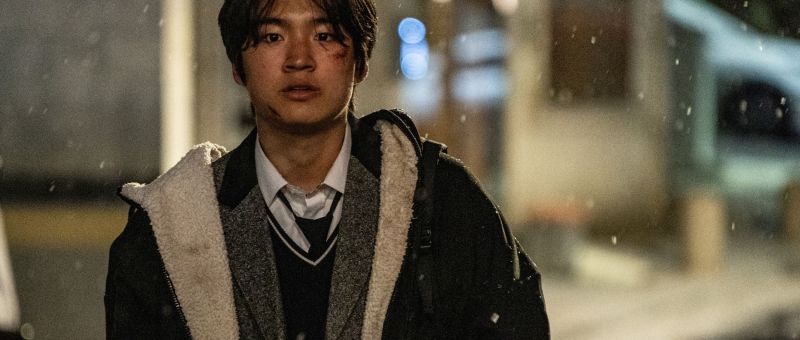
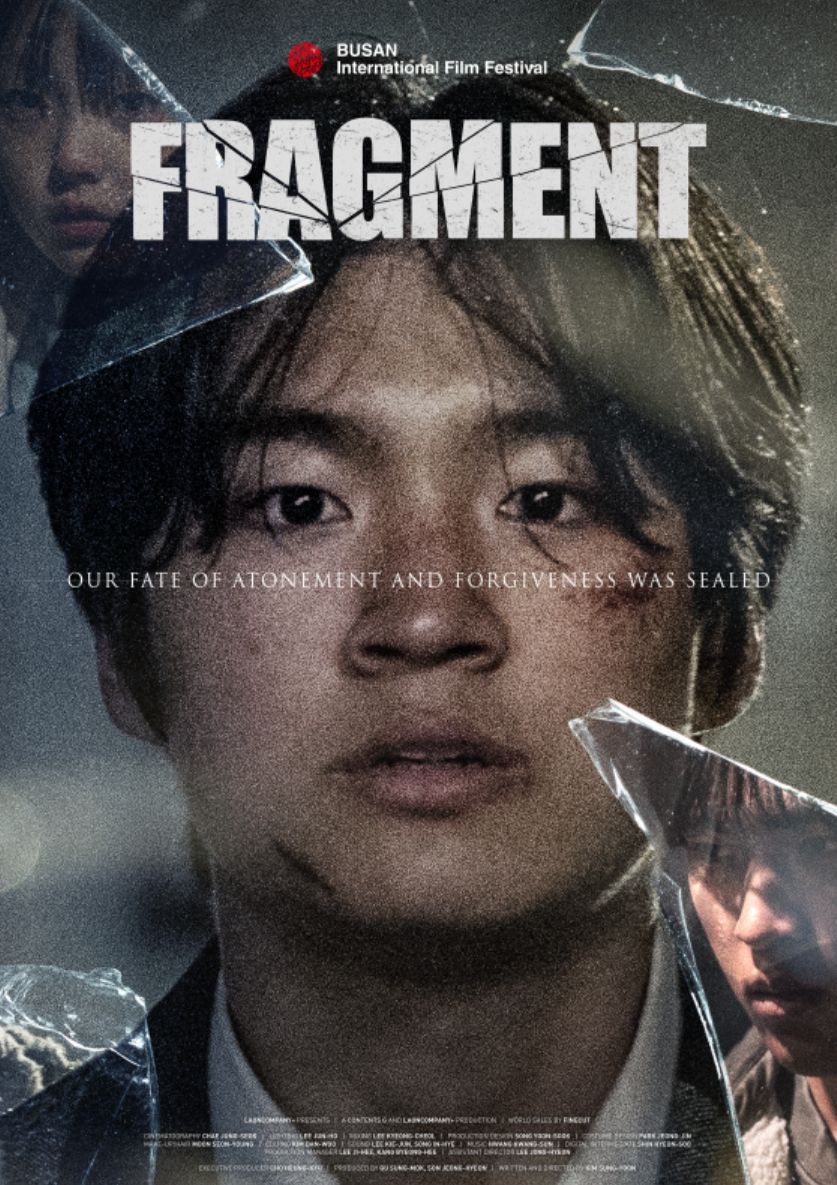
There are things you have to put up with if you live in an apartment block, and if you live in a city an apartment is often your only option. The question is, how much is it reasonable to expect someone to accept and what are the limits that can reasonably be placed on your own behaviour. What does it really mean to be a “good neighbour”? It’s clear the “noise” at the centre of Kim Soo-jin’s apartment block horror is not simply the sound of other people living, but a swarming cacophony of societal anxiety and persistent judgement.

There’s a large banner hanging off the side of this particular building that says residents don’t want to die inside their collapsing apartment block. Their fear hints the indifference of a society driven by capitalistic desires in which things like building regulations that ensure people’s safety and quality of life have become a thing of the past. The chairwoman of the residents’ association (Baek Joo-hee) is fiercely petitioning for the block to be knocked down and rebuilt properly, but that won’t happen if they don’t think they’ll be able to sell units in the new build because of untoward rumours about the old one. For those reasons, she doesn’t want people causing trouble or dragging up unpleasantness, which is why she’s not minded to help when Ju-young’s (Lee Sun-bin) sister Ju-hee (Han Su-a) goes missing after declaring that she was going to find the source of the “noise” within the apartment block that’s driving her and others out of their minds.

The interesting thing is that Ju-young is originally not particularly bothered by noise as she has a hearing impairment from a childhood accident and can simply remove her hearing aid to avoid it. Ju-hee asks her if she really can’t hear anything, or if it’s more like she chooses not to hear and goes about her life deliberately avoiding the “noise” of the contemporary society. There may be something in her criticism in that Ju-young, who works in a noisy factory, eventually moves out into the workers’ dorms to escape her sister’s increasingly erratic behaviour rather than stay to help her through her anxiety or actively look for somewhere less “noisy” they could live together in peace.

Hearing noise from above, Ju-hee bangs on the ceiling but inadvertently spreads the noise below as if a great flow of frustration and resentment were trickling down from top to bottom so that those nearest to the ground can barely hear themselves think. But there’s also a great stink rising from below given that the basement is home to a decade’s worth of illegally dumped rubbish. Rather than dispose of it, the security guard has simply chained up the doors but complains that for unclear reasons people are still dumping things through the broken window at the back, which no one is making an effort to fix. There’s so much “noise” that no one is really paying attention to the bigger things like missing women and fugitive killers, in part because they’re inconveniences that would prevent them upgrading their block or being able to sell up and move on. Yet paradoxically, the owner-residents blame everything of the renters insisting that they are inconsiderate because they don’t have a stake in the building’s future. 

The block itself becomes a kind of metaphor for a lingering authoritarianism with constant reminders that everyone can hear what everyone else is saying and is making less than silent judgements about the way their fellow residents live their lives. A woman drives herself crazy believing that she’s being a good neighbour by letting her child play outside so the noise won’t disturb anyone, only for them to be hit by a car and killed. The building has a haunted quality, as if everyone here were already dead and living in a kind of limbo. They complain about the noise, but ignore it when their neighbours are desperately asking for help. As Ju-young later advises, the way to continue living is not to listen and live your own life in your own way rather than give in to the petty demands of those around you who try to control your life because they know they can’t control their own. Driven out of their minds by the constant thrumming of social pressure, acts of violence are inevitable but as Ju-young traverses the dingy corridors and ill-lit stairways in search of her missing sister all while venturing deeper inside her own buried trauma, it becomes increasingly difficult to tell where exactly the threat may lie.


Noise screened as part of this year’s Fantasia International Film Festival.

Trailer (English subtitles)

Somebody (침범, Kim Yeo-jung & Lee Jeong-chan, 2024)

“A mother should do everything to protect her child,” according to one young woman, but are there, or perhaps should there be, limits even to a mother’s love? Adapted from a webtoon, Kim Yeo-jung and Lee Jeong-chan’s Somebody (침범, Chimbeom) is really about what it means to be a family and who it is that gets to be included in one more than it is about its otherwise outlandish premise or how we should deal with young children who have severe mental health issues accompanied by violent tendencies. 

Then again, as So-hyun (Gi So-yoo) herself says she isn’t like the others and in that sense not necessarily good or bad but only what she is. It’s obvious that she has no understanding of conventionally held notions of right and wrong and actively enjoys inflicting pain on others, perhaps because as she later says it’s when she feels people are being most honest. She’s only seven years old, but she’s already been expelled from several schools and nurseries for scaring the other children, and her mother now locks all the sharp implements away at night having previously woken up to So-hyun slashing away at her arms and legs. But in a paradoxical way, it’s abandonment that So-hyun fears the most in knowing that her mother cannot fully accept what she is, while Young-eun (Kwak Sun-young) does her best to “protect” her at the cost of her own mental and physical health. 

So-hyun’s parents’ got a divorce because her father felt she could be better cared for in an institution, while Young-eun was determined to care for her herself despite the fact that So-hyun’s behaviour is not improving even with therapy and she continues to be a threat to those around her. This is particularly true of other girls her age towards whom she becomes jealous when they approach her mother as if they meant to replace her in Young-eun’s affections and So-hyun would lose her home. The film’s Korean title translates more literally as “invasion”, and this fear of being pushed out and excluded that motivates the actions all concerned.

20 years later, we’re introduced to Min (Kwon Yu-ri), who is living with an older woman, Hyun-kyung (Shin Dong-mi), who lost her daughter, it’s implied to suicide, while her own mother lives in a psychiatric institution. Though she is reserved and emotionally distant, Min has taken the place of Hyun-kyung’s daughter only to find it threatened when they take on another young woman, Hae-young (Lee Seol), to help with their business clearing houses after lonely deaths. Min too fears invasion, that Hae-young has come to kick her out and take her place by monopolising Hyun-kyung’s position as their “mother” in this accidental “family” unit. Hyun-kyung too fears abandonment, knowing what it’s like to be left alone and only too happy to become a maternal figure to these two orphaned young women each in search of a place to belong.  

But there’s also a question mark over whether someone like So-hyun whose brain is wired differently can ever be accepted into a conventional family unit. She has no understanding of human empathy, but simultaneously longs to be loved and accepted and is resentful that she doesn’t feel herself to be even by her mother or other maternal figures whom she believes owe her all those things. Min too seems to have a dark past and on discovering that she has become pregnant by an apparently controlling and violent boyfriend struggles with the decision of whether to keep the child. She fears that she may turn out to be like her own mother and does not particularly seem to want to raise it, but at the same time reflects that the baby has done nothing wrong and therefore it’s unfair to prevent it from being born. 

So-hyun also insists that she’s done nothing “wrong,” though her understanding of what “wrong” means is obviously different from most people’s. She expects unconditional love from her mother, and Young-eun gives it to her to the best of her ability despite the fact that she is afraid of her daughter and ultimately at a loss as to how best to protect her and also the outside world. Though at times hamstrung by its webtoon origins, Kim and Lee’s handsomely lensed thriller explores this the irony in this need for maternal acceptance with a genuine sense of poignancy and more than a little sympathy for the “inhuman” So-hyun if also terror of the hell she creates around her in her constant quest to find a place where she can truly be herself.


Somebody screens 20th July as part of this year’s New York Asian Film Festival.

Trailer (English subtitles)

Dark Nuns (검은 수녀들, Kwon Hyeok-jae, 2025)

Large organisations have a tendency to gloss over inconvenient truths, but is it really in keeping with the teachings of the Church to ignore a confirmed case of demonic possession and allow a boy to die rather than admit that demons are real and members of the clergy are conducting successful exorcisms? According to Sister Giunia (Song Hye-kyo), a chain-smoking nun with a penchant for vulgar language, it is not, but she is largely hamstrung because of the ingrained misogyny of the patriarchal superstructure of the Catholic religion.

A spin-off from 2015’s film The Priests, Dark Nuns (검은 수녀들, Geomeun Sunyeodeul) goes in hard for the Church’s hypocrisy. As Giuna squares off against a powerful demon when taking over from two priests who’ve botched an exorcism on a teenage boy, it taunts her that the blood of all the demons she has slain will echo in her womb like a drum. There’s a suggestion that the existence of a nun is itself is an affront to God, as if a woman who has rejected her maternity and remained celibate is an aberration suggesting that a woman’s only proper role lies in motherhood. The fact that Giuna is later diagnosed with uterine cancer implies the same, as if she has cursed herself in her decision to serve God and become a bride of Christ. In her final confrontation with the demon, it tells her again that she will die of the tumour in her womb, a fact she already knows, but Giunia counters that she will exorcise the demon from this boy and use her womb to imprison it. Which is to say, she will kill him with her maternity and thereby fulfil her ideal role by becoming a “mother” to this demon, and symbolically to Hee-joon (Moon Woo-jin) the possessed boy, before condemning them both to the flames. 

This fact itself is ironic, as the council at the Church refused her request to conduct an exorcism because she is not ordained and “only” a nun. Of course, a woman cannot be ordained in the Catholic Church and the priesthood is open only to men. Her powerlessness within the organisation makes it easy for them to dismiss what she is saying while writing her off as a crazed devotee of the weird teachings of Father Kim, the priest from the earlier film. When they finally do give permission for an “unofficial exorcism” after Giuna has contacted the Rosicrucians in Rome to borrow some holy artefacts necessary for the ritual, the council inform her that the exorcism will be performed by Father Paolo (Lee Jin-wook). A sceptic who believes demonic possession is a psychological phenomenon not a spiritual one, Father Paolo is an odd choice but there is something quite moving and transgressive when in he fact takes off his priestly robes and places them over Giunia’s shoulders, ordaining her and acknowledging both that what she has said is true and that she is the only person who can carry out this exorcism. 

This is doubly true as Father Paolo had also tried to use the teachings of the Church to press another nun, Sister Michela (Jeon Yeo-been), by leading her to believe that her own spiritual awareness was a psychological illness that she should struggle to overcome through faith and medicine. It seems that Michela and other women like her may have found themselves retreating within Catholicism to reject the destiny of becoming a shaman while she herself was placed in a Catholic orphanage as a “cursed” child born between a human and a demon. Giuna had friend who was once a fellow nun but has now left to assume her true calling as a shamaness. The two remain good friends and often work together while Giuna is open to the presence of other gods and other forms of spiritual divination such as Michele’s talent with the Tarot. As such, all of these practices exist within a wider spiritual universe which is another challenge to the Church’s oppressive rigidity in its denial of folk beliefs and ancient traditions. After all, there is no real gender bias in shamanism, or if there is, it runs the other way for the majority of shamans are women. 

In any case, beating the demon requires everyone to work together for a common goal using, as the Rosicrucian father says, “all available means”. Through participating in the exorcism, Sister Michela begins to accept her own identity later continuing to work with Deacon Choi to track down the remaining 12 Manifestations while accepting Sister Giuna as a mentor figure. They are each in a way freed from the Catholic Church while simultaneously remaining inside of it as they progress with their mission of quieting the demonic forces at large in the world and protecting the innocent from their rippling evil. 


Dark Nuns is released digitally in the US July 15 courtesy of Well Go USA.

Trailer (English subtitles)

The Old Woman with the Knife (파과, Min Kyu-dong, 2025)

There’s an acute vulnerability that comes with ageing. It’s not vanity or mortality so much as your body betraying you as even once simple tasks become increasingly more difficult. When you’re an assassin, a loss of speed or dexterity is cause for concern and Hornclaw (Lee Hye-young) is beginning to feel her age. Her hands have begun to shake uncontrollably and as she admits to a stray dog she finds herself taking in, you forget things when you’re old. There are those in the office who have begun to notice that Hornclaw is not quite as she was and view her as a thorn in their side, a relic of an earlier era preventing them from moving on into a hyper-capitalistic future.

The original Korean title of Min Kyu-dong’s The Old Woman with the Knife (파과 Pagwa) is “bruised fruit”. An old woman working at a greengrocers throws in an extra peach for free because it’s damaged and people won’t buy them, which is silly, in her view, because they’re the best ones and always taste the sweetest. On that level, the film is about ageism and the ways older people are often written off as past their prime, but on another also about Hornclaw’s bruised but not quite buried heart and the hidden empathy that defines her life even as a contract killer. It may also in its way refer to her opposite number, Bullfight (Kim Sung-cheol), a hotshot young assassin recruited by her less ethically minded boss Sohn (Kim Kang-woo) who despite his sadistic cruelty is really just a hurt little boy looking for a maternal figure in the legend that surrounds Hornclaw. 

She was a stray dog herself until someone took her in and gave her a home, much as Bullfight is now looking for a place to belong. Hornclaw comes to identify with the dog she rescues, Braveheart, because as the vet says it’s awful to be abandoned when you’re old and sick, but perhaps also when you’re young and lonely. As her mentor taught her, having something to protect also makes you vulnerable while as you age the people you’ve lost return. Like her underling Gadget who sees visions of his late daughter, Hornclaw too is drawn back towards the past in seeing echoes of Ryu (Kim Mu-yeol), the man who saved her, in altruistic vet Dr Kang (Yeon Woo-jin).

There may be something disingenuous in the insistence that each of us must save the world coming from a band of supposedly ethical hitmen who only knock off “bugs” that are actively harmful for society. After all, who is making those decisions as to what constitutes “harmfulness”? Everyone Hornclaw takes out is indeed morally indefensible, but as she cautions Bullfight, when you start seeing people as insects you become an insect yourself. Sohn wants to reform the agency to take on more lucrative contract killing jobs such as taking out a wealthy man whose only crime appears to be being a cheating louse, while Hornclaw insists on sticking to their principles and only carrying out missions of justice which are the cases Sohn keeps turning down like that of a religious leader who has been abusing his followers. 

The vision of Hornclaw as a resentful avenger echoes that of Meiko Kaji in the Female Prisoner Scorpion series. Often caught in silhouette, she too wears a wide-brimmed hat that hides her eyes and aids anonymity, while she at one point gives her real name as “Seol-hwa” which means “snow flower” and hints at Lady Snowblood but also to her own moment of rebirth after being discovered half-dead in the snow and rescued by Ryu who gave her a purpose and sense of self-worth, not to mention a home. The irony is that Hornclaw ends up creating a monster because of her own repressed emotionality and is then unable to understand why this figure from the past has returned to her because her way of seeing the world only allows her to interpret it in terms of vengeance.

But what her new mission tells her is that having something to protect is in many ways the point and the very thing that gives her an edge over those who have nothing left to lose. Wresting back control over the agency, she vows to continue their mission as it’s always been rather than allow Sohn’s amoral capitalism to win out over justice and righteousness. Truth be told, the superhuman quality of Hornclaw’s movements is slightly at odds with the otherwise realistic tone of the rest of the film in which, as the secretary puts it, the weight of all the years is beginning to take its toll. But ironically it’s in closing her escape route that she finds true liberation in putting her ideas into practice in a more direct way while opening herself up to the world around her. There’s still life in the woman with the knife yet, and there are still plenty of bad guys out there along with a stack of files in need of attention, which is all to say retirement is going to have to wait.


International trailer (English subtitles)

Forte (포르테, Kimbo Kim, 2025)

A worried policeman nervously asks Yeonji (Im Chae-young) if the rumours are true. They say that everyone who works at Studio Forte ends up going mad or dying, but Yeonji has only just started working there herself and it’s too early for her to say whether that really is the case, though it’s true enough that the building has an eerie energy. Even a visiting film director remarks that the atmosphere is unusual, though it doesn’t seem to have put him off returning. The director, Jeonghwa (Lee Jung-eun), is one of the best after all which is why Yeonji took this job in the first place.

On arriving at recording studio Forte, Yeonji remarks that it seems like a great place for inspiration but the building itself is anything but inspiring. A block of concrete and glass, it stands ominously and incongruously in the middle of nature as a defiantly manmade structure intent on disrupting the natural order. It feels oppressive, rigid, and constraining. Not the sort of environment that best serves creative impulses despite the well-appointed interior with its modern design and copious light from the large windows. 

Yeonji walks the surrounding forest in wonder, but at the same time there’s something odd about it in a bewitching sort of way. Her colleagues seem to be haunting her, seemingly standing around and staring while she’s otherwise disappointed by the lack of faith Jeonghwa seems to have in her. At the first team briefin,g she neglects to give Yeonji anything to do and then tells her to help her colleague Haejoon finish his section of the score for an upcoming film. Only Haejoon already seems to be having strangely. He looks ill, and sometimes doesn’t even turn up for their work sessions to the point that Yeonji ends up working with another colleague, Dojin (Cha Se-jin), to get everything finished on time. 

“Everything that happened here is real.” Haejoon later says cryptically after screaming that something is “here” and means him harm. Yeonji begins having visions of the forest and an oily, muddy figure along with images of death and fire. In any case, even without the existential dread of lingering supernatural threat, it’s easy to see why this place might drive someone mad. Yeonji tries asking Dojin what’s happening with credits on the movie and he brushes the question off, replying only that Jeonghwa will sort it out, which sort of implies only she will actually be credited. When the director arrives for a test screening, Jeonghwa treats Yeonji like the tea girl and explains that she’s “new”, but the director asks for her opinion anyway and she gives it, honestly, though it contradicts Jeonghwa’s. The producer (Cho Sueun) claims she could tell that Yeonji wrote the tail end of the music because it was “different”, which gives her the feeling that her work may be good after all and that Jeonghwa is playing it too safe with her conventional approach. 

Though she had been somewhat mousy and earnest on her arrival, dressed in an elegant if constraining outfit, Yeonji gradually becomes bolder and wilder. She lets her hair down and dresses in darker, looser clothing while often talking back to Jeonghwa and contributing her own contradictory opinions. But in the end none of it matters. She realises that Jeonghwa is basically exploiting her, getting her to ghostwrite the score while taking all the credit. The director makes a drunken pass at her, and while confused by her reaction explains that this is her big opportunity. Both Jeonghwa and himself only got to where they are by playing the game, which means submitting oneself to this kind of quid pro quo. 

It stands to reason that Yeonji’s barely suppressed desires would eventually burst through as they eventually do in the bloody climax building towards a crescendo of emotion in which Yeonji appears to become smaller and smaller behind the piano as the music overcomes her as if she were possessed. Only now has she released her creative freedom, playing Jeonghwa’s piano with a furious abandon that threatens to burn the whole edifice to the gound. Drawing on 1970s folk horror in it its aesthetic the film has an intriguingly eerie, surreal sensibility deepened by its own unsetting score as the evil haunting the studio begins to make its presence felt if only in Yeonji’s mounting resentment towards an industry that does indeed view her as little more than an inconvenient ghost in the machine.


Trailer (English subtitles)

The Square (광장, Kim Bo-sol, 2025)

A young man with blond hair and blue eyes stands out in North Korea, though Isak speaks the language fluently, if with a Southern inflection, and tries to make friends with those around him but is generally kept at arms’ length by those who struggle to understand his motivations. As his boss tells him, foreigners are destined to be lonely, but that goes for the local community too. Constant observation has a curiously isolating quality, as if you were always under a spotlight with every word and gesture scrutinised for potential signs of dissidence, though ironically you are never really alone.

Set in the secretive Communist state, Kim Bo-sol’s melancholy animation The Square (광장, Gwangjang) is in many ways about the dehumanising effects of a surveillance state and the pressures of living in a society in which it becomes impossible to communicate with other people because every interaction has the potential to destroy your life. Everyone you meet is a potential enemy and betrayal lurks around every corner. To begin with, the perspective is Isak’s. He looks at North in the same way we do. Scenes familiar from North Korean travelogues such as the underground station and passages with social realist artwork featuring soldiers smashing capitalism dominate, but he also as an abstracted perspective in trying to reconcile this place with that of his Korean grandmother who followed his grandfather to Sweden before the Korean War. A Swede should eat Swedish food, she ironically tells him in a letter included with a care package full of tinned sausages, through he washes them down a few glasses of soju.

He tries to share them with Myeong-jung, ostensibly his interpreter though Isak is in the North to work as a translator himself and doesn’t really need one despite Myeong’s advanced skills in both English and Scandinavian languages. Myeong-jung always rudely rebuffs his attempts at friendship and appears displeased when Isak tells him he’s trying to get his stay extended. This is partly because of the tense situation, it would be difficult for Myeong-jung to be on friendly terms with a foreign diplomat without arousing suspicion, but also because Myeong-jung seems to have developed some genuine affection for Isak which makes his real job, monitoring him for signs of “harmful” behaviour, much more difficult. Myeong-jung lives in the apartment across the courtyard and has a camera trained on Isak’s window. Like the hero of the Conversation or the Lives of Others he’s become invested in Isak and has begun doctoring his reports to protect him after becoming aware that he has become romantically involved with a young woman who directs traffic for a living, Bok-joo. 

Asked why he tried to help him, Myeong-jung replies that perhaps he was just “lonely” though there is something of a homoerotic tension in his relationship with Isak. After Isak drinks too much on realising that the woman he loves has been disappeared, Myeong-jung steps out of the shadows to rescue him and Isak rests his head on Myeong-jung’s back as they ride home, just as Bok-joo had while riding behind Isak on his bicycle. If that really were the case, his love is as futile as Bok-joo’s or perhaps more so. In any case, he’s right when he calls Isak naive. If their affair were exposed, Bok-joo could be in a lot of danger. His pursuit of her is selfish, and perhaps if he really loved her, the most sensible thing would be to avoid seeing her again. Isak seems put out when Bok-joo tells him she won’t leave with him because she doesn’t want to leave her country or her family for the complete unknown, but were she to do so it would also be selfish. Her family would be made to pay in her absence.

Then again, the worst thing that happens to anyone in this film is being exiled from Pyongyang and other than their loneliness, they do not seem to be particularly unhappy in the North and have no real desire to leave though arguably that’s because they are already resigned its futility. Isak asks Myeong-jung why he doesn’t apply to travel with his advanced language skills but Myeong-jung brushes the question off and replies he’s barely been out of the city let alone another country though his interest in Isak maybe a reflection of his desire for the world outside of the North. Isak, by contrast, asks himself if he could stay in the North forever to live with Bok-joo and make the reverse decision his grandmother once made though in the end the decision is not really his to make. He has to accept that love is an impossibility under such a repressive regime let alone love between a citizen and a foreigner and that the division will forever keep them apart. Whatever choice his grandmother had, Isak does not have any. But despite the melancholy setting of Pyongyang in the snow, there is a kind of warmth to be found that these connections were made at all even as Myeong-jung spins his wheels, riding in circles like Isak and listening to the DiscMan Isak left behind like an echo of a far off freedom.


Trailer (English subtitles)

Winter in Sokcho (Hiver à Sokcho, Koya Kamura, 2024)

A young woman is awakened from a kind of spiritual hibernation by the unlikely arrival of an incredibly brusque French artist in Koya Kamura’s adaptation of the Elisa Shua Dusapin novel, Winter in Sokcho. Like many, Soo-ha (Bella Kim) is waiting for spring, though it’s less this place that has her feeling trapped than an inability to find her place within it, or indeed anywhere, as she struggles with her own identity and the unanswered questions about the father she never knew.

In any case, it seems clear that Soo-ha as begun to resent herself on some level and is unhappy in her long-term relationship with a high school boyfriend, Joon-ho (Gong Do-yu), an aspiring model. It’s not clear why shy returned to Sokcho after studying French and Korean literature in Seoul, but she otherwise lives her life in peaceful monotony working at a small boarding house where the owner, Mr Park (Ryu Tae-ho), has recently lost his wife and is therefore in need to practical and emotional support. One night a week she spends with her mother (Park Mi-hyeon), a fishmonger specialising in fugu, though there’s a frostiness and frustration to their relationship in which neither seems quite satisfied with the other’s life choices. 

Soo-ha repeatedly asks her mother why she never attempted to look for her father, a Frenchman who worked in the fishing industry, though her mother doesn’t really want to talk about, it leaving Soo-ha with unresolved doubts and questions about her past. Her interest in French literature may be a way of trying to explore this side of herself in the absence of a guide, though the attempts at connection a frustratingly one-sided. When a Frenchman suddenly turns up at the boarding house, Mr Park encourages her to use her skills “the one time they’re useful”, though she herself is reluctant, giving Yan (Roschdy Zem) the smallest room in the adjacent annexe like a thought paused for later.

Yan asks her to show him her Sokcho, but as he later says, he’s just a tourist and like the father she never met is just passing through. There may be something a little exploitative in his working visit for though he’s come to draw inspiration from this place, he is willing to give almost nothing to it. He refuses to eat the food that Soo-ha cooks at the boarding house and instead badgers her to take him to restaurants while finding little to like there either. As his incredibly outdated, paper driving licence isn’t valid in Korea, he talks her into taking him to the DMZ which seems to echo the liminal space that exists between them. Soo-ha talks about how sad it is that people still yearn to be reunited with their relatives all these years later, though Yan is indifferent and later mentions a son that it seems he may rarely see. But as he tells her, she may be looking in the wrong place if it’s a deeper connection that she’s seeking or searching for something that will unlock the secrets of herself.

There are reasons for her to feel displaced even in Sokcho given that her unusual height makes her stand out as the nickname “beanpole,” makes plain. Her mother nags her for never eating properly or enjoying her food which may be another expression of her listlessness, but also reminds her not to eat too much and get fat. Joon-ho tells her get plastic surgery, as do a few other people, and though it’s even more insensitive and troubling given that Soo-ha’s father was French. It’s as if they’re telling her to erase these parts of herself, as if she were not “fully” Korean and should become so by adjusting her jawline and the shape of her eyes. Soo-ha’s internal questioning is expressed in brief animated sequences in the style of Yan’s ink paintings as she tries to conjure the image of herself.

There’s a woman at the guest house who’s there recovering from extensive plastic surgery that will give her a whole new face. She sits in the dining area, simultaneously anonymous and instantly identifiable by her bandaged face. Her story is never revealed, so it’s impossible to say whether her decision was motivated by a desire for conformity and conventional beauty or to become more herself and have her outside reflect the person she feels herself to be. Sokcho is also undergoing a process of renewal, as high-rise office blocks spring up everywhere and the traditional quality of the streets disappears as if this urbanisation were creeping up on Soo-ha and taking from her even the anchor of this place which no longer quite exists. 

Joon-ho assumes they will move back to Seoul together when his career takes off because “who doesn’t want to get out of Sokcho?” But Soo-ha may be beginning to feel that perhaps this place might suit her after all. A few cosmetic upgrades could breathe new life into the old-fashioned boarding house and brighten an otherwise gloomy existence. While showing Yan around town she describes a local legend, or perhaps concocts one for the occasion, about a bird who wanted to fly above the clouds but couldn’t. She, meanwhile, may have begun to soar amid the arrival of spring, finally ready to break out of her self-imposed winter in having discovered a way to become more herself rather than what others perceive her be.


Trailer (English subtitles)

Yadang: The Snitch (야당, Hwang Byeng-gug, 2025)

A Korean prosecutor can make or break a president, according to the ambitious Ku (Yoo Hae-jin) making a final power play to put an arrogant chaebol son in his place. But Ku isn’t trying to make a stand for the rule of law so much as bend it to his own will while securing his position, because in the world of Yadang: The Snitch (야당) justice is largely illusionary while mediated through the complex interplay between the social and political elite, crime, and law enforcement.

The hero, Kang-su (Kang Ha-neul), makes this plain in explaining that the big drug busts that get the police into the papers are largely all orchestrated through the snitchery of yadang like himself, a set up in which low-level drug users are encouraged to become police informants in return for lenient sentences allowing the detectives to take care of the dealers. Perhaps that’s all very well, as detective Sang-jae (Park Hae-joon) says, there’s no point locking up hundreds of users because the supply is endless and it makes no difference to the business. Kang-su’s likening of them cockroaches is a little problematic, even if he has a point that if you want to get rid of the infestation you have to go in for the nest.

But it turns out the nest is in an unexpected place because the nexus of corruption is in the government and political system which has been infiltrated by wealthy businessmen looking to further their own ambitions through politics while their feckless children behave like princelings knowing they can do whatever they want and then ring their fathers to make whatever consequences might occur go away. Though the film doesn’t go too deeply into it, there is something in the fact that both Ku and Kang-su come from poor, single-parent families though the direction of their ambitions might be quite different. Ku has studied hard to become a prosecutor and escape his poverty, but has only 10 years to make it into the top ranks or be forced to resign. He exploits Kang-su’s desire for wealth and agency to help him achieve his ambitions but though he describes him as a brother, is all too ready to throw him under the bus once he’s no longer useful to him. 

For his part, Kang-su relishes his role within this ironic system as someone on the fringes of crime but also facilitating law enforcement without being manipulated by the police in the same way that their informants often are. Sang-jae swears to protect a young actress after picking her up in a bust if she helps him catch the kingpins but in the end he can’t do it, partly because of Ku, but also because at the end of the day his fellow officers have the same opinion of their snitches as Ku does his and aren’t terribly invested in their safety or wellbeing. After getting caught up in Ku’s showboating raid on a hotel where chaebol son Hoon is partying with yakuza drug dealers, Su-jin’s (Chae Won-bin) career is ruined and on her release she has only the drug scene to rely on with the consequence that she becomes an addict and a dealer herself.

But it was Hoon (Ryu Kyung-soo) that made her a user in the first place by spiking a drink and then went on to use his privilege to control her and make sure that she stayed within his orbit. Ambitious men like Ku make their deals and let the chaebol sons get away with their crimes, though his late in the game attempt to remind Hoon that he could ruin his father’s chances of becoming Korea’s next president if he chose to implies his own sense of worthiness that he is actually above this illusionary elite though he may be overestimating his reach. These three branches of branches of power operate in a symbiotic system and need each other to survive. Ku is only really a kind of Yadang himself, mediating between a social and political elite while enjoying only the illusion of power and independence. Hwang ups the action stakes with some high impact set pieces including that in which Kang-su uses the brute force of his Hummer to literally bulldoze a car full of drug dealers while the police chase after them with metal poles, but seems to suggest the real violence stems from the system if ultimately opting for an ironic buddy cop conclusion in which Kang-su uses his considerable skills in a more legitimate fashion.


Trailer (English subtitles)

Edhi Alice (에디 앨리스: 리버스, Kim Il-ran, 2024)

“I’m Alice, who is living in the present,” one of the two protagonists of Kim Il-ran’s documentary Edhi Alice tells the camera when asked to introduce herself. A transwoman in her 40s, Alice got her name from film director Lee Joon-ik while working on Dong-ju: The Portrait of a Poet, a film inspired by the life of a poet who died as a political prisoner yearning for freedom and authenticity in a Japanese jail during the colonial era. 

Freedom and authenticity are both things that Alice has found in her transition and is continuing to seek. As a child, she had a consciousness of herself as female until her sister remarked in a phone call that she was becoming a man after noticing that her voice was breaking. Surrounded by an intensely patriarchal society, Alice convinced herself to conform to common notions of masculinity, even getting married in an attempt to live as a man and prove herself as one by having a child. Only after the marriage ended did she begin to embrace her authentic self by undergoing surgery which, she points out, is somewhat unusual in that she chose to remove her genitals right away because she couldn’t bear to live with the reminder of her masculinity. However, she has avoided other kinds of medical interventions such as plastic surgery stating that she doesn’t see the point now that she is already in her 40s and has no plans to date. 

She does, however, live in a more liminal space in which her transness is not immediately apparent while working in a stereotypically masculine industry as a lighting director for film and TV in which, as she points out, her height and strength are definite advantages. Though she says she has not experienced much prejudice and discrimination while working on films, she reveals that she was dismissed from a TV project because the producers were “ultra-conservative” and did not want to work with her. Meanwhile, there’s a genuine poignancy in the crew’s visit to a public bath as Alice reflects that she probably won’t ever have the opportunity to visit one again, suggesting that she most likely won’t be admitted to the women’s bath given her gender presentation and fears may make people uncomfortable if she were. 

Edhi doesn’t have the same trouble, but has not yet completed her transition having visited a fortune teller and been advised to wait until a more auspicious time. Working as a councillor for LGBTQ+ youth, she assumed she must have been gay because she liked men but only later came to realise after joining an LGBTQ+ choir that the gay men around her did not experience the same kind of discomfort in their bodies and that she must be trans. But like Alice, she originally tried to conform to what it means to be a man in Korean society. When she tried to explain her identity to her mother, she had dismissed it by saying that it was only because she didn’t want to serve in the military. Trans people are not welcomed in the armed forces and Edhi reflects on the death of Byun Hui-su who fought for her right to serve by beginning her transition while on leave from military service. Her desire to continue being a member of the armed forces was denied and she was dismissed. She later took her own life.

While affected by the deaths of so many people around her who could not find a way to survive amid the intensely conformist pressures of Korean society, Edhi does her best to live her life while taking care of her parents and nephews. Though her father might use male pronouns and continue to refer to her as his son and her mother, though supportive, worries that she might regret her choices later, Edhi was surprised by the ease with which her nephews simply accepted her explanation of her transness and agreed that “Edhi is just Edhi,” agreeing to call her by her name rather than uncle or aunt. She fears being forgotten and regrets having thrown away photos of her other life but continues to pursue her dream of living in a house with her mother and opening a cafe. While never shying away from the physical pain involved in transitioning, the film reinforces the sense of liberation it can bring if tempered by the realities of life in contemporary Korea.


Edhi Alice screens at the ICA 18th May as part of this year’s Queer East.

Holy Night: Demon Hunters (거룩한 밤: 데몬 헌터스, Lim Dae-hee, 2025)

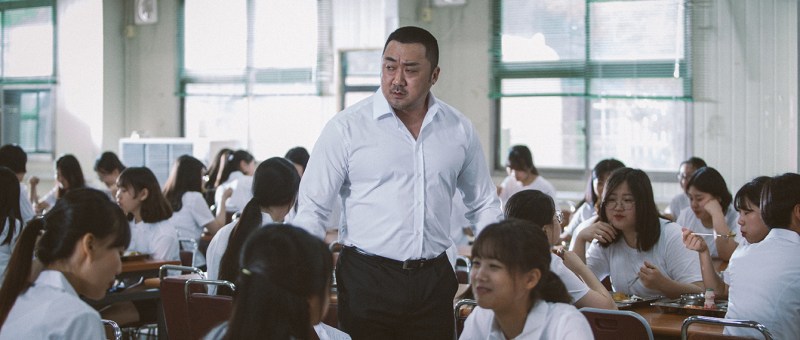
The mighty fists of Ma Dong-seok punch the Devil right back to hell in Lim Dae-hee’s supernatural action drama, Holy Night: Demon Hunters (거룩한 밤: 데몬 헌터스, Geolughan Bam: Demon Hunters). The latest in the long line of vehicles for the much loved star, the film is as much about its hero’s own demons as the more literal kind as he finds himself confronted by the past and his unresolved trauma while trying to save a young woman who seems to have been possessed by a powerful and malevolent supernatural entity.

Bow (Ma Dong-seok) runs a detective agency that specialises in supernatural crime and is often called in when the police run out of other options. He and his two assistants, Sharon (Seohyun), the exorcist, and Kim Gun (Lee David), the cameraman, are charged with a missing persons case that has links to a series of ongoing violent crimes apparently committed by “Worshippers,” or those who have chosen the dark side and are in league with the demons to “cause harm to people and spread evil”. Meanwhile, the team is also approached by a doctor, Jung-won (Kyung Soo-jin), who is at her wit’s end trying to treat her younger sister Eun-seo (Jung Ji-so). Eun-seo is currently being treated for schizophrenia but, Jung-won now suspects after taking advice from fellow doctor and Catholic priest Father Marco, she may actually be possessed.

The film’s worldview is indeed steeped in religion and though it doesn’t really get into it, there’s something a little discomforting in its positioning of Jung-won as a woman of science eventually forced to accept that her sister’s illness is demonic. Not only is the implication that those living with schizophrenia are inherently dangerous and, in fact “evil”, but also that they pose an ongoing threat as Bow fights off a corridor full of otherwise zombified patients who’ve been released from their cell-like rooms by the demonically empowered Eun-seo. 

Meanwhile, in contrast to other similarly themed Korean supernatural thrillers, the Catholic Church is presented uncritically as a source of infinite good and the only means of fighting the darkness the demons represent. The only note of uncertainty lies in Bow’s feud with Father Marco because he unwittingly appeased the demons after realising that Bow’s childhood friend Joseph, with whom he grew up in the same orphanage, is actually the incarnation of Lucifer. He chose not to say anything because he didn’t want to believe that Joseph could be “evil”. In any case, Bow’s trauma flows from the same source. He blames himself for being unable to stop Joseph when he attacked the orphanage, killing several children along with their shared maternal figure Sister Angela. Working with another nun, Sister Catalina, Bow is saving to open a new Catholic orphanage as a means of atonement while otherwise vanquishing other demons with his God-given gift, his fists.

It’s only in confronting his trauma that Bow is able to unlock his full power, which actually comes from the Devil, though he, like Sharon, has elected to use it for “good” rather than evil. Thus they are both in some sense fighting their darker impulses in rejecting the “evil” view of the world presented by the Worshippers who, the film suggests, very much walk among us in the guise of “good neighbours.” The film sets this cosmology up as a kind of comic book-esque universe and even slips into webtoon-style animation in the closing scenes as Bow takes on yet more ungodly forces and smacks them straight back to hell.

That said, there’s less of Ma Dong-seok punching bad guys than might be expected from this type of film, though there’s certainly room for his brand of deadpan, wisecracking humour that gives the team a lived-in feel even if they otherwise seem slightly underwritten as if this were the big-screen adaptation of a television series the viewer hasn’t seen. It also has less in common with previous exorcism dramas such as The Priests, The Divine Fury, or Devil’s Stay and seems to be influenced more by Hollywood films about demonic possession while otherwise taking visual inspiration from the Paranormal Activity series and ghost shows along with the odd J-horror jump scare. It also borrows J-horror’s technological anxiety in Eun-seo’s ability to make the digital signal twitch, though the film never particularly does very much with it. Nevertheless, it’s all carried along by Ma’s winning charm as an action star along with the committed performances of the cast even when not particularly well served by the material. 


Holy Night: Demon Hunters is in US cinemas now courtesy of Capelight Pictures.

International trailer (English subtitles)