Big Time Gambling Boss (博奕打ち 総長賭博, Kosaku Yamashita, 1968)

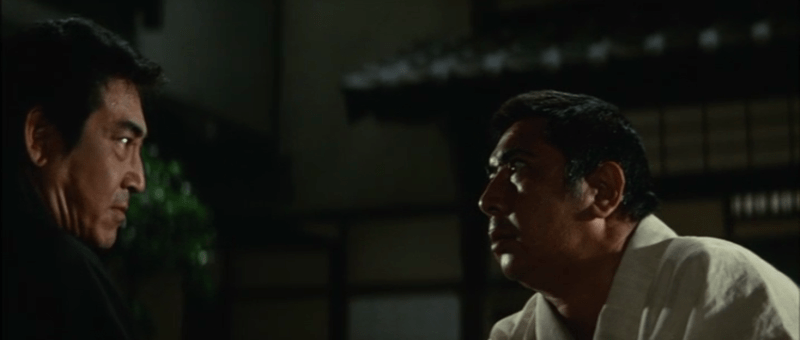
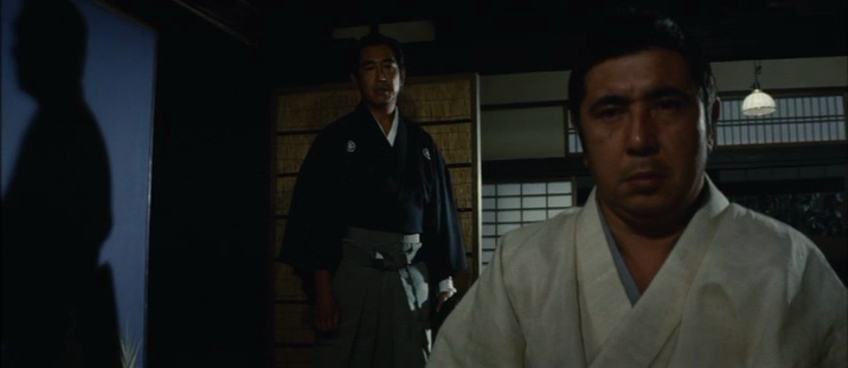
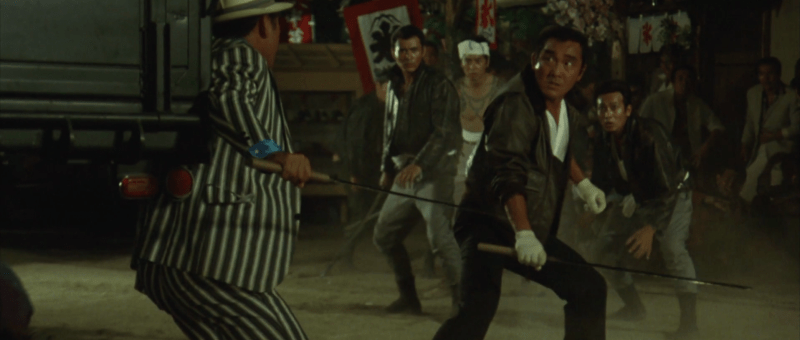
A Shakespearean tragedy of blood and honour, Kosaku Yamashita’s Big Time Gambling Boss (博奕打ち 総長賭博, Bakuchiuci: Socho Tobaku) discovers only fatalism and futility in the nobility of the yakuza code. The tragedy is that at any moment anyone could make a free choice to walk away, to abandon these arbitrary notions that convince them they must kill their friends and let their enemies go free, but they don’t because spiritually they cannot. Abandoning the yakuza code would in its own way a kind of death and mentally unsurvivable. 

There is however a greater tragedy in play. The film opens in the spring of 1934 with a villain remarking that it’s absurd to restrict oneself to one’s home terrified while a sword and the Japanese flag appear behind him. The catalyst for all this drama is Japan’s imperialist expansion. Yakuza fixer Senba (Nobuo Kaneko) and the shady Kawashima have hatched a plan to get all the yakuza clans to unite in a “patriotic” mission to traffic drugs to the frontlines looting as they go. Noble boss of the Tenryu Awakawa refuses, reminding them he’s just a simple gambling man and has no desire to get involved with politics before collapsing with a stroke. With Awakara alive but bedridden and no longer able to communicate effectively, the Tenryu decide to nominate a successor. The ideal candidate, Nakai (Koji Tsuruta), declines the offer on the grounds that he is a transplant from another gang in Osaka and thinks it would be inappropriate for an outsider to lead the clan. He proposes that his sworn brother, Matsuda (Tomisaburo Wakayama), should be appointed, though he is currently surviving a prison sentence so a caretaker should serve in his stead until his release. Most think this sensible though the proposed caretaker, Ishido (Hiroshi Nawa), also declines given the rules of seniority despite the fact that he is Awakawa’s son-in-law and so dynastic succession would also seem permissible. 

It’s during all of this finagling that Senba begins manipulating events to his advantage, gently manoeuvring the other lieutenants towards accepting Ishido as the new boss while he has no idea he’s being used as a pawn in Senba’s nefarious nationalist plotting. When Matsuda is released early, the entire situation kicks into overdrive in his outrage that the codes of rank have not been respected and that a man who is his inferior now sits at the head of the clan in a place he think’s rightfully Nakai’s but in light of his honourable refusal no one’s but his own. Even Matsuda later recognises his hot-headed recklessness in directly challenging Ishido over his decision to accept, insisting that the proper thing to do in his position would have been to persuade Nakai to take the job. Meanwhile, his own righthand man who’d been slumming it as a mere labourer in his absence, is dragged into intrigue in foolishly defending his honour by recklessly attacking Ishido’s men incorrectly believing they had provoked another gang’s attack on Matsuda little knowing it was all part of Senba’s plot. 

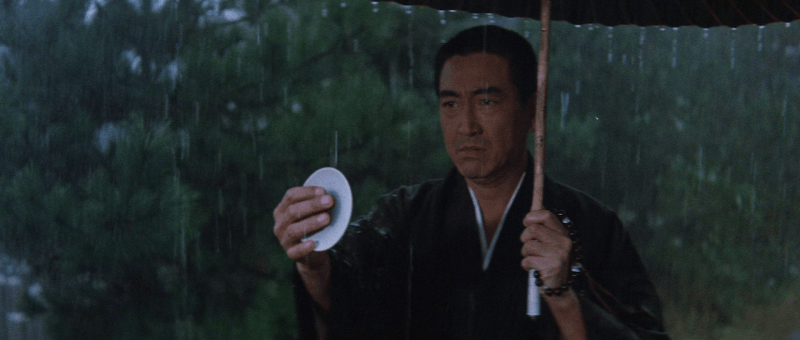
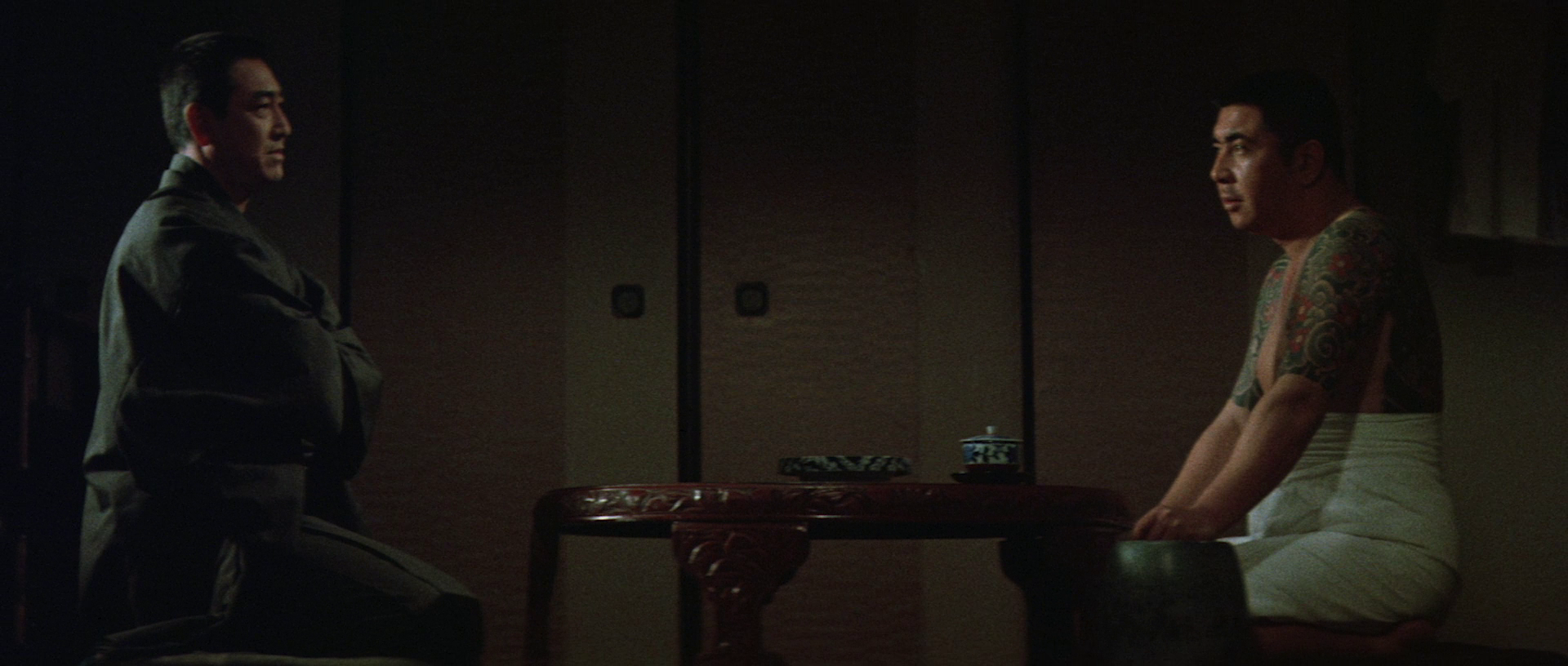
Nationalist trappings aside, Senba’s villainy is obvious from the moment he tells Nakai he thinks Matsuda was foolish for going to prison on the clan’s behalf and that he should have just found a scapegoat and put the blame on them, signalling himself a member of the new amoral yakuza who does not believe in giri and has no ninjo. Nakai rather is the opposite, as his old boss confirms in praising him for his correct decision to turn down the succession as it would not be right for him to accept as one who did not originate in their gang. Matsuda meanwhile pays too much attention to the letter of the code and not its spirit, obsessed with Ishido’s transgression and unable to let the matter drop to live a quiet life even as Nakai tries to convince him that the decision has been ratified by the lieutenants and the boss and so he must obey it. In a poignant moment, Nakai brings out the cup they used to seal their friendship and tells him that he will choose the clan, breaking the cup if Matsuda does not agree to accept a minimal degree of humiliation in returning with the intention of lying low and subtly reminding him that if he does not Matsuda will be placing a heavy burden on him that he may be forced to inflict lethal violence on his best friend and in fact brother-in-law. Realising the gravity of the situation, Matsuda immediately backs down, but events are now in motion that neither of them are capable of stopping. 

Of course, they could walk away but they don’t. Nakai offers the opportunity to Matsuda’s remorseful foot soldier Oto, telling him to leave the clan and take the woman he loves far away to live a peaceful life but of course he can’t because of his debt of loyalty to Matsuda. They are all trapped by the code which they follow and the villains ignore, laughing at them all the way. Then again, that’s what men like Nakai are for, born to set things right even if it comes at great personal cost. Even he finally snarls that he’s merely a murderer, rejecting any sense of honour in his actions while throwing a sword at the symbol of the system which has defined his life and submitting himself to the automatic operation of law of the state as a kind of martyr for system in which he may no longer believe. 


Trailer (English subtitles)

The Tattooed Hitman (山口組外伝 九州進攻作戦, Kosaku Yamashita, 1974)

The close brotherhood between two men is disrupted by changing times in a more contemporary gangster drama from Kosaku Yamashita, Tattooed Hitman (山口組外伝 九州進攻作戦, Yamaguchi-gumi gaiden: Kyushu shinko-sakusen). As many are fond of saying, times have changed and the yakuza must try to change with them or else meet a melancholy end. But as the hero admits, change is something he has no intention of doing even as his old school gangsterism leaves him increasingly at odds with the corporatising ways of the contemporary yakuza. 

The change in the times is obvious from the film’s opening sequence set in 1957 in which an attempt is made on the life of petty boss Ishino (Tatsuo Umemiya) by a gunman who shouts “die, for the good of the world” before firing a pistol and running away. Ishino has been targeted in a dispute over construction rights connected with the regeneration of hot springs resort, Beppu. The hit seems to have been ordered by rival gang, Sakaguchi (Eizo Kitamura), the leader of which is also a prominent local politician who is content to abuse his power for his own financial gain. So confident is he in his safety, that Sakaguchi even gets the police involved rather than deal with it himself. 

Ginji (Bunta Sugawara) has been Ishino’s sworn brother since their teenage delinquent days and determines to get revenge by raiding the Sakaguchi offices and killing one of their high ranking officers. Seeing as he’s already wanted by the police for a previous murder, Ishino sends Ginji to Osaka to lay low while working for an associate, Daito, mainly as a debt collector. It’s this act of separation which introduces a rift between the two men. While Ginji waits patiently to be recalled, Ishino climbs the ranks of corporatised gangsterism by learning to play by the new rules. 

To fill the void, Ginji takes on a new “brother” or perhaps surrogate son in the wayward Ken (Tsunehiko Watase) whom he first meets cheating at pachinko at a parlour where his pregnant wife Fusako (Mayumi Nagisa) is working. It’s Ken who first drags him into a brewing turf war as Korean gang Soryu threaten to disrupt the local equilibrium not least by selling drugs of which Ginji does not approve. Ginji “saves” Ken from joining Soryu by essentially making him his one of his guys though he doesn’t really have much of a position in Daito’s gang, offering him a sense of grown-up responsibility by handing him a pistol with the only the instruction to make sure he shoots with two hands. Unfortunately, Ken will follow his advice but otherwise ends up almost causing an incident with another gang by shooting a man who disrespected him in the street. Ginji marches straight down there to sort things out, but on arrival discovers an arrangement has already been made with his boss which further strains his sense of pride and confidence in his position as a yakuza.

Ginji feels something similar on being invited to a party to celebrate Ishino’s promotion only to be seated with the lowly footsoldiers and ignored by Ishino all night. Ishino rejects him still further in agreeing to plan to send him back to Kyushu out of the way hoping that his old school hotheadedness can finally be tempered. Others meanwhile voice concern that Ginji may have forged a relationship with rival Kobe gangs during the 18 months he abruptly disappeared from Osaka and has only come back to cause trouble. Ginji perhaps knows that he has no more future in the contemporary society, others remarking that seems like someone who is in a sense already dead for having accepted that he will die and most likely in Hakata, the town he had wanted to conquer with Ishino who had crushed his dreams in his newfound pragmatism by calmly explaining that they would never have the power to take it. 

Koji Takada’s screenplay positions Ginji’s gradual decline as an allegory for the yakuza himself while citing the new legislation that this particular series of incidents made necessary creating the new offence of assembly with dangerous weapons as a decisive moment in weakening the yakuza as an institution. Ginji remains a man displaced by his times unable to move forward into a new society in the way that Ishino has but stuck in a permanently post-war mentality despite the constant reminders that “times have changed”. Yamashita adopts the trappings of the jisturoku drama with frequent references to real life events and narrative voiceover but otherwise maintains his classicist formalism while ending on a note of ambivalence that tells us a certain kind of justice may have been served but the cycle of violence may not yet be completed.


Original trailer (no subtitles)

Father of the Kamikaze (ゝ決戦航空隊, Kosaku Yamashita, 1974)

By the mid-1970s, Japanese cinema at least had become much more comfortable with critiquing the wartime past, considering it from a greater distance than the often raw depictions of war in the films from the previous two decades. 1974’s Father of the Kamikaze (ゝ決戦航空隊, A Kessen Kokutai), however, is among the few to skew towards the nationalist rather than the ambivalence or simple anti-war messages of other similarly themed films of its era. 

Starring ninkyo icon Koji Tsuruta who served in the air force himself, the film is a kind of biopic dedicated to Admiral Onishi who oversaw the kamikaze operations at the end of the war. As is pointed out, Onishi had been against the war in general terms even before its inception and is originally against the philosophy behind the kamikaze squadrons but as Japan’s fortunes continue to decline he becomes its biggest advocate citing a kind of sunk cost fallacy that it would be in someway unfair to the men that have already died to surrender while insisting that suicide missions are the only feasible way to turn the tide because one kamikaze could take out a hundred men by destroying battleships singlehandedly. 

The film in part attributes this extreme solution to the prevailing with your shield or on it philosophy of the contemporary society which placed extreme shame on the act of being taken prisoner. In the prologue that opens the film, a squadron of downed pilots whose heroic deaths have already been recorded is discovered alive in an American prisoner of war camp but as being a prisoner of war is so shameful and would reflect badly on the military, the decision is taken to fix the books by sending the men on a mission from which they are not intended to return. Onishi is opposed to the plan, he asks why they can’t find a way for the men to live, but the decision is already made. In any case, he describes the action of a suicide mission as a “beautiful ideal” even when insisting that a war cannot be fought in that way not least for purely practical reasons in that they do not have the resources to be wilfully sacrificing skilled pilots and their planes. 

Having come round to the idea, however, Onishi is a crazed zealot who cannot accept the idea of surrender and even goes so far as to barge into a cabinet meeting to urge ministers against a truce even though the war is clearly lost. To his mind, the only way to honour the sacrifices of those who’ve died is to fight to the last man. Kozono (Bunta Sugawara), another officer opposed to the kamikaze, eventually meets a similar fate in refusing to obey the order to lay down his arms and ending up in a psychiatric hospital. His objection had partly been that it’s wrong to turn men into ammunition, but also that the kamikaze project is itself defeatist and self-defeating when there are men such as himself who are committed to fighting on.  

In this the film leans into the image of militarism as a death cult in which dying for the emperor is the only noble goal of the whole imperial expansion. In its eventual lionising of Onishi’s image, his bloody suicide atop a white cloth resembling the flag of Japan while his parting words scroll across the screen in text, it does not shy away from his more problematic aspects in which he fails to object to a request from a junior officer that soldiers should be allowed to test their swords on American prisoners of war, roundly telling a subordinate who breaks protocol to insist that such a thing is not only morally wrong but will ruin their international reputation that he has no need to think of consequences because Japan will win this war. He claims to want to find a way of defeat that will satisfy the living and the dead, but in reality cannot accept it not least in that it would entail admitting that he sent 2600 young men to their deaths for nothing. 

Tsuruta brings the same level of pathos to his performance as he did in playing conflicted yakuza stoically committed to a destructive code, but there’s no getting away from the fact that the film focuses mainly on Onishi’s personal suffering as a man who sent other men to die for a mistaken ideal and then could not admit his mistake offering an apology only in his death in which he urged the young people of Japan to work to rebuild the nation in the name of peace. In switching to the present day and showing us Onishi’s dilapidated former residence and in fact the room in which he died with its tattered shoji and peeling paintwork, he veers towards the nationalistic in uncomfortably reinforcing the nobility of his death rather than the folly of war or absurdist tragedy of the kamikaze programme. Adopting a quasi-jitsuroku approach with frequent use of onscreen text, a narratorial voiceover, and stock footage of kamikaze in action Yamashita may portray war as madness in Onishi’s crazed devotion but cannot help depicting it as a “beautiful ideal” even in the undignified violence of Onishi’s ritual suicide. 


The Pledge (博奕打ち外伝, Kosaku Yamashita, 1972)

The gangster code slowly consumes series of men each trying to do the right thing but hamstrung by the actions of others in Kosaku Yamashita’s yakuza tragedy, The Pledge (博奕打ち外伝, Bakuchiuchi Gaiden). It is indeed a promise between brothers which damns them all, but the roots of it lie in repressed emotion and a desire to protect other people’s feelings by keeping a destructive secret while trying to satisfy oneself that one has behaved properly even if no one else understands. 

The battleground is Wakamatsu, Kyushu, where outsider Egawa (Koji Tsuruta) has united the local boatmen and is undercutting the prices of a rival gang led by Omuro (Tomisaburo Wakayama). While Omuro is out of town, his right-hand man Taki (Hiroki Matsukata) has decided to take advantage of a minor squabble between some of his guys and Egawa’s to initiate a small scale turf war hoping to take the river back under their control. He does this by kidnapping Egawa’s younger brother Masakazu (Goro Ibuki) to lure him to their headquarters alone, something of which Omuro does not approve on his return but decides to go with as an excuse to bring his rivalry with Egawa to a head. Just as the pair are squaring off, a mutual friend, Hanai (Ken Takakura), arrives and intervenes convincing the two men to lay down their arms for the moment at least.

It could be argued that it is this interrupted fight that is resolved in the film’s conclusion if only by inexorable fate. In a repeated motif, Omuro keeps to the code and is exasperated and disapproving of Taki’s underhanded tactics but accepts the responsibility for them himself knowing that Taki acted only on his behalf and his recklessness is only an expression of his love for him. There is indeed something homoerotic in the relationship between the two men as Omuro cradles a wounded Taki and attempts to comfort him that the fault is all his own, while resolving to accept Taki’s actions and build on them rather than try to deescalate or try to apologise. 

The real crisis occurs when the boss, approaching 60 which represents the full circle of a life, decides to name Omuro as a successor rather than the anticipated Hanai. Hanai stoically accepts though intending to leave the gang and travel to another part of Japan but other members of the clan are perplexed, little understanding the boss’ decision in feeling that Omuro is not of good character whereas Hanai is easily the better choice. As it transpires, the boss has made his decision deliberately in order to mitigate the fact that Hanai is secretly his illegitimate son whose origins he has kept secret in deference to his legal wife. He chooses not to name him as a successor in order to avoid causing him problems in his later life while justifying himself that he has not made the decision for dynastic reasons or out of simple favouritism. Yet the relationship between the two men, father and son, is raw and painful if founded on a deep understanding that leaves them unable to meet each other directly with emotional honesty. 

Because of his father’s decision, Hanai forces Egawa to promise that he will not antagonise Omuro which leads to problems in his own gang with his men angry and confused, unable to understand why Egawa is letting Omuro walk all over him. Compounding the problem, Egawa’s errant brother Tetsu (Bunta Sugawara) returns unexpectedly and as Egawa cannot tell him about the pledge without disclosing Hanai’s secret, thinks his brother is being messed around and raids Omuro’s offices to reclaim money he had extorted from Egawa. He learns the truth from devoted geisha Hideko (Yuko Hama) who is deeply in love with Egawa yet largely unable to act on it again because of the gangster code while pledging that she’d sooner die and prove her devotion to him than summit herself to Taki, who is also in love with her, even when he threatens her with a knife. 

The yakuza code dictates that Omuro must die though he is little more than a passive antagonist all too willing to accept the evil deeds that Taki did on his behalf because of the code of loyalty though he would not have dared to do them himself. Secrecy and repressed emotion drag all into a dark web of self-destructive violence until reaching their inevitable conclusion and perhaps bringing one cycle to a close if only in the birth of another. 


Original trailer (no subtitles)

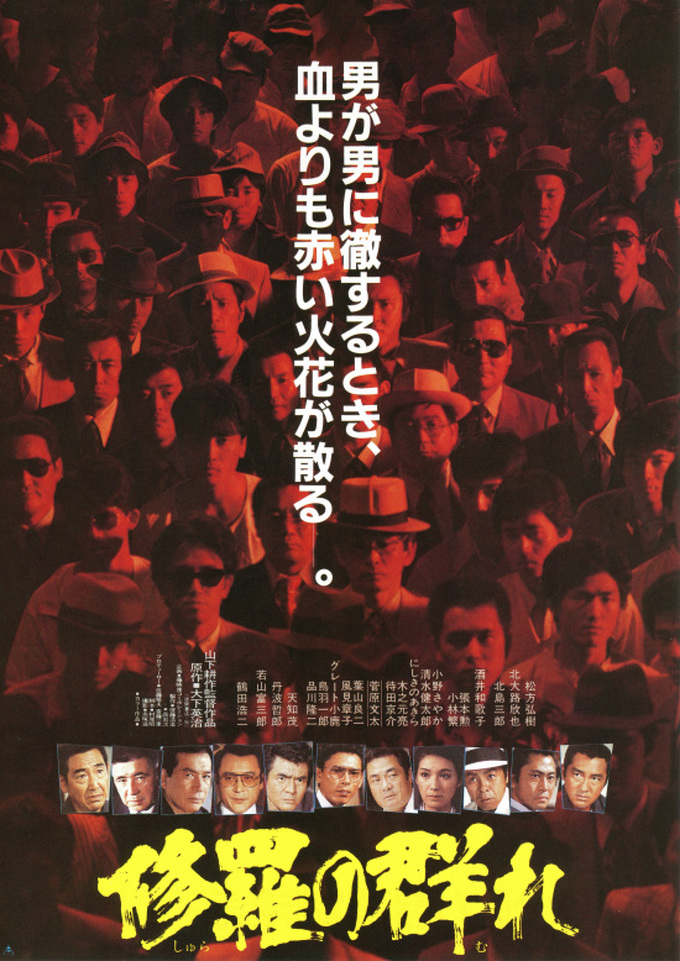
The Story of a Man Among Men (修羅の群れ, Kosaku Yamashita, 1984)

The ninkyo eiga, chivalrous tales of noble gangsters standing up for the little guy with decency and honour, had been Toei’s mainstay throughout the 1960s but a decade later the image of righteous yakuza had been well and truly imploded by the advent of the jitsuroku or “true account” movie which drew inspiration from real life tales of post-war gangsterdom using voiceover narration and onscreen text for added authenticity as it proved once and for all that there was no “honour and humanity” to be found in the gangster life only nihilism and futility. Still, the ninkyo, like many of its heroes, proved hard to kill as 1984’s Story of a Man Among Men (修羅の群れ, Shura no Mure) perhaps proves. A throwback to an earlier era with its infinitely noble hero and unexpectedly if not quite happy then defiantly positive ending, Kosaku Yamashita’s manly drama nevertheless adopts some of the trappings of the jitsuroku in its infrequent use of voiceover and emphasis on concrete historical events. 

The hero, Ryuji Inahara (Hiroki Matsukata), is like many heroes of post-war gangsterdom an orphan though his story begins in the mid-1930s as he’s recruited by a friendly yakuza at a karate dojo. As his teacher explains, Ryuji has already been offered a job with the police but given the chance to join the other side instead immediately agrees, explaining that his life’s ambition has been to gain revenge against the force that ruined his father and destroyed his family, gambling. He chooses to do this, however, not by destroying gambling dens everywhere but by becoming a gambler himself determined to be a winner which is, it seems, a textbook example of having learned the wrong lesson. Still, his noble gangster cool stands him in good stead in the yakuza world where he quickly earns the loyalty of other men, rapidly advancing up the ranks to head his own gang by the crime heyday of the mid-1950s. 

As the title implies, this is a story of a man, a very manly man, among other men. The gangster world is intensely homosocial and founded on ideas of brotherhood and loyalty. Thus, Ryuji finds a surrogate father figure in fellow gangster Yokoyama (Koji Tsuruta) who constantly gives him advice on what it is to be a proper man. “Don’t be a fool, don’t be too smart, and most of all don’t be half-hearted” he advises, later adding “you can’t be a man if you’re dirty about money”, and “taking action isn’t the only way to be a man. It takes a man to have patience.” (this last one as Ryuji hotheadedly discharges himself from hospital to get revenge on a punk who got the jump on him outside a shrine). To be a man, Ryuji intervenes when he sees some less than honourable young toughs hassling an old couple running a dango stand at the beach and the young woman from the caramel stall next-door, throwing his entire wallet on their counter to make up for the damage in what will become something of a repeated motif. His manliness earns him the eternal devotion of the young woman, Yukiko (Wakako Sakai), who eventually becomes his devoted wife against the will of her concerned mother who is nevertheless brought round on realising the love she has for him because of his intense nobility. 

Indeed, Ryuji lives in a noble world. He’s a gambler by trade but only because he hates gambling and is trying to best it. He doesn’t participate in the seedier sides of the yakuza life such as drugs or prostitution and is also in contrast to jitsuroku norms a humanist who defiantly stands up against racism and xenophobia, taking another gambler to task for using a racial slur against a Korean opponent while opting to befriend the “foreign” gangs of Atami when eventually put in charge of the lucrative area rather than divide and conquer. This is apparently a lesson he learned from his flawed but goodhearted father who hid a Korean man and his daughter from the pogroms after the 1923 earthquake because “we’re all the same human beings”. Spared the war because of an injury to his trigger finger, Ryuji kicks off against an entitled son of a gang boss for acting like a slavedriver while working at a quarry but earns only the respect of his superiors further enhancing his underworld ties because of his reputation as a standup guy willing to stand up to oppression. 

Such an intense sense of uncomplicated righteousness had perhaps been unseen since the ninkyo eiga days, and Ryuji’s rise and rise does in that sense seem improbable as his goodness only aids his success earning him the respect of over 1000 foot soldiers even as he finds himself in the awkward position of having to exile one of his most trusted associates for getting too big for his boots and disrespecting the yakuza code. His children also suffer for their connection to the gangster underworld, but are reassured that their father is a good man if with the subtle implication that he has damned them as his father did him. Shot with occasional expressionist flourishes such as crashing waves or a midnight sky, A Story of a Man among Men is not free from manly sadness and indeed ends on the sense of a baton passing from one era to another but does so with an unexpected sense of moral victory for its righteous hero who vows to bring his manly ideas with him into a new age of gangsterdom. 


Original trailer (no subtitles)