Samurai Hustle Returns (超高速!参勤交代 リターンズ, Katsuhide Motoki, 2016)

At the conclusion of 2014’s Samurai Hustle, it seemed that samurai corruption had been beaten back. Corrupt lord Nobutoki had got his comeuppance and the sympathetic “backwoods samurai” Naito was on his way home having found love along the way. Of course, nothing had really changed when it comes to the samurai order, but Naito was at least carving out a little corner of egalitarianism for himself in his rural domain. 

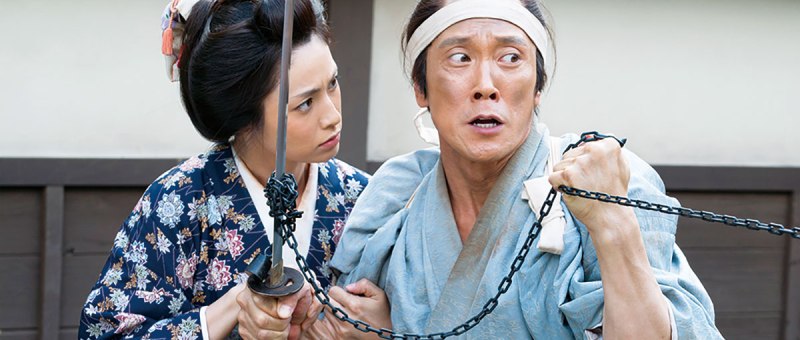
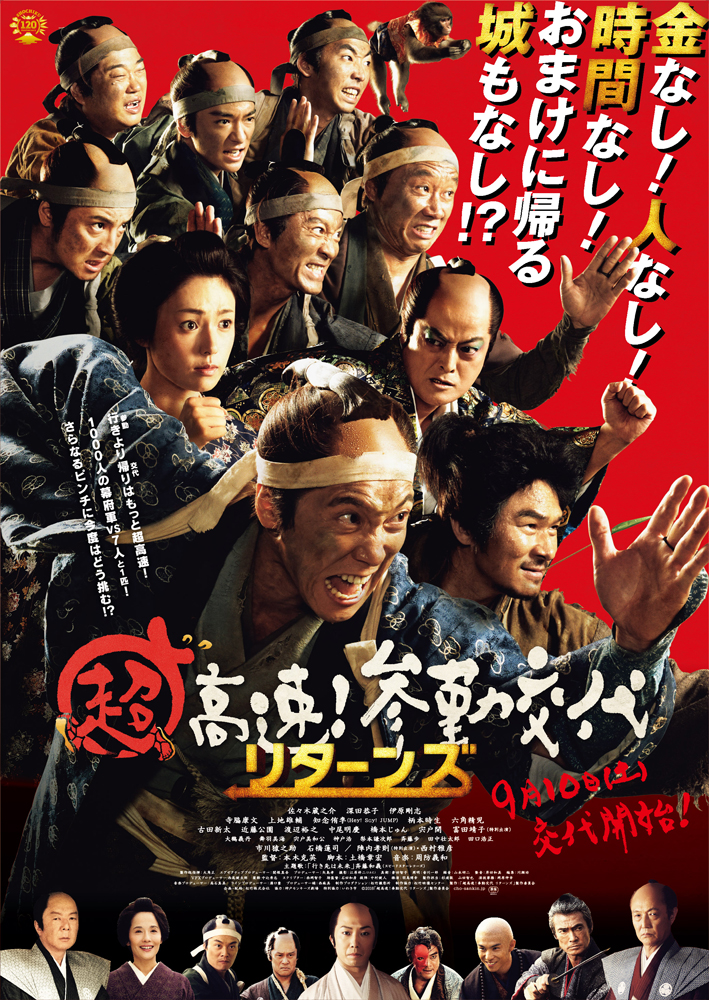
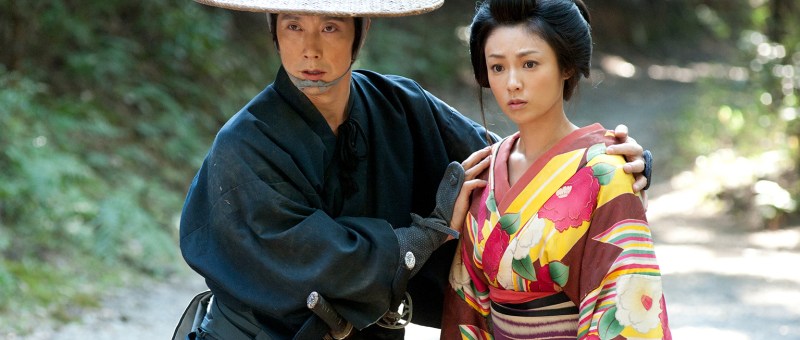
The aptly named Samurai Hustle Returns (超高速!参勤交代 リターンズ, Cho kosoku! Sankin kotai returns) picks up a month later with Naito (Kuranosuke Sasaki) taking a rather leisurely journey home in preparation for his marriage to Osaki (Kyoko Fukada) only to receive news that there has been a “rebellion” in Yunagaya. Predictably, this turns out to have been orchestrated by none other than Nobutoki who has been released early from his house arrest thanks to his close connections with the shogun but has been humiliated at court and is otherwise out for revenge with a slice of treasonous ambition tacked on for good measure. Just as in the first film, but in reverse, Naito and his retainers must try to rush home to get there before the imperial inspector arrives or else risk their clan being disbanded. 

Meanwhile, the shogun is absent at the wheel after having decided to resurrect an old tradition abandoned because of its expense and inconvenience to make a pilgrimage to Nikko. In an interesting parallel, the farmers are uncharacteristically upset with Naito, blaming him for the destruction of their fields because he wasn’t there to protect them. Naito also feels an additional burden of guilt given that, having run flat out all the way to Edo, he took his time coming back leaving his lands vulnerable to attack while he now risks losing the castle. Nobutoki wastes no time at all looking for various schemes to undermine him while secretly plotting to overthrow the shogun and usurp his position for himself. 

As in the first film, the battle is between samurai entitlement and the genial egalitarianism of Naito’s philosophy. “The real lords of Yunagaya are people like you who are one with the soil,” he tells the farmers, while Nobutoki sneers that “lineage rules supreme in this world, inherited wealth breeds more”. It doesn’t take a genius to read Nobutoki’s machinations as a reflection of his insecurity, that he invests so much in his rights of birth because he has no confidence in his individual talents. Naito counters that it’s the people around him that matter most, “people are priceless. Friends are priceless,” but Nobutoki rather sadly replies that people will always betray you in the end. Even the shogun eventually agrees that “anger brings enemies, forbearance brings lasting peace” but treats Nobutoki with a degree of compassion that may only embolden him in his schemes.

“Nepotism has endangered the shogunate,” the shogun ironically sighs apparently lacking in self-awareness even if beginning to see the problems inherent in the samurai society but presumably intending to do little about them. “No government should torment its people,” Naito had insisted on boldly deciding to retake his castle but even if this particular shogun is not all that bad, it’s difficult to deny that his rule is torment if perhaps more for petty lords like Naito than for ordinary people or higher-ranking samurai. Naito struggles to convince Osaki that she is worthy of his world and only finally succeeds in showing her that she has nothing prove and love knows nothing of class. The people of Yunagaya are impoverished but happy, satisfied with the simple charms of pickled daikon unlike the greedy Nobutoki whose internalised sense of inadequacy has turned dark and self-destructive. 

Then again, Naito is still a lord. He obeys the system out of love for his clan and a genuine desire to protect those around him but otherwise has little desire to change it actively even if his quiet acts of transgression in his closeness with the villagers and professions of egalitarianism are in their own way a kind of revolution in a minor rejection of the shogun’s authority to the extent that the time allows. Nevertheless, with his return journey he once again proves the ingenuity of a backwoods samurai getting by on his wits as he and his men race home to save their small haven of freedom from samurai oppression from the embodiment of societal corruption.


Trailer (no subtitles)

Samurai Hustle (超高速!参勤交代, Katsuhide Motoki, 2014)

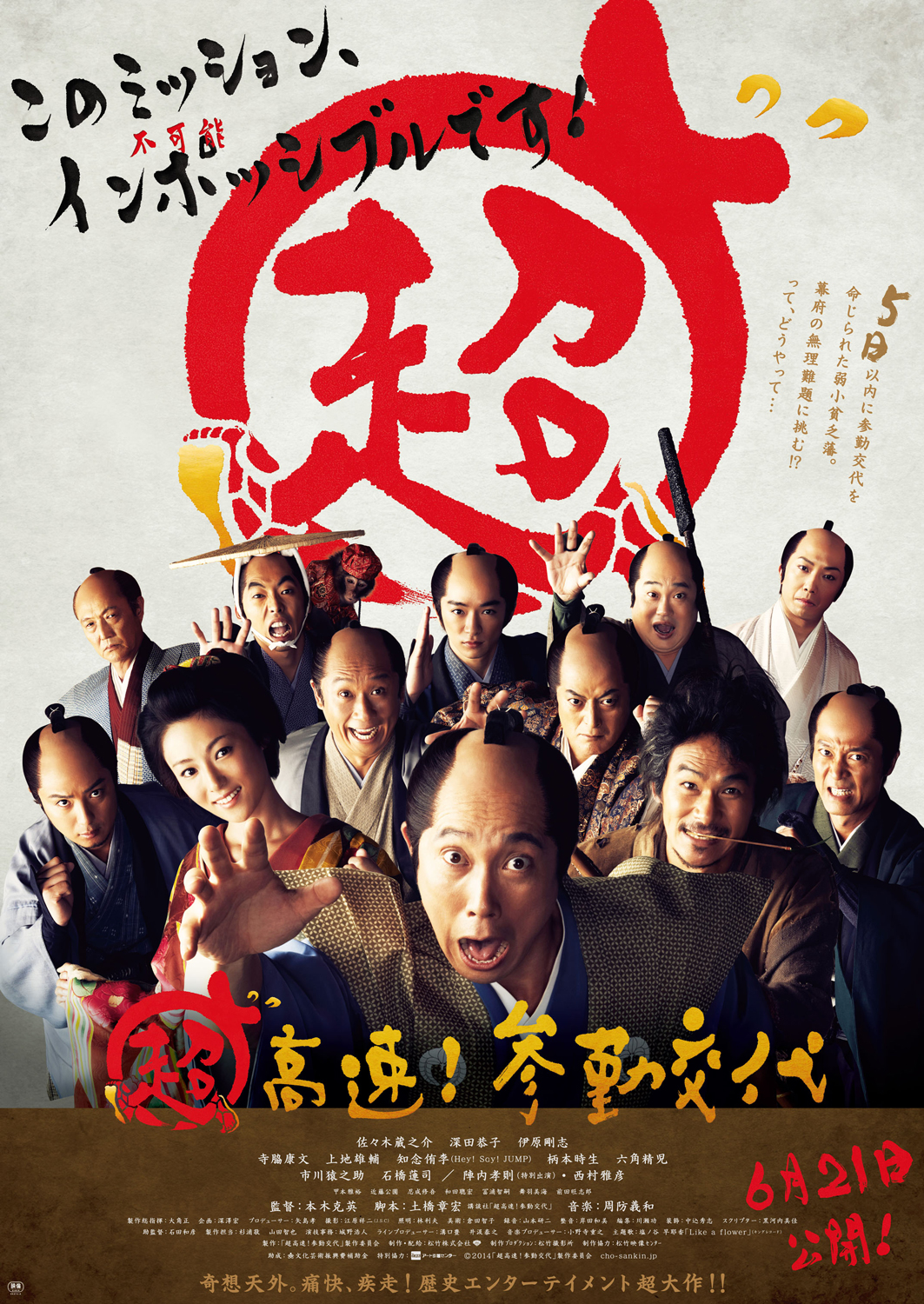
A kindhearted lord finds himself in deep trouble when he’s suddenly called back to Edo despite having just returned from his biennial service in Katsuhide Motoki’s jidaigeki comedy Samurai Hustle (超高速!参勤交代, Chokosoku! Sankin Kotai). Set in 1735, the film is in some senses unusual in pointing the various class biases even with the hierarchal samurai society as the tiny rural clan at the film’s centre are swept into intrigue by the machinations of an ambitious courtier who thinks they lied about their goldmine being extinct and plans to get his hands on it by dobbing them in to the Shogun.

The problem is that they really weren’t lying. The Yunagaya clan is dirt poor, especially after having spent a small fortune travelling to Edo and back. In this era, even distant lords were called to Edo every two years to serve at court. They were expected to parade to the capital in style, showing off their wealth and status as they go which is of course inordinately expensive. The expense was the point. Practices like these along with forcing clans to move domains on a whim were designed to weaken their resources so they’d have no recourse to rebellion even if they were even more annoyed about being forced to travel back and fore for no real reason. 

It took Lord Naito (Kuranosuke Sasaki) and his retinue 10 days to walk home, which is why it’s even more of a shock to get a letter telling them to high-tail it back in five or risk being dissolved by the shogun. Evil retainer Nobutoki (Takanori Jinnai) knows it’s impossible for them to arrive on time which is how he plans to get his hands on the gold. What he didn’t count on, however, is the unexpected scrappiness of a “backwoods samurai” who’s used to having to find ingenious solutions to difficult problems because he doesn’t have the money to solve them. Nobutoki is essentially a snob who looks down on country folk and thinks Naito does not befit the rank of a samurai anyway, sneering at his humble gift for the Shogun of some locally sourced daikon pickles. 

The homeliness of the daikon signals Naito’s down to earth nature as a fairly egalitarian samurai who doesn’t really care about hierarchy and status even if he knows he has to play the game. What he cares about is the safety and happiness of his people, which is one reason he’s going to bust his arse to get back to Edo and clear his name. Aside from his humanitarian principles, also giving away some of their rice stocks to neighbouring clans suffering during a time of famine, Naito is also thought of as an eccentric because of his severe claustrophobia which makes it impossible for him to close the door when using the bathroom, let alone travel in a palanquin, though he’s found an ingenious solution for that one too. 

In an odd kind of paradox, he becomes a defender to proper samurai values in his opposition to Nobutoki who plays fast and dirty, sending out ninja assassins on the road to try to ensure he won’t make it to Edo before the deadline. Meanwhile, he bonds with a feisty sex worker who, like him, is dealing with childhood trauma and is sick of entitled noblemen who look down on the poor despite being a fellow human who as she puts it poops and screws just like everyone else. In a way she frees him from the confines of his hierarchal existence by helping him overcome his claustrophobia, at least while she’s at his side, while he saves her from her oppression by transgressing class boundaries and bringing her into the samurai world if only as a concubine.

Nevertheless, as he warns her, being poor is hard even when you’re a samurai, and ironically his circumstances aren’t much better than hers even if he has a superficial level of comfort and security tempered by his genuine ability to appreciate the simple charms of daikon over fancy Edo cuisine. After all, sometimes samurai become peasants or peasants become samurai and for an impoverished lord like Naito the distinction is fairly thin, though he evidently does his best to protect those around him from both sides of the class divide while remaining unafraid to tell the Shogun exactly what he thinks of him. After all, you’ve got to roll with the times, especially if you’re a backwoods samurai at the mercy of a harsh and arbitrary system but also far enough away from the mechanisms of power to begin to ignore them. 


Trailer (no subtitles)

Iwane: Sword of Serenity (居眠り磐音, Katsuhide Motoki, 2019)

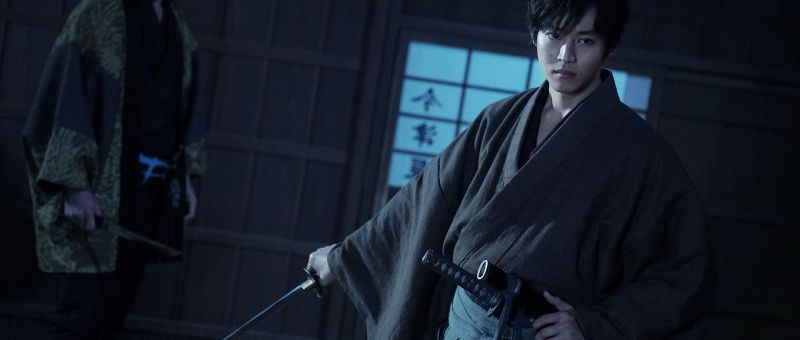
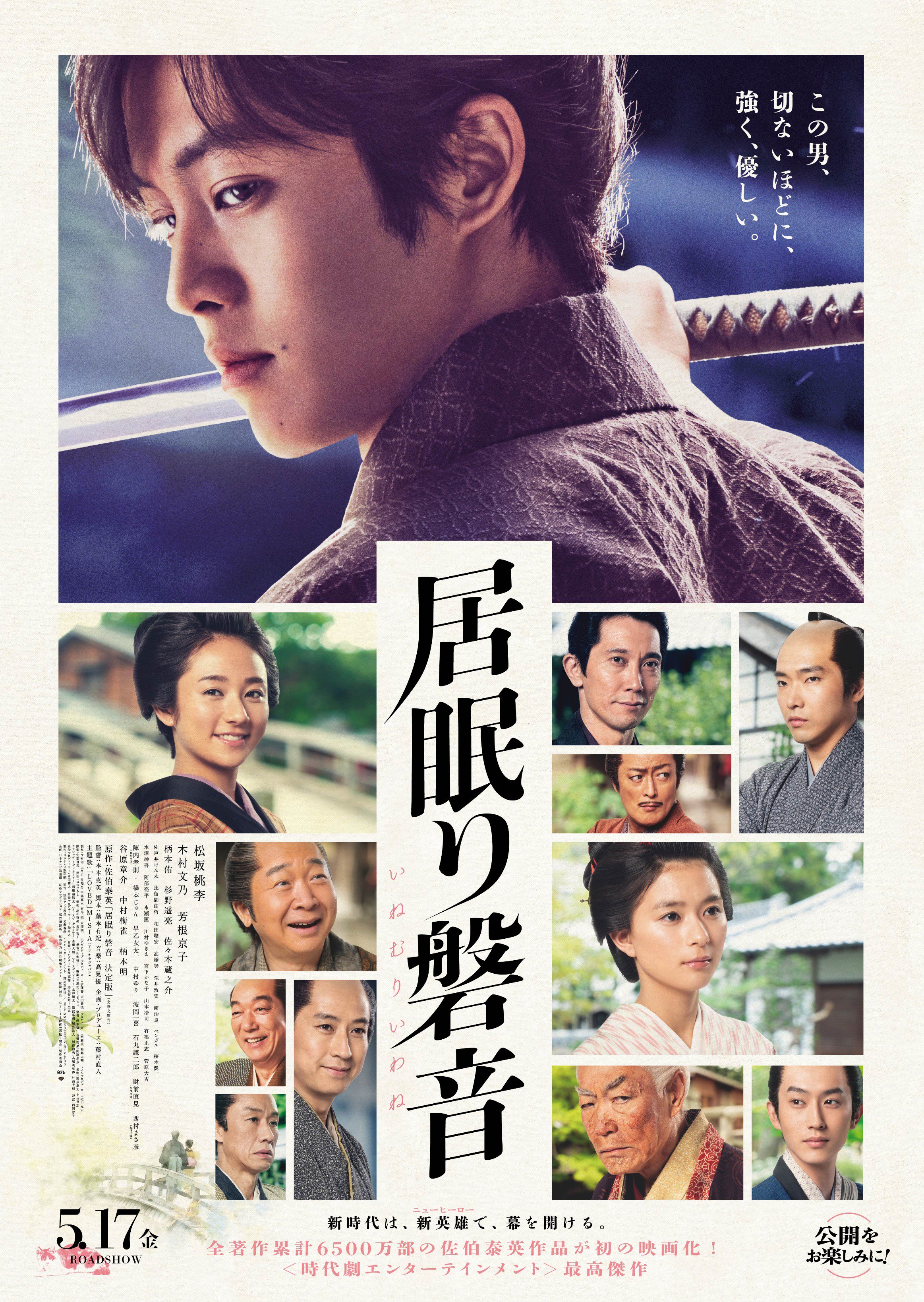
The contradictions of the samurai code conspire against one noble-hearted young man in Katsuhide Motoki’s adaptation of the long running series of historical novels by Saeki Yasuhide, Iwane: Sword of Serenity (居眠り磐音, Inemuri Iwane). Yet this truly serene samurai is a stoical sort, learning to bear his pain with fortitude while standing up for justice in an increasingly corrupt Edo where money rules all while an ascendent merchant class continues to challenge the fiercely hierarchical social order. 

Beginning in 1772 which turned out to be a disastrous year, the tale opens as hero Iwane (Tori Matsuzaka) prepares to return home after completing his three year rotation in Edo in the company of childhood friends Kinpei (Tasuku Emoto) and Shinnosuke (Yosuke Sugino). Shinnosuke is in fact married to Kinpei’s sister Mai, while Iwane will himself be married to Kinpei’s other sister Nao immediately on his return so close are they. As Iwane’s father tells him, there are great hopes for these young men that they can “turn our outdated clan around”, but events will conspire against them. Spoiling the happy homecoming, Shinnosuke is accosted by a drunken uncle who convinces him Mai has been unfaithful in his absence with the consequence that he kills her immediately on his return home. Unable to understand this turn of events, Kinpei confronts his friend but eventually kills him, while Iwane is then forced to kill Kinpei after he goes on murderous rampage in revenge for the wrong done to his sister. 

In trying to mediate the case, the argument is put forward that Shinnosuke acted rashly and should have brought his suspicion to the authorities rather than opting for summary execution. The lord however disagrees, condoning Shinnosuke’s actions under the rationale that to do so would have been considered “weak minded” while as Shinnosuke himself had claimed he acted in accordance with the samurai code in which female adultery is illegal and punishable by death. By contrast, he finds Kinpei’s rashness offensive, insisting that he also should have recognised the legitimacy of his sister’s murder and simply left quietly with her body. Having learned the truth in which his childhood friends became victims of clan intrigue, romantic jealousy, and tragic misunderstandings in this Othello-like plot, Shinnosuke and childhood sweetheart Nao are also consumed by the rashness of samurai law each exiled from their clan and cast adrift in Edo-era society. 

Edo-era society is however also itself corrupt. Some months later, Iwane has returned to Edo as a lowly ronin lodging with a kindly old man, Kinbei, who helps him find a job firstly gutting eel then as a bodyguard at a money exchange which has been receiving anonymous threats they assume are from rival broker Awaya who has hatched a nefarious plan to manipulate the currency market to stop the current Shogun introducing a new unit which can be used in both Edo and Kyoto which would understandably cut into his already corrupt business model. Luckily, Imazuya is an honourable man who backs the new currency plan and wants to do the right thing which makes him a perfect fit for Iwane’s innate sense of justice. “You don’t know the way of the merchant” Awaya snaps at him, suggesting both that the samurai are already on their way down as the merchants rise and that his unwillingness to play dirty will be his downfall. Nevertheless, Iwane is the type to adapt quickly, instantly coming up with a way to play Awaya at his own game and kick his destructive amoral capitalism to the curb. 

Meanwhile, he continues to pine for Nao while drawing closer to Kinbei’s earnest daughter Okon (Fumino Kimura). As we discover Nao is also a victim of an intensely patriarchal social order but through the tragedy that befalls them also finds strength and agency making a life changing decision that allows her to become independent while looking after her family if in the knowledge that the childhood romance she shared with Iwane is a thing of the past. Iwane too agrees that he is trapped in a living hell of guilt and grief, yet choosing to go on living anyway as calm and cheerful as he’d ever been while standing up to Edo-era corruption though uncomfortably enough this time against the destabilising influence of the rising merchant class and therefore in contrast to most jidaigeki reinforcing the legitimacy of the samurai order which has paradoxically also ruined his life with its rigid and implacable social codes. In any case, Motoki’s classic chanbara melodrama has a serenity of its own as the cheerfully laidback hero resolves to live his life by a code of his own free of samurai constraint. 


Trailer (no subtitles)

Godzilla Minus One (ゴジラ-1.0, Takashi Yamazaki, 2023)

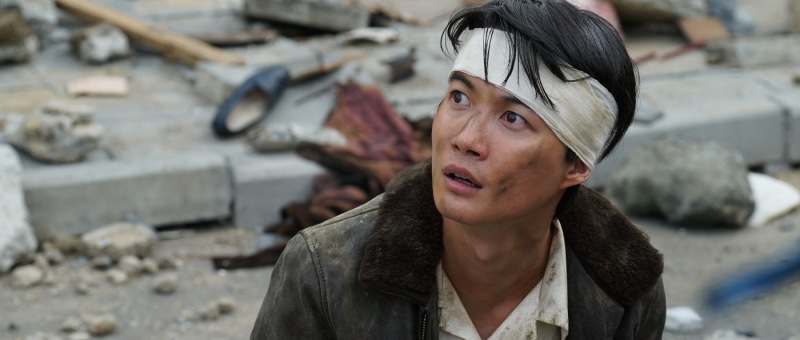
When Godzilla emerges from the waves in Takashi Yamazaki’s entry into the classic tokusatsu series Godzilla Minus One (ゴジラ-1.0), he does so as an embodiment of wartime trauma most particularly that of the hero, Koichi (Ryunosuke Kamiki), a kamikaze pilot who failed die. Some might call his actions cowardice, returning to base siting engine trouble rather than doing what others regard as his duty, though the film implies it’s simply a consequence of his natural desire to live, a desire which the tenets of militarism which in essence a death cult insisted he must suppress. 

But for Koichi as he’s fond of saying the war never ends. He’s trapped in a purgatorial cycle of survivor’s guilt and internalised shame, feeling as if he has no right to a future because of the future that was robbed from other men like him because of his refusal to sacrifice his life. When he first encounters Godzilla on a small island outpost, he is ordered back into his plane to fire its guns at him but freezes while the rest of the men, bar one, are killed. Tachibana (Munetaka Aoki), a mechanic who had already branded Koichi a treacherous coward, gives him a packet of photographs belonging to the dead men each featuring the families they were denied the opportunity to return to. Photographs on an altar become a motif for him, though he has none for his parents who were killed when their house was destroyed by the aerial bombing of Tokyo. A surviving neighbour similarly blames him, directly aligning Koichi’s act of selfish cowardice with the razing of the city.

The return of Godzilla is literal manifestation of his war trauma which he must finally confront in order to move into the new post-war future that’s built on peace and solidarity rather than acrimony and resentment for the wartime past. But then again, the film situates itself in a fantasy post-war Tokyo in which the Occupation is barely felt and the government, which mainly consisted of former militarists, is also absent. Both the US and the Japanese authorities refuse to do anything about Godzilla because of various geopolitical implications making this a problem that the people must face themselves, though they largely do so through attempting to repurpose rather than reject the militarist past. Noda (Hidetaka Yoshioka), a scientist who worked on weapons production during the war, gives a rousing speech in which he explains that this time they will not pointlessly sacrifice their lives but instead fight to live in a better world which is all very well but perhaps mere sophistry when the end result is the same. 

Called back by their old commander, many men say they will not risk their lives or abandon their families once again because they have learned their lessons but others are convinced by the message that they must face Godzilla if they’re ever to be free of their wartime past. Koichi wants vengeance against Godzilla but also to avenge himself by doing what he could not do before. The film seems to suggest that this time it’s different because he has a choice. No one has ordered him to die, and he is free to choose whether to do so or not which is also the choice of being consumed by his war trauma or overcoming it to begin a new life in the post-war Tokyo that Godzilla has just destroyed. 

Despite the desperation and acrimony he returns to, Koichi maintains his humanity bonding with a young woman, Noriko (Minami Hamabe), who agreed to take care of another woman’s child. Even the neighbour, Sumiko (Sakura Ando), who first rejected Koichi and is suspicious of Noriko, willingly gives up her own rice supply for the baby proving that in the end people are good and will help each other even if that seems somewhat naive amid the realities of life in the post-war city ridden with starvation and disease. In any case, it’s this solidarity that eventually saves them, Godzilla challenged less by a pair of large boats than a flotilla of small ones united by the desire to finally end this war. Like Yamazaki’s previous wartime dramas The Eternal Zero and The Great War of Archimedes, the film espouses a lowkey nationalism mired in a nostalgia for a mythologised Japan but as usual excels in terms of production design and visual spectacle as the iconic monster looms large over a city trapped between the wartime past and a post-war future that can only be claimed by a direct confrontation with the lingering trauma of militarist folly.


Godzilla Minus One opens in UK cinemas 15th December courtesy of All the Anime.

International trailer (English subtitles)

The Pass: Last Days of the Samurai (峠 最後のサムライ, Takashi Koizumi, 2021)

“Even with 100 plans and 100 ideas, we cannot defeat the march of progress” a progressive samurai admits, well aware that he’s witnessing the end of his era while knowing that the “thrilling future” that lies ahead will have no place for him. Adapted from the novel by Ryotaro Shiba, The Pass: Last Days of the Samurai (峠 最後のサムライ, Toge: Saigo no Samurai) is inspired by the life of Kawai Tsugunosuke, known as the “Last Samurai” for his steadfast embodiment of the samurai ideal during the chaos of the Bakumatsu and subsequent Boshin War

As the opening voiceover from Tsugunosuke’s wife Osuga (Takako Matsu) explains, the Tokugawa Shogunate had ruled Japan for close to 300 years after bringing the warring states era to an end following the Battle of Sekigahara, placing the nation into a period of enforced isolation which by the 1850s was beginning to crack while resentment towards the Tokugawa continued to grow over their handling of access to foreign trade. In 1867, Tokugawa Yoshinobu (Masahiro Higashide) effectively relinquished his monopoly on power and restored ultimate authority to the emperor (the “Meiji Restoration”). Yet if he hoped his decision would both restore peace and allow the Tokugawa to maintain political influence he was quite mistaken. In the immediate wake of this political earthquake the nation became polarised between those in favour of imperial rule and those who remained loyal to the Shogunate. 

The chief retainer in Nagaoka, Tsugunosuke (Koji Yakusho) finds himself in an impossible position caught between the forces of East and West and essentially unable to pick a side because of the demands of samurai loyalty. Fearing another war would prove disastrous, he chooses neutrality certain that the present conflict cannot be resolved militarily and requires a political solution. To this effect he attempts to petition a delegation from the Western, pro-emperor, pro-modernisation army but his pleas fall on deaf ears and lead only to a rebuke that he is a coward and a traitor. Like any good leader, however, Tsugunosuke has also been preparing for the worst, buying a gatling gun from foreign dealers in order to boost his meagre man power eventually realising they have no other option than to go war 

The irony is that Tsugunosuke tacitly supports imperial rule but cannot say so because his clan is closely affiliated with the Tokugawa. He is well aware that his era has come to a close and that he will not live to see the new Japan, knowing that he is man of the old world and cannot progress into the classless society he is certain is coming. For all that he seems to be excited by the promises of revolution, encouraging the son of a friend to take advantage of the freedoms of a new era while dreaming of foreign travel and advocating for “liberty and rights” along with universal education in the hope of building of a better society. 

Yet for himself he cannot let go of samurai ideals, knowing he must fight a pointless war in which he does not believe because honour dictates it. “If it shows future generations what we samurai truly stood for then this battle will have been worthwhile” he tells a friend, fearful of a future dominated by the clans of Satsuma and Choshu. “Your samurai spirit will encourage countless others” another retainer tells him, “you are our ideal”, touched by his stoicism and grace even in defeat as he takes sole responsibility for the failure of their military campaign caused in part by the betrayal of a defecting ally. “This warriors’ way shall die with me” he cheerfully tells a servant, advising him to become a merchant and travel abroad to seize the “thrilling future” which lies ahead of him. 

A martyr to his age, Tsugunosuke is the last of the samurai stoically defending a lofty ideal in an acknowledgement that he does not belong in the new society and must sacrifice himself in order to bring it about. An homage to classic samurai cinema from former Akira Kurosawa AD Takashi Koizumi, who even throws in the odd screen wipe, featuring cameos from golden age stars Tatsuya Nakadai and Kyoko Kagawa, The Pass is about the passage from one era to the next taking as its hero a closet revolutionary and walking embodiment of the idealised samurai who chooses unity and shared vision over conflict in the creation of a better world he does not intend to live to see.


The Pass: Last Days of the Samurai screens on Aug. 21 and Sept. 1 as part of this year’s Japan Cuts.

Original trailer (English subtitles)

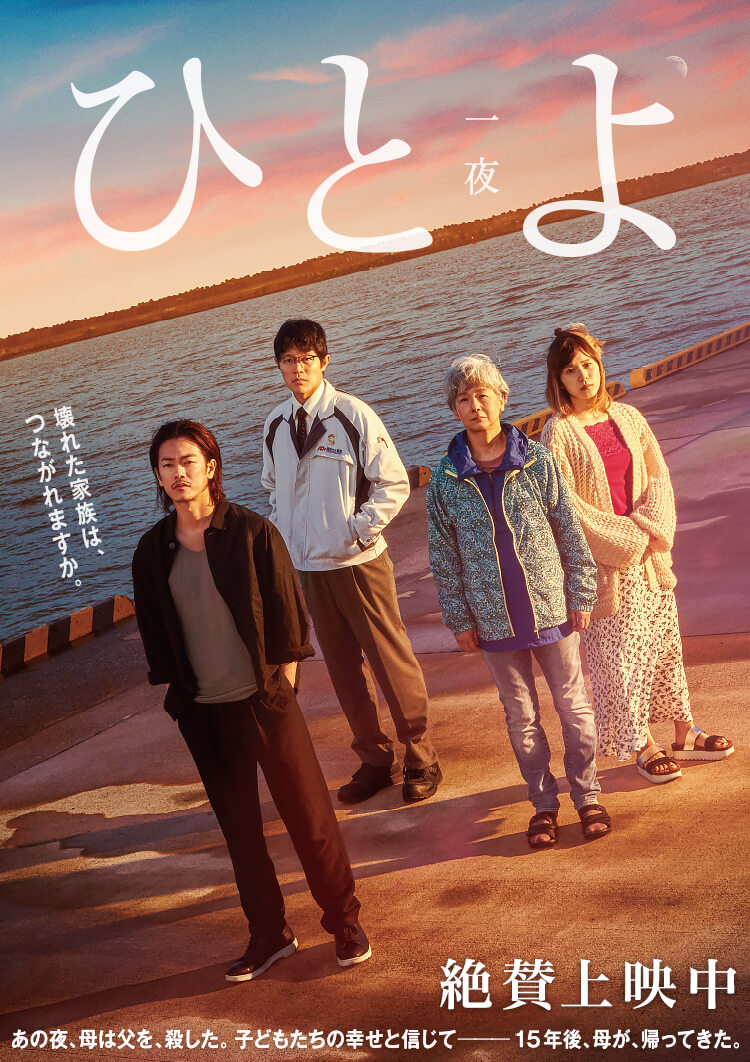
One Night (ひとよ, Kazuya Shiraishi, 2019)

“You can live however you want, you’re totally free. You can be anything” a woman tells her children, believing she is freeing them from a cycle of violence and oppression but unwittingly consigning them to another kind of cage in Kazuya Shiraishi’s raw family drama One Night (ひとよ, Hitoyo). Adapting the stage play by Yuko Kuwabara, Shiraishi is the latest in a long line of directors asking questions about the true nature of family, taking the hahamono or “mother movie” in a new direction but ultimately finding faith at least in the concept as the family unit finally begins to repair itself in a spirit of reconciliation and forgiveness. 

The “one night” of the title is that of 23rd May, 2004 on which wife and mother Koharu (Yuko Tanaka) backs over her relentlessly abusive husband in one of the taxis operated by their company. At some point, even if only perhaps in those few moments sitting at the steering wheel, Koharu appears to have given this a great deal of thought. Calmly walking back into her familial home where her three children are each sporting prominent facial wounds from a recent beating, she hands each of them a handmade onigiri and explains that she has just killed their father. Planning to hand herself in she reassures them that an uncle will look after them and the company so they’ve no need to worry. She has no idea how long she’ll be in prison for, but cautions that she may not return for 15 years hoping that by then the stigma will have passed. On her way out, she pauses to tell them that she is proud of what she’s done, saving them from their father’s authoritarian abuse and urging them to be free to live their lives in whichever way they choose. 

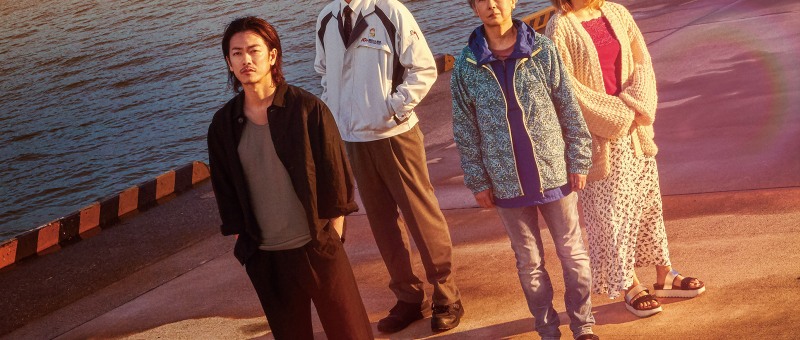
15 years later, however, the children find themselves burdened by her words. Yuji (Takeru Satoh) who dreamed of being a novelist has become a cynical journalist working for a pornographic magazine. Daiki (Ryohei Suzuki) who has a stammer and wanted to be a mechanic has never been able to hold down a steady job and is on the brink of divorce after showing signs of becoming abusive himself, while Sonoko (Mayu Matsuoka) who wanted to be a hairdresser is now working as a bar hostess drinking herself into oblivion. Living with the legacy of that one night, none of them has been able to live freely or to achieve their dreams but has remained arrested in some way waiting for Koharu’s return. 

While in her mind she freed them, the children find themselves dealing with the secondary sense of abandonment in her decision to exile herself from their lives, essentially leaving them to deal with the fallout of her “crime” all alone. Not only are they now orphaned, they also have to live with the stigma of being related to a notorious murderess with all of the peculiar burdens that entails in Japanese society from harassment and bullying to reduced employment opportunities and an internalised shame. Meanwhile, their mother’s words ring in their ears, urging them to be free, to be who they wanted to be and achieve their dreams, but they find themselves paralysed by the pressure to live up to the sacrifice Koharu has made on their behalf. While Sonoko is the most sympathetic, the boys are consumed by resentment. Koharu sees her 15 years of wandering as an exile undertaken as a kind of atonement and intended to keep the children safe from further social stigma, but her sons feel only the abandonment. 

Still, “mom’s still mom. It’s we who’ve got to change” Daiki tries to convince his brother, “we’re not kids anymore” he later adds as they recreate a thwarted teenage attempt to save their mother but in a very real sense they are. The problem in Daiki’s marriage turns out be rooted in insecurity, a failure of intimacy that saw him reluctant to let his wife and daughter into his traumatic past which finally expressed itself in violence. Meanwhile another driver at the taxi firm finds himself in a parallel struggle as he processes his own troubled relationship with an estranged teenage son and comes to realise his sins are indeed being visited on him despite his best efforts to prevent it. He sympathises with Koharu against the “ungrateful” children who, like the those of the classic hahamono, fail to understand the quality of their parent’s love as expressed in the sacrifices they have made on their behalf. Yet it’s Yuji who had branded his family a mere simulacrum who eventually fights hardest to save it, paving the way for a reconciliation as they finally bring closure to the events of 15 years previously and begin to move on with the rest of their lives. A raw and painful examination of familial trauma, Shiraishi’s bruising drama eventually allows the family to reclaim the night, repairing their fracturing bonds in sharing their emotional burdens freed at last from the oppressive legacies of abuse and resentment.


One Night streams in the US via the Smart Cinema app on Sept. 6 & 11 as part of this year’s New York Asian Film Festival.

Original trailer (no subtitles)

We Make Antiques (嘘八百, Masaharu Take, 2018)

We make antiques posterWho will scam the scammers? The antiques trade is a high stakes business, and at least as far as Masaharu Take’s We Make Antiques (嘘八百, Uso Happyaku) goes, one which makes use of its aura of respectability to cheat unsuspecting amateurs out of their hard earned cash for the false promise of exclusivity. Then again, does it really matter when something was made so long as it was made well and with artistic integrity? Perhaps collectors are just as happy with a nice piece as an authentic one, if only no one ever tells them the difference.

Jaded antiques dealer Norio Koike (Kiichi Nakai) prides himself on having a good eye, forced to learn to spot the inauthentic in record time after having his reputation trashed when he accidentally sold a “fake”, making the rookie mistake of taking provenance at face value without assessing all the facts. These days he’s not as precious as he used to be, mostly making his living out of buying up genuine antiques from clueless owners, convincing them their pieces are fakes and therefore worthless before selling them on at tremendous profit. It’s a trick he pulls on a wealthy man with a warehouse full of teacups that belonged to his father he’d rather get rid of so he can open a cafe, spotting an obvious fake and buying it cheap to take it straight back to where he knows it came from. Koike gets his comeuppance however when the man calls him back and says he’s found something interesting – an Edo-era letter in a box. Koike lies and says the letter is a random missive about a peasant revolt, when really it’s from grandmaster Rikyu and mentions coming with a tea bowl which Koike manages to find after searching the warehouse again.

After buying the entire stock to mask his desire for the tea bowl and letter, Koike realises he’s been had. The man he was talking to isn’t the owner of the warehouse but a caretaker, and the warehouse only exists to store fakes produced by a team of master forgers operating out of a nearby ramen joint. Noda (Kuranosuke Sasaki), who managed to scam Koike, was like him professionally embarrassed and by the same two corrupt elitists, Tadayasu Hiwatashi (Kogan Ashiya) and his celebrity authenticator Seiichiro Tanahashi (Masaomi Kondo), who picked him up as an aspiring ceramicist, giving him a fancy award but secretly using him to produce “replicas” to sell in their store. 20 years later, Noda is a cynical and jaded figure, unable to connect with his “nerdy” son (Tomoya Maeno) who spends his time building fantastically realistic military dioramas, and increasingly distanced from his patient wife who deeply resents the loss of his artistic integrity.

After a brief locking of horns, the two men decide to team up to scam the scammers, teach them a lesson, get a little ironic revenge, and become filthy rich in the process. Creating expert fakes, however, is a taxing business which requires an extreme depth of knowledge and in this case of a well known and hugely respected historical figure. Sen no Rikyu, the father of the tea ceremony, was, ironically enough, ordered to commit seppuku after speaking truth to power and, because he was an honourable man, he did it.

The reason most fakes fail is because they’re soulless replicas, often expertly crafted but essentially superficial. Creating a convincing fake allows Noda to regain the creative mojo that he’s been suppressing all these years in resentment towards Hiwatashi and Tanahashi, determined to craft something that reflects the spirit of Rikyu by virtue of the fact that it contains a piece of his own soul. Of course, the guys fully intend to exploit their own “artistic integrity”, Koike turning on the salesman’s patter to sell the dream of Rikyu to two soulless elitists too wrapped up in their sense of self-importance and blinded by greed to see things properly. Yet, there is a perverse love not only for the grift but for the craft and for Japan’s disappearing traditional culture, if only in the ironic rebuke of those who misuse it for their own gain. Bonded in revenge not only against the the venal Hiwatashi and Tanahashi but middle-age and and life itself, the guys generate an unlikely friendship, rediscovering their authentic selves through forgery as they scam the scammers and retake their sense of integrity in the form of a briefcase stuffed with cash.


International trailer (English subtitles)

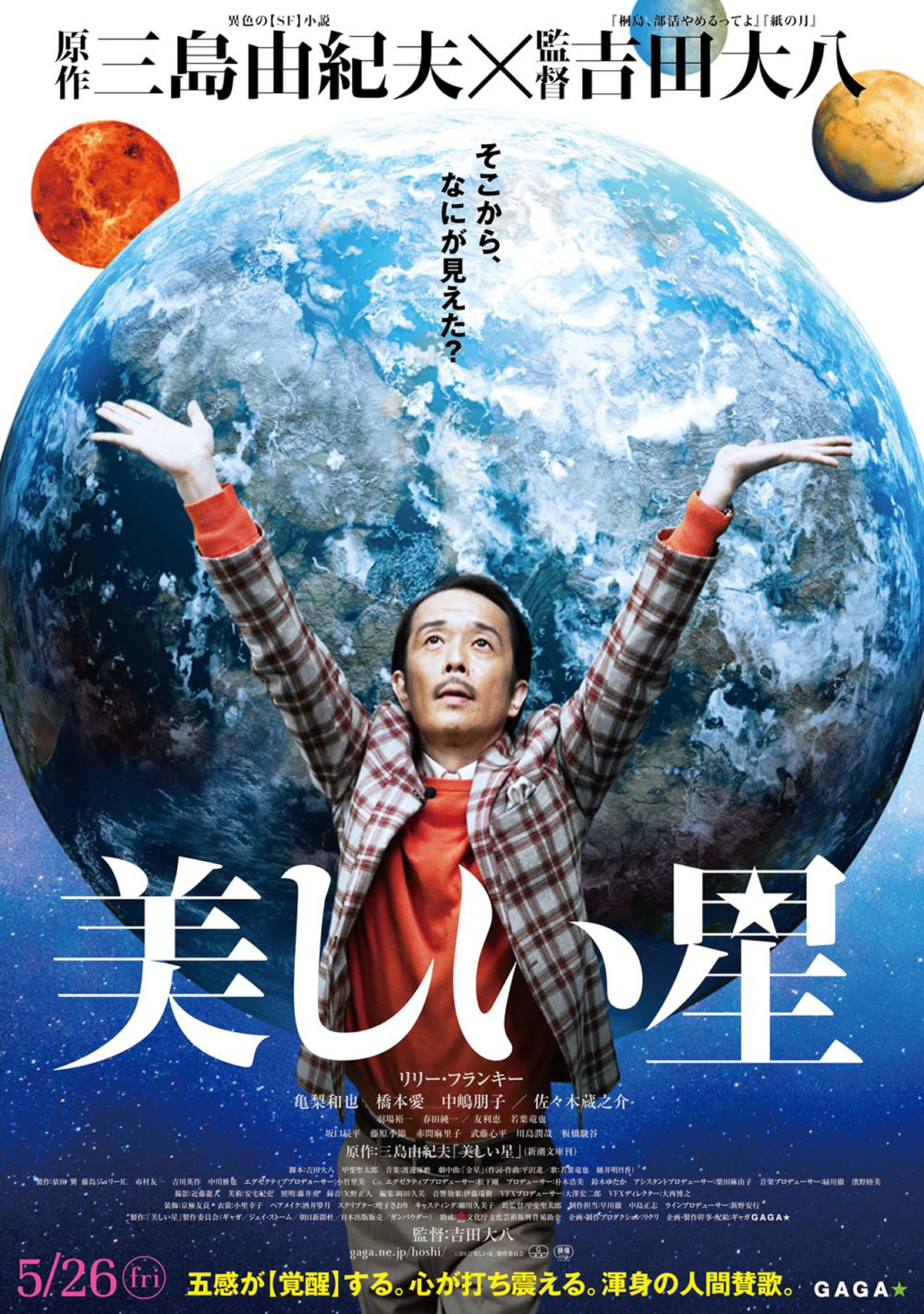
A Beautiful Star (美しい星, Daihachi Yoshida, 2017)

A Beautiful Star poster 1Given life’s anxieties, it can sometimes be hard to remember that the world is a beautiful place. If only we humans could learn to stop and smell the flowers every so often, we wouldn’t be so eager to destroy the place that gave us life. Loosely adapting a novel by Yukio Mishima, Daihachi Yoshida’s A Beautiful Star (美しい星, Utsukushii Hoshi) swaps Cold War nuclear paranoia for climate change anxiety as a collection of extra-terrestrials consider differing strategies to save the Earth, the most radical of them being the eradication of the human race.

Yoshida opens with the Osugi family, minus son Kazuo (Kazuya Kamenashi), “enjoying” a birthday dinner at an Italian restaurant. The tension between them is obvious as patriarch Juichiro (Lily Franky) bad mouths his absent son, daughter Akiko (Ai Hashimoto) sits sullenly not touching her food, and mum Iyoko (Tomoko Nakajima) tries to keep the peace. Juichiro, as we later realise, is a minor celebrity – a much loved TV weatherman whose predictions are not terribly good but he does have a very personable manner. Unfortunately, he’s not so nice offscreen and has been cheating on his wife with a much younger woman who is after his job. After a tryst at a love hotel, the pair get into some kind of bizarre car accident and Juichiro wakes up on his own in a field feeling not quite right. After a colleague suggests he might have been abducted by aliens, he develops an interest in UFOs and, after being moved to tears on air, comes to the conclusion that he is a Martian emissary from the League of Solar Planets come to enlighten the Earth to the dangers of global warming before it’s too late.

In fact, Juichiro is not the only member of the Osugis to believe he is not of this Earth. Except for mum Iyoko, everyone eventually realises they are actually from another planet but their feelings of “alienation” are perfectly Earthbound and born of extremely normal anxieties the like of which can cause discord in any family. Complaining about his son’s lateness to the birthday dinner, Juichiro runs down Kazuo’s lack of full-time employment and writes him off as “just an errand boy”. Kazuo, resentful of his father, feels an intense insecurity about his failure to forge a successful life for himself – something that is thrown into stark relief when he meets an old college buddy now a salaryman who seems to take pleasure in the fact that the captain of the basketball team has made a mess of things where he is now on the road to career success. So when Kazuo meets shady fixer Kuroki (Kuranosuke Sasaki), currently running the campaign for conservative politician and climate change denier Takamori (Jyunichi Haruta), and finds out he is actually from Mercury, it restores his sense of purpose even if it pushes him towards becoming a slightly dangerous right-wing manipulator.

His sister, meanwhile, is a lonely, depressed university student with a complex about her appearance. Approached by a creepy guy running some kind of campus beauty pageant, she can’t get away fast enough but is captivated by the song of a street busker who eventually tells her she likes his music because it’s inspired by their shared roots as Venusians and that the reason she “despises” her own beauty is that Venusians used to set the beauty standards on Earth but now they’ve been usurped. Feeling not quite so alone and more confident in her skin, Akiko decides to enter the pageant to “correct” the perception of beauty in human society.

“Beauty” seems to be the key. Iyoko finds herself sucked into a pyramid scheme selling “beautiful” water mostly out of a sense of lonely purposelessness. Apparently from power spot deep within the Earth, the water is supposed to be its rejuvenating life blood but like so much else, humanity has misused and commodified it. Juichiro’s Martians have a conventional solution to the present problem in that they want humanity to wake up and slow down. The Mercurians, however, have more radical ideas. Seeing as humanity is toxic to this planet that we all love, the obvious answer is simply to eliminate it, engineer a reset in which the Earth could heal itself after which point a new, more responsible humanity could be permitted to return. The problem, they say, is that humans do not think of themselves as a part of nature or realise that extinction is a perfectly natural part of the ecological life cycle. If they did, they might not be in this mess, but now they need to accept their responsibility and agree to a mass cull to save the planet.

Each of the Osugis has their insecurities wielded against them, and in the end each of them is in some way deceived. Kazuo’s resentful ambition is exposed by Kuroki, but he eventually realises he’s not much more than a patsy, while Akiko has to face up to the possibility that she’s been spun a yarn by an unscrupulous man who was only after the usual thing from a naive and vulnerable young woman. Iyoko’s deception is of the more usual kind as she figures out that “beautiful water” is an obvious scam she only bought into because of the false sense of belonging and achievement it afforded her, and Juichiro has to wonder if his Martian “delusion” has a medical explanation, but through their various deceptions the family is eventually forced back together again springing into action as a unit. The Mercurians dismissed humanity as unable to see the world’s beauty, remaining wilfully ignorant of the gift they had been given. The Osugis have at least been awakened to a kind of beauty in the world and in themselves as they face their alien qualities and integrate them with those of others. Yoshida may not have a clear answer for the problems of climate change (who does?), but he is at least clear on one thing – you lose that which you take for granted. Smell the flowers while the flowers last.


International trailer (English subtitles)

We Are Little Zombies (ウィーアーリトルゾンビーズ, Makoto Nagahisa, 2019)

Little Zombies poster“Reality’s too stupid to cry over” affirms the deadpan narrator of Makoto Nagahisa’s We Are Little Zombies (ウィーアーリトルゾンビーズ), so why does he feel so strange about feeling nothing much at all? Taking its cues from the French New Wave by way of ‘60s Japanese avant-garde, the first feature from the award winning And So We Put Goldfish in the Pool director is a riotous affair of retro video game nostalgia and deepening ennui, but it’s also a gentle meditation on finding the strength to keep moving forward despite all the pain, emptiness, and disappointment of being alive.

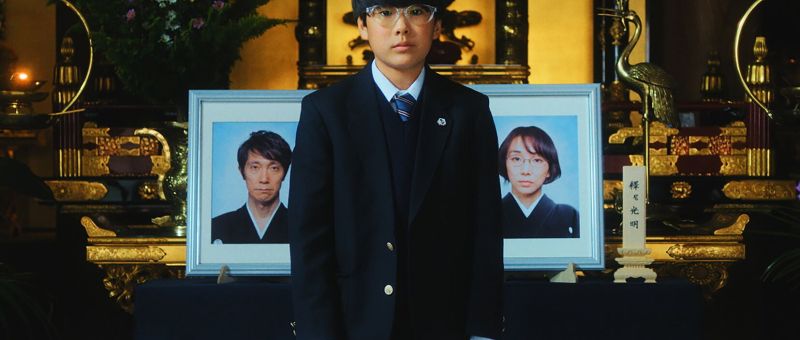
The “Little Zombies”, as we will later discover, are the latest tween viral pop sensation led by bespectacled 13-year-old Hikari (Keita Ninomiya). Recounting his own sorry tale of how his emotionally distant parents died in a freak bus accident, Hikari then teams up with three other similarly bereaved teens after meeting at the local crematorium where each of their parents is also making their final journey. Inspired by a retro RPG with the same title, the gang set off on an adventure to claim their independence by revisiting the sites of all their grief before making themselves intentionally homeless and forming an emo (no one says that anymore, apparently) grunge band to sing about their emotional numbness and general inability to feel.

Very much of the moment, but rooted in nostalgia for ages past, Little Zombies is another in a long line of Japanese movies asking serious questions about the traditional family. The reason Hikari can’t cry is, he says, because crying would be pointless. Babies cry for help, but no one is going to help him. Emotionally neglected by his parents who, when not working, were too wrapped up in their own drama to pay much attention to him, Hikari’s only connection to familial love is buried in the collection of video games they gave him in lieu of physical connection, his spectacles a kind of badge of that love earned through constant eyestrain.

The other kids, meanwhile, have similarly detached backgrounds – Takemura (Mondo Okumura) hated his useless and violent father but can’t forgive his parents for abandoning him in double suicide, Ishii (Satoshi) Mizuno) resented his careless dad but misses the stir-fries his mum cooked for him every day, and Ikuko (Sena Nakaijma) may have actually encouraged the murder of her parents by a creepy stalker while secretly pained over their rejection of her in embarrassment over her tendency to attract unwanted male attention even as child. The kids aren’t upset in the “normal” way because none of their relationships were “normal” and so their homes were never quite the points of comfort and safety one might have assumed them to be.

Orphaned and adrift, they fare little better. The adult world is as untrustworthy as ever and it’s not long before they begin to feel exploited by the powers intent on making them “stars”. Nevertheless, they continue with their deadpan routines as the “soulless” Little Zombies until their emotions, such as they are, begin inconveniently breaking through. “Despair is uncool”, but passion is impossible in a world where nothing really matters and all relationships are built on mutual transaction.

Mimicking Hikari’s retro video game, the Zombies pursue their quest towards the end level boss, passing through several stages and levelling up as they go, but face the continuing question of whether to continue with the game or not. Save and quit seems like a tempting option when there is no hope in sight, but giving in to despair would to be to let the world win. The only prize on offer is life going on “undramatically”, but in many ways that is the best reward one can hope for and who’s to say zombies don’t have feelings too? Dead but alive, the teens continue their adventure with heavy hearts but resolved in the knowledge that it’s probably OK to be numb to the world but also OK not to be. “Life is like a shit game”, but you keep playing anyway because sometimes it’s kind of fun. A visual tour de force and riot of ironic avant-garde post-modernism, We Are Little Zombies is a charmingly nostalgic throwback to the anything goes spirit of the bubble era and a strangely joyous celebration of finding small signs of hope amid the soulless chaos of modern life.


We Are Little Zombies was screened as part of the 2019 Nippon Connection Film Festival.

Original trailer (English subtitles)

Makoto Nagahisa’s short And So We Put Goldfish in the Pool

Music videos for We Are Little Zombies and Zombies But Alive

Something Like, Something Like It (の・ようなもの のようなもの, Taiichi Sugiyama, 2016)

something like, something like it posterSadly passing away at the young age of 61 in 2011, Yoshimitsu Morita had been relatively prolific in his 25-year career, leaving behind him a hugely varied back catalogue that ran from zany idol movies to prestigious literary adaptations. His recurrent concerns, however, were relentlessly populist – he wanted to make films that ordinary people could enjoy which intensely reflected the time in which they were made. Five years after his death, one of his early ADs chose to pay tribute to his mentor by drawing inspiration from Morita’s 1981 feature debut, Something Like It. Something Like, Something Like It (の・ようなもの のようなもの, No Yona Mono no Yona Mono) brings the original cast back together with a few new faces from the late director’s more recent works to recreate yesterday’s pleasures for today’s audiences.

Our hero this time round is young Shinden (Kenichi Matsuyama). Well, he’s not really all that young despite being the lowest ranking rakugoka on the roster. Now 30 and beginning to lose hope, Shinden is a former salaryman well known for taking his time. Meanwhile, the 13th memorial service for the late master is fast approaching and the troupe’s patron has decreed she wants to see the return of an old friend – Shintoto (Katsunobu Ito) who abruptly disappeared right after the funeral. Seeing as Shinden is not so hot at rakugo, the other guys task him with tracking down Shintoto in the hope of convincing him to make a return to the stage so the patroness doesn’t decide to remove her patronage.

Rakugo – the traditional art of comic storytelling, is a rarefied affair. It requires extreme rigour from the performer in order to make often extremely familiar tales funny in all the right places. Shinden isn’t very good at it because he’s too stiff all over. Poor at reading social cues, he has an urge to point out tiny and embarrassing mistakes like a slightly frayed curtain or a wonky sign. He might not be best placed for finding and then convincing a sad old man to take back up the career he’d sworn to lay down. Nevertheless, once Shinden manages to find Shintoto and realises he’s made an extremely circular journey, he makes himself his disciple and commits himself to doing all Shintoho’s odd jobs in the hope he’ll finally finish the “Pop-Eyed Goldfish” routine that the patroness so wants to hear.

Taiichi Sugiyama* was an AD on Something Like It but is only making his own feature debut 25 years later. Reassembling the old cast, Sugiyama remains true to an old formula and his genial retro comedy certainly has an old fashioned quality right down to the cutesy jazz score which feels right out of the ‘80s. More modern additions come in the form of Kenichi Matsuyama (who starred in Morita’s final film, Train Brain Express) back on comedy form with a typically left of centre performance as the archetypal “cannot read the air” aspiring rakugoka whose tendency towards literalism as well as that to be distracted by minor imperfections threatens to ruin his career before it’s even really begun. That’s not to mention his nascent crush on his mentor’s daughter Yumi (Played by Keiko Kitagawa who made her feature debut in Morita’s Mamiya Brothers) and mild jealousy over the other various young and good looking men she seems to take an interest in.

Through getting closer to the now somewhat schlubby but basically good hearted Shintoto, Shinden learns to loosen up a bit and his Rakugo perhaps improves even if he also figures out when it’s best to make a sacrifice on someone else’s behalf. Shintoto too rediscovers his talent for comedy, if not the love. Morita never had much of a “signature” style – his films were in a sense tailor made to suit a particular purpose, but Sugiyama remains firmly within the world of early ‘80s comedy, allowing the everyday to brim with silliness as Shinden pursues his roundabout quest before coming quite literally full circle and then finding his feet again. A man pays tribute to his late mentor, mentors someone else, and then absents himself from the frame to let his pupil grow. One generation retreats and another rises – an age old story, but one that like a rakugo tale shines in the telling.


*IMDB and some other sites list his name as Yasukazu but according to the JFDB and Shochiku the official reading of his name is Taiichi.

Chinese release trailer (English & Traditional Chinese subtitles)