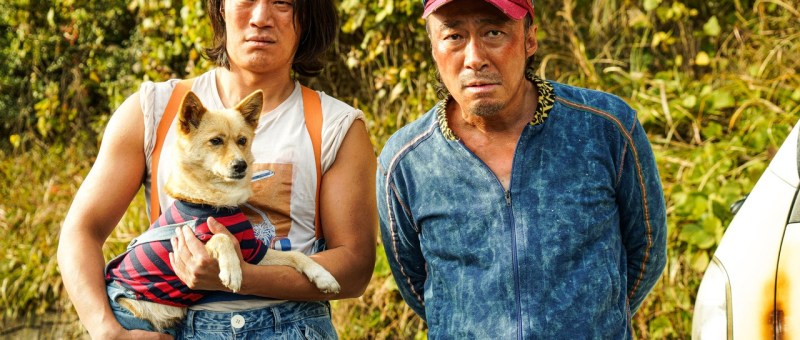
Handsome Guys (핸섬가이즈, Nam Dong-hyub, 2024)

The malicious inequalities of the contemporary society are manifested in an angry goat demon who wants to burn the world in Nam Dong-Hyub’s zany horror comedy, Handsome Guys (핸섬가이즈). Adapted from the American film Tucker & Dale vs. Evil, the film plays with prejudice and superficiality along with the pernicious snobbishness of a society founded on status in which, as a would-be-exorcist later says, some have lost the ability to distinguish good from evil.

Step-brothers Sanggu (Lee Hee-joon) and Jaepil (Lee Sung-min) often suffer precisely because of this inability. They are actually nice, sweet guys who are always trying to do the right thing but somehow their behaviour always comes off as creepy giving rise to a series of misunderstandings. That might be why they’ve decided to buy a cottage in the woods in order to live a rustic life, only the house they’ve purchased is a little more rundown than the estate agent implied and was previously home to a Catholic priest which doesn’t altogether explain the goat-themed pentagram in the basement. 

Like the brothers, Mina (Gong Seung-yeon) is also a nice person as we can tell because she’s the only one of her friends who wanted to give the goat they hit with their car a proper burial while the others decide to just leave it in the road and drive off. She too thought the brothers were creepy, but is also awakening to the fact that Sungbin (Jang Dong-joo), a rising star of the golf world, is a bit of a twit who wields his privilege like a weapon and has essentially invited her on this country weekend as entertainment. He also bullies his friend/minion Byung-jo (Kang Ki-doong) whom they regard as a loser and is evidently willing to bear humiliation merely to be in the same orbit as a man like Sungbin who with his good looks, refined manners and modern manliness projects an idealised image of contemporary masculinity that is the exact opposite of the brothers. 

In many ways, he is the demonic presence of privileged youth damaging the hopes and prospects of ordinary youngsters like Mina. Believing that she has been kidnapped by the brothers, the three guys set out to “rescue” her but Sungbin doesn’t care about Mina at all and in fact only wants to retrieve his phone which contains evidence of his sordid lifestyle which would destroy his prospects of becoming a celebrity through achieving success in his golfing career. Nevertheless, they decide to attack the brothers with mostly disastrous results believing them to be nothing other than idiotic hillbillies if also depraved backwoods serial killers living an animalistic, uncivilised existence that is far too close to the land for city slickers like Sungbin. 

Once again, the brothers are plagued by a series of bizarre misunderstandings based on the perception of their “ugliness” which aligns them with “evil” and demands they be exiled from a society that equates physical “beauty” with moral goodness. To that extent, having been rescued from falling in a pond, Mina becomes a kind of Snow White ensconced in the home of the brothers and coming to understand that they are actually nice, if a bit strange, and merely have difficulty expressing themselves while their down-to-earth homeliness only seems suspicious to those who are a little less honest with emotions.

Their niceness, however, seems to be perfectly primed to face off against the Goat Demon as they become determined to protect their homestead from the likes of Sungbin who has only contempt for them and thinks they’re merely fodder for his heroic fantasy of retrieving his phone and proving his manliness at the same time. In essence, it’s Sungbin who embodies the ugliness of the contemporary society with its hypocrisy and superficiality, its casual misogyny and petty prejudice, while the brothers later vindicated as angelic presences of altruistic goodness. Slapstick humour mingles with a sense of malevolence and an inescapable cosmic irony that plagues the brother’s with misunderstandings and has kept them isolated, “handsome guys” too beautiful for a profane world and attempting to find refuge in their remote homestead and homoerotic relationship but eventually discovering unexpected solidarity with the equally exiled Mina as she delivers a silver bullet to privilege and patriarchy, sending ancient evil back to whence it came.


Handsome Guys screened as part of this year’s London Korean Film Festival.

International trailer (English subtitles)
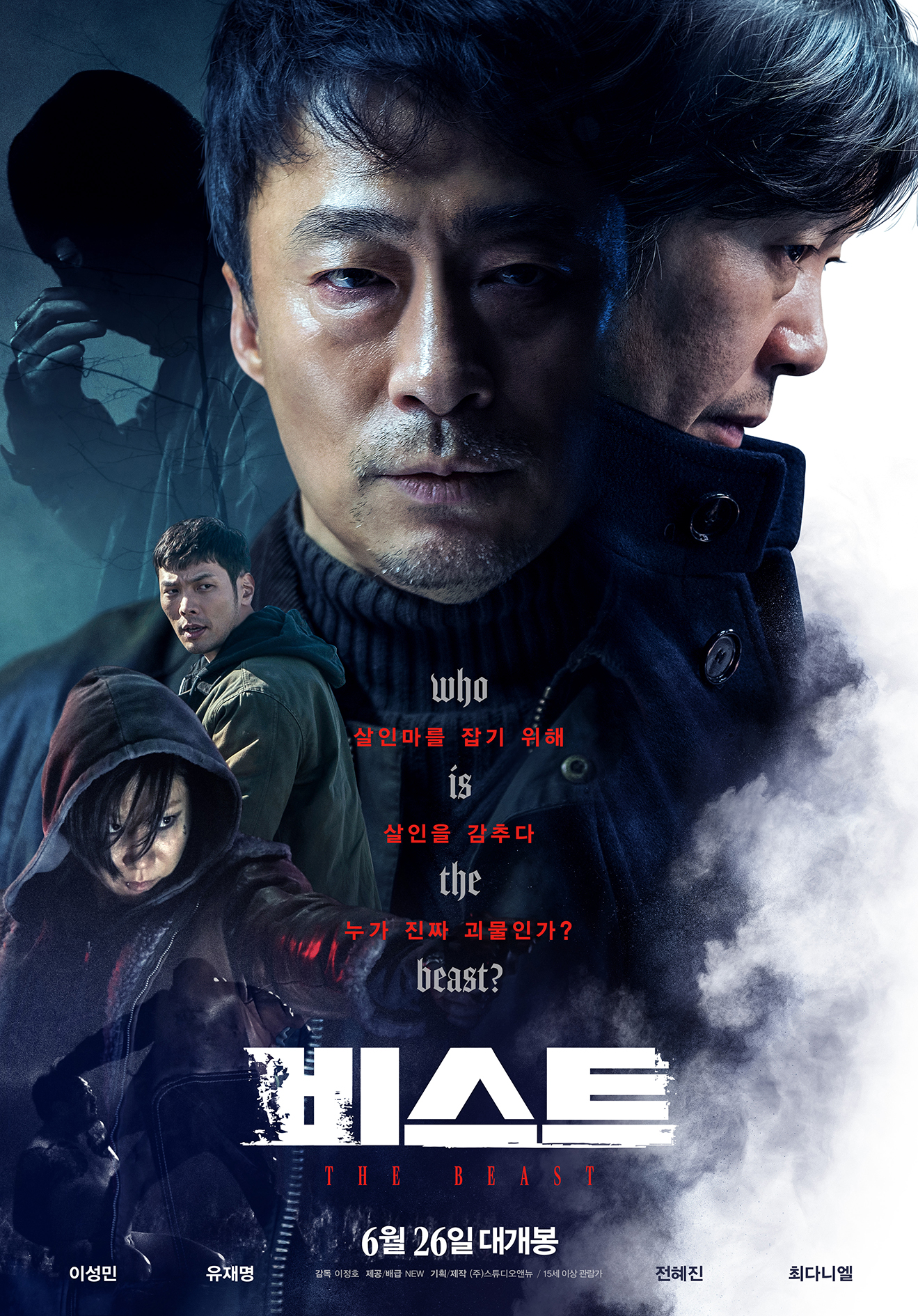
The Beast (비스트, Lee Jung-ho, 2019)

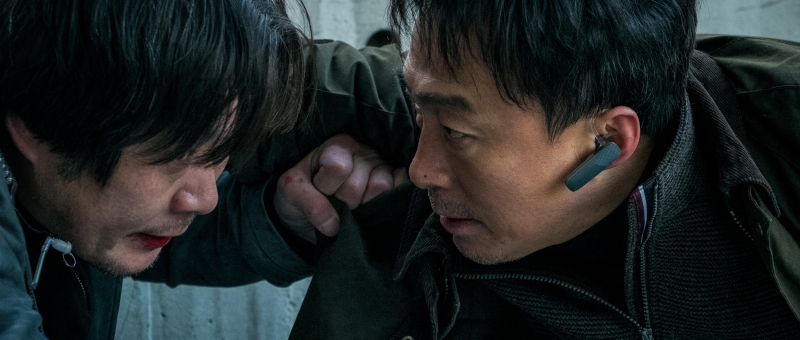
Internal police politics frustrate the hunt for a potential serial killer in Lee Jung-ho’s dark social thriller, The Beast (비스트) inspired by Oliver Marchal’s 36 Quai des Orfèvres. As a pathologist suggests, we all may have a hidden beast and it’s certainly true of the film’s conflicted protagonist, thuggish policeman Inspector Jung (Lee Sung-Min) who finds himself dragged ever deeper into a mire of corruption as a natural result of a series of bad decisions that started long ago, while his rival, Captain Han (Yoo Jae-Myung), presents the facade of efficient modern policing but inevitably turns out to be little better. 

As the film opens, Jung and his subordinate Yang are each wearing balaclavas while driving a heavily tattooed man out into the middle of nowhere though only for the purposes of frightening him so that he’ll back off their informant, local bar owner Madame Oh (Kim Ho-jung). Jung’s inner conflict is palpable as stares at his bloodied, shaking hands asking himself how it is it’s come to this while Yang later reminds him not to become too attached to his sources because once they’ve exceeded their usefulness they’ll simply be arrested. While all of this is going on, the police force is under immense pressure and receiving a lot of negative press over their handling of the case of a missing teenage girl, Mi-jin. Unfortunately, the girl later turns up dead with the murder enquiry split between two teams, those of Jung and Han each of whom are in the running to take over from the superintendent who before all of this happened was about to be promoted which is why he is desperate to solve the case as soon as possible. 

It might at first be tempting to read Jung and Han as representatives of different kinds of policing with their rivalry representing a battle for the soul of the police force only as it turns out each is merely corrupt in their own way. Jung is very much of the jaded veteran cop school, wanting to shift the case off his books as soon as possible by pushing the most likely suspect to confess. In this case that’s a shady pastor at a church Mi-jin used to frequent who was found in possession of her underwear and a series of photos of very young girls. Jung pushes the pastor to “confess” by selling him a story that a woman he was accused of assaulting in university took her own life as did her mother while her father later developed cancer as a result of all the stress and tragedy. Of course the pastor breaks down insisting that he killed her and it’s all his fault, only he’s talking about the other girl not that Jung cares too much about that. Han meanwhile quickly exonerates him by doing actual investigating, but only really so that he’ll still be in the running to solve the case and get the big promotion thereby besting his former partner turned rival. Jung had been the first to mention the possibility of an active serial killer only to be shut down because that would mean they’d lose the case to Major Crimes and therefore the personal opportunities for career advancement solving it would present. 

Both men eventually end up at the showdown by each of their respective routes implying there’s little practical difference between them. Han jeers that he can’t tell anymore if Jung is a bad guy or a cop but all he can answer is that it might be a matter of perspective, while he is also aware of Han’s backdoor deals and willingness to compromise himself in order to win advancement. In the midst of all this jockeying for power, it gets forgotten that a young woman lost her life in the most heinous of ways while whoever really did it may still be out there looking for the next girl to torture and kill. Everyone may indeed have a beast inside them, Jung already acquainted with his in his morally compromised soul while Han battles his internal ambition but the real beast may be the contemporary city and the infinitely corrupt hierarchies of the modern Korea along with the toxic masculinity that forces these men to betray their ideals simply not to be accounted a failure trapped at the bottom of the pyramid by their own problematic righteousness. When they’ve served their usefulness, the system chews them up and spits them out but until then it’s only hanging on as long as they can in the utter futility of a morally bankrupt existence. 


International trailer (English subtitles)
Switch (스위치, Ma Dae-yun, 2023)

An egotistical actor is given an unexpected lesson in what it is that makes life worth living when he’s suddenly transported to a parallel world in Ma Dae-yun’s charming Christmas dramedy, Switch (스위치). Rather than the body swap comedy the title might suggest, Ma’s warmhearted morality tale is a more a meditation on what might have been and may be again while contemplating the emptiness of a life of fame and riches when there’s no one to share it with. 

“What matters more than money?” top star Park Kang (Kwon Sang-Woo) chuckles after telling his manager he’ll accept a job he just described in quite insulting terms after being informed it comes with a hefty paycheque. Kang is currently riding high. He’s become enormously successful and even a recent sex scandal involving his co-star in a TV drama has only boosted his profile. Yet he tells his analyst that he can’t sleep and attributes it to “depression and anxiety”. He treats those around him poorly and most particularly his long suffering best friend from his fringe theatre days, Joe Yoon (Oh Jung-Se) who now works as his manager, while struggling to accept his loneliness and meditating on lost love in the memory of the woman he broke up with in order to chase stardom. 

After getting into a weird taxi one Christmas Eve, he’s suddenly granted the “wish” of getting to find out what would have happened if he’d made a different choice. After waking up in an unfamiliar house he discovers that he’s married with two children and slumming it fringe theatre while Joe Yoon is now the superstar having aced the audition Kang ran out on to chase Soo-hyun (Lee Min-Jung) to the airport and convince her not to leave. Of course, Kang is originally quite unhappy about all of this. He doesn’t understand why no one recognises him anymore and resents that he’s suddenly subject to the rules of “ordinary” people again after a decade as a pampered star. In his acceptance speech after winning an award, he’d stated his intention to “forget” his roots as a humble actor and embrace his new role as a member of the showbiz elite fully demonstrating his sense of alienation and insecurity along with his intense loneliness. As the taxi driver had said, Kang has “everything”. He’s achieved his dreams and lives the high life he’d always dreamed of, yet he’s deeply unhappy.

But his “new” life immediately challenges his sense of masculinity in realising that he has little power without money and is in fact financially dependent on Soo-hyun whom he may also have robbed of a bright future by preventing her from studying abroad and achieving success as an artist. Meanwhile he looks down on himself for continuing to follow his artistic dreams in fringe theatre when his plays attract few audiences members and make little money. Just as Joe Yoon had become his manager, so he ends up getting a taste of what it’s like trying to manage a “star” while coming to appreciate that Joe Yoon may be feeling just as lonely and unfulfilled as he once had. 

Yet even as Kang settles into his new life as a husband and father while slowly rebuilding his acting career though a combination of talent, supportive friendship, and good luck, he fails to learn the right lessons continuing to yearn for external validation through material success. He spends money on fancy dinners and tries to move the family into a swanky apartment in Seoul without realising that he’s already got a “home” in the quaint little provincial house he and Soo-hyun set up together filled with memories (that admittedly he doesn’t actually have) of the children when they were small. Slowly, he begins to look beyond himself while developing a new sense of security that means he doesn’t need to chase status-based affirmation in empty materialism but now has a new sense of what’s really important. A charming season morality tale with a little more than a hint of A Christmas Carol, Ma’s gentle drama never suggests that success itself is wrong or that Kang must give up his movie star persona to become a happy everyman but only insists that true happiness is brokered by treating others well and being treated well in return much more than it is by consumerist success.


Switch screens at UltraStar Cinemas Mission Valley April 22/24 as part of this year’s San Diego Asian Film Festival Spring Showcase.

International trailer (English subtitles)
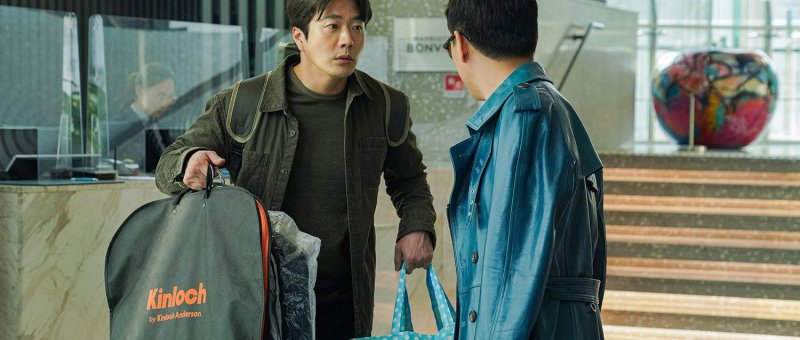
Deliver Us From Evil (다만 악에서 구하소서, Hong Won-chan, 2020)

A melancholy hitman bids for paternal redemption but finds himself literally stalked by the mistakes of his violent past in Hong Won-chan’s pulpy action drama, Deliver Us From Evil (다만 악에서 구하소서, Daman Akeseo Goohasoseo). Aptly named, Hong’s noirish thriller takes us from the back streets of Osaka to underground Bangkok while the hero longs for the tranquil horizons of Panama but finally discovers that he cannot outrun himself even if he can perhaps repay his karmic debt by freeing others from the riptide of his moral transgressions. 

A former government agent apparently unceremoniously burned, In-nam (Hwang Jung-min) has been earning his keep as a killer for hire hiding out in Japan. His “one last job” is knocking off a Zainichi Korean mob boss, Koreda (Kosuke Toyohara), after which he’ll be free to go wherever he wants, arbitrarily setting his sights on Panama solely because of the tranquil scene featured in a picture opposite his favourite seat in his local izakaya. The past is however not done with him yet. His old handler gets in touch to let him know old flame Young-ju (Choi Hee-seo) has been trying to contact him, but so consumed with shame and defeat is he that he declines to respond only to hear a short time later that Young-ju has been found dead in Bangkok and as she’d listed him as next of kin he’s responsible for the repatriation of her body. Remorseful, he’s shocked to discover that Young-ju had a daughter, Yoo-min (Park So-yi), whose kidnap by her Korean-Chinese nanny may be connected to her murder. Switching up his plans, In-nam determines to save the daughter he believes to be his own but is pursued by flamboyant Korean-Japanese gangster Ray (Lee Jung-jae) hellbent on getting revenge for his estranged blood brother Koreda. 

In-nam finds himself in a sense caught between a series of codes of masculinity, apparently a former government spy who seems to have been involved in state sanctioned acts of torture and murder that may privately be against his sense of morality only to fall still further as a killer for hire even if we’re told in no uncertain terms that Koreda was a bad guy, a killer of women whose death is perhaps morally justifiable within the codes of chivalry. In-nam’s partner warns him about Ray, reminding him that they should have killed him at some point in the past but apparently let him live, a decision that has led, as Ray later states, to their present confrontation. Quizzed by a local Thai mobster, Ray claims he can’t even remember why he’s so set on killing In-nam but is mindlessly bound to follow his own code of manliness in avenging the death of a blood brother he had apparently fallen out with some years previously.

Meanwhile, in retrieving his daughter In-nam attempts to reclaim the right to a peaceful life making up in a sense for the mistakes of the past in having first abandoned Young-ju because of his manly code and then failed her in refusing her request for help. He attempts to reassert himself as a father by saving his little girl, but in doing so opts only for the personal, unmoved on discovering a child trafficking network enabled by the peculiar medical regulations of Japan and Korea which prohibit child organ transplants looking to save only Yoo-min while making no real effort to help the others. On reporting her daughter missing to the police, Young-ju had been horrified to discover Yoo-min’s photo pasted onto a wall entirely covered in similar notices for other children the police, as we later discover somewhat complicit, have so far failed to find. Yet saving the children is more happy accident than design, an indirect consequence of In-nam’s violent intervention. 

Indeed, In-nam more or less leaves the kids to his local sidekick a Korean transgender woman whose confirmation surgery he’s promised to fund in return for her assistance as guide and translator while he remains bound to a nihilistic path of manliness knowing there’s no way out for him that does not end in violent confrontation with past sins. Caught between the outlandish pulp of the flamboyant Ray and the noirish fatalism of In-nam’s journey into the darkness of the Bangkok underworld, Deliver Us From Evil defiantly refuses to marry its conflicting sensibilities as the two men pursue their respective codes each looking for their own particular deliverance but finding that salvation lies only in confrontation. 


Deliver Us From Evil screens at Edinburgh Filmhouse on 22nd June and Genesis Cinema London 24th June as the first Teaser Screening for this year’s London Korean Film Festival. The next screening in the series, Voice of Silence, will screen at Edinburgh Filmhouse on 1st July and Curzon Soho 3rd July, while Samjin Company English Class will then screen at London’s Screen on the Green on 8th July.

International trailer (English subtitles)

Money (돈, Park Noo-ri, 2019) [Fantasia 2019]

money poster 1“Could you ask him something for me,” the beleaguered yet victorious protagonist of Park Noo-ri’s Money (돈, Don) eventually asks, “what was he going to use the money for?”. Wealth is, quite literally it seems, a numbers game for the villainous Ticket (Yoo Ji-tae) whose favourite hobby is destabilising the global stock market just for kicks. As for Cho Il-hyun (Ryu Jun-yeol), well, he just wanted to get rich, but where does getting rich get you in the end? There’s only so much money you can spend and being rich can make you lonely in ways you might not expect.

Unlike most of his fellow brokers, Cho Il-hyun is an ordinary lad from the country. His parents own a small raspberry farm and he didn’t graduate from an elite university or benefit from good connections, yet somehow he’s here and determined to make a success of himself. In fact, his only selling point is that he’s committed the registration numbers of all the firms on the company books to memory, and his ongoing nervousness and inferiority complex is making it hard for him to pick up the job. A semi-serious rookie mistake lands the team in a hole and costs everyone their bonuses, which is when veteran broker Yoon (Kim Min-Jae) steps in to offer Il-hyun a way out through connecting him with a shady middle-man named “The Ticket” who can set him up with some killer deals to get him back on the board.

Il-hyun isn’t stupid and he knows this isn’t quite on the level, but he’s desperate to get into the elite financial world and willing to cheat to make it happen. As might be expected his new found “success” quickly goes to his head as he “invests” in swanky apartments and luxury accessories, while his sweet and humble teacher girlfriend eventually dumps him after he starts showering her with expensive gifts and acting like an entitled elitist. It’s not until some of his fellow brokers who also seem to have ties to Ticket start dying in mysterious circumstances that Il-hyun begins to wonder if he might be in over his head.

Unlike other similarly themed financial thrillers, it’s not the effects of stock market manipulation on ordinary people which eventually wake Il-hyun up from his ultra capitalist dream (those are are never even referenced save a brief reflective shot at the end), but cold hard self-interest as he finally realises he is just a patsy Ticket can easily stub out when he’s done with him. Yoon only hooked him up in the first place because he knew he’d be desperate to take the bait in order to avoid repeated workplace humiliation and probably being let go at the end of his probationary period. What he’s chasing isn’t just “money” but esteem and access to the elite high life that a poor boy from a raspberry farm might have assumed entirely out of his reach.

It’s difficult to escape the note of class-based resentment in Il-hyun’s sneering instruction to his mother that she should “stop living in poverty” when she has the audacity to try and offer him some homemade chicken soup from ancient Tupperware, and it’s largely a sense of inferiority which drives him when he eventually decides to take his revenge on the omnipotent Ticket. Yet there’s a strangely co-dependent bond between the two men which becomes increasingly difficult pin down as they wilfully dance around each other.

The world of high finance is, unfortunately, a very male and homosocial one in which business is often conducted in night-clubs and massage parlours surrounded by pretty women. There is only one female broker on Il-hyun’s team. The guys refer to her as “Barbie” and gossip about how exactly she might have got to her position while she also becomes a kind of trophy conquest for Il-hyun as he climbs the corporate ladder. Meanwhile, there is also an inescapably homoerotic component to Il-hyun’s business dealings which sees him flirt and then enjoy a holiday (b)romance with a Korean-American hedge fund manager (Daniel Henney) he meets at a bar in the Bahamas, and wilfully strip off in front of Ticket ostensibly to prove he isn’t wearing a wire while dogged financial crimes investigator Ji-cheol (Jo Woo-jin) stalks him with the fury of a jilted lover.

Obsessed with “winning” in one sense or another, Il-hyun does not so much redeem himself as simply emerge victorious (though possibly at great cost). Even his late in the game make up with Chaebol best friend Woo-sung (Kim Jae-young), who actually turns out to be thoroughly decent and principled (perhaps because unlike Il-hyun he was born with wealth, status, and a good name and so does not need to care about acquiring them), is mostly self-interest rather than born of genuine feeling. In answer to some of Il-hyun’s early qualms, Ticket tells him that in finance the border between legal and illegal is murky at best and it may in fact be “immoral” not to exploit it. What Il-hyun wanted wasn’t so much “money” but what it represents – freedom, the freedom from “labour” and from from the anxiety of poverty. Life is long and there are plenty of things to enjoy, he exclaims at the height of his superficial success, but the party can only last so long. What was the money for? Who knows. Really, it’s beside the point.


Money was screened as part of the 2019 Fantasia International Film Festival.

International trailer (English subtitles)
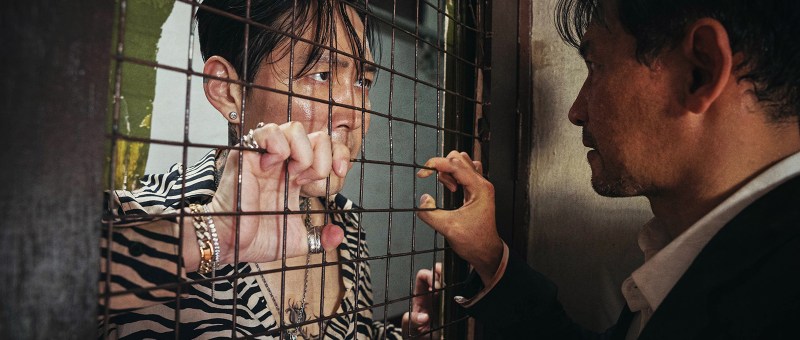
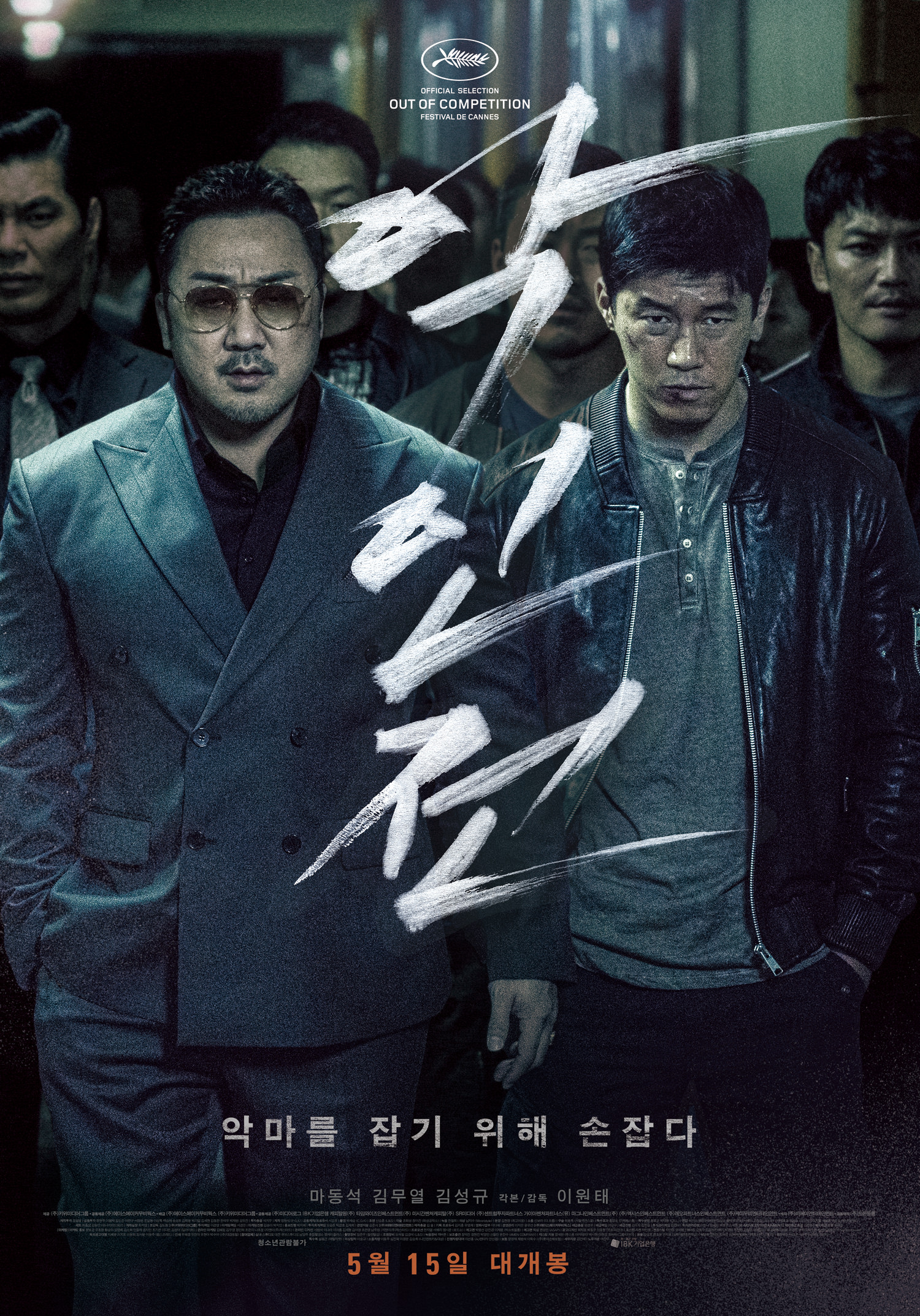
The Gangster, The Cop, The Devil (악인전, Lee Won-tae, 2019) [Fantasia 2019]

81745_1000“Two bad guys will catch the worst man” according to irritated gangster Jang Dong-su (Ma Dong-seok) in Lee Won-tae’s The Gangster, The Cop, The Devil (악인전, Akinjeon). He doesn’t quite know how right he is, even as he forms an unlikely alliance with a maverick cop himself highly irritated because his lazy colleagues won’t listen to his theory that a spate of unsolved murders are the work of a serial killer. More alike than they’d care to admit, the two “bad guys” team up to do what they have to do in order to make the killing stop but at what price?

A vicious killer (Kim Sung-kyu) has developed a habit of rear-ending solo drivers on lonely roads, stabbing them repeatedly and then leaving them for dead. Maverick cop Tae-seok (Kim Mu-yeol) has become convinced that the killings were carried out by the same perpetrator and that they have not yet been identified as a “serial killer” partly because the crimes took place in different districts and there is insufficient co-operation between precincts, and partly because his colleagues think serial killers are something you see in American movies. His superiors just want to close cases, they aren’t particularly concerned with upholding justice or protecting the innocent and so Tae-seok starts thinking outside of the box when he hears that the killer’s latest target was none other than top mob boss Jang Dong-su.

Dong-su got rear-ended after running an errand to have a word with a wayward underling, Hur (Yoo Jae-myung), who has forgotten his place. The killer made a serious mistake going after Dong-su who is a big, handy kind of guy and therefore manages to fend him off, even wounding him in the shoulder despite being badly injured himself. Though the obvious conclusion is that Hur sent someone after him, Dong-su is unconvinced seeing as he had never seen his assailant before and is pretty sure he’s not a member of the gangster underworld. Still, he’s very annoying because a gangster only has power in being respected and right now Dong-su looks a fool. If he wants to get his “professional” life back on track, he needs to get his revenge but to do that he’ll have to cross the floor and work with law enforcement, temporarily teaming up with rogue cop Tae-seok whose heart is in the right place even if he’s not averse to bending the rules.

One of the things which most bothers Tae-seok about amoral killer “K” is that, unlike most serial killers, he kills indiscriminately and purely for pleasure. He has no “type” and generally goes up against those most likely to fight back, unlike your average pattern killer who targets the vulnerable. Like Tae-seok and Dong-su, he is however quite annoyed – this time because someone has “framed” him for a murder he didn’t commit in order to further their own ends. Hugely overconfident and cooly psychopathic, he sits in the dock and asks what makes his crimes different than the state’s if the state is fixing to execute him without proper evidence. Pointedly looking at law enforcement, he affirms that the real villains are those who commit crime with kind faces (say what you like, but at least K looks the part).

When it comes to Tae-seok he might have a point. Conspiring with Dong-su to “kill him with law”, Tae-seok gleefully manipulates the system while giving Dong-su tacit permission to take his revenge as long as “justice” has been properly served. K doesn’t believe in anything, Tae-seok believes in a particular kind of “justice” if not quite in the law, while Dong-su mourns the sense of self-belief that allows you to rule the roost as an all powerful gangster. The three men are a perfect storm, each angry, each resentful, each vowing a particular kind of revenge against the forces which constrain them be they corrupt and lazy superiors, gangsterland disrespect, or the “injustice” of being accused of a crime you did not commit but not being properly credited for the ones you did. Bathed in a garish neon, Lee’s anti-buddy-cop drama embraces its noirish sense of fractured morality with barely suppressed glee as its similarly conflicted heroes pursue their violent destinies, true to their own but dragged to hell all the same.


The Gangster, The Cop, The Devil was screened as part of the 2019 Fantasia International Film Festival.

International trailer (English subtitles)