Treat or Trick (詭扯, Hsu Fu-Hsiang, 2021)

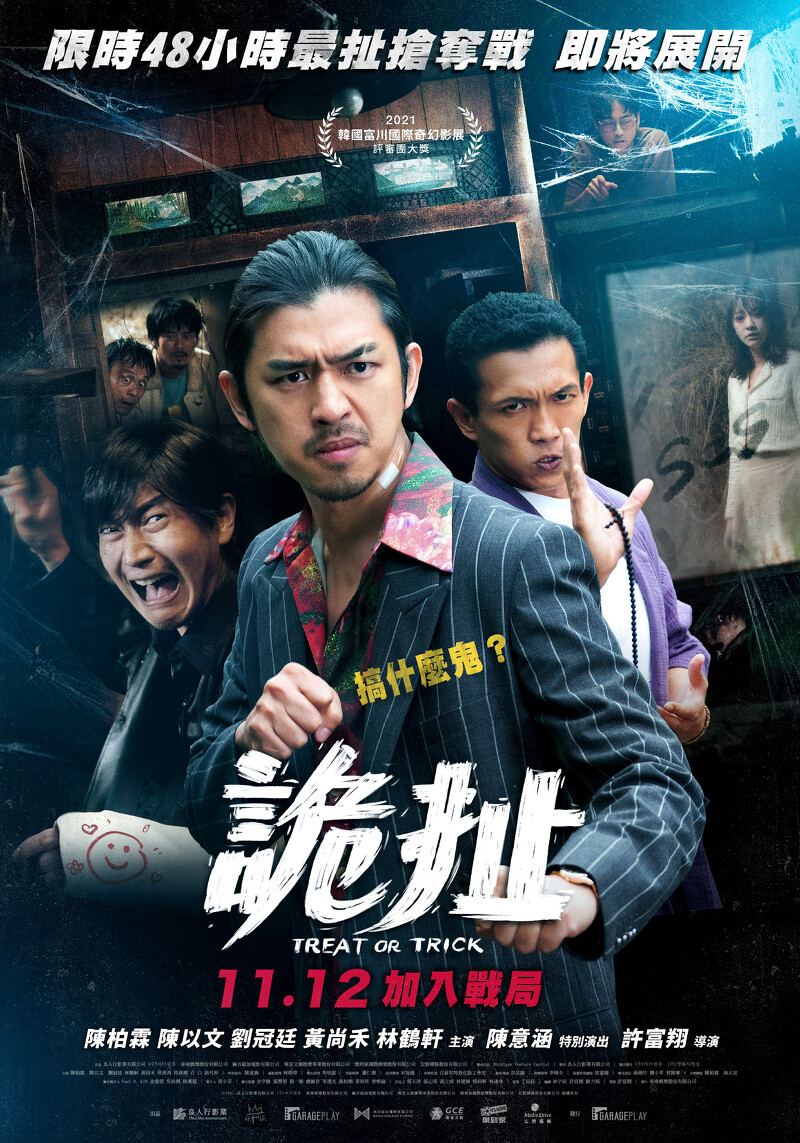
Diamonds, What it is it about them that makes everyone crazy? A bag of the elusive gemstones leads a series of corrupt cops towards a purgatorial hellscape deep in the mountains in Hsu Fu-Hsiang’s remake of the 2004 Korean film To Catch a Virgin Ghost, Treat or Trick? (詭扯, guǐ chě). The title could stand in for diamonds themselves which after all have little intrinsic value outside the illusionary desirability they evoke, but also hints at the “trickster” nature of its duplicitous hero. 

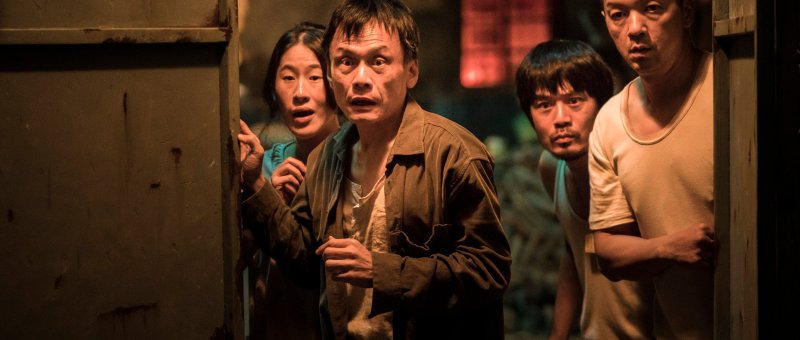
Corrupt cop Feng (Chen Bolin) admits that he didn’t join the police out of a fierce sense of justice, but because it was more convenient for his gangster lifestyle as he demonstrates in arresting a bunch of crooks only to stage a secondary robbery, getting his best friend Chiang (Yen Sheng-yu) to pose as a thief taking him hostage and running off with a bag of diamonds. Only, unbeknownst to Feng, Chiang has been picked as a fall guy for Boss Lin (Yu An-shun) to whom they were supposed to deliver the diamonds and has taken off with them. This is obviously a problem for Lin who takes cop Psycho hostage and charges Feng, his buddy Monk, and a guy from the gang Yang (Liu Kuan-ting), to track him down and bring the diamonds back. The trouble is that Chiang got into a car accident swerving to avoid the ghostly presence of a young woman and has wandered into a very weird village where everyone seems to be acting suspiciously. 

In many ways, you could see the village as a kind of purgatorial space inhabited by those trapped between two worlds towards which the gang of corrupt cops is beckoned to answer for their transgressions. Meanwhile, they’re also haunted by the figure of the mysterious woman whose presence is both help and hindrance hinting at dark goings on in this very remote area where visitors are a rarity. Having found out about the diamonds, the villagers are obviously keen to keep hold of them but then there are only so many to go round and it’s not as if you can cut a diamond in half, so the dilemma remains exactly who is going end up with the loot and how creating division on both sides. 

You couldn’t really say that either of these groups are the good guys, but it’s true enough that the villagers variously end up paying a high price for their greed usually caught out by their attempts to get one up on the cops, injured by backfiring weapons or caught in their own traps. Meanwhile, even Chiang falls victim to the essential weirdness of the village in succumbing to a freak accident which leads some to believe that he is dead though in a running gag he turns out to be more or less unkillable as if the eeriness of the place will not allow him to die no matter how many times he’s thrown off a hill, nailed in the head, crushed under falling objects, or set on fire. Yet Feng and his buddies remain largely untouched, outsiders in this strange world and completely by accident occupying some kind of murky moral high ground in trying to rescue their friend (along with diamonds which they need to get Psycho back and save their own lives by smoothing things over with Lin).

Hopping from the gangster movie to supernatural horror, martial arts, and mystery Hsu’s absurd morality farce throws in a series of running gags from “unlucky” Chiang’s strange ability to survive the unsurvivable to frequent allusions to the diamond sutra while possessing its own sense of karma as the greedy find themselves victims of their own scheming, but then perhaps not as the final twist might imply. Even so in this weird place, natures and destinies perhaps possess the ability to change, eccentric thug Yang getting far too into his role as a cop and finally deciding he’d like to be a “good guy” after all while guided by their brotherhood Feng and Monk too find themselves rediscovering a sense of justice in accidentally helping to solve a long dormant cold case. It’s all curiously circular, which is perhaps fitting for this farcical morality tale, but the jury seems to be out on whether even the brotherhood between Feng and his buddies not to mention their newfound sense of justice can survive the cursed allure of the stolen diamonds. 


Treat or Trick screens in Chicago April 9 as part of the 14th season of Asian Pop-Up Cinema.

Original trailer (Traditional Chinese / English subtitles)
A Leg (腿, Chang Yao-sheng, 2020)

“Life is long. We all have some regrets.” a grieving widow is told by a disingenuous doctor in full damage limitation mode. He’s not necessarily wrong, nor is his advice that the widow’s pointless quest to retrieve her late husband’s amputated limb has little practical value though of course it means something to her and as he’d pointed out seconds earlier a physician’s duty is to alleviate suffering of all kinds. Apparently inspired by the true story of director Chang Yao-sheng’s mother, A Leg (腿, Tuǐ) is in many ways a story of letting go as the deceased man himself makes a presumably unheard ghostly confession while his wife attempts to do the only thing she can in order to lay him to rest. 

Husband Zi-han (Tony Yang) is in hospital to deal with a painful, seemingly necrotic foot which eventually has to be amputated in a last ditch attempt to cure his septicaemia. “Keep the leg and lose your life, or keep your life and lose the leg” the otherwise unsympathetic doctor advices wife Yu-ying (Gwei Lun-mei) in a remark which will come to seem ironic as, unfortunately, Zi-han’s case turns out to be more serious than first thought and he doesn’t make it through the night. Grief-stricken, Yu-ying leaves in an ambulance with the body but later turns back, determined to retrieve the amputated foot in order that her husband be buried “complete” only it turns out that it’s not as simple as she assumed it would be. 

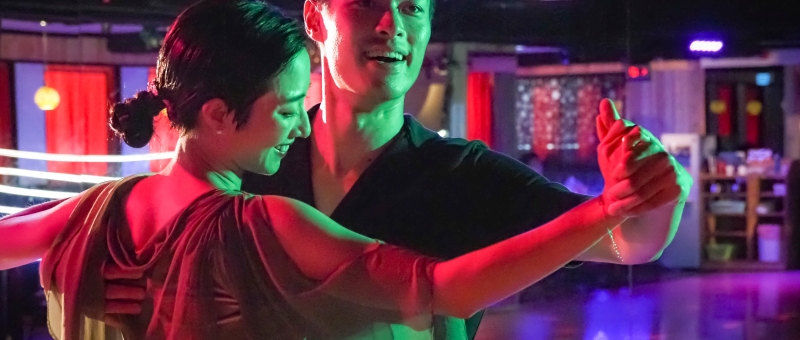
The loss of Zi-han’s foot is all the more ironic as the couple had been a pair of ballroom dancers. As Yu-ying makes a nuisance of herself at the hospital, Zi-han begins to narrate the story of their romance which began when he fell in love with a photo of her dancing in the window of his friend’s photography studio. Explaining that, having died, he’s reached the realisation that everything beautiful is in the past only he was too foolish to appreciate it, Zi-han looks back over his tragic love story acknowledging that he was at best an imperfect husband who caused his wife nothing but pain and disappointment until the marriage finally broke down. He offers no real explanation for his self-destructive behaviour save the unrealistic justification that he only wanted Yu-ying to live comfortably and perhaps implies that his death is partly a means of freeing her from the series of catastrophes he brought into her life. 

Given Zi-han’s beyond the grave testimony, the accusation levelled at Yu-ying by his doctor that the couple could not have been on good terms because Zi-han must have been ill for a long time with no one to look after him seems unfair though perhaps hints at the guilt Yu-ying feels in not having been there for her husband when he needed her. As we later discover, however, this is also partly Zi-han’s fault in that he over invested in a single piece of medical advice and resisted getting checked out by a hospital until he managed to sort out an insurance scam using his photographer friend, wrongly as it turned out believing he had a few months slack before the situation became critical and paying a high price for his tendency to do everything on the cheap. Nevertheless, Yu-ying’s quest to reattach his leg is her way of making amends, doing this one last thing for the husband whom she loved deeply even though he appears to have caused her nothing but misery since the day they met. 

In order to placate her, the slimy hospital chief offers to have a buddhist sculptor carve a wooden replica of Zi-han’s leg made from wood destined for a statue of Guan-yin goddess of mercy but Yu-ying eventually turns it down, struck by the beauty of the object but convinced that turning it to ash along with her husband’s body would be wrong while believing that wood ash and bone ash are fundamentally different. She regrets having ticked the box on the consent form stating she didn’t want to keep the “specimen”, never for one moment assuming that her husband would not recover. Despite their dancing dreams, she thought the leg was worth sacrificing against the long years they would have spent together after, though this too seems a little unlikely considering the state of their relationship prior to her discovery of Zi-han’s precarious health. Zi-han meanwhile is filled with regret for his continually awful behaviour and the obvious pain he caused his wife. Getting his leg back allows him to begin “moving on” while doing something much the same for Yu-ying though his afterlife pledge about the endurance of love seems a little trite given how he behaved while alive. A little more maudlin than your average quirky rom-com, A Leg nevertheless takes a few potshots at a sometimes cold, cynical, and inefficient medical system, inserting a plea for a little more empathy from a pair of unexpectedly sympathetic police officers, while insisting that it’s important to dance through life with feeling for as long as you’re allowed. 


A Leg screens Aug. 14  & streams in the US Aug. 15 – 20 as part of this year’s New York Asian Film Festival.

Original trailer (English/Traditional Chinese subtitles)

Your Name Engraved Herein (刻在你心底的名字, Liu Kuang-hui, 2020)

Taiwan is often thought to be the most socially liberal of Asian nations and was the first to legalise same sex marriage in 2019, but a little over 30 years ago things were very different. Many thought that the lifting of martial law which had been in place for 38 years would usher in a new era of freedom only to discover that society is slow to change and despite a gradual opening up the old prejudices still remain. So it is for A-han, the hero of Liu Kuang-hui’s Your Name Engraved Herein (刻在你心底的名字, Kè Zài nǐ Xīndǐ de Míngzi) who finds himself struggling to accept his sexuality as young man coming of age in changing times. 

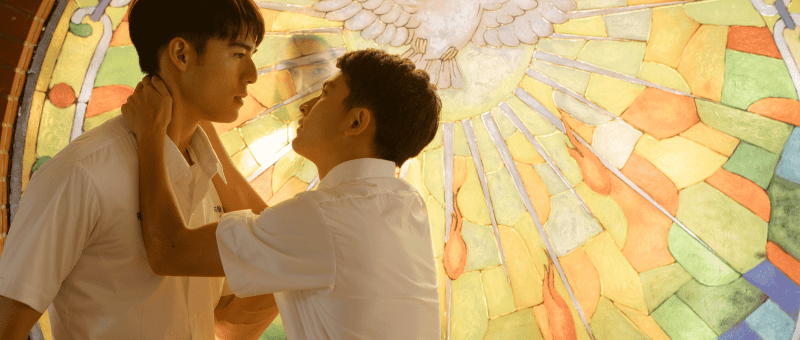
In 1987, as martial law is repealed, A-han (Edward Chen) is a student at a Catholic boys boarding school run along military lines. Many things are changing, but the school is much the same, as the principal Dirty Head (Ta Su) makes plain in conducting an impromptu inspection of the boys’ bunks looking for anything untoward. Nevertheless, A-Han and his friends sneak out at night to play in a band and hang out with girls. A-Han’s reticence is put down to shyness, but the reason he’s not much interested is that he’s taken a liking to a rebellious student, Birdy (Wang Shih-shien), only he’s not quite sure how to interpret his feelings or how to come to terms with them. 

This is in part because the school itself is extremely homophobic with the boys actively policing suspected homosexuality as a means of homosocial bonding. When the gang are caught sneaking out, band leader Horn (Barry Qu) targets an effeminate boy he accuses of dobbing them in, beating him up in the bathroom little knowing that A-han is hiding in a nearby stall after bringing ointment to Birdy who has also been caned. A-han emerges from the stalls after Horn hears a noise and is encouraged to join in the fun, handed a baseball bat and asked to participate in a literal act of queer bashing to prove his manhood. To his shame, A-Han prepares to comply, only to be saved by Birdy who breaks cover to rescue the other boy while casting scornful looks at Horn and the gang but most especially at the hypocritical A-Han. 

Taking his nickname from the Alan Parker film, Birdy may indeed be as “wild” as his namesake, but his rebelliousness has its limits and perhaps masks an internalised sense of shame. Nevertheless, he connects with the conflicted A-Han and the boys generate an intense friendship that of course has tension at its centre. A trip to Taipei to mourn the death of the president brings them closer, but also makes them feel ashamed as they witness a protester holding up a sign to the effect that homosexuality is not a disease and marriage is a human right being carted off by plain clothes police while the uniformed kind lurk in the shadows behind. Martial law may be over, but not everyone is free. As A-Han grows bolder, Birdy finds himself travelling in the opposite direction, dating a rebellious female student, Banban (Mimi Shao), as a kind of beard in the frustrated hope that he may “save” A-Han from his homosexuality by denying their feelings before they can fully develop. 

The central irony is that because of the changes to the educational system the high school is now required to take female pupils and the hardline Catholic, militarist teachers are paranoid about “misbehaviour”, even putting up a chainlink fence to divide the girls from the boys. Romance is forbidden even for heterosexual couples, and homosexuality unthinkable. A-Han finds himself trying to talk to his priest, Father Oliver (Fabio Grangeon), who would like to be more sympathetic but cannot offer him much by the way of advice. Later we discover that Father Oliver left his native Montreal to escape religious oppression and joined the priesthood to mask his own homosexuality, finally leaving the Church to live a more authentic life only many years later when such things were more acceptable. 30 years on A-han travels to a much changed Montreal where he sees lesbians dancing happily in bars and men kissing in the street with no one batting much of an eyelid. He reflects on all that’s changed and all the wasted time he and others like him were forced to endure hiding who they were, living in a world without love. A melancholy lament for the lost opportunities of a repressive society, Your Name Engraved Herein ends on a note of hope in which first love can blossom once again in a less restrictive world where all are free to love without shame.


Your Name Engraved Herein made its World Premiere as part of this year’s Osaka Asian Film Festival.

Original Trailers (English subtitles)

The Bold, the Corrupt, and the Beautiful (血觀音, Yang Ya-che, 2017)

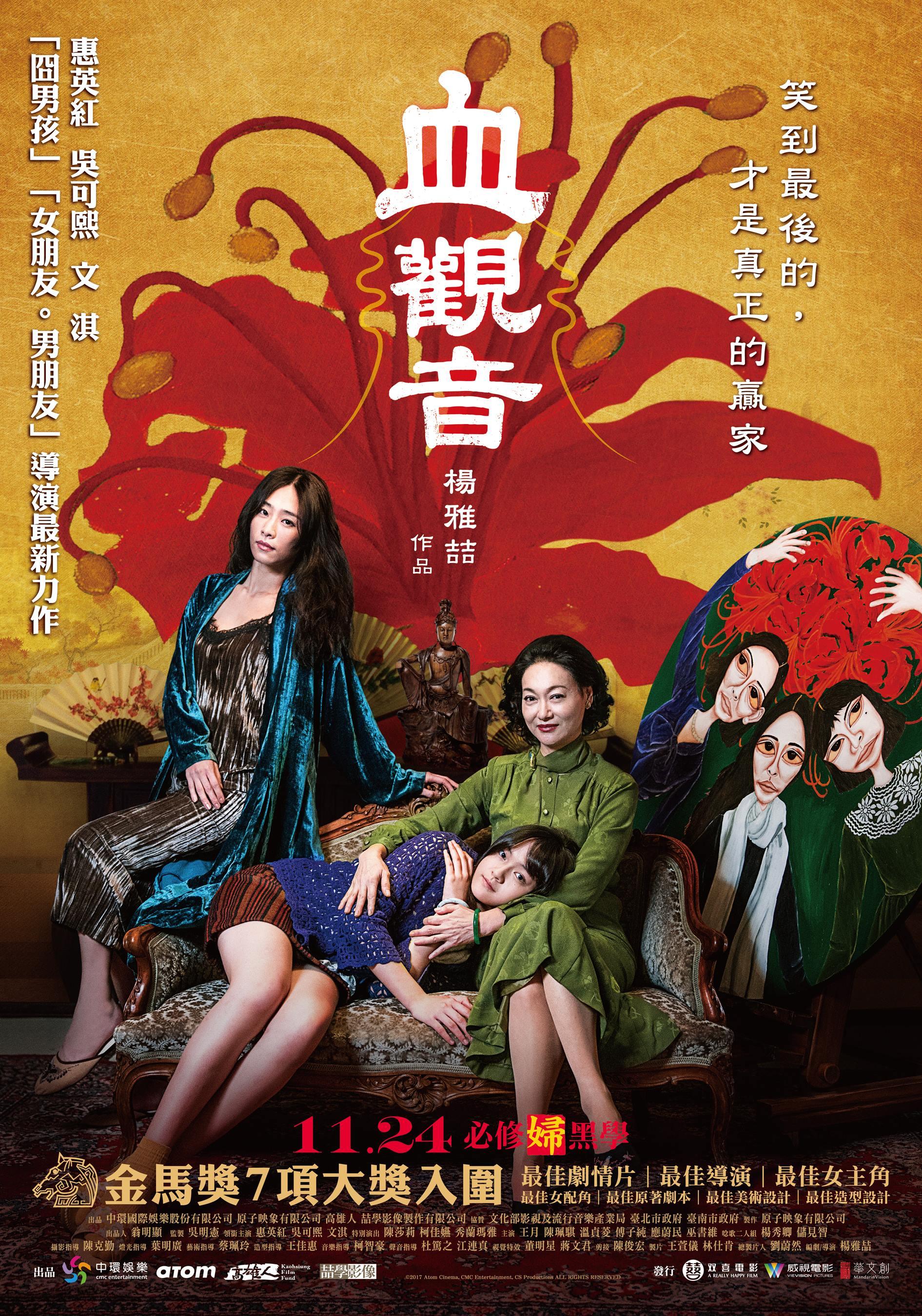
The Bold the corrupt and the beautiful posterAre you playing the game or is the game playing you? The Bold, the Corrupt, and the Beautiful (血觀音, Xuè Guānyīn) is, as its name suggests, somewhere between trashy soap opera and spaghetti western as its entirely amoral matriarch prepares to sacrifice everything in order to get ahead. The family becomes a metaphor for the state – corrupt, prejudicial, hypocritical, and often heartless in its ruthlessness but like a family a state perhaps reaps what it sows and the lessons Madame Tang has taught her daughters may come back to haunt her.

In the Taiwan of the 1980s – the dying days of the old regime but firmly within the pre-democratic past, Madame Tang (Kara Hui) is the widow of a general and, on the surface of things, an antiques dealer. Her real worth however lies in making herself the society face of genial corruption as the conveyor of the ancient treasures that often stand in for monetary bribes in the complex system of reciprocal politics. Designed to manoeuvre herself and her family into a position of power and perhaps safety, Madame Tang’s machinations amount to a mess of intrigue, manipulating the social interactions of her “friends” in order to convince them to destroy each other and clear a path for her ascendance. Part of her grand plan has involved extensive use of her daughter, Ning Ning (Wu Ke-xi) – now approaching middle-age and thoroughly sick of being her mother’s prize pony, while Chen-Chen (Vicky Chen), still a teenager, has usurped her place as the latest cute little thing to be trotted out and fussed over.

Everything starts to go wrong when a powerful neighbouring family, the Lins, is murdered in a suspicious looking home invasion leaving the daughter, Pien-Pien (Wen Chen-ling), who was the closest thing Chen-Chen had to a real human friend, in a coma. Pien-Pien had been carrying on with Marco (Wu Shuwei) the stable boy which obviously had not gone down well with her parents though she had backed out of a plan to elope with him. The police’s theory is that Marco had come back to the family home and taken his revenge, but there is an awful lot more going here than just a jealous proletarian boyfriend hitting back at the bourgeoisie.

Piling layer upon layer Yang’s script is dense and sometimes impenetrable to those not well versed in Taiwanese history and culture. Madame Tang seems to have something of an interesting hidden backstory, swapping easily between standard Taiwanese Mandarin, Cantonese, and Japanese which she, and Chen-Chen, use to get close to Mrs. Lin whose grasp of Taiwanese remains poor despite having lived on the island for many years and being heavily involved in politics. The house the family inhabits is also distinctly Japanese in layout, a colonial era home now inhabited by post-war migrants from other areas of China. The Lins look down on their stable boy not only because of the obvious class difference, or because of their daughter’s relative youth and tarnished reputation, but because he is from a persecuted minority of native peoples.

Marco does however become a kind of key. Chen-Chen, curious and privy to more knowledge than a child of her age ought to have thanks to her mother’s scheming, has developed a fondness for the strapping stable boy and mildly resents being made fun of by the oddly amused Pien-Pien. The rot sets in as Chen-Chen is sent to fetch Ning-Ning only to find her engaging in some kind of orgy in a forest, over which Chen-Chen lingers a little to long only to catch Ning-Ning’s eye and find herself suddenly caught out while her “sister” apparently finds extra spice in her discomfort. Ning-Ning, after years of emotional abuse at the hands of her mother, has begun to rebel by embarrassing her, losing herself in drink, drugs, and promiscuous sex with unsuitable men while Madame Tang still harps on about possible dynastic marriages if now to a distinctly third class tier of potential husbands.

Yang adds a post-modern dimension to the story by framing it as a cautionary tale recounted by a pair of traditional musicians in the manner of Gezi Opera which begins closer to the now before flashing back to show us how we got here. Even if the political metaphors do not hit home without some kind of primer in Taiwanese history, the familial allegory is obvious enough – corruption breeds corruption and the hollow family will eventually swallow its young. The closing coda, presented via intertitles, reminds us that the scariest prospect is not imminent punishment, but a loveless future. The Tangs’ tragedy is not that there was no love between them, but that in their cynicism and insecurity they destroy themselves through a selfish need for control and possession. Madame Tang’s lessons have indeed been learned too well, and in this she damns herself as well as her daughters, condemning all to a loveless future fuelled by greed and fear from which it is impossible to escape.


The Bold, the Corrupt, and the Beautiful was screened as part of the New York Asian Film Festival 2018.

Original trailer (traditional Chinese subtitles only)

Interview with director Yang Ya-che from the 2017 Busan Film Festival (English subtitles)