
The Curse (ザ・カース, Kenichi Ugana, 2025)

Could it be fair to say that sometimes we curse ourselves, or perhaps more accurately that the only true curse is morbid curiosity? Those at the centre of Kenichi Ugana’s J-horror inspired The Curse (ザ・カース) have the option to simply stay off social media, but they find themselves unable to do so. Be careful what you post about yourself online, the film seems to say, as if an Instagram profile were basically opening a portal to your soul through which any evil entity pass.

But at the same time, a priest cautions that one may do harm to others without even realising it and it transpires that even the most innocuous of posts can be enough to push someone over the edge. The versions of their lives that people post online are obviously idealised or perhaps aspirational, but they can still provoke a sense of jealousy or envy to the extent that saying “I am having a lovely day” can upset someone who is not and perhaps has not for a long time but continues to hate follow these kinds of accounts. This in itself is a kind of curse, the film argues, as a deepening sense of self-loathing is projected outward towards those apparently living better lives the unhappy obsessive feels they may not deserve.

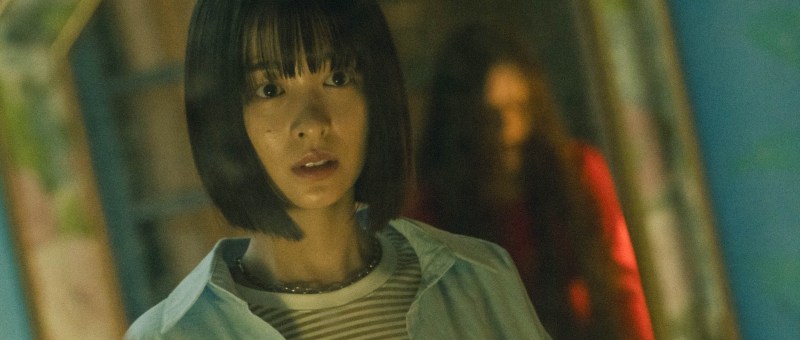
Still, there is an extent to which the curse is also “real”. When Riko (Yukino Kaizu) spots a creepy photo posted by a friend, Shufen, which is accompanied by the caption “Drop dead already, all of you” and seems to contain the image of a malevolent entity, she is of course immediately concerned. Her anxiety is compounded by the fact that her friend is Taiwanese and posts in Mandarin, so she uses the auto translate feature but has no way of knowing if the translation is accurate. When Shufen fails to reply to messages, Riko decides to get over her sense of awkwardness and contact her ex in Taiwan, a mutual friend. Confused, Jiahao (Yan Yu Teng) tells her Shufen died six months previously in circumstances so strange and disturbing her family preferred to keep it quiet. “Curses are very real, in Taiwan at least,” he tells her. People die from them. 

Riko then faces another barrier in trying to navigate her away around the ritual beliefs of another culture. When her friend Airi began exhibiting strange symptoms after watching a video online, she took her to a doctor who was unable to help. After her Taiwanese friends recommend an exorcism, she begins to feel guilty. Perhaps if she’d contacted a priest instead of a doctor, she could have been more help to Airi. The Japanese-speaking priest in Taiwan isn’t necessarily that much help either, though. He demands payment up front, which reduces his credibility and opens the door to the suggestion that the rituals he provides are more placebo effect than anything else. Nevertheless, it seems he really does have the power to intervene with spirits, only this one is a little beyond his capabilities.  

There’s an essential irony in the fact that Riko is only able to detect the ghostly presence through its reflection in images while otherwise unable to see it lurking in the shadows or under her bed. This embodiment of resentment seems to affect her offline life too as the manager of the upscale hair salon where she works begins to act strangely towards her and a homeless man he warns her about arrives to advise she deal with her ghost problem before it gets out of hand. Ugana frequently cuts back to the ranks of disembodied mannequin heads that line the salon as a kind of foreshadowing lending the place an ominous quality and perhaps playing into the anxieties of the antagonist with its elitist vibes and unwelcoming atmosphere. Perhaps the real villains are unfair female beauty standards, ageism, and lookism, or equally perhaps we’re back at the figure of a witch who doesn’t want to grow old and is cursed with vanity, resentful of those who possess a beauty she believes herself to have lost. Turning unexpectedly bloody in final moments, the film suggests that this particular curse will never be lifted in part because it has become its own reward as this this particular malevolent entity dances cheerfully in her garden, secure in the knowledge that no one is watching.


The Curse is on UK, Ireland, Australia and New Zealand digital platforms 13 July

Trailer (English subtitles)
Your Name Engraved Herein (刻在你心底的名字, Liu Kuang-hui, 2020)

Taiwan is often thought to be the most socially liberal of Asian nations and was the first to legalise same sex marriage in 2019, but a little over 30 years ago things were very different. Many thought that the lifting of martial law which had been in place for 38 years would usher in a new era of freedom only to discover that society is slow to change and despite a gradual opening up the old prejudices still remain. So it is for A-han, the hero of Liu Kuang-hui’s Your Name Engraved Herein (刻在你心底的名字, Kè Zài nǐ Xīndǐ de Míngzi) who finds himself struggling to accept his sexuality as young man coming of age in changing times. 

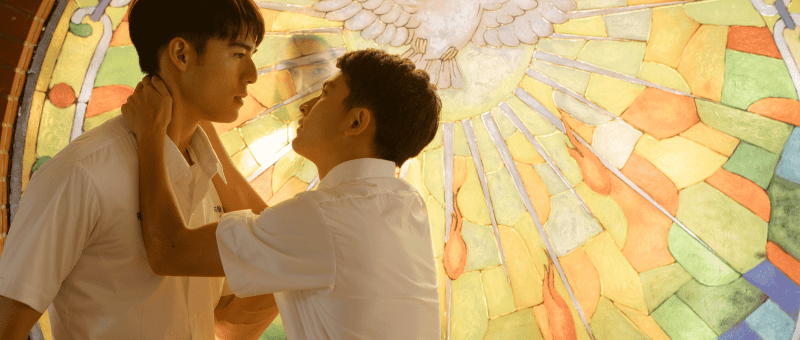
In 1987, as martial law is repealed, A-han (Edward Chen) is a student at a Catholic boys boarding school run along military lines. Many things are changing, but the school is much the same, as the principal Dirty Head (Ta Su) makes plain in conducting an impromptu inspection of the boys’ bunks looking for anything untoward. Nevertheless, A-Han and his friends sneak out at night to play in a band and hang out with girls. A-Han’s reticence is put down to shyness, but the reason he’s not much interested is that he’s taken a liking to a rebellious student, Birdy (Wang Shih-shien), only he’s not quite sure how to interpret his feelings or how to come to terms with them. 

This is in part because the school itself is extremely homophobic with the boys actively policing suspected homosexuality as a means of homosocial bonding. When the gang are caught sneaking out, band leader Horn (Barry Qu) targets an effeminate boy he accuses of dobbing them in, beating him up in the bathroom little knowing that A-han is hiding in a nearby stall after bringing ointment to Birdy who has also been caned. A-han emerges from the stalls after Horn hears a noise and is encouraged to join in the fun, handed a baseball bat and asked to participate in a literal act of queer bashing to prove his manhood. To his shame, A-Han prepares to comply, only to be saved by Birdy who breaks cover to rescue the other boy while casting scornful looks at Horn and the gang but most especially at the hypocritical A-Han. 

Taking his nickname from the Alan Parker film, Birdy may indeed be as “wild” as his namesake, but his rebelliousness has its limits and perhaps masks an internalised sense of shame. Nevertheless, he connects with the conflicted A-Han and the boys generate an intense friendship that of course has tension at its centre. A trip to Taipei to mourn the death of the president brings them closer, but also makes them feel ashamed as they witness a protester holding up a sign to the effect that homosexuality is not a disease and marriage is a human right being carted off by plain clothes police while the uniformed kind lurk in the shadows behind. Martial law may be over, but not everyone is free. As A-Han grows bolder, Birdy finds himself travelling in the opposite direction, dating a rebellious female student, Banban (Mimi Shao), as a kind of beard in the frustrated hope that he may “save” A-Han from his homosexuality by denying their feelings before they can fully develop. 

The central irony is that because of the changes to the educational system the high school is now required to take female pupils and the hardline Catholic, militarist teachers are paranoid about “misbehaviour”, even putting up a chainlink fence to divide the girls from the boys. Romance is forbidden even for heterosexual couples, and homosexuality unthinkable. A-Han finds himself trying to talk to his priest, Father Oliver (Fabio Grangeon), who would like to be more sympathetic but cannot offer him much by the way of advice. Later we discover that Father Oliver left his native Montreal to escape religious oppression and joined the priesthood to mask his own homosexuality, finally leaving the Church to live a more authentic life only many years later when such things were more acceptable. 30 years on A-han travels to a much changed Montreal where he sees lesbians dancing happily in bars and men kissing in the street with no one batting much of an eyelid. He reflects on all that’s changed and all the wasted time he and others like him were forced to endure hiding who they were, living in a world without love. A melancholy lament for the lost opportunities of a repressive society, Your Name Engraved Herein ends on a note of hope in which first love can blossom once again in a less restrictive world where all are free to love without shame.


Your Name Engraved Herein made its World Premiere as part of this year’s Osaka Asian Film Festival.

Original Trailers (English subtitles)