A Foggy Tale (大濛, Chen Yu-hsun, 2025)

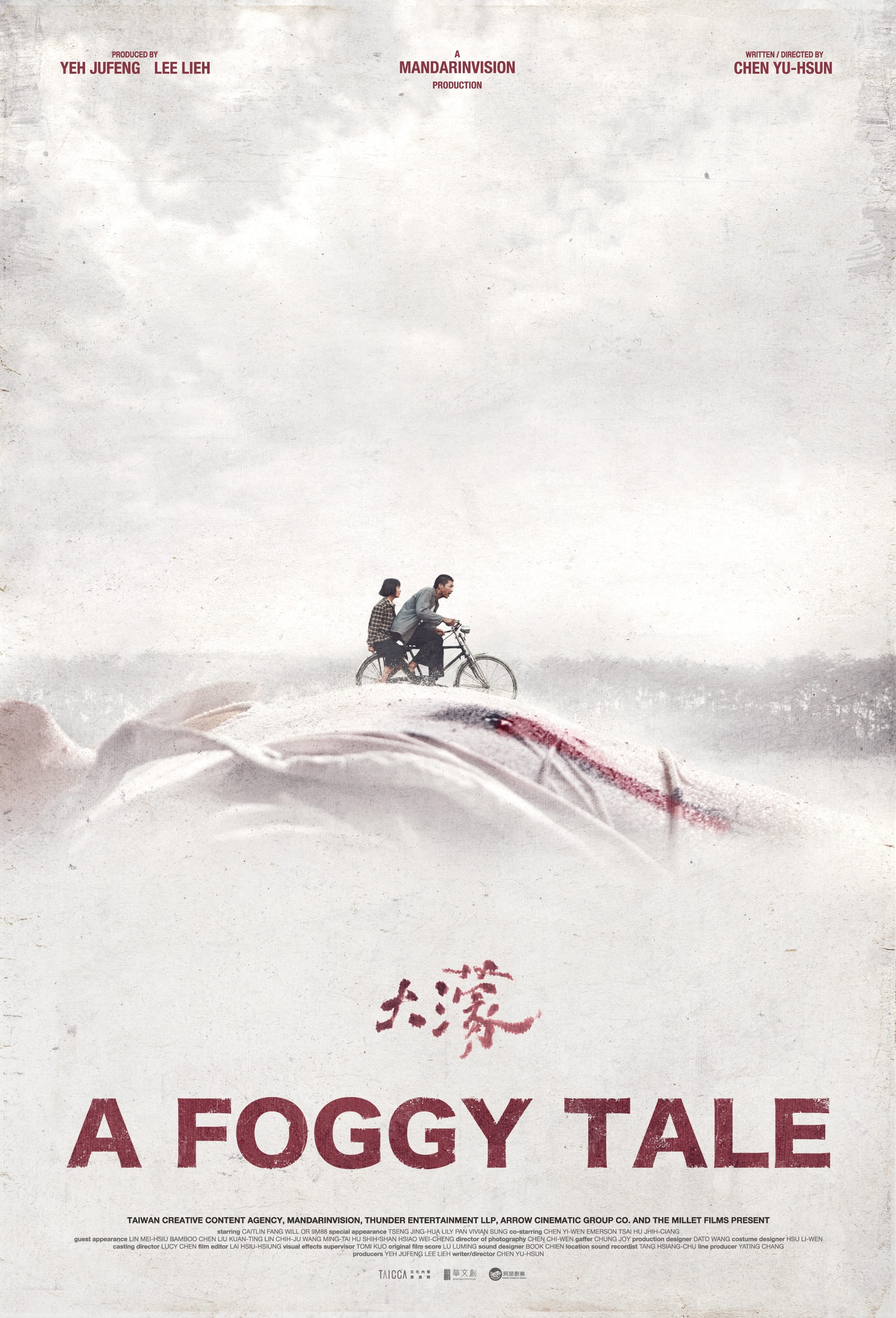
A young girl witnesses the horrors of the White Terror when she travels from her rural hometown to retrieve the body of her brother who has been executed by military police in Chen Yu-hsun’s otherwise light-hearted odyssey through 1950s Taipei, A Foggy Tale (大濛, dà méng). The title refers to a story the heroine’s brother Yun (Tseng Jing-hua), whose name means “cloud”, tells twice. First, it’s a metaphor for a resistance movement as two drops of water join many others to form a cloud that then descends on a patch of land that makes it farmable. Secondly, the second water droplet never makes it to the cloud, but instead becomes trapped half way and dissolves into the mist.

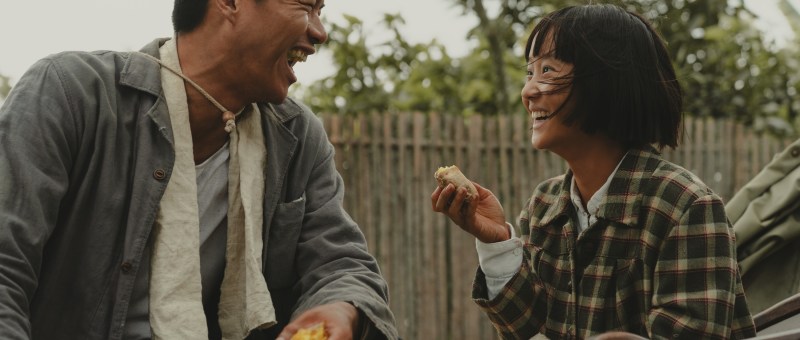
It is, however, into a foggy town that Yue (Caitlin Fang) arrives after leaving alone when her uncle, who has taken over her parents’ house following both of their deaths, explains that he can’t pay to retrieve Yun’s body. Their aunt is already resentful of the money they spent trying to save, and in truth does not want the extra mouths to feed of her niece and nephew. She would much rather have the house, which she regards as her husband’s rightful inheritance anyway, to herself for her sons to be the masters of. While he was in hiding, Yun had approved of Yue’s desire to become a teacher though she’s been taken out of school and, as he says, women in the country generally have little other choice than to become wives and mothers working the land. 

To add to the sense of displacement, Yue has an older sister in Taipei whom she’s never met because she was fostered out as a future daughter-in-law before Yue was born. Hsia (9m88) has since left the family who brought her up after refusing to marry the man she was betrothed to because they had been raised like siblings, though he remains somewhat resentful and badgers her to return. She had been acquainted with Yun while he was a student in the city, but has no idea that he has been killed after being arrested as a possible “communist” for protesting against the regime. 

Though she may not have felt it in the country, the forces of oppression are all around Yue in the city in the very presence of the military police. After being caught sleeping in the street, she’s taken in and beaten up by a policeman for talking back, while they also push her to “explain” where she got her money as a prelude to confiscating it for themselves. A kind yet flawed rickshaw driver (Will Or Wai-lam) who saves her from being kidnapped and sold into sex work, explains to her that the funeral home even charges for the bullets that were used to shoot her brother and she likely needs two or three times as much as she thought or they’ll throw him in a mass grave with the other victims of the regime.

Years later, an older Yue who has fulfilled most of her dreams though she no longer speaks Taiwanese with her adult daughter but Mandarin, sees a news report about the discovery of a mass grave and checks the names of those identified looking for someone she lost. This unearthing of the buried is past of symbolic of the desire to expiate this history, though Yue does not find the answers she’s looking for and the question is left hanging. When times where unbearable, Yun had told her to wind his watch forward and think of the Taiwan years to come that would be better where people could be free from oppression and exploitation. It took longer than expected, but some of that world has come to be, the film seems to say, if not completely and still with this mist hanging in the air that is the victims of the White Terror. Still, Yue’s story has its share of whimsy as she chases through the backstreets of a labyrinthine city. She encounters both kindness from the justice-loving rickshaw driver who tries to help but also scams her out of her brother’s watch only to return it years later as a means of assuaging his guilt, and cruelty from the men who tried to sell her, the secret policeman who apparently went into business, and unforgiving detectives. But in other ways, what she finds is a kind of peace and her place as a part of this nation and society as time continues its eternal march forward.


A Foggy Tale screens in Chicago 10th April as part of the 20th edition of Asian Pop-Up Cinema.

Trailer (English subtitles)
Eye of the Storm (疫起, Lin Chun-Yang, 2023)

In the early days of the pandemic, Taiwan was thought of as kind of safe haven which had largely managed to keep the disease a bay allowing many to live their lives more or less normally while much of the rest of the world contended with intermittent lockdowns of varying severity. The reasons for their success are said to lie in their experience during the SARS crisis of 2003. 

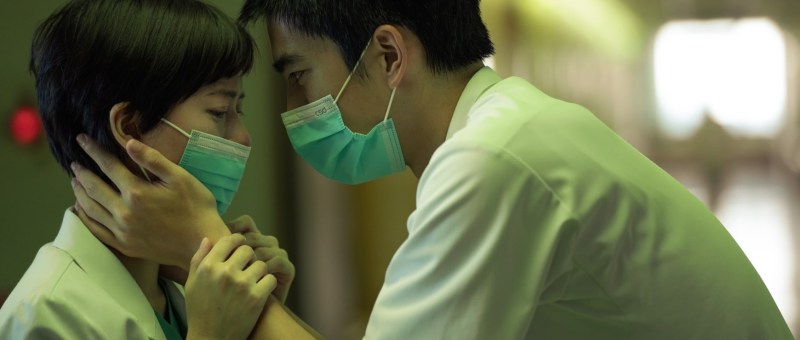
To that extent, there’s a kind of eeriness in Lin Chung-Yang’s poignant drama Eye of the Storm (疫起, yì qǐ) in watching the early days of this present pandemic play out 20 years earlier as medical personnel attempt to deal with a new illness about which they know almost nothing save that it appears to have a frighteningly high mortality rate. As the film opens, self-involved surgeon Xia (Wang Po-chieh) is clocking off a few minutes early in an attempt to make it to his daughter’s birthday party, rudely brushing off the complaints of warmhearted male nurse Tai-he (Tseng Ching-hua) and dismissing requests from his colleagues. Leaving in a taxi, however, he’s soon called back to deal with an emergency operation and becomes trapped when the hospital is placed into lockdown after the report of a possible SARS case. 

Unlike so many dramas centring on frontline healthcare workers during the COVID-19 pandemic, :Lin does not necessarily portray the medical staff in the best light. As the suspected case was being treated in B Wing it is the first to be shut down and some of the doctors and nurses start a protest refusing to treat patients with SARS resentful that they’ve been locked up with the disease. Meanwhile, in A Wing some of the nurses also go on strike holing themselves up in the rec room and refusing to come out. As Tai-he had been helping out in B-Wing, he is quickly rejected by his peers and exiled there despite having no symptoms while the nursing staff otherwise know that they maybe condemning him to death in sending him to the frontline battle against the disease.

Also on the frontline is journalist Yu-zhong (Hsueh Shih-ling) who snuck into the hospital after a tip off and is determined to let the people know by capturing the chaotic scenes at the hospital first hand. He and Xia eventually end up going through old records to figure out how the virus took hold while Xia mainly spends his time hiding in a storage cupboard and trying not to come into contact with anyone who might have SARS which is not very doctorly. Though originally desperate to get out of the hospital, Xia’s mindset begins to change when he sees how bad things are in B Wing after being charged with transporting food supplies while he later comes to realise that he may bear some responsibility in the rather cavalier treatment of a patient he recently operated on.

Then again, perhaps there is something also a little on the nose in the constant references to the disease’s origins in China while it’s the hospitals choice to use a Mainland construction firm that directly leads to the infection. In any case, Xia eventually beggins to come around realising that it’s selfish of him to refuse to help when the hospital is already so short staffed with some medical personnel on strike and others already falling ill and even dying. Lin lends the tunnel connecting the two wings an eerie quality in the ominous opening and closing of its oversize doors, as if Xia were really descending into hell dressed in a makeshift hazmat suit of yellow overalls. 

Xia had appeared to be a narcissistic surgeon with little interest in his patients. Criticised by Tai-he he clapped back that it’s the nurse’s job to care for them, not his, while continuing to keep his distance and fixating on being allowed to leave the hospital before beginning to empathise with the sick. Yet many other medical staff react in a similar way, overwhelmed by the fear and chaos of the situation while resentful in feeling that they’ve been unfairly imprisoned only later coming to accept the situation and returning to caring for the patients as best they can. Eerily echoing our present times, Lin’s poignant drama eventually finds a kind of serenity even among so much panic in quiet moments of small victories and human solidarity.


Eye of the Storm screened as part of this year’s New York Asian Film Festival.

Netflix trailer (English subtitles)

Your Name Engraved Herein (刻在你心底的名字, Liu Kuang-hui, 2020)

Taiwan is often thought to be the most socially liberal of Asian nations and was the first to legalise same sex marriage in 2019, but a little over 30 years ago things were very different. Many thought that the lifting of martial law which had been in place for 38 years would usher in a new era of freedom only to discover that society is slow to change and despite a gradual opening up the old prejudices still remain. So it is for A-han, the hero of Liu Kuang-hui’s Your Name Engraved Herein (刻在你心底的名字, Kè Zài nǐ Xīndǐ de Míngzi) who finds himself struggling to accept his sexuality as young man coming of age in changing times. 

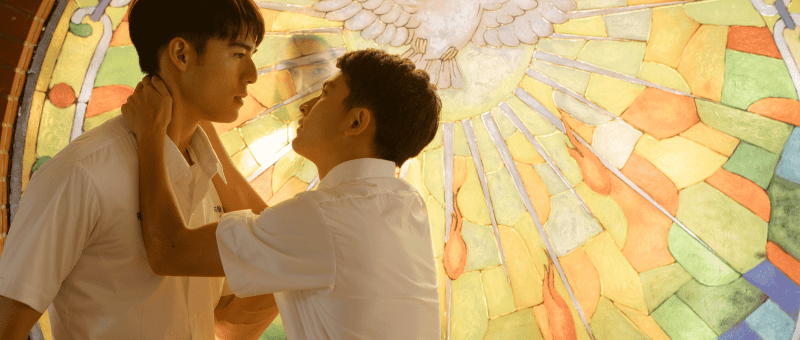
In 1987, as martial law is repealed, A-han (Edward Chen) is a student at a Catholic boys boarding school run along military lines. Many things are changing, but the school is much the same, as the principal Dirty Head (Ta Su) makes plain in conducting an impromptu inspection of the boys’ bunks looking for anything untoward. Nevertheless, A-Han and his friends sneak out at night to play in a band and hang out with girls. A-Han’s reticence is put down to shyness, but the reason he’s not much interested is that he’s taken a liking to a rebellious student, Birdy (Wang Shih-shien), only he’s not quite sure how to interpret his feelings or how to come to terms with them. 

This is in part because the school itself is extremely homophobic with the boys actively policing suspected homosexuality as a means of homosocial bonding. When the gang are caught sneaking out, band leader Horn (Barry Qu) targets an effeminate boy he accuses of dobbing them in, beating him up in the bathroom little knowing that A-han is hiding in a nearby stall after bringing ointment to Birdy who has also been caned. A-han emerges from the stalls after Horn hears a noise and is encouraged to join in the fun, handed a baseball bat and asked to participate in a literal act of queer bashing to prove his manhood. To his shame, A-Han prepares to comply, only to be saved by Birdy who breaks cover to rescue the other boy while casting scornful looks at Horn and the gang but most especially at the hypocritical A-Han. 

Taking his nickname from the Alan Parker film, Birdy may indeed be as “wild” as his namesake, but his rebelliousness has its limits and perhaps masks an internalised sense of shame. Nevertheless, he connects with the conflicted A-Han and the boys generate an intense friendship that of course has tension at its centre. A trip to Taipei to mourn the death of the president brings them closer, but also makes them feel ashamed as they witness a protester holding up a sign to the effect that homosexuality is not a disease and marriage is a human right being carted off by plain clothes police while the uniformed kind lurk in the shadows behind. Martial law may be over, but not everyone is free. As A-Han grows bolder, Birdy finds himself travelling in the opposite direction, dating a rebellious female student, Banban (Mimi Shao), as a kind of beard in the frustrated hope that he may “save” A-Han from his homosexuality by denying their feelings before they can fully develop. 

The central irony is that because of the changes to the educational system the high school is now required to take female pupils and the hardline Catholic, militarist teachers are paranoid about “misbehaviour”, even putting up a chainlink fence to divide the girls from the boys. Romance is forbidden even for heterosexual couples, and homosexuality unthinkable. A-Han finds himself trying to talk to his priest, Father Oliver (Fabio Grangeon), who would like to be more sympathetic but cannot offer him much by the way of advice. Later we discover that Father Oliver left his native Montreal to escape religious oppression and joined the priesthood to mask his own homosexuality, finally leaving the Church to live a more authentic life only many years later when such things were more acceptable. 30 years on A-han travels to a much changed Montreal where he sees lesbians dancing happily in bars and men kissing in the street with no one batting much of an eyelid. He reflects on all that’s changed and all the wasted time he and others like him were forced to endure hiding who they were, living in a world without love. A melancholy lament for the lost opportunities of a repressive society, Your Name Engraved Herein ends on a note of hope in which first love can blossom once again in a less restrictive world where all are free to love without shame.


Your Name Engraved Herein made its World Premiere as part of this year’s Osaka Asian Film Festival.

Original Trailers (English subtitles)