Crossing a Dawn (今晚正好, Zhao Badou, 2026)

“Beijing is Beijing, no need to romanticise it,” according to the practically minded heroine of Zhao Badou’s romantic odyssey, Crossing a Dawn (今晚正好, jīnwǎn zhènghǎo). A little less zany than 2012’s similarly themed Lacuna, the heroes of Zhao’s tale of city serendipity are in their own ways yearning to believe in something beyond urban cynicism with its lack of affordable housing, dissatisfying dating app romance, scammers, and pressure to conform to socially defined notions of success.

In their own ways, Qiu (Ma Sichun) and Yuzhou (Edward Chen) are each displaced people struggling to get a foothold in the city. They spend the entire night wandering around in part because they can’t find anywhere to hook up. For various reasons that only will be disclosed in a final moment of mutual vulnerability, neither than take the other one home while they’re kicked out of a hotel when a receptionist figures out what they were planning on doing there. An attempt to borrow a friend’s apartment is also frustrated, firstly by nosy neighbours and the need to avoid waking her roommate, and then by the friend coming home unexpectedly after catching her boyfriend with another girl. Tinting (Lv Xingchen) hadn’t wanted to move in with him to preserve her own space and independence, only for him to complain it made him feel “insecure”.  

Qiu may seem cynical and materialistic, but in another way she is trying to exert a degree of control by asserting dominance over her dating life. Perhaps bearing out the superficiality of dating app culture, she seems to go for conventionality handsome men but is generally disappointed. This one wants to meet her in a supermarket, for some reason, but turns out to have been using an outdated photo. Qiu feels as if she’s once again been “scammed” by this duplicitous city, though her would be date may have an ironic point about ageism. He complains that he’s done a lot of interesting things in his life and is still the fun-loving and adventurous person he was in his youth, but no one gives him a chance. Qiu is saved from this encounter by Yuzhou, in the supermarket in search of somewhere to return his power bank, though their criticism of him turns out to be somewhat hypocritical given the extent to which both he and Qiu are misrepresenting themselves. After all, as Qiu later reflects, who can resist the temptation to make out their lives are a little more impressive than they really are if it’s just going to be for one night?

It’s clear that Qiu isn’t really looking for anything more than that. Her constant references to making money may seem cynical but also hint at the extent to which money is the only thing that can be relied on in this environment, even if others may try to con it out of you. Her desire to own her own apartment is symbolic of that root herself in this city and carve out a domestic space that’s hers alone. Yuzhou, meanwhile, says he prefers renting because it offers more freedom. In contrast to Qiu’s straightforward practicality, he is more soulful and romantic, countering Qiu’s desire for ownership by suggesting that the place doesn’t matter as long as you get to live with the person you love. 

Qiu may not, however, be quite as cynical as she seems so much as she is afraid to trust in this moment of city serendipity. Beijing beats you down, she says, like the woman still looking for a dog who went missing a year ago driven out of her mind by loneliness and disillusionment. Yuzhou has been here two years, but feels as if he’s achieved less than nothing. Their long walk through the city takes them from walk-up, multiple occupancy apartments to a vast, unoccupied mansion full of unused rooms watched over by one of Qiu’s previous hookups whose name she never found out. He too is experiencing romantic drama with a free-spirited young woman equally afraid to face her feelings. As the night wears on, the pair begin to generate a kind of intimacy that paves the way towards emotional authenticity. Whether this one magical night in the city, or the beginning of something more, they have at least crossed their own kind of dawn, now less guarded and more open to the possibilities of the world around them.


Trailer (Simplified Chinese & English subtitles)
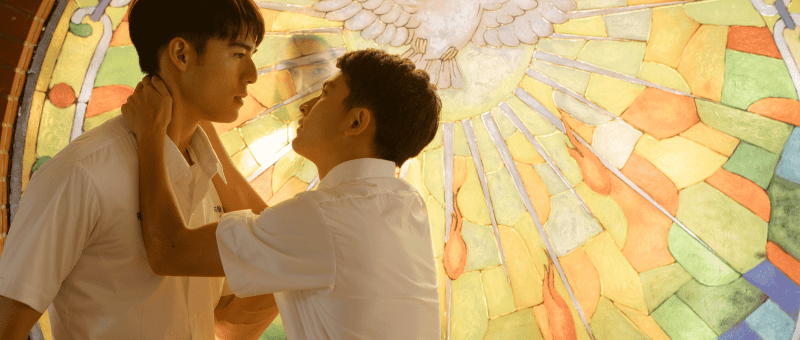
Your Name Engraved Herein (刻在你心底的名字, Liu Kuang-hui, 2020)

Taiwan is often thought to be the most socially liberal of Asian nations and was the first to legalise same sex marriage in 2019, but a little over 30 years ago things were very different. Many thought that the lifting of martial law which had been in place for 38 years would usher in a new era of freedom only to discover that society is slow to change and despite a gradual opening up the old prejudices still remain. So it is for A-han, the hero of Liu Kuang-hui’s Your Name Engraved Herein (刻在你心底的名字, Kè Zài nǐ Xīndǐ de Míngzi) who finds himself struggling to accept his sexuality as young man coming of age in changing times. 

In 1987, as martial law is repealed, A-han (Edward Chen) is a student at a Catholic boys boarding school run along military lines. Many things are changing, but the school is much the same, as the principal Dirty Head (Ta Su) makes plain in conducting an impromptu inspection of the boys’ bunks looking for anything untoward. Nevertheless, A-Han and his friends sneak out at night to play in a band and hang out with girls. A-Han’s reticence is put down to shyness, but the reason he’s not much interested is that he’s taken a liking to a rebellious student, Birdy (Wang Shih-shien), only he’s not quite sure how to interpret his feelings or how to come to terms with them. 

This is in part because the school itself is extremely homophobic with the boys actively policing suspected homosexuality as a means of homosocial bonding. When the gang are caught sneaking out, band leader Horn (Barry Qu) targets an effeminate boy he accuses of dobbing them in, beating him up in the bathroom little knowing that A-han is hiding in a nearby stall after bringing ointment to Birdy who has also been caned. A-han emerges from the stalls after Horn hears a noise and is encouraged to join in the fun, handed a baseball bat and asked to participate in a literal act of queer bashing to prove his manhood. To his shame, A-Han prepares to comply, only to be saved by Birdy who breaks cover to rescue the other boy while casting scornful looks at Horn and the gang but most especially at the hypocritical A-Han. 

Taking his nickname from the Alan Parker film, Birdy may indeed be as “wild” as his namesake, but his rebelliousness has its limits and perhaps masks an internalised sense of shame. Nevertheless, he connects with the conflicted A-Han and the boys generate an intense friendship that of course has tension at its centre. A trip to Taipei to mourn the death of the president brings them closer, but also makes them feel ashamed as they witness a protester holding up a sign to the effect that homosexuality is not a disease and marriage is a human right being carted off by plain clothes police while the uniformed kind lurk in the shadows behind. Martial law may be over, but not everyone is free. As A-Han grows bolder, Birdy finds himself travelling in the opposite direction, dating a rebellious female student, Banban (Mimi Shao), as a kind of beard in the frustrated hope that he may “save” A-Han from his homosexuality by denying their feelings before they can fully develop. 

The central irony is that because of the changes to the educational system the high school is now required to take female pupils and the hardline Catholic, militarist teachers are paranoid about “misbehaviour”, even putting up a chainlink fence to divide the girls from the boys. Romance is forbidden even for heterosexual couples, and homosexuality unthinkable. A-Han finds himself trying to talk to his priest, Father Oliver (Fabio Grangeon), who would like to be more sympathetic but cannot offer him much by the way of advice. Later we discover that Father Oliver left his native Montreal to escape religious oppression and joined the priesthood to mask his own homosexuality, finally leaving the Church to live a more authentic life only many years later when such things were more acceptable. 30 years on A-han travels to a much changed Montreal where he sees lesbians dancing happily in bars and men kissing in the street with no one batting much of an eyelid. He reflects on all that’s changed and all the wasted time he and others like him were forced to endure hiding who they were, living in a world without love. A melancholy lament for the lost opportunities of a repressive society, Your Name Engraved Herein ends on a note of hope in which first love can blossom once again in a less restrictive world where all are free to love without shame.


Your Name Engraved Herein made its World Premiere as part of this year’s Osaka Asian Film Festival.

Original Trailers (English subtitles)