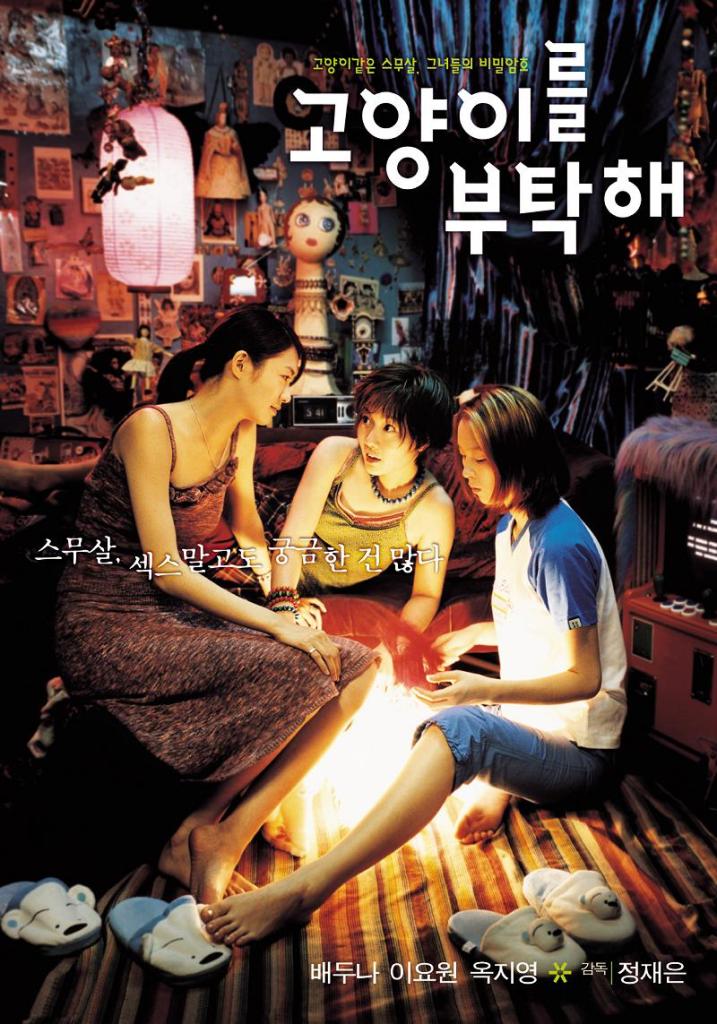
Take Care of My Cat (고양이를 부탁해, Jeong Jae-eun, 2001)

take-care-of-my-catThe time after high school is often destabilising as even once close groups of friends find themselves being pulled in all kinds of different directions. So it is for the group of five young women at the centre of Jeong Jae-eun’s debut feature, Take Care of My Cat (고양이를 부탁해, Goyangileul Butaghae). All at or around 20, the age of majority in Korea, the girls were a tightly banded unit during high school but have all sought different paths on leaving. Lynchpin Tae-hee (Bae Doo-na) is responsible for trying to keep the gang together through organising regular meet ups but it’s getting harder to get everyone in the same place and minor differences which hardly mattered during school grow ever wider as adulthood sets in.

Cheerful scenes of high school mischief give way to the uncertain present as five old friends prepare to celebrate the 20th birthday of the group’s self appointed star, Hye-joo (Lee Yo-won). Hye-joo, however, has moved on to a high level office job in Seoul and is about to blow off her high school friends to hang out with her possibly sleazy boss, only to revert back to plan A when he cancels on her. Too cowardly to ring her friends in person, Hye-joo leaves the business of calling off the party to the chief organiser, Tae-hee, who rings round letting the other three girls – jobless Ji-young (Ok Ji-young), and half Chinese twins Bi-ryu (Lee Eun-sil) and Ohn-jo (Lee Eun-ju), know (and presumably has to then ring them all back to tell them the party’s back on).

Hye-joo moved farthest away from her roots both in terms of location and of her social ambitions through taking a well paid admin job in the city. Increasingly materialistic and status orientated, her friendship with the other girls suffers as she sees herself as transitioning to a higher social class. Ironically, her views are equally deluded as she continues to believe that her dedication and willingness to work hard can make up for her lack of a degree but quickly finds herself displaced when the next batch of newbies arrive.

This growing desire for material status has also contributed to a seemingly unbridgeable rift with Ji-young whose economic status is the most vulnerable. Orphaned and living in a shack with her elderly grandparents, Ji-young has recently lost her job and is having difficulty finding another one precisely because of her circumstances – one firm even point blank refuses her application because both of her parents are dead and they need a direct family member to vouch for her. Hye-joo is insensitive in the extreme and often flashes her money around whilst rubbing salt in Ji-young’s wounds by emphasising her lack of it and pouring cold water over her ideas of saving money to study abroad. Small digs like these and insisting that all the girls leave their home town to visit her in Seoul (leaving aside the additional costs for Ji-young whom she knows is having difficulty making ends meet) point to Hye-joon’s own sense of neediness and insecurity.

As a result, Ji-young distances herself from her friends, ashamed of her desperation and feeling unable to ask them for help. It is she who finds the cat of the title when she hears it mewing whilst trapped behind debris on her way home. The cat becomes almost a mirror of Ji-young – alone and abandoned on the streets with no one to look after her. Originally, Ji-young tries to give the kitten to Hye-joon as a birthday present only to have it immediately returned. The cat is then passed around among each of the friends looking for a more permanent kind of affection, but finding little in the way of stability.

The longest and most devoted guardian turns out to be Tae-hee who is perhaps most affected by the loss of her friends and changing circumstances. Tae-hee is from a moderately well off middle class family and has been helping out in her father’s business since leaving school (apparently without pay). Despite her lack of worry over material comforts, she finds herself feeling restless and increasingly interested in the “foreign” with dreams of taking off alone for adventures overseas. Her desire for freedom is partly down to her domineering father who simply overrules all of her decisions even down to ordering food in a restaurant. Tae-hee is the only one to reach out to Ji-young when she realises she might be in trouble and is the only one still there for her at the end. Their economic and familial circumstances may be different, but in their desire to escape the confines of the rundown Incheon for something outside of what it might have planned for them, the two girls are a perfect match.

Of the group of friends the twins receive the least attention, hovering on the sidelines, separate from the mini dramas erupting between the insensitive and self obsessed Hye-joo and the increasingly desperate Tae-hee and Ji-young. As a unit of two they have their own little world which seems much happier and more solid than that of any of the other girls and arguably have less need for the immediacy of their old friendships. They are therefore the ideal place to deposit them, in the form of a stray cat finally finding a home. The past has its place – in the past, the memories are warm and fluffy and deserve to be taken care of, but there comes a time you have to surrender full custody and be content to visit from time to time.

An extraordinarily well composed debut feature, Take Care of My Cat has a more European feeling than many a Korean coming of age drama but is filled with realistic detail such as the constant ringing of the girls’ ever present mobile phones and the onscreen representation of their straightforward text based conversation. There’s a kind of sadness associated with the transition from carefree adolescence to the difficult journey into adulthood with each of the girls discovering what it is they want out of life, or more aptly what it is they don’t want. Hye-joo emerges as the quasi-villain of the piece as she makes an obvious, superficial choice to follow the consumerist trend over valuing human relationships though it’s hard not to feel sorry for her when it appears she’s being set up for disappointment. Ending on a note of hopeful uncertainty, Jeong’s debut feature is a hymn to the theme of moving on but is careful to admit the bittersweet quality of a new beginning.


International trailer (English subtitles)
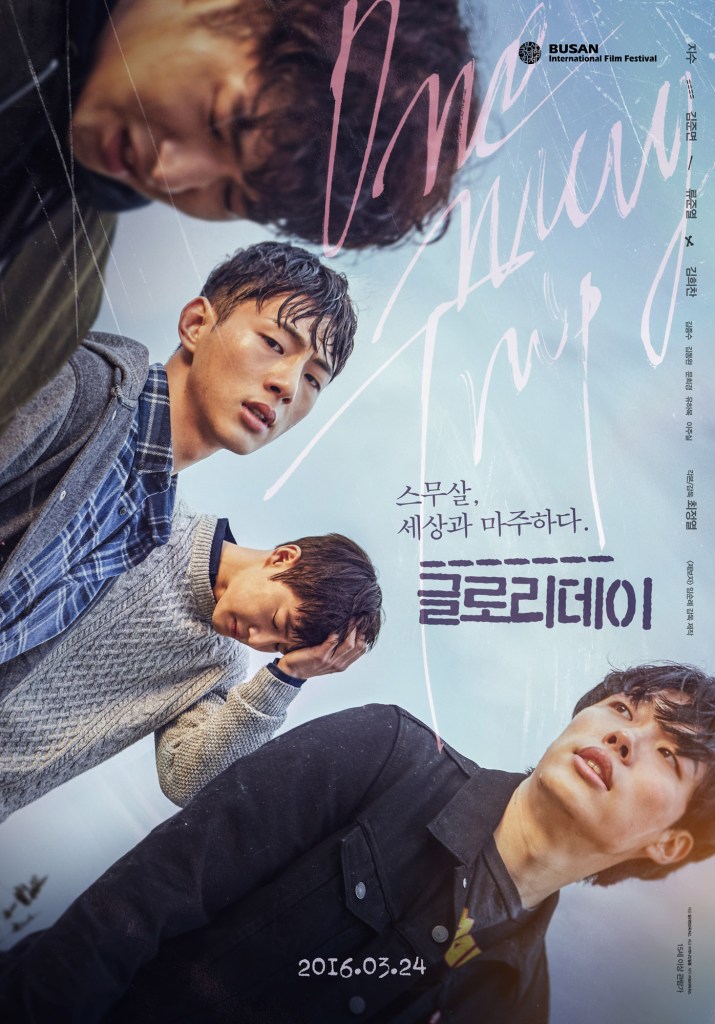
One Way Trip (글로리데이, Choi Jeong-yeol, 2016)

one-way-trip-poster

Young men just trying to do the right thing often end up losing out in the long run – so it is for the four best friends at the centre of Choi Jeong-yeol’s One Way Trip (글로리데이, AKA Glory Day). Caught right on the liminal divide between adolescence and adulthood, each of the four has a different path set before him, not entirely of their own choosing. De facto leader Young-bi (Ji Soo) seems the most directionless of the four but as the only one with a driving license he’s found an old banger of a van and got the guys together for one last road trip before Sang-woo (Suho) enlists in the military. Joined by city councilman’s son Ji-gong (Ryoo Joon-Yeol) and Doo-man (Kim Hee-Chan), a reluctant baseball player, the boys take off for the last real trip of their adolescent lives.

Things do not go to plan as the opening sequence features the guys furiously running away from the police, more worried about their parents finding out than any more serious consequences, but tragedy strikes when Sang-woo is knocked over in a hit and run accident. With Sang-woo unconscious in the hospital, the remaining three guys find themselves locked up on assault charges which later graduate to murder. How did their peaceful trip turn out like this?

Told largely through flashbacks explaining both the events of that night and the guys’ lives, One Way Trip examines the effect of a traumatic incident on each of the boys as they find their friendship coming under increasing pressure. Hanging around near the harbour, the guys spot a couple having a domestic dispute in a nearby car before the man drags the woman outside and proceeds to accuse her of having an affair whilst becoming increasingly violent. Headstrong Young-bi decides to intervene but goes too far in picking a fight with the guy while the woman gets herself to safety. When the violent husband falls into a nearby boat, the guys get scared and run off but the battered wife has already called the police who wind up chasing them through the town.

Panicking in the police station, distraught Young-bi gets himself into even more trouble sending their case straight up to the detectives. Though originally sympathetic, the police change their tune when it turns out that the woman involved is a high profile TV news reader. In an attempt to protect her reputation, she refuses to back the boys’ story and implicates them in the murder of her husband. The police, not overly interested in the finer details of the case, want a speedy resolution – a desire which is only echoed from further up where head office is getting pressure from the media.

These are all nice, ordinary kids who’ve never been in any kind of trouble before but suddenly they’re being encouraged to turn on each other and engineer the best possible outcome for themselves as individuals. Ji-gong’s mother (Moon Hee-kyung) is a prim woman most worried about what the neighbours will think, not to mention the impact on her husband’s political career. Doo-man’s father (Yoo Ha-bok) is even more panicked than his son and immediately starts making every conceivable kind of fuss at the police station, including attempted bribery. Young-bi, by contrast, has no one to speak for him as the only responsible adult is his older brother (Kim Dong-wan) – his father is already in jail. To the other parents, the answer is obvious, blame it on the no good delinquent their “nice” kid has been lead astray by and forget about the whole thing.

Though these boys are almost men, they have very little control over their own lives which continue to be dictated by parental expectation. Ji-gong’s overbearing mother locks him in the house to try and force him to study while Doo-man’s father ignores his pleas that he can’t stand playing baseball and is sick of the other players’ resentment because they know he’s only on the team because his father put him there. Young-bi has no firm parental input but his feelings about his family circumstances are what lead him to try and help a woman in peril, as well as the reason he loses his temper so quickly. Sang-woo, the most blameless among the boys, has only his grandmother whom he wanted to spare a life of hardship by serving in the military followed by a solid government guaranteed job afterwards.

Fear and external pressures start to work their magic on the three previously innocent guys who thought they were doing something good but have ended up paying the price. Heartbreak and betrayal are the order of the day as money, power, and influence will always win out over justice, goodness and friendship. Injustice is the force that governs the world, Young-bi thought he was doing the right thing by coming to the aid of a woman under attack only for everyone else to tell him he should have just minded his own business and not gotten involved. Bookended scenes of the four guys together having fun on the beach only reinforce the stark contrast between their youthful innocence, naively believing in friendship and the essential goodness of helping others, and their post-trip awakening to the self-centred indifference of the adult world.


Reviewed at the 2016 London Korean Film Festival.

International trailer:

The Truth Beneath (비밀은 없다, Lee Kyoung-mi, 2016)

10_06_15__574b920705d42Politics in South Korea has never been exactly drama-free, though recent times have seen a multitude of storms engulf its top brass running from the national to the personal. Frequent Park Chan-wook collaborator Lee Kyoung-mi’s followup to her acclaimed 2008 debut Crush and Blush, The Truth Beneath (비밀은 없다, Bimileun Eobda) begins as if it’s going fit into the ‘70s dark political thriller mould but gradually shifts gear to present both a bleak family drama and the story of one woman’s descent into the near madness of grief as she attempts to uncover the true circumstances behind her private tragedy even as it plays out on a national stage.

Married to a prominent candidate in a tightly contested electoral race, Yeon-hong (Son Ye-jin) is perfect first lady material save that she’s from an inconvenient home town. Two weeks before the big day, Yeon-hong’s daughter Min-jin (Shin Ji-hoon) does not return from school as expected which, aside from the obvious distress, is not ideal for her father as his political campaign has largely been run on Min-jin’s face and the slogan “I will protect your children”. Jong-chan (Kim Ju-hyeok), Min-jin’s ambitious father, is reluctant to report her disappearance for fear it will hurt him politically and, after all, Min-jin has “disappeared” at times before. Yeon-hong is deeply worried and unable to understand her husband’s indifference to their daughter’s mysterious absence. As time passes, Yeon-hong steps up her investigation becoming ever more suspicious of those around her.

On the surface of things, Yeon-hong had the ideal life with a wealthy, handsome husband, and a nicely turned out, studious teenage daughter. The first glimpse we catch of them is a celebration of the campaign’s launch in which Yeon-hong is furiously cooking away, a motif which is to be repeated with an entirely different sense of celebration some time later. Yet there’s something slightly artificial about the setup even in its beginning as the conversation between the men takes on a barbed, guarded quality while Min-jin lies to her mother even whilst pledging to straighten up now that the campaign is in full swing.

The more Yeon-hong investigates, the more she realises how much of the life she’d been living was careful artifice. Min-jin had gone off the rails before, though perhaps no more than any other teenage girl and given her father’s position, she’d been under a considerable amount of strain. The “friend” Min-jin had claimed to be meeting does not seem to exist and on visiting her school, Yeon-hong finds out that Min-jin had been ostracised by the other girls, even experiencing violent treatment at their hands.

Min-jin had, in fact, eventually embraced her outsider status by forming a performance art-influenced, punk-inspired rock band with a similarly “uncool” girl, Mi-ok. Mi-ok may have been one of the last people to have contact with Min-jin before her disappearance and quickly becomes a person of interest in Yeon-hong’s investigations but whatever it is she’s hiding, it’s clear that there was a whole side of Min-jin’s life that her mother was entirely unaware of.

As Yeon-hong becomes increasingly desperate, she starts entertaining the idea of conspiracy. Her first thoughts turn to her husband’s rival, Noh, an unscrupulous man who may just be capable of kidnapping Jong-chang’s poster girl in order to punch a hole through his opponent’s ill-advised slogan by demonstrating that he can’t even protect his own child, let alone anyone else’s. Then again, how far would her husband be prepared to go in the quest for power? Would his campaign team really kidnap his own daughter to cast suspicion on Noh and win public sympathy? Jong-chang’s ongoing indifference could be easily explained if he already knows the score, but the more Yeon-hong finds out the more she begins to doubt everything she thought she knew about her family.

Son Ye-jin turns in a career making performance in capturing Yeon-hong’s increasingly volatile emotional state. A once elegant political wife, Yeon-hong’s disintegration is manifested in her untidy hair and progressively relaxed dress sense as she becomes ever surer that there is something larger at play than a runaway teen. Yeon-hong defiantly rejects the entirety of her experience through her appearance at a funeral wearing a bright and colourful floral dress almost as if demanding to be seen, remembered, and addressed. No longer will she remain Jong-chang’s silent partner, Yeon-hong’s grief-stricken, maternal fury requires answers and will not rest until the whole of the truth is known.

Lee’s composition is simply stunning making frequent use of dissolves, superimpositions, and a subtle floating of time periods to underline Yeon-hong’s precarious mental state. When Yeon-hong discovers a particularly unpleasant truth, the previously balanced camera suddenly slides into a canted angle, leaving the ordered world of a political thriller behind for a new kind of noir-ish murkiness. Yeon-hong is, literally, unbalanced, wrong footed and wild as she enters into a desperate quest to understand not only the truth beneath the events which have engulfed her, but the essential truth beneath her life. Playing out almost like an inverted The World of Kanako, the Truth Beneath is a similarly bleak tale filled with coldness and duplicity, yet its distressing finale carries with it a fragmentary warmth and the slightest glimpse of hope in the embrace of a motherless child and childless mother.


Reviewed at the 2016 London Korean Film Festival.

International trailer (English subtitles)

Twenty (스물, Lee Byeong-heon, 2015)

Twenty Movie PosterReview of Lee Byeong-heon’s Twenty (스물, Seumool) up at UK Anime Network. I really felt so old watching this film.


The age at which you become “an adult” varies according to your culture but in Korea, as in Japan, at 20 you become fully grown up with all the rights and responsibilities that carries. The three guys at the centre of the Korean film Twenty are just walking through this magic doorway which marks the end of their childhoods and the beginning of their adult lives. The road has forked for them and they have to decide which path to take. However, they’ll have to take their minds off the opposite sex long enough to make a decision.

To state the obvious, Twenty is aimed at a very specific audience and is likely to please a certain group of people very well whilst leaving others a little lost and bemused. It stars a collection of popular and very good looking younger Korean actors and actresses and is largely about what it’s like to be on the cusp of adulthood in contemporary Korea. What it’s not is a hard hitting drama. The target audience for this movie is people who are in their teens or early twenties, so they know what it is to be young, now. They just want to laugh along or sympathise with others in a similar position.

We meet the three guys, Chi-ho (popular rich kid), Dong-woo (put upon poor boy), and Gyung-Jae (doing OK middle class guy) towards the end of their high school years. The boys became friends after falling for the same girl who eventually picked Chi-ho but being boys they had a fist fight about it and are now bonded for their rest of their lives. In many ways they’re quite different, Chi-ho is rich, good looking and only interested in girls whereas Dong-woo comes from quite an impoverished background which means he’ll find it difficult to pursue his studies past high school because he needs to be supporting his mother and siblings. Gyung-Jae is almost the protagonist and is a typical middle class boy who’ll go to college and probably do alright for himself. He’s also a typical “nice guy” with a selection of fairly ordinary romantic issues (bar one interesting aspect which is raised but never followed up on) but being pretty level headed he’ll almost certainly get over it.

At twenty they have the whole of their lives ahead of them – or they kind of do given the fairly restrictive nature of Korean society. Chi-ho just thinks about sex. His parents are rich so he just lives in a perpetual adolescence where he hasn’t applied for university but hasn’t decided on a job either. He watches lots of movies and mopes but honestly he’s just a bit lost and afraid to admit it. Dong-woo wants to be a manga artist and decides to repeat the last year of high school whilst continuing to work all the other hours to support his family all the while feeling guilty about trying to pursue his dream rather than accepting the offer of a steady office job at his uncle’s company. Gyung-Jae actually has it pretty easy as his problems are just the normal sort of romantic growing pains everybody goes through and realising that makes them a little easier for him.

The film is not really a serious examination of the problems young people face. Even the eventual looming of military service is treated in quite a matter of fact way. Twenty is more of a celebration of being young and that it’s OK to be a bit lost and stupid when you’ve just left school. It gets surprisingly crude given that it’s aimed at a comparatively conservative Korean audience but generally gets away with it thanks to its cheeky tone. Undoubtedly hilarious in places (the “fist fight” finale in a Chinese restaurant being a late highlight) Twenty is a film that will play best to those around the same age as its protagonists in real terms and truthfully doesn’t offer so much for those who are already little older but it is nevertheless very funny and likely to entertain Korean idol fans of any age.


Reviewed at the London Korean Film Festival 2015.


A Matter of Interpretation (꿈보다 해몽, Lee Kwang-kuk, 2015)

matterofinterpretation_keyartFirst published on UK Anime Network – review of Lee Kwang-kuk’s A Matter of Interpretation (꿈보다 해몽, Ggumboda Haemong).


Romance Joe director Lee Kwung-kuk returns to the director’s chair with a another meta take on modern Korean life only this time he’s interested in the nature of dreams vs reality. A Matter of Interpretation is, ironically, a little closer to Lee’s mentor Hong Sang-soo thanks to its repeated dream motifs but always stands at a slightly more abstracted angle than the comparatively more realistic Hong. Building on the promise of Romance Joe, A Matter of Interpretation further marks Lee out as a talent to watch in modern Korean cinema.

The film begins with a group of performers nervously waiting in a rather circus-like theatre before eventually deciding to cancel the performance because no tickets have been sold. Yeon-shin, the star actress, storms out and goes for a smoke in a nearby park. Her boyfriend eventually finds her and they talk about the film project Yeon-shin has just been bumped from in favour of a young pop idol. They break up and we time jump to the same bench some point later as Yeon-shin talks to a policeman who, it turns out, can also interpret dreams. Yeon-Shin has had a dream about attempting to commit suicide in an abandoned car only to find a man (who now has the face of Seo, the policeman) tied up in the car’s boot.

The car itself ends up becoming a recurrent theme in the film, appearing in the dreams of multiple people and eventually in reality (maybe?). The policeman (who frequently pulls out a pocket watch and seems to be late for a very important date) interprets Yeon-shin’s dream as being about regret over rashly ending her relationship with her boyfriend and a mixture of guilt and worry that he quit his theatre job soon after and she hasn’t heard from him since. There are other repeated motifs such as the date 7th February circled on a calendar and, like Romance Joe, a pre-occupation with suicide but A Matter of Interpretation proves an apt title for a film that’s so bound up with playful symbolism.

Also like Romance Joe, A Matter of Interpretation owes a lot to Lee’s mentor Hong Sang-soo. Like Hong, Lee has opted for a concentration of static camera shots with his subjects centrally framed like a conventional landscape photograph albeit with the occasional creeping zoom. However, where Hong can be deliberately repetitious, Lee’s repeated motifs take on a different kind of playfulness – deliberately disorientating us with his mix of dream and reality to the point where we can’t really be sure which of the two is the “real” world. He’s also ported over his love of Alice in Wonderland (or this time Through the Looking Glass) which adds another surrealistic layer of whimsy to the film.

Ultimately, A Matter of Interpretation builds on the promise of Romance Joe to create something that feels much more well thought out as well as much more affecting than Joe’s rather distant atmosphere. Much of this is thanks to Shin Dong-mi’s engaging performance (even more so than her winning turn as the “coffee waitress” prostitute in Romance Joe) as the aging actress Yeon-shin who’s coming to regret some of her previous life choices and wondering how things might have been different. Whimsical is probably the best way to describe the film. It isn’t trying to be deep or profound so much as playfully thoughtful though its complex, interconnecting narrative symbolism is certainly likely to spur post viewing debate. Less contrived and undoubtedly more fun than Romance Joe, A Matter of Interpretation marks a definite step up for director Lee Kwang-kuk and hints at even more meta tales of playful absurdity to come from this promising director.


Reviewed at the London Korean Film Festival 2015.

Romance Joe (로맨스 조, Lee Kwang-kuk, 2011)

romance-joeReview of Lee Kwang-kuk’s Romance Joe (로맨스 조) up at UK Anime Network. First saw this at the LFF a couple of years ago but now it’s back alongside Lee’s latest film A Matter of Interpretation at the London Korean Film Festival.


Lee Kwang-kuk’s meta romantic comedy drama first got a London outing at the BFI film festival back in 2012 but now makes a welcome return visit as part of the 2015 Korean film festival in a strand dedicated to its director. Playing alongside a short film, Hard to Say, which was completed by Lee in-between Romance Joe and his new film A Matter of Interpretation, the film brings Lee’s meta concerns to the fore and offers plenty of Alice in Wonderland inspired absurdity to its otherwise straightforward plot elements.

Romance Joe is a film with many levels. On the first layer, we have an elderly couple arriving in Seoul to look for their son who came to the city to be a director 18 years ago but he’s not been in contact recently so they’re worried. His friend greets them and tells them their son had been feeling depressed lately over the suicide of a well known actress. He then starts to tell them about an idea for a screenplay he’s had about a director with writer’s block who checks into a motel where he’s told another set of stories by a prostitute who delivers coffee as a cover. From here the stories radiate out like cracks in a broken mirror though we never quite get the answers we’ve been looking for.

Lee has worked extensively with Korean auteur Hong Sang-soo and his shadow looms large over the film. From the cutesy title cards to the static camera with occasional creeping zooms and often unbearably awkward situations, there is certainly a lot of Hong in Lee’s film. However, where Hong takes the same situation and replays it with a different outcome, Lee gives you a set of intersecting stories which spring forth from each other. Lee’s interests are more surreal and metaphysical than Hong’s which are, ostensibly, more naturalistic in feeling than Lee’s almost hyperreal world.

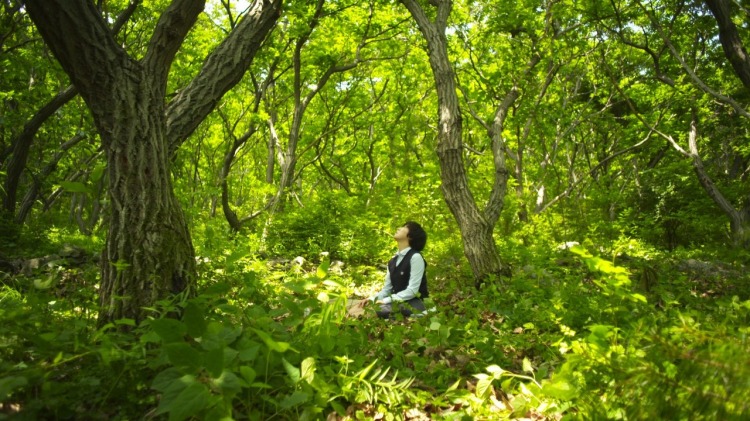
In contrast to Hong’s social comedies, Lee also digs a little darker into the Korean psyche and reveals a strange preoccupation with suicide and abandoned children. The furthest point back in the film deals with the lonely mid forest suicide attempt of a teenage schoolgirl who’s become a figure of fun thanks to a loud mouth “boyfriend”. Her rescuer may (or may not be) the man we later come to know as Romance Joe. Though the two eventually bond, the story is not an altogether happy one as they’re rushed into fairly adult decisions which neither of them is really ready for.

Later, a young boy who may (or may not) be the child of the high school girl arrives at the “cafe” from which the prostitute operates looking for his mother who apparently last wrote to him from that address sometime ago and has since disappeared. Later, the prostitute receives a call from her own son safely in the country being cared for by grandparents while his mother earns the money in the city.

In many ways it’s a series of sad yet inevitable stories leaping out from inside each other each more heart rending than the last, though somehow it never becomes as affecting as you’d like it to be. Romance Joe feels like a deliberate experiment in form or at least a dedication to pushing conventional narrative structures into new and exciting places but it does so in a way that’s self consciously about form rather than content so that it never quite takes hold. It wants to discuss time and memories and stories but ends up mostly talking about itself and, in truth, a little lengthily, still Romance Joe does at least manage to offer an intriguing, beautifully filmed and often enjoyable surrealist tale that will have your mind in knots long after you see it.


Reviewed at the London Korean Film Festival 2015.

http://www.youtube.com/watch?v=gby8x6X-AWI


The Piper (손님, Kim Gwang-tae, 2015)

PiperPosterReview of Kim Gwang-tae’s The Piper (손님, Sonnim) up at UK Anime Network. I really liked this one!


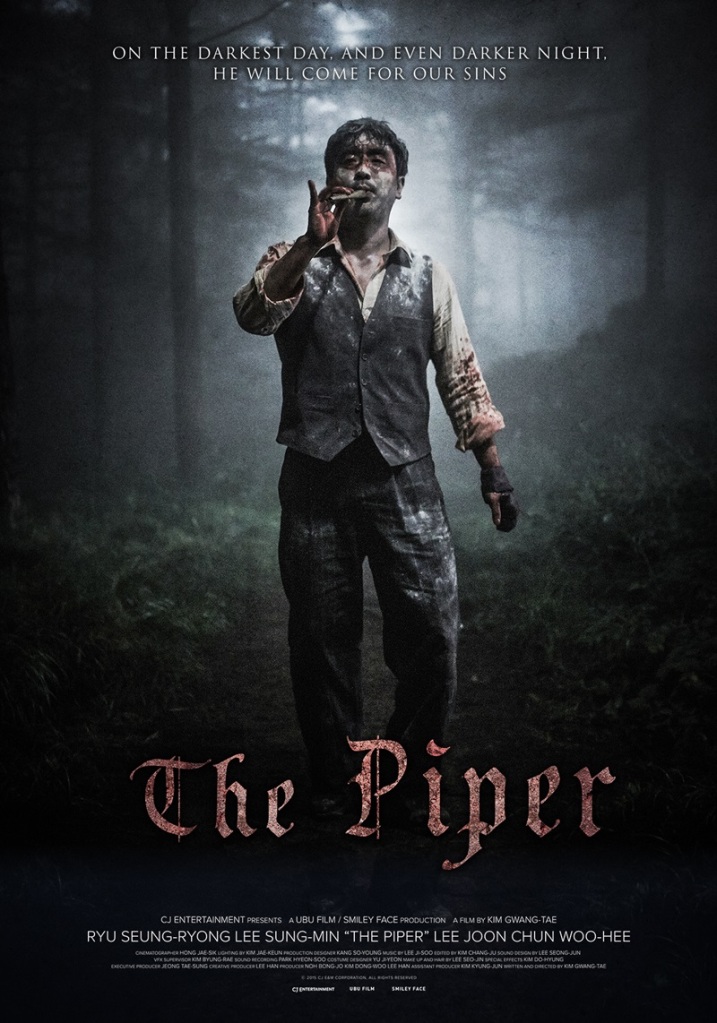
The piper must be paid. So goes the old saying, and with good reason – one should always honour one’s promises but even so there are those should not be crossed. So the denizens at the centre of the mysterious hidden village in the debut feature from Korean director Kim Gwang-tae come to discover as they’re repaid for some not quite unforgotten sins when a travelling piper and his invalid son come calling.

Kim Woo-ryong is a travelling piper with a crippled leg journeying to Seoul with his young son after hearing that there is an American doctor there who may be able to treat the boy’s TB if only they can reach the city in time. After walking through the countryside they eventually come across a village which isn’t marked on any map and beg shelter from the village chieftain there. Life in the village seems like a scene from the middle ages, everyone is wearing traditional clothing and there’s something more than a “stranger in town” vibe about the way they look at Woo-ryong and his son Young-nam. The chieftain allows the pair to stay but warns them they can reveal nothing of the outside world to the village’s inhabitants and especially not that the Korean war is already “over” and has been for some time. Later Woo-ryong and Young-nam wander into a village dispute and in a fit of over helpfulness Young-nam exclaims he’s sure his dad can fix the problem (though he doesn’t know what it is). Woo-ryong jumps to the conclusion it must be about the rats which plague the town and offers to take care of them. The chieftain offers him the price of a cow if he can rid the town of vermin, but one gets the impression there’s more than one kind of rodent lurking in this strange, isolated place.

If you know the classic children’s fable, The Pied Piper of Hamelin, you likely know the outcome won’t be a pleasant one though the events of the The Piper turn a little bloodier and even more supernatural than in the Brothers Grimm  fairytale. The story starts out pleasant enough as Woo-ryong and Young-nam start to make friends in the village – Woo-ryong playing his pipe and Young-nam enjoying spending some time with the other children. However, from their very first entrance you can tell there is something very wrong in this community. There’s not just suspicion or curiosity in the way the villagers stare at the strangers, there’s fear too. Woo-ryong is a middle aged man with a lame leg, and Young-nam is a weedy 10 year old boy with a lung disease. They are no threat to anyone, what do these people have to fear?

The chieftain himself is obviously quite a sinister fellow. He charms Woo-ryong but lies to him when asked for guidance about the journey on to Seoul and seems to instil nothing but fear in the eyes of the other inhabitants. Woo-ryong strikes up a tentative romance with the village’s reluctant shaman which further raises the chieftain’s concerns – perhaps, he thinks, he doesn’t need to pay this piper after all. As might be expected, there’s a dark past at play here. Everyone is so terrified of the war, which they still believe is going on, and the things they’ve already done to survive that they’re prepared to go along with whatever their leader says to maintain their peaceful village life. Mob mentality at its worst, even those who were growing closer to the pair of strangers are quick to turn on them in a paranoid frenzy.

Like the original story, the moral is that you reap what you sew and if you don’t keep your promises, you deserve everything that’s coming to you. These are people who have lived in difficult times and done cruel things to survive. The rats which plague the town take on an almost supernatural air and have apparently developed a taste for human flesh. They become a kind of metaphor, a haunting presence which refuses to allow the villagers to forget the crimes they’ve committed and reminds them that their present safety was bought with innocent blood. A perfectly pitched fairytale with an all pervading sense of dread and foreboding, The Piper is an impressive effort from first time director Kim Gwang-tae and marks him out as a promising new voice in the world of Korean cinema.


Reviewed at the London Korean Film Festival 2015.


Miss Granny (수상한 그녀, Hwang Dong-hyeok, 2014)

131212-001_1401140436597Review of Hwang Dong-hyeok’s age swap comedy Miss Granny (수상한 그녀, Soosanghan Geunyeo) up at UK Anime Network.


Miss Granny is something of a departure for Korean director Hwang Dong-hyeok whose previous two films have both explored fairly weighty subjects firstly in The Father which, based on a true story, features an American adoptee looking for his father only to find him languishing on death row, and more recently in Silenced (also known as The Crucible) which depicted the harrowing, and again true, events that occurred at the Gwangju Inhwa School for the Deaf in which pupils were routinely abused by teachers and staff. So far as we know, Miss Granny is not based on a true story and is a more mainstream comedy in which a “difficult” old lady suddenly finds herself transformed into her 20 year old self.

At the beginning of the film, Oh Mal-soon is a bad tempered 74 year old woman who terrorises everyone around her into submission including her middle aged daughter-in-law who eventually lands up in the hospital with a heart condition that may in part have been brought on by Mal-soon’s constant criticism. Mal-soon’s son faces an impossible choice, ship his mother off to a home and give his wife some peace or risk losing either his marriage or his wife by keeping his mother around. Heartbroken at the thought her son maybe about to abandon her, Mal-soon wanders around the city before deciding to enter a mysterious portrait photographers and dolling herself up for a “funeral photo”. However, when she emerges she’s mysteriously transformed into a lithe and pretty 20 year old! Suddenly young again with potentially a whole life in front of her, what sort of choices will Mal-soon make this time around?

Much of the comedy of Miss Granny centres around the young Mal-soon, renamed Oh Doo-ri after her favourite actress, Audrey Hepburn, speaking and acting as if she really really were a 74 year old woman with all of the freedoms (and the invisibilities) that age grants you. Snapping away in her thick rural dialect and handing out unsolicited advice in the way only a nosy old woman can, Doo-ri is a very strange, and perhaps a slightly frightening, young woman. Undoubtedly, as we find out, Mal-soon has had a difficult life – starting out as an upperclass woman before becoming a young, penniless single mother dependent on the kindness of others and doing everything in her power to ensure that her son will grow up a fine man. Life has made her hard and in turn she makes things hard for all around her.

As a young woman she’s initially much the same yet comes to understand something of who she was and who she is. In her younger days she dreamed of being a singer and even as an old woman was well known for her fine voice. After unexpectedly jumping up to sing at a senior’s event in order to best another old lady rival, she’s “discovered” by a producer who’s tired of all the soulless idol stars who walk across his stage. Doo-ri is exactly what he’s been looking for, a young and pretty face with a voice that’s full of a lifetime’s heartbreak. Here is the real coup of the film – the younger actress, Shim Eun-kyung, reinterprets these classic pop songs from 40 years ago beautifully with exactly the right levels of pain and regret perfectly matching the montage flashbacks to Mal-soon’s youth. Becoming young again, experiencing everything again as if for the first time – opportunity, romance, friendship, Mal-soon finally begins to soften as if some of the harsh years of her original young life had been smoothed away.

Of course, nothing lasts forever and Mal-soon eventually has to make a choice between her newly returned youth and something else precious to her. She comes to understand that however hard it was she’d do it the same all over again because the same things would always have been the most important to her. Though it’s far from original and drags a little in the middle, Miss Granny still proves a warm and funny tale that walks the difficult line between serious and funny with ease and throws in a pretty catchy soundtrack to boot.


Reviewed at the London Korean Film Festival 2015.

Also here is one of the musical sequences in the film – I think this is a famous song from the ’70s (?) called White Butterfly. ‘Tis quite beautiful (mild spoilers for the film as it includes a montage of Mal-soon’s youth in the ’60s).


The Shameless (무뢰한, Oh Seung-uk, 2015)

fullsizephoto602641Review of Oh Seung-uk’s The Shameless (무뢰한, Moorwehan) up at UK Anime Network. I read some lukewarm reviews but I actually really liked this one (though I’m a sucker for B-movie noirs and my tolerance for melodrama is sky high)!


Director Oh Seung-uk maybe best known as the screenwriter behind such varied and well respected efforts as Green Fish (directed by Korean auteur Lee Chang-dong), Christmas in August and H, but way back in 2001 he made a minor splash at Cannes with his existential gangster piece, Kilimanjaro. The Shameless sees him one again turn to the shady world of underground crime though this time what he’s interested in is a romantic melodrama laced with deadly film noir morality.

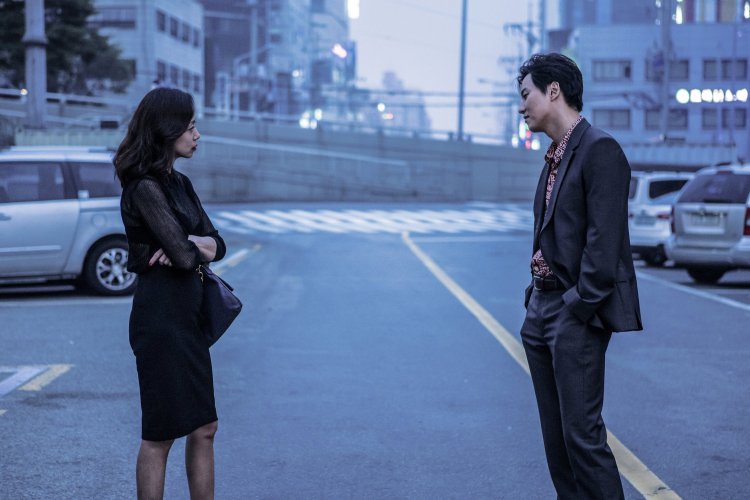
Recently divorced police detective Jung Jae-gon has been handed what seems like a fairly straightforward murder. They already know who the killer is and the motive behind the crime, all that remains is to track the guy down. Luckily they also know that Park, a gangland thug, has a regular girlfriend, Kim Hye-kyung, who works at a seedy downtown bar. Through tailing her they’ll find their man. This is where things get sticky. Said girlfriend is the former lover of the head of another crime syndicate who’d now like to use Park’s current predicament to exact some revenge on the drifter who’s stolen his girl. Roping in a disgraced ex-cop, the gang offer Jae-gon a significant amount of money to cripple Park during his arrest and take him out of the picture for good. Jae-gon is conflicted. The way he sees it, the day you can’t tell which side you’re really on is the day you need to hand back your badge, but Jae-gon’s in need of money, this guy used to be his friend and then, there’s the girl…

Right here you have all the essential elements of your classic film noir. Basically good, if imperfect, detective receives an offer he can’t refuse and ultimately accepts it against his better judgement in part because of a femme fatale that he just can’t get out of his mind even if the more rational part of his brain knows this is something that is never going to happen. Before you know it, Jae-gon has researched Park’s history and adopted the persona of a former cellmate before taking an undercover job at Hye-kyung’s bar and attempting to become close to her in the hope that she’ll eventually lead them to Park’s whereabouts. Of course, he starts falling for her too and though she remains doggedly committed to Park, something in her begins to warm to him in return. This is a situation which can never end well and its classic B-movie style inevitability only adds to the eventual pathos of its deliberately downbeat ending.

The film is called The Shameless for a reason – nobody looks good in this shady world of corrupt cops and vicious gangsters who will stop at nothing to get what they want. The fact that you can barely tell who is on which side is a good indicator of the levels to which this world of chaos has become warped. Even the police are literally “shameless” stooping so far as to indulge in an interrogation technique which is, in fact, a sexual assault. At least the gangsters are abiding by their own rules.

The picture has a slick, stylish aesthetic which is perfectly in keeping with its morally grey, film noir inspired mood. It’s full of existential angst and the ennui of modern, aimless life. As usual for this kind of film, Hye-kyung repeatedly gets the short end of the stick – used and abused by faithless men, so massively in debt it’s almost impossible she’ll be able to extricate herself from the seedy world of hostess bars and petty gangsters before its too late. She’s only one victim of the pervasive sexism that defines this harsh world. Clinging desperately to Park, Hye-kyung’s one and only escape route is to hope one of these feckless men is the one who can take her away from this place.

Needless to say this isn’t one of those films where everyone gets what they want and walks off into the sunset of eternal happiness, but perhaps it isn’t as apocalyptic as the original premise might promise. That is actually something of a problem as the slightly softer ending undercuts the film’s emotional resonance and ultimately leaves one feeling a little less than satisfied. Still, even if The Shameless fails to hit its mark at the very end, Oh has still crafted a stylish and beautifully photographed neo-noir romance that stays true to its classic B-movie roots whilst also embracing the best of the modern crime movie.


Reviewed at the London Korean Film Festival 2015.


Ode to My Father (국제시장, JK Yoon, 2014)

ode_to_my_father_stillReview of JK Yoon’s Ode to My Father (국제시장, Gukjeshijang) – first published by UK Anime Network.


Of late, we’ve seen a lot of films attempt to trace the history of a nation through the story of one man and his family which ultimately becomes a metaphor for the that of the land itself. Many of these have come from China which shares something of the turbulent history that has affected the Korean peninsula over the last hundred years. In Ode to My Father, director JK Youn has tried to pay tribute both to his own father and to all the fathers of modern Korea who underwent great difficulties and suffered immensely in the hope of building a better, happier, future for their own children.

Mostly we view events from the point of view of Duk-soo – an old man at the beginning of the film who has made a success of himself and is surrounded by a large, loving family though seems to retain a kind of unresolved sadness. When we travel back with him, he’s just a small boy fleeing his homeland with his parents and siblings. As the oldest, he’s put in charge of his sister only to have her cruelly snatched away from him during the final escape. This event colours the rest of Duk-soo’s life as he carries with him both the tremendous guilt of having failed to protect his sister and of losing his father has he went back to look for her. The remaining family members gather together at the small imported goods shop belonging to an aunt which becomes another motif of the film.

Growing into manhood, Duk-soo is now the man of the house with both his siblings and his mother to provide for. Making countless sacrifices which see him abandoning his own dreams and travelling abroad to seek better paid work – first in the coalmines of West Germany and later the warzone of Vietnam, Duk-soo puts his family before himself every single time. Working tirelessly, Duk-soo grows up but inside he’s forever the little boy on a boat watching his father drift away him and desperately hoping he’ll some day miraculously turn up at the shop with a smile and an improbable story.

This is a story of painful separations and the shockwaves they send through the rest of one’s life and of all the lives throughout history. Having fled the Chinese and the communists in the North, Duk-soo and his family are excited about the prospect of being able to go home at the “end” of the war. However, this is a war which is still not technically over, merely suspended by a truce, and Duk-soo will never see his hometown again. Eventually, during the ‘80s, 30 years since Duk-soo was separated from his father and sister, a nationwide campaign is held to try and re-unite family members forced apart by the traumatic events of the 1950s. Entire squares in the city are covered with people desperately looking for each other wearing signs with their relatives’ names and point of last sighting, clothing etc all in the hope of finally finding each other again. Needless to say, some of these people are luckier than others and there are tears of both joy and sadness.

Still, all in all, Duk-soo and South Korea made a success of themselves even if there’s a resulting ache from the great wound which has split the nation in two. Much of the story is universal – a father’s love for his family, but Ode to My Father will obviously speak loudest to Koreans who can identify more strongly with the historical context. Yoon has also injected some humorous incidents involving real life Korean historical celebrities which may mystify international viewers even if they’re sign posted well enough that one gets the gist of it anyway.

Unabashedly sentimental and oftentimes overblown, Ode to My Father nevertheless succeeds in tugging at the heartstrings in all the intended ways. A paean to the post war generation and all that they endured in building the modern Korea that their children could live in without fear or hunger, Ode to My Father is in the end far too sugary but also, it has to be said, affecting.


Reviewed at the London Korean Film Festival 2015.