
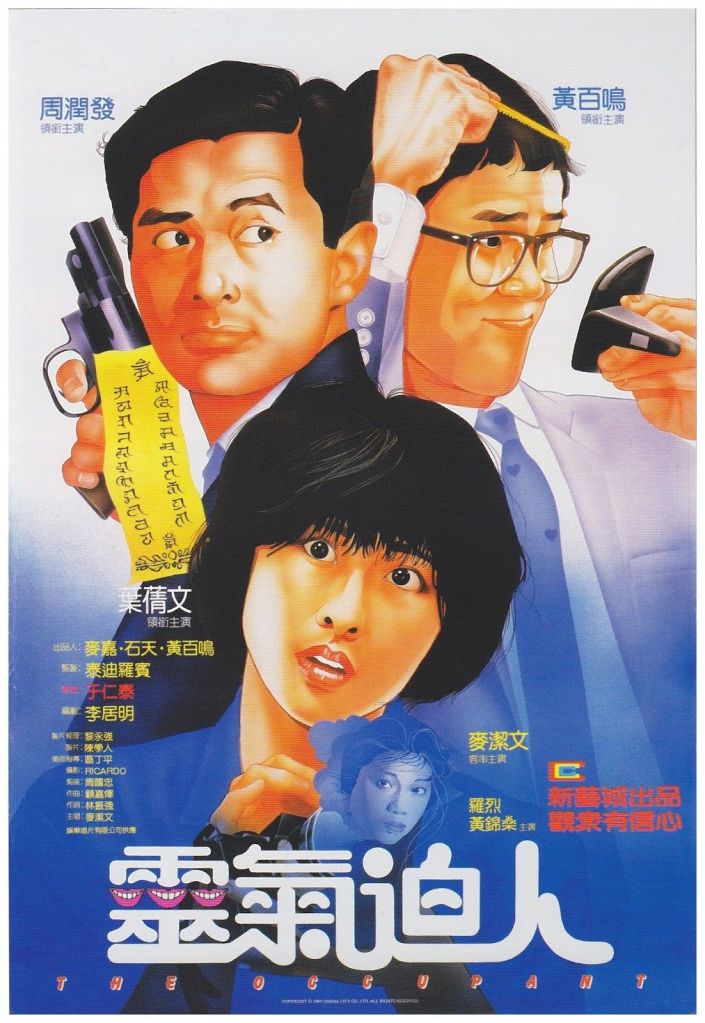
There’s no such thing as a reasonably priced apartment, and so when you find one that seems strangely spacious for the rent, it’s prudent to wonder why that might be. Yes, that’s right, your dream apartment may in fact be haunted! Going a bit meta, Ronny Yu Yan-Tai gets in on the comedy ghost game with The Occupant (靈氣逼人), a tale of supernatural suspense starring Taiwanese-Canadian actress and singer Sally Yeh as a young woman returning from Canada for a three week stay to work on her dissertation researching “Chinese superstition”.
Having not thought to book ahead for her accommodation, Angie (Sally Yeh Chian-Wen) is shocked to discover that hotel rooms in the Hong Kong of 1984 are in no way cheap. Locked out of even the cheapest flea pits, she decides to try renting an apartment only to run into the slimy Hansome Wong (Raymond Wong Pak-Ming), an unscrupulous estate agent/used car salesman. Angie spots an apartment sitting on his board that’s in her budget and asks to see it. Hansome is delighted because it’s been on the market ages, but what he doesn’t disclose is that the reason it’s so cheap is that the place is haunted. Angie is originally quite confused by the fact her furniture seems to move back to its original position all by itself, and irritated by loud noises such as a woman singing and a couple having an argument late at night, but on being told that she’s the only resident by the decidedly creepy caretaker (Yam Ho), decides she’s not really bothered if the apartment has another occupant besides herself and anyway it might be quite useful for her thesis.
Very much in the Wong Jing vein, much of the early comedy revolves around Hansome’s cringeworthy attempts to worm his way into Angie’s life. Luckily for her, he says, Hansome is a very “superstitious” person and so offers to show her around all the best “superstitious” sights of the city, particularly a local temple where they seem to do every kind of taoist ritual going. The problem is that Angie can’t seem to get rid of him. He even pulls the trick of saying that he left something behind in her apartment so he can come in and retrieve it, only to get his arm trapped in a priceless vase. Hearing about the ghost he vows to stay the night and protect her from the boogeyman, but he didn’t count on the real thing turning up and expelling him from the apartment in exasperation with creepy men everywhere.
Meanwhile, Angie is actually quite taken with a handsome policeman she runs into at the airport, but incorrectly assumes he’s a “sex maniac” because he was only hanging out with her as camouflage for surveilling another woman who turned out to be a pickpocket. Valentino (Chow Yun-Fat) is an honest cop, which is why he ends up getting asked to take some time off after discovering a fellow officer visiting an establishment they were raiding on a tip off that it was employing underage girls. Like Hansome, Valentino has also taken to Angie, if in a slightly less creepy way, and the three of them eventually get together to try and solve the ghost problem (not that Angie actually has much of a problem with it).
On investigation, Angie discovers that the previous occupant of the apartment was a nightclub singer who apparently shot herself after a failed affair with a married man who wouldn’t leave his family. She becomes ever more obsessed with the dead woman, Lisa Law (Kitman Mak Kit-Man), despite the warnings from Valentino’s former policeman turned taoist priest buddy (Lo Lieh) who tells her that the ghost most likely bears a grudge and will try to engineer a reprise of her tragedy using a susceptible subject. Yu has fun parodying some of the genre staples like magical charms supposed to ward off ghosts which get mysteriously lost at critical moments, but edges towards a real supernatural dread as the curse takes hold, swallowing our trio in a bizarre recreation of the past which accidentally reveals a long hidden truth and helps to alleviate the ghost’s anger. In her frequent voice overs recorded on a dictaphone, Angie reveals that she came to Hong Kong with a low view of “Chinese superstition” but thanks to her experiences now has a new appreciation for the power of the supernatural. Ghosts it seems can’t be exorcised so much as appeased, ignore them at your peril.
Original trailer (no subtitles)
 Where oh where are the put upon citizens of martial arts movies supposed to grab a quiet cup of tea and some dim sum? Definitely not at Boss Cheng’s teahouse as all hell is about to break loose in there when it becomes the centre of a turf war in gloomy director Kuei Chih-Hung’s social minded modern day kung-fu movie The Teahouse (成記茶樓, Cheng Ji Cha Lou).
 Windows on Worlds