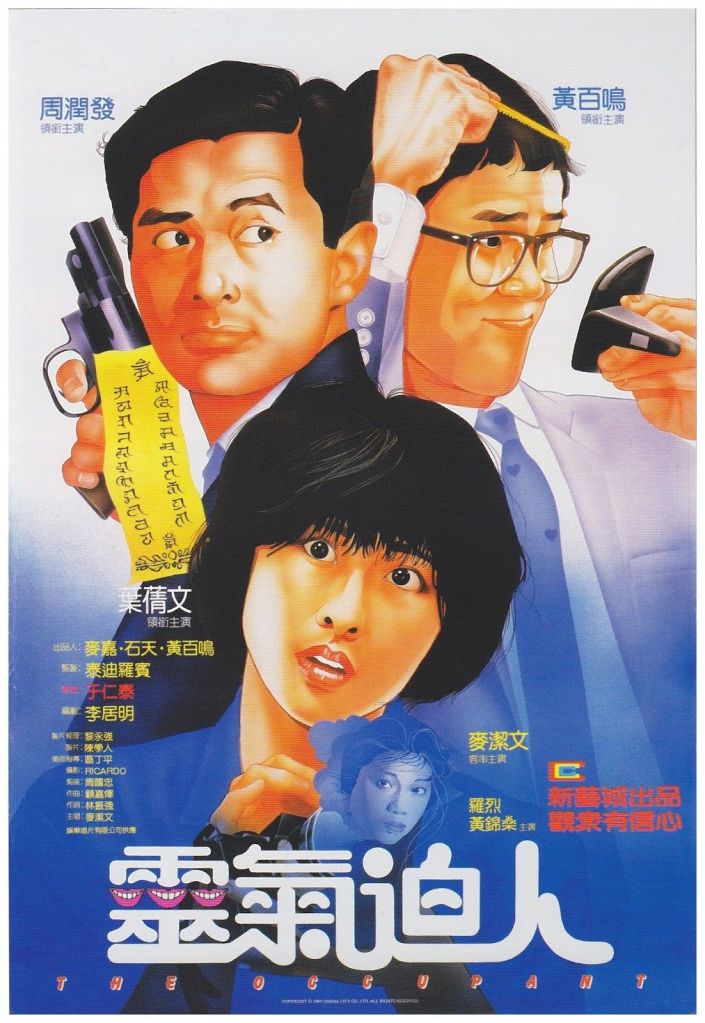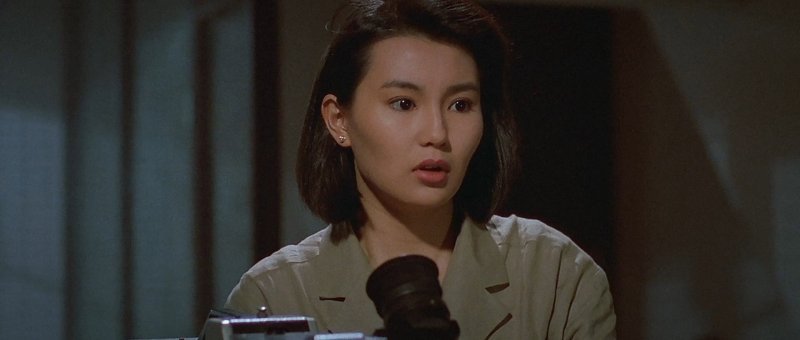
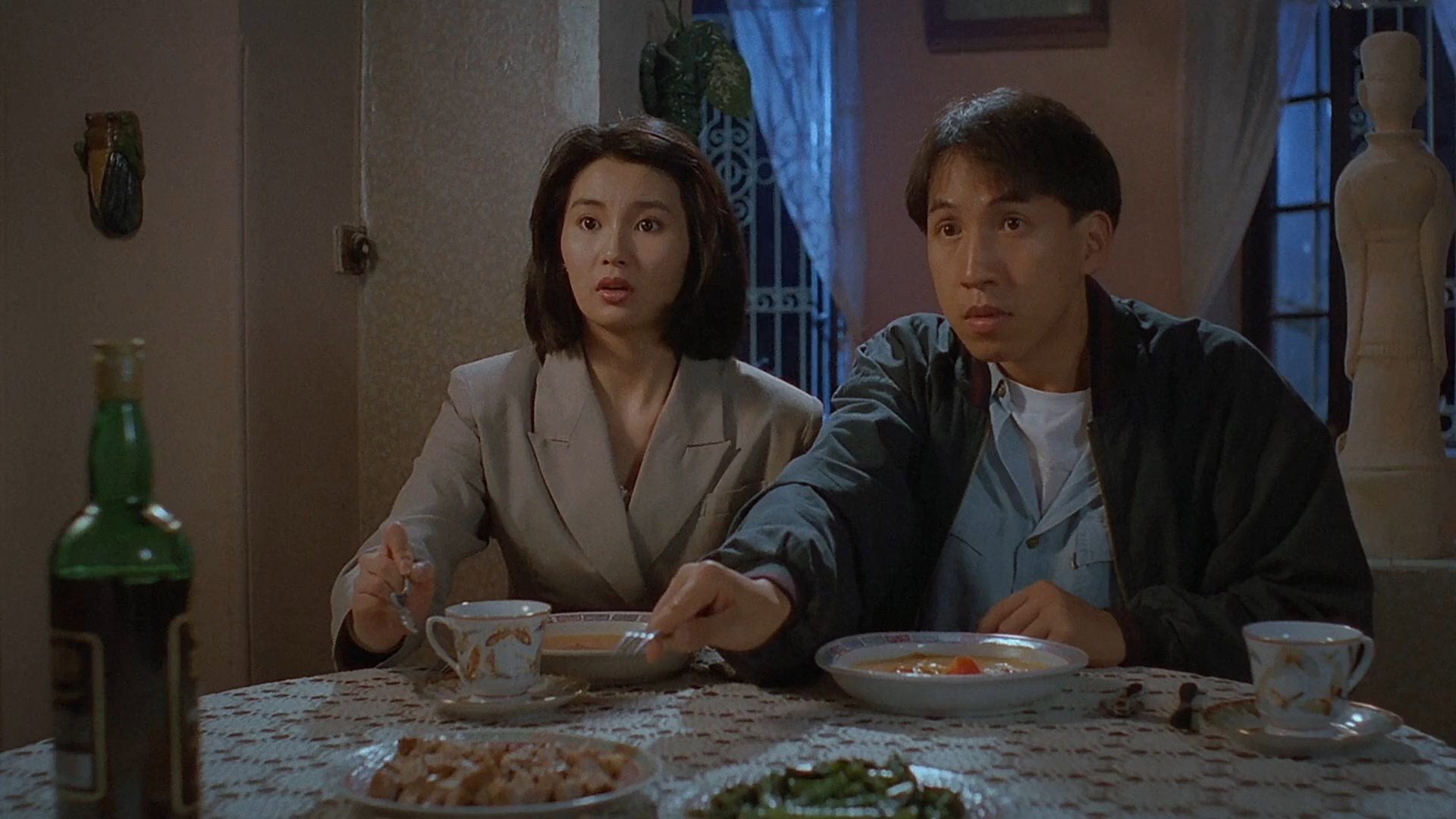
In Between Loves (求愛夜驚魂, Allan Fung Yi-Ching, 1989)

Zany rom-com meets serial killer thriller in Allan Fung Yi-Ching’s decidedly odd horror comedy, In Between Loves (求愛夜驚魂). Though the title may hint at romantic melodrama, the film is filled with unexpectedly edgy humour and references to the real life “Jars Killer” case that also inspired the film Dr. Lamb in which a taxi driver murdered several of his female passengers and kept their body parts in Tupperware boxes at his home where he lived with his apparently oblivious family members.

Lung (Alfred Cheung Kin-Ting) is the head of a small band of late night taxi drivers who entertain each other with various party tricks over the radio, Lung’s being the ability to tell Christmas cracker-style jokes. They seem to have a long-standing vendetta against another gang of taxi drivers who challenge them to drinking contests and other tests of strength. Lung, meanwhile, has a fixation with beautiful TV reporter Jenny (Maggie Cheung Man-yuk) who once said something nice to him getting out of his cab, and makes a point of watching the news whenever she’s on. His taxi driver friends mostly seem to support his crush and are keen to help him in his romantic quest which is why they all agree to pass on tips about newsworthy goings on that Lung can send to Jenny in the hope of making himself useful to her.

Jenny, meanwhile, is sort of grateful for the tips because she feels undervalued at the station where she works. She clearly wants to be a crusading reporter exposing things like political corruption and injustice, but as her boss tells her, the people of Hong Kong prefer soap operas to news and in any case, they don’t have the budget for serious investigative reporting. There is a mild criticism here of the mass media landscape which is increasingly compromised by its commercial concerns in world in which the line between factual reporting and entertainment is beginning to blur. The press are desperate for salacious content to keep viewers hooked, feeding on human misery and almost willing it into being.

Thus it’s not a stretch when it first appears that Lung has gone off the deep end after being insulted by Jenny’s terrible elitist boyfriend John (Lawrence Ng Kai-Wah) and actually become a serial killer just so that Jenny can have something exciting to report on followed by a scoop on his confession. It turns out that Lung is not the real killer and only wanted to give Jenny a real confession wrapped up in a false one, but this still bears out the depths of his problematic, one-sided romantic obsession with a public figure. In some ways, Lung is presented as an underdog whose pure-hearted love just hasn’t been properly noticed, yet. He picks up another man with flowers for Jenny who is more obviously deranged, but is irritated rather than noticing that he is really no different. He is also irritated to see John pick Jenny up, but, at the same time, perhaps thinks it’s fair enough if she has a boyfriend already.

The problem is that John might actually be the worst person in a film about a cannibalistic serial killer without needing to actually kill anyone. He is possessive of Jenny and has an unpleasant, elitist world view in which he is violent towards Lung and point-blank tells him that a lowly taxi driver who didn’t even finish high school has no business dating an educated, upper-middle-class woman like Jenny. Though this originally presented as an unpleasant point of view and a symbol of the kind of classist oppression faced by men like Lung, the film eventually embraces it with Lung coming to the conclusion that John is right, he’s not good enough for Jenny and ought to date someone from his own social class such as fellow taxi driver Ti (Sandra Ng Kwan-yue). As such, it adopts a rather conservative attitude that supports class divisions and negates the idea of social mobility in insisting that love across the class divide not only will not work but is in some way improper.

Lung may realise both that his infatuation is not “love” but “worship” and that his behaviour has been dangerously obsessive bordering on madness, but this is not the reason that he finally decides to give Jenny up so much as a sense of inferiority in returning to his own working-class world. Meanwhile, the film treats Ti as something of a joke, firstly mocking her for being a tomboyish woman in a man’s occupation, then half-hinting that she maybe transgender. Despite its offbeat humour, the film goes to a fairly grisly place in its final stretches, transitioning into slasher territory as Lung and Jenny are stalked by the real killer upset by Lung’s attempts to claim responsibility for their crimes. Order may have been restored, but this Hong Kong remains a fairly bleak place overshadowed by violence and anxiety in which romantic fantasy may be the only means of escape.


Trailer (no subtitles)
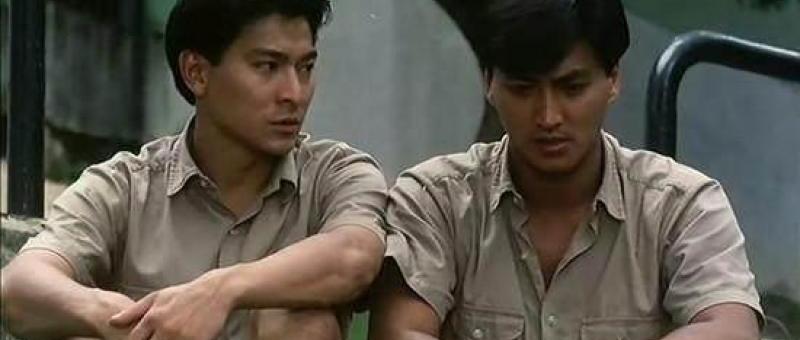
Dragon in Jail (獄中龍, Kent Cheng Jak-Si, 1990)

“For the poor life is a punishment” according to Henry (Andy Lau Tak-Wah), the embattled hero of Kent Cheng Jak-si’s Dragon in Jail (獄中龍), a subdued heroic bloodshed offshoot in which a poor boy and rich kid meet in juvie and become best friends for life even though fate seems to have very different paths in store for them. Less a critical expose of the cruelties of an increasingly stratified society than an ode to intense male friendship, Dragon in Jail puts its hero in a different kind of cell as he tries to escape the triad net but finds himself ensnared by past crime and present rage. 

Rich kid Wayne (Kenny Ho Ka-King) ends up in a reformatory for pulling petty stunts supposedly because he doesn’t like it that his widowed mother has remarried. Different from the other boys, he’s immediately hazed and asked for his gang affiliation, only he doesn’t have one. Tough boy Henry stands up for him, roping in his other friend Skinny (John Ching Tung) to take on the cell’s Mr. Big after which the boys become firm friends as they study together to sit their A Levels while inside. Wayne wasn’t planning to take his exams as a way of getting back to his mother, but Henry convinces him that education is the one way to show the world who’s boss. The boys come top in their class, Wayne gets out and decides to go the UK to study law, while Henry serves out the remainder of his sentence in an adult prison, sentenced to four years for manslaughter after accidentally killing a triad member during a fight over protection money at his family’s kiosk. 

Despite the differences in the scope of their possibilities, Henry and Wayne remain good friends, but once Henry gets out of prison he’s nothing much to look forward to. His hopes of attending a university are dashed by his defeatist father who thinks education is pointless and blames him for the failure of their business, while he struggles to find steady employment as a man with a criminal record. Eventually he decides to work as a mechanic by day and a cram school teacher by night with the aim of saving enough to apply for uni at later date so he can marry his longstanding girlfriend, Winnie (Gigi Lai Chi). Skinny, meanwhile, gets out of jail and heads straight back to the triads, trying to convince Henry he should join too. Henry doesn’t want to, but faces constant harassment from Brother Charlie (William Ho Ka-Kui), the boss of the man he killed in the fight. When his little brother is badly burned in a triad attack, he decides his only option is to become one himself to earn the protection of Boss Sean (Leung Gam-San) who mediates an uneasy truce with the psychopathic Charlie. 

When Wayne returns from the UK after graduating law school, Henry is married and a father-to-be living in a swanky apartment having risen in the triad ranks, but he’s also a hotheaded opium addict still sparring with the very present Charlie. “I’m a bad egg! I deserve it!” Henry wails on being confronted by Wayne who points out that it was he who was always encouraging him to study so that no one would ever look down on him. Henry thinks he’s not good enough to be Wayne’s friend and fully expects to be abandoned, but after some strong words of defence from Winnie, Wayne comes around, resolving to help get his friend off the stuff. The problem is the sense of futility which has already set in. Henry has become what everyone expected him to be, a thuggish triad, because they convinced him he could become nothing else.

Winnie berates Henry for keeping his sorrows to himself, remaining sullen and resentful at his inability to escape the triad world for an honest life of safety with his new family, though he once told Wayne that he should “speak up if you feel unhappy”. Despite everything the intense friendship between the two men endures. Cheng adds to the faintly homoerotic tone by shooting his early prison scenes with a lingering romantic gaze, while Wayne seems to pine for his broody friend, affirming that “no matter what you are, you are my buddy”. A caged dragon, Henry’s vengeance is swift and brutal but he retains his nobility even in the depths of his despair, eventually taking refuge in an unconditional friendship which transcends the forces which imprison him.


The Occupant (靈氣逼人, Ronny Yu Yan-Tai, 1984)

There’s no such thing as a reasonably priced apartment, and so when you find one that seems strangely spacious for the rent, it’s prudent to wonder why that might be. Yes, that’s right, your dream apartment may in fact be haunted! Going a bit meta, Ronny Yu Yan-Tai gets in on the comedy ghost game with The Occupant (靈氣逼人), a tale of supernatural suspense starring Taiwanese-Canadian actress and singer Sally Yeh as a young woman returning from Canada for a three week stay to work on her dissertation researching “Chinese superstition”.

Having not thought to book ahead for her accommodation, Angie (Sally Yeh Chian-Wen) is shocked to discover that hotel rooms in the Hong Kong of 1984 are in no way cheap. Locked out of even the cheapest flea pits, she decides to try renting an apartment only to run into the slimy Hansome Wong (Raymond Wong Pak-Ming), an unscrupulous estate agent/used car salesman. Angie spots an apartment sitting on his board that’s in her budget and asks to see it. Hansome is delighted because it’s been on the market ages, but what he doesn’t disclose is that the reason it’s so cheap is that the place is haunted. Angie is originally quite confused by the fact her furniture seems to move back to its original position all by itself, and irritated by loud noises such as a woman singing and a couple having an argument late at night, but on being told that she’s the only resident by the decidedly creepy caretaker (Yam Ho), decides she’s not really bothered if the apartment has another occupant besides herself and anyway it might be quite useful for her thesis. 

Very much in the Wong Jing vein, much of the early comedy revolves around Hansome’s cringeworthy attempts to worm his way into Angie’s life. Luckily for her, he says, Hansome is a very “superstitious” person and so offers to show her around all the best “superstitious” sights of the city, particularly a local temple where they seem to do every kind of taoist ritual going. The problem is that Angie can’t seem to get rid of him. He even pulls the trick of saying that he left something behind in her apartment so he can come in and retrieve it, only to get his arm trapped in a priceless vase. Hearing about the ghost he vows to stay the night and protect her from the boogeyman, but he didn’t count on the real thing turning up and expelling him from the apartment in exasperation with creepy men everywhere. 

Meanwhile, Angie is actually quite taken with a handsome policeman she runs into at the airport, but incorrectly assumes he’s a “sex maniac” because he was only hanging out with her as camouflage for surveilling another woman who turned out to be a pickpocket. Valentino (Chow Yun-Fat) is an honest cop, which is why he ends up getting asked to take some time off after discovering a fellow officer visiting an establishment they were raiding on a tip off that it was employing underage girls. Like Hansome, Valentino has also taken to Angie, if in a slightly less creepy way, and the three of them eventually get together to try and solve the ghost problem (not that Angie actually has much of a problem with it). 

On investigation, Angie discovers that the previous occupant of the apartment was a nightclub singer who apparently shot herself after a failed affair with a married man who wouldn’t leave his family. She becomes ever more obsessed with the dead woman, Lisa Law (Kitman Mak Kit-Man), despite the warnings from Valentino’s former policeman turned taoist priest buddy (Lo Lieh) who tells her that the ghost most likely bears a grudge and will try to engineer a reprise of her tragedy using a susceptible subject. Yu has fun parodying some of the genre staples like magical charms supposed to ward off ghosts which get mysteriously lost at critical moments, but edges towards a real supernatural dread as the curse takes hold, swallowing our trio in a bizarre recreation of the past which accidentally reveals a long hidden truth and helps to alleviate the ghost’s anger. In her frequent voice overs recorded on a dictaphone, Angie reveals that she came to Hong Kong with a low view of “Chinese superstition” but thanks to her experiences now has a new appreciation for the power of the supernatural. Ghosts it seems can’t be exorcised so much as appeased, ignore them at your peril.


Original trailer (no subtitles)