The Rescue (紧急救援, Dante Lam, 2020)

The rescue poster 3

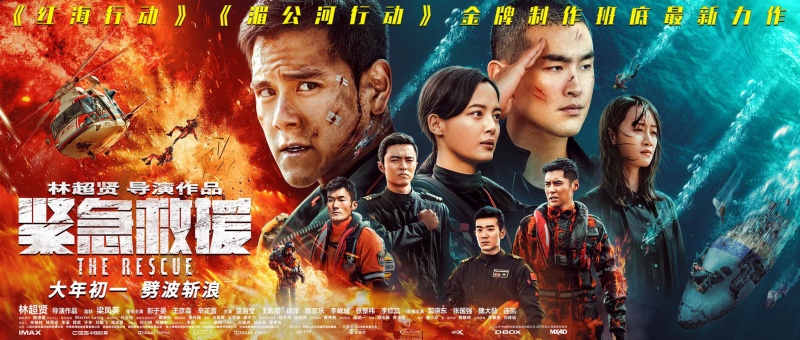
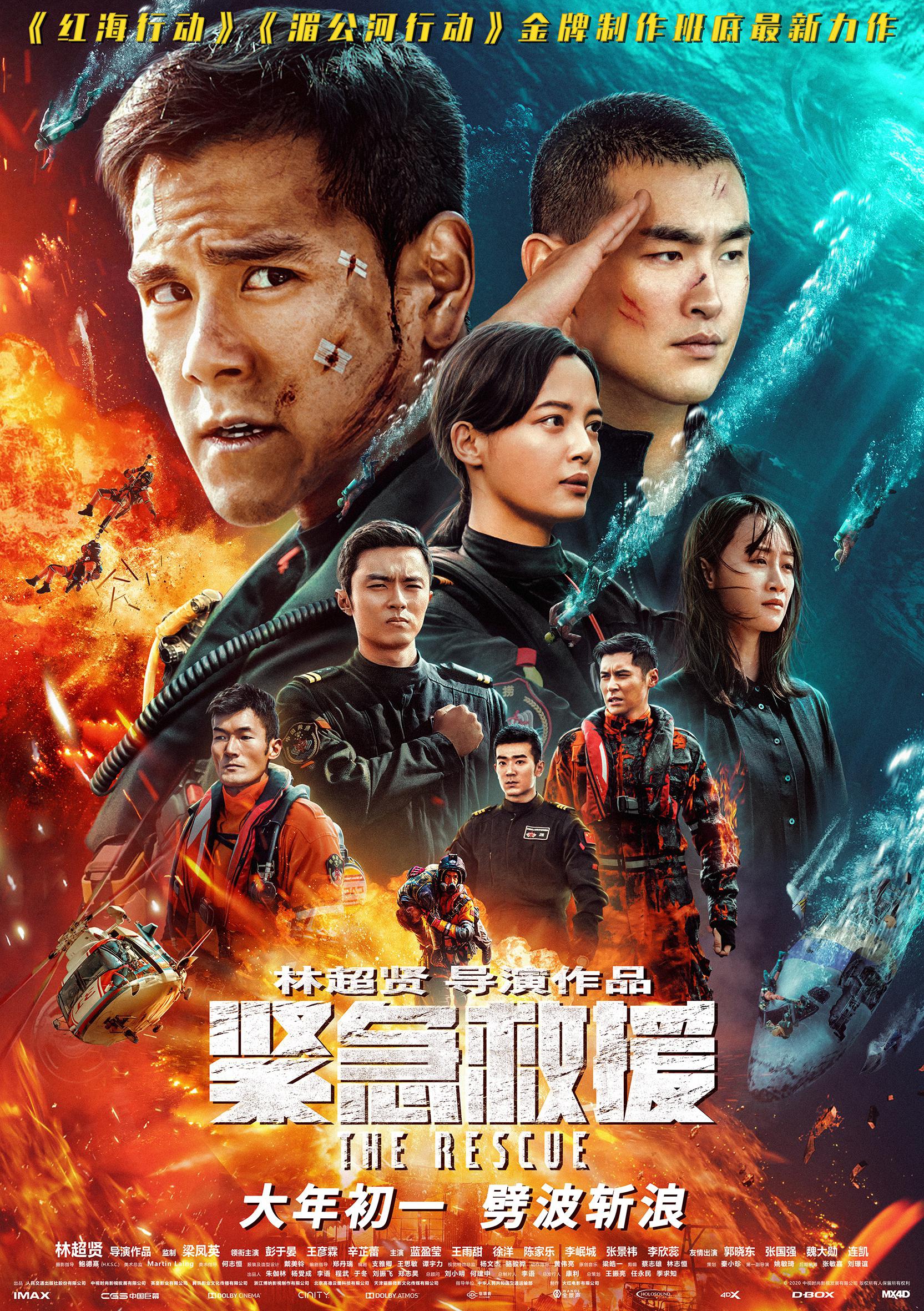
It’s tempting to see Dante Lam’s latest foray into big budget mainland action as a continuation of his previous hits Operation Mekong and Operation Red Sea which paid tribute to the police and navy respectively, but it is also the latest in a series of films featuring China’s finest bravely battling against the odds to save the day. Like Tony Chan’s The Bravest which celebrated the selfless heroism of China’s firemen as they risked their lives to stop a potentially catastrophic fire in an oil refinery, The Rescue (紧急救援, Jǐn Jyuán) pays tribute to another undersung arm of the emergency services – China’s Coast Guard.

Our hero, Captain Gao Qian (Eddie Peng Yu-yen) of China Rescue And Salvage, is a devil-may-care hero who throws himself into danger without a second thought where lives are at stake. The motto of China Rescue And Salvage is “we risk our lives to give others hope”, but some feel that Gao Qian is too reckless with his and fear that he’s forgotten that you can’t save anyone if you get yourself killed playing at heroics. That’s something that’s temporarily brought home to him when the pilot of his helicopter is badly injured during a rescue on an oil rig engulfed by flames, leaving the inexperienced co-pilot to fill-in on his behalf. Gao Qian works his magic in the nick of time, but both of the pilots quit the team immediately afterwards, the pilot struck by the proximity of death and the co-pilot by his sense of inadequacy in feeling as if he failed to live up to the job.

Luckily the team soon get a new pilot – a lady, Yuling (Xin Zhilei), who clashes with Gao Qian in true disaster movie fashion in her desire for rational action and the kind of heroics that are strictly by the book. Against the odds, however, they make a good team, eventually bonding in mutual admiration for their complementary skills. Meanwhile, Gao Qian is also dealing with some home drama in that he’s just brought his young son Congcong (Zhang Jingyi), who had been staying with his grandmother, to live with him. Congcong seems to be suffering with some kind of illness, but is otherwise cheerful enough and hoping that his dad will get him a new mum, like, for example, the beautiful Yuling.

The death of his wife, his son’s illness, and the loss of colleagues he was forced to leave behind, haunt Gao Qian like a cosmic joke, as if he’s being “punished” for snatching so many other lives from the jaws of death. No matter how hard he tries, there are lives which cannot be saved – no helicopter can rescue you from terminal illness or debilitating disease. Nevertheless, he continues to do his best no matter the personal costs. “Everyone has their own battleground, mine is rescue” he tells a superior with determination after his priorities are questioned. In training, the coach reminds the rescuers that their enemy is nature. They push their bodies as far as they can go, willingly risking all to let others know that someone is always looking out for them and will come in their time of need. Faced with certain death, Gao Qian enters an eerily beautiful existential space born of liminality in which he is perhaps able to feel everything that is to be alive while his son, fighting his own battle, does something much the same.

The strangely poetic quality of life in extremis is directly contrasted with the hokey comedy of Gao Qian’s home life and the brotherly comradeship of the base which are both much more of the typical “New Year Movie” mould. Lam fares much better than Chan in heading off the obvious melodrama, though he too resorts to the obvious foreshadowing of a young man daring to get wedding photos taken while planning to risk his life for the greater good, while the quirky production design and wholesome warmth of Gao Qian’s home life as he attempts to make the world safe for his son offer a much needed escape from the anxiety of his disaster-fuelled existence. Unlike that of Red Sea, the world of The Rescue is a more open and hopeful one in which Gao Qian does his best to save everyone who needs saving no matter their nationality, feted far and wide as a hero even if he awkwardly embodies a magnanimous China as a world protector as he does so. Nevertheless, Lam once again manages to elevate his material beyond its propagandist aims, edging towards a more ambivalent contemplation of selfless nobility and the costs of courageous endurance.


In UK cinemas from 25th January courtesy of CMC Pictures. Unfortunately, the release of The Rescue has been postponed because of the Coronavirus outbreak in China. We will update you as soon as we hear of new release date!

Original trailer (English subtitles)

Little Q (小Q, Law Wing-Cheong, 2019)

little q poster 4You might think, in this day and age, that guide dogs are a fairly uncontroversial subject, but it might interest you to know that Hong Kong apparently has a vast guide dog deficit with fewer than 40 working in the city as of 2016 which is around one for every 4,300 visually impaired people. That might be part of the reason that Little Q (小Q, Xiǎo Q), adapted from a Japanese photobook by Ryohei Akimoto & Kengo Ishiguro, largely plays out as a feature length advert for the Hong Kong Guide Dogs Association, which is one of only two organisations training guide dogs and was set up in 2011 ending a 26-year absence of any such body.

The film charts the entire life cycle of the titular Little Q, whom we first meet literally falling into the arms of grumpy pastry chef Po-ting (Simon Yam Tat-wah). Rewinding a little, we realise that Po-ting’s sister and her vet husband are involved with the raising of guide dogs, sending Little Q off to live with his “foster family” which, perhaps irresponsibly, is in the home of plucky little girl Tsz-kiu (Jessica Liu Chutian). For those who don’t know, and as the film perhaps hopes to illuminate, guide dogs are trained in a family home by ordinary people who’ve agreed to look after them for the first 18 months of their lives, after which the dogs are given a final aptitude test and then placed with a blind person for a probationary period to assess their compatibility. Of course, agreeing to foster a dog knowing that you’ll eventually have to give it up can be emotionally difficult even for an adult, so placing that responsibility on a child is only going to lead to tears, of which there are plenty as Tsz-kiu is finally forced to accept that Little Q can’t stay with her forever because she has a greater calling.

Simon (Him Law Chung-him), the trainer/co-ordinator, promises Tsz-kiu that he’ll make sure Little Q has a lovely life with a person who truly appreciates her and that he’ll be sure to bring Little Q right back if she’s ever hurt or mistreated, but in part he knows he’s being disingenuous because they’ve already decided she’ll be going to Po-ting. Po-ting does not want a guide dog and is only getting one because of his sister’s connection to the programme. The problem is that Po-ting was always a “difficult” person. A well known TV pastry chef, he made a name for himself being mean in the way only a celebrity chef can. He has no respect for his service animal in part because he has no respect for other people, and because he was good at what he did people let him get away with it. Po-ting once cut down a contestant on the TV show by insisting that a chef must use all five senses, so he feels particularly trolled by the universe to have lost his sight and is struggling to accept his blindness. Feeling a sense of internalised shame because of his disability in addition to the fear and anxiety involved with adjusting to his new life has made him even more unpleasant and resentful than he was before. Angrily insisting he needs no additional help, he rejects and mistreats Little Q, even violently throwing her out of his well appointed home in the pouring rain.

As this is Little Q’s story, however, we only get a back seat view to Po-ting’s gradual softening as he begins to let her into his life, engineering not only a warmer relationship with his sister/partner in the pastry shop (Gigi Leung Wing-kei) but also with his apprentices, while he begins to see that the loss of his sight is only a change and not a tragedy. Through it all, Little Q is at his side, steadfastly loyal even when he tries to push her away, which is perhaps not quite the best message to be sending though it does emphasise the intense attachment that necessarily develops between a guide dog and its owner.

Law hints at an ethical dilemma in pointing out the toll taken on the dogs in the course of their work, but heads it off in reminding us that they get to “retire” and live out their final days as pampered pets while demonstrating that the reformed Po-ting breaks all the rules by playing ball with Little Q like a regular family dog. The paradox is difficult to bear as owners must act in symbiosis with their dogs, but are reminded that they’re service animals belonging to the organisation not personal pets and should something happen to them, will be shuffled on to others in need or returned to their foster families. Nevertheless, Little Q gets the best of both worlds, bonding fiercely with the grumpy Po-ting as he figures out how to live and love by following her lead.


Screened in association with Chinese Visual Festival.

Trailer (Cantonese with English subtitles)

Adoring (宠爱, Larry Yang, 2019)

Adoring poster 1Pets can often be a point of contention in your average romance. As often as they bring people together, they can also drive them apart which is perhaps why the tug of war over an unexpectedly orphaned dog has become such a trope in bitter divorce narratives. Cheerful New Year movie Adoring (宠爱, chǒngài), however, is 100% pet positive, showing us that shared love for an adorable little critter only brings people closer even if it takes a little while to get there.

Each of our animal loving heroes is connected through a network of friendship or simply by using the same, very cheerful, vet’s. Teenager Nan (Zhang Zifeng) uses her pet golden retriever Zha as an aid while looking after her best friend, Leyun (Leo Wu Lei), who has recently lost his sight through illness. Illustrator An Ying (Kan Qingzi) has a crush on a handsome reporter who lives in her building but is both extremely shy and incredibly germaphobic which poses a small problem for her when he suggests co-parenting a little kitten they rescue from under a car. An Ying’s boss Zhao Le (William Chan Wai-ting) has just married beautiful air hostess Fang Xin (Zhong Chuxi), but her beloved dog Seven is both extremely jealous and aggressively territorial making the start of their married life somewhat stressful. Fang Xin’s friend Fay (Yang Zishan) has been dating smartly turned out fund manager Li Xiang (Wallace Chung Hon-leung), but is concerned that they always meet in hotels. Fearing he has another woman at home, she barges into his swanky townhouse but is surprised to discover that his big secret is a pampered pretty pink pig called Bell that occupies his basement in the height of luxury. Meanwhile, divorced dad Gao Ming (Yu Hewei) has become overly attached to the family cat and fears his daughter Mengmeng (Li Landi) will take it back to the US with her, and rookie delivery driver Ah De (Guo Qilin) bonds with a stray dog who helps him navigate a complex housing estate.

Much as everyone loves their pets, the animals are in some way also conduits for love between people. Leyun has been struggling to accept the loss of his sight and the feeling that the world he’s always known is slipping away from him, which is why he takes it so badly hearing that Nan’s parents are thinking of moving to be closer to her new high school. Nan wants to help him, and chooses to do so by training Zha to be a guide dog, but Leyun only sees the ways in which his friend is trying to fob him off with a dog rather than embrace the warmth that was meant by her gesture. Likewise, Gao Ming, has become so attached to the cat, Hulu, because he sees it as the last remnant of his family, his wife having left him and taken their teenage daughter to the US. Mengmeng Skypes him to talk to the cat, and he worries about losing touch with her if she no longer needs to, but misses the fact that perhaps she merely lets him use the cat as an excuse because she knows he’s an awkward man who doesn’t know how to talk to her. Zhan Le, meanwhile, is understandably irritated by Seven’s jealously, but does his best to make friends with him because he loves his wife and she loves her dog. An Ying too begins to become less afraid of human contact thanks to unexpectedly bonding with the kitten, allowing her to grow closer to her crush.

Bell, however, continues to be a problem for Fay who can’t get her head around why her handsome, stylish boyfriend keeps a “dirty” farmyard animal in the basement, let alone why he lavishes so much luxury on her. Jealous of the pig, she misses all the ways that Bell is actually rooting her human’s love story and just trying to make friends with her while protecting the household like any good pet should, leading her to make a potentially disastrous decision only to realise her mistake just in the nick of time. Darkness also invades the tale of delivery driver Ah De who finds out his new friend is under threat from vicious gangs who apparently round up stray dogs and sell them to restaurants (!). Somewhat uncomfortably, the “gangsters” following Ah De have Korean names, but ultimately turn out to be the good guys and part of the rescue team when all the pet lovers come together to save the independent pup and convince him that it’s OK to love again. As Ah De said, people think they take care of their pets, but sometimes it’s them taking care of you.


Currently on limited release in UK/US/Canadian/Australian/New Zealand cinemas courtesy of CMC Pictures.

International trailer (English subtitles)

Send Me to the Clouds (送我上青云, Teng Congcong, 2019)

Send me to the clouds posterWomen hold up half the sky, Chairman Mao once said, but in contemporary China sexual equality is an unrealised dream of a previous era. The debut feature from Teng Congcong, Send Me to the Clouds (送我上青云, Sòng Wǒ Shàng Qīngyún) follows one “left-over” woman as she attempts to assert her independence in a world which still expects her to accept her subjugated position in a male dominated society by marrying and subsuming herself within a man’s career.

Ageing investigative journalist Shengnan (Yao Chen) whose name literally means “surpass men” has a cynical eye and fiercely independent nature but is struggling to make a living while protecting her integrity in an increasingly acquisitive culture. Getting kicked in the stomach by a “nutcase” while looking for evidence to support her theory that a local wildfire was started by a politician hoping to capitalise on successfully putting it out forces her to make a long delayed trip to the doctor who tells her that the pain in her abdomen is a result of advanced ovarian cancer and that she needs expensive surgery as quickly as possible.

As she’s been keen to ensure she acts ethically, ready money’s something Shengnan doesn’t have a lot of. Confiding in her cynical, ambitious best friend Simao (Li Jiuxiao) who has no such scruples, Shengnan finds him unwilling to help because, after all, there’s a chance Shengnan might die anyway which would mean it’s a bad investment because she won’t be able to pay him back. He does, however, offer her a job ghostwriting an autobiography for the eccentric father of the local official she was just in the business of exposing for shady double dealing. Understandably she doesn’t want to take the job and decides to try asking her parents without disclosing what the money’s for. Shengnan’s skeevy industrialist father (Shi Qiang), however, is currently losing out in the precarious Chinese economy and actually deigns to ask Shengnan for a loan before she can even broach the subject leading to a spiky father daughter argument. Shengnan has to take the job and throw her lot in with Simao even if she doesn’t feel quite right about it.

Simao cynically affirms that a problem which can be solved with money isn’t a problem, but unlike Shengnan he has no qualms about bowing before power if he feels there’s something to be gained by it. Shengnan nearly blows the gig when she takes offence to the official’s extremely condescending attitude but does after all have little choice given that her life is on the line. Meanwhile, the job is further complicated by the unexpected arrival of her mother (Wu Yufang) who decides to tag along while feeling neglected seeing as her now estranged husband is having yet another affair leaving her entirely alone in a culture which expects women to go back in their boxes until the menfolk want to take them out.

Shengnan and her mother come from very different generations, but in essence not much has changed. Shengnan’s mother married young and had her only daughter at 19 only to see her husband tire of her and the deeply entrenched idea that a woman’s career is a home and family exposed as a fallacy. Shengnan meanwhile was born during China’s reformist period and told that she had total equality only to be frequently criticised for her “manliness” in her desire to assert her independence. On visiting the doctor she displays worryingly little awareness of her health in her confusion regarding the cause of her cancer, stating that her love life ended years ago, but even if she’s quick to roll her eyes at Simao’s insensitive story about a woman who had the surgery and found it ruined her sex drive eventually decides she’d like to have one last hurrah with someone she really likes only to have her proactive stance on female desire rejected as unfeminine.

Yet this hyper capitalistic, intensely sexist environment is also harming men as Shengnan discovers in her unsatisfying encounters both with Simao and with a philosophical photographer she meets on a boat. Shengnan develops an attraction for Guangming (Yuan Hong) because of his softness and seeming desire to see further than others but eventually he disappoints her, trapped as he is by a hierarchal system to which he can offer only token resistance while hating himself for his cowardly complicity. Simao meanwhile has jumped headlong into the consumerist dream, obsessed with getting rich and not particularly caring what he has to do to make that happen.

The most meaningful connection Shengnan makes turns out to be with the subject of her biography, a randy 80-year-old poet (Yang Xinming) who quickly sets about romancing her mother with a series of cryptic text messages. The old man knows his son is a “complete moron” and even changed his name to something bland and commonplace so that the police might arrest someone else by mistake if he got caught while committing a crime, but has a sort of exasperated love for him and for the world that transcends his failing body and worldweary philosophy. Thanks to his refreshing earthiness, Shengnan starts to see a way forward, once again claiming her independence and resolving to live her life in the way she chooses for as long as it lasts while the men around her largely crumble under the weight of social expectations and a rampantly capitalist society.


Send Me to the Clouds  was screened as part of the 2019 London East Asia Film Festival.

International trailer (English subtitles)

The Wandering Earth (流浪地球, Frant Gwo, 2019)

Wandering Earth poster 5Chinese cinema has not been as averse to science fiction as some would have it, but it’s true enough that The Wandering Earth (流浪地球, Liúlàng Dìqiú) marks a bold new chapter in its ambitious attempt to take Hollywood on at its own game. Adapting the novel by China’s premier sci-fi author Liu Cixin, Frant Gwo’s third feature is an interesting take on the New Year movie in which new beginnings are sought and families desperately try to reunite to see them in, only this time they do so against the backdrop of impending apocalypse as the universe threatens to swallow us whole.

Far in the future, the vast expansion of the sun will soon consume the Earth. The Wandering Earth project aims to save humanity by attaching jet thrusters to the Earth’s surface to push it out of harm’s way yet this safety measure has also had grave effects on the planet’s climate rendering the surface uninhabitable. 17 years previously, astronaut Liu Peiqiang (Wu Jing) left his 4-year-old son behind in the care of his father (Ng Man-tat) to take up a position on the space station intended to safeguard the Earth’s future. Now 21, Liu Qi (Qu Chuxiao) has grown up into a resentful, rebellious young man intent on seeing the surface for himself if only not to be home when Peiqiang finally returns to Earth. A natural disaster, however, leaves him stranded with his adopted teenage sister, Duoduo (Zhao Jinmai), just as the Earth is inconveniently drawn into a fatal collision course with Jupiter.

As much about fatherhood as it is about survival of a species, The Wandering Earth centres itself on the angry figure of Liu Qi who has been forced to live his entire adolescence underground and has come to deeply resent the memory of the father who allowed his sickly mother to die and then abandoned him. Peiqiang, meanwhile, has spent 17 years on the space station solely in order to save his son’s future, dreaming of the day they will finally be reunited. He cares little for his own life and has already spiritually handed the baton on to the next generation whose descendants, he hopes, may finally see a kinder sun rise over a new Earth.

This kind of selflessness is also reflected in the film’s refreshingly globalist outlook in which the world, no longer divided, has learned to act as one in order to combat the extreme threat from its own sun. The resistance may be China led, but depends on common endeavour and personal sacrifice. When a last ditch effort is required, the government cannot order its forces away from their families but can offer them the individual choice to keep fighting for survival, bringing teams from all corners of the Earth together as they descend on Indonesia where there just might be a one in a million chance to strike back at Jupiter and escape its gravitational pull.

Meanwhile, Peiqiang is up still up on the space station all alone and powerless while the annoyingly efficient operating system MOSS attempts to frustrate his efforts to save the Earth in service of its own mission to preserve humanity’s legacy. MOSS has made a series of calculations and given up, but giving up is not a very human trait and Peiqiang won’t do it. He makes impassioned speeches to the French-accented global authorities and ponders the best way to ensure his son’s survival even at the cost of his own but finally can only resist by literally attacking the system in overruling MOSS and acting on his own initiative.

A New Year tale through and through, The Wandering Earth is a celebration of family, togetherness, and home but is careful to dial down the patriotism for an insistence on the importance of mutual cooperation between peoples in order to combat existential threat with the spectre of climate change always on the horizon. The point, however, is that it is important to keep hope alive, if not for yourself then at least for others rather than give in to nihilistic despair. The Wandering Earth, grand and ambitious in scale, marks a new dawn of its own in terms of Chinese blockbuster sci-fi and does so with refreshing positivity as it places its hopes in human solidarity and individual sacrifice over jingoism and self-interest.


Currently available to stream on Netflix in the UK and possibly other territories.

Netflix trailer (English subtitles)

Only Cloud Knows (只有芸知道, Feng Xiaogang, 2019)

930161b9ca654d4cac056b550c6d0542If contemporary Chinese cinema has one message, it’s come home to China. Feng Xiaogang, however, has never been keen to go with the flow for all of his occasionally problematic affection for the nation as it was before the ‘80s reforms. A co-production with New Zealand, unabashed romantic tearjerker Only Cloud Knows (只有芸知道, Z Yǒu Yún Zdào) seems primed to speak directly to the diaspora audience, asking if perhaps the meaning of the word “home” has changed, less place than people and, therefore, infinitely portable.

In the present day, recently widowed Dongfeng/Simon (Huang Xuan) prepares to say goodbye to his late wife, Yun/Jennifer (Yang Caiyu), by travelling back through their long years together facing many ups and downs as they strove to make a life for themselves in the laidback greenery of the New Zealand countryside. Dongfeng travels first to the small town where they started a humble restaurant, cooking the kind of food Westerners expect rather than the authentic Chinese dishes they fear no one will try, and using their English names “for convenience”. While there they employ a friendly waitress, Melinda (Lydia Peckham), who is something of a free spirit saving up money to travel to distant lands, touring Asia and Africa.

Though they are blissfully happy, life is not without its difficulties. Working so hard to make the restaurant a success leaves them with time for little else and wondering if they’ve perhaps lost sight of something important. Dongfeng no longer plays his flute, and Yun worries that he’s sacrificed a part of himself to provide for her, becoming a slightly different person in the process. Obsessed with blue whales, Yun craves protection and security, the kind of things many associate with a building a stable home, but she also yearns for freedom and for something more than ordinary happiness. Minor resentment creeps in born of that central contradiction. Dongfeng wants to give Yun the kind of security he assumes she needs by betting everything on the restaurant, but all she really wants is him.

Nevertheless, protection and security were the things which attracted her to Dongfeng in the first place as symbolised by her obsession with blue whales. Somewhat improbably, his hotheaded decision to start a fight with a man who cut them up in a carpark and then insulted Yun only endears him to her further and also gets him a commendation from a local policeman who even tells him he might be cut out for life on the force, but to ease back on the violence because New Zealand is a peaceful place. There are things, however, that one cannot be protected from and as much as fate gives it also takes away. Yun craves protection because she feels insecure in an existential sense, convinced that she is “unlucky” and originally reluctant to agree to Dongfeng’s proposal in fear that she is destined to make him unhappy.

Sadly, that prediction eventually proves correct though through no fault of her own. Lucky in love, the couple face their share of hardships from an inability to start a family to losing beloved pets and dealing with illness, but there’s no joy without sadness and if your time together is shorter perhaps it is equally sweet. In his opening monologue, Dongfeng muses, quoting poetry, that time moved slower in the past and there was only enough of it to love one person before telling us that his life has been about one woman. Only Cloud Knows is the story of how he learned to say goodbye, but also of a 20-year love that endures to transcend time.

Apparently inspired by the true life love story of one Feng’s friends and collaborators, Only Cloud Knows has a rare kind of authenticity in its deeply felt romance which somehow seems all the more real for its clichéd genesis. Foreshadowings of partings echo throughout, reminding us that all love ends one way or another and it’s the ones left behind who mind it most, but rather than dwell on the maudlin, Feng shows that life goes on even in the midst of heartbreak. Houses change hands, old owners with teary eyes making space for bright-eyed youngsters full of hope for the future, while those who are leaving bequeath their unlived years to those they love with hopeful generosity. What Dongfeng discovers is that home is where the heart is, even if the heart is forever in the past.


Currently on limited release in US/UK cinemas courtesy of China Lion.

Original trailer (English subtitles)

The Whistleblower (吹哨人, Xue Xiaolu, 2019)

Whistleblower poster 2One of the many ironies of an intensely authoritarian system which prizes the self-criticism as a means of enforcing discipline is that whistleblowing, as opposed to “informing” on individuals, is not only frowned upon but actively dangerous. It is, after all, suggesting the Party may have made errors in judgement which have gone on to become systemic. It’s not surprising that the Party would not like to have them pointed out. Nevertheless, in these new times in which anti-corruption has become a minor buzzword, whistleblowing has been re-designated as a public service, though perhaps in not so much different a way as “informing” was in the old days and probably it very much depends on who and what one wishes to blow the whistle.

This the earnest hero of Xue Xiaolu’s The Whistleblower (吹哨人, Chuīshàorén) finds out to his cost when he is unwittingly alerted to a possible conspiracy and entrenched corruption among his co-workers. Mainland-born Mark (Lei Jiayin) works for a top Australian energy company keen to do business with China, though as they keep reminding him he is one of only two Chinese members of personnel, the other being the mysterious Peter (Wang Ce) whose unexpected absence is the reason Mark has been sent on a swanky but possibly illegal jolly to a resort to charm a delegation from a Chinese coal company. Two things immediately go wrong for him – the wife of the company’s (absent) CEO turns out to be his long lost first love Siliang (Tang Wei) who broke up with him because she wanted someone richer, and Peter turns up to the party in a dishevelled state to shout at him about something that happened in uni, which later turns out to be a coded clue to “check the gate”.

Needless to say, Siliang who seems to be in the middle of trying to break up with her husband, and Mark, who is married with a young son, “reconnect” before she dutifully runs off to a catch a plane which later crashes killing everyone on board. Peter is then found dead of an apparent insulin overdose, but even if he’s suspicious Mark doesn’t think much of it until he realises Siliang is still alive and on the run from her corrupt CEO husband who is apparently trying to have her killed because she knows too much about his dodgy dealings.

The Whistleblower tries to have it both ways in insisting that Siliang is simultaneously a greedy, ruthless, criminal mastermind, and such useless lady of the manor sort that she doesn’t know you can’t put metal in the microwave and is a terrible getaway driver because she’s always had chauffeurs. We’re told that she broke up with Mark because of his lack of materialism, marrying a top CEO for wealth and status and helping him conduct bad faith business by managing his bribes, but may now be conflicted – not only because her husband is trying to kill her, but because she’s realised her mistake and is attracted to Mark’s untarnished innocence. Her taste for corruption was, however, a moralistic one in that she would apparently never have condoned bribery if she knew that the technology really was unsafe and posed a threat to ordinary Chinese people.

It might be telling in one sense that this battle is being fought in Africa meaning that whatever problems there are with this innovative pipeline system are uncomfortably being worked out among less powerful people far away from either the Australian energy giant or the complicit Chinese coal company looking for new paths forward. The central implication, however, is that this kind of corruption is an element of Western imperialism rather than homegrown. The villains are the bigwigs at the Australian conglomerate, one of whom speaks fluent Mandarin but is apparently not much of a friend of China. Mark tries to expose them, turning against a company which is always keen to remind him that he is a foreigner (Australian PR pending), only to find himself at the centre of a smear campaign which seems like it would play much better on the Mainland, chased by thugs, and targeted for elimination.

The message that Mark gets, looking on with hope at a bright red sign reading “rebuild your life”, is come home – don’t do business with corrupt foreigners, help make China great again. A series of textual explanations appended to the film’s conclusion attempt to explain the word “whistleblower” to an audience that might not be familiar with it, pointing out that most developed nations have instituted legislation to protect those who attempt to expose illicit business practices but that China is lagging a little behind though it too apparently introduced legal protections in 2016 as part of its intensive drive to reduce corruption among petty officials. Mark has done the “right” thing, and he’s paid a price for it, but, the film says, his is the example to be followed in standing up to oppressive global corporate corruption which will eventually imperil the ordinary men and women of China if consumerist zeal wins out over national integrity.


The Whistleblower opens in selected UK cinemas on 6th December courtesy of Cine Asia.

UK trailer (English subtitles)

Nina Wu (灼人秘密, Midi Z, 2019)

Nina Wu poster 1“They’re not just destroying my body but my soul” complains an exploited woman in a film within a film, “I’ll do something you’ll all regret” she adds, only the actress never will. Penned by leading actress Wu Ke-xi, Nina Wu (灼人秘密, Zhuó Rén Mì) provides a timely exploration of the gradual erasure of the self the pursuit of a dream can entail in a fiercely patriarchal, intensely conservative culture. Arriving in the wake of the #metoo scandal the film goes in hard for industry exploitation but never tries to pretend that these are issues relating to the film industry alone or deny the various ways it informs and is informed by prevailing social conservatism.

Originally from the country, the titular Nina Wu (Wu Ke-xi) has been in Taipei for eight years trying to make it as an actress but is still awaiting that big break. Aside from some small bit parts and commercial jobs, she supports herself by working in restaurants with a side career as a live-streaming webcam star. Then, just as she’s starting to think it’s too late, a call comes through – she’s in the running for the lead in a high profile period spy thriller. The only snag is that the part requires full frontal nudity and explicit sex scenes.

Nina is understandably conflicted. Aside from the potential discomfort, taking a part in the kind of film this could turn out to be is a huge gamble that could either make or break her career (just look at what happened to Tang Wei after Lust Caution, itself a period thriller about a female assassin who falls for her target). Nina’s unsympathetic agent skirts around the fact this might be her last chance while promising to respect her decision, implying it’s this or nothing. Of course, neither he nor the sleazy director inviting parades of identically dressed hopefuls up to his hotel room where he forces them to engage in dubious acts of degradation for his own enjoyment will admit that the reason they want a “fresh face” isn’t for any artistic motivation but that no well established actress with a proper agent would ever take a role like this (and even if she did, she couldn’t be pushed around in the same way).

Convincing herself to do whatever it takes, Nina takes the part but goes on to suffer at the hands of a controlling and tyrannical director who psychologically tortures and physically abuses her supposedly in order to get the performance he wants rather than the one she chooses to give him. A repeated motif sees hands continually around Nina’s throat as if she were being permanently strangled, unable to speak or express herself, permitted breath only when compliant with the desires of men.

Subsuming herself into the part, Nina avoids having to think about the various ways her offscreen life is also a performance or of her own complicity in the erosion of her emotional authenticity. A visit home reveals a difficult family environment with a father (Cheng Ping-chun) losing out in the precarious modern economy, while she, now the “famous actress”, wonders if she was happier as an am dram bit player staging inspirational plays for children. The secret she seems so desperate to conceal seems to be her same sex love, sacrificed for a career in Taipei and now perhaps unsalvageable. Her lover has moved on, preparing to marry a man and embark on a socially conventional life. If she too has made her peace with sacrificing a part of her true self, she does at least seem superficially “happy” in contrast to Nina’s gradually fracturing psyche.

Meanwhile, Nina becomes paranoid that a mysterious woman is stalking her. Apparently another hopeful also driven mad by the demands of an exploitative industry, the woman is convinced Nina has taken what was rightfully hers and done so by selling her body for career advancement. Yet as time goes on we begin to wonder if the film ever happened at all or is only a part of Nina’s fabricated delusion sparked Marienbad-style by the single traumatic event on which the film ends, filled as it is with a lingering sense of tragic defeat. Nina Wu never takes her longed for revenge, even if she (perhaps) gains it in a kind of success, but silently endures as the misuse of her body begins to destroy her soul and leaves her nothing more than an empty vessel on which the desires of others are projected.


Nina Wu was screened as part of the 2019 London East Asia Film Festival.

Original trailer (English subtitles)

Fagara (花椒之味, Heiward Mak, 2019)

Fagara poster 2“We remember the bad and forget the good” a regretful mother laments, trying to find the right words to connect with her emotionally distant daughter. Heiward Mak’s adaptation of the Amy Cheung novel Fagara (花椒之味, Hjiāo zhī Wèi) melts a subtle One China narrative into a heartwarming meditation on unexpected connections and the modern family as three women from three cultures discover an instant and easy bond, meeting as sisters in adulthood united in a shared sense of hurt and disappointment but learning to find the good among the bad as they process the legacy of their late father and the pain he left behind.

Harried middle-aged travel agent Acacia (Sammi Cheng Sau-man) spends her days fending off junk calls and booking discreet getaways for executives going on “business trips” with their secretaries. So, when she gets a panicked message that her estranged father Ha Leung (Kenny Bee) is in hospital she naturally assumes it’s a scam, only it’s not – she needs to get across the Harbour to Victoria Hospital, but in a motif that will be repeated finds it difficult to get a cab willing to take her. By the time she arrives, it’s too late. Her dad has passed away. So little does she know about him that she has to double check what year he was born on his driving licence, passed to her by a young man working at her father’s “family” hotpot restaurant.

On charging his phone, Acacia is shocked to discover that he’s been exchanging text messages with two other young women, apparently his daughters from other relationships in Taiwan and on the Mainland. Thinking they ought to at least know, Acacia invites them to the funeral, which, embarrassingly enough, she has arranged as a Taoist ceremony because she was unaware her father was actually a Buddhist (something apparently known to some of the other guests only they were too polite to say). Meeting for the first time and setting aside their mutual resentments, the three women find an easy connection, uniting to save the restaurant by figuring out Ha Leung’s secret recipe for his famed Fagara soup.

Though Mak largely minimises the obvious political allegory in favour of the human story, it’s impossible to miss the message that these three women are all daughters of the One China, let down by a well meaning but flawed “father” who nevertheless loved them all if imperfectly. Given the current tensions, some might find the implications of that message trite at best, but you can’t argue with the positivities of finding common ground as children failed by distant paternity, or as Acacia puts us, “regardless of the choice he made, he hurt us all”.

Cherry (Li Xiaofeng), the daughter from the Mainland, counters that she was never “hurt” because she was never anyone’s “choice”. Abandoned twice over, Cherry has lived with her grandmother (Wu Yanshu) since her mother remarried in Canada, leaving her behind. A young woman of her times, she’s staked everything on Instagram fame, rejecting the idea of marriage in favour of perpetual independence but unselfishly. The most family oriented of the sisters, she is determined to take care of her grandmother even while she tries to push her away partly in vanity, afraid to let her see the vulnerability of ageing, and partly not wanting to feel as if she’s trapped her granddaughter in a life of servitude to an old woman that will leave her lonely in her own old age.

Acacia meanwhile also remains lukewarm on the idea of “family”, resentful towards her father and insecure in her relationships, breaking up with a meek but supportive fiancée (Andy Lau Tak-wah) because he was only ever bold enough to say he was “OK” with getting married. Striking up a friendship with a cheerful doctor (Richie Jen Hsien-chi) who knew her father, she meditates on her future while trying to sort out her complicated feelings about her father’s “family” hotpot shop.  What she discovers is that her father, while useless at the business of family, had a gift for the family business, turning the hotpot shop into a makeshift community offering second chances to those who couldn’t find them elsewhere.

Uncle Leung, as they called him, was also the only one to encourage Taiwanese daughter Branch (Megan Lai) to follow her dreams when everyone else told her to give up and settle down. Unlike Acacia and Cherry, Branch has a relationship, albeit a strained one, with her mother (Liu Juei-chi) who, as she reveals to Acacia, struggles to connect with her daughter, never quite knowing the right words to say, always striking on the ones sure to work the wound. Heavily coded as gay, Branch is aloof and closed off, literally shutting a devoted young woman out of her life, but begins to brighten on connecting with her sisters, shifting from silent but deeply felt sadness at the funeral to a cheerful solidarity helping to make the restaurant a success. Of course, it turns out that the secret ingredient in the soup was memories of everyone Ha Leung had loved, literally a “family hotpot”. Finally learning to remember the good as well as the bad, Acacia finds the strength to forgive her father, seizing her independence and driving off into a freer future full of possibility but with her sisters, in spirit at least, right alongside her.


Fagara was screened as part of the 2019 Five Flavours Film Festival.

Original trailer (English subtitles)

Heavy Craving (大餓, Hsieh Pei-ju, 2019)

Heavy Craving poster 1“Just look at yourself” the heroine of Hsieh Pei-ju’s Heaving Craving (大餓, Dà È) is constantly told, as if she should simply know why she’s not getting on in life. Ying-juan (Tsai Jia-yin) is a larger lady in a culture which prizes conformity, insisting on its own narrowly defined notions of “beauty” and rejecting all which lies outside them. Though she’s perhaps “happy” in herself, at least to a point, Ying-juan harbours an intense sense of inferiority which is not helped by her emotionally distant yet judgemental mother whose less than gentle prodding presents an additional barrier to her daughter’s forward motion.

When we first meet Ying-juan, she’s buying a trolly full of puddings from the supermarket, in fact clearing out their entire stock. A woman behind her complains that she can’t see any on the shelves, noticing that they’re all in Ying-juan’s trolley and silently judging her, assuming that she’s going to eat them all herself. Ying-juan takes a box out and gives them to the woman, well accustomed to this kind of disapproval though as we later discover the puddings were actually for the kids at the school where she is temporarily working as a cook. These kinds of micro-aggressions are a constant occurrence in Ying-juan’s everyday life. She tries to give up her seat on a bus to an elderly lady, but everyone tells her to sit down because she’ll block the aisle. She thinks about getting another job in a restaurant but realises that the kitchen is too narrow for her to move about freely, and then there are horrible kids in the street who like to throw eggs at the local “fatso”.

Despite her kind heart and affable nature, Ying-juan is constantly told that she’s undesirable and that her unconventional looks are an embarrassment to those around her. Ying-juan’s mother (Samantha Ko Hoi-ling), a skinny, elegant woman, practices yoga and puts great effort into being presentable. She’s “ashamed” to introduce her daughter looking as she does and constantly makes excuses, eventually signing her up for weight loss courses as a “birthday present” under the pretext that she’s trying to help Ying-juan get her mojo back so she can get going with a “proper” career and perhaps a relationship.

The weight loss courses, which we are first introduced to by means of a creepy advert, are almost akin to a dodgy cult promising to introduce participants to their “better selves”. Ying-juan is not really invested and somewhat dismissive of the the impatient life coach’s theatrical manner, but after she meets a handsome delivery driver, Wu (Chang Yao-jen), who comes to her defence when a neighbour tries to sexually assault her, she decides to give them a go. Though she tries to follow their guidance even as they try to sell her expensive “supplements”, treatments, and finally an operation, Ying-juan cannot seem to lose the weight, leading her to feel even more inadequate that she did before.

Underneath it all, she wonders if anyone is going to like the “real” her, that perhaps her size wasn’t the problem and she’s just not someone people will want around whether she conforms to their desires or not. A caring and nurturing person, Ying-juan loves to cook but her mother doesn’t even come home in time for her birthday dinner, which she cooked herself because going to restaurants is no fun when people judge you for what or how much you’re eating.

Judgement is indeed the primary problem, and when it’s connected to your appearance that’s something you cannot hide. Wu, confiding in her that he used to be bigger himself, tells Ying-juan that he eventually came to the conclusion that changing other people is too hard, it’s faster to change yourself, but his words have a rosier connotation than it at first seems in that it’s not so much that Ying-juan needs to lose weight as it is that she needs to feel more comfortable in herself so that she’s not enduring judgement but actively rejecting it. It’s a lesson she begins to discover after bonding with a lonely little boy, Xiao-yu (Chang En-wei), whom she accidentally discovers likes to wear dresses.

Like Ying-juan’s mother, Xiao-yu’s does not approve of her son’s difference and has apparently already sent him to several doctors to try and get it fixed. Because he doesn’t like upsetting his mum, Xiao-yu vowed not to wear girls’ clothes anymore, but living with shame and repressing a part of your true self is a painful and heavy thing, especially for a child. The mothers might say that they’re looking out for their kids, that they know their lives will be harder if they seem to be “different” and that therefore they want them to fit in and be “likeable”, but it’s also true that they are embarrassed and ashamed to have have children that don’t “measure up” to the norm, preoccupied with the way their difference reflects on them as people and as parents.

Luckily, Xiao-yu has a friend like Ying-juan who tells him that it’s OK to be himself and there’s nothing wrong in liking to wear pretty dresses even if she hasn’t quite learned to extend herself that same generosity. After trying everything and finally being robbed of her sense of taste, she begins to rediscover what’s important seeing a chubby little boy living his best life by thoroughly enjoying a tasty sandwich and radiating joy, while a pair of skinny women walk past grumpily judging others for their lack of self-control when they themselves are wilfully repressing their desires and probably a little bit miserable on the inside. The creepy self help video from the beginning was right in one respect, in that what Ying-juan craves is happiness but that’s not something you find by following other people’s arbitrary rules, only in accepting yourself and embracing joy where you find it.


Heavy Craving was screened as part of the 2019 Five Flavours Film Festival.

Original trailer (Traditional Chinese / English subtitles)