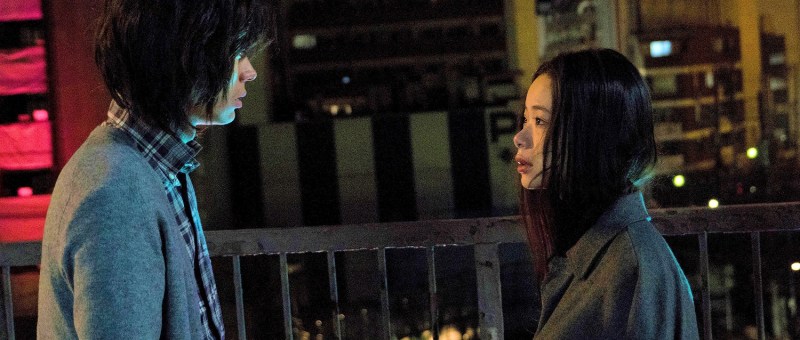
Cloud (Cloud クラウド, Kiyoshi Kurosawa, 2024)

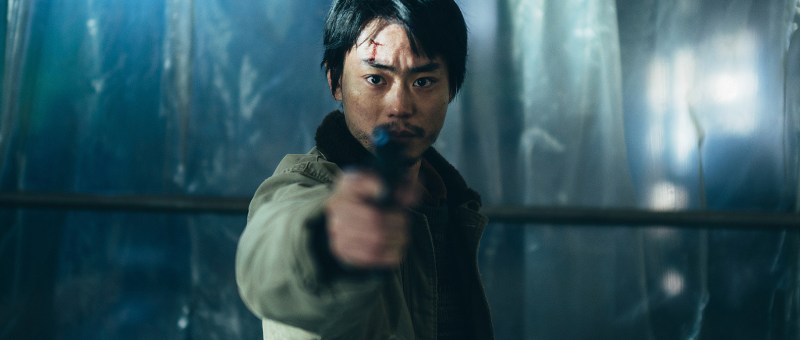
“We wanted to make easy money,” a down-on-his luck reseller admits, “is life easy now?” Factory worker Ryosuke (Masaki Suda) rebels against capitalism by subverting it through buying low and selling high while repeatedly refusing promotions at his job in a textiles factory. Though it might seem that reselling is just a way to earn an income that seems almost passive but is actually fairly labour-intensive, it’s clear that Ryosuke is a young man dissatisfied with capitalistic realities and lacking direction in his life. 

Reselling has become a kind of game to him and like a gambler who plays to lose he’s hooked on the thrill of making a killing exploiting other people’s misery. He’s at once filled with pride and smugness over his apparent triumph over his society and consumed by self-loathing. His friend and fellow reseller Muraoka (Masataka Kubota) tells him that another acquaintance has been arrested for scalping concert tickets with both of them lamenting his foolishness in getting involved with something so risky. The implication is that their friend, Goto, must have been in real desperation to lower himself to such levels and they each fear they may someday end up in the same position. Muraoka laments that that kind of selling is a young man’s game and neither of them have the time or energy to spend all day queuing to buy stuff just to sell it on cheap. They are each, it seems, beginning to feel the increasing desperation of their age that they are running out of time and have little to show for their efforts nor any prospects for the future. 

But on the other hand, neither of them want to be locked into the grind or join the oppressive but secure world of the salaryman. In many ways, Ryosuke’s factory boss Takimoto (Yoshiyoshi Arakawa) represents the “correct” path of hard and honest work, though his own paternalistic conviction in meritocracy seems outdated in a man of his age whose formative years occurred during an era of economic stagnation. He talks to Ryosuke as if he’s a young man who wants to get on but lacks confidence, telling him that he has leadership potential and is wasted on the shop floor, but his language also has an edge of the uncanny as if he were trying to recruit Ryosuke into his own worker drone revolution. In any case, even if it might be true that Ryosuke lacks confidence and ambition, that isn’t the reason he refuses promotions, which seems to be another way of rebelling against capitalism. When he eventually quits, he suggests it’s because he’s sick of being told what to do and wants more autonomy over his life and finances.

He tells his girlfriend Akiko (Kotone Furukawa) that she should quit her job too, which she’s only too happy to do because, unlike him, she actively doesn’t want to work and only wants to spend money. When she said she was thinking of giving up her apartment, Ryosuke naturally asked her to officially move in but she refused because his place is too small and she has too much stuff. Akiko has already been corrupted by the same consumerist bug that’s driving Ryosuke’s reselling business, but neither of them can really afford this lifestyle in the city. Ryosuke’s bright idea is to move to the remote countryside where he’s able to rent a huge, though ominous-looking, property for a fraction of the price with the idea of also economically supporting Akiko who will revert to traditional gender roles as a housewife in charge of the domestic space and most especially the kitchen.

But freedom cannot be found simply by retreating from urbanity and the couple soon find themselves plagued by a pervasive sense of resentment. The locals are not particularly accepting of people from Tokyo and are also needled by their success which is something they feel they’ve been unfairly denied. When Ryosuke tries to report a smashed window, even the policeman hassles him and says he’s received a tip-off that Ryosuke is breaking trading standards regulations by selling counterfeit goods as the real thing. Reselling in itself is not illegal, if definitely dubious morally and incredibly cynical. Ryosuke doesn’t seem to like to think about that and tells his new assistant, Sano (Daiken Okudaira), that he tries to sell all the items as quickly as possible so he doesn’t have to worry too much about their authenticity. If they’re wanted they’ll sell, Ryosuke justifies but he might as well be talking about himself.

“Being real or fake doesn’t matter?” Sano asks him, just as Ryosuke’s online and offline personas start to blur. He’s unaware that there are people actively hunting him for selling them substandard goods and is later pursued by real life vigilantes acting like online trolls and planning to torture him to death during a livestream. Like many of Kurosawa’s heroes, Ryosuke is completely convinced that he’s the benchmark for normal and it’s everything around him that’s strange or unfair. As the internet once again invades the “real” world, or perhaps it’s more that Ryosuke’s living his online life offline, the increasing unreality of the situation makes us wonder if any of this is “really” happening or product of Ryosuke’s fractured identity as it finally collapses under the twin corruptions of capitalism and social media. “Please keep focusing only on making money,” his new guardian angel Sano tells him, “everything will be obtainable. Whatever you want. Even things that can end the world.” Flying through ironically heavenly clouds, Ryosuke reflects that the path to hell really is paved with gold and his Mephistophelian pact with hyper-capitalism may have damned him beyond all repair.  


Cloud is in cinemas from 25th April courtesy of Blue Finch Film Releasing 

UK trailer (English subtitles)
Sunset Sunrise (サンセット・サンライズ, Yoshiyuki Kishi, 2024)

In a way, the 2020 coronavirus pandemic presented a kind of turning point in which it became possible to envision a different kind of future brokered by technological advance in which society was no longer ruled by the dominance of the cities. If people could work remotely from anywhere, then they could easily improve their standard of living by moving to more rural areas for cheaper rents and healthier environments. Assuming the infrastructure was in place to allow them to do so, they could also support and reinvigorate communities struggling with depopulation in which the young have all left for the cities leaving the elderly behind to fend for themselves.

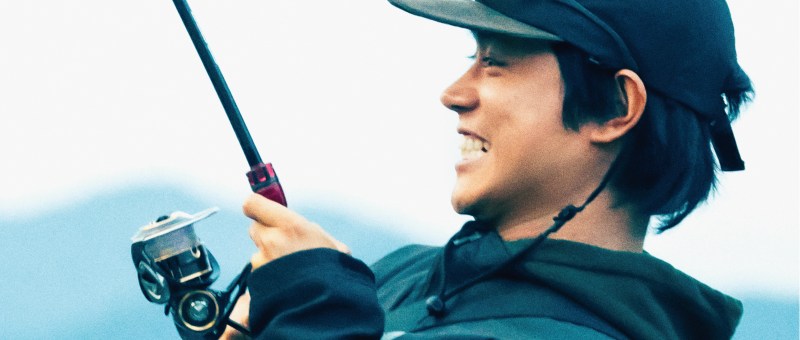
It’s an elegant solution that solves many of the problems of the contemporary society, but change isn’t always as straightforward as it seems as the hero of Yoshiyuki Kishi’s Sunset Sunrise (サンセット・サンライズ) finds out after he jumps at the chance to move into an abandoned house in Tohoku for a fraction of the rent he’d have to pay for a flat in Tokyo if he didn’t still live with his parents. The catch is, however, that houses have souls too and are more than just places to live for those that own or inherit them. Momoka (Mao Inoue), who decides to put her own empty house on the market, has her reasons for not wanting to live there herself nor for selling it completely but renting it out is also emotionally difficult. In the end, she only really does it after being put in charge of the town’s empty house problem at her job working for the council and thinking she should probably start with her own. Not knowing what to charge, it hadn’t really occurred to her someone would be as interested as Shinsaku (Masaki Suda), a fishing enthusiast longing to escape his salaryman life in the city for something a little more traditional in a peaceful rural area. 

Then again, that’s not to say that Shinsaku is a traditionalist and his decision quickly sparks controversy but also attracts the attention of his boss who senses a promising business opportunity. Momoka’s is a slightly special case, but Japan is filled with these so-called “akiya” which might, amid the work from home revolution of the pandemic, now be attractive to young professionals looking for a better environment to start a family. Houses generally start to deteriorate quite quickly when no one lives in them, and it’s true a lot of them need some work doing but it’s an idea that could work out well for everyone. Younger people who can’t find decent living space in the cities would be able to afford larger homes in the country where they would also then be contributing and integrating into the local community to provide support for its elderly residents.

Shinsaku becomes a part of the local community quite quickly and strikes up a friendship with an elderly woman whose children have all moved to Tokyo and rarely visit now that their own children are getting older. They’ve asked her to move to Tokyo with them, but as she points out, it would be the same as them moving back. There’s nothing for her to do there, and she’d have no friends. She’d only feel in the way and that she was getting under her daughter-in-law’s feet. Nevertheless, they fear for her especially as the area is still dealing with the scars of the 2011 earthquake which have left many clinging to a now bygone past. Once Momoka and Shinsaku start working with his boss on the akiya project, they find it hard to convince the inheritors of the houses to agree. Though they won’t live there, they might want to pop back a few times a year just for the memories and somehow can’t bear to part with their childhood or relative’s homes. But Shinsaku points out, it doesn’t necessarily have to be a case of either or and the renovation projects they undertake modernise the houses in a sympathetic way that brings them up to date with modern living yet honours the past even sometimes incorporating some of the previous resident’s furniture and belongings while issuing a caveat that the owners are welcome to visit should they wish to.

Essentially, the idea is a kind of co-existence with the past but also with unresolved trauma such as that presented by the earthquake and the ongoing pandemic. Momoka too is struggling to move on and while a gradual romance seems to arise between herself and Shinsaku, she isn’t sure she can ever let the past go though he makes it clear it’s okay to bring it with her. For his part, despite the initial fears of the early pandemic period and the suspicion of him as an outsider, Shinsaku’s quickly taken in by the community and adapts to a more rural way of life with relative ease though his boss’ big plan is rather undermined by his later insistence that he come back to Tokyo to run the project from the office like a many a contemporary CEO rolling back promises of flexible working environments that make this kind of utopian ideal much harder to materialise. In any case, there’s something quite refreshening in the eventual resolution just to do their own thing, not particularly paying attention to labels or what other people might think, but just doing what makes them happy right now. As an old fisherman’s song says, the sun sets but then it rises again. Scripted by Kankuro Kudo and adapted from a novel by Shuhei Nire, the film has kind of wholesome optimism that is rooted in a sense of continuity but also the potential to start again and make a new life inside the old that is less bound by outdated social norms than brokered by the gentle solidarity between people and a generosity of spirit that allows all to seek happiness in whatever way they choose.


Sunset Sunrise screens in Chicago 22nd March as part of the 19th edition of Asian Pop-Up Cinema.

Trailer (English subtitles)

Don’t Call it Mystery (ミステリと言う勿れ, Hiroaki Matsuyama, 2023)

Totono once again finds himself at the centre of of conspiracy in the big screen edition of the popular drama based on the manga by Yumi Tamura, Don’t Call it Mystery (ミステリと言う勿れ). Embroiled in what first looks like a family succession drama as he points out recalling The Inugami Family, he soon discovers there’s more in play than might be expected but also that the wounds of the past are slow to heal and often cause people to act in unexpected ways.

In any case, he ends up getting involved care of Garo (Eita Nagayama) who is still on the run following the end of the TV series so unable to help a teenage girl, Shioji (Nanoka Hara), who is one of four grandchildren in line to inherit her grandfather’s legacy if only she can fulfil the bizarre quest he left for them in his will. Her worry is that, as family law dictates one person inherits everything, there will inevitably be deaths and violence involved as the cousins battle each other for the prize of a giant estate near Hiroshima where Totono also just happened to be on a day trip.

Once again, the running gag is that mystery just seems to find Totono who only wants to get on with living his peaceful life as a student eating curry and going to museums though there are some tantalising clues to his own backstory littered through the piece such as his unexpected familiarity with the city of Hiroshima. The case this time as also has a link to Totono’s famously curly hair which only adds to his Kindaichi-esque sense of eccentricity deepened by his reluctance to allow Shioji’s family to do his laundry or to a take a bath in another person’s home. But these foibles are, as he points out to those around him, reflective of a conflict in what is considered considerate behaviour. They think they’re being nice by offering to do his laundry, but he doesn’t want them to so it’s just additional inconvenience for him much in the same way as you if offer someone a lift to the station thinking that’s easier for them and they accept not to cause offence but are secretly disappointed because they were looking forward to the walk.

Totono’s defining characteristic as an accidental detective is indeed his emotional intelligence and ability to pick up on the slightest things that might be bothering those around him, often prone to lengthy monologues that advocate for a more compassionate world and better understanding between people. As the mystery becomes clear, he begins to realise that the parents of the grandchildren were trying to protect them from the toxic legacy of tradition and end the ridiculous family succession drama that apparently led to the deaths of some of their immediate relatives. He gives similar advice to Shoji’s cousin Yura (Ko Shibasaki) on hearing her father tell her that women are happiest as wives and mothers and she should drop what she’s doing to pay more attention to her husband and daughter. Totono takes him to task for his sexist thinking and tells him it’s unfair, advising Yura that she might not unwittingly want to pass these ideas on to her own daughter by suppressing herself to conform to her father’s outdated idea of conventional femininity.

As Totono says, children are like wet cement and the things dropped on them leave their mark for the rest of the child’s life. It seems that the family was in a sense haunted by a child they’d wronged and worried would someday come back to wreak their revenge as a phantasmagorical embodiment of their latent guilt and shame about how they usurped their fortune. What the grandchildren come to realise, is that their late parents did actually understand them and wanted them to be happy following their own paths rather than bound by tradition or outdated notions of properness regardless of whatever happens with the grandfather’s more literal legacy and the buried skeletons it contains. Filled with the same kind of gentle intrigue and mystery along with the compassionate spirit of the TV series and manga, the big screen edition features another difficult case for Totono that also begins to illuminate his own troubled past and the secrets behinds his empathetic soul.


Don’t Call it Mystery screened as part of this year’s Toronto Japanese Film Festival.

Original trailer (English subtitles)

The Asadas! (浅田家!, Ryota Nakano, 2020)

There’s a kind of irony at the centre of Ryota Nakano’s The Asadas! (浅田家!,Asada-ke!) in that its photographer hero makes a name for himself photographing his family yet at times neglects them or appears curiously insensitive, perhaps even selfish in the pursuit of his dreams. Inspired by the life of photographer Masashi Asada, the film is at once a celebration of the family and an advocation for the tangibility of a photograph as a repository of memory that can bring comfort even in the absence of its subject.

The first part of the film is narrated from the perspective of Masashi’s (Kazunari Ninomiya) much more conventional older brother Yukihiro (Satoshi Tsumabuki) who is generally exasperated by and a little resentful of the family’s indulgence of Masashi, a seeming free spirit who acts on impulse and gives little thought to the consequences of his actions. People frequently describe both Masashi and his father Akira (Mitsuru Hirata) as “not normal,” and there is something unconventional in their family setup with Akira a househusband in a small town in the 1980s while his wife Junko (Jun Fubuki) supports the family with her career as a nurse. It’s Akira who first gives Masashi a camera and his dream of becoming a photographer which he eventually achieves through taking amusing pictures of his family in various scenes casting them as firemen, racing drivers, or even gangsters. 

Masashi attempts to get the photos published as a book, but is quickly dismissed and told that no one wants to buy his personal family photo album. Though the publisher may have a point that in general people value photos of their own family but not those of others, the family photo itself is treated as a triviality as if it had no real worth. The same could be said of Masashi’s work, that some do not take it seriously because the subject is his own family. Yet Masashi finds new value in it in his ability to capture the essence of a moment in family life through a staged photograph such as that he designs for the family of a little boy who is dying of a brain tumour.

In the back of his book, eventually published by an eccentric woman who runs a small press and decides to take a loss because she found the photos so funny, Masashi pledges to travel anywhere to take similar photos for other families which of course means he is often separated from his own whom he then rarely photographs much to his father’s disappointment. After leaving for university, he had barely contacted them for two years while after travelling to the zone of the 2011 earthquake and tsunami he abruptly drops out of contact with his long suffering girlfriend Wakana (Haru Kuroki) after becoming immersed in the task of cleaning up the orphaned photos found among the wreckage. 

Of course, there are those who object to his work thinking that there are more important things to do while so many people are still missing, but as he discovers recovering the photos gives people a sense of comfort and healing as if they were getting back a little bit of the past that had been taken from them and most particularly if the people in the photographs are no longer here. A little girl who’s lost her father is alarmed and resentful that she can find no photos of him, realising that he was rarely in the ones they took as a family and wondering if that meant he didn’t really love them hinting at an ironic sense of parental absence in that parents often take the photos of their children so do not appear themselves but still leave their imprint in a sense of absence in which every photograph also contains the invisible presence of the photographer.

And then sometimes the reverse is true. A grandmother comes looking for pictures of her grandchildren, but ironically finds pictures only of herself. The triviality with which the family photo was regarded seems almost offensive for something that can offer such comfort and warmth in a time of profound grief as a tangible link to a past that will never return. Masashi makes his family’s unrealised dreams come true through his photos, bringing them joy if also a little anxiety in a creating a perfect record of their unconventional family while Nakano does something similar capturing of the essence of a happy family life filled with equal parts laughter and tears.


The Asadas! screens Feb. 24 as part of Family Portrait: Japanese Family in Flux

Original trailer (Traditional Chinese / English subtitles)

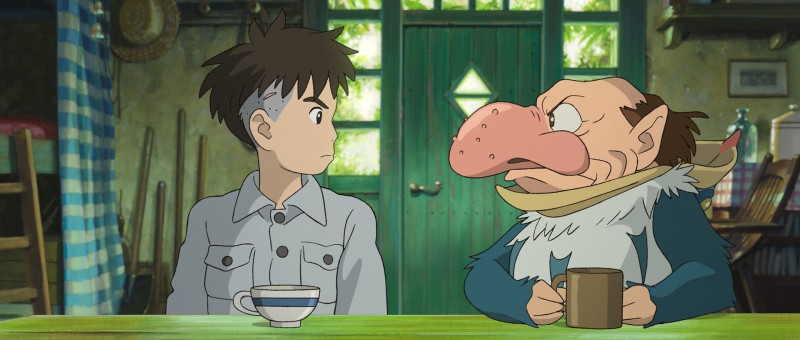
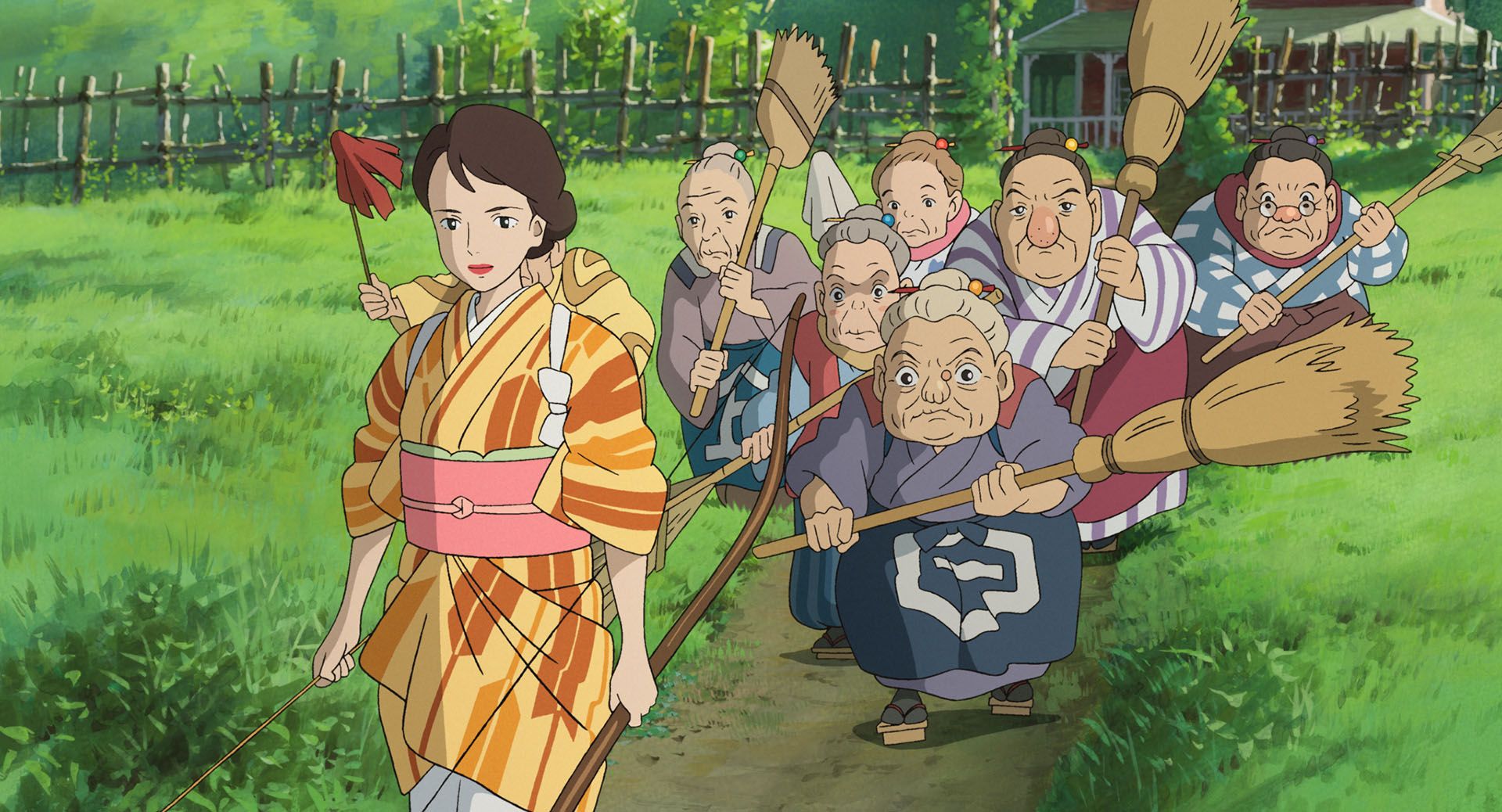
The Boy and the Heron (君たちはどう生きるか, Hayao Miyazaki, 2023)

Sales of Genzaburo Yoshino’s 1937 novel How Do You Live? (君たちはどう生きるか, Kimitachi wa Do Ikiru ka? went through the roof when it was announced that the no longer retired Hayao Miyazaki would be directing a new film with the same title. Predictably, Miyazaki’s film turned out not to be an adaptation at all, or at least not a literal sense, but was intensely interested in the question not so much how do you live but how will you? Will you allow the past to make you bitter and live in a world of pain and resentment, or will you choose to live in a world of peace and beauty free of human malice?

These are of course the questions faced by a post-war generation, the children of Miyazaki’s own era who came of age in a time of fear and suffering. Mahito (Soma Santoki), the hero, loses his mother in the firebombing of Tokyo. He runs through a world of shadows to save her from the flames but of course, he cannot. A year later everything has changed. His father has remarried, taking his mother’s younger sister Natsuko (Yoshino Kimura) as his new wife. Natsuko is now pregnant which suggests the relationship began some time ago though Mahito knew nothing of it and had no recollection of ever having met Natsuko before being sent to live in her giant mansion in the country more or less untouched by the war. 

It’s here that Mahito’s own malice rises. He is polite, if sullen, but cannot warm to his new stepmother and resents his father’s relationship with her. Perpetually bothered by a grey heron (Masaki Suda) his first thought is to kill it, crafting a bow and arrow from bamboo and one of the heron’s own feathers. Shunned as the new boy at school he hits himself on the head with a rock while his father, Shoichi (Takuya Kimura), comically vows revenge and lets him stay home. As he points out, there’s not much “education” going on anyway with most of the students pulled away from their studies for “voluntary” labour in service of the war effort in this case agricultural. 

Shoichi has moved to the country to open a factory which it seems produces canopies for fighter planes which is all to say that he is profiting from the business of war, though transgressively referencing the failure in Saipan over breakfast with the mild implication that it might work out alright for him. There is after all a grim reason they’ll be in need of large numbers of aircraft parts in the near future. Mahito’s dark impulses are directly linked to those of militarism and the folly of war. When he finally enters the tower of madness apparently constructed by a great-uncle who went insane through reading too many books, he discovers that his enemies are an ever expanding clan of fascistic, man-eating parakeets led by a Mussolini-like despotic leader attempting to manipulate the Master of the tower. 

Inside the tower is a land out of time, a place for those already dead or in essence an eternal past. It’s here that Mahito is presented with a choice, how will he live? Will he choose malice and destruction, or will he choose to leave and build a new world of beauty and peace above? In many ways, the important point is that the choice is his as it is ours, that we are free to decide and that our choices create the world in which we live. Through his adventures in the tower, Mahito begins to come to terms with his situation and resolves to accept Natsuko as a mother and make friends of those he once considered enemies. When the tower itself crumbles, it takes with it the last vestiges of authoritarianism and tyranny.

Prompting his epiphany, Mahito discovers a copy of How Do You Live? in his room, a present from his late mother inscribed to the grown-up Mahito. He is surrounded by the world’s ugliness, forced into a surprisingly graphic fish gutting session that leaves him wiping away blood, recalling his profusely bleeding head injury and the scar it will forever mark him with. Pelicans imprisoned in the other world meanwhile tell him that they have no choice but to behave as they do for the Master of the Tower neglected to put enough fish in the rivers intending them to destroy rather nurture new life while their young too learn all the wrong lessons. Yet there is beauty and strangeness here too, along with kindness and humanity. Boundlessly inventive, Miyazaki couples surrealist visions of murderous birds and the hellish scenes of a city on fire with Mahito the only figure visible in his pale blue school uniform darting through the soot and the shadows. A vivid symphony of life, the film may in its way be about grief and the pain of moving on but finally discovers a kind of serenity in an accommodation with the present and the eternally unfinished question of how you yourself will live. 


The Boy and the Heron screened as part of this year’s BFI London Film Festival.

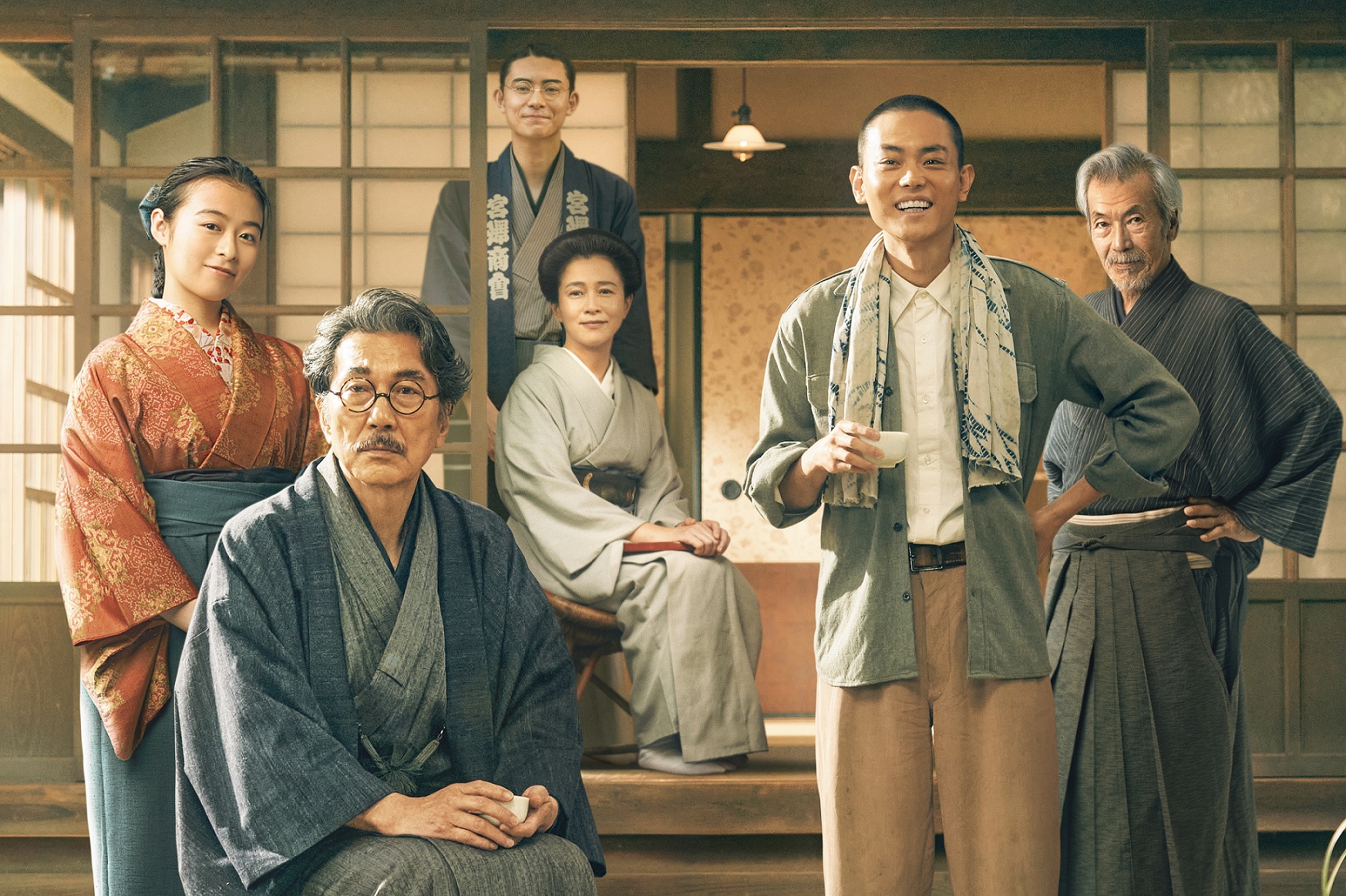
Father of the Milky Way Railroad (銀河鉄道の父, Izuru Narushima, 2023)

Generations of Japanese children have grown up with Kenji Miyazawa’s much loved classic Night on the Galactic Railroad but Miyazawa remained largely unknown in his lifetime and passed away from pneumonia at the young age of 37 in 1933 with the book that would make his name still unpublished. His story has been told before, most notably by Kazuki Omori in 1996’s Night Train to the Stars, but Izuru Narushima’s Father of the Milky Way Railroad (銀河鉄道の父, Ginga Tetsudo no Chichi), adapted from the Naoki Prize-winning novel by Yoshinobu Kadoi, takes a slightly different angle in exploring the life of his generally supportive father, Masajiro (Koji Yakusho).

As he’s fond of saying, Masajiro is a product of the modern era and a very modern father even in some ways by the standards of today. The film opens (and closes) with him on a train, this time hurrying home having received a telegram informing him that his first child has been born. So excited is he that he offends his own father by running past him on the way to see the baby without offering the proper greeting. Kisuke (Min Tanaka) is indeed more of a traditionalist raised with feudal values that are fast becoming out of date in the new society. As the head of the household, it’s he who gives the baby his name, Kenji, written with the characters for intelligence and healing which will indeed define his character if leaving him somewhat at odds with his society. 

Such a devoted father, Masajiro breaks with tradition and accepted gender roles in insisting on accompanying Kenji to hospital when he is taken ill despite his father’s admonition that caring for the sick is a role reserved for women. Kisuke also tells him his decision to have Kenji educated is wrongheaded, that literature and the arts only confuse a man and may prove more ruinous to him than drink or women. Annoyingly, Kisuke may have a point in that on his return from middle school Kenji (Masaki Suda) immediately rejects the family’s business as pawnbrokers having read too many Russian novels in which they are depicted as exploiters of the poor. He decries Masajiro’s justification that they support farmers who would otherwise be unable to access other forms of financial help such as bank loans and be forced to sell their daughters into sex work as mere sophistry. Masajiro may share some of his concerns, but remains in part wedded to some aspects of feudalism in insisting that as the oldest son Kenji has no choice other than to take over the family pawn shop.

Nevertheless, he also educates his daughter, Toshi (Nana Mori), who later begins working as a school teacher and is able to convince him to allow Kenji to further his studies only for Kenji to suddenly announce he wants to go to agricultural college to better understand their customers who are after all predominantly farmers. Having sent him away to be educated, Masajiro laments that Kenji knows “nothing of the world” after seeing him taken in by an obvious sob story from a duplicitous customer reflecting that his liberal education may have given him ideas that prevent him from living successfully in the society in which he lives. Kenji continues to resist the idea of taking over the pawnbroker’s while evidently unsuited to it before worrying his family further by becoming dangerously obsessed with radical new Buddhist sect Nichiren. 

It’s with this that Masajiro cannot really help him and begins to lose his patience as Kenji gives in nihilistic despair believing that nothing he does has any real meaning. His literary gifts are appreciated only in the wake of a tragedy that reconnects him with his childhood self while finally freeing Masajiro to embrace his son’s natural gifts as a writer rather than trying to force him to take over the family business. In truth, the film barely touches on the novel from which it takes its title if subtly hinting at it and bookending itself with the celestial train motif, but rather takes its lead from one of Miyazawa’s best known poems about his desire to become a better, more selfless, less self-defeating person that is perhaps inspired by his “modern” father’s “new” ideas of a society founded above all else on love. Perhaps it’s not so bad to know nothing of the world after all.  


Father of the Milky Way Railroad screens in New York July 29 as part of this year’s JAPAN CUTS.

Original trailer (no subtitles)

A Hundred Flowers (百花, Genki Kawamura, 2022)

An expectant father finds himself confronted with paternal anxiety and past trauma on learning that his mother has been diagnosed with Alzheimer’s in Genki Kawamura’s adaptation of his own novel, A Hundred Flowers (百花, Hyakka). A prolific film producer behind such hits as Lee Sang-il’s Rage and Tetsuya Nakashima’s Confessions, Kawamura also penned the international bestseller If Cats Disappeared from the World which was later adapted into a film starring Takeru Satoh and here makes his directorial debut with a semi-autobiographical exploration of memory and forgetting. 

Kawamura neatly signals his central concern in the opening scenes as Yuriko (Mieko Harada) seems to become unstuck in time, a withered dandelion on her kitchen table as she flits between swapping it for a new one and playing the piano eventually watching herself from an alternate temporal space. Her grown-up son Izumi (Masaki Suda) seems surprised to witness her decline on a visit home, running panicked through the streets looking for her only to find his mother sitting on the swings at the park muttering about “half fireworks”. When he approaches her she seems to mistake him for someone else, Izumi rejecting her too intimate hug and later making his exit earlier than expected, leaving the New Year food Yuriko has prepared uneaten and making an excuse about an emergency at work. 

The chase through the streets may have awakened traumatic memories in Izumi too, forcing him to remember another time as a child he came home and found his mother gone. Disappearing again, Yuriko is found at his old school, guided by a memory of a parents day at which Izumi read out sections of Osamu Dazai’s Run, Melos!, a story of a man running back to the city to save his friend before he is executed in his place. Thrown back into the past, Yuriko later berates the grown Izumi for his habit of wandering off, suggesting that he gets lost on purpose so that she’ll look for him which is perhaps what Yuriko is doing longing for her son to understand and forgive her for an act of childhood betrayal. Kawamura often places the camera directly behind Izumi’s head, following him as he chases the mother who he fears has forgotten him while he feels foolish in his inability to forget her despite the depth of his resentment. 

Ironically enough, Izumi and his heavily pregnant wife Kaori (Masami Nagasawa) both work at a music company developing a virtual idol whom they explain has been fed thousands of memories as data in order to improve her AI but ends up oddly soulless as if these fragments of moments in time are meaningless in isolation. His friend quips that maybe they should have given the AI the ability to forget, as if that would make it more “human” and relatable. Izumi is pretty sure he hasn’t forgotten anything important, but memory remakes itself every day and is in some ways selective. Though he holds his mother at arm’s length, he begins to put the past behind him in learning to forgive her and in the process regaining the happy memories of his earlier childhood that his trauma had taken from him. 

The flowers so closely associated with Yuriko who is often dressed in a bright yellow are perhaps another allusion to Dazai and his insistance on embracing the gift of a single dandelion as a kind of metaphor for the frustrated love between mother and son, while the half fireworks they later see also resemble a dandelion dispersing mimicking the continual scattering of Yuriko’s memories. Izumi remarks that it’s like her memories are being stolen while charting her decline as a depletion of her identity until there is nothing left of her at all, the various boxes in her apartment standing in for blocks of data slowly being shed. Shifting between the perspectives of mother and son who are each in some way blind to the other, Kawamura touches on the tactile quality of memory as one moment sparks another while for Yuriko time proceeds on a maddening loop of overlapping incidents that robs of her present, past, and future in equal measure. The irony may be that only in losing his mother does Izumi begin to find her again, searching for her within the halls of his own memory and rediscovering a sense of himself as a child that he had long forgotten. 


A Hundred Flowers screened as part of this year’s London East Asia Film Festival 

International trailer (English subtitles)

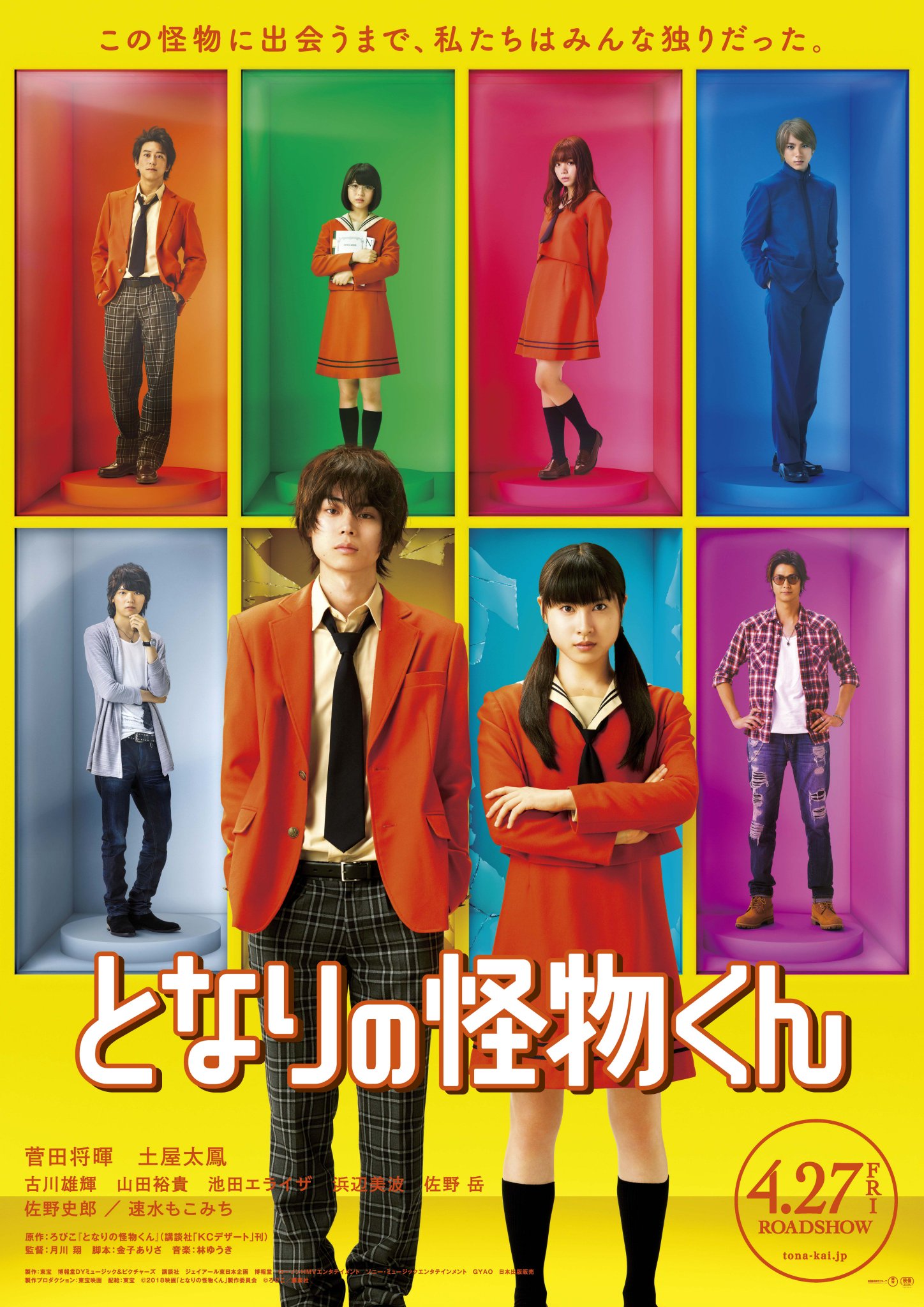
My Little Monster (となりの怪物くん, Sho Tsukikawa, 2018)

A wilfully self-contained high school girl falls for a big-hearted classmate, but struggles to understand that they are in essence fighting different battles in their parallel quests for acceptance. Adapted from the hit shojo manga by Robico, Sho Tsukikawa’s My Little Monster (となりの怪物くん, Tonari no Kaibutsu-kun) is in many ways a typical high school rom-com in which a repressed young woman begins to deal with her abandonment issues essentially by mothering a displaced young man whose “problematic” big-heartedness sees him regarded as a “monster” by a still conservative society. 

Opening with a flashback presumably set in the present day, an older Shizuku (Tao Tsuchiya) now wearing a lawyer’s pin listens wistfully to Kana Nishino’s 2010 hit Best Friend and reflects on a time when all she cared about was studying, rejecting all human connection. Until that is she met the titular “monster” Haru (Masaki Suda) and suddenly found herself surrounded by people. Haru, as we discover, got into a fight on the first day of school and never actually showed up for classes. Because Shizuku should have been his desk neighbour, the panicked teacher asks her to take the handouts etc to his home in the hope he’ll one day return. Shizuku has no interest in doing as the teacher has tasked her but fulfils her duty, only to unexpectedly encounter Haru who then decides they must be “friends” based on a primary school understanding that friends take each other notes and homework when one of them is sick. 

It turns out that Haru hasn’t been coming to school because it bothers him that everyone finds him scary because of his lack of impulse control. He desperately wants to make friends and thinks he has some in a trio of local boys but Shizuku can see right away that they are essentially bullying him for money and tries to explain that “real” friends don’t sponge off each other. Perhaps because of his innate kindness, Haru is completely guileless and sees the best in everyone unable to understand when he’s being taken advantage of. Despite herself, Shizuku begins to feel protective assuring Haru that he will one day be surrounded by people who understand him unwittingly echoing the words of his late aunt who was the only other person who’d ever rooted for him. Straightforward as ever, Haru immediately confesses his love and so their awkward high school romance begins. 

Shizuku, however, is still largely uninterested in love. She has devoted herself to studying and only cares about coming top in the school exams. As we discover this is less because of academic ambition than practical application. She studies hard and immediately sees results. It’s the sure thing, something which is completely within her own control, unlike other people’s feelings which are necessarily messy and unpredictable. There is however an uncomfortable conservatism in the centring of Shizuku’s trauma solely in the fact that her mother works outside the home and is therefore not present in her life in the way that mothers are expected to be in a patriarchal society while her family set up is regarded as unusual in that her father, having failed several times in business, is a househusband. 

Meanwhile, she remains fairly blinkered to Haru’s parallel familial disconnection in that he has apparently been disowned by his authoritarian father for his free-spirited ways. Taken to a birthday party held for Haru’s older brother Yuzan (Yuki Furukawa), Shizuku begins to realise there is a large class difference between them but reacts badly, confused that he is rejecting the very things she’s striving for in refusing to reconnect with his father, ignoring the fact that he has separated from him because he is essentially abusive. He refuses to let Haru be Haru, trying to straight-jacket him into conventionality by forcing him to clamp down on his noisy impulsivity, something which he seems unable to do even if he wanted to. Shizuku fails to realise the hurt she deals him in refusing to understand his reluctance, unable to see that it amounts to a rejection from the one person he assumed had completely accepted him. 

What she discovers is that you won’t always be forgiven for momentary thoughtlessness and in the end you have to let people be what they are, which throws into light the problematic “monster” of the title which is how Haru is often seen by others, a quality brought to vivid life in Suda’s manic performance. A rival suitor, Yamaken (Yuki Yamada), selling himself as the slow and steady candidate perhaps more suited to Shizuku in being more like herself, describes their relationship as a “make-believe friendship” rather than a real romance, something she has to accept may have a grain of truth in it in her inability to fully understand the person she claims to love, but nevertheless comes to the conclusion that while Yamaken may make her feel at ease in herself it’s the stressful stimulation with the intense yet passionate Haru that she truly craves. That aside, their romance is a fairly cool affair and its resolution too contrived to have any kind of impact which is perhaps why Tsukikawa resorts to anime-style imagery including a flying leap of love accompanied by bright sunshine flooding in from behind. Nevertheless, in true shojo fashion My Little Monster celebrates not only its heroine’s gradual path towards an embrace of the chaos of being alive, but also the power of friendship and acceptance as the gang find a place to belong in each other and with it a more concrete sense of self.


Singapore release trailer (English/Simplified Chinese subtitles)

Kana Nishino – Best Friend

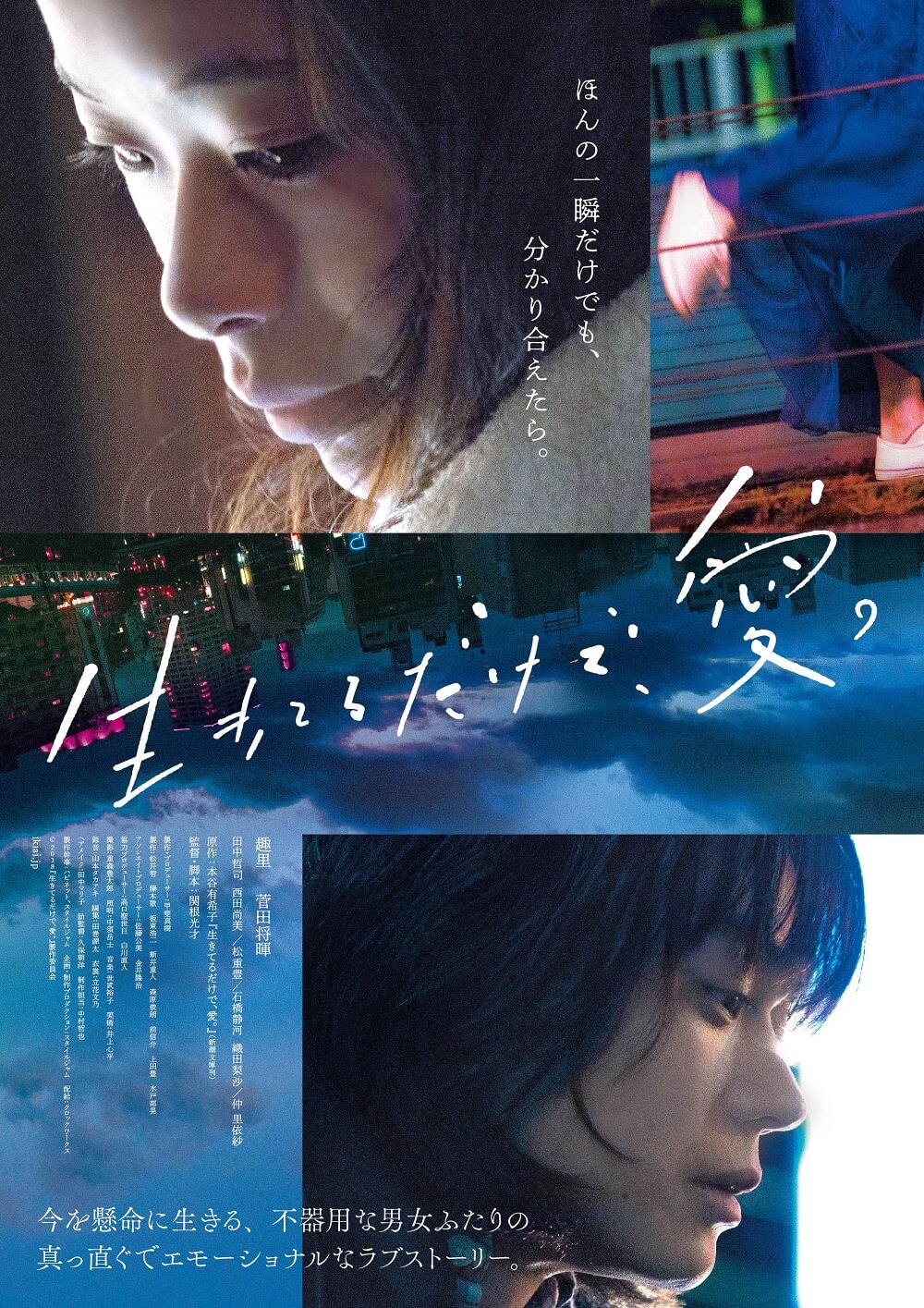
Love At Least (生きてるだけで、愛, Kosai Sekine, 2018)

love at least posterFor some, it might be impossible grasp just how exhausting it can be merely being alive. For the heroine of Kosai Sekine’s debut feature Love At Least (生きてるだけで、愛, Ikiteru Dake de, Ai) , adapted from the novel by Yukiko Motoya (Funuke, Show Some Love You Losers!, Vengeance Can Wait), life is a draining cycle of waking and sleeping from which she fears she will never be able to free herself. An encounter with an equally atypical though perhaps more destructive young woman who orders her to leave her ordered existence so that she might step into the newly vacant space unwittingly helps her towards a moment of clarity though not the one it might at first seem.

Yasuko (Shuri) has vague memories of her mother dancing when the power went out but she herself is afraid of the dark. Looking back there’s a lot that makes sense to her about her mother’s behaviour and subsequently her own, but she hasn’t yet found a way to come to terms with her psychology. Yasuko has bipolar and is currently unemployed as she suffers with hypersomnia and hasn’t been able to hold down a job. She’s supported by her live-in boyfriend of three years, Tsunaki (Masaki Suda), who once dreamed of being a writer but now has a soul crushing job at a tabloid magazine writing salacious exposés about celebrities.

Yasuko is currently in the middle of a depressive spell and rarely leaves the house, spending most of the day asleep and exchanging texts with her somewhat unsupportive sister but her life is turned upside-down when she receives a surprise visit from a woman calling herself Ando (Riisa Naka) who drags her off to a nearby cafe and explains that she previously dated Tsunaki three years ago and now she wants him back. Viewing Yasuko as some kind of lesser human, Ando thinks she should see sense and leave Tsunaki to which Yasuko quite reasonably points out she has no income and so the request is quite unreasonable. Ando, however, is nothing if not thorough and it’s not long before she’s bamboozled both the cafe and Yasuko into taking her on as a part-time waitress.

Ando, an extremely unpleasant and manipulative woman, may be as Yasuko points out even “sicker” than she is but somehow she seems to make all around her do her bidding. Oddly enough, working at the cafe might actually be good for Yasuko – the cafe owner and his wife are kind and sympathetic people who seem to want to help and the other waitress was once a hikikomori so they might truly have some idea of what is involved in trying to help those in need. Ando, however, doesn’t quite seem to want her to succeed – she turns up at the cafe on a regular basis to feed Yasuko’s insecurities, pointedly asking her if she’s considered whether the problem might not just be that she’s “useless”, telling her that it’s pointless to try because she’ll inevitably fail, all of which seems quite counterproductive to her nefarious plan.

Then again, kindness and sympathy are not always quite as helpful as they seem. The cafe owner’s wife is nice, to be sure, but is fond of repeating the mantra that depression is caused by loneliness and that therefore making friends with the people at the cafe will make everything better. There might be something in her way of thinking, but it’s also a superficial approach to a more complicated problem and mild refusal to face some of the more serious aspects of Yasuko’s condition. When she’s started to feel as if the cafe is a safe space, told to think of herself as “family”, Yasuko lets down her guard and reveals one subject of her obsessive anxieties which just happens to be the washlet and the possibility of its sudden explosion should the water pressure go haywire. All of a sudden it’s as if the air changes, they look at her like she’s “mad” and the facade of their patronising desire to help is suddenly ripped away. Yasuko’s worst fear has been realised, they “see through” her and she feels as if there’s no hope any more.

Being seen through is perhaps something which Yasuko both fears and craves. Tsunaki, meanwhile, is suffering something similar only in a less extreme way. He also feared being seen through, but unlike Yasuko chose to isolate himself, rarely speaking and maintaining a healthy distance to the world. For this reason he’s been able to put up with his awful tabloid job, even excusing himself when an actress whose affair they’d exposed committed suicide because after all it was “nothing to do with” him despite the fact he was so obviously complicit. Increasingly conflicted, he begins to pull away from Yasuko, unwilling to overburden her with his own worries or perhaps more accurately equally afraid to expose them. Yasuko’s cruel barb that she wished Tsunaki’s “lack of character” would infect her hints at her mild frustration with his passivity, that his refusal to engage and habit of pussyfooting around her illness to avoid creating a scene are also contributing to her ongoing lethargy. The passive aggressive texts from her sister which seemed so unsupportive are perhaps less so as she is the only person willing to go toe to go with her and suddenly Yasuko’s meanness towards her outwardly patient and caring boyfriend reads more like provocation, as if she’s trying to make him respond rather than allow him to continue enabling her inertia.

Being driven apart by their parallel crises eventually brings the pair back together again, closer to an emotional centre and reaching a brief moment of understanding. As Yasuko says, the connection may have been only momentary, but within that infinitesimal space she can perhaps find a life. The dark is not so scary after all. Anchored by an extraordinary performance from Shuri, Love at Least is a beautifully composed examination of the costs of modern living in which fragmentary moments of absolute connection become the only source of salvation in a world of broken dreams and hopeless futures.


Love At Least made its World Premiere at the 2018 Raindance Film Festival.

Original trailer (no subtitles)

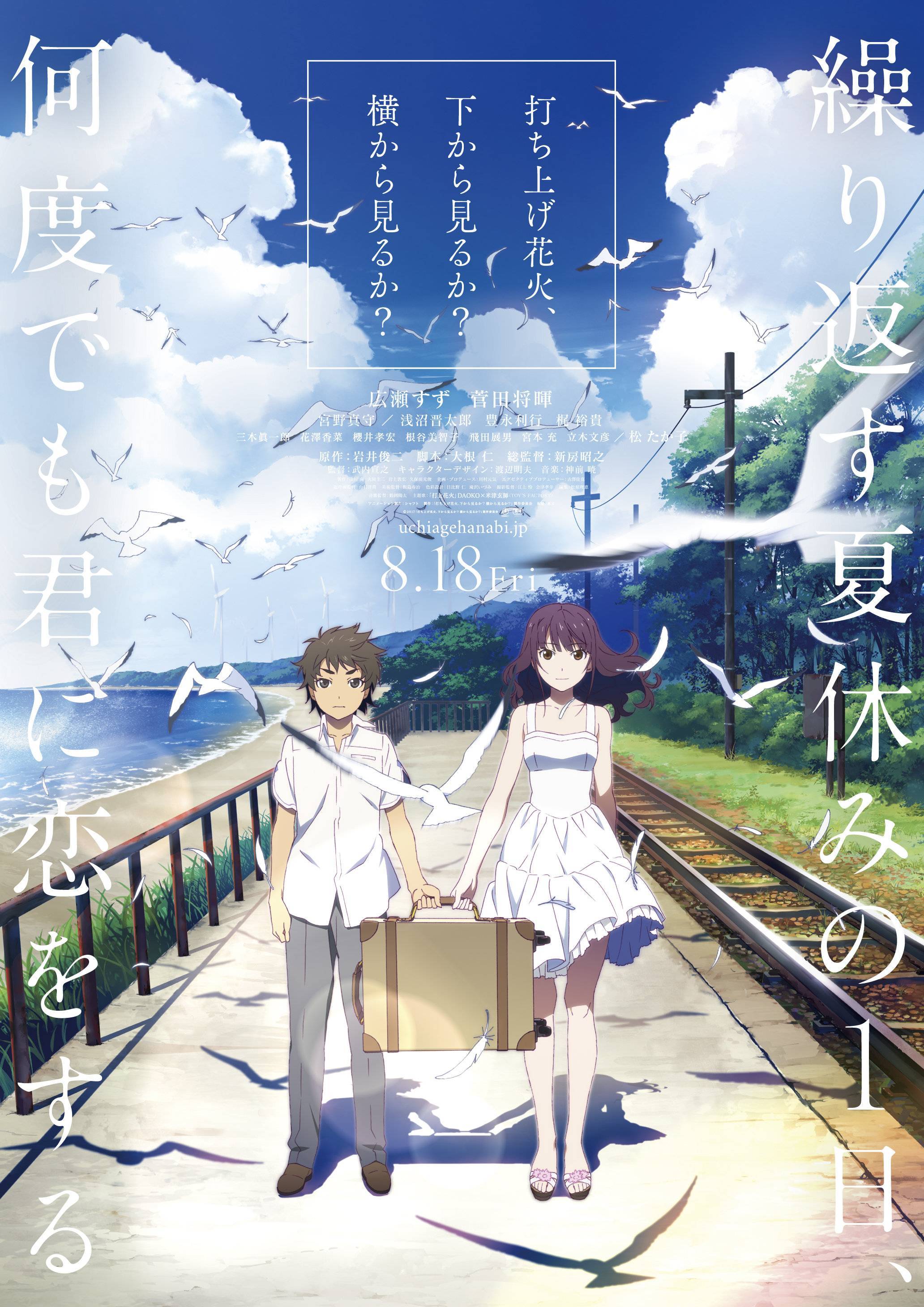
Fireworks (打ち上げ花火、下から見るか? 横から見るか?, Akiyuki Shinbo & Nobuyuki Takeuchi, 2017) [Fantasia 2018]

Fireworks posterBack in 1993, Fireworks, Should We See it From the Side or From the Bottom? (打ち上げ花火、下から見るか? 横から見るか?, Uchiage Hanabi, Shita kara Miru ka? Yoko kara Miru ka?), became something of a sliding doors moment for the young Shunji Iwai who received an award from the Directors Guild of Japan for what was in essence a single episode in an anthology TV series dedicated to the idea of “what if”. “What if” is, it has to be said, a constant theme in nostalgic Japanese cinema as slightly older protagonists look back on the hazy days of youth and wonder what might have been if they’d only known then what they know now. Scripted by Hitoshi One (Scoop!) and produced by Shaft, the anime adaption attempts to do something similar, floating in with a gentle summer breeze that could easily be from 30 years ago or yesterday while its conflicted hero ponders where it is he ought to stand to get the most beautiful view of life passing him by.

The central dilemma that seems to obsess the boys this particular summer is whether fireworks are flat or three dimensional and whether your perception of them changes depending on where you stand. Norimichi (Masaki Suda) risks falling out with his best friend Yusuke (Mamoru Miyano) and so has avoided revealing the fact that they both have a crush on the same girl – Nazuna (Suzu Hirose), who (neither of them have noticed) has a dilemma of her own. A chance meeting at the swimming pool seems primed to dictate the romantic fate of all concerned. Norimichi and Yusuke race for the affections of Nazuna who, in the original timeline, ends up asking Yusuke to see the summer fireworks with her even though it’s Norimichi she went there to meet.

Unfortunately Yusuke is a flake and nothing goes to plan. He stands Nazuna up to hang with his buddies and figure out the answer to their inane riddle leaving her to run into Norimichi who gets an unexpected glimpse at her inner turmoil. A mysterious orb salvaged by Nazuna from the nearby sea gives Norimichi a chance to start over, be braver, do things differently thanks to the benefit of hindsight, and so he begins a path to idealised romance by manipulating the events around him to finally “save” Nazuna from making a rash decision (or at least from making it alone).

In 1993, Nazuna’s dilemma was perhaps a little more unusual than it might seem now. Her twice married single-mother (Takako Matsu) is planning to marry again which requires the teenage Nazuna to leave her home behind to live with a strange man in a strange town. Though her new step-dad seems nice and is obviously trying his best, Nazuna is not of a mind to give in. She consents to accepting one of the ice-creams he’s bought to curry favour (after all, there’s no need to be “rude”), but is not about to go so far as to say thank you or to enjoy eating it together with the rest of the family when she could guzzle it sulkily in the comfort of her bedroom. Nazuna wants to escape, but her ideas of doing so are childishly naive even if she puts on a sophisticated front by joking about going to Tokyo to work on the fringes of the sex trade by lying about her age. Hence, she asks a boy she likes but barely knows to take her away from this place, but the boy is just a boy and not quite equipped for rescuing damsels in distress from suffering he doesn’t understand.

Like many Japanese teen dramas, Norimichi’s interior monologue takes on a rueful quality, as if he’s eulogising his youth while still inside it. He doesn’t know whether there’s a difference if you look at things from one angle or another because he’s not particularly used to thinking about things and his first few experiments with the orb are pure reactions to events rather than thought through decisions about effects and consequences. Nevertheless, use of the orb shifts him into a philosophical contemplation of what it is to live a life. Finally realising he should probably ask Nazuna what it is she really wants, the process the pair undergo is one of learning to live in the now rather than obsessing about the end of something that might never begin if you never find the courage to start.

In the end their beautiful dream world is ruptured by a drunken old man, shattering into a thousand shards of memory of things that never were. Fireworks wants to ask if you can have a more fulfilling life by simply changing your perspective, but its central messages never quite coalesce. There is something about Iwai’s original concept which inescapably of its time, sliding neatly into the melancholy world of early ‘90s teen drama drenched in nostalgia for an era not yet past. Reaching for poignant philosophising, Fireworks falls short through, ironically enough, focussing too heavily on a single point of view. An oddly “flat” exercise, Shinbo’s adaptation misses the mark in its climactic moments but perhaps manages to offer something to the lovelorn teens of today if only by yanking them back to a more innocent time.


Fireworks was screened as part of Fantasia International Film Festival 2018.

International trailer (English subtitles)
The original 1986 Seiko Matsuda song reprised by Nazuna at a climactic moment.

https://www.youtube.com/watch?v=87fAJ4jSxPM