Escape (逃走, Masao Adachi, 2025)

Satoshi Kirishima’s incongruously smiling face was a familiar presence across on the nation for over 40 years until he finally made a deathbed confession revealing his true identity as a man wanted in connection with a series of bombings in the 1970s and that he’d successfully evaded the authorities until the very end of his life. What apparently appealed to director Masao Adachi, a former Japanese Red Army member, was the question of why he chose to come clean rather than enjoy his secret victory by taking the truth to his grave.

That might be a minor irony at the centre of the Escape (逃走, Toso) in that Satoshi (Kanji Furutachi) is essentially in flight from himself only to finally escape from his torment by accepting his original identity. As a young man, Satoshi had been a member of a left-wing cell that wanted to awaken the population at large to the ways Japanese society had not changed in continuing to discriminate against the Ainu, those from the Ryukyu Islands, Koreans and other minorities while modern corporations enact another kind of capitalistic imperialism built on exploitation. It was for this reason that they embarked on a bombing campaign targeting large companies, but due to a miscalculation with the explosives, the bombing of the Mitsubishi Heavy Industries Building in 1974 proved more destructive than intended resulting in loss of life. 

Satoshi was not directly involved in that bombing which was carried out by another cell but was wanted for allegedly setting up a bomb in the Economic Research Institute of Korea which did not result in any casualties. Details of the real Satoshi’s life during his 40 years on the run are thin on the ground, but Adachi paints him as a man torn apart by internalised conflict and unable to make peace with the sense of guilt he feels for those who killed even if he was not directly responsible. The film’s Japanese title is a kind pun in that it’s a homonym which can mean both “escape” and “struggle” which for Satoshi become one and the same. He’s in flight from his younger self while simultaneously preoccupied with how he can continue the revolution in the name of his friends who were not so lucky. Adachi structures the later part of the film as a kind of self-criticism session as Satoshi engages in various dialogues with himself notably as a Buddhist priest interrogating him about his worldly attachments. 

These worldly attachments also obviously separate him from his true calling to revolution including a non-relationship with a woman he meets at a concert venue and is later told has two previous convictions for marriage fraud. Most of the people around him are also leading double lives or harbouring secrets of their own including a man that Satoshi once worked with whom he finds out years later was also another former member of the far left movement living life on the run. The implication is that this sense of isolation and aloneness in wilfully having to suppress his identity became a kind of prison, but that it also liberates Satoshi to a more intensive examination of the self. 

To that extent, his escape is also from contemporary Japan and an act of resistance towards an increasingly capitalistic and indifferent society. Hoping to stay below the radar, Satoshi works a series of casual construction jobs chiefly because of their anonymity. There was plenty to be built in this era and jobs like these were plentiful, usually offering basic accommodation in a company dorm. He experiences the hardships of the working man first-hand and lives a life of asceticism in which live music and drinking are his only outlets. “We’re all dying to survive,” he reflects, “trying to go home,” though he no longer has a home to go to and has become estranged from his previous identity. He meditates on fallen comrades who either took their own lives or spent them in prison while convincing himself that he’s continuing the struggle on their behalf even in the act of running away in perfecting his “escape”. Though Adachi’s approach is less sentimental than Banmei Takahashi’s in I am Kirishima, he is not immune to sentiment as in his depiction of Satoshi’s final escape from life as the ultimate form of liberation even as his ghost proclaims he will continue to fight, but nevertheless introduces a meta commentary of self-examination in Satoshi’s constant questioning if his long years of struggle have really been worth it.


Escape screened as part of this year’s Nippon Connection.
TOCKA (タスカー, Yoshitaka Kamada, 2023)

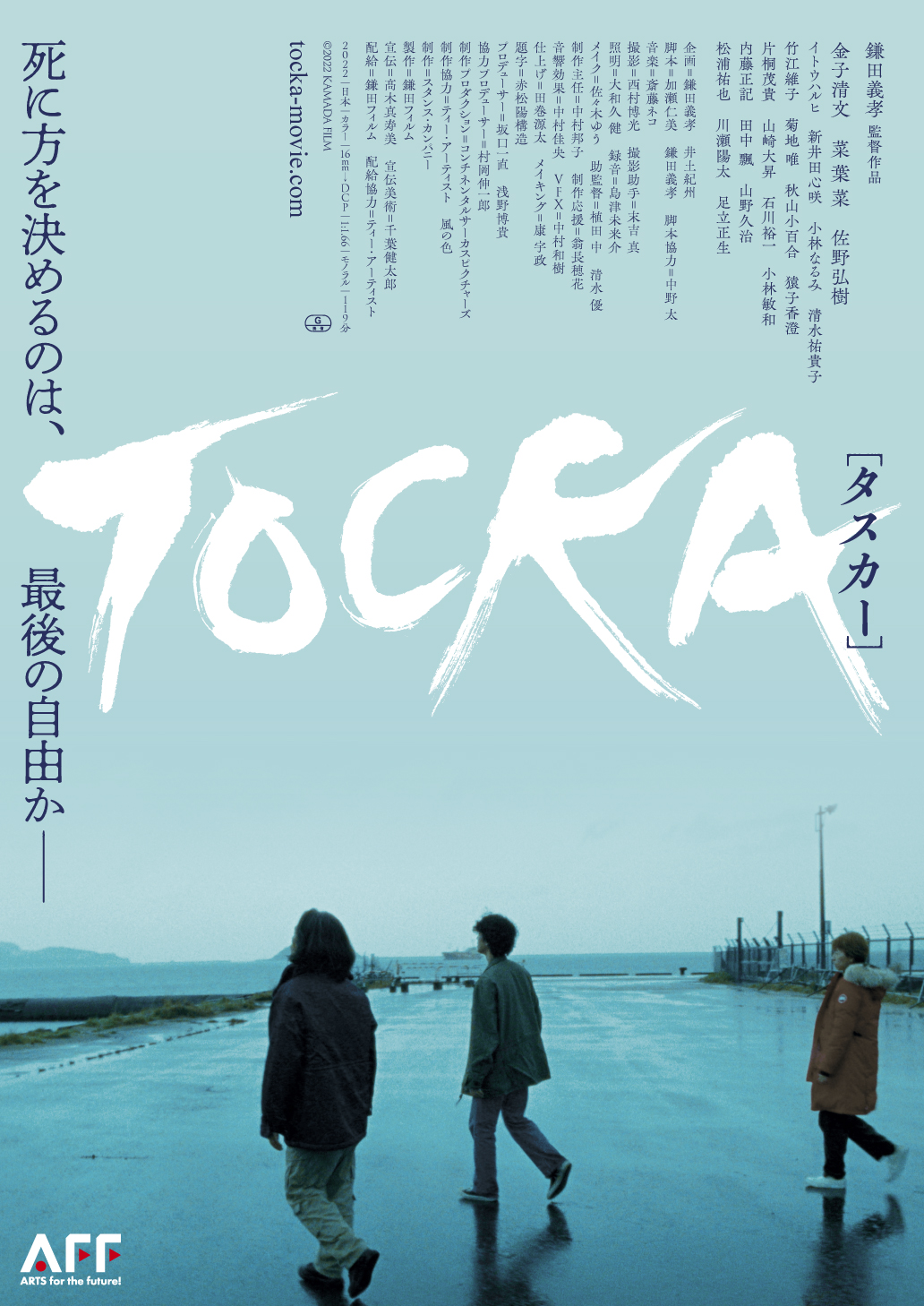
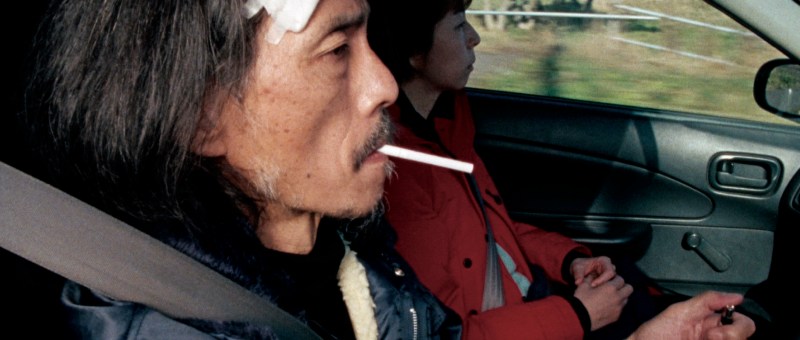
The man at the centre of Yoshitaka Kamada’s bleak social drama Tocka (タスカー) claims that he no longer knows why he’s alive, but as the woman he’s just asked to kill him replies no one else really knows either but even so they continue to live. Set in the northernmost reaches of Hokkaido where you can pick up Russian-language radio and it’s not unusual to spot signage in Cyrillic, the film’s title is taken from a Russian word that describes a quality of spiritual agony that manifests as listless ennui while its sensibility seems to be very much in tune with that of 19th century Russian literature. 

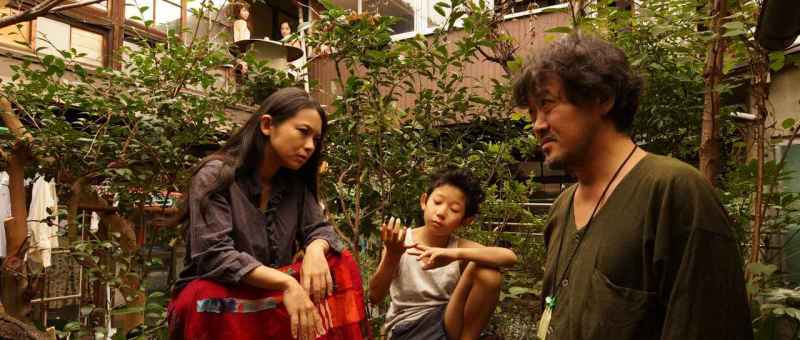
This indeed a cold a barren place almost devoid of signs of life. The heroine, Saki (Nahana), has returned in flight from the implosion of her life in Tokyo but has not told her parents who presumably live not too far away that she’s lost her job or broken up with her fiancé. Instead, she’s living a difficult and dissatisfying life with a part-time job in a local supermarket while contending with massive debts. Unable to see a way forward, she begins to consider taking her own life which is how she ends up meeting Shoji (Kiyobumi Kaneko), a man who wants to die but is unable to kill himself so is looking for someone to help him. 

Perhaps it says something of Saki’s own desperation that she considers his proposal or at least does not necessarily see anything odd about it aside from Shoji’s general vagueness about the reasons he wants to die. Like her, he is living a dissatisfying life but mostly precipitated by the loss of his family and his subsequent descent into alcohol dependency. He used to run a junk shop selling second hand appliances, but his business has also gone bust leaving him with nothing. His only goal is to make sure his daughter receives the payout from his life insurance policy which would be void if it was ruled that his death was a suicide. 

Yukito (Hiroki Sano) also works as a junk man, but scams his clients by pressing them to pay despite advertising a free removals service for unwanted appliances. He also steals petrol to sell illegally on the side and has nothing much going for him in his life while feeling guilty that he has failed to repay the sacrifices his mother made to raise him. Meanwhile, his sister is pregnant and the baby’s father has abandoned them leaving her in much the same position as her own mother but worried she doesn’t have the strength to manage on her own. 

It’s not difficult to understand the reasons why they want to end their lives even if as they sometimes suggest it’s more that they lack reasons to live while those in favour of dying are readily apparent. There doesn’t appear to be much going on in Northern Hokkaido when the businesses seem to be those dedicated to moving around obsolete items, buying junk or selling junk or maybe even stealing junk to sell to people who can’t afford anything better or else for scrap. All three feels themselves already on the scrap heap with nothing more than broken dreams to their names. Saki once wanted to be a singer in Tokyo, but now can’t seem to see a reason to be much of anything at all.

The way she later sees it, it’s alright to want to die and it’s alright to do it too even if you’ll hurt the people you’ll leave behind. None of them are fully able to escape their sense of despair or hopelessness despite the bonds that arise between them as they try to fulfil Shoji’s dying wish. In the end, the firmest expression of friendship is that they will help one another die if and when it’s what they really want though they may never meet again in more pleasant circumstances. In any case, Kamada captures a sense of bleakness in the beauty of the snowbound landscape which remains otherwise barren and defined by emptiness even as those trapped inside it try to find reasons either to live or to die but more often than not find nothing much of anything at all. 


TOCKA screened as part of this year’s Nippon Connection

Original trailer (English subtitles)

Images: ©2022 KAMADA FILM

The Kamagasaki Cauldron War (月夜釜合戦, Leo Sato, 2018)

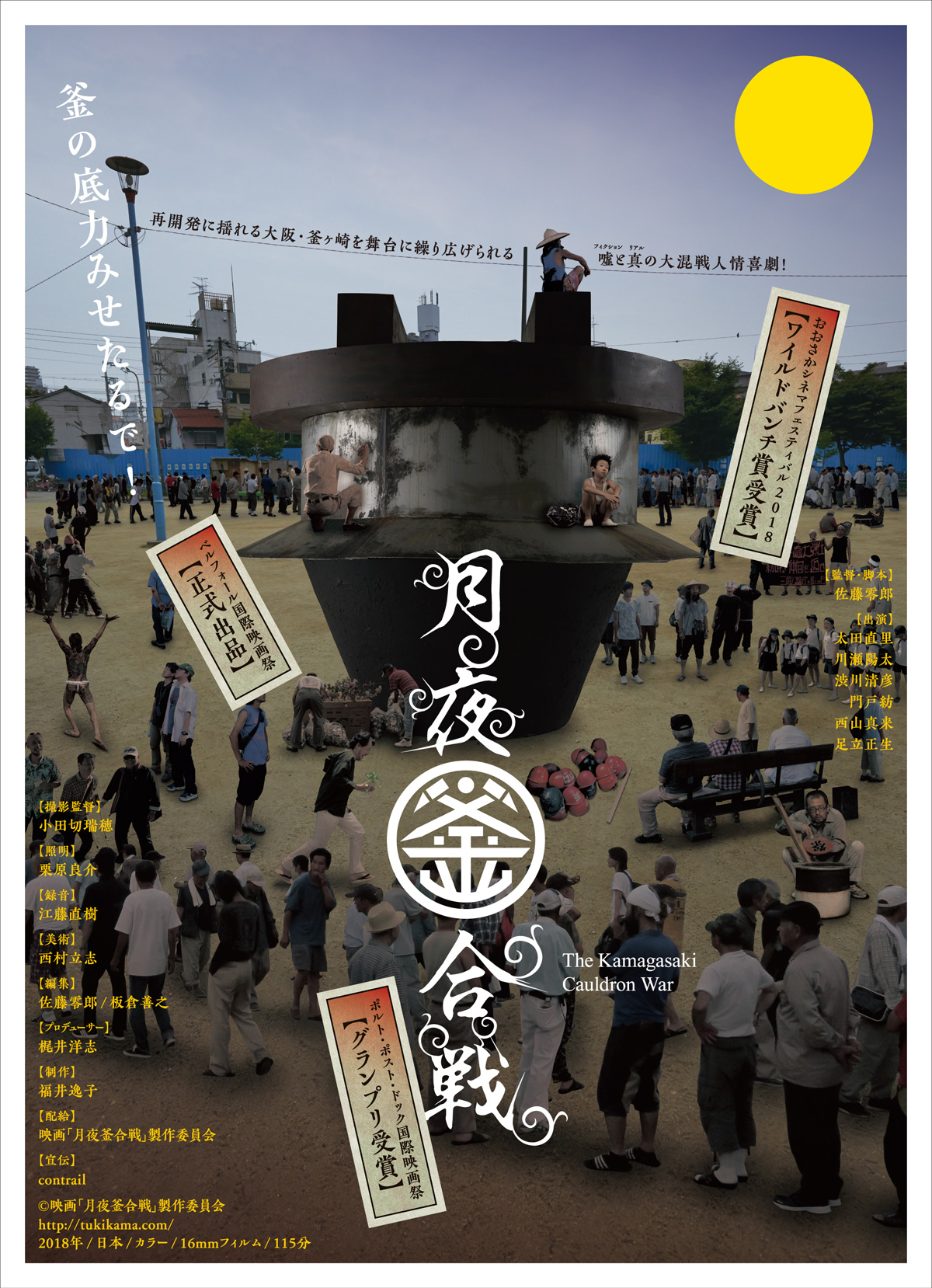
Kamagasaki couldron warAs far as Japanese cinema has been concerned, the city of Osaka is renowned for two very specific things – gangsters and comedy. The Kamagasaki Cauldron War (月夜釜合戦, Tsukiyo no Kamagassen), the debut narrative feature from Leo Sato, neatly brings them both together in an anarchic tale of social inequalities and the pettiness of organised crime. A warmhearted exploration of the eponymous “invisible slum”, Kamagasaki Cauldron War delights in everyday resistance as its ordinary citizens attempt to live their ordinary lives all but forgotten in a society intent on swallowing them whole.

The drama begins with drifter Henmi – a casual labourer with a young son, Kantaro (Tumugi Monko), who dreams of joining the local yakuza gang Kamitari but is rudely rejected by its foot soldiers. In revenge, he steals their precious “kama” sake bowl which is the symbol of their clan and essential for carrying out the succession ritual. This is all the more embarrassing because the elderly boss is thinking of retiring now that his son, Tamao (Kiyohiko Shibukawa), has been released from a 20-year prison stretch. Tamao, however, is secretly pleased because he doesn’t much fancy taking over while the petty yakuza who’s been running the show all this time is also quite happy because he doesn’t really want to give up control. Nevertheless, the precious Kama must be recovered at all costs or the gang will continue to face a significant loss of street cred.

Meanwhile, a bigger drama is underway. Kamagasaki is home to a significant proportion of “homeless” people, many of whom congregate around Sankaku Park where a regular soup kitchen runs next to the giant symbolic Kama cauldron in the park’s centre. It also the last remaining undeveloped post-war area and is therefore rich pickings for unscrupulous property developers such as Capital Beat who are primed to bulldoze the welfare centre to build more housing and therefore need to clear the park of the homeless in order to make the area seem attractive. Already trying to prevent the homeless from settling, the city has put up a series of insidious barriers including floral centrepieces and more obvious metal barriers but is nervous of taking direct action such as physical evictions. Which is where the yakuza come in. Working with Capital Beat and corrupt police, the yakuza take clubs to the soup kitchen and get vulnerable people to commit arson by setting fire to live rats and having them run into “derelict” buildings.

At the centre of events, orphan Nikichi (Yota Kawase) tries to keep himself afloat when the only gigs going are transfers to Turkish nuclear power plants by taking advantage of the Kama crisis and getting his hands on as many as possible little knowing that he is actually in possession of the Kamitari sake bowl thanks to little Kantaro whom he has been persuaded to adopt with his sex worker girlfriend Mei (Naori Ota) who grew up with him in the same orphanage. Coincidentally, the pair were also childhood friends with Tamao who has apparently been holding a torch for Mei all these years as well as grudge against Nikichi for an embarrassing injury caused during a sports contest at school. While they’re busy scrapping it out, the local area decides to fight back against Capital Beat by protesting the city’s treatment of the homeless leaving Nikichi an accidental figurehead for a campaign he doesn’t quite believe in and is only tangentially involved with.

Decrying that there is “no place to rest in the whole world” some enterprising homeless guys have built a tunnel under the giant Kama while others attempt to repurpose their penury by declaring that “garbage is the weapon of the people”. Recalling the anarchic spirit of the student protests (including a surprising cameo by Masao Adachi), the residents of Kamagasaki rise up against social intransigence by taking on the yakuza armed with pots and pans before the police stick their oar in and end up becoming a mutual point of irritation. Filmed on retro 16mm, Kamagasaki Cauldron War offers no real solutions to its various problems but delights in the everyday anarchism of its workaday world in which its scrappy residents do their best to get by in an often hostile environment, finding whatever ways they can to resist societal oppression while maintaining a sense of humour and world weary hope for the future.


The Kamagasaki Cauldron War was screened as part of Japan Cuts 2019.

Original trailer (English subtitles)

Three Resurrected Drunkards (帰って来たヨッパライ, Nagisa Oshima, 1968)

Three Resurrected Drunkards posterThe pop star movie has a long and distinguished history in Japanese cinema, but one might not have expected it to include Nagisa Oshima – a legendary iconoclast and conscientious objector to this particular strain of pop culture frivolity. Then again, taking a much hated form and turning it in on itself as a multifaceted form of protest is exactly the sort of thing one might expect Oshima to do. Therefore we find him in 1968 teaming up with The Folk Crusaders – a folk rock band enjoying a sudden flash of popularity after pressing their own indie record and seeing it go gold when radio stations picked up their North Korean themed Imujingawa and turned it into a giant hit. The band’s best known hit remains Kanashikute Yarikirenai which was released the same year, but it was perhaps Imujingawa with its melancholy Korean theme which attracted Oshima’s attention. A Monkees-esque surreal pop-star vehicle, Three Resurrected Drunkards (帰って来たヨッパライ, Kaette Kita Yopparai) is the third and most direct (strangely) in a series of films critiquing Japan-Korea relations, pushing further into the contemporary era with additional questions to ask about American imperialism and the complicity of both nations in the ongoing conflict in Vietnam.

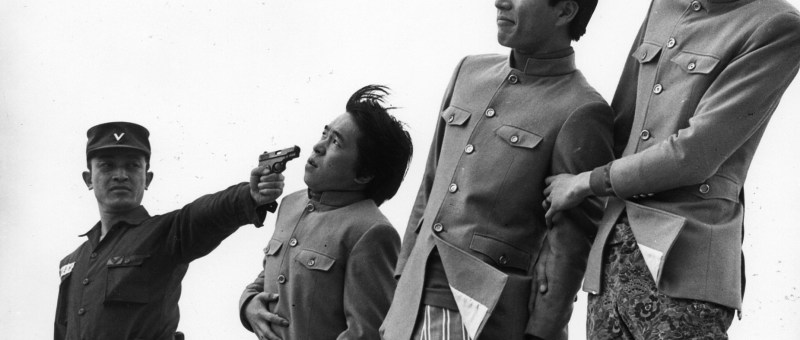
Three students, played by the three members of The Folk Crusaders, frolic on a beach recreating the famous Vietnam war photo of General Nguyen Ngoc Loan executing a prisoner in the street, before stripping off to go swimming. While they’re enjoying the waters, a hand rises up from beneath the sand and exchanges their clothes for a set of Korean military uniforms and some cash. The boys put on the strangers’ clothes and try to go home, but run into trouble when they try to scam an old grandma running a tobacco stand by pretending to have forgotten the price of cigarettes has gone up by 10 yen, assuming a dotty old grandma out in the sticks might not know anyway. Instantly suspicious, and seeing as this is “crack down on stowaways week”, the grandma tips off the authorities. After all, no Japanese person could be unaware of the rise in the price of cigarettes, so our heroes must be the “them” everyone is looking for.

What transpires is a surreal adventure of mistaken identities and rampant xenophobia in which our three students become temporarily transposed with their Korean counterparts – a draft dodging corporal trying to escape being sent to die in Vietnam, and his friend who’s come with him in the hopes of getting into a Japanese university. The third student, “Beanpole”, gets to keep his “Japanese” identity as a kind of control, but finds himself punished alongside his “Korean” friends as they face the harshest of punishments in this increasingly cruel and arbitrary world.

The three “stowaways” are then chased by the “real” Koreans who want to kill them and fake their own deaths to become Japanese. Later the three turn the tables on their pursuers but find themselves unable to pull the trigger because “Koreans don’t kill other Koreans”. In a bold piece of narrative reframing, Oshima abruptly resets the narrative halfway through, literally “resurrecting” our three drunkards who are instantly aware of what’s going on and determine to do things differently this time around – offering the grandma the right money, not taking the Korean uniforms with them when they leave the bathhouse etc, but they still get caught by the “real” Koreans and manage to survive only by “becoming” Koreans themselves, owning their new identities and rejecting their Japaneseness whilst turning their captors’ questions back on them and accusing them of being Japanese.

Meanwhile, the students take to the streets for an extended voxpop session in which they ask the question “are you Japanese?” to which all of their interviewees reply “No.”, asked “so how’s that then?”, they all calmly state it’s because they’re Korean. Aside from a pointed shot at a Westerner, Oshima seems to be making the rather banal point that Japanese and Koreans cannot be distinguished visually despite what some rather ignorant people might think – hence the identity confusion resulting from putting on “Korean” clothes, but he goes a little further in muddying the waters with a comparison between ongoing American imperialism and that of the Japanese past. Koreans in Japan experience oppression and xenophobic racism, but their nation as a whole also suffers from external oppression born of their government’s reliance on America for military support in the event that their truce with the North will someday be broken. Hence they find themselves packed off to another controversial war killing other Asians at the behest of a foreign government and its intense cold-war paranoia. 

Japan of course is also subject to this same oppression in reliance on American military power and so is also complicit in the horrors of Vietnam. These twin threads meet not only in the melancholy folk song penned by The Folk Crusaders, but in the final image which sees the executed Vietnamese man replaced by a Korean “stowaway” and the soldier by a Japanese policeman. Concentric circles flash in and out but Korea is always left in the middle, suffering at the hands of external powers, though Oshima remains largely silent on that presented by the authoritarian government of the day save criticising its determination to cling to American military might. A pop star movie with a title named for one of the band’s biggest hits – the high pitched and cartoonish Kaette Kita Yopparai which is itself a nonsense adventure of silliness, Three Resurrected Drunkards is a psychedelic treatise against systemic prejudices, complicity, and the seemingly inescapable cycle of geopolitical manoeuvring such prejudices fuel and enable.


Original trailer (English subtitles)

Imujingawa

https://www.youtube.com/watch?v=1-eJDL3zLCQ

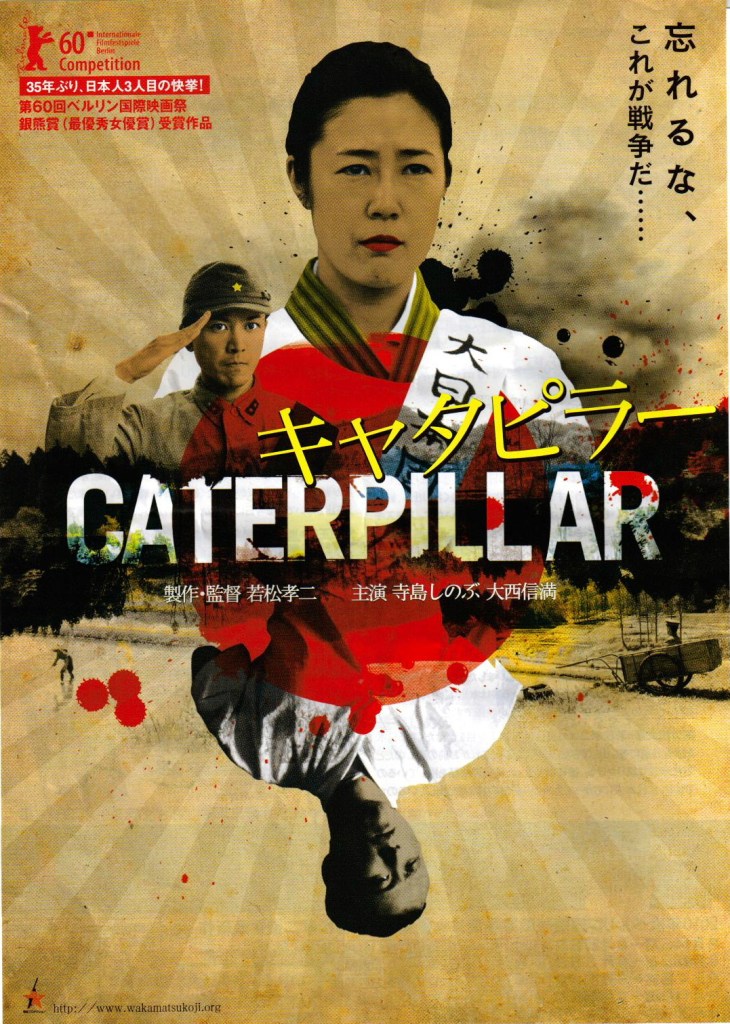
Caterpillar (キャタピラー, Koji Wakamatsu, 2010)

Koji Wakamatsu made his name in the pink genre where artistic flair and political messages mingled with softcore pornography and the rigorous formula of the genre. Wakamatsu rarely abandoned this aspect of his work but in adapting a well known story by Japan’s master of the grotesque Edogawa Rampo, Wakamatsu redefines his key concern as sex becomes currency, a kind of trade and power game between husband and wife. Caterpillar (キャタピラー), aside from its psychological questioning of marital relations, is a clear anti-war rallying call as a small Japanese village finds itself brainwashed into sacrificing its sons for the Emperor, never suspecting all their sacrifices will have been in vain when the war is lost and wounded men only a painful reminder of wartime folly.

Kyuzo Kurokawa (Shima Onishi) has returned from the war. This makes him luckier than many of the other young men who disappeared from the village over the last few years. His return, however, provokes howls of fear and disbelief from his long suffering wife, Shigeko (Shinobu Terajima), who refuses to believe the creature they’ve brought back from the battlefield is really her husband. Kyuzo has lost all of his limbs, has facial disfigurement from burns, and has also lost his voice and hearing. Sitting across from the remnants of her brother, Shigeko’s sister-in-law remarks that she’s glad they didn’t “send Shigeko back to her family” because she is obviously the one who will have to look after this entirely helpless though apparently conscious battle scarred man.

This being early in the war, the village is in a fury of patriotic zealotry, determined to make Japan glorious again in the name of the Emperor. Far from letting the case of Kyuzo dissuade them from their warlike fervour, his sacrifice becomes a totem. He’s not a man destroyed by war but a “war god” and the pride of the village, a testament to their love and devotion that they would send a son of theirs to war who would return to them even in such a ruined form. Shigeko, quickly getting over her initial revulsion, comes to realise that her husband’s new-found status is also her own. As the wife of the war god, she becomes his voice and mistress in a way she had never been permitted before.

Truth be told, the war did not ruin Kyuzo’s character. The marriage of Kyuzo and Shigeko was never a happy one and perhaps her initial reeling, wailing flight on learning of her husband’s return was more out of fear than disbelief and compassion. Despite a lengthy marriage the couple had no children (perhaps an explanation for that early “sent back” comment), and Kyuzo regularly beat his wife for her failure to bear him a male heir. Now his carer, the roles are reversed as Shigeko babies her defeated husband, lamenting that all he is is urge – sleep, eat, sex. Kyuzo’s needs are animal and definite despite the signs of intelligent communication in his eyes. Shigeko, constrained to satisfy them, bends his need to her own advantage.

Emasculated in a deeper way by Shigeko’s increasing dominance, Kyuzo first attempts to assert himself in resentment at being trotted out to sell the virtues of war in his pristine uniform even as a man destroyed by nationalised violence. Spitting in Shigeko’s face as she dresses him, he attempts to refuse but is powerless to reject her authority. As time wears on and Kyuzo submits to female authority, memories of his atrocities haunt him as the fire which marked his face mingles with the faces of the Chinese women he raped and killed as a brave son of Japan on Manchurian soil.

For Wakamatsu war and sexualised violence are synonymous as the local women train for defending their village by repeatedly penetrating hey bales with long spears crying out patriotic slogans as they go. The flag waving and furore never waver despite the evidence of Kyuzo’s suffering and the numerous young men who will never come home or have done so in square boxes wrapped with white cloth. Only nearing the end is Shigeko left wondering what will become of her war god husband when no one needs a talisman. What will the nation do with these men who’ve sacrificed so much and received nothing in return?

Wakamatsu’s message is an unmistakably anti-war one though the curious inclusion of the executions of the lower class war criminals “hanged by the country they fought to protect” almost undercuts it even if his sympathy lies with those who succumbed to a national madness and have been made to pay a personal price. Kyuzo becomes the literal caterpillar of the title, taunted by Shigeko as he writhes and crawls around, condemned to eternal undulation, but it’s Shigeko who has been in a chrysalis all this time waiting to emerge from the fear and tyranny which has marred her married life into something with more freedom and autonomy – much like a nation waking up and realising that its Emperor is just a man and the long years of suffering nothing more than brainwashed madness.


Original trailer (English subtitles)