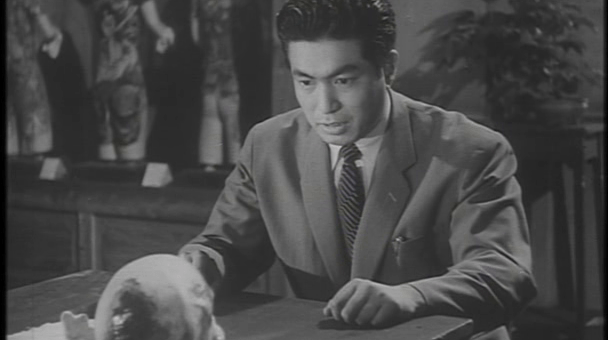

The Military Policeman and the Dismembered Beauty (憲兵とバラバラ死美人, Kenpei to Barabara Shibijin) was apparently a substantial hit on its release, though to modern eyes at least it doesn’t quite live up to the salaciousness of its title. In fact, it seems a little more interested in reassessing the militarist past while attempting to rehabilitate an authoritarian power and reframing it as good and compassionate unlike the corrupted killer who is selfish and ambitious to the extent that he’s literally poisoning the militarist wells.
What we’re first introduced to, however, is a rather familiar tale of a soldier who’s gotten a girl pregnant but now won’t marry her mainly because he’s onto a good thing with a pretty girl from a prominent family so his girlfriend’s in the way. Though we see a prelude to the murder, we don’t get good a look at the soldier’s face (though we do hear his voice) which on one level hints at the generalised violent threat of the militarist machine but is also a neat plot device that allows us to into the crime but still maintains the mystery. When we do see the actual killing, it’s surprisingly frank for the time period and disturbing in its sexual charge though there is no gore involved save a grisly discovery in yet another well.
The killing occurred shortly before the regiment left for Manchuria, which seems to be one way the killer sought to move on and leave his crime behind. The first hint of the corruption is discovered by a gang of new recruits as yet unused to the militarist machine. They notice that the water in the well in the barracks is bad, but are at first bullied and insulted by another soldier who’s been there longer and gives them a rather priggish speech about the sanctity of the regimental water. What they discover is that the water tastes bad because there’s a dismembered torso in there and has been for the last six months. One has to wonder why the culprit would think this a good place to hide a body given the risk of discovery and increasing suspicion but as it turns out no one is all that interested. The Military Police aren’t that keen on investigating themselves, and then we get the familiar conflict between the local cops and the specialists as a top investigator, Kosaka (Shoji Nakayama), is assigned to investigate the crime and insists on doing so thoroughly rather than just beating their favourite subject into a false confession.
Kosaka is then posited as a nice Military Policeman, an emissary of legitimate authority rather than bumbling provincials who are ridiculous and self-serving not to mention incompetent and resentful. We’re told repeatedly that Kosaka is prepared to work with the civilian police unlike the other military policemen who insist on militarist primacy and refuse to allow the detectives onto the base to investigate. He’s a representative of a less authoritarian age that looks forward to the democratic future, but he is also a part of that organisation himself no matter how different he may seem to be and cannot escape the overarching structures of militarism. Nevertheless, his edges are further softened by a nascent romance with the middle-aged innkeeper at his lodging house while his assistant is after her sister, a childhood friend who can’t stop calling him by his old nickname.
The two of them investigate scientifically, making frequent trips to the pathologist to discuss theories and evidence though Kosaka is eventually guided towards the solution after seeing the young woman’s ghost. The local military police meanwhile fixate on another soldier who has a reputation for using sex workers, one of whom has recently disappeared, though Kosaka thinks the man is a just a crook with what modern viewers make think of as a sex addition that sees him steal supplies from the kitchen to sell in order to finance his visits to the red light district. The military police whip him in an oddly sexually charged manner to try to get him to confess, but he maintains his innocence. One of the motives for the murder was seemingly that the victim planned to expose the affair, taking her concerns to the killer’s superior officer in an effort to force him to marry her which would have ruined his career prospects in what is supposed to be an organisation of honourable men. Unlike Kosaka who shares his name with the writer of the novel the film is based on which may have been inspired by true events, the other military police are largely like the killer, arrogant, selfish and unfeeling though all Kosaka himself represents is a supposedly more benevolent authority that for his niceness may not actually be all that much nicer.
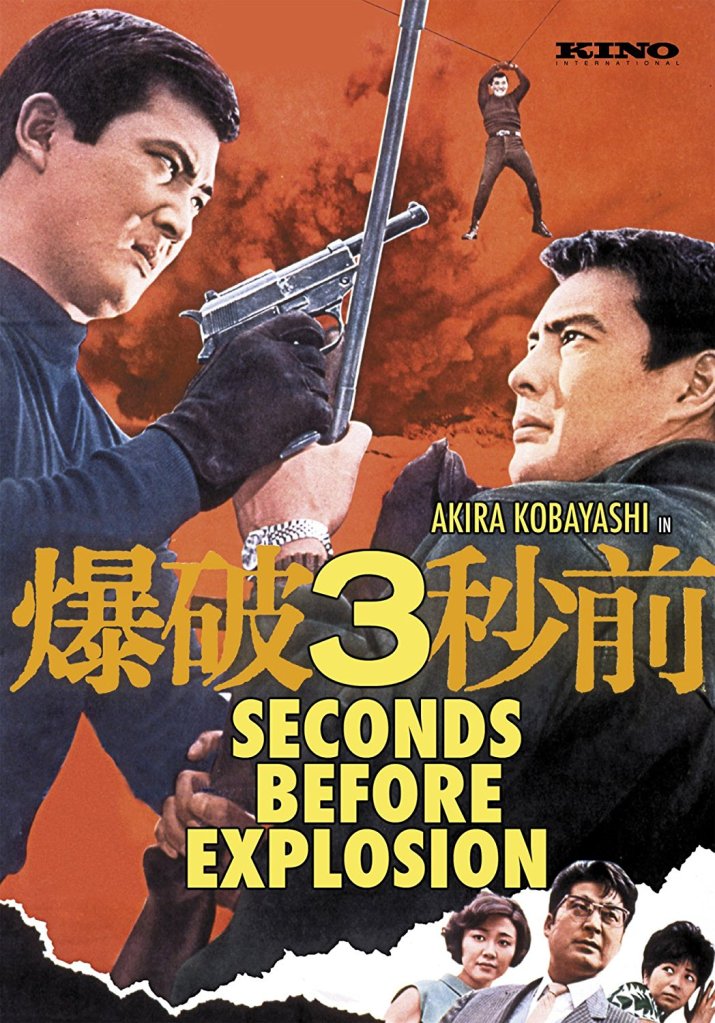 If Nikkatsu Action movies had a ringtone it would probably just be “BANG!” but nevertheless you’ll have to wait more than three rings for the Kaboom! in the admittedly cartoonish slice of typically frivolous B-movie thrills that is 3 Seconds Before Explosion (爆破3秒前, Bakuha 3-byo Mae). Once again based on a novel by Japan’s master of the hard boiled Haruhiko Oyabu, 3 Seconds Before Explosion is among his sillier works though lesser known director Motomu Ida never takes as much delight in making mischief as his studio mate Seijun Suzuki. What he does do is make use of Diamond Guy Akira Kobayashi’s boyish earnestness to keep things running along nicely even if he’s out of the picture for much of the action.
 Windows on Worlds