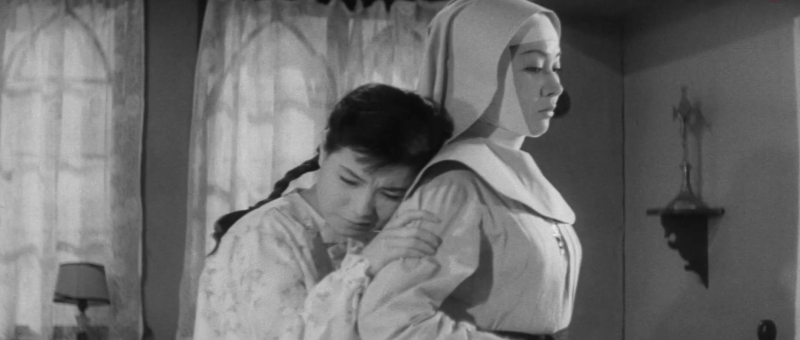
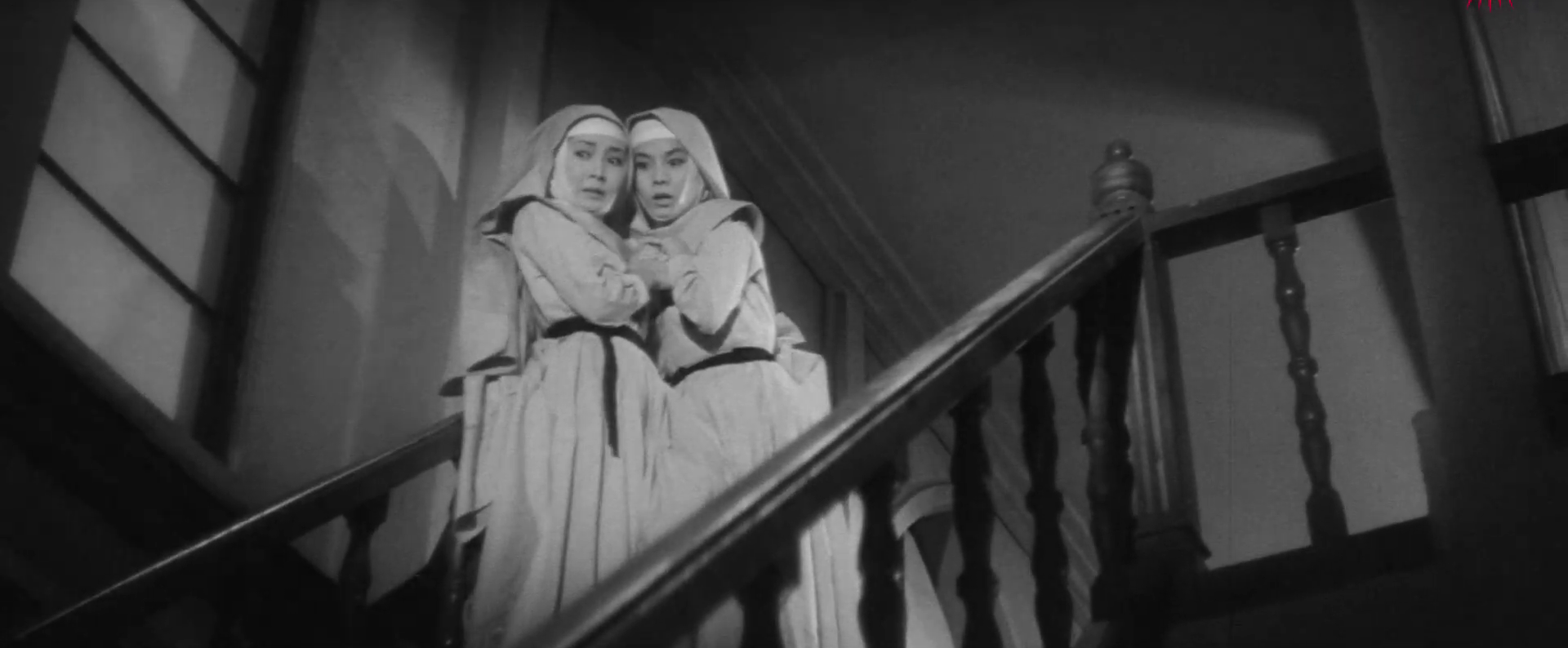
Sincerity (まごころ, Mikio Naruse, 1939)

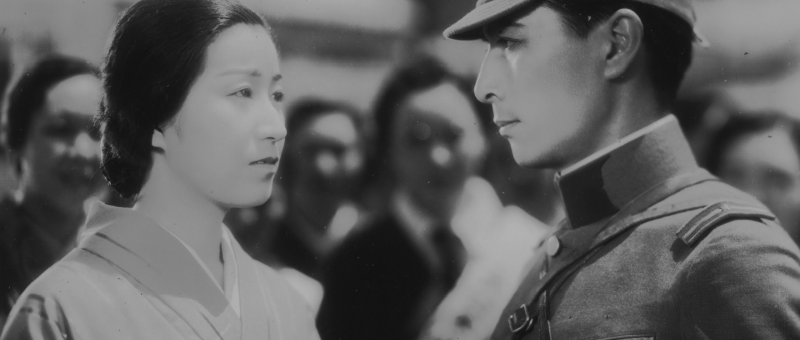
When the daughter of a poor family leapfrogs that of a rich one to be named top of the class, it exposes a series of hypocrisies and contradictions within the militarist order in Mikio Naruse’s 1939 drama, Sincerity (まごころ, Magokoro). The film opens, however, with a parade led by the Patriotic Women’s Association seeing young men off war. The group is led by Mrs Asada (Sachiko Murase), the mother of the rich girl, Nobuko (Etchan), who is busy giving orders to the other women regarding the air defence watch and sweet potato market which seems very forward thinking for the time period.

But in other ways it’s Mrs Asada who comes in for the greatest criticism as her bossiness and involvement with patriotic activity is depicted as a kind of displacement activity to mitigate her sense of uselessness and unhappiness in her marriage to arch militarist Kei (Minoru Takada) whom she fears is still hung up on his old girlfriend, Tsuta (Takako Irie), who is also the mother of Tomiko (Teruko Kato), the poor girl and apparent model student who has just displaced Nobuko as the cleverest girl in the class. Through Mrs Asada is rightly concerned that Nobuko has dropped a whole 10 places, Kei is not bothered by it at all because she is physically robust and healthy, which are the two most important qualities from a militarist perspective, leaving aside the fact that many wouldn’t regard a woman’s academic success as particularly important. Indeed, Kei is dismissive of his wife. Mrs Asada suggests that he finds her “stupid” and that their daughter is “stupid” by extension while Tsuta’s is clever and earnest because Tsuta is the same. He tells her that a child’s education is the mother’s responsibility and it’s probably her fault for busying herself outside of the home with her wartime activities with the implication that she’s been neglecting her child and that’s why her grades have fallen.

This point seems contradictory seeing that even at this stage, the nation expects women to serve their country in ways other than dedicating themselves to their families which is a responsibility secondary to that they owe to the emperor. Nevertheless, the implication remains that she’s doing it for the wrong reasons because what she enjoys is the status it gives her and the power of being in charge. Unlike Tsuta who has no husband, Mrs Asada’s family is wealthy with servants to take care of the domestic work so has nothing to do all day, while it’s also clear that the marriage is more or less dead and Kei does not particularly care for her, which he later admits, though partly because he has already rededicated himself to the nation in eagerly anticipating his call-up letter. When he’s first introduced, Kei is admiring a sword he’s having made ready for when he gets his papers to enlist as an officer. 

It’s a remark about Kei’s call-up that first sets alarm bells off in Tomiko in noticing the sadness it provokes in her mother, itself a little transgressive from a propaganda perspective. The grades situation doesn’t affect the girls’ friendship in the slightest, though this sudden reckoning with the past does begin to place a wedge between them not only in a growing awareness of their class differences but an awkwardness about the complicated situation between their parents which they are not well equipped to fully understand. Tsuta first tries to tell Nobuko the truth, but it upsets her so much that she lies instead and says that it’s true she knew Kei in the past but only as an acquaintance not a romantic partner. Nevertheless, the fact that she called him “Kei” rather than “Keikichi” or whatever his surname was before he married into Mrs Asada’s family suggests a great degree of intimacy which is something Tomiko seems to pick up on. 

There’s a persistent implication that Kei may be the father of both girls, which further reinforces the idea that their contrasting characters are a product of the way their mothers have raised them. Nobuko is described as self-involved and lazy, characteristics which reflect her privileged upbringing and sense of entitlement. Mrs Asada tries to talk to her new teacher, Mr Iwata, but his opinion is that Nobuko was most likely coasting and is struggling now because the work is more difficult and she hasn’t learned how to study or developed a consciousness that results are born of what you put into them. She, and her mother, simply expect to come top because it’s what a girl of her status deserves. Her displacement is a discomforting inversion of the social order. In this, the film both undercuts and reinforces militarist ideology in stressing the importance of hard work for all while doing so at the expense of a reverence for feudalistic ideas of class hierarchy. 

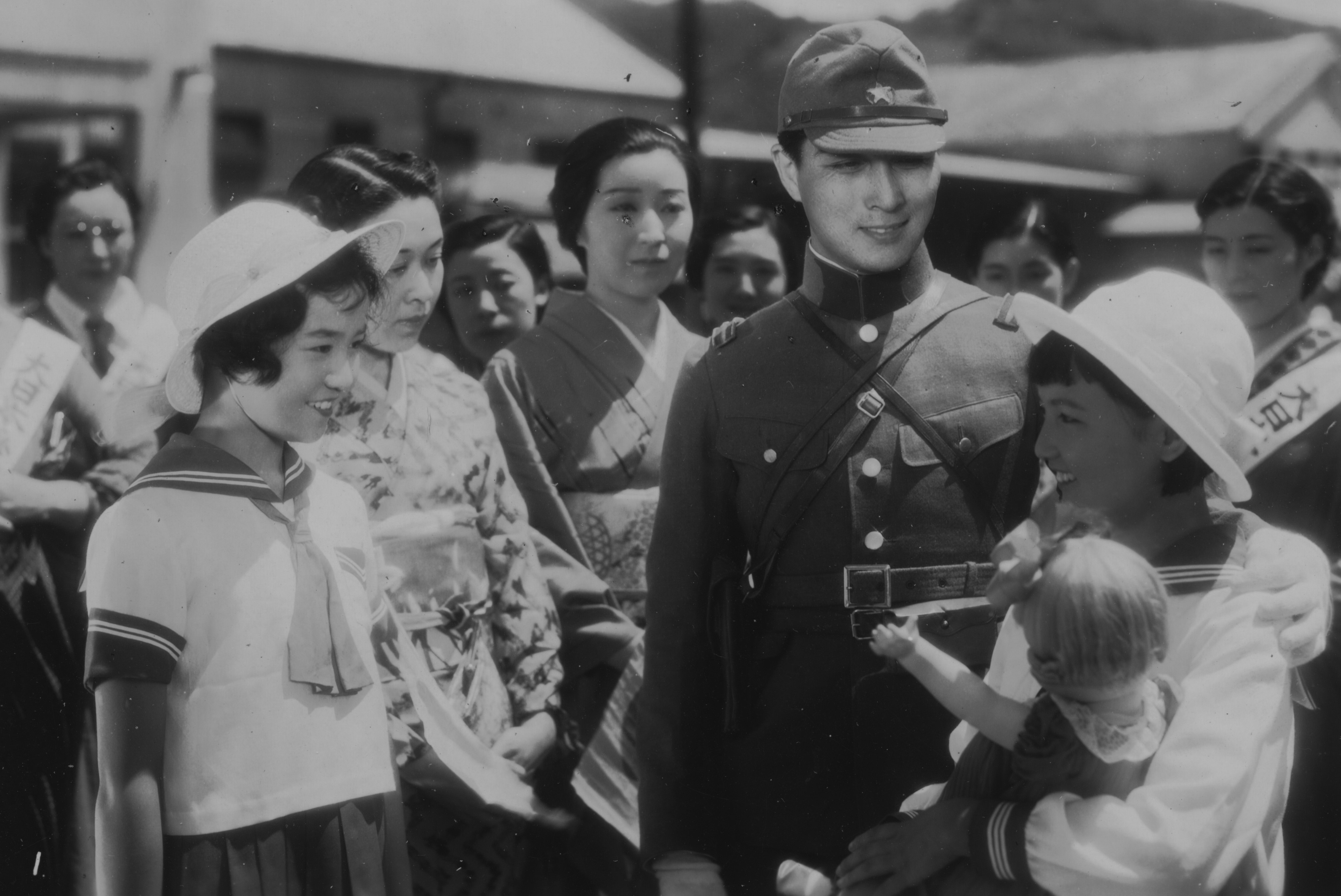
It’s this class divide that is transgressed when Kei sends the present of an expensive French doll to Tomiko after she and her mother come to Nobuko’s rescue when she cuts her foot on some sharp rocks while the girls’ are playing together at the river. The gift seems rather extravagant for the relatively minor act of kindness Tomiko and her mother performed which accidentally reunited Tsuta and Kei though neither of them say very much and while Tsuta seems to look at him longingly, Kei appears indifferent. Nevertheless, the grandmother suggests the doll reflects Kei’s sincere heart with the implication that it reflects his continuing attachment to Tsuta. Tsuta wants to refuse it, but realises she can’t because Mrs Asada likely doesn’t know and her finding out would just cause more trouble, though it’s a painful reminder of her romantic disappointment. 

Tomiko ends up sending it back herself with a note for Nobuko explaining everything. Nobuko then limps off with her injured foot to return the doll to Tomiko and tell her none of that matters, she wants her to have the doll anyway. The doll then becomes a symbol of the sisterhood between the girls and the erasure of the class boundary between them. Tomiko can be seen holding the doll when they join the parade to send Kei off to war, while Tsuta and Mrs Asada also smooth out the misunderstandings between them to celebrate Kei’s mobilisation together. The message here is more that old differences must now be put aside so that everyone can serve the nation together rather than selfishly fixating on personal drama such as wounded pride or romantic heartbreak. Even so, Naruse slightly undercuts the patriotic conclusion with the hint of sadness on Tsuta’s face before she recomposes herself to smile at Mrs Asada and reinforce the sense of solidarity between them, while what we’re left with is the memories of the idyllic countryside setting and sense of pastoral serenity along with the sincerity of the relationship of the two girls which is rooted not in patriotism but genuine friendship that cares nothing for the divisions of social class or the rigidities of the adult world.


Sincerity screens at Japan Society New York May 10 as part of Mikio Naruse: The World Betrays Us – Part I.

Images: Collection of National Film Archive of Japan

A Bullet Hole Underground (地下街の弾痕, Kazuo Mori, 1949)

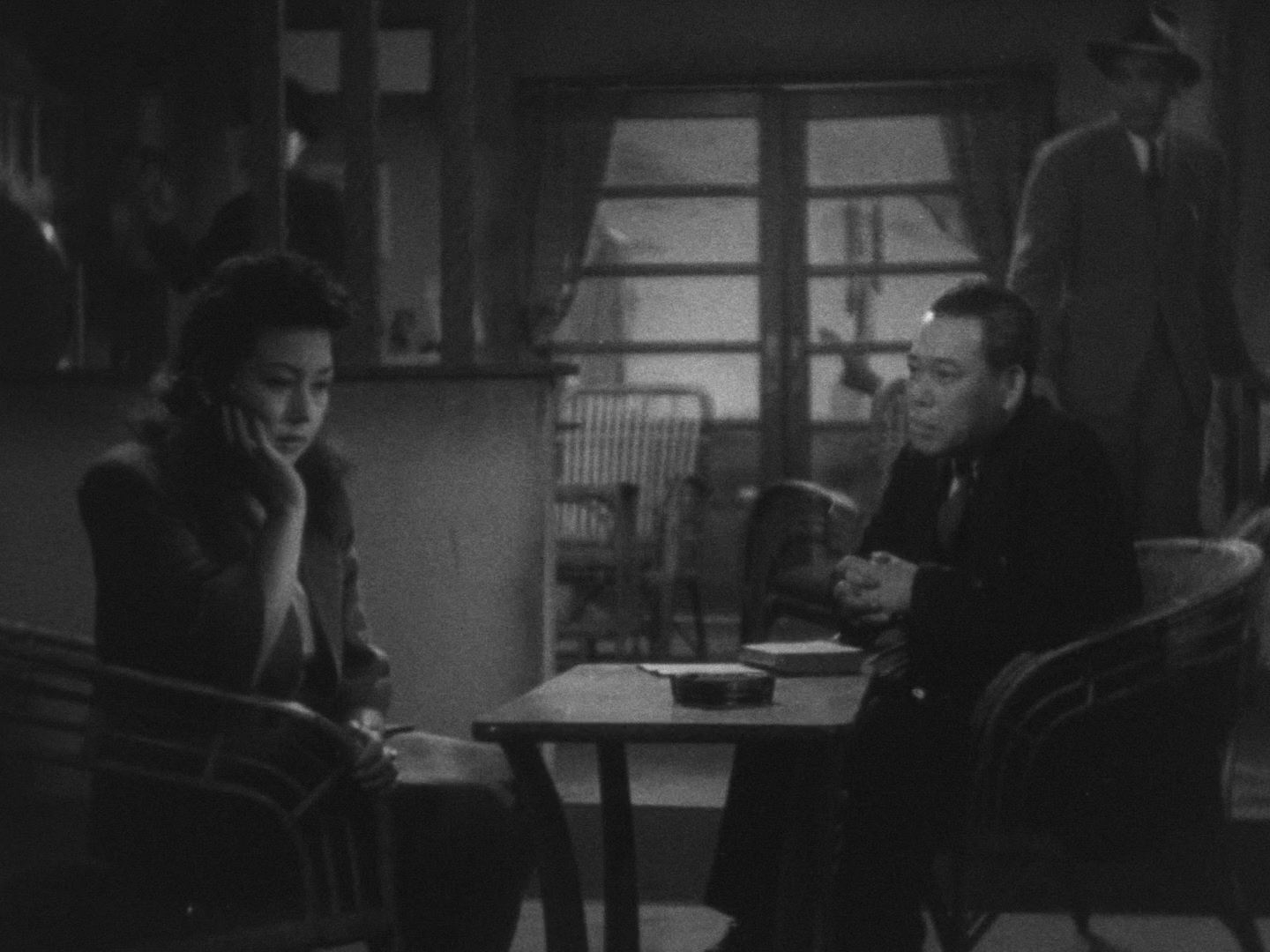
Produced by Daiei Kyoto under the guidance of the Osaka Police, Bullet Hole Underground (地下街の弾痕, Chikagai no Dankon) is keen on selling a vision of order in a new Japan in which the police force employs all the latest technology to solve crimes calmly and methodically. We see them approach the crime scene forensically and conduct a series of scientific tests with microscopes and gadgets such as lie detector machines and code breaking equipment as they proceed towards the truth while earnest policeman Minagawa (Hiroshi Nihonyanagi) battles the ghosts of his past on realising that the dead man’s wife is his own lost love.

In any case, the film opens with a noirish scene at Umeda Station, Osaka, which then turns strangely comic. A man stumbles toward the exit and we assume that he is probably drunk but another man soon comes up behind him and pushes a pistol into his back. The second man pulls the trigger, then again to make sure, before calmly walking up the steps and leaving the station. A little while later, another drunk man arrives and has a little banter with the body before covering it with a signboard which is one reason it isn’t spotted until the shoeshine boys turn up in the morning. 

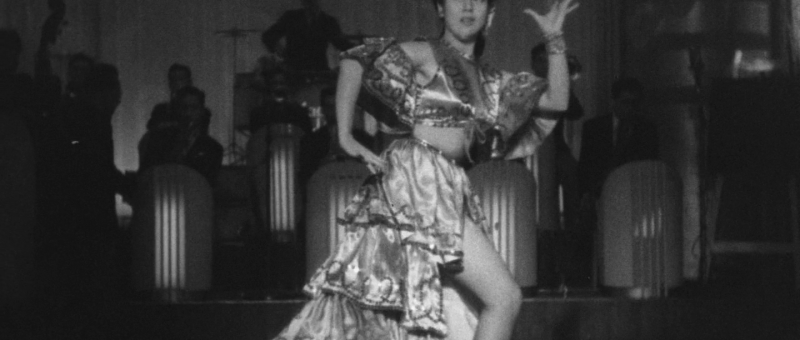
This sudden influx of children at rush hour is another symbol of the destabilisation of the post-war society in which the war orphans try to support themselves amid the still difficult economic environment. The lack of economic opportunities is also posited as a reason that the deceased, later identified as Kaneko, may have turned to crime by getting involved with a criminal gang smuggling drugs and money to destabilise the society even further. Yet the rot may have set in a little earlier than that. Before the war, Minagawa had wanted to marry Michiko (Machiko Kyo), the sister of his friend Sekiguchi (Toshiaki Konoe), but she later threw him over to marry the wealthy son of a family running a pharmacy. She admits she married him for the money, but after the war he lost everything. Unable to find work, Kaneko became a wastrel while Michiko gained employment at a cabaret bar as a dancer. He told her that he’d found a job at a company, but this turned out to be a lie and chief investigator Fujimoto (Takashi Shimura) assumes he must have been working for the gang. 

Still, to begin with it seems like it may have been a case of mistaken identity. Kaneko’s clothes turned out to belong to other people, a fact easily explained by Michiko that they were second hand, but also suggesting that someone may have set him up to take their fall. The gang needed the skills he learned in the navy but maybe they didn’t need him anymore. The root of the evil is located, ironically enough, in a jewellery store presenting a front of affluence and elegance but in reality founded on crime and misery when so many are still struggling to rebuild their lives. Michiko too seems to have turned cynical. She snarls and pushes Minagawa away, but privately cries and appears to regret her youthful decision to reject love for material comfort.

Perhaps because of its genesis as a film designed to promote the local police force, it has a much more upbeat conclusion and particularly for Michiko who is, unusually, allowed to redeem herself and gain a second chance to make a better decision by reuniting with Minagawa who does not and never has held her past against her. The pair of them look out over the fracturing city and remark at how it just carries on as if nothing had happened which feels like advice intended for the post-war society that it should do the same and try to leave the past behind to start a new life in this new era. Meanwhile, huge numbers of policemen swarm the harbour to crack down on the smuggling gang sending the not altogether comforting message that this city is well protected against all kinds of crime and the police force is a well-trained, modern institution that has the latest technology at its disposal along with astute and compassionate officers. There may be sleazy clubs, duplicitous men and heartless gangsters, black markets and smuggled dangers, but there are, the closing scenes with their wide-open vistas in which scorched trees stand behind the burgeoning city imply, better days to come.


Twilight Saloon (たそがれ酒場, Tomu Uchida, 1955)

A generational divide echoes around a beer hall filled with a defeated sense of bonhomie until finally finding a point of rest in Tomu Uchida’s elliptical single set drama, Twilight Saloon (たそがれ酒場, Tasogare Sakaba). The melancholy title captures the feeling of finality which seems to overhang the bar but equally the shift that is taking place as the old must decide whether they will allow the young to be free or forever trap them with the legacy of their own mistakes. 

The tensions are obvious as a once feared military colonel nicknamed “Demon” Onitsuka (Eijiro Tono) strides into the bar cutting a slim, anxious figure evidently a shadow of his former self. Puffing out his chest, he lives on memories of past glory claiming that though he may now be a lowly estate agent, he will rise again should the occasion call and will never lose his soldier’s spirit. Kibe (Daisuke Kato), a regular at the bar, is excited to run into him, his former commanding officer, and evidently still holds Onitsuka in some esteem but the pair of them seem ridiculous, even a little pitiable, as relics of the wartime generation unable to move into the post-war era. Onitsuka has a minor apoplexy when the table of students across from them begin singing a communist song explaining it as evidence of the absence of morality in the contemporary society. Somewhat embarrassingly, he and Kibe begin singing along to what they thought was a classic military ballad sung by someone outside only to abruptly realise that it is the communists once again. Strapped for cash, Onitsuka makes an abrupt exit leaving a confused Kibe to chase after him yelling “put it on my tab.” 

“Put it on my tab” might as well be the life philosophy of regular patron Umeda (Isamu Kosugi) who unlike Onitsuka and Kibe is wracked with guilt over his wartime experiences and has dedicated the remainder of his life to making amends by paying it forward. Once a famous painter, he feels he sullied his art by wilfully depicting warfare in a manner that sought to glorify it and may have led others astray ultimately costing them their lives. Umeda feels he no longer has a right to practice his art and has made a sacrifice of it in atonement, his earnestness leant a poignant quality by the fact that he is played by Isamu Kosugi who had himself starred in a propaganda film co-produced by Nazi Germany. 

Yet he’s far from the only one who’s abandoned or compromised his art because of what he sees as a moral failing. All knowing, Umeda recounts the history of accompanist Eto (Hiroshi Ono) who he claims once lives under a different name and returned from abroad to found a revolutionary opera company only to be betrayed by his protégé who left to set up his own revolutionary company taking Eto’s wife with him. Eto later stabbed her in jealously and like Umeda has lived the rest of his life in quiet contemplation slumming it in this backstreet bar while training up a new protégé, Kenichi (Takuya Miyahara), said to be the son of a former bandmate. Eto is a vision of defeat, Umeda remarking that his time has most likely come, walking around in a Russian tunic unable to let go of the past. Emi (Keiko Tsushima) is much the same. Once a promising ballet dancer she feels she’s lost the right to dance after becoming a stripper apparently because of a bad man who later breaks into the bar and slashes her arm with a knife echoing Eto’s dark crime of passion. 

This might in part be why she is so keen to ensure that Eto will not prevent Ken from taking advantage of a valuable opportunity because of his own jealousy and resentment. The offer comes from Nakaoji, the leader of a national opera group and the man who once betrayed Eto though as the snippy “intellectuals” at another table point out he may once have been a “revolutionary” but is now an old man and has in effect become the establishment. The dilemma brings things full circle, the generational divide which once existed between master and pupil has now been eclipsed by a turn of the wheel. Eto cannot help but recognise Nakaoji, the cause of all his suffering, but Nakaoji does not acknowledge him and after all he has another name. 

Umeda pleads with him to allow Kenichi to go, not to ruin his life in the same way his was ruined by holding on to his pettiness and resentment as the man who took all from him returns to take his surrogate son too. His call is to those of his generation who bear the responsibility for wartime folly that they should accept that the world now belongs to the young and it is their duty to nurture them while setting them free to pursue their own destiny. The young customers in the bar are universally cheerful, still drunk on the exuberance of youth while those a little older are mostly defeated and melancholy, meditating on their own failed revolutions unable to move forward or let go of the past. 

Yet the youngsters who work there aren’t quite so happy, barmaid Yuki (Hitomi Nozoe) caught between the posturing of current and former gangster boyfriends while simultaneously discovering that her mother has been taken ill. She lost her father in the war and her home to the bombing and claims she has nothing other than the love of Masumi (Ken Utsui), a young tough who wants her to abandon her mother and schoolgirl sister to go with him to Osaka. Umeda adds 3000 yen to his tab, Yuki’s monthly salary, when the manager vacillates over granting her request for an advance to pay for her mother’s medical care seeing as they no longer even have rice at home. Later he runs into an old journalist friend who simply gives him the same amount of money from his wallet as if it were mere pocket change. The fact that Yuki doesn’t go with Masumi is not because she is afraid to or constrained by the burden of her family but an active choice to embrace her responsibility to others over her personal desire much as Umeda has already been doing. 

This maybe a twilight place, peopled by the hopeless and downtrodden, but there’s life here in all of its confusing randomness. A young man at one point runs in and jumps over the balcony to the stairs eventually chased by an older one, an incident otherwise unexplained just like the minor argument between a woman clutching a cat and the man who may be a patron of sorts who also brush through the bar. Uchida gives the snobbish left-wing intellectuals quite a kicking in their pithy discussions about existentialism and mocking of the students for trying to actually do something rather than just talk about it even if it’s singing in the street. Shot as if the action were unfolding in real time, the camera floats around the saloon as if it were itself a ghost lighting on the small moments of action that contribute to the incongruously warm atmosphere before ending up more or less where it started with a man singing on stage to an empty room. Even so, it does it with equal measures of hope and melancholy as age quite literally retreats and surrenders the space those who may still fill it.


Original trailer (no subtitles)

The Green Music Box (緑はるかに, Umetsugu Inoue, 1955)

An incredibly surreal musical kids adventure, The Green Music Box (緑はるかに, Midori Haruka ni) saw the film debut of future Nikkatsu star Ruriko Asaoka who in fact took her stage name from the character she plays in the movie. She was born in Manchuria in 1940 as Nobuko Asai (she retains the first character of her surname but the second “oka” or “hill” is also inspired by the “faraway” in the Japanese title). Her father was a political secretary but the family was extremely poor and her entry into the film world came about through an open audition for the role of Ruriko in the film adaptation of a serialised novel for children by Makoto Hojo which would be produced by Takiko Mizunoe and directed by Umetsugu Inoue. Junichi Nakahara who handled the costume design for the film personally picked Asaoka out from the 3000 applicants reportedly saying “this is the girl” after seeing her in makeup. 

A classic children’s adventure movie, the film nevertheless has a strong theme of loneliness and displacement as each of the young protagonists either has no parents or has in some way been separated from them. Ruriko’s father is a scientist who left for a research project in Hokkaido a year previously and has since stopped responding to her letters. Missing him, Ruriko uses a green music box he had given her as a present as a means of floating off into a surreal dream world on the moon filled with children dressed as bunny rabbits who sing and dance with her. Later she teams up with a trio of orphans who have left their orphanage in search of adventure as well as another girl a little younger than herself, Mami (Noriko Watanabe), who has run away from the countryside to look for her mother in Tokyo. At the film’s conclusion all the children have happy family homes, Mami now living with her mother and the three boys adopted by Ruriko’s family meaning that she’s no longer lonely with her brothers now beside her as they all take a trip to the moon and a nation ruled by love, justice, and peace. 

Before all that, however, Ruriko and her mother are kidnapped by a spy, Tazawa (Kenjiro Uemura), claiming to be a colleague of her father’s. Explaining that Professor Kimura (Minoru Takada) has been taken ill, he bundles the pair into a car but takes them to a secret lab in the middle of nowhere where Kimura is being held and attempts to use them to blackmail him into giving up the scientific research he burned on learning that Tazawa belonged to a foreign power explaining that his creation could greatly benefit the world if used peacefully but cause great destruction if not. He manages to sneak the key to his research into Ruriko’s music box and tells her to escape with it though at the film’s conclusion he’ll decide to burn it anyway resolving that it’s too dangerous were it to end up in the wrong hands. 

Such dark events are not exactly unusual in children’s films, though the level of violence is surprising. Ruriko’s mother is taken off and hanged by her wrists while the foreign spies whip her. Though much of it occurs off screen, the whip cracks and screams are audible to Ruriko and her father while we also see her spin and twist, writhing in agony before falling silent perhaps having died as Ruriko comes to infer from the eerie quiet. Later, during the chaos at a circus which is also a front for international espionage a large goon slams the head of one of the children, Fatty (Hideaki Ishii), repeatedly into a table though he appears relatively unhurt and soon fights back cartoonishly by hitting him on the head with an iron bar. 

It’s not really clear why the spies operate out of a weird circus which is also seemingly guilty of copyright infringement given the various Disney-inspired papier-mâché masks lying around, but it is strangely scary for something meant to entertain small children including a surreal performance by Frankie Sakai in a brief cameo as a clown beckoning the kids towards the circus tent. The film was also Nikkatsu’s first colour movie using the short-lived Konicolor method and has a slightly sickly, washed out effect that lends an additional layer of discomfort to the brightly decorated circus environment. In any case, Ruriko and her friends are eventually able to triumph, regaining the music box and even convincing the police that the circus guys really are foreign spies even if it’s partly down to the otherwise unexplained reappearance of her parents who are in fact alive and well. In some ways melancholy, appealing to a sense of loneliness in post-war children who either may have become orphaned or are otherwise separated from their parents, the film ends on a more hopeful note in championing the sense of family that emerges between the children themselves through generational solidarity in offering a happy ending that might seem overly optimistic but nevertheless returns the kids to the kingdom of the Moon Queen and a happy world of love, justice, and peace. 


The Last War (世界大戦争, Shue Matsubayashi, 1961)

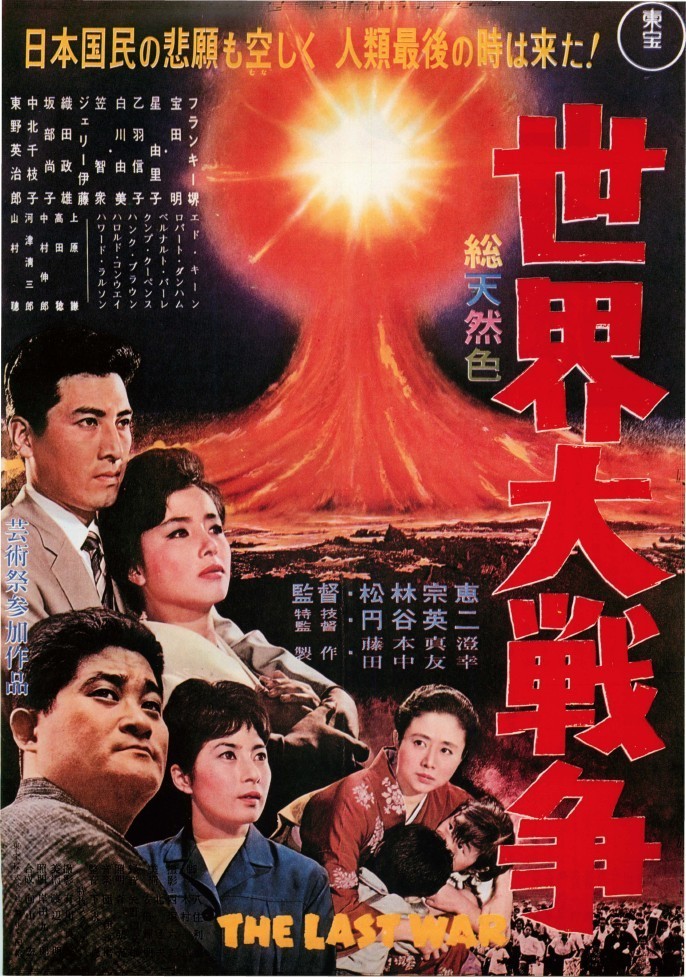
As The Last War (世界大戦争, Sekai Daisenso) points out, by 1961 16 years had passed since the end of World War Two during which Japan had begun to rebuild itself, heading into a period of unprecedented economic prosperity with the Olympics already on the horizon. But the early 1960s were also a time of increased international tension as the Cold War mounted and many in Japan feared being pulled into another conflict especially with the Korean War not quite so much in the distant past. Toho had become the home of special effects cinema and such films were often coloured with strong messages of peace and social responsibility as humanity banded together to combat an existential threat be it a giant monster or mad scientist. The Last War is no different in that regard, but sadder in showing us that the end of the world may come suddenly and without warning and that if we for a second become complacent it could already be too late to stop it. 

Patriarch Mokichi (Frankie Sakai) has made a decent life for himself after the war working as a driver. His wife, Oyoshi (Nobuko Otowa), is in poor health and he dreams of buying a house by the sea where she can live in comfort. Meanwhile, they have a grownup daughter, Saeko (Yuriko Hoshi), born before the war, and two much younger children, a girl, Haru, and boy, Ichiro. They are a very happy, very ordinary family who are beginning to think that their days of hardship are finally behind them and they have escaped the war’s shadow. The only note of potential conflict lies in the fact that Saeko wants to marry a family friend, Takano (Akira Takarada), a sailor, and is afraid of Mokichi’s reaction, especially as he keeps trying to set up matches for her. 

In fact, having lived through the war Oyoshi and Mokichi are certain that nothing like that is going to happen again, even if the younger generation is filled with anxiety. “Who could ever profit from the destruction of the Earth?” Mokichi not unreasonably asks, signalling his newly consumerist world view. Mind you, he adds, everyone knows the alternative to calamity is hard work, “you have to work hard for peace”. 

Mokichi has indeed been working hard, but has perhaps begun to neglect other areas of his life in his desire to become rich even if that desire is only to make his family more comfortable and give his children better opportunities than he had. Brought over to see a new TV set now on sale, he scoffs that he already has one, “Who needs a second TV?” he asks, but on hearing the news that tensions are rising because a military plane has gone down off the coast of Africa, his first thought is to get on the phone to his broker and junk his real estate stocks for shares in aeronautics. Mokichi is unconvinced by an old man selling potatoes on their street who apparently lost everything in Hiroshima and has since become a devoted Christian donating most of his profits to anti-nuclear charities, describing him as just “showing off”, firmly believing that nothing like that is ever going to happen again. “I cannot accept it” he says, “what would be the point of the aspirations of humble folk like us if we’re all destined to go poof into extinction?”.  

As the only nation to have directly experienced nuclear war, the intense fear of its recurrence is indeed understandable. If a nuclear war escalates, it will be the end of everything. All human endeavours over thousands of years will be mere dust. There will be no weddings, no births, no graduations, no grand discoveries, just nothing. When the bomb does indeed hit, the scenes of devastation must have proved extremely traumatic for many in the audience as buildings crumble ominously, the sky turns a fiery red, the streets run with lava, and we can see the outlines of charred bodies lying among the wreckage. The tip of the Diet building sits neatly atop the rubble as if in rebuke of the political failures which, despite the best efforts of the Japanese politicians who make an effort to govern responsibly and are honest with the electorate while advocating strongly for peace through diplomatic channels, have led to the literal end of the world. “You have to work hard for peace” the closing title card reminds us. “We can stop this before it happens, but we have to work together”. “I won’t let you destroy our happiness” Mokichi had screamed at the void, but in the end he was powerless. All it takes is a minor slip, and the world as we know it will cease to be.


Eternal Heart (不壊の白珠, Hiroshi Shimizu, 1929)

Eternal Heart still 1

Hiroshi Shimizu is most often remembered for his sensitive depictions of childhood, but his career, which spanned more than 160 films many of which are presumed lost, was much more varied than might be assumed. His earliest completely extant feature, 1929’s Eternal Heart (不壊の白珠, Fue no Shiratama, AKA Undying Pearl), is a case in point. Set in the heady days of early Showa long before militarism took hold, Eternal Heart bears early witness to Shimizu’s distrust of romantic solutions as its wounded protagonists are forced to accept that they have lost out in the great game of love and there’s nothing they can do about it except learn to endure their sadness.

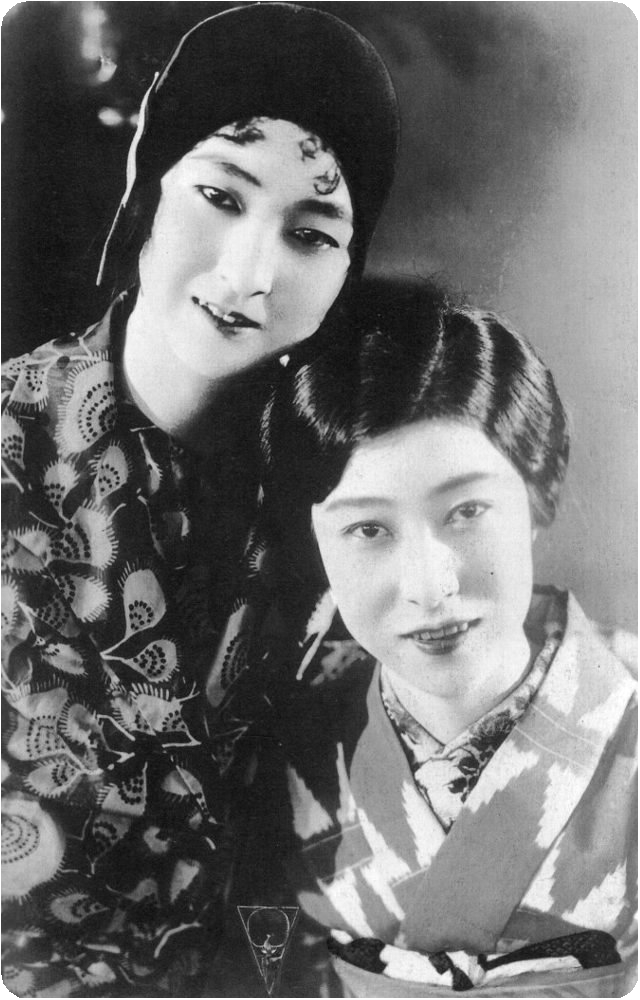
The heroine, Toshie (Emiko Yagumo), is an earnest young woman working as a typist. She has developed a crush on a nice young man, Shozo (Minoru Takada), who works at the same company but unfortunately for her, her “modern girl” sister Reiko (Michiko Oikawa) has taken a liking to him too. To Reiko, Shozo is just one of the guys she likes to string along, but to the seriously minded Toshie he’s the only man she’ll ever love. Plucking up the courage, Toshie writes a cryptic note asking to talk to Shozo about something important and has it sent to him in the interoffice mail to avoid the embarrassment of giving it to him directly. In a spectacular case of bad timing, however, she discovers that Shozo has proposed to Reiko. He thinks the letter is about the possible marriage and that perhaps Toshie is worried he’s not a suitable person to become her brother-in-law, never dreaming that Toshie herself meant to declare her love to him. Hugely embarrassed, Toshie does not handle the situation well but agrees to put a good word in with her mother, after all she does think that Shozo is the best of men and so could never speak ill of him.

The marriage is agreed and Toshie tries to make her peace with it, only to have some kind of episode at the wedding party that leaves Shozo feeling guilty, as if he might have somehow alienated his new sister-in-law. Meanwhile, Toshie also receives the solicitous attentions of the company’s boss, Katayama (Arai Atsushi), a middle-aged widower with three children who makes a clumsy pass at her in the coach home but later apologises and embarks on a more appropriate style of courtship.

The irony is that Shozo and Toshie are actually perfectly suited, only he never saw her because he was distracted by her sister’s modern sparkle. It would be easy enough to see the contrast between the two women as one between tradition and modernity, Toshie the perfect exemplification of traditional Japanese values and her sister the avarice of the flapper generation, but the distinction is more nuanced than it might at first seem. Despite her presentation as a “traditional” woman, Toshie is more progressive than her sister in that she has made a free choice to be a working woman and takes her job seriously, quickly becoming irritated by those who don’t, whereas Reiko is never in search of direct independence only of the freedom to move between one man of means and another. Toshie wants real love, but also her independence and perhaps does not feel that one must necessarily conflict with another.

While the relationship between Shozo and Reiko sours as she becomes bored with his niceness and lack of consumerist avarice, Toshie finds herself filled with hostility towards her former object of affection and consenting to date Katayama partly in romantic rebound. Though he eventually turns out to be a little nicer than that first unpleasant incident in the taxi might have suggested, Toshie cannot escape the sense of social inferiority which keeps her in a subordinate position to a man who ought, in her view it seems, to be her equal if they were married. On an abrupt visit to his family home, she finds herself waiting in the hallway where Katayama’s precocious son (Shoichi Kofujita) mistakes her for the new maid, while his daughters and nieces, dressed in the modern style, openly mock her for being a career woman, suggesting that “typist” is a synonym for “loose woman” while Katayama fails to help the situation by countering only that “some of them are decent”. In response, Toshie calmly and confidently reaffirms that she is proud of her job and ashamed of nothing, only for the kids to chime in with a show of banging a keyboard as if it were something that a baby could do for amusement and little more than noisemaking.

Toshie leaves humiliated, but seemingly continues seeing Katayama at least superficially. It’s at this point she re-ecounters Shozo, who now has something important he wants to discuss with her. Having married Reiko believing her to be playful and innocent, Shozo has awoken to her coquetry and figured out she’s been going on drives with the moustachioed man we saw her glare at on the train on her honeymoon. The implication is that Reiko is only dating the other guy, whom she knows to be married with children, because he has a fancy car – something Shozo showed no interest in getting even if he had the money because like Toshie what he wanted was love. Shozo is understandably hurt and angry but wants to reconcile. Toshie vows to help him, overcoming her timidity to head into one of the modern bars frequented by her sister to convince her to come home, which she does but only to collect her things. Reiko claims that it’s Shozo who is being “selfish” for asking about her life before their marriage. In that she might have had a point, but it’s not something Shozo particularly cared about and he is not in that sense jealous only confused and embarrassed. Reiko refuses to accept her role as a wife, but unlike Toshie she never means to be independent and decamps to the home of her married lover, presumably intending to live off him until something better comes along.

In that sense, Reiko’s “modernity” is not so much the problem as her innate selfishness which the modern world perhaps enables. Reiko, amoral, claims her individuality by reserving the right to do as she pleases ignoring both social convention and other people’s feelings. She married Shozo because he was kind of a catch only to grow bored with him and wonder if she might do better. Toshie, meanwhile, nurses her broken heart with as much grace as she can manage, desperately trying to save her sister’s failing marriage in order to preserve Shozo’s happiness more than to avoid the scandal of marital breakdown. Despite his disillusionment with Reiko’s Westernised “modernity” Shozo finds himself considering emigrating to America in order to escape his heartbreak, resolving that a separation would be “socially unacceptable” and hoping that Reiko will continue to live as “Mrs. Narita” at least superficially even in his absence. Toshie loses Shozo twice. Having married her sister there was no longer any way for her be with him other than as a relative, but now she must watch the pearl her sister cast aside sail away from her never to be seen again. United only in heartbreak they part, Toshie selflessly reflecting on Shozo’s sadness rather than her own, but in even in the midst of her disappointment she stands stoically alone, independent and self-possessed like truly “modern” woman.


Invisible Man (透明人間, Motoyoshi Oda, 1954)

invisible man 1954 posterThe Invisible Man is a frightening presence precisely because he isn’t there. The living manifestation of the fear of the unknown, he stalks and spies, lurking in our imaginations instilling terror of evil deeds we are powerless to stop. Daiei made Japan’s first Invisible Man movie back in 1949 – a fun crime romp with the underlying message that scientific research is important but not as important as ensuring knowledge is placed in the right hands. Toho brought Eiji Tsuburaya back for another go at the same material in 1954 as part of their burgeoning tokusaku industry fathered by Godzilla. The 1954 Invisible Man (透明人間, Toumei Ningen), directed by Motoyoshi Oda, is once again a criticism of Japan’s wartime past but also perhaps of its future. This Invisible Man is an invisible hero but one whose heroism is only recognised once the mask is removed.

Opening in grand style, the film gets off to a mysterious start when a speeding car hits “something” in the road. The “something” turns out to be a previously invisible man whose appearance is returned to him as blood leaks out from under the now stopped car. In his pocket, the man has a suicide note explaining that living life invisible is just too depressing and he can’t go on. Seeing as the note is addressed to a “friend” who is also apparently an Invisible Man that means there are more out there. Despite there being no real threat involved in any of this, the newscasters are alarmed and the public frightened.

This is quite useful for some – a shady gang quickly starts putting on Invisible Man suits including wrapping their heads in bandages just like in the movies, and robbing banks. Admittedly this makes no practical sense but adds to the ongoing fear of an “invisible” threat. An intrepid reporter, Komatsu (Yoshio Tsuchiya), links the crimes to a nightclub where the head of the gang is also trying to pressure the headline star, Michiyo (Miki Sanjo), into a career as a drug mule. Besides violence, their leverage is the little girl who lives across from Michiyo and is blind – the money they would be paying her could also be used to pay for the girl’s eye surgery. Mariko is waiting patiently for her grandfather to make the money, unaware that he has also fallen under the spell of the criminal gang.

The real “Invisible Man” is doing a good job of hiding in plain sight by proudly standing out in a traditional clown outfit complete with makeup and a fluffy nose. Nanjo (Seizaburo Kawazu) works as a promoter for the club and is also good friends with little Mariko who is unable to see him either with or without his clown suit. Unlike other Invisible Men, Nanjo is good and kind – the curse of his condition has not ruined soul.

He is, however, afraid of being exposed. Aside from social ostracism (perhaps someone who wears a clown suit 24/7 isn’t particularly bothered about that), Nanjo fears what his government would do to him if they discovered he was still alive. Like his friend who later committed suicide, Nanjo was a member of an experimental army squad recruited towards the end of the war as Japan sought to create the ultimate warriors to turn the tide in the battle against the Americans. The Invisible Men were born but the war lost, and it was assumed that they had all fallen. Nanjo, surviving, has been abandoned by the land that he fought for. His existence is a secret, an embarrassing relic of Japan’s attempt at scientific warfare, and something which no one wants to deal with. Nando’s friend could no longer cope with his non-existence. Unable to return home, unable to work, unable to marry, there was no “visible” future which presented itself to him.

In this sense, Nanjo represents a point of view many might have identified with in 1954. These men fought and risked their lives for a god they now say is only a man, to come home to a land ruled by the “enemy” in which they can neither criticise the occupation or the former authorities. These men may well feel “invisible” in the new post-war order in which the younger generation are beginning to break free while they suffer the continuing effects of their wartime service even if not quite as literally as Nanjo.

Yet there’s a kind of internalised resentment within Nanjo who describes himself as a “monster created by militarism”. Disguising himself as a clown he attempts to live a “normal” life though one segregated from mainstream society. A half-hearted romance with club girl Michiyo and a well meaning paternalism for the orphaned little blind girl point to Nanjo’s altruistic heroism but also to a reluctance to fully engage with either of them due to a lingering sense of guilt and shame.

The Invisible Man is the hero here while the bad guys subvert and misuse his name to do their evil deeds, terrorising women and threatening to burn the city down rather than surrender to authority. Even more than others in Toho’s expanding universe of tokusatsu heroes, Invisible Man is a defence of the other as not only valid but morally good even in the face of extreme prejudice and violence. It is, however, also one of their less well considered efforts and Tsuburaya’s effects remain few and far between, rarely moving beyond his work on Daiei’s Invisible Man five years previously. Bulked out with musical numbers and dance sequences, Toho’s Invisible Man is a less satisfying affair than Daei’s puply sci-fi adventure but is nevertheless interesting in its defence of the sad clown who all alone has decided to shoulder the burdens of his world.


Battle in Outer Space (宇宙大戦争, Ishiro Honda, 1959)

battle in outer spaceIshiro Honda returns to outer space after The Mysterians with another dose of alien paranoia in the SFX heavy Battle in Outer Space (宇宙大戦争, Uchu Daisenso). Where many other films of the period had a much more ambivalent attitude to scientific endeavour, Battle in Outer Space paints the science guys as the thin white line that stands between us and annihilation by invading forces wielding superior technology. Far from the force which destroys us, science is our salvation and the skill we must improve in order to defend ourselves from hitherto unknown threats.

In 1965 Japan is a hit in space. Having launched their first space station, things are going well but after it is destroyed by flying saucers there is cause for concern. The problem intensifies as strange events occur across the Earth with bridges suddenly collapsing, boats being lifted from the sea and the waters of Venice conspiring to drown the town. World leaders gather in Tokyo to come up with a plan but one of the scientists’ key assets, Iranian professor Dr. Ahmed, is possessed by the Natalians via their high-tech remote control radio waves and procedeeds to do their dirty work for them. The Natalians will settle for nothing less than enslavement of the entire planet and have even set up a base on the moon to make it happen! Time to put those shiny new spaceships to good use!

Scientists may be the heroes of this particular story but the scientific basis for their actions is just as silly as your average B-movie. According to our top professor, the Natalians’ anti-gravity shenanigans can be put a stop to by means of a freeze ray – gravity is, of course, caused by the movement of atoms which is impeded by cold hence the freeze ray. A likely story, but it’s the best they’ve got. The other major problem is that the Natalians are able to possess various people and force them to do their bidding, apparently through “radio waves”. Less about the enemy within, the possibility of becoming a Natalian sleeper agent is more plot device than serious philosophical discussion.

Battle in Outer Space is, in this sense at least, one of the most straightforward of Toho’s B-movie leaning SFX extravaganzas. There is little hidden message here bar the importance of international collaboration as the whole world comes together to fight the alien threat – Middle Eastern and Indian scientists are at the forefront of research and Japan leads the charge flanked by Americans one side and Russians on the other.

Our intrepid band of scientists are the vanguard sent to see off the Natalian threat by jetting off into space and fighting them in their own territory. Honda and Tsuburaya outdo themselves with the special effects which are pretty astounding for 1959 making use of large scale models and matt painting. The scientists travel to the moon to look for the Natalians’ base only to encounter them in space and engage in exciting dogfight. Eventually landing they meet the Natalians face to face and discover they are very tiny and sort of cute but also hellbent on enslaving the Earth. Engaging them in a firefight using heat rays and laser guns, the scientists manage to escape but the Natalian threat follows them all the way back to Tokyo. In true Toho fashion, buildings are destroyed and people knocked flying as the Natalians take the city but our brainy scientists have thought of that and so the aliens have a whole barrage of heat ray guns to welcome them to Earth.

Battle in Outer Space might not have an awful lot going on in the background, but it makes up for it with sheer spectacle both in its effects and in production design. The Natalians are a scary bunch, until you actually meet them, but this time science is on our side as the good guys manage to figure out a way to save the Earth rather than destroy it through fear and angst. In the end it is determination and togetherness which finally lets the Natalians know humanity is not a good prospect for colonisation, only by coming together and making the best of their collective strengths is humanity able to triumph over a superior force – sadly a still timely lesson.


Original trailer (no subtitles)
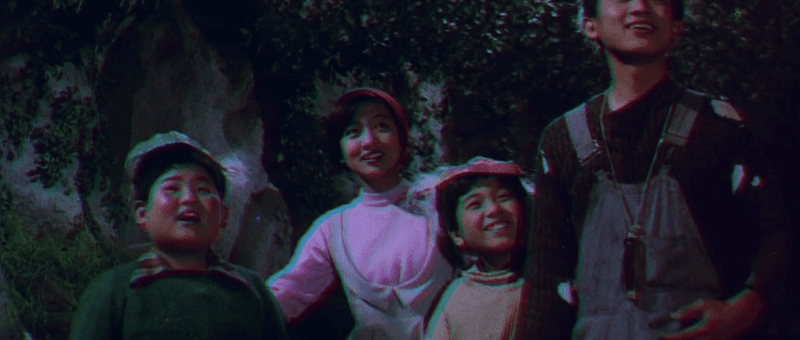
So Young, So Bright (AKA Janken Musume, ジャンケン娘, Toshio Sugie, 1955)

Janken MusumePop stars invading the cinematic realm either for reasons of commerce, vanity, or just simple ambition is hardly a new phenomenon and even continues today with the biggest singers of the era getting to play their own track over the closing credits of the latest tentpole feature. This is even more popular in Japan where idol culture dominates the entertainment world and boy bands boys are often top of the list for any going blockbuster (wisely or otherwise). Cycling back to 1955 when the phenomenon was at its heyday all over the world, So Young, So Bright (ジャンケン娘, Janken Musume) is the first of four so called “three girl” (Sannin Musume) musicals which united the three biggest female singers of the post-war era: Hibari Misora, Chiemi Eri, and Izumi Yukimura for a music infused comedy caper.

As far as plot goes, it’s actually very simple and yet quite complicated at the same time as highschoolers Yumi (Chiemi Eri) and Ruri (Hibari Misora) end up on a school trip to Kyoto where they fall in a river because they’re laughing so much at their classmates’ excitement at spotting someone filming a jidaigeki on the riverbank (neat cameo from director Toshio Sugie). Breaking off from their group, they take their uniforms off to dry only to be disturbed by a young man who tries to take photographs of them at which point they pretend to be washing some clothes in the river. Later they head to an inn which is owned by a friend of Ruri’s mother (who is also an inn owner and former geisha) where they befriend an apprentice geisha, Piyo (Izumi Yukimura).

Piyo then turns up in Tokyo in a bit of a state as it turns out she will shortly be sold into prostitution! She’s fallen in love with someone from the city who she thinks could save her if only she can find him so the girls set out to help her, except the guy’s name is Saito which is the Smith of Japan. During all of this, Ruri also has a subplot about her long lost father who will shortly be moving abroad and apparently wants to actually meet her, opening lots of old wounds.

So Young, So Bright is not a musical in the classical sense, it’s not integrated, but allows ample space for its singing stars to do their thing. Yumi just loves to sing so she randomly starts singing songs she’s heard everywhere, Piyo sings as a geisha and Ruri is rehearsing for some kind of kabuki style performance she gives alone on stage at the climax of the film.

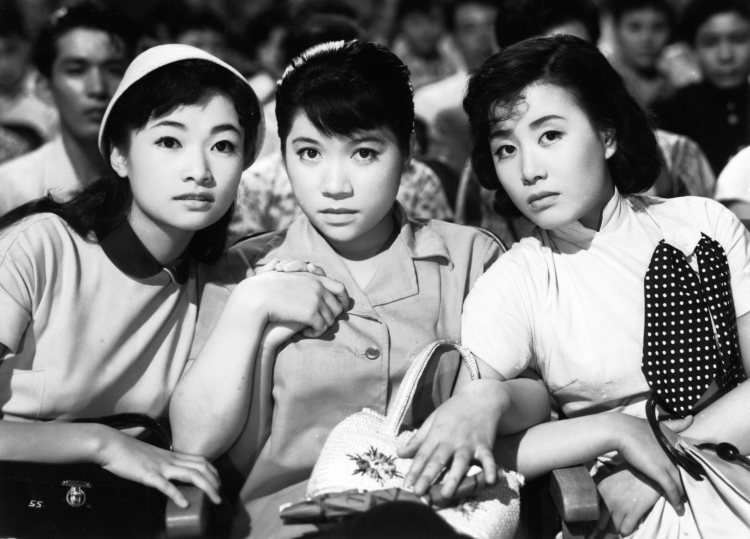
That aside, the main musical sequence comes towards the end where the three girls go to the theatre together and strangely end up seeing “themselves” performing on stage. It’s a neat kind of fantasy sequence in which each of the girls indulges in a little bit of daydreaming as they imagine themselves as stage stars with Piyo being given the cutest, most MGM style number which is then followed by a number from Yumi entitled “Africa” which is very much of its time…and then you get the elegant number from Ruri which is mostly the English version of La Vie en Rose. They also get a trio number to close the film which takes place entirely on a rollercoaster but celebrates each of their slightly different singing styles.

So Young, So Bright is not intended to be anything other than irrepressibly cheerful fluff (despite containing a subplot about possible forced prostitution), but succeeds in being exactly that. An early colour film from Japan it certainly makes fantastic use of its technicolour swirl to give Hollywood a run for its money in the sophistication of happiness stakes. Hollywood musicals are quite clearly the biggest influence though perhaps more those from the pre-war era even down to the only large scale dance sequence which has a distinct Busby Berkley vibe (even it only lasts twenty seconds or so). The rest of the film is actually quite light on dance but makes sure to showcase the singing talents of each of its leading ladies equally. Strangely innocent, even if darkness lurks around the edges with the betrayed geisha and possible prostitution subplots, So Young, So Bright lives up to its name as a completely charming musical comedy that is perfectly primed to banish even the bluest of blues far into the distance.


These movies are so much fun! No subtitles but here are some clips of the various musical numbers:

Izumi Yukimura’s Cha Cha number:

https://www.youtube.com/watch?v=4x-ThhiEpok

Chiemi Eri’s Africa number (not very PC by modern standards, just a warning)

https://www.youtube.com/watch?v=ddbJULH30hI

Hibari Misora’s take on the English language version of La Vie en Rose

https://www.youtube.com/watch?v=jm1-KXgPlvI

And the finale:

https://www.youtube.com/watch?v=mrbegS0LHrI