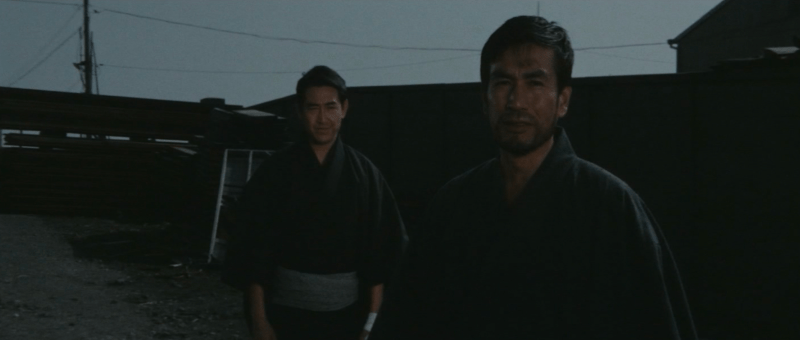
Dissolution Rites (解散式, Kinji Fukasaku, 1967)

“We’re all legitimate businessmen now” as a former yakuza explains to a recently released foot soldier stepping out into a very different Japan in Kinji Fukasaku’s Dissolution Rites (解散式, Kaisan Shiki, AKA Ceremony of Disbanding). The funereal opening scenes feature the first in a series of dissolution rites as a man dressed in black reads from a scroll and explains that all the local yakuza clans will be disbanding because despite “working day and night for the benefit of the world and humanity in the spirit of democracy” times have changed and they find themselves unnecessary.

There at the beginning of that change, Sawaki (Koji Tsuruta) served eight years in prison for the murder of a rival gang boss to ensure his gang got hold of a local landfill site where they later built an oil complex. While he was inside, his boss died and his clan disbanded leaving him with nowhere to go but thankfully looked out for by an old friend, Shimamura, who has since become a construction magnate. On his arrival at Shimamura’s office, however, he’s ambushed in a suspected case of mistaken identity while the man driving him is killed. 

Shimamura (Fumio Watanabe) tells him he’s gone straight, but it soon becomes clear that even as yakuza forsake the streets for more organised crime they still behave like thugs using the same old tactics to get what they want. Shimamura is in cahoots with a corrupt local politician, Kawashima (Asao Uchida), and is determined to get access to another stretch of bombed out wasteland owned by an egalitarian doctor, Omachi, who refuses to sell because he’s set up a community there of marginalised people, including Sawaki’s former girlfriend Mie (Misako Watanabe), who work on his chicken farm. Meanwhile, Shimamura is targeted by rival “legitimate businessman”, Sakurada (Hosei Komatsu), who pulls a few dirty tricks of his own in an effort to cut Shimamura out of the picture.

Once again Tsuruta plays a man who is out of step with his times, partly because he’s been in prison but also in his fierce commitment to a now outdated code of gangsterdom. “The chivalry that we were taught was just a way for bosses to use their soldiers” Shimumura insists, “you’ll look foolish if you don’t get rid of it”, disingenuously casting his transformation into a legitimate businessman as a way of freeing himself from yakuza oppression. Sawaki turns down his offer to join the business because it seems a bit dodgy while intensely disappointed to discover another former colleague, Kubo (Kyosuke Machida), running a trafficking ring masquerading as a management studio for cabaret singers and strippers by tricking women with the offer of good jobs then getting the hooked on drugs and shipping to them to Okinawa to do sex work near the US bases.  

On his return, Sawaki is also stalked by the man whose arm he severed in killing the rival boss who turn out to be, like him, an old school gangster which is why he insists on his revenge only to find an unexpected kindred spirit as the two men find themselves each adrift in a world in which no one really cares about humanity and honour. Sakai (Tetsuro Tanba) chooses to walk a different path, conducting his disbandment ceremony in protest of yakuza corruption. Like many Tsuruta heroes, Sawaki also has the possibility of walking away and living a conventional family life as a husband and father having been forgiven by Mei but inevitably is pulled in a darker direction by the necessities of his code. The oil complex he helped to create is only a symbol of the duplicities of the post-war society allowing men like Shimamura to get rich while literally choking the life out of those like Mei whom they now want to kick out of her home to add insult to injury. 

There’s no one more tragic than a yakuza Sawaki admits, knowing there is no longer any place for him in an amoral gangster society while unable to simply leave it and enjoy a quiet life with the woman he loves. An indictment both of corporatised yakuza and the equally duplicitous practices of “legitimate” businesses and corrupt authorities, the film ends in another righteous assault filmed handheld with Fukasaku’s characteristically canted angles amid the chaos and confusion of a rapidly changing society. 

The Incorrigible (悪太郎, AKA The Bastard, Seijun Suzuki, 1963)

(C) Nikkatsu 1963

(C) Nikkatsu 1963

Seijun Suzuki often credits 1963’s Youth of the Beast as the real turning point in his directorial career, believing that it marked the first time he was ever really able to indulge his taste for the surreal to the extent that he truly wanted. The Incorrigible (悪太郎, Akutato, AKA Bastard), completed directly after Youth of the Beast, is another turning point of a kind in that it marks Suzuki’s first collaboration with set designer Takeo Kimura who would accompany him through his ‘60s masterpieces contributing to the uniquely theatrical aesthetic which came to be the director’s trademark.

Inspired by an autobiographical novel by Toko Kon, The Incorrigible of the title, Togo Konno (Ken Yamauchi), is a young man coming of age in the early Taisho era. He’s of noble birth and enjoys both wealth and privilege – something of which he is well aware, but is also of a rebellious, individualist character believing himself above the normal rules of civil society. Expelled from his posh Kyoto school after getting into a dalliance with a teacher’s daughter (she’s been sent off to a convent), Konno is then abruptly abandoned by his mother who has tricked him into travelling to a remote rural town where a friend of a family friend has promised to reform him at his military middle school. Konno thinks he’s too clever for this, he makes a point of deliberately failing his entrance exam in the mistaken belief that failing to get in would make him free to travel to Tokyo and start life on his own. He’s wrong, and failure to pass the exam would only entail being held back a year. Konno capitulates and agrees to start his new life as one among many in a backward little village in Southern Japan.

Though set in the Taisho era, Konno’s youth seems to suffer from the same problems that would plague the young men of 30 years later. His school is proto-militarist and hot on discipline. The boys are trained to be strong rather than smart and have inherited all the petty prejudices of their parents which they hone to the point of weaponry. The “Public Morals” department operates almost like a mini military police for students – making routine inspections of students’ home lives and keeping an eye out for “illicit” activities round and about town. Konno sees himself as grown man with a rebellious heart – he smokes openly, keeps a picture of the girl who got him into this mess in his room, and tells bawdy, probably made up stories about how he lost his virginity to a geisha (for free). He will not bow to the morality police, or any authority but his own.

Authority is something Konno seems to be good at. Picked on for his continuing preference for Japanese dress, Konno neatly deflects the attentions of the Public Morals division and comes out on top. When they raid his room and complain about his novel reading habit, he shouts them all down and gets them to sit on the floor while he “educates” them about foreign literature. Militarism has not yet arrived, but anti-intellectualism is already on the up and up. Konno’s love of literature is one of his many “deficient” qualities as teachers and students alike bemoan his “frivolous” hobbies, seeing his sensitivity and disregard for the commonly accepted ideals as signs of his unwelcome “unmanliness”.

Konno’s other big problem is, as might be expected, girls. Having been in town only moments Konno takes a fancy to doctor’s daughter Emiko (Masako Izumi) – his desire is only further inflamed after catching sight of her in the book shop and realising she too has bought a copy of Strindberg’s Red Room. She doesn’t care for Strindberg’s misanthropy, but a bond is quickly forged between the two sensitive souls trapped in this “traditional” small town where feelings are forbidden and youth constrained by social stricture.

It is, however, a love doomed to fail. The majority of Suzuki’s early work for Nikkatsu had been contemporary youth dramas, yet the artfully composed black and white photography of the Taisho setting is a melancholic affair which rejects both the rage of the modern action dramas and Suzuki’s trademark detached irony. Using frequent dissolves, The Incorrigible conjures a strong air of nostalgia and regret, a sad love story without end. Yet at its conclusion it makes sure to inject a note of uplifting inspiration as our hero wanders off into a fog of confusion, filled with a passion for pursuing truth and vowing to live without losing hope.


The Incorrigible is the fourth of five films included in Arrow’s Seijun Suzuki: The Early Years. Vol. 1 Seijun Rising: The Youth Movies box set.

Original trailer (English subtitles)