The Housemaid (하녀, Im Sang-soo, 2010)

Kim Ki-young’s landmark 1960 film The Housemaid (하녀, Hanyeo) was a gothic tale positioning the source of its horror in the temptations of an increasingly consumerist society as a moderately wealthy man acquires the means to hire a domestic servant only to give in to sexual temptation which brings about his ruin. Kim’s moralising drama may cast a young woman as a salacious femme fatale, but it also ends with a perhaps surprising coda that reminds the male members of the audience that rules exist for them too and they can’t expect to escape unscathed should they break them. 

Im Sang-soo’s 2010 “remake”, perhaps more accurately described as a re-imagining, updates the tale for the modern day in which a class of super elites has become almost entirely detached from regular society and with it any sense of conventional morality. The heroine, Eun-yi (Jeon Do-yeon), is not a naive schoolgirl but a mature woman once divorced, while the head of the household, Hoon (Lee Jung-jae), is in fact absent for most of the picture which otherwise features only women engaged in accidental class warfare and desperate, internecine fights for survival. 

Im opens, however, with a tense and prophetic scene roving around the night market where Eun-yi is temporarily working alongside a friend while waiting for another opportunity. A young woman hovers over a rooftop railing, eventually falling to her death. Eun-yi is oddly fascinated, asking her friend to come with her to check out the scene on their way home. This odd reaction may fit with later characterisations of her as “childlike”, though otherwise in conflict with constant reminders that Eun-yi is a “good person” despite the potential for corruption offered by the Goh mansion. While Mrs Goh, Hae-ra (Seo Woo), is heavily pregnant with twins and unable to satisfy her husband sexually, he turns to the maid who is much older than she is but also more experienced, earthier, and freer in spirit. Eun-yi is a willing participant in their affair, but is surprised when Hoon leaves her a cheque the next morning as if he were paying her an overtime bonus or merely trying to justify his sexual transgression as a transaction sealed off from his family life. 

Nevertheless, the situation reaches a crisis point when veteran housekeeper Mrs Cho (Youn Yuh-jung ) discovers the affair and suspects that Eun-yi may be pregnant. While as Hae-ra’s mother Mi-hee (Park Ji-young) puts it, affairs are part of the package with a rich husband, a child is an existential threat yet for all her plotting Mi-hee may be overplaying her hand pushing Eun-yi from a second floor ladder in full view of her daughter and granddaughter hoping to engineer if not a death then at least a miscarriage. Victims of this same system of class and patriarchy, Hae-ra and her mother believe they must destroy another woman to ensure they hang on to their position which they only occupy in their relationship to Hoon. 

Mrs Cho, meanwhile, once felt something similar, in essence a turncoat believing that her only possibility lies in toadying for the super rich but now that her son has been made a prosecutor she’s beginning to tire of a life of constant degradation. “R.U.N.S.” is her favourite acronym for describing her existence, “Revolting, ugly, nauseating, and shameless”. Fearing for her safety, she advises Eun-yi not to linger too long in the house, but is finally forced to admit that she feels ashamed in her complicity with the shady machinations of her employers whom she describes as “scary people” willing to act with absolute impunity when it comes to protecting their wealth and position. “Why’d you just stand still and let her slap you like that?” she asks of Eun-yi confronted by the jealous wife, indigent on her behalf but also unable to deny that it’s an apt metaphor for the way she has lived her life trapped in the house of Goh. 

As for the house itself, its fierce modernity makes for a cold home along with its sense of spotless sterility in which everything, and everyone, must have a place. The only source of heat provided is by a raging fire in front of which Hae-ra and her mother plot their “revenge” behind the back of an otherwise emasculated Hoon who is later forced to confront the reality that he is largely without power in this matriarchal household. Im’s camera tilts at these destabilising moments, a degree of unease lurking in the house’s shadowy interiors. Eun-yi wanders around in her white nighty like a living ghost now defined by her complicated status straddling a class divide. Yet she really is a “good person” with a “pure heart”, her desire for revenge largely turning inward but also doomed to fail in that you cannot shame the shameless into recognising their own immorality. Eun-yi never considers digging in and taking over the house herself, while her opposing numbers operate under a misplaced terror of her potential to unseat them. Their ongoing oppression is both modus vivendi and ingrained defence mechanism. 

Yet they are all victims of the same systems of entrenched class privilege and patriarchy that set one person against another driven by fear and desperation. Only Mrs Cho finally has the courage to reject the system altogether by removing herself from it, no longer willing to be complicit with her own degradation. “That’s what these people are like,” Hoon sneers, almost offended but perhaps shaken by Mrs Cho’s quiet revolution in realising he holds no power over those who’ve decided to be free. 


International trailer (English subtitles)
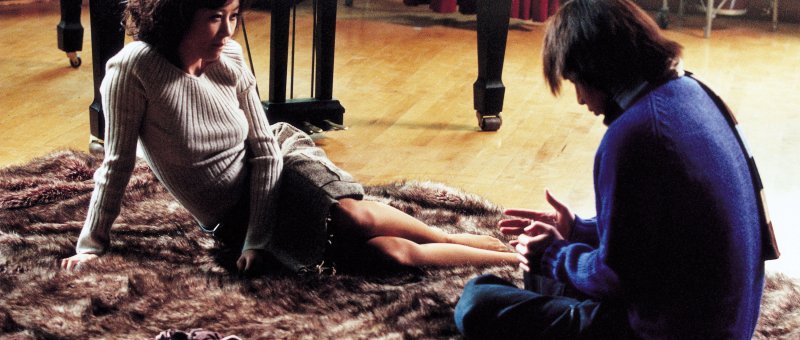
A Good Lawyer’s Wife (바람난 가족, Im Sang-soo, 2003)

Sexual repression and rigid patriarchal social codes slowly dissolve a “normal middle class” family in Im Sang-soo’s extremely frank treatise on contemporary gender roles, A Good Lawyer’s Wife (바람난 가족, Baramnan Kajok). The Korean title translating as “adulterous family” perhaps hints at Im’s winder intentions focussed not only on the role of “wife” but each of those within the family unit which is it seems resistant to change even as the society changes around it, the widowed mother-in-law ironically emerging as the most liberated and progressive of them all. 

Hojung (Moon So-ri) may be a good lawyer’s wife, but she’s also quietly dissatisfied eventually drifting into a relationship with a strange teenage neighbour she caught peeping at her in the nude. Her husband Youngjak (Hwang Jung-min), the lawyer, is a poor lover unable to satisfy her sexually while conducting a secret affair with a bohemian artist with whom he is able to have transgressively kinky sex. The couple have a young son, Soo-in, who is adopted and a little insecure worried that his grandmother doesn’t really like him because they aren’t related by blood while the other kids sometimes pick on him at school. Grandma Byunghan (Youn Yuh-jung) meanwhile is also having an affair, contemptuous of Youngjak’s father Changgeun (Kim In-mun) who has just been told he has only a month to live. 

Yet to everyone else the Joos lead “normal middle class life”, words Youngjak later uses unsuccessfully to help a woman get off on charges she otherwise admits. It might be taboo to speak of it, but sexual repression seems to be at the root of all their problems or at least an incompatibility between leading a what is conceived as “normal middle class life” and embracing one’s sexuality. As good lawyer’s wife Hojung remarks to a friend, once you get married “you’re not a woman anymore, you’re really nothing”. As his wife, and as a mother to Sooin, Hojung is no longer perceived as a sexual being by her husband, though as we later discover he remains somewhat passive both with his wife and with his mistress by whom he is penetrated from behind. Hojung meanwhile achieves her only orgasm when positioning herself on top of her inexperienced teenage lover, symbolically if also problematically reclaiming her sexual agency.

Hojung’s rebellion also has an ironic quality in that finally restores her maternity as she experiences what she describes as a miracle pregnancy, pointing at the couple’s sexual incompatibility as the primary reason they were not able to conceive a child. Even so, the film heavily suggests the cruel and unexpected tragedy which later befalls the family is a kind of punishment for the mutual transgressions of husband and wife as they sought the fulfilment denied to them by the constraints of a “normal middle class life” within the confines of a patriarchal marriage. “If your body wants it, give it what it wants” Byunghan eventually offers when meeting with her lover, declaring herself too old to feel guilty or embarrassed for satisfying her sexual desire while openly contemptuous of her husband with whom it seems she had an unhappy life. “Life’s about being truthful to yourself” she explains to her son, finally taking control now freed from marital constraints if ironically immediately considering re-marriage. 

Changgeun meanwhile sings North Korean military songs in the operating theatre and as we eventually realise, has no siblings because his mother and six sisters were all abandoned in North Korea where they died. His father escaped with him alone though it appears they are now estranged and it can be assumed that Changgeun’s drinking habit which eventually leads to the illness which kills him and destroys his marriage is born of a desire to overcome his guilt and trauma. Changgeun’s past too is something which must be repressed, he cannot easily speak of it because of the stigma surrounding his North Korean roots neatly linking back to Youngjak’s work with the families of those still looking for loved ones executed during the war quite literally falling into a mass grave in the film’s opening. All of these buried truths erode the foundations of the traditional family, yet Im seems to suggest perhaps the family in this form at least isn’t worth saving if it only causes people to hurt each other while forced to conform to a series of socially defined roles unable to be their most authentic selves even within a bubble of supposedly unconditional “love”.


Trailer (no subtitles)

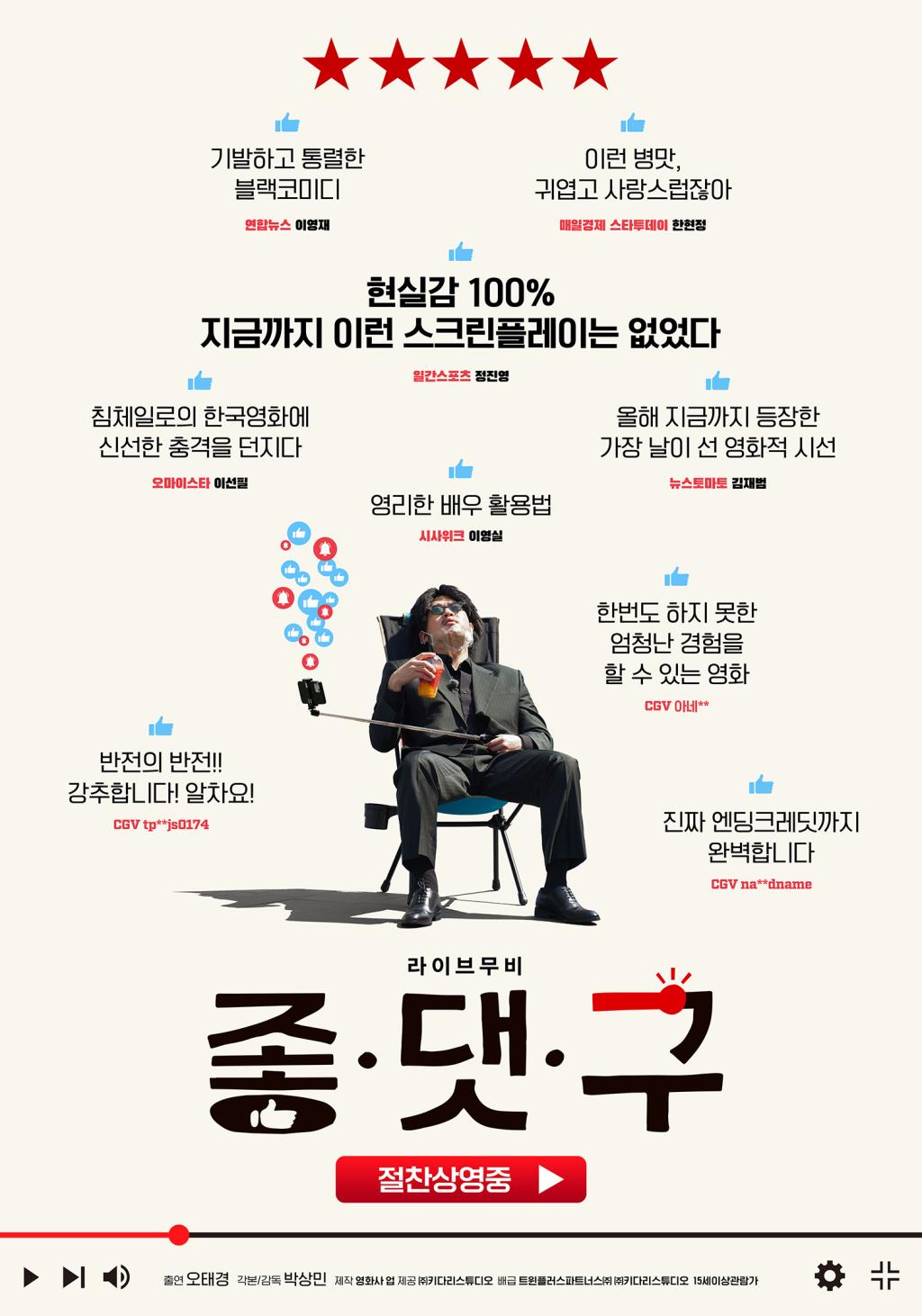
I Haven’t Done Anything (좋.댓.구, Park Sang-min, 2022)

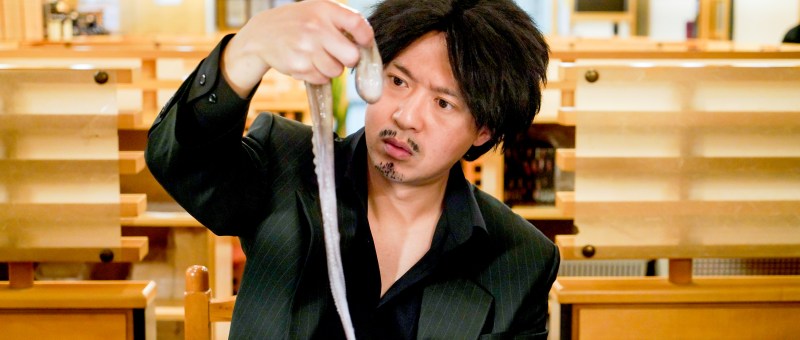
The central irony of Park Sang-min’s meta comedy I Haven’t Done Anything (좋.댓.구, Joh.Daes.Gu) is that a man who remains defiantly silent generates much more interest than the one desperately chasing YouTube success. Adopting a “screen life” aesthetic in which much of the action is told through social media and video screens, the film asks a series of questions about our petty obsessions, online authenticity, media manipulation, and the impossibility of escaping a predetermined image as its embattled hero strives to reinvent himself by his inhabiting most famous role.

Actor Oh Tae-kyung plays a version of himself who is struggling to maintain his career as an actor having begun as a child star with his most high profile roles including that of the younger Oh Dae-su in Park Chan-wook’s Oldboy. With work thin on the ground, he turns to YouTube but fails to make an impact with content that commenters describe as old hat such as “mukbang” eating videos and unboxings. It’s then that he comes up with the idea of rebranding as “Li’l Oh Dae-su”, dressing up as the protagonist of Old Boy and accepting viewers’ challenges which at one point include him taking revenge on a gang of class bullies by hitting them on the head with a plastic mallet while mimicking the famous corridor fight scene from the landmark drama.

But then, someone else has already shared their screen with us. Going under the name “Bulldog”, a viewer asks Tae-Kyung to solve the mystery behind a man who’s been standing silently in the square with a large sign reading “I Haven’t Done Anything”. Tae-kyung reasonably wonders why Bulldog didn’t just ask the guy himself, but as he explains “Picket Man” refused to answer him. Given the large amount of money Bulldog has pledged for this seemingly simple request, Tae-kyung accepts the challenge but Picket Man continues to ignore him no matter the silly stunts he pulls an attempt to break his concentration. 

Bulldog’s apparently strong desire to know the truth, willing to offer up vast sums of money just to satisfy his curiosity, hints at our own petty obsessions. After all, the cryptic quality of the sign is intriguing. What exactly is Picket Man trying to say, what didn’t he do and who says he did it? Of course, in another way, Tae-kyung also feels he hasn’t done “anything” with his life and stuck in a career morass unable to shed the image of himself as a child actor and young Dae-su in particular. Every time someone offers him another role, he worries that the baggage of his early career follows him and he’s simply not credible as a hardened gangster, for example, if everyone only sees him as the eldest of six siblings in a much loved TV drama or the little boy who grow up to become the schlubby captive Oh Dae-su. 

When the skit becomes an accidental viral hit, Tae-kyung begins to worry that perhaps he’s doing Picket Man a disservice and this kind of publicity isn’t really what he was after though it’s puzzling that he himself refuses to speak about what it is he hasn’t done. What he realises is that Picket Man is much like himself and he’s done to him what others have done to Tae-kyung in reducing him to a single image. How will anyone ever see this otherwise anonymous person as anything other than “Picket Man” now? Tae-kyung has unwittingly exploited him for his own ends and possibly ruined his life in the same way that anyone who becomes a meme is robbed of an identity. 

Then again, in this very meta tale not everything is as we think it is and we ourselves, like the YouTube commenters, are being manipulated by unseen forces. As Picket Man becomes the latest social media phenomenon, other content creators start arbitrarily jumping on the hashtag, randomly mentioning Picket Man to boost their own views while unscrupulous forces also exploit the meme potential to run scams featuring Picket Man’s image. Park carries the meta quality through to interrupting the film with fake YouTube ads and product placement from sponsors that remind us we are being sold something whether we realise it or not and that we might not even realise what the product is or who’s selling to us as the final reveal implies. Nevertheless, there’s a sense of triumph in the success of this heist that’s been pulled on us in the winning self-deprecation of dejected former child star Tae-kyung and his great master plan to shed himself of an otherwise inescapable image. 


I Haven’t Done Anything screens 5th November as part of this year’s London Korean Film Festival.

Original trailer (English subtitles)

Three Sisters (세자매, Lee Seung-won, 2020)

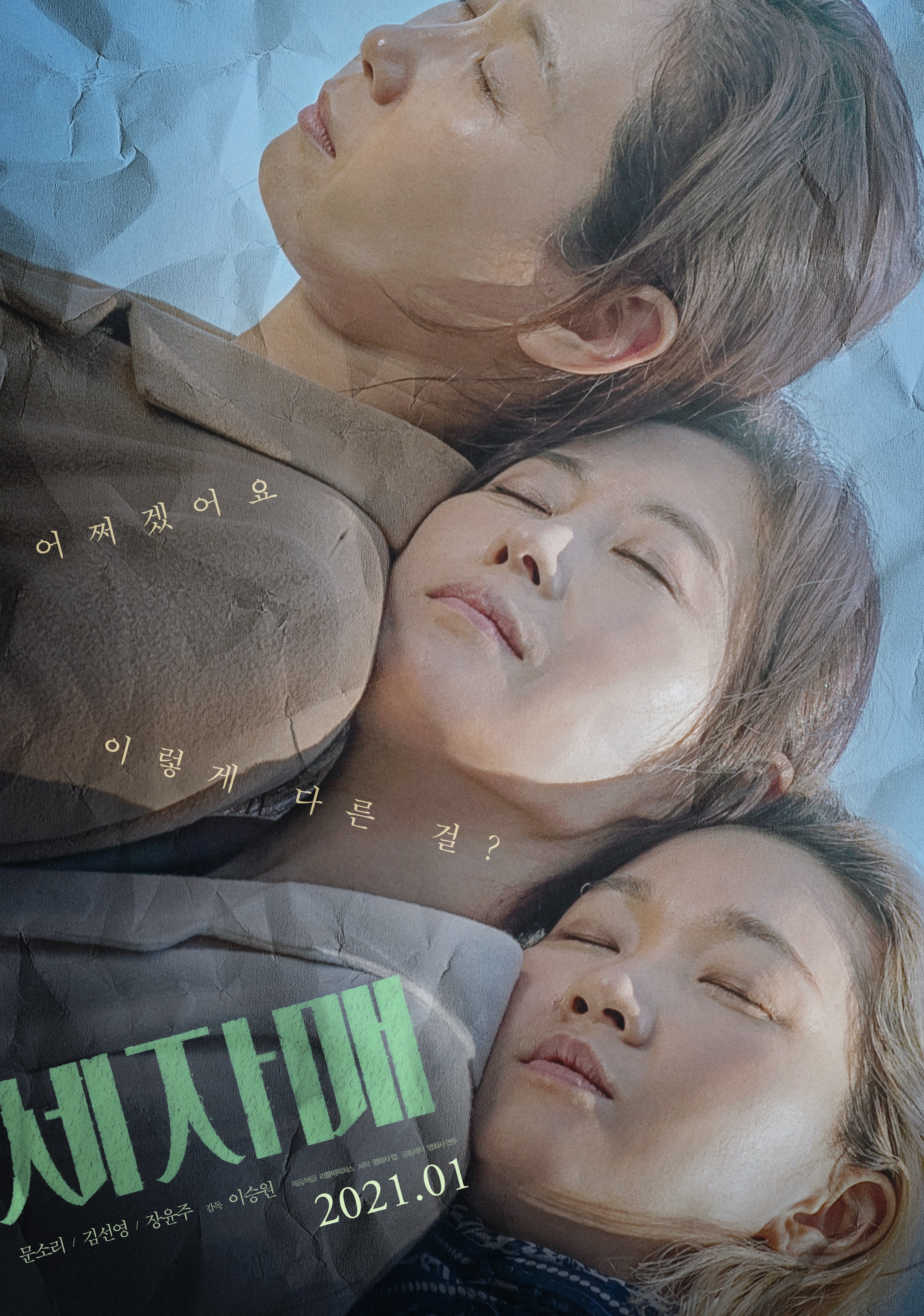
Lee Seung-won’s lightly humorous family drama is not an adaptation of the Chekhov play, but like its namesake does find Three Sisters (세자매, Se Jamae) trapped in the past, their lives “messed up” by the demands of living in a patriarchal society. A showcase for the three actresses at its centre, Lee’s drama works towards a gradual sisterly solidarity brokered by an awkward confrontation with the source of all their trauma but also lays bare the radiating consequences of unchecked male failure as the three women struggle to lead successful adult lives in the shadow of their childhood suffering. 

Opening with a black and white sequence in which two young girls run hand in hand quite clearly away from something bad rather than just for the joy of it, Lee switches to the present day in which oldest sister Hee-sook (Kim Sun-young) is an anxious middle-aged woman perpetually making apology for her existence, while middle sister Mi-yeon (Moon So-ri) is a cooly controlled deaconess and mother of two, and little sister Mi-ok (Jang Yoon-ju) is an unstable drunk and struggling playwright married to a moderately wealthy greengrocer with a teenage son from a previous marriage. 

They have all quite obviously chosen different methods in effort to suppress the effects of their childhood trauma, raised as we later realise in a violent home abused by their drunken father but apparently expected to put up with it out of filial piety. A half-sister Hee-sook finds herself apologising for anything and everything, filled with intense shame for her very existence. Mi-yeon by contrast has chosen order, devoutly religious she maintains high standards for her family but is filled with barely repressed rage unable it seems to express any other emotion. On realising that her professor husband (Jo Han-chul) is having a highly inappropriate affair with a much younger student she reacts with both violence and cunning, unilaterally putting a stop to his philandering while subtly letting him know that she knows and has dealt with it. Further emasculated, he tries to get some kind of normal reaction from her, hoping she will shout or hit him but she continues in the same calm and controlled fashion as if nothing had happened. Meanwhile, in another echo of her father’s violence she finds herself taking out her frustrations on her young daughter, Ha-eun (Kyung Daeun), who rebels against her need for order by refusing to say grace. 

Mi-ok by contrast has in a sense chosen chaos, drinking herself into oblivion while often ringing Mi-yeon in intense confusion unable to recall a seemingly unimportant detail from their mutual past. Taking on the big sister role, Mi-yeon finds herself in a similar position with Hee-sook who apparently doesn’t remember an event that was important to her of their dining together in the same cafe they are currently visiting back when she first came to the city and Hee-sook worked in a nearby office. Later the three sisters will attempt to visit another cafe that Mi-ok had struggled to remember but will find it closed, their past perhaps locked to them but in a sense also pushing them towards a happier future as they reaffirm their sisterly bonds after living lives of highly individualised suffering. 

Failed by a feckless father, the three women find themselves at the mercy of problematic men Hee-sook apparently re-victimised as the wife of an abusive partner who returns periodically to extort money and undermine her self-esteem, while Mi-yeon attempts to evade subjugation by dominating her husband only to find him rebelling against her through an extra-marital affair. Only Mi-ok seems to have made a better marriage to a mild-mannered, patient and caring husband but is also accused of marrying him for his money while taken to task by others for her “failure” to play the part of the conventional wife and mother, her ability to do so perhaps corrupted by her traumatic childhood. “Just treat them with love” Mi-yeon ironically advises seconds after unfairly scolding her own daughter, simultaneously explaining that no one learns to be a mother, though of course in some senses they do, and that anyone can be one as long as they work at it. Nevertheless, after confronting the source of all their pain and suffering the three women manage to rediscover a sense of solidarity that perhaps allows them to reclaim their agency and live better, more fulfilling lives free of the shadow of the past. 


Three Sisters screened as part of the 2021 Osaka Asian Film Festival

Original trailer (English subtitles)
Family Ties (가족의 탄생, Kim Tae-yong, 2006)

What is it that binds a “family”, bonds or blood, and do you really have a choice when it comes to being in one? Those are all questions which might have greater import in societies in which the concept of family is clearly defined and deeply entrenched, but even so the answers may be in a state of flux in the face of rapid social change which perhaps dangles the possibilities of greater personal freedom while in other ways remaining rigidly conservative. 

More literally translated as the birth of a family, Kim Tae-yong’s Family Ties (가족의 탄생, Gajokeui tansaeng) explores these changing connections through three interconnected stories, the first two occurring roughly contemporaneously and the third around a decade later. The heroine of the opening chapter, Mira (Moon So-ri), is a reserved young woman running a small cafe mostly catering to noisy teens. Originally excited to receive a phone call from her younger brother Hyung-chul (Uhm Tae-woong) whom she hasn’t seen for five years letting her know he’ll be coming home for a visit, Mira’s enthusiasm for the reunion dwindles when he turns up with a new wife, Mu-shin (Go Doo-shim), who appears to be much older than him. Mira is understandably put out. Firstly, he obviously didn’t invite her to his wedding, in fact he didn’t even bother to share the news he’d got married, and secondly it’s quite inconsiderate not to have warned her there would be an extra guest in tow especially as they’ve not met before. 

On the other hand, perhaps seeing him again merely reminds her of all the reasons they haven’t stayed in touch. In a quiet moment, Hyung-chul reveals he wants to open a shop selling traditional hanbok nearby, which is a surprise, but Mira instantly realises he’s probably come for money and repeatedly tells him she doesn’t have any. When everyone’s asleep, she makes a point of putting her bank book in a locked box inside the safe just to be sure he won’t abscond with it in the night. With Hyung-chul picking a fight with her fiancé and a random child turning up who turns out to be Mu-shin’s unwanted stepdaughter from several relationships ago, Mira’s patience begins to come to an end. She suggests that perhaps they’ve outstayed their welcome, but then evidently thinks better of it only to be let down once again by her irresponsible brother who claims he can take care of everyone, but predictably does not follow through. 

Family becomes a burden left to women to bear while acting as a safety net for men who view their role as protector yet largely can’t look after themselves. Sun-kyung (Gong Hyo-jin), the slightly younger protagonist of the second story, is frustrated by this same self sacrificing quality in her mother who has been continually deceived by useless lovers all her life including the most recent, a married man who won’t leave his wife and children. She also resents the presence of her much younger brother, still an elementary student doted on by the mother from whom she feels increasingly disconnected. Having run away from home to become a singer, Sun-kyung now has her sights set only on escaping abroad and is currently working as a guide for Japanese tourists only to end up bumping into her ex-boyfriend on a day out with his new partner. For her family is little more than a trap, her boyfriend apparently breaking up with her for being too selfish while she eventually pays a visit to the home of her mother’s lover to confront him and ask if “love” is really worth the price of sneaking around living a lie. Yet bonding with her brother and discovering what was in the mysterious suitcase her mother insisted on leaving at her apartment perhaps reconnects her with her childhood self and a more positive take on family bonds, even if that means in a sense regaining one dream only to abandon another. 

In any case, the anxieties of the first two sequences are visited in the third through the story of a young couple we first meet sitting next to each other on a train. So familiar with each other are they that we assume they are already involved, but they are in fact strangers meeting for the first time. Flashing forward a little, however, we can see their relationship is strained. Kyung-seok (Bong Tae-gyu), the young man, has inherited a sense of male insecurity, flying into jealous rages ostensibly because his girlfriend Chae-hyeon (Jung Yu-mi), is simply too nice or more to the point she’s nice to everyone and not just to him. He is frustrated by her because he feels she allows herself to be taken advantage of, often lending money to people who won’t see the need to pay her back because she’s too “nice” to bring it up. The last straw comes when he feels she’s embarrassed him by not showing up for a family dinner because she got involved in the search for a missing child. 

“When I’m with you I’m dying of loneliness” he somewhat dramatically announces as part of a breakup speech, annoyed that Chae-hyeon does not devote herself entirely to him as perhaps he expects a woman to do, but defiantly carries on being indiscriminately nice to everyone. He describes his mother as “pathetic” for having been overly attached to unreliable men, only to be corrected by his sister who reminds him that she merely had a big heart, something he’s perhaps lacking in his broody neediness. Yet through meeting Chae-hyeon’s family we get a sense of something different and new in which two women have raised a child unrelated to them by blood who came into their lives by chance as the result of a man’s irresponsible behaviour, an unnecessary throwaway reference to separate bedrooms perhaps undermining the boldly progressive introduction of Chae-hyeon’s two mothers to the extremely confused Kyung-seok. Nevertheless what we see in this last family, born as it was through a series of accidental meetings, is the first instance of a warm and loving home built on mutual support and affection rather than simply on blood or obligation. Having reclaimed the nature of family for themselves perhaps gives the women the courage and conviction to firmly close the door on those who might seek to misuse or corrupt it with their own sense of selfish entitlement, blood relation or not. 


Family Ties streamed as part of this year’s London Korean Film Festival.

Peppermint Candy (박하사탕, Lee Chang-dong, 1999)

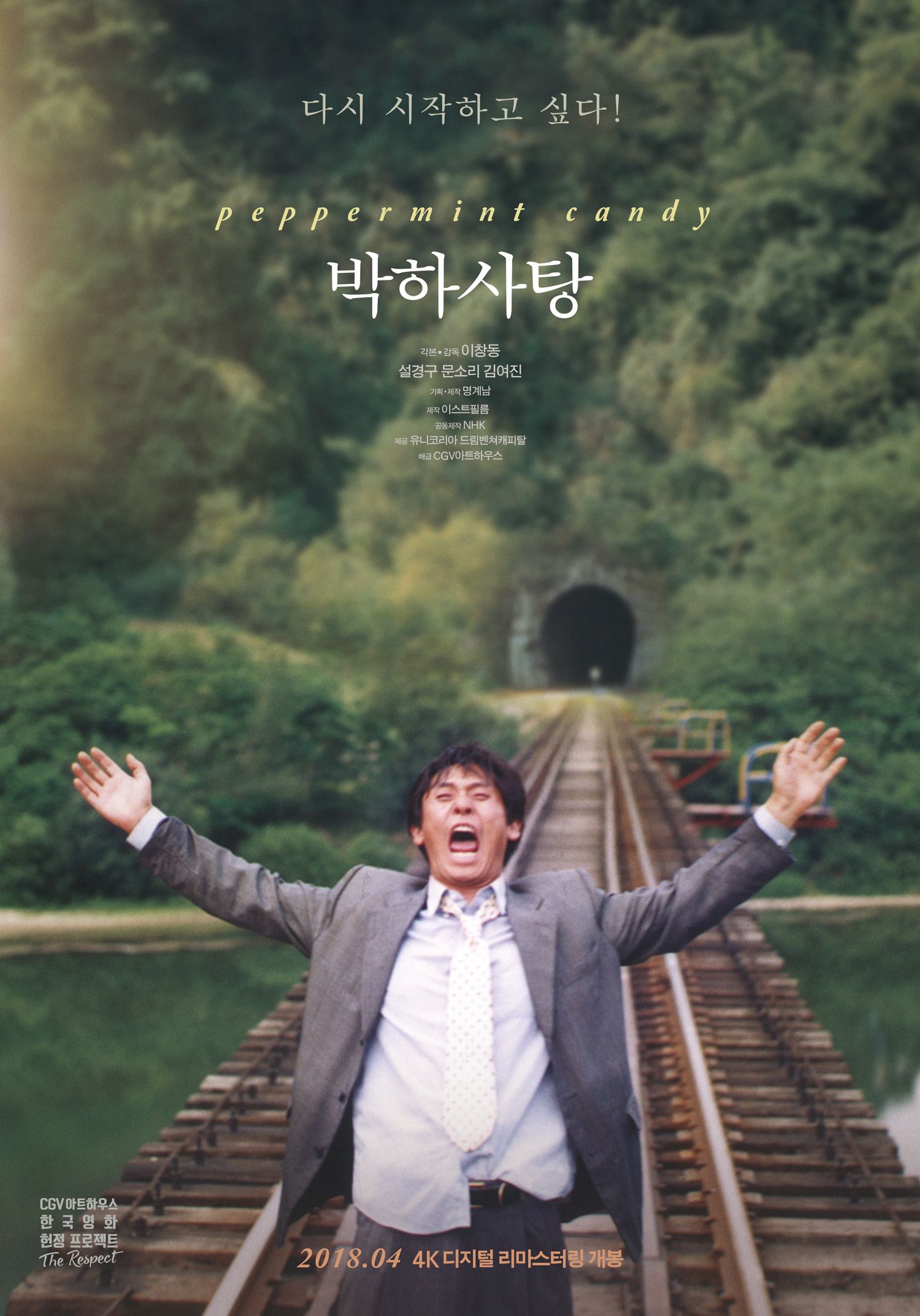
Peppermint Candy 4K posterA wise man once said that the tragedy of life is that you have to live it forwards but it can only be understood in reverse. Lee Chang-dong’s second feature, the poignantly titled Peppermint Candy (박하사탕, Bakha Satang), lays bare the wounded innocence of 20th century Korea through the story of one man betrayed by the world in which he lived, eventually destroying himself in a protracted act of self-harm intended as a perverse attempt either at atonement or grudging conformity with a society he could not resist.

Beginning and ending with a picnic, Lee opens in 1999 as a hopelessly drunk Yong-ho (Sol Kyung-gu) crashes a reunion party he wasn’t technically invited to held to mark 20 years of friendship among former factory workers now approaching middle age. Dressed in a suit which looks somehow wrong on him, Yong-ho hogs the karaoke mic to sing a maudlin song about failed love, dances wildly, and sobs with the crushing hopelessness of a man entirely alone in the world. While his old friends try to reclaim the cheerful atmosphere, he climbs up to a nearby railway bridge where he waits for a train with outstretched arms, screaming “I’m going back” as he prepares to greet it.

Yong-ho does indeed “go back” as the train bears us ceaselessly back into the past, showing us the moments of Yong-ho’s life which struck him like a hammer to the soul and turned him into the defeated figure on the railway bridge, howling into the wind. At 40, Yong-ho is a hollowed out shell of a man, divorced and living in a greenhouse after falling foul of the volatile late ‘90s stock market, subsequently cheated out of all his money and the possibility of a new start by a man he thought was his friend. Given what we later learn about the middle-aged Yong-ho, it’s difficult to believe he had any kind of friends at all, and even if we’re conditioned to pity him as a man already dead he does nothing to earn our sympathy, cheating a poor roadside coffee seller out of a few pennies and then quietly smirking to himself in the safety of his car.

Yet, he begins to soften when a kindly man shows up and tells him that his first love, Sun-im (Moon So-ri) – now apparently this good man’s wife, is close to death and wants to see him one last time never having given up on the man he once was. Given the suit which doesn’t suit him by Sun-Im’s husband so that she won’t realise Yong-ho has made a mess of his life and be upset, Yong-ho stops to pick up a small jar filled with the titular “peppermint candy”, suddenly revealing that perhaps he never quite gave up on that man either and that may be his tragedy.

Before he was an arch capitalist making a few shady bucks in the pre-financial crisis economic boomtown of the newly democratised Korea, Yong-ho was a policeman working for the authoritarian government brutally torturing teenage democracy activists during the dying days of the regime. As a young rookie we see him squeamishly try to resist, only to be pressured into violence and then snap. The suspect fouls Yong-ho’s hand with the kind of smell that never really washes off, but it’s just one more stop on Yong-ho’s journey to spiritual ruination. Finally we reach his breaking point, in Gwangju in 1980, where his soul is forever soiled.

The Gwangju Massacre, in the story of Yong-ho’s life which is also the story of Korea, is the great festering wound which can never be healed. He carries it with him in an intermittent limp that resurfaces at times of emotional difficulty, and convinces himself that he is unworthy of everything good or innocent in the world. He breaks with Sun-im, cruelly betraying her faith in him with a crude gesture that wounds them both equally, mutually understood as a perverse act of kindness. Becoming what he thinks he’s supposed to be, what this society has made him, he wilfully destroys himself in a decades-long act of self harm that leads only back to the train which haunts him throughout all of his encounters, so painfully central to the arc of his life. Literally railroaded by an inexorable fate, Yong-ho lacks the will to resist believing he is no better than the hand he has been dealt but consumed by self-loathing and infinite regret. There is no way back, only forward, but for Yong-ho, and perhaps for Korea, Lee sees only one way out and the soft of heart will not survive it.


Peppermint Candy was screened as part of the 2019 London Korean Film Festival.

Trailer (English subtitles)

Juror 8 (배심원들, Hong Seung-wan, 2019)

Juror 8 poster 1What is the role of the law in a free and democratic society? In an effort to democratise justice, Korea held its first jury trial in 2008 giving “the people” a voice in the courts. As might be expected the judiciary had its doubts. Where judges and lawyers are best placed to assess the evidence and draw their conclusions, might not ordinary citizens be swayed by emotion or argument? Then again, compassion might be a force sorely lacking in a legal process some might feel to have become too efficient in its keenness to see justice is done speedily, losing all important scrutiny and allowing corruption and complacency to sneak their way in.

Juror 8 (배심원들, Baesimwondeul), a courtroom comedy drama, subtly puts the nation on trial as it asks what the point of the law is if it’s wielded like a blunt object. The case in hand concerns a middle-aged man, Kang Du-sik (Seo Hyun-woo), accused of hitting his elderly mother (Lee Yong-yi) on the head with a hammer and then throwing her off the balcony to disguise the crime. Though the defendant made a confession to police shortly after the incident, he did so vaguely from a hospital bed after being knocked out and now claims he can’t remember the events in question. This presents a problem for the judiciary who had chosen this case for the first jury trial precisely because it seemed so open and shut, all the jury was supposed to do was consider sentencing. Now they’re being asked to consider guilt or innocence and asking lots of awkward questions in what was supposed to be a token effort on behalf of law enforcement to demonstrate that it is listening.

Everything might have gone to plan if it hadn’t been for problematic “Juror 8” Nam-woo (Park Hyung-sik ) who, despite giving some worryingly conservative answers in his interview, instantly sympathises with the suspect and worries that there are too many unanswered questions in the evidence presented. His conviction only strengthens when he wanders off trying to get to the patent office to file sample of a self-defence device he was trying to launch as a business and accidentally meets Kang who seems despondent and frightened, worried he really might be guilty but fundamentally unable to remember.

More cynical minds might ask if Kang’s memory lapse is merely convenient and he hopes to exploit the jury trial to win acquittal through sympathy. Having noticed that Kang has no fingers, Nam-woo insists on a test to see if he is able to swing a hammer only for others to point out that there is no real way to know if he is not physically able to do it or chooses not to to aid his case. Meanwhile, Kang sits sullenly like a defeated ball of pent-up rage, eventually exploding when the jury is handed a letter he claims he was forced to write expressing frustration with his mother’s refusal to sign a legal separation form so that he would be eligible to receive welfare payments.

As his lawyer later puts it, the real villain here is poverty. Kang was raised by a single-mother, something still frowned upon, who had to leave him alone to go out to work. She locked the door from the outside to keep him safe, but that also meant he was unable to escape a house fire and was badly burned at only five years old sustaining prominent facial scarring and the loss of the fingers on both hands which means he is unable to work and cannot easily write. According to the testimony, Kang and his mother argued constantly over money, especially since her job washing dishes at a restaurant came to an end. As her son and dependent, he was unable to claim benefits and wanted, the prosecution claims, to legally sever ties. When his mother refused, they allege that he lost his temper, killed her, and tried to make it look like an accident.

Nam-woo is unconvinced as is another juror whose 30 years as an embalmer tell him that the head wound was unlikely to have been caused by a hammer. Juror 6 is dismissed for speaking out in court, his exuberance held up as an example of teething problems in the jury system, but his words strike a chord with some of the other jurors who wonder if the smug expression on the forensic scientist is there to mask the fact that he didn’t really bother to investigate because there had already been a confession and all he needed to do was “confirm” the police’s findings. Time and again, the jurors accidentally uncover the failings of justice in a system geared towards efficiency. Kang was pushed to confess by police keen to meet their targets, the confession then became basis for deprioritising his case. Or as some of the legal minds put it, they got “sloppy” because there was no sense in devoting time and energy to a matter already closed.

The same thing happens in the jury room. The jurors are ordinary people. They have lives waiting for them. Nam-woo wants to file his paperwork for the business loan, another juror has a child to get back to, one is a salaryman with an angry boss on the phone. Everyone has a vested interest in getting this over with as quickly as possible so they can all go home, but they also take their responsibilities seriously – much more seriously than they were intended to. Korea is a conservative society in which it is natural to follow the guidance of the authorities and the collective will, and so it seems natural to everyone that you simply rubber-stamp whatever the judge says. Nam-woo is a bit different, he notices details and he asks awkward questions. “Just go with the flow” the other jurors urge him, “when in doubt follow their lead”, but he wants to do what feels right. The exasperated businessman orders him to fall in with the boss, in this case the judge, but crumbles when another juror asks for his own opinion. He doesn’t have one, because he’s corporate drone and he’s been conditioned to do whatever the boss says without really thinking about it.

In any case, the jury system itself is a bit of a sham. The jury’s opinion is not legally binding, the judge only has to take it under advisement and can overrule. Sympathetic judge Kim (Moon So-ri), defended in her appointment as “strong and resolute like a man”, is fighting her own battles in a male-dominated arena, hoping for a long overdue promotion following the successful handling of this high profile case she only got through lottery. She begins to notice things she might not have when it was just a formality of sentencing a man who had confessed, but she is under pressure to maintain control and authority while demonstrating the magnanimity of the state. The jurors’ deliberations expose their pettiness and snobbery, some taking against Kang just because he lives in the poor part of town, but also their keenness to ensure the law is fair and exists to protect and not to oppress. Genial and humorous, Juror 8 addresses a serious subject with a lightness of touch and a subtlety that gently exposes the shortcomings of its society while placing its faith in “the people” to make a compassionate choice in the face of a fierce pressure to conform.


Juror 8 screens in Chicago on Sept. 12 as part of Asian Pop-Up Cinema season 9 where director Hong Seung-wan will be in attendance for an introduction and Q&A moderated by Korean cinema expert Darcy Paquet.

Original trailer (English subtitles)

Ode to the Goose (군산: 거위를 노래하다, Zhang Lü, 2018)

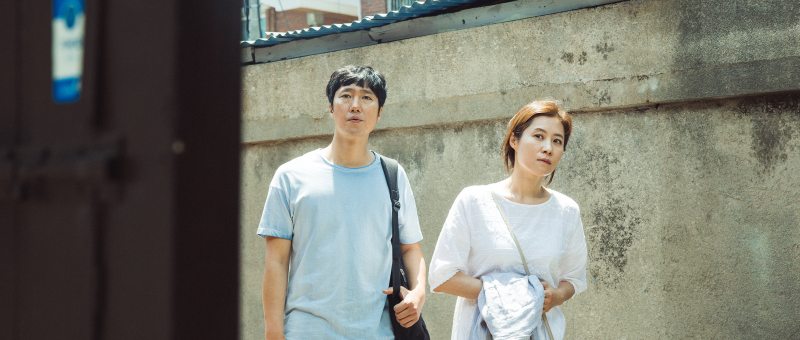
15eeddc21a2c46f3992b2b459ee3ceb3Past and present flow as one in Zhang Lü’s elliptical Ode to the Goose (군산: 거위를 노래하다, Gunsan: Geowileul Nolaehada). Making a perhaps controversial point, Zhang sets the majority of his tale in the harbour town of Gunsan which echoes ‘30s Korea when the nation was still brutally oppressed by the Japanese to which the many graphic photographs and monuments on display stand testament. Yet Zhang seems to ask, returning to his favourite theme, if they’re all Koreans no matter where they were born, why are some more oppressed than others?

The film opens with the hero, struggling poet Yoon-young (Park Hae-il), standing in front of a street map, lost in his mother’s home town. He is then joined by a slightly older woman, Song-hyun (Moon So-ri), whom he has apparently asked to accompany him to Gunsan on a whim without really explaining why. Still hung over from the night before, they stop off at an odd little noodle joint run by an elegant older woman (Moon Sook) who seems oddly fascinated by their strange chemistry. Yoon-young, innocently enough, makes conversation by asking about her home town only for her to shut him down. “What home town?” she fires back, “home is where you settle”.

Later we discover she speaks fluent Japanese, cheerfully conversing with the autistic daughter of the inn owner (Park So-dam) where the couple eventually stay after being judged “lucky” enough to be allowed in. The daughter of Japanese-Korean parents apparently “returned” from Fukuoka, the girl rarely speaks to strangers and only ever in Japanese, though she seems to take a liking to Yoon-young and is keen to try and connect with him, making sure he is always well taken care of while Song-hyun has turned her attentions to the girl’s father, melancholy widower Mr. Lee (Jung Jin-young) who likes to take photographs but only ever of landscapes and not of people.

The Lees are Korean too, even if one of them only speaks Japanese and they run a Japanese-style inn in the middle of a moribund museum to colonial horror (the local shrine even has a comfort woman statue standing in the back). Meanwhile, a passerby mistakes Song-hyun for a Chinese-Korean woman she once knew and insists on speaking to her in Yanbian dialect which Song-hyun, as we later learn, is unable to understand even if there is a Chinese-Korean connection in her family history. Song-hyun muses that had her grandfather, like his brother, chosen to stay in Manchuria after the war then she’d be Chinese-Korean too, as would famed poet of the colonial era Yun Dong-ju if he hadn’t died a political prisoner in a Japanese jail in Fukuoka which is, coincidentally, where the Lees were “from”. It is all “coincidental”.

So why does Yoon-young’s “right wing nut job” (as Song-hyun calls him) father hate Chinese-Koreans so much, blaming them for all the faults of the modern nation and decrying those who left for Shanghai with the Independence Movement as traitorous communist collaborators? A whimsical prequel (or a kind of re-imagining) of the Gunsan incident sees Yoon-young walking through his own “hometown” while a man who probably is not actually Chinese-Korean himself and may just be out to claim a buck or two, holds a rally for the rights of “foreign” Koreans in order to avoid exploitative employment practices and affirm that Koreans from other parts are the same as Koreans from Korea. Are “native” Koreans perhaps oppressing “non-native” ones in the same way that they were oppressed by the Japanese? In practical terms no, obviously not – there are no essential horrors here, but there is deeply ingrained prejudice and wilful exploitation. Interestingly enough, despite his conservatism, Yoon-young’s dad had him attend Chinese language classes, if ones that were run by the Taiwanese who are obviously not “communist” but were also formerly a Japanese colony.

Meanwhile, Yoon-young’s life takes him on a curious symmetry in which everything reminds him of something else. He repeatedly asks the women he meets if they’ve met before, experiences eerily similar moments in Gunsan and at home, and continues to look for connections between himself and a world of universal poetry stretching from the classical Chinese of the film’s title to the melancholy odes of Yun Dong-ju, writing in his “native” language in defiance of colonial authority. Dualities predominate – beauty/horror, attraction/indifference, silence/language, here/there, then/now, but through it all there is commonality. Yoon-young’s failure to communicate leaves him feeling defeated and depressed, trapped in a self-imposed exile while the gregarious Song-hyun gleefully moves forward little caring of the costs. Whimsical and “ambiguous”, Zhang’s playful poetry is difficult to parse but nevertheless carries an essential warmth in its reassuring familiarities and openhearted commitment to the universality of human connections.


Ode to the Goose was screened as the latest teaser for the upcoming London Korean Film Festival. Tickets are already on sale for the next and final teaser screening, Kokdu, which will take place at Regent Street Cinema on 16th September.

Original trailer (no subtitles)

https://www.youtube.com/watch?v=z8vZ0RIJ0GU

Maggie (메기, Yi Ok-seop, 2018)

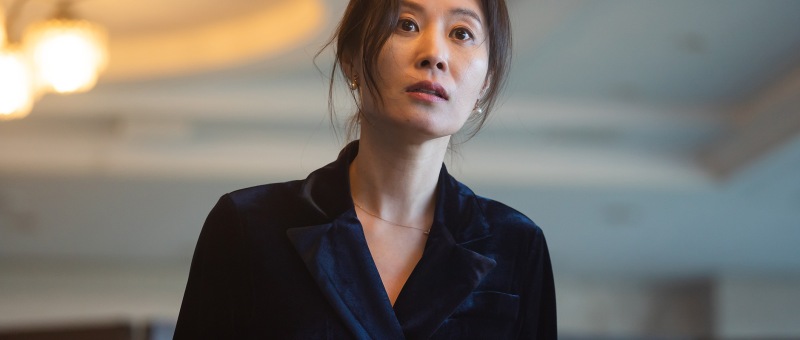
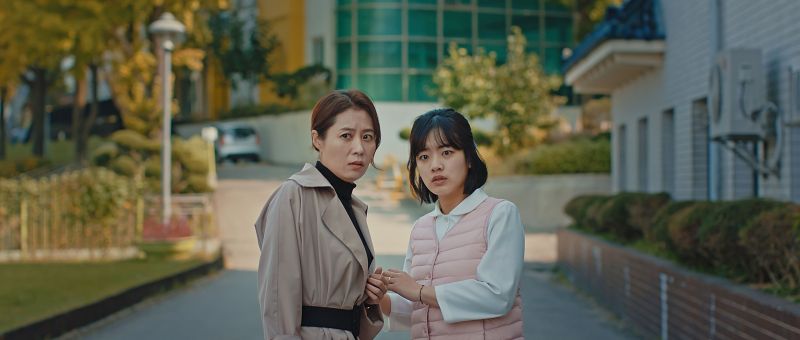
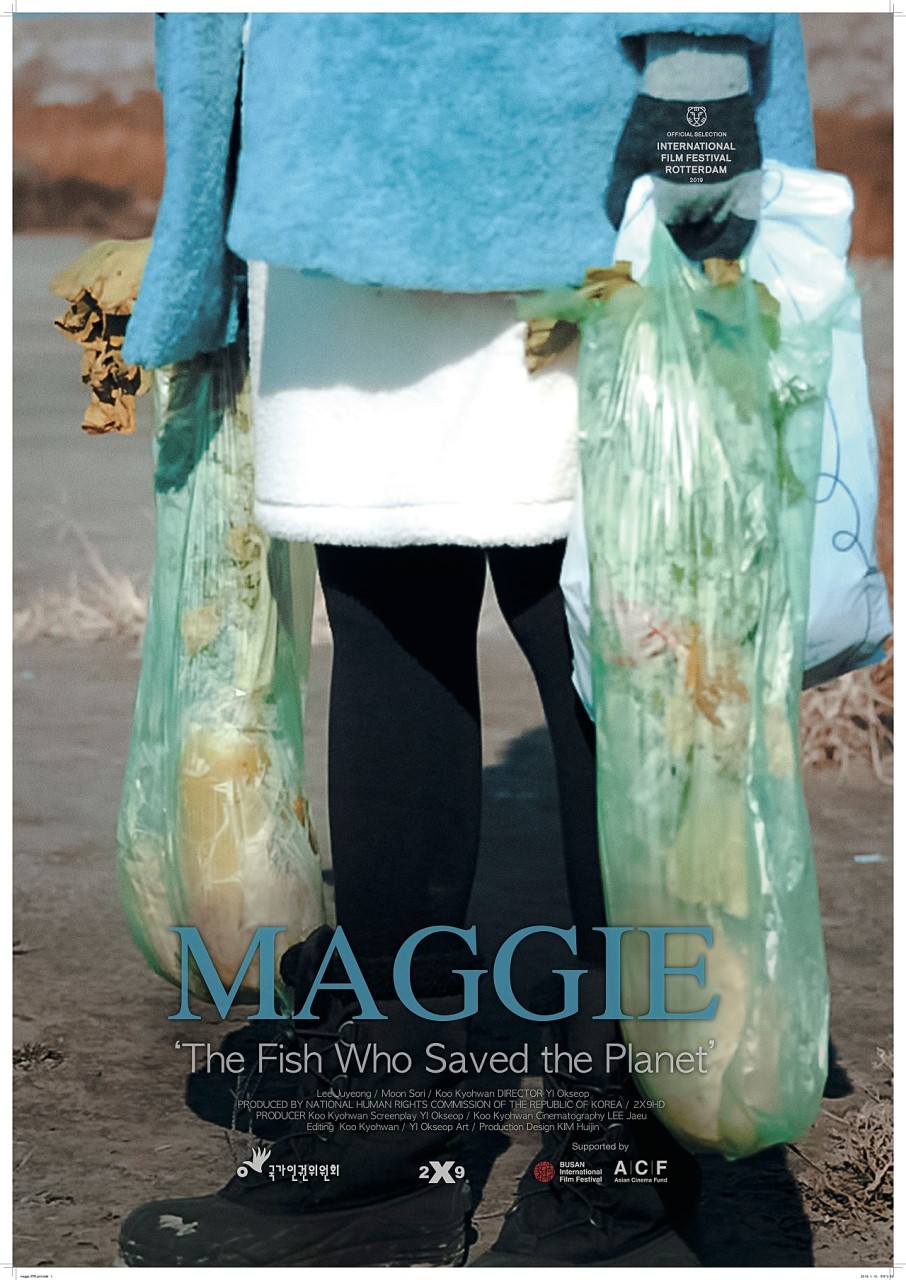
Maggie poster 1“When we fall into a pit, what we need to do, is not dig any further but quickly climb out” according to a mysterious post-it discovered by a nurse when picking up the laundry (apparently inexpertly performed by her preferred cleaning service). The aphorism turns out to belong to Doctor Lee (Moon So-ri), the head physician at Love of Maria hospital where the titular Maggie (메기), a catfish, lives in a small tank observing the life around her and sometimes predicting earthquakes and other earth shattering events. A surrealist odyssey across the “pitfalls” of modern society, Yi Ok-seop’s quirky debut feature ponders the ramifications of distance as her various heroes weigh up the nature of “truth” as an absolutist concept.

Narrated by Maggie, the drama begins when the radiographer and her boyfriend are unexpectedly snapped during an intimate moment in the X-Ray room. The picture is then stolen and held up for everyone to see, at which point nurse Yoon-young (Lee Joo-young) worries that she and her boyfriend Sung-won (Koo Kyo-hwan) have been caught out using the privacy of the X-ray booth for unintended purposes. As Maggie says, no one pays much attention to who took the photo only to who might be in it, which is why the entire hospital, except Doctor Lee, ring in sick the next day with only Yoon-young turning up in the morning with the intention to resign. Figuring out what must have happened (and seeing as she’s the only one not embarrassed we can guess who took the photo), Doctor Lee is very upset to realise that the entirety of her staff has probably lied to her. With her intense belief in humanity shaken, Doctor Lee decides to engage in a trust game with her new best friend, Nurse Yoon-young, and simply choose to believe what they’re told, testing their hypothesis by visiting a random employee to verify if they really are “sick”.

Meanwhile, as a result of the earthquakes Maggie intermittently predicts,  mysterious sinkholes have begun appearing all over the nation. This is good news in one sense because it provides lots of extra work for otherwise unoccupied young men like Sung-won who have lost out in Korea’s insanely competitive economy. Like Sung-won, the other men on his team are also well-educated types who otherwise wouldn’t be considering manual work and are hoping for something better once the sinkhole business finally clears up. Mistrust, however, also works its way into their relationship when Sung-won loses a precious white gold ring given to him by Yoon-young, later becoming convinced that one of his colleagues has swiped it.

The loss of the ring leads to an increasing unease between Yoon-young and her boyfriend which is deepened by a visit from Sung-won’s ex who suggests there may have been problems in their relationship which she feels Yoon-young ought to be aware of. Though Sung-won seems sweet natured and laidback, never having acted in any way that would have given Yoon-young cause for concern, she begins to doubt him – suddenly worried by his overly violent crushing of a can out in the street. Doctor Lee’s advice is to simply ask Sung-won directly if the accusations are true, but Yoon-young can’t seem to do it and continues living along side him somewhat resentfully as she eventually comes to the decision to “believe” her friend at face value without investigating further.

“The truth cannot exist wholesomely”, according to Maggie’s “father” (Kwon Hae-hyo). It will always be polluted by self-interest and personal bias. As Doctor Lee says, there will always be people who believe you and people who don’t, so perhaps a healthy level of cynicism is something you need to accept in order to go on living in the world. Even Love of Maria Hospital is not immune to the disease of misrepresentation – a former convent given over as a place of healing it was later bought by an arch capitalist and is now run as a private hospital business (not that it appears to have many “customers”), despite Doctor Lee’s rather amusing ad which proclaims it “of the patients, by the patients, for the patients”.

Finally Yoon-young concedes she’ll need to simply ask Sung-won about his past and gets an honest response, but his honesty only seems to see him falling into a deep pit of despair, calling out from the bottom in the hope of being understood. A surreal exploration of contemporary social woes from the rabidly capitalist society to the growing distance between people in an increasingly interconnected age, Maggie attempts to find the emotional honesty sweet spot but discovers that trust, like everything else, is a complicated business.


Maggie screens on 13th July as part of the 2019 New York Asian Film Festival. It will also be screening as part of the 2019 Fantasia International Film Festival on 17th/18th July.

Interview with director Yi Ok-seop from the Busan International Film Festival

Little Forest (리틀 포레스트, Yim Soon-rye, 2018)

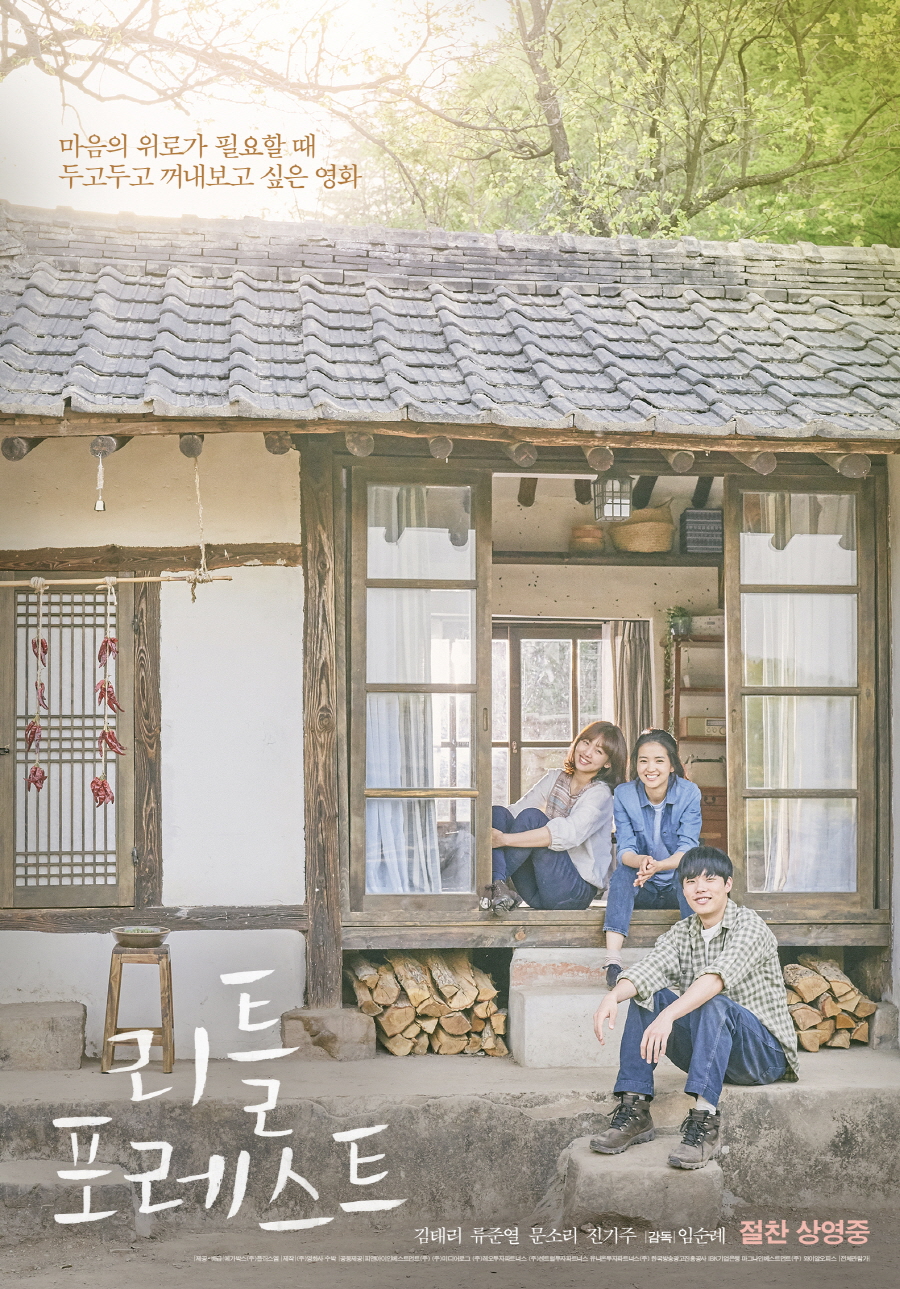
Little forest korean posterWhen you don’t know what to do, you go home. The logic seems sound and indeed the idea is common in many cultures, but the heroine of Little Forest (리틀 포레스트) has gone home to an empty, snow covered house with the intention of burying herself away rather than basking the unconditional support of the people who raised her. Yim Soon-rye, leading light of the Korean New Wave, takes the original manga by Daisuke Igurashi which was previously adapted as a two-part, four hour exploration of Japanese rural life by Junichi Mori, and relocates it to Korea finding that urban malaise and youthful indecision are from isolated phenomena.

Hye-won (Kim Tae-ri) has come home “for a few days”. What she wants is to be alone for a while, to take a time out from her life before trying to figure out what to do next. Accordingly, as she’s in hiding, she didn’t want anyone to know she’s here but perspicacious aunt Bok-soon has spotted smoke on the horizon and come running. Bok-soon thought that Hye-won’s long absent mother who abandoned her in the last year of high school might have been making a rare visit and is surprised to find her daughter instead, though perhaps not quite so much as you’d think. Nothing stays secret for long in a village, and Hye-won’s return is soon discovered first by the slightly unwelcome attention of the older village ladies and then by her treasured childhood friends, Eun-sook (Jin Ki-joo) and Jae-ha (Ryu Jun-yeol) who gives her a pet dog to look after in the hope that she will be eventually decide to stay for good.

Hye-Won faces many of the same problems as the heroine of Mori’s Japanese adaptation, but whereas Ichiko had come back in defeat and heartbreak, Hye-won’s flight is mostly pride mixed with fear and awkwardness. She admires Jae-ha who once lived in the city but eventually came home to be himself, rejecting the conformist salaryman life to be his own his boss, but knows deep down that her decision to retreat to the country is a cowardly attempt to delay dealing with the problems of adult life. After her mother left, Hye-won went to Seoul for university where she, along with her boyfriend, was studying for a teaching exam which only he passed. Wounded, Hye-Won has run away. Refusing her boyfriend’s calls and cocooning herself inside her childhood home she delays the inevitable breakup conversion along with the galling need to congratulate him on his exam success while silently nursing her own humiliating failure to match him.

Rather than the strained relationship Ichiko had with her long absent mother, Hye-won’s feelings run more towards a healthy competition – she wants to exceed her mother in all things but most especially as a cook. Unsatisfied with the tasteless pre-packaged nature of big city food, Hye-won came home because she was hungry, spiritually but also physically. Rejoicing in nature’s bounty, she finds new and exciting ways to cook the various fruits and vegetables grown by her own hand, living closely with the land and running with the rhythms of the seasons. In Seoul she ate cold food all alone, at home she shares her table with her two friends eager to see what she’s come up with to combat the latest glut while filling their souls with the warmth of friendship.

Despite her mild resentment and lingering anger towards her mother for disappearing so abruptly, Hye-won eventually comes to a kind of acceptance, realising that her mother’s “little forest” was raising her but seeing as she declared to her intention to repot herself somewhere else, her mother’s work was done and now it’s time for Hye-won to find her own little forest and set about tending to that. Still unsure if she’s in the country because that’s where she needs to be or is merely afraid to leave and risk failure, Hye-won eventually finds the strength move forward, breaking out of her extended period of hibernation to look for her answers wherever they may lie. Filled with the joy of home cooking and soulful down-home wisdom, Little Forest adapts itself well enough to the Korean climate, finding that life in the country, hard as is it may be, offers its own rewards in the simple pleasures of unconditional friendship and the natural freedom to enjoy all nature has to offer.


Screened at the 20th Udine Far East Film Festival.

International trailer (English subtitles)