The Romantic President (피아노 치는 대통령, Jeon Man-bae, 2002)

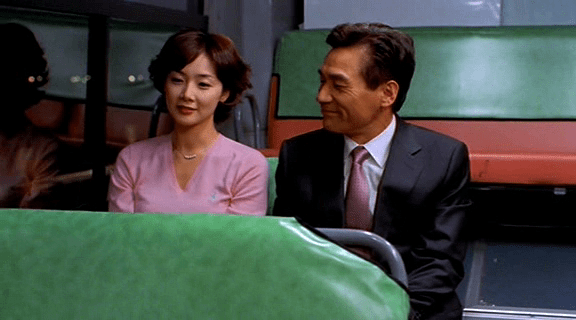
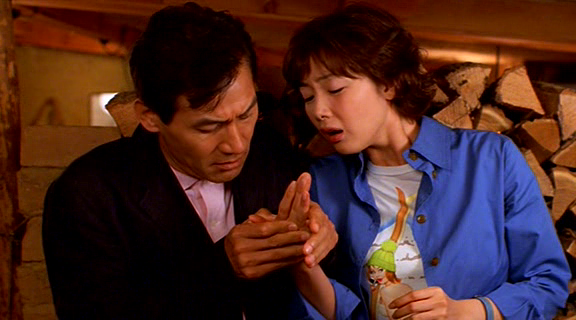
A pure-hearted politician finds himself falling for an uncompromising teacher in Jeon Man-bae’s nonsense comedy Romantic President (피아노 치는 대통령, Piano chineun daetongnyeong). This president is indeed “romantic” in the sense that he is an idealised vision of a political leader. The film doesn’t go into his politics at all and it’s ambiguous where he belongs on the political divide. Instead, he is depicted as a man of integrity who is good and kind. In short, the kind of political leader that might not really exist in real life.

Min-wook (Ahn Sung-ki) first appears in disguise having gone undercover to talk to a group of homeless people living at the station. While talking to them, he himself is harassed by a policeman overstepping the bounds of his authority. The policeman calls the men “trash” and says that they disgust ordinary people. Little knowing who he is, the policeman bullies Min-wook who then identifies himself by striking the same pose as on as his campaign photo.

Something similar happens later when Min-wook decides to take a day driving a taxi in order to get closer to the people he is supposed to be serving. All of which marks him out as someone who is genuinely interested in the lives of the electorate and how to make them better. Though references are made to other political scandals, Min-wook seems to be held to a different standard and is a figure of integrity and incorruptibility. This is, however, why his romance is so dangerous in that It complicates his image and the secrecy involved because of his position makes it seem like he’s done something wrong or that there is an illicit quality to his relationship with schoolteacher Eun-soo (Choi Ji-woo). However, at the film’s conclusion, Min-wook admits that the “piano-playing president” was a persona he constructed for the purpose of winning the election, which is to say inauthentic. He has been lying all along, but his romance with Eun-soo has made it impossible for him to continue with the subterfuge. Only by being his true self can he gain romantic fulfilment even if it comes at the cost of his political career.

For her part, Eun-soo may also be harbouring a secret that paints her as something of a political rebel and possible extremist. She has failed to keep a job for more than six months because of her eccentric behaviour and intense interest in teaching in which, like Min-wook, she is invested in her pupils lives and wants to do what she can to make them better. On arrival at her new school she poses as a pupil to find out the class gossip and then becomes determined to save Young-hee (Im Soo-jung) who has become a delinquent little knowing she is the president’s daughter. No one else is willing to go against the Blue House with the consequence that Young-hee has become drunk on power, rebelling in the hope that someone will push back. Eun-soo is that person and soon earns Young-hee’s trust precisely because of the genuine interest she takes in her that is undaunted by her father’s position.

Young-hee too responds to authenticity and gradually becomes more authentic herself through her interactions with Eun-soo. Nevertheless, at the same time, the film suggests that society remains judgemental and is not always prepared to recognise an individual’s authentic identity. Eun-soo’s roommate is a transwoman who is repeatedly deadnamed and then eventually outed by the invasive press when Eun-soo’s relationship with Min-wook is exposed. Nevertheless, Eun-soo strives to protect her friend while accepting that she may have to deny her feelings to protect Min-wook’s position.

Despite all the silliness and zany antics, the film has a degree of earnestness at its heart in which it believes that it shouldn’t be wrong to express one’s true feelings. Authority figures can fall in love too, and it’s better for everyone if they do, otherwise you end up with the toxic combination of power and unhappiness that causes the policeman to abuse his authority to bully the homeless. Even so, the irony is that on becoming Min-wook’s official partner, Eun-soo must again play another role, radically altering her appearance to conform to the image of the president’s wife. Nevertheless, once authentically embraced, their love is accepted by the wider society which is then itself improved as a result.


Trailer (English subtitles)
A Good Lawyer’s Wife (바람난 가족, Im Sang-soo, 2003)

Sexual repression and rigid patriarchal social codes slowly dissolve a “normal middle class” family in Im Sang-soo’s extremely frank treatise on contemporary gender roles, A Good Lawyer’s Wife (바람난 가족, Baramnan Kajok). The Korean title translating as “adulterous family” perhaps hints at Im’s winder intentions focussed not only on the role of “wife” but each of those within the family unit which is it seems resistant to change even as the society changes around it, the widowed mother-in-law ironically emerging as the most liberated and progressive of them all. 

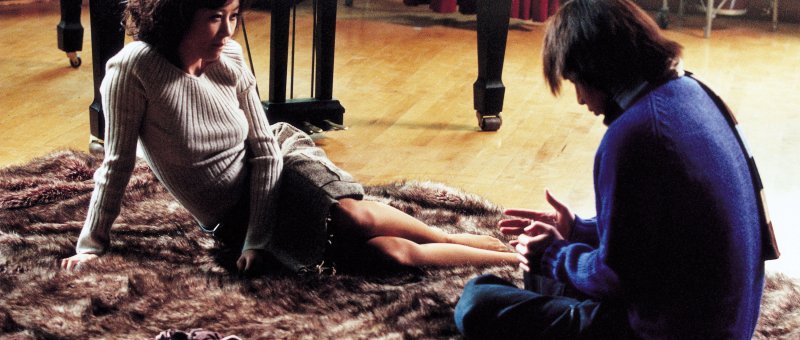
Hojung (Moon So-ri) may be a good lawyer’s wife, but she’s also quietly dissatisfied eventually drifting into a relationship with a strange teenage neighbour she caught peeping at her in the nude. Her husband Youngjak (Hwang Jung-min), the lawyer, is a poor lover unable to satisfy her sexually while conducting a secret affair with a bohemian artist with whom he is able to have transgressively kinky sex. The couple have a young son, Soo-in, who is adopted and a little insecure worried that his grandmother doesn’t really like him because they aren’t related by blood while the other kids sometimes pick on him at school. Grandma Byunghan (Youn Yuh-jung) meanwhile is also having an affair, contemptuous of Youngjak’s father Changgeun (Kim In-mun) who has just been told he has only a month to live. 

Yet to everyone else the Joos lead “normal middle class life”, words Youngjak later uses unsuccessfully to help a woman get off on charges she otherwise admits. It might be taboo to speak of it, but sexual repression seems to be at the root of all their problems or at least an incompatibility between leading a what is conceived as “normal middle class life” and embracing one’s sexuality. As good lawyer’s wife Hojung remarks to a friend, once you get married “you’re not a woman anymore, you’re really nothing”. As his wife, and as a mother to Sooin, Hojung is no longer perceived as a sexual being by her husband, though as we later discover he remains somewhat passive both with his wife and with his mistress by whom he is penetrated from behind. Hojung meanwhile achieves her only orgasm when positioning herself on top of her inexperienced teenage lover, symbolically if also problematically reclaiming her sexual agency.

Hojung’s rebellion also has an ironic quality in that finally restores her maternity as she experiences what she describes as a miracle pregnancy, pointing at the couple’s sexual incompatibility as the primary reason they were not able to conceive a child. Even so, the film heavily suggests the cruel and unexpected tragedy which later befalls the family is a kind of punishment for the mutual transgressions of husband and wife as they sought the fulfilment denied to them by the constraints of a “normal middle class life” within the confines of a patriarchal marriage. “If your body wants it, give it what it wants” Byunghan eventually offers when meeting with her lover, declaring herself too old to feel guilty or embarrassed for satisfying her sexual desire while openly contemptuous of her husband with whom it seems she had an unhappy life. “Life’s about being truthful to yourself” she explains to her son, finally taking control now freed from marital constraints if ironically immediately considering re-marriage. 

Changgeun meanwhile sings North Korean military songs in the operating theatre and as we eventually realise, has no siblings because his mother and six sisters were all abandoned in North Korea where they died. His father escaped with him alone though it appears they are now estranged and it can be assumed that Changgeun’s drinking habit which eventually leads to the illness which kills him and destroys his marriage is born of a desire to overcome his guilt and trauma. Changgeun’s past too is something which must be repressed, he cannot easily speak of it because of the stigma surrounding his North Korean roots neatly linking back to Youngjak’s work with the families of those still looking for loved ones executed during the war quite literally falling into a mass grave in the film’s opening. All of these buried truths erode the foundations of the traditional family, yet Im seems to suggest perhaps the family in this form at least isn’t worth saving if it only causes people to hurt each other while forced to conform to a series of socially defined roles unable to be their most authentic selves even within a bubble of supposedly unconditional “love”.


Trailer (no subtitles)