Dongji Rescue (东极岛, Guan Hu & Fei Zhenxiang, 2025)

If someone’s drowning, then you save them no matter what language they speak or where they come from. Such is the simple logic of the Dongji fisherman who risked their lives to rescue British prisoners of war when the boat they were travelling on was torpedoed in the waters near Zhoushan. Inspired by this historical event, Guan Hu and Fei Zhenxiang spin a tale of resistance and righteousness with an unexpected advocation for borderlessness and freedom as the two orphaned pirate brothers at the film’s centre finally find their way back to their home in the sea.

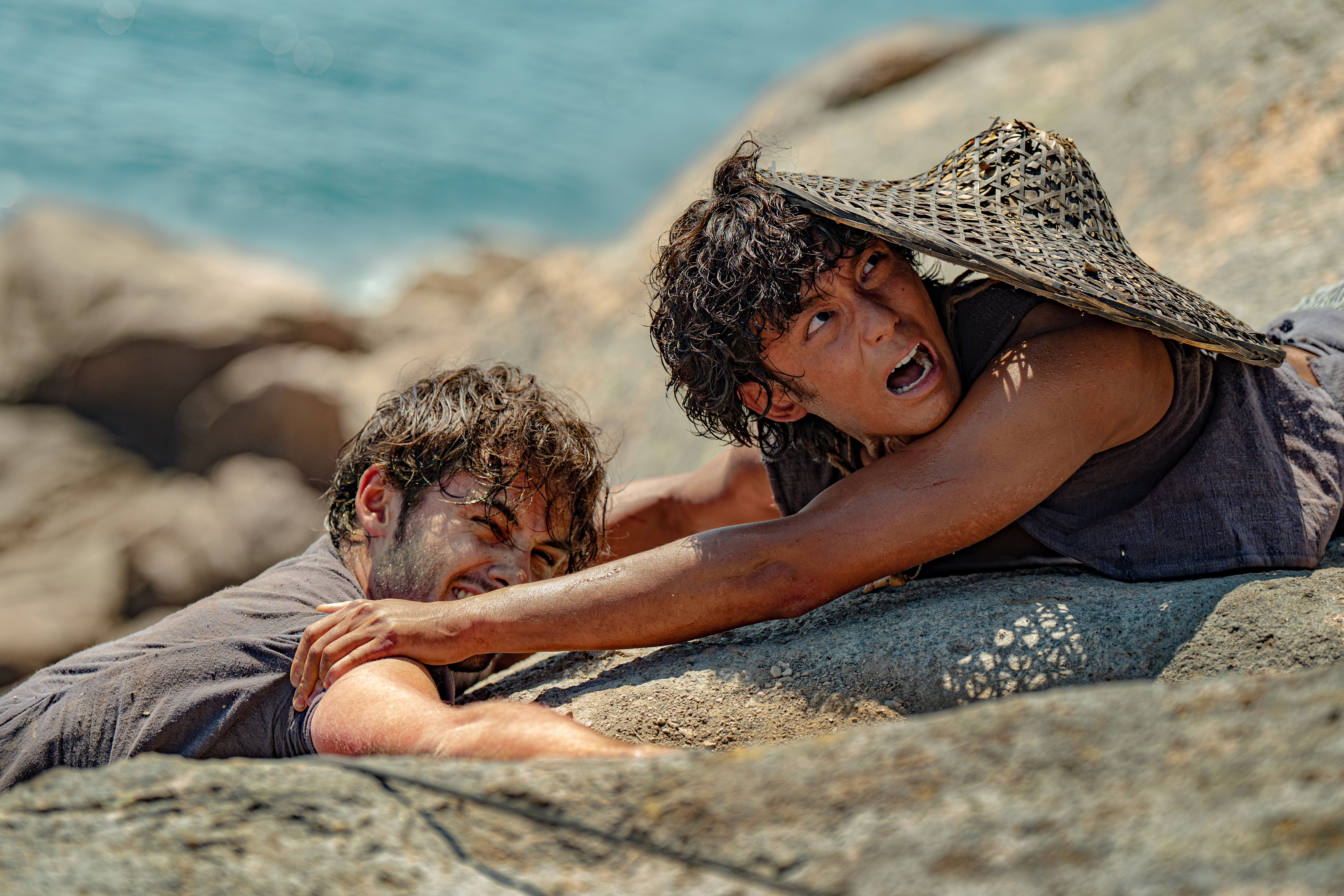
It’s Ah Dang (Wu Lei), the younger of the brothers, who fishes a British soldier out of the water and tries to rescue him, while the older, Ah Bi (Zhu Yilong), refuses and tries to throw the man back. Ah Bi may appear heartless, but considering the risk the presence of the British soldier poses to the islanders perhaps Ah Bi’s callousness is perfectly understandable. Nevertheless, Ah Dang stashes the young man, Thomas Newman, in their cabin and seems fascinated by his blue eyes and a vision of the wider world that he seems to represent. Thomas desperately tries to communicate with Ah Dang but though he knows some Cantonese cannot get through to him that there are men trapped on the sinking boat. Meanwhile, Japanese troops turn up on the nominally occupied island erroneously looking for a blond, blue-eyed man missing from the ship. Convinced the islanders must be harbouring him, they start taking hostages and executing villagers until Thomas finally knocks out Ah Dang so he can give himself up to save them.

Though the island was not in fact occupied in real life, here the villagers are placed under incredibly oppressive rule despite there only being two Japanese soldiers standing guard. The fishermen are no longer allowed out to fish and are, they say, stuck on land like turtles unable to practise their traditional crafts or way of life. Old Wu led the resistance before, but didn’t end well and now even he has been cowed into submission. The rescue is then as much for the islanders as anyone else as an act of resistance to authoritarian oppression in their following their belief that those in peril on the sea must be saved in defiance of the Japanese’s prohibition on sailing. The same is doubly true of Ah Bi’s girlfriend Ah Hua (Ni Ni), Old Wu’s adopted daughter who takes up his place and breaks a taboo about women going to sea to lead the rescue mission. 

She, Ah Bi, and his brother are all technically outsiders on the island who were never fully embraced by the community. The brothers were held at arms’ length because of their possibly pirate origins, while Ah Bi’s dream had been to escape to Shanghai with Ah Hua. Ah Dang is then touched by Thomas’ constant attempts to talk to about “home” though he perhaps doesn’t quite have one while Ah Bi’s “home” more than anything else is simply Ah Dang. Rather than the expected definition of a homeland of the greater China, the brothers’ “home” is later redefined as “the sea” which is to say a place of boundless freedom where national borders don’t exist. 

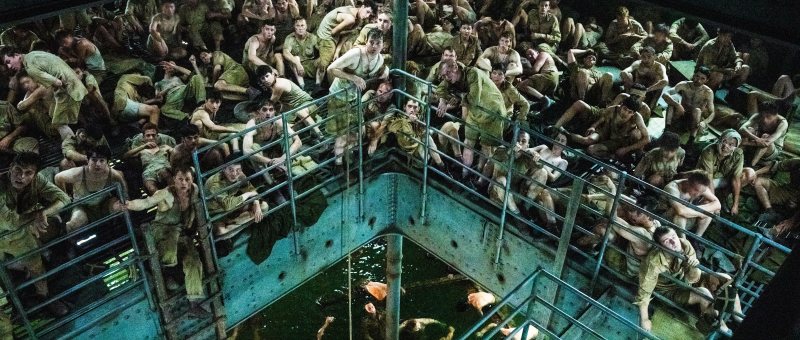
These elemental origins also give the brothers a mythical quality that adds to the sense of heroism in the rescue as Ah Bi goes after the Japanese and attempts to save the remaining POWs, some of whom can’t swim, marooned in the middle of the sea. The Japanese, meanwhile, are intent on covering the incident up which means everyone must die from the POWs to the residents of Dongji Island, though it isn’t really clear who the islanders would tell anyway considering that they live on a fairly remote island. In any case, the heroism of the Chinese fisherman is directly contrasted with the craven callousness of the Japanese who are still trying to pick off the POWs like fish in a barrel and only stop on realising that there are too many Chinese fisherman and if they were to kill them all it would get out and they’d look very, very bad. Epic in scope and impressively staged with some truly stunning underwater photography, there is a sense of genuine poignancy and human solidarity in standing up to oppression and cruelty no matter how ironic or jingoistic it might otherwise seem as ordinary villagers rise to up to help those from a distant land they don’t even know at the risk of their own lives and livelihoods.


Dongji Rescue opens in UK cinemas 22nd August courtesy of CineAsia.

Trailer (English subtitles)
Lost in the Stars (消失的她, Cui Rui & Liu Xiang, 2023)

A desperate husband with five days left on his visa finds himself at the mercy of a foreign police department when his wife suddenly disappears into thin air during their honeymoon in a fictional South East Asian nation in Liu Xiang & Cui Rui’s hugely entertaining mystery thriller Lost in the Stars (消失的她, xiāoshī de tā). Produced and co-scripted and produced by Detective Chinatown’s Chen Sicheng, the film draws inspiration from the 1990 Russian drama Trap for a Lonely Man which was itself adapted from a 1960 French play, Piège pour un homme seul, which Alfred Hitchcock had once been interested in adapting. 

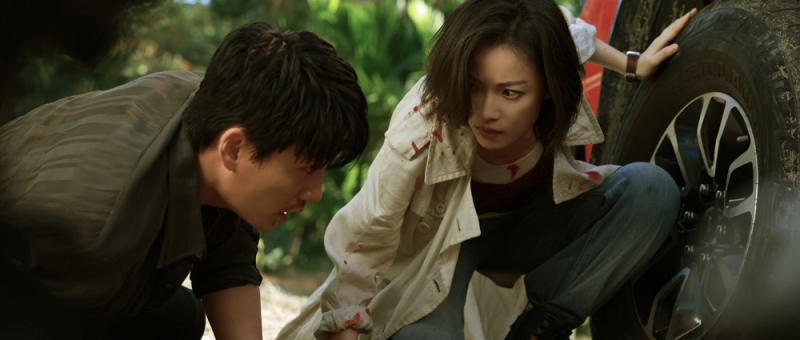
It’s not difficult to see why seeing as the film revolves around a classic “wrong man” in frantic husband He Fei (Zhu Yilong) who like so many Hitchcock heroes is left feeling like the only sane man in an insane world when he wakes up next to a woman who claims to be his missing wife only he’s never seen her before and is adamant that something untoward must be going on though all the evidence points to the contrary and no one really believes him. The film never really entertains the possibility that the “fake” wife (Janice Man) is indeed telling the truth and Fei is undergoing some kind of psychotic break but does leave a question mark over his mental state and credibility on revealing that he is suffering from a neurological condition caused by his work as a diving instructor for which he is on serious medication. 

In any case, the film opens with him bursting into a local police station exasperated with their lack of interest in his wife’s disappearance. In something of a trope in recent Mainland cinema, the action takes place in a fictional South East Asian nation which has shades of Thailand and Indonesia where the implication is the authorities don’t really care very much about a missing tourist. A Chinese policeman, Zheng (Du Jiang), eventually admits as much confessing that the police department is massively understaffed and only investigates “criminal” cases which they don’t believe his wife’s to be, rather that she most likely got fed up with Fei and has gone off of her own accord. Their lack of concern echoes a persistent theme in mainstream Mainland movies that the safest place for Chinese citizens is at home, an idea only reinforced by the film’s melancholy conclusion and the implications of Chen Mai (Ni Ni), a top international lawyer Fei meets by chance, who suggests that his wife may have been taken by an international trafficking ring. 

Nevertheless, in its various twists and turns the film also has a few things to say about class disparities in contemporary China in which as someone later says money may even buy the Devil’s soul. With his visa running out, Fei insists that he won’t leave without finding out what’s happened to his “real” wife and what’s going on with the “imposter” who soon drops any pretence and openly admits that she’s out to get Fei for reasons he finds unclear though assumes to be financial. Then again, we start to realise that perhaps he hasn’t been a hundred percent honest even with the information he’s giving Mai who is the only person interested in helping him find his wife who may or may not be at the mercy of vicious international gang backed by important people against whom an ordinary tourist like Fei or even an international figure like Mai has little power. 

While the film noticeably carries a strong anti-gambling message perfectly in tune with the censors’ sensibilities, it also has a surprising queer subtext in the quite obviously coded persona of super lawyer Mai who makes a dramatic motorbike entrance and then more or less steals the film as she tries to ascertain the whereabouts of Fei’s missing wife. Nothing is quite as it first seems, subterfuge piles on on subterfuge along with altered realities and personal myth making though the film’s title takes on a poignant note in the closing moments in which another starry image is presented in an attempt to evoke an emotional reaction from an otherwise heartless villain. Boasting excellent production values and elegant production design, the film is careful never to lose itself in its various twists and reversals before quite literally dropping the curtain on its extremely satisfying conclusion in which we discover just how far some are willing to go in pursuit of the stars.


Lost in the Stars is in UK cinemas now courtesy of CineAsia.

Trailer (Simplified Chinese / English subtitles)

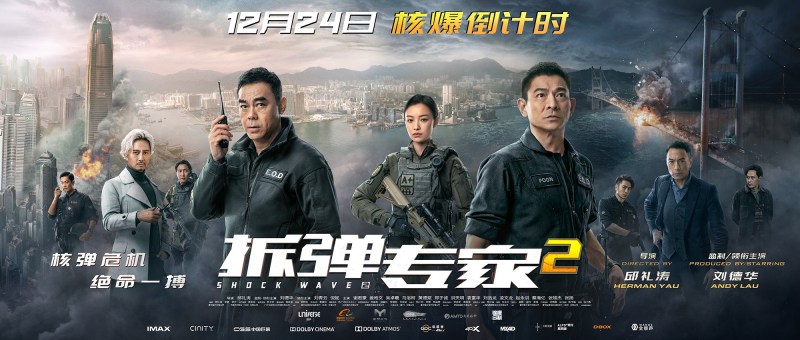
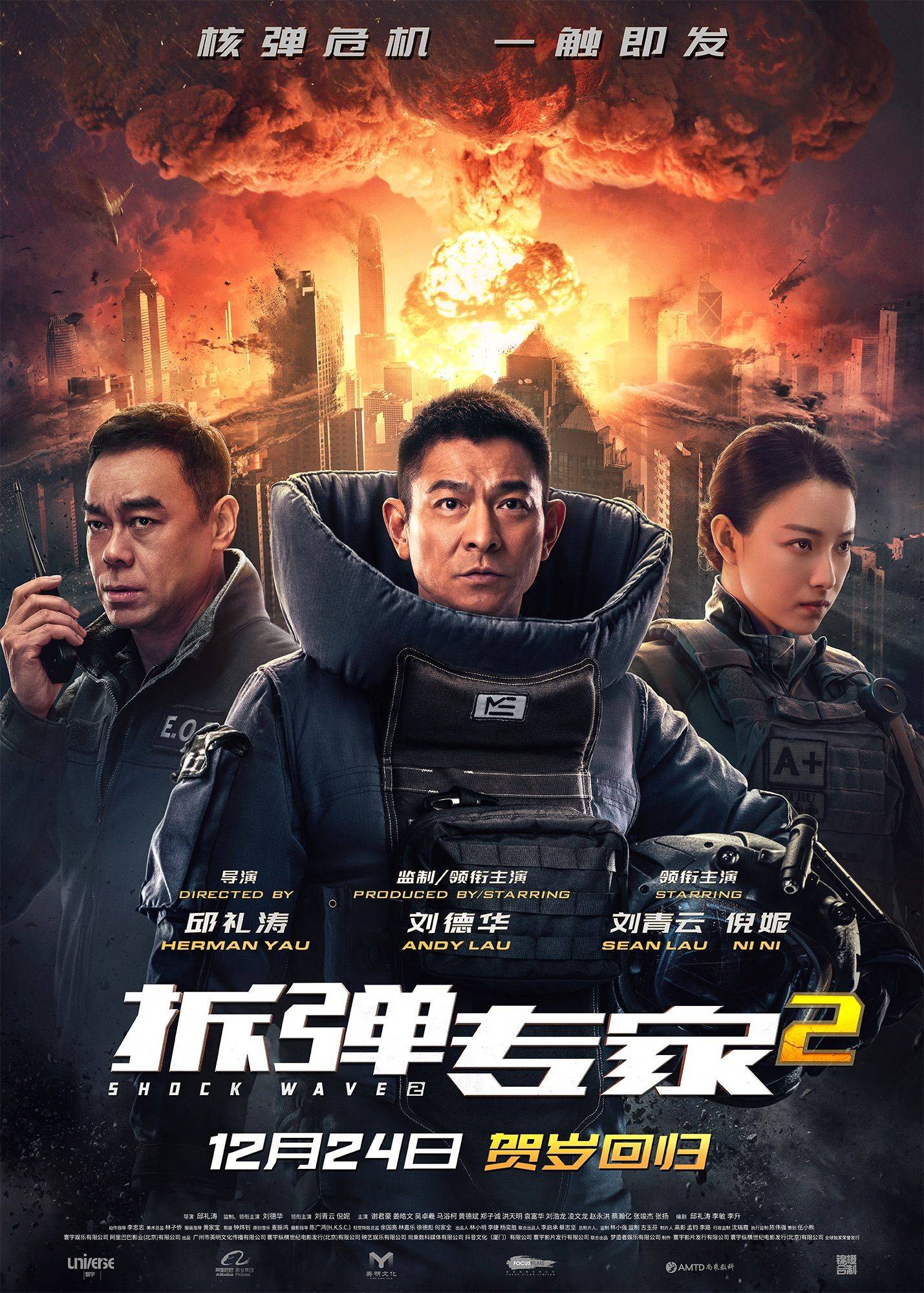
Shock Wave 2 (拆彈專家2, Herman Yau, 2020)

“Anger can destroy everything” according to the voiceover opening Herman Yau’s Shock Wave 2 (拆彈專家2), a thematic sequel to the original Shock Wave once again starring Andy Lau as a Hong Kong police bomb disposal officer battling serious threat to the island’s transport infrastructure but also picking up themes from the pair’s subsequent collaboration White Storm 2 in which the veteran actor had starred against type as a Batman-esque billionaire vigilante fighting a one man war on drugs. The villains here claim they want “change”, but in reality want little more than to burn the world, enraged by its refusal to recognise or remember them consumed as they are by wounded male pride. 

The hero, Fung (Andy Lau Tak-wah), finds himself suffering from amnesia after encountering the second serious accident of his professional life. When we first meet him, he’s essentially playing the same role as the first film, a cheerful, slightly cocky bomb disposal expert with a potentially reckless streak born of his willingness to risk his own life to save those of others. When he’s injured on a job, tricked by a random booby trap while trying to free a trapped cat, and loses his leg he reacts with characteristically upbeat stoicism quickly adjusting to his new prosthesis and determined to get back to work, training intensely with the help of his friend Tung (Sean Lau Ching-wan) who was also injured in the same blast only not so seriously. Despite passing all the fitness criteria Fung is fobbed off with an offer of a desk job in police PR, refused a return to the bomb squad as the panel quite openly admit not so much because they feel his disability impairs his ability to do the job as they fear public blowback should something go wrong and they be blamed for having hired a disabled person in the first place. 

It’s less a sense of discrimination than unfairness that fuels Fung’s growing sense of anger and resentment not only towards the police force but towards society in general which he now feels regards human beings as little more than disposable tools. He rejects the sense of himself as “disabled”, internalising a sense of societal shame keen to remind everyone that he is not impaired proving himself capable above and beyond the force’s criteria but is still rejected while Tung, who suffered only minor burns, is permitted to return to duty and even gets a promotion. His friends later recount that he became a different person after the accident, angry and embittered as if at war with the world. 

Yet after encountering a second accident, Fung loses his declarative memory which is to say he still has his everyday skills such as walking around (including using a prosthesis), getting dressed, brushing his teeth, using a computer and presumably the mechanics of bomb disposal but no longer remembers his own name or how he ended up in hospital now at least implicated in an act of major terrorism. Without his memories, Fung is a blank slate, freed from all the trauma and resentment that may have pushed him towards the dark side and returned to the innate goodness of a soul untouched by the world’s cruelty. The question is, which way will he turn, back towards the darkness or further into the light as the Fung they once new who willingly risked his life for others? In any case, he finds himself potentially misused by his well meaning ex Pong Ling (Ni Ni) who engages in some dubious psychology involving false memory implantation to convince him that he’s been working for the Hong Kong police undercover, hoping to engineer a softer landing for him than the realisation that he may be responsible for the deaths of at least 18 people as a member of an anarchist sect going under the apt name of “Vendetta”. 

Like Fung, the leader of Vendetta is an angry man resentful of having been forgotten by someone he cared about who had simply grown away from him. He rages against the world partly as a consequence of his aimless privilege having discovered his wealthy family made their money peddling opium with the assistance of the colonial authorities, but also as a direct result of childhood bullying and frustrated male friendship. Vendetta claims it wants to stop the world from getting “worse”, but all it really has is anger and the intense hurt of wounded pride. These men refuse to be “KO’d by this sick society” but in the end all they want is to be seen, to be recognised and remembered. To ease their sense of belittlement and impotence, they plan to burn the world by literally severing connections with it. 

Yau takes aim at the various systems which generate this kind of anger, hinting at the shockwaves of ingrained societal discrimination even if Fung internalises a sense of stigmatisation in his intense need to prove himself free of “disability”. Robbed of his memories, Fung’s anger dissipates allowing his natural capacity for selfless heroism to resurface along with a healthy desire to reflect on his own behaviour, at least as much as can he rely on the sometimes duplicitous vagaries of memory both his own and that of others as he searches for the truth of himself and his “vendetta” with the world. Torn between risking his life to save others and blowing it all to hell, Fung ends up doing both, sending shockwaves throughout his society in a deeply ambivalent act of personal and societal redemption. 


Shock Wave 2 is available to stream in the UK until 12th May as part of the Chinese Cinema Season. It will also be released on DVD/blu-ray on 7th June and digitally on 14th June courtesy of Cine Asia.

UK release trailer (English subtitles)

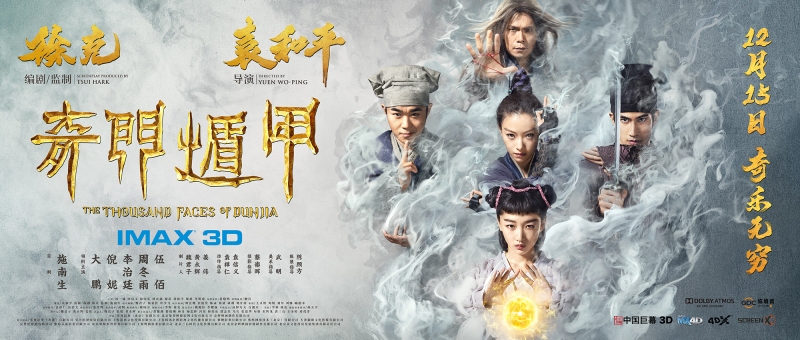
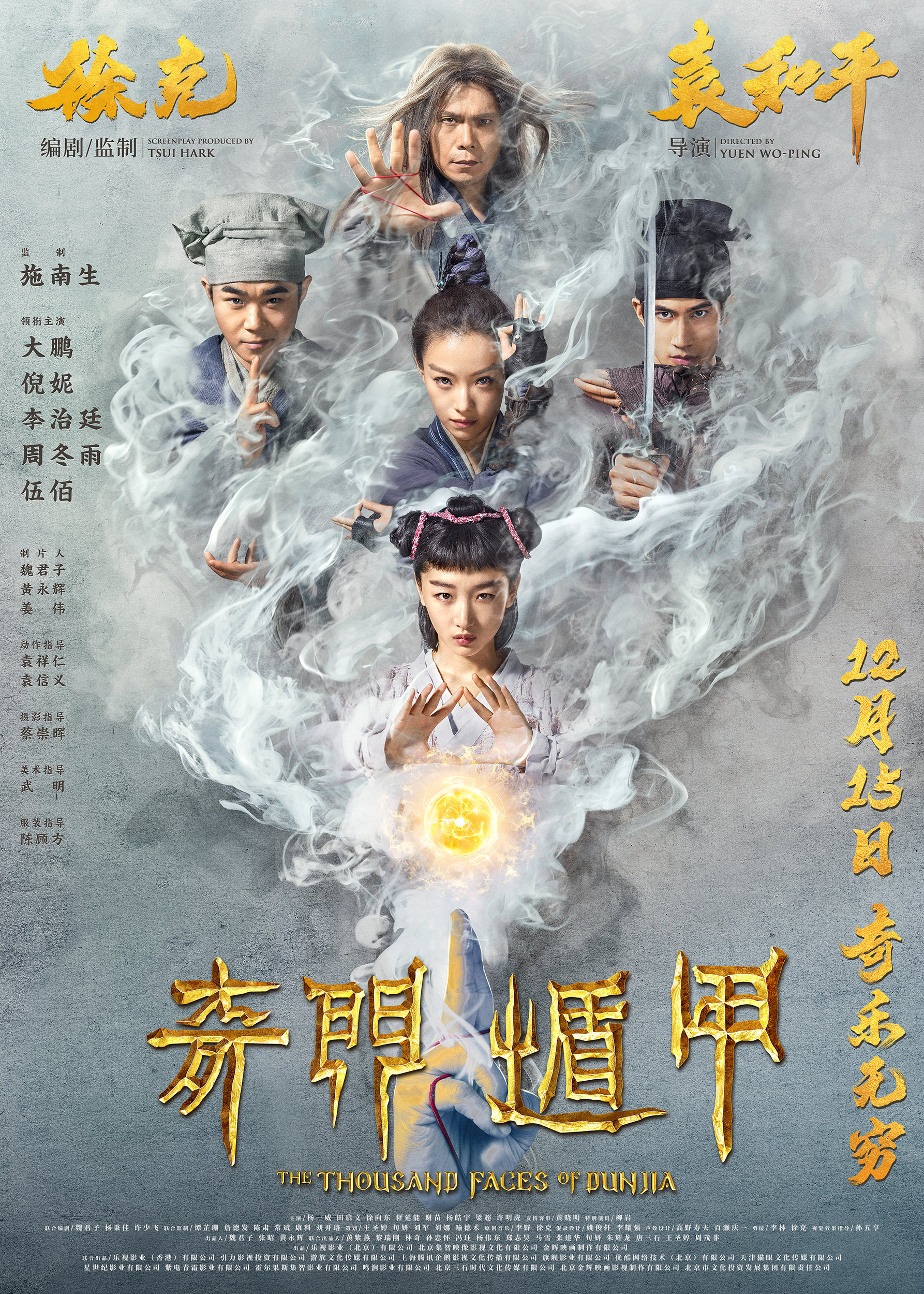
The Thousand Faces of Dunjia (奇門遁甲, Yuen Woo-ping, 2017)

Thousand faces of Dunjia poster 6The Dunjia has a thousand faces. Or maybe not. Yuen Woo-ping teams up with Tsui Hark for a “remake” of Yuen’s 1982 classic The Miracle Fighters retitled The Thousand Faces of Dunjia (奇門遁甲, Qíméndùnjiǎ), only it isn’t much of a remake at all and simply pinches the idea of supernaturally-charged heroes fighting for justice which, it has to be said, is hardly original or at least not enough to justify Tsui’s claim that the two films are linked by a desire to push the boundaries of the wuxia film. Nevertheless, Yuen does his best to craft a tale of brotherhood and rebirth for his noble warriors newly re-energised by a life-giving phoenix, but struggles under the weight of an otherwise incoherent narrative.

So, in fantasy medieval China, the land is beset by a stealth invasion from otherworldly powers. Our heroes, the Wuyin clan, are the last line of defence against the increasingly powerful alien marauders. In order to beat them, they need to unlock the mysterious power of Dunjia, which, according to a prophecy, can only be done by a very specific person. Accordingly, the clan’s “big brother”, Zhuge (Da Peng), has gone out looking. Unfortunately, not everyone is convinced by what he brings back – a young woman he found in some kind of institution who has a childish, ethereal quality and a surprising ability to suddenly morph into a giant colourful phoenix.

Yuen opens with a brief discussion of Qimen and the Dunjia which seems to have something to do with interdimensional co-ordinates but truth to tell it turns out not to be very important. The main thrust is that weird alien beings have been living amongst us for centuries and are quietly waiting for us to die out so that they can inherit the Earth. Only some of them have lost patience. The aliens might be about to get their hands on a world destroying device, something the Wuyin are desperate to prevent but the aliens keep using their abilities against them and their prospects look increasingly hopeless.

With the narrative in disarray, Yuen relies on the camaraderie between the members of the Wuyin to carry the film (which it largely does). There’s history between the de facto leader Dragonfly (Ni Ni) and healer Zhuge despite the Wuyin’s increasingly silly code which forbids affection between comrades and punishes it with mutual slapping. Accordingly the pair spend most of the film bickering while conflicted by the arrival of romantic rivals in the form of the mysterious Circle (Zhou Dongyu) and an earnest young policeman, Dao (Aarif Lee), who keeps stumbling on the activities of the Wuyin but has his memory wiped to prevent the truth getting out. Despite the plot holes and inconsistencies, the Wuyin are an intriguing bunch who do their best to earn our sympathies even whilst shouldered with a series of incomprehensible events.

Incomprehensibility is not necessarily a problem in a wuxia film, in fact it can sometimes be an asset, but the concept is continually let down by over reliance on poor quality CGI and bland production design. Yuen opens with an engaging, if surprisingly cutesy, sequence of Dao and Dragonfly enjoying a (re)meet cute while chasing a giant three-eyed fish through the streets of an ordinary city, but despite the resurgent beauty of Circle’s colourful phoenix the cartoonish battles between soulless alien mecha giants largely fail to convince.

Cartoonish though it may be, there is charm in Dunjia’s lowbrow humour as the gang bicker amongst themselves and engage in a comically romantic tug of war. Yuen breaks the tale into a series of chapters as if mimicking an old fashioned wuxia serial and there is certainly a strain of meandering fairytale nonsense in the film’s refusal to pick a direction and follow it even if it takes things too far with an all too abrupt ending designed only as an inelegant hook for an upcoming sequel. Ironically enough, Dunjia is a film about coming “full circle” and then being reborn anew like a phoenix from the flames but pushes itself too far in threatening to set the wheel turning again just when it ought to be hitting its stride. Flawed but intermittently entertaining, the first adventure fo the Wuyin clan is off to a rocky start but sheer charisma alone may be enough to ensure repeat custom.


Currently available to stream in the UK (and possibly other territories) via Netflix.

Original trailer (English subtitles)

Wu Kong (悟空传, Derek Kwok, 2017)

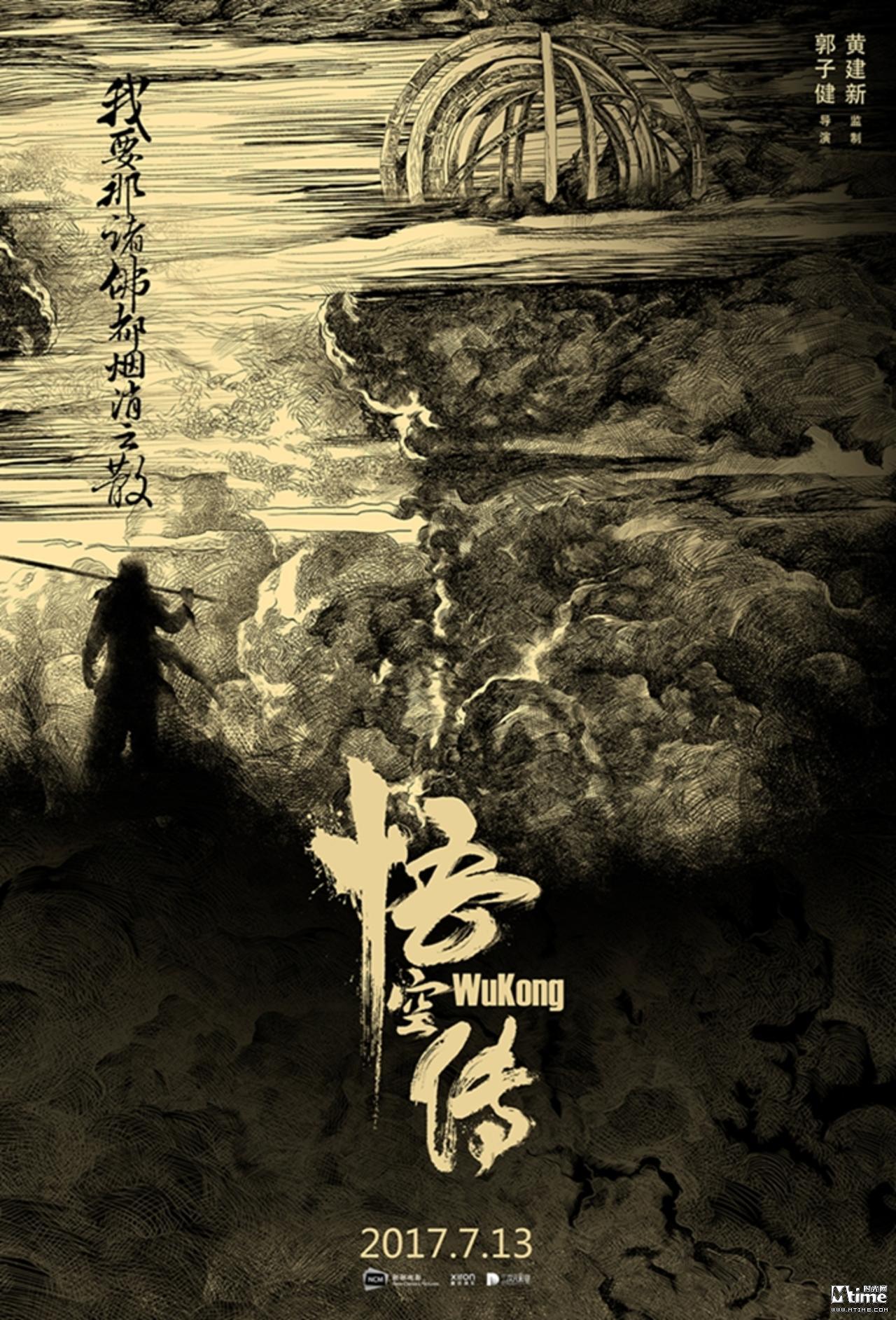
Wu KongAs it stands, contemporary Chinese cinema is veering dangerously close to Monkey King fatigue. Stephen Chow brought his particular sensibilities to the classic Journey to the West before Donnie Yen put on a monkey suit for Cheang Pou-soi, both of which were quickly followed by sequels. Eddie Peng is the latest to pick up the staff for Gallants’ Derek Kwok, though this is a much more youthful incarnation of the iconic hero, acting as a kind of prequel to recent incarnations and as a coming of age tale for the titular “demon” as recounted in the popular online novel Legend of Wukong by Jin Hezai. Told in grand style, Kwok’s Wu Kong (悟空传, Kōng Zhuàn) is a star studded box office extravaganza but embraces both extremes of its family friendly, mainstream blockbuster thrills.

So, Sun Wu Kong (the Monkey King), as you know, was born from a stone atop Mount Huaguo  – a remnant of a giant who attempted to battle the heavens but was defeated. Heaven fears the existence of the mischievous demon and determines to destroy him but he’s saved by a teacher who gives him a human form and the name Sun Wu Kong. Devastated by the destruction of his homeland, Wu Kong (Eddie Peng) vows revenge on the Heavens and travels to voice his concerns in person. Resenting his “destiny” Wu Kong focusses his attentions on destroying the divine astrolabe which ascribes fate to all beings, but little does he know that its guardian, Hua Ji (Faye Yu), wants his heart for herself so that she might rule all of Heaven and Earth.

Kwok opens with a beautifully designed sequence modelled after traditional chinese ink paintings in which he recounts the pre-history and birth of the demon later known as Sun Wu Kong. Unlike some other recent attempts to tackle this famously fantastical world, Wu Kong boasts fabulously high production values as well as much better special effects than most Chinese blockbusters, and it helps that Eddie Peng is not burdened with spending the majority of the movie in prosthetics.

Nevertheless for all the lack of actual plot, there is a lot going on and the brisk pace of the exposition filled opening is hard to follow (but, thankfully, details are unimportant). As in his other adventures, Wu Kong ends up with a collection of friends and enemies including love interest Azi (Ni Ni) – the equally rebellious daughter of Hua Ji who has just returned from 100 years in “re-education” exile and fiercely resents her mother’s cruel and controlling nature. Likewise her half brother, Erlang (Shawn Yue) has also arrived home at just the right/wrong moment and is conflicted in his views towards the Heavens – wanting to be accepted as a true “immortal” but also wanting to protect his little sister, so obviously unhappy with the ruling regime. Two more cohorts appear in the gadget laden Juan Lian (Qiao Shan) – a kind hearted man with a hopeless crush on Azi, and the lovelorn retainer, Tian Peng (Oho Ou), still pining after his childhood sweetheart who was exiled to the mortal world.

Much of the central drama occurs after Wu Kong, Erlang, and Tian Peng destroy “The Bridge of Destiny” and are cast down to the mortal world themselves along with Juan Lian and Azi. Finding themselves in a desperate village which happens to be on the former site of Mount Huaguo, the five start to believe they’ll never be going home and discuss staying to help the villagers defeat the “Cloud Demon” which has been stealing all their water. Interacting with the villagers teachers each of them some vaiuable lessons, but “destiny” is still waiting, and trying to change the fate of these desperate people may have disastrous, unforeseen consequences.

Once again, Wu Kong’s battle lies in the Heavens and may end up costing more than it gains. Kwok’s direction is conventional in one sense, but also manages to add a youthful energy which befits the film’s message. Wu Kong’s rebellion is the same as many a young a man’s – against a pre-ordained fate. As he puts it in the punkish final title cards, he will not be blinded by the sky or bound by the Earth – he will decide his own destiny and will never submit himself to the authority of any god or Earthly power. Attempts at melodrama largely fall flat, as does the unwise decision to shift to fantasy sequences for moments of high emotion, not to mention the inclusion of a sappy pop song to really ram home the theme of tragic romance, but whatever Wu Kong’s failings it succeeds brilliantly in its primary objective as an admittedly vacuous summer blockbuster primed to speak to the hearts of hemmed in teens everywhere.


Currently on UK release at selected cinemas.

Original trailer (Mandarin with English/simplified Chinese subtitles)

https://www.youtube.com/watch?v=ssWq4T-if-I